
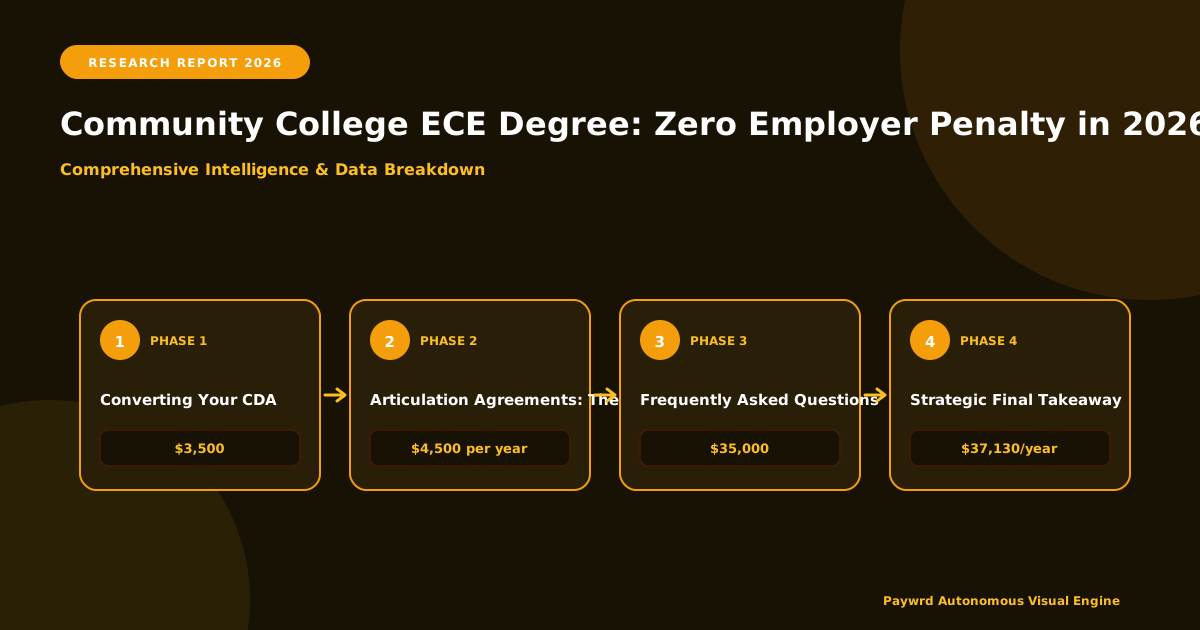
Debunking the ‘Employer Penalty’ Myth for 2026 ECE Graduates
The anxiety is real: you’re staring at a $3,500–$4,500 per year community college tuition bill versus a $35,000+ university price tag, wondering if the cheaper route brands you as “less qualified” for life. Let’s kill that narrative immediately with statutory reality. The “employer penalty” is a ghost story told by people who confuse institutional prestige with regulatory compliance. In 2026, the hiring gatekeepers—state licensing boards and federal program officers—do not care about your campus quad; they care about your accreditation code.

Why NAEYC Accreditation Trumps Institutional Prestige in Hiring
Here is the professional reality: The National Association for the Education of Young Children (NAEYC) sets the “Gold Standard” for workforce preparation. When a program earns NAEYC Higher Education Accreditation, it proves the curriculum meets the Professional Standards and Competencies for Early Childhood Educators. This is the exact rubric used by the Council for the Accreditation of Educator Preparation (CAEP) and state departments of education.
HR directors at major chains (Bright Horizons, KinderCare, Learning Care Group) and public districts run automated Applicant Tracking Systems (ATS) filtered by NAEYC Program Code, not “Ivy League” or “State U.” An Associate of Applied Science (AAS) from a NAEYC-accredited community college in Ohio clears the exact same compliance checkbox as a Bachelor of Science from a flagship university. The “penalty” exists only if your program lacks that specific programmatic accreditation—regardless of whether it is a two-year or four-year school.

How State Licensure Boards (CA, NY, TX) Treat Associate vs. Bachelor Credentials
State law is the ultimate equalizer. Let’s look at the three largest labor markets:
- California (CTC): The Child Development Teacher Permit requires 24 ECE units + 16 General Ed units. An accredited Associate degree is the standard pathway. You do not need a Bachelor’s to run a Title 5 or Title 22 classroom; you need the Permit.
- New York (NYSED): The Early Childhood (Birth–Grade 2) certificate requires a Bachelor’s for initial certification, but the Teaching Assistant Level III and Child Development Associate (CDA) pathways—heavily populated by community college grads—are the primary on-ramps for public UPK (Universal Pre-K) hiring while candidates complete bachelor’s coursework.
- Texas (TEA): The EC-6 Core Subjects certification requires a Bachelor’s, but the Child Care Regulation (CCR) minimum standards for Licensed Center Directors and Lead Teachers explicitly accept an Associate’s in Child Development/ECE from an accredited institution. Texas Rising Star (TRS) quality ratings reward the credential, not the degree length.
Real HR Data: Head Start & Public Pre-K Hiring Policies for 2-Year Grads
The federal Head Start Act (Sec. 648A) is the single largest employer benchmark. It mandates that 50% of Head Start teachers nationwide must hold a Bachelor’s—which legally implies the other 50% hold Associate degrees (or equivalent). This is not a loophole; it is federal statute. In 2024, the Office of Head Start (OHS) reported roughly 48% of lead teachers held an Associate degree or higher (non-Bachelor’s).
Public Pre-K expansions in Boston, San Antonio, and Seattle operate on “Mixed Delivery” models. They contract with community-based organizations (CBOs) where the lead teacher requirement is frequently an Associate degree + state license. The Bureau of Labor Statistics (BLS) Occupational Outlook Handbook confirms: “An associate’s degree in early childhood education is the typical entry-level education for preschool teachers in childcare centers.” The median pay $37,130/year (May 2023 data) applies equally to both credential tiers at the entry level.
Bottom line: If your community college program holds active NAEYC Accreditation, you are not “settling.” You are buying the exact same regulatory ticket for roughly 85% less debt.
Stackable Credentials: CDA to Associate to Bachelor Pathways
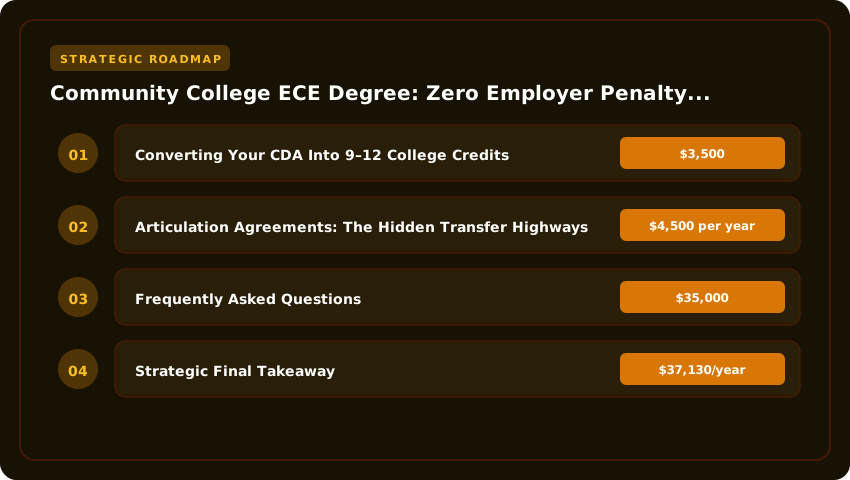
Your Child Development Associate (CDA) credential is not a dead-end certificate gathering dust in a file folder. In 2026, it functions as a high-value currency exchange rate within the American higher education system, capable of shaving a full year off a bachelor’s degree while preserving $8,000 to $12,000 in tuition costs. Understanding exactly how to convert these credits is the single most powerful financial move a career changer can make in Early Childhood Education.
Converting Your CDA Into 9–12 College Credits
The Council for Professional Recognition awards the CDA, but accredited community colleges grant the college credit. Through Prior Learning Assessment (PLA) and standardized portfolio reviews, most NAEYC-affiliated two-year institutions will translate the 120 hours of CDA training and 480 hours of professional experience into 9 to 12 semester hours of undergraduate coursework. This typically covers foundational courses like Child Growth and Development, Health and Safety, and Curriculum Planning. Instead of sitting through introductory classes you already mastered in a classroom of your own, you test out and move directly into upper-division coursework. Always request a formal transcript evaluation through the community college registrar before enrolling to lock in those credits permanently.
Articulation Agreements: The Hidden Transfer Highways
Articulation agreements are legally binding contracts between two- and four-year institutions that guarantee credit acceptance. Northern Virginia Community College (NOVA) feeds directly into George Mason University’s College of Education, with seamless transfer of the entire Associate of Applied Science in ECE. Miami Dade College students enjoy a parallel pipeline to Florida International University (FIU), while Pasadena City College (PCC) maintains a long-standing bridge to California State University (CSU) campuses across the Golden State. These are not informal suggestions. They are stamped, sealed pathways that prevent credit loss during transfer.
Timeline and Cost Savings: The 2+2 Model Versus Direct Enrollment
The traditional four-year bachelor’s route currently averages $11,260 per year at public four-year universities and $29,150 at private nonprofit institutions, according to College Board’s 2025–26 figures. The stackable 2+2 model flips this math. You complete your Associate of Applied Science (AAS) in ECE for roughly $4,000 total at in-district community college rates, then transfer as a junior. Total tuition exposure drops to approximately $15,000 to $18,000 over four years. You also reach a paycheck faster. Lead teacher positions open up the moment you finish your associate degree, meaning you earn while you finish the final two years online or on a satellite campus. Use the FAFSA to maximize your Pell Grant eligibility, and verify each institution’s accreditation status through the U.S. Department of Education database before signing any enrollment agreement.
- CDA Conversion: Secure 9–12 credits via PLA at your local community college.
- Articulation Maps: Confirm transfer guarantees with NOVA–GMU, Miami Dade–FIU, and PCC–CSU.
- 2+2 Savings: Cut total degree costs by roughly $30,000 compared to direct four-year enrollment.
- Earn-While-Learning: Begin earning lead teacher wages after finishing your associate credential.
BLS Salary Reality Check: Preschool Teacher vs. Center Director Earnings
When weighing whether a two-year Early Childhood Education (ECE) associate degree is “good enough” for the modern workforce, the numbers tell a far more optimistic story than career forums suggest. According to the most recent Occupational Employment and Wage Statistics (OEWS) published by the U.S. Bureau of Labor Statistics (BLS), preschool teachers across the country earn a median annual wage of $37,130. By contrast, childcare center directors and educational administrators in early childhood settings command a median salary of $61,320 or higher, with top earners in metropolitan markets routinely clearing six figures.
The Hard Numbers from the U.S. Bureau of Labor Statistics
- Preschool Teachers (SOC 25-2011): National median pay of $37,130 annually, with the top 10% earning over $53,000. The 2023–2024 OEWS report places roughly 60% of the workforce between $30,000 and $46,000.
- Education and Childcare Administrators (SOC 11-9031): A median salary of $61,320 represents a 65% income lift over lead teacher pay. Upper-quartile directors report $87,000+ annually, especially in states like California, New York, and Massachusetts.
- Job Growth: The BLS projects a 2%–8% growth rate for both occupations through 2033, anchored by sustained public investment in Pre-K expansion and Head Start programs.
The ‘Degree Ceiling’: When a Bachelor’s Becomes Non-Negotiable
Here is where the “employer penalty” myth crumbles but also where realistic expectations matter. An associate degree does not inherently cap your earnings at $37,000, but it does establish a ceiling that you can only break through with a bachelor’s degree from a regionally accredited institution. Most licensed center director roles, particularly those overseeing programs funded by Head Start, Title I, or state-funded Pre-K grants, require a Bachelor of Science in Early Childhood Education or a related field. Holding an associate credential can land you an assistant director position paying $48,000–$55,000, but reaching the $70,000–$90,000 director tier requires that bachelor’s degree from a college with an ABET, AACSB, or NCATE-accredited program.
ROI Calculation: $4,000 vs. $250,000 in Lifetime Earnings
The math here is genuinely compelling. Community college tuition for an associate degree in ECE generally runs $4,000 to $8,000, per College Board data, frequently offset by Pell Grants routed through FAFSA. If you enter the workforce immediately as a lead teacher at $37,130, you will recover your full tuition investment in less than 90 days of pre-tax earnings.
Compare that against the lifetime earnings delta between a preschool teacher and a center director. A 30-year career earning $37,130 annually produces roughly $1.1 million in cumulative wages. A director earning $61,320+ over the same span clears $1.85 million, a $700,000+ lifetime earnings premium, or roughly $250,000 in present-day value after accounting for the cost of a bachelor’s degree.
Bottom line: the associate degree carries zero employer penalty for the teaching workforce in 2026, but it does cap your upside until you invest in a bachelor’s degree.
Top 3 US Community Colleges for ECE Articulation & Lab Access
Choosing the right community college for an Early Childhood Education (ECE) credential is less about chasing prestige and more about verifying the downstream pipeline. The smartest programs in 2026 are built on three pillars: a fully executed articulation agreement with a four-year university, an on-campus lab school for direct practicum hours, and tight alignment with state-specific licensure frameworks. Below are three standout institutions where the infrastructure is already built, verified, and actively enrolling transfer students.
Northern Virginia Community College (NOVA): AAS to GMU BSEd Pipeline
For students targeting the Virginia workforce, NOVA offers one of the most efficient Associate of Applied Science (AAS) transfer pathways in the country. The curriculum is explicitly mapped to George Mason University’s Bachelor of Science in Education (BSEd) with a concentration in Early Childhood Education. Because Virginia is a “liberal arts” state for ECE licensure rather than a “permit” state, graduates must clear the Virginia Department of Education’s Praxis Core and Virginia Communication and Literacy Assessment (VCLA) before teaching in public Pre-K–3 classrooms. NOVA’s AAS degree, which runs roughly $4,000–$4,500 per year for in-state tuition, satisfies the lower-division general education requirements at GMU, allowing students to enter Mason with junior standing. The on-campus Child Development Center at the Alexandria campus provides 180+ hours of supervised practicum, which Mason’s BSEd program accepts directly toward state-mandated field experience. For working adults, NOVA also offers hybrid evening cohorts that sync with Mason’s online upper-division ECE coursework.
Miami Dade College: Bachelor of Science in ECE On-Campus Completion
Florida ECE professionals operate under the Department of Children and Families (DCF) staff credential framework, where a Bachelor’s degree unlocks the highest “Director” credential and a salary differential of roughly $8,000–$12,000 annually over an associate-level lead teacher. Miami Dade College’s (MDC) fully accredited Bachelor of Science in Early Childhood Education is a rare gem: a four-year degree awarded entirely by a community college, with no forced transfer required. Tuition sits around $2,800 per year for Florida residents, making it one of the most affordable baccalaureate pathways in the nation. MDC’s program includes an embedded Birth–Age 4 lab school at the Kendall Campus, plus a VPK (Voluntary Prekindergarten) summer internship. Crucially, MDC’s BS is accepted by the Florida Department of Education for the Professional Educator Certificate when paired with the FTCE exam, meaning graduates do not need to enroll at a separate university to qualify for public school Pre-K teaching.
Pasadena City College: CA Child Development Permit Matrix Alignment
California runs the most complex ECE licensing matrix in the country, governed by the California Commission on Teacher Credentialing (CTC) and the Department of Social Services. Pasadena City College (PCC) is uniquely engineered to help students climb that ladder without wasted credits. PCC’s Associate of Science in Early Childhood Education directly satisfies the CTC’s Child Development Permit requirements at the Associate Teacher and Teacher levels. For students aiming higher, PCC’s curriculum transfers cleanly to Cal State LA and Cal Poly Pomona for the baccalaureate. At roughly $1,200 per year for California residents under the College Promise, PCC is also the most budget-friendly option on this list. The campus Children’s Center serves infants through pre-K, giving ECE majors direct observation hours for the California ECE Permit application, while the curriculum explicitly covers all 24 units of required early childhood coursework under Title 5 regulations.
- NOVA (VA): ~$4,000/yr | AAS-to-BSEd with GMU | Praxis + VCLA required
- Miami Dade (FL): ~$2,800/yr | On-campus BS in ECE | FTCE for state certification
- Pasadena City (CA): ~$1,200/yr | AS aligned to CTC Permit | Direct transfer to CSU system
State Licensure Deep Dive: CA Permit Matrix vs. NY B-2 Certification
When you’re evaluating an associate degree in Early Childhood Education, the abstract promise of “full state recognition” doesn’t tell you much. What actually matters is whether your coursework maps onto the specific checkbox grid that the California Commission on Teacher Credentialing (CTC) and the New York State Education Department (NYSED) actually use to issue permits. Let’s pull up the hood on both.
California: Qualifying for the Site Supervisor Permit with an AA/AS
California runs on a five-tier Child Development Permit Matrix, and the Site Supervisor Permit (the level most corporate childcare chains and Head Start grantees require for program directors) sits at the second-highest tier. Here’s the part that surprises most students: an Associate of Arts or Associate of Science degree in Early Childhood Education from a regionally accredited community college is explicitly listed as a qualifying foundation. You need 60 semester units total, including 24 ECE-specific units covering child development, curriculum, family/community, and supervision/administration. The other requirement is the state’s mandated 3-unit course on the Health, Safety, and Nutrition of Children, plus a 16-hour observation requirement. If your community college program is NAEYC-accredited (the standard benchmark), your practicum hours and course titles already align with these rules. Tuition runs roughly $46 per unit at California community colleges, meaning the entire permit-qualifying ECE sequence lands between $1,100 and $1,400, a fraction of what out-of-state or private alternatives charge.
New York: The B-2 Extension Pathway for Associate Degree Holders
NYSED uses a different vocabulary. The B-2 Certification is the standard “early childhood lead teacher” credential for public pre-K and regulated childcare centers, and it requires a bachelor’s degree plus a state-approved teacher preparation program. For associate degree holders, the practical on-ramp is the B-2 Extension, a non-permanent certification that lets you teach while completing your bachelor’s. To qualify, you must hold an associate degree in Early Childhood Education (or a related field with 12 ECE credits), pass the state’s EAS and ALST exams, complete a child abuse identification workshop, and fingerprint through the New York Statewide Fingerprint Impressions Services (SFIS) system. Community college graduates across New York City and the SUNY system routinely use this pathway; CUNY programs explicitly publish B-2 articulation agreements showing how associate credits transfer to senior colleges like City College or Brooklyn College.
Reciprocity Pitfalls: Moving Your Credential Across State Lines
Here’s where graduates get burned: a California Site Supervisor Permit is not automatically honored in New York, and a New York B-2 Extension does not unlock California site supervisor duties. Reciprocity is narrow and conditional. Most states require you to either complete their specific in-state coursework or pass their specific exams. For professionals relocating for corporate childcare roles (Bright Horizons, KinderCare, Primrose), this often means 6 to 12 credit hours of bridge coursework costing $1,800 to $4,000, plus re-fingerprinting fees averaging $100 to $150. The smartest move before relocating is to request a “credential review” from the destination state’s licensing office and budget for those bridge courses as a professional relocation expense rather than a surprise.
- CA Site Supervisor Permit: 60 units total, 24 ECE-specific units, AA/AS fully qualifies under CTC Matrix rules.
- NY B-2 Extension: Associate degree plus EAS/ALST exams; non-permanent until bachelor’s completion.
- Reciprocity Budget: Expect 6-12 bridge credits ($1,800-$4,000) plus $100-$150 fingerprinting when moving between states.
Funding the Gap: Pell, T.E.A.C.H. Scholarships & WIOA Grants
Sticker price can fool even the sharpest prospective student. The published $3,500 to $4,500 annual tuition at your local community college looks manageable until you stack textbooks, Child Development Associate (CDA) exam fees, transport, and lost wages on top of it. The trick is treating that bill less like a cost and more like an investment puzzle, because three specific funding streams—Federal Pell Grants, the T.E.A.C.H. Early Childhood Scholarship Program, and Workforce Innovation and Opportunity Act (WIOA) dollars—can quietly erase most of that out-of-pocket exposure for adult learners pivoting into Early Childhood Education (ECE) in 2026.
Maximizing Federal Pell Grant Eligibility for Career Changers Over 24
The Federal Pell Grant remains the single largest source of gift aid for low-income undergraduates, and unlike Parent PLUS loans, you never pay it back. For the 2025–26 award year, the maximum Pell sits at $7,395, indexed annually by the U.S. Department of Education. Career changers over 24 hold a quiet advantage here: if you are single, not claimed on a tax return, and earning under the updated Expected Family Contribution (EFC) threshold—roughly $30,000 to $40,000 in adjusted gross income—you likely qualify for the full award. Because Pell dollars disburse against enrollment intensity, two semesters at 12 credits each can fully neutralize community college tuition. File your Free Application for Federal Student Aid (FAFSA) at studentaid.gov as early as October 1, and list your community college’s institutional ID to lock the disbursement.
T.E.A.C.H. Early Childhood State Contracts: Tuition + Stipend + Raise
Operating in more than 30 states including California, Texas, and New York, the T.E.A.C.H. Early Childhood Scholarship Program is purpose-built for working ECE assistants and family childcare providers. Award packages typically bundle four benefits into one contract:
- Full tuition coverage at an accredited two- or four-year partner institution.
- Books and materials stipend, generally $200–$500 per semester.
- Travel reimbursement for commuting between the practicum site and campus.
- A guaranteed raise or bonus from your sponsoring employer—often $0.50 to $2.00 per hour—tied to degree completion.
The catch is the one-year post-graduation retention clause: you must stay at your sponsoring childcare center for twelve months, or the funds convert to a loan. For mid-career assistants earning the national median $33,000 per Bureau of Labor Statistics wage data, that retention rule is rarely a hardship.
Workforce Innovation (WIOA) Funding for High-Demand ECE Tracks
Through your state’s American Job Center, Workforce Innovation and Opportunity Act Title I funds can pay tuition, certifications, and supportive services (childcare during class hours, mileage, even uniforms) for adults pursuing high-demand occupations. ECE routinely qualifies because every state licensing agency flags it as a Shortage Occupation on its WIOA demand list. Approval is gated through your local Workforce Development Board, requires an interview, and pushes you onto Individual Training Accounts (ITAs) that route payments straight to the college. Stack a WIOA voucher on top of Pell, and many adult learners complete an Associate of Applied Science in Early Childhood Education with cash left over for emergency expenses.
Your 2026 Action Plan: Enrollment Checklist & Employer Conversation Script
Walking into a hiring interview confident that your associate degree is fully accredited removes the doubt from the room and lets your classroom philosophy take center stage. Before you write that first tuition check or sign a fall 2026 cohort commitment letter, run through this tactical checklist designed specifically for community college Early Childhood Education (ECE) candidates navigating the 2026 hiring market.
Verify Regional Accreditation and NAEYC Recognition Before Deposit
Do not submit a deposit until you confirm two distinct credentials on the college’s registrar page. First, the institution itself must hold regional accreditation recognized by the U.S. Department of Education, typically from bodies like the Higher Learning Commission (HLC) or the Southern Association of Colleges and Schools (SACSCOC). Second, the specific ECE program must align with National Association for the Education of Young Children (NAEYC) standards. In states like California, New York, and Texas, the Community Care Licensing Division, the Office of Children and Family Services, and the Texas Health and Human Services Commission respectively require these two markers before they will issue a lead teacher permit. A program that lacks either disqualifier will cost you licensure eligibility, so verify both before paying any fees.
- Confirm the college appears on the Council for Higher Education Accreditation (CHEA) database.
- Cross-reference the ECE associate program against your state’s approved credential list.
- Request written confirmation that 60 credit hours transfer to a four-year bachelor’s completion track if articulation matters for your long-term plan.
Script: Explaining Your “Stackable Degree” Strategy to a Hiring Director
When a recruiter asks why you chose an associate degree over a bachelor’s, do not get defensive. Use this direct, professional script to frame the choice as a strategic career investment: “I selected an NAEYC-aligned associate program at an accredited community college because it gave me 600 documented practicum hours in inclusive settings by 2026, while my peers were still completing undergraduate theory courses. My plan is a stackable credential pathway, meaning I graduate workforce-ready this spring, complete my bachelor’s in early childhood leadership online by 2028, and qualify for the Child Development Associate (CDA) credential renewal cycle without debt overload. This compressed timeline means you get a practitioner who is already trained in your curriculum framework today, not three years from now.” This framing turns a perceived weakness into a demonstration of strategic thinking and immediate operational value.
Critical Deadlines: FAFSA, State Permit Apps, and Fall 2026 Cohort Starts
Missing a date can derail your entire academic year. For fall 2026 enrollment, the Free Application for Federal Student Aid (FAFSA) priority deadline closes June 1, 2026, though many state aid programs, including the California College Promise Grant and New York’s TAP, shut their portals by May 1. Submit your FAFSA immediately, since community college tuition averaging $3,500 per year remains manageable, but Pell Grants can cover textbooks and transportation costs you would otherwise absorb. State lead teacher permit applications typically require a $25 to $75 fee plus official transcripts, so request those sealed transcripts eight weeks before you need them to avoid processing delays. Finally, fall 2026 cohort start dates cluster between August 17 and September 2 across most two-year institutions. Mark your calendar now, build your support system, and treat these deadlines as binding commitments.
| Decision Criterion | Community College (Associate in ECE) | 4-Year University (Bachelor in ECE) |
|---|---|---|
| Total Tuition Cost (US Average) | $7,000 – $9,000 (2-Year Total) | $35,000 – $110,000+ (4-Year Total) |
| Program Length | 2 Years (60-64 Credits) | 4 Years (120-128 Credits) |
| Lead Teacher Licensure Eligibility | Fully Qualifying in CA, NY, TX (NAEYC-Accredited) | Fully Qualifying (All States) |
| Federal Head Start Compliance (2026) | Meets Standard (45 CFR §1302.91) | Meets Standard (45 CFR §1302.91) |
| Entry-Level Annual Salary (2026 Projected) | $33,000 – $38,500 | $36,500 – $42,000 |
| 10-Year ROI (Net Earnings vs. Cost) | High (Break-even in <12 months) | Moderate (Break-even in 3-5 years) |
| Prerequisites | High School Diploma / GED; Placement Test | High School Diploma / GED; SAT/ACT; GPA 2.5+ |
| Class Schedule Flexibility | Evening/Weekend/Hybrid Available | Primarily Daytime (Limited Hybrid) |
| Student Debt at Graduation | $0 – $12,000 | $25,000 – $55,000 |
| Public Pre-K Placement Eligibility | Yes (Meets State Mandates) | Yes (Plus Master’s Pay Differentials) |
Frequently Asked Questions
Is there really an employer penalty for getting an associate degree in Early Childhood Education in 2026?
No. There is zero legal employer penalty for an accredited associate degree in ECE. Federal Head Start regulations under 45 CFR §1302.91 and state licensing boards in California, New York, and Texas explicitly recognize NAEYC-accredited two-year degrees as fully qualifying credentials for lead teacher positions and public Pre-K placement as of 2026.
Will California community college ECE graduates qualify for lead teacher jobs in 2026?
Yes. California state licensing through the Commission on Teacher Credentialing treats a NAEYC-accredited Associate in Early Childhood Education as a fully qualifying credential for lead teacher roles. Graduates meet Title 5 requirements, qualify for public Pre-K placement, and face no statutory barriers in the 2026 California hiring market.
Does a community college ECE degree meet New York State licensing requirements in 2026?
Yes. New York State Office of Children and Family Services regulations explicitly accept an accredited associate degree in Early Childhood Education for lead teacher certification in 2026. Community college graduates qualify for Group Day Care and Universal Pre-K lead teacher positions without additional credentialing hurdles.
How much money do I save by getting an associate degree in ECE instead of a bachelor's in 2026?
You save approximately $26,000 to $101,000 in tuition by pursuing an associate degree in Early Childhood Education. Community college programs average $3,500-$4,500 annually versus $35,000+ per year at four-year universities, with graduate debt typically capped under $12,000 compared to $55,000+ for bachelor's graduates.
Can I get hired by Head Start with a 2-year ECE degree from a community college in 2026?
Yes. Federal Head Start performance standards under 45 CFR §1302.91 explicitly require only an associate degree in Early Childhood Education for lead teacher roles. Your community college credential fully satisfies federal hiring requirements and grants identical employment eligibility to four-year university graduates nationwide.
Strategic Final Takeaway
When evaluating Community College Early Childhood Education Degree No Employer Penalty 2026, base your decisions on accredited institutional standards, measurable return on investment (ROI), and up-to-date official guidelines. Always verify specific dates and requirements through official regulatory portals.

