The Associate-to-Bachelor Pipeline: How Alamo and 40+ Districts Are Eliminating the ‘Pay Ceiling’
For decades, early childhood educators have faced a frustrating financial reality known as the “pay ceiling,” a structural barrier where earning an Associate of Applied Science (AAS) degree maxes out a teacher’s earning potential at roughly $32,000 to $38,000 annually in Head Start and public prekindergarten roles. The Bureau of Labor Statistics consistently places preschool teachers in the lower quartile of wage distribution, largely because most states historically required only a Child Development Associate (CDA) credential or a two-year degree for entry-level positions. While dedicated educators loved the work, the economics often forced them to choose between passion and financial sustainability, with many leaving the profession within five years.
In 2026, a quiet revolution is dismantling this ceiling. Over 40 community college districts across the United States now offer streamlined pathways that allow students to matriculate from an Associate of Arts (AA) or Associate of Science (AS) directly into a Bachelor of Applied Science (BAS) degree in Early Childhood Education (ECE), bypassing the traditional Bachelor of Arts (BA) routes that often required students to change institutions, lose credits, and navigate bureaucratic transfer mazes. This shift is fundamentally altering the profession by making a four-year degree accessible, affordable, and efficient for working adults and career changers alike.
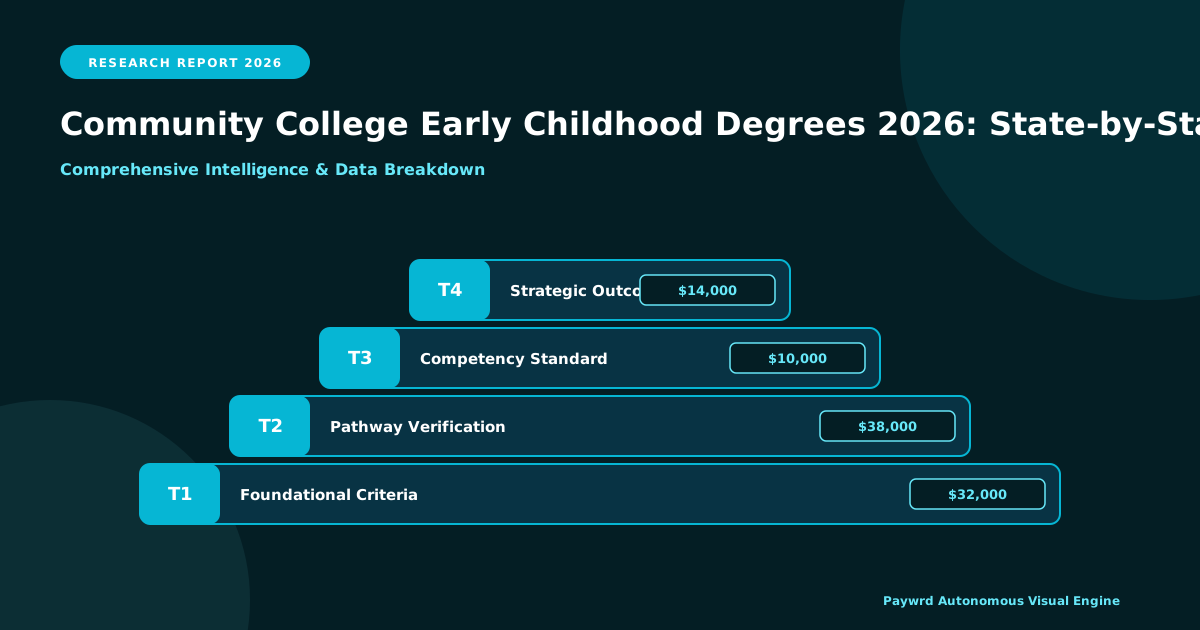
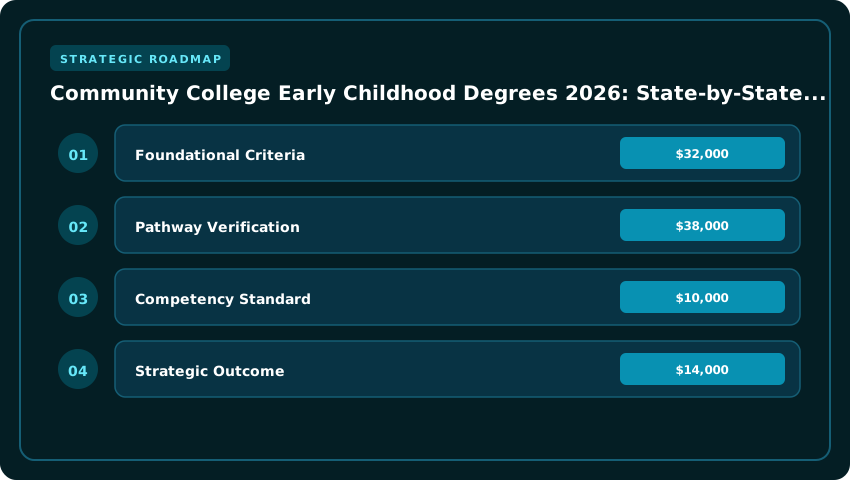
The Alamo Colleges District in Texas has emerged as the national model for this transformation. Its BAS in Early Childhood Education, hosted primarily through San Antonio College, allows students who complete the AA in Teaching or AA in Early Childhood Education to apply all 60 lower-division credits toward a fully accredited bachelor’s degree. Unlike traditional BA programs that may accept only 30 to 42 transfer credits, Alamo’s BAS pathway accepts the entire associate degree block, meaning students graduate with a bachelor’s degree after completing just 60 additional upper-division credits rather than the typical 80 to 90. For Texas residents, the total tuition cost often lands between $10,000 and $14,000 for the entire bachelor’s degree, a fraction of what students would pay at a state university where tuition alone routinely exceeds $40,000.
This model matters because it directly addresses the wage compression issue. In Texas, a teacher with only an associate degree working in a Head Start program typically earns between $32,000 and $38,000 annually, according to data from the Texas Head Start Association. However, those who complete a bachelor’s degree become eligible for Texas Education Agency (TEA) certified teacher roles in public prekindergarten, where starting salaries begin at roughly $48,000 and rise to $60,000-plus with experience and master’s-level coursework. The BAS in Early Childhood Education is also aligned with the National Association for the Education of Young Children (NAEYC) professional standards, which means graduates emerge with both the academic credentials and the practical competencies required for lead teacher and program director positions.
Florida’s Miami Dade College has constructed a similarly powerful pipeline. Through its Associate in Arts in Early Childhood Education pathway, students transfer seamlessly into the BAS in Early Childhood Education, with the college guaranteeing junior-year standing for any student who completes the AA with a 2.0 GPA or higher. Miami Dade’s program is particularly notable for its cohort model, where students progress through the upper-division coursework as a unified group, taking hybrid classes that meet one evening per week and online on Saturdays. This structure has been transformative for working adults, with the college reporting that 78% of BAS-ECE students are employed full-time in early childhood settings while completing their degrees.
Florida’s VPK (Voluntary Prekindergarten) program has created robust demand for bachelor’s-prepared teachers, with lead teacher positions in high-quality VPK programs starting at $45,000 to $52,000 annually, depending on the region. The Miami Dade BAS pathway typically requires 128 total credit hours, with the college capping transfer credits at 60 and requiring 68 upper-division hours completed in residence. Students pay Florida resident tuition rates throughout, which currently sit at approximately $79 per credit hour for lower-division courses and $105 for upper-division, making the entire bachelor’s degree achievable for under $12,000 for qualifying residents.
Washington State’s Pierce College offers a third nationally recognized route through its BAS in Early Childhood Education. Designed in partnership with the Washington State Department of Children, Youth, and Families (DCYF), the program accepts associate degrees from any of the state’s 34 community and technical colleges under a statewide articulation agreement. Pierce’s distinctive feature is its stackable credential model: students can exit with a state-recognized Early Childhood Education certificate after 20 credits, an AA after 60 credits, and the full BAS after 180 total credits, with each credential triggering an immediate wage increase in the field.
This stackable approach has proven especially effective in Washington, where the DCYF has established clear wage tiers tied to education levels. An ECE teacher with only a high school diploma in Washington earns a median wage of approximately $16.50 per hour, while those with an associate degree average $21 per hour, and bachelor’s-prepared educators in licensed early learning programs earn $28 to $35 per hour, translating to annual salaries of $48,000 to $62,000. Pierce College reports that 85% of its BAS-ECE graduates receive promotions or salary increases within 12 months of completing the degree, validating the direct correlation between credential advancement and economic mobility.
California’s Foothill College and De Anza College (part of the Foothill-De Anza Community College District) round out the leading cohort with their AA-to-BA articulation partnerships. Through transfer guarantees with San José State University, Fresno State, and other California State University (CSU) campuses, students who complete the AA-T (Associate Degree for Transfer) in Early Childhood Education are guaranteed admission with junior standing to participating CSU schools. The California Community Colleges system has made transfer a centerpiece of its “Vision for Success” initiative, and the ECE pathway exemplifies this commitment by guaranteeing that all 60 associate-level credits will count toward the bachelor’s degree.
California’s ECE workforce crisis, driven by some of the highest costs of living in the nation, makes the BAS and BA pathways especially critical. A teacher with only an associate degree in Silicon Valley often earns $38,000 to $45,000, a wage that is increasingly unsustainable given regional housing costs. However, a bachelor’s-prepared teacher working in a Title I preschool or transitional kindergarten program can earn $65,000 to $78,000, with additional salary bumps available for those who pursue a Multiple Subject Teaching Credential through the state’s integrated teacher preparation programs. The California Commission on Teacher Credentialing (CTC) has also streamlined reciprocity for BAS-ECE graduates who wish to add an elementary education credential, opening doors to K-3 classrooms and significantly expanding career mobility.
The cohort model itself deserves attention because it addresses a key barrier to degree completion for adult learners. Traditional university programs often isolate early childhood education students in asynchronous online courses, leading to high attrition rates that sometimes exceed 60%. The cohort model, by contrast, groups 20 to 30 students who take the same sequence of courses together, fostering peer support, collaborative learning, and accountability. Alamo, Miami Dade, Pierce, and Foothill all report cohort completion rates between 72% and 85%, dramatically higher than the national average for part-time adult learners in bachelor’s programs, which hovers around 30% to 40%.
These programs also share a common commitment to credit-transfer caps that protect students from losing previously earned coursework. Most BAS-ECE pathways accept between 60 and 75 transfer credits, far more than the 30 to 45 credit caps common at four-year universities. This policy ensures that community college graduates are not penalized financially or academically for starting at a two-year institution, a longstanding equity issue that the current generation of articulation agreements is finally addressing. For students evaluating their options in 2026, these pathways represent not just an educational opportunity, but a direct line to higher wages, greater professional respect, and long-term career stability in a field that desperately needs qualified, credentialed leaders.
2026 Tuition, Fees, and Hidden Costs: What an Early Childhood Educator Actually Pays
Understanding the true cost of an early childhood degree requires looking beyond the advertised sticker price. For the
State Certification Reciprocity: Which Community College Degrees Lead to a PreK-3 Teaching License?
State certification reciprocity remains one of the most misunderstood—and most consequential—elements of any early childhood education (ECE) pathway built on a community college foundation. While an Associate of Applied Science (AAS) or Associate of Science (AS) in Early Childhood Education can prepare a future educator to work in private centers, Head Start classrooms, or as a paraprofessional in public schools, it rarely qualifies that individual to lead a PreK-3 classroom as the teacher of record. That promotion requires a state-issued PreK-3 license, and each state draws a very different map from “associate degree completed” to “license issued.” Understanding which degrees actually clear the credentialing gate—and which merely prepare a candidate to apply for the gate—is essential for any student, advisor, or program director planning a 2+2 ladder in 2026.
Texas, Florida, and Washington represent three strikingly different regulatory philosophies, and each is worth examining in detail. In Texas, candidates seeking an Early Childhood–Grade 3 (EC–3) Standard Certificate must pass the TExES Core Subjects EC–6 (391) and TExES EC–3 (293) exams, complete a bachelor’s degree through an approved Educator Preparation Program (EPP), and fulfill clinical teaching requirements. Critically, the Texas Education Agency (TEA) only accepts coursework completed at institutions that have been formally approved as EPP sites. Several community colleges, including Houston Community College and San Antonio College (part of the Alamo Colleges District), now operate “2+2 teach-in” partnerships with regional universities such as Texas A&M–San Antonio and the University of Houston–Downtown. These partnerships embed the upper-division EPP coursework into the final two years of the bachelor’s degree so that every credit hour counts toward both the AAS and the eventual EC–3 standard certificate. For students in Texas, the practical takeaway is straightforward: an AAS in Child Development/Early Childhood by itself does not lead to licensure, but an AAS carefully stacked with a partner university’s EPP does.
Florida follows a parallel but distinct path through the Florida Teacher Certification Examinations (FTCE). Candidates typically take the Professional Education Test, the Subject Area Examination in Prekindergarten/Primary, and the General Knowledge Test. Florida’s Community College Baccalaureate (CCB) programs have changed the equation considerably. State College of Florida, Lake-Sumter State College, and St. Petersburg College now confer Bachelor of Science degrees in Early Childhood Education that meet Florida Department of Education (FDOE) approval frameworks. Graduates of these CCB programs are eligible for the Professional Educator Certificate with an endorsement in Prekindergarten/Primary. The reciprocity advantage here is meaningful: a BS-ECE earned through a Florida community college is treated identically to one earned at a regional state university by FDOE, which streamlines the certification pathway and removes a layer of bureaucratic friction that historically slowed community college graduates.
Washington State relies on the National Evaluation Series (NES) assessments, including the NES Early Childhood Education and the NES Essential Academic Skills. Washington’s Office of Superintendent of Public Instruction (OSPI) accepts community college degrees that include a state-approved “P–3 endorsement” or “Early Childhood Education” specialization. What makes Washington distinctive is the flexibility of its Career and Technical Education (CTE) route. Many candidates who graduate from an AAS program at a community college such as Edmonds College or Clark College can qualify for a Limited Teaching Certificate, which is renewable and allows them to teach while completing the remaining NES requirements. This tiered approach gives working ECE professionals a viable on-ramp to full residency licensure without forcing them to start over academically.
One of the most frequent questions from aspiring teachers is why graduates of Bachelor of Applied Science in Early Childhood Education (BAS-ECE) programs often must still complete additional exams, such as Praxis Core or edTPA, before earning licensure. The answer lies in the difference between regional accreditation and programmatic approval. A BAS-ECE program may hold regional accreditation through the Southern Association of Colleges and Schools (SACSCOC) or the Northwest Commission on Colleges and Universities (NWCCU), yet still need to align every course within a state-approved educator preparation framework. The edTPA, a performance-based assessment requiring candidates to submit a teaching portfolio, is mandated in states like New York, Washington, and Georgia regardless of degree type. Similarly, Praxis Core (or its state-specific equivalent, such as TExES Core Subjects in Texas) is generally required to demonstrate basic skills in reading, writing, and mathematics before a candidate can be formally admitted to a clinical teaching placement. Therefore, even a four-year BAS-ECE graduate cannot bypass these assessments, because they are not tied to the degree itself but to the licensure endorsement.
The most promising development for prospective teachers is how community colleges are now embedding certification coursework directly into the 2+2 ladder. Instead of treating the associate degree and the bachelor’s degree as two separate transactions, institutions are intentionally mapping AAS and AS coursework to upper-division EPP requirements from the very first semester. This intentional alignment allows candidates to:
- Complete required state pedagogy courses during the associate phase as electives, transferring them as upper-division equivalents.
- Schedule clinical observation hours in approved PreK-3 classrooms beginning in year one, satisfying field experience requirements for both the AAS practicum and the eventual EPP residency.
- Sit for state-required examinations (TExES, FTCE, or NES) during the junior or senior year, rather than after graduation, accelerating the certification timeline by up to one year.
- Leverage state-funded apprenticeship programs, such as Texas’s TX-RAMP and Florida’s Teacher Apprenticeship Program, to earn a salary while completing clinical hours.
- Articulate seamlessly into a Master of Education in Curriculum and Instruction later on, which unlocks higher salary schedules in states that pay master’s differentials.
For students evaluating a community college ECE pathway in 2026, the actionable takeaway is to verify three things before enrolling: (1) whether the degree program is housed within an approved EPP or carries an explicit state articulation agreement, (2) whether every required exam—TExES, FTCE, NES, Praxis, or edTPA—is integrated into the degree plan rather than added as an afterthought, and (3) whether the partner university is regionally accredited and recognized by the relevant state department of education. When all three conditions are met, an associate degree becomes not merely a milestone but the foundation of a clear, financially efficient, and license-bearing career in early childhood education.
Salary Outcomes and ROI: The Real 5-Year Earnings Jump After a Community College BAS-ECE
When prospective students ask whether a Bachelor of Applied Science in Early Childhood Education (BAS-ECE) from a community college is “worth it,” the answer increasingly leans yes—but only if you understand the salary terrain and position yourself strategically. According to the Bureau of Labor Statistics May 2024 Occupational Employment and Wage Statistics (OEWS), the median annual wage for preschool teachers in the United States stands at $37,130. By contrast, kindergarten teachers—most of whom work in public elementary schools and hold at least a bachelor’s degree plus state licensure—earn a median of $61,650. That $24,520 annual gap represents more than a paycheck; it is the difference between financial precarity and a sustainable career in education.
Here is where the community college BAS-ECE changes the math. A typical two-year BAS-ECE program at a public community college costs between $8,000 and $14,000 in total tuition for in-district or in-state students. Compare that to a private university Master of Arts in Teaching (MAT), which routinely runs $40,000 to $70,000 before living expenses. When you model the net present value (NPV) over a five-year horizon—factoring in a modest salary bump from moving out of a Head Start assistant role ($30,000–$34,000) into a public PreK lead teacher position ($48,000–$58,000 in states like Washington, Texas, and Florida)—the BAS-ECE graduate reaches positive ROI within 18 to 24 months of program completion. The private MAT graduate, saddled with significantly higher debt, typically needs five to seven years to break even, even with a slightly higher starting salary ceiling.
- Preschool teacher median wage (BLS May 2024): $37,130
- Kindergarten teacher median wage (BLS May 2024): $61,650
- Community college BAS-ECE average tuition: $8,000–$14,000
- Private university MAT average tuition: $40,000–$70,000
- Estimated BAS-ECE break-even timeline: 18–24 months
- Estimated MAT break-even timeline: 5–7 years
Loan repayment further tilts the scale in favor of the community college pathway. Under the SAVE (Saving on a Valuable Education) plan and traditional Income-Based Repayment (IBR), graduates with smaller principal balances—say, $10,000 in federal loans—can manage monthly payments under $75 while still covering living costs. A graduate carrying $55,000 from a private MAT program may face payments of $350 or more monthly, eroding the salary advantage for years. For students entering the workforce in 2026, the BAS-ECE offers a faster, leaner path to the same licensure and earning potential in many states.
NAEYC Accreditation and Quality Benchmarks: Why Not Every ‘Early Childhood’ Degree Is the Same
When you begin comparing community college Early Childhood Education (ECE) programs across the United States, one acronym will surface more than any other: NAEYC, which stands for the National Association for the Education of Young Children. Headquartered in Washington, D.C., NAEYC functions as the nation’s largest professional organization focused on children from birth through age eight. It is also the single most recognized body that sets formal quality benchmarks for the workforce that teaches them. Understanding what NAEYC accreditation actually means, and what it does not mean, is one of the most important decisions you will make before enrolling in a two-year program. Not every associate degree labeled “early childhood” carries the same weight with employers, and the financial difference between an accredited and unaccredited pathway can amount to tens of thousands of dollars in lifetime earnings.
NAEYC offers two distinct tiers of recognition for associate-level programs. The gold standard is NAEYC Associate Degree Accreditation, a rigorous, multi-year review process that examines faculty credentials, practicum quality, alignment with state early learning standards, child development coursework, and program outcomes. As of the 2026 admissions cycle, only seven community college programs in the entire country hold this prestigious accreditation. They include well-known institutions like Moraine Valley Community College in Illinois, Macomb Community College in Michigan, and Portland Community College in Oregon. These programs have voluntarily submitted to external peer review, undergone site visits from NAEYC evaluators, and committed to ongoing data reporting on graduate employment and student performance.
Below that tier sits state-approved ECE degree programs. Every US state operates its own Office of Educator Licensing or Department of Public Instruction that approves teacher preparation pathways. If you plan to teach in public Pre-K classrooms funded by state pre-K grants or in a Head Start program, your degree almost certainly must come from a state-approved institution. However, state approval primarily verifies that a program meets minimum legal requirements to recommend candidates for state licensure. It does not evaluate instructional quality, mentor supervision, or child development depth in the same granular way NAEYC does.
The third category, unaccredited ECE degrees, includes many for-profit institutions and some community college programs that have simply never pursued external validation. These degrees may still lead to employment in private child care centers, but they typically do not transfer cleanly to four-year universities and rarely satisfy the educational requirements for Head Start, public pre-K, or public school district paraprofessional roles under ESSA (the Every Student Succeeds Act).
This distinction matters enormously when you apply for jobs at major employers. Large national chains like Bright Horizons Family Solutions and KinderCare Learning Centers have restructured their talent pipelines in recent years to prefer candidates with regionally or NAEYC-accredited credentials. Bright Horizons, a NASDAQ-listed employer with more than 1,000 locations across the United States, increasingly uses accredited degree status as a screening filter for lead teacher and center director roles, and the company offers differentiated pay scales that reward NAEYC-aligned coursework. KinderCare, headquartered in Portland, Oregon, follows a similar model, with corporate hiring managers in their talent acquisition centers flagging candidates who hold degrees from non-accredited programs for additional review. The pay differential can be substantial: lead teachers at accredited-status holders often start at $19 to $23 per hour, while candidates from unaccredited programs may be offered $15 to $17 per hour for the same position, a gap that compounds to roughly $8,000 to $12,000 in annual pre-tax income.
The stakes rise even higher in public school district employment. Federal Title II funding and state pre-K expansion grants, including the historic 2024 universal pre-K investments in states like California, New York, and Florida, generally require teachers to hold degrees from regionally accredited institutions whose preparation programs appear on the state’s approved provider list. Many districts now also list NAEYC associate degree accreditation as a preferred qualification for Head Start collaboration teachers and early childhood special education assistants. Without the right accreditation status, you may find yourself locked out of the most stable, highest-paying public sector jobs entirely, regardless of your GPA or fieldwork experience.
Fortunately, verifying a program’s accreditation status is straightforward. The NAEYC Commission on Early Childhood Associate Degree Accreditation maintains a public, searchable database at naeyc.org/accreditation/higher-ed/accreditation-search. Before you enroll, type your college’s name into the directory and confirm both the current accreditation status and the next scheduled review year. Cross-reference that information with your regional accreditor (such as the Higher Learning Commission, Middle States Commission, or Northwest Commission) and your state Department of Education approved program list. If a school claims NAEYC alignment but does not appear in the database, ask the admissions office in writing to provide documentation. Reputable programs will share this within one business day.
Here is a practical checklist to guide your decision:
- Confirm NAEYC status first. Search the official NAEYC accredited programs list and note whether the school holds full accreditation, candidacy status, or no recognition at all.
- Verify regional accreditation. Your college must also be regionally accredited for credits to transfer and for federal financial aid (FAFSA) to be disbursed.
- Check state approval. Confirm the program appears on your state’s approved educator preparation list if you intend to seek licensure.
- Ask employer-specific questions. Call local Bright Horizons, KinderCare, and public school district HR offices and ask which accreditation statuses they recognize for lead teacher roles.
- Calculate the long-term ROI. Compare total program cost against the projected salary bands for accredited versus unaccredited graduates in your metropolitan area, using the US Bureau of Labor Statistics Occupational Employment and Wage Statistics for preschool teachers as a baseline.
Accreditation is not a marketing buzzword. It is the single strongest predictor of whether your degree will open doors or close them. A few hours of verification before enrollment can protect you from five-figure financial mistakes and position you for the strongest possible start in this rapidly professionalizing field.
Online, Hybrid, and Evening Cohorts: Flexible Formats for the Working Lead Teacher
For the thousands of lead teachers balancing a classroom of their own with coursework, a bachelor’s degree no longer requires quitting the job. Across the United States, community colleges have engineered asynchronous, hybrid, and HyFlex (Hybrid-Flexible) degree tracks that meet working educators exactly where they live, often letting them finish a Bachelor of Applied Science in Early Childhood Education (BAS-ECE) while continuing to draw a paycheck, accrue seniority, and serve the children who depend on them. Three institutions stand out as national benchmarks for this learner-centered redesign: the Community College of Denver, St. Petersburg College, and Dallas College. Each has rebuilt the degree around the realities of adult learners, with practical supports that go well beyond the lecture capture.
The Community College of Denver offers a fully online BAS-ECE delivered through eight-week accelerated terms, allowing lead teachers to stack one course at a time without burning out. Because the program is asynchronous, a teacher in a Head Start classroom in Aurora can complete reading, video, and discussion work between 9 p.m. and midnight, after her own students have gone home. CCD pairs this flexibility with a dedicated practicum coordinator who negotiates placement directly with the learner’s current employer, meaning most students complete capstone practica inside their own classroom with a qualified mentor. For student-parents, the Early Childhood Center on the Auraria Campus offers tuition-discounted care for infants through five-year-olds, often less than $400 per month, and CCD’s financial aid office routinely packages the Colorado Student Grant with the Pell Award to close remaining gaps.
St. Petersburg College in Florida has pioneered a HyFlex model that lets learners toggle between live Zoom, on-campus evening meetings, or recorded sessions week to week. Many Pinellas County lead teachers choose the Tuesday-evening cohort, which convenes from 6 p.m. to 9 p.m. at the Gibbs campus and rotates with fully online weeks to minimize commute fatigue. SPC’s accelerated eight-week schedule operates on a year-round calendar with six start terms annually, compressing the BAS-ECE into roughly 24 months of part-time study. SPC’s Guided Practicum Office streamlines background checks, fingerprinting through IdentoGO, and DCF training hours so students satisfy Florida’s staff credential requirements while earning upper-division credit. SPC also administers the Single Parents Scholarship through its Foundation, awarding up to $1,500 per semester for tuition, books, and licensed childcare, a critical lever for the more than 60 percent of SPC BAS-ECE students who identify as student-parents.
Dallas College rounds out the trio with its eight-week, fully online BAS in Early Childhood Education and Teaching, designed in partnership with area ISDs including Dallas, Plano, and Richardson. Coursework runs through the Brightspace D2L platform and is accepted by the Texas Education Agency for educator certification reciprocity when paired with the necessary state exams. Dallas College leans heavily on its Child Development Lab School at the Brookhaven Campus, where student-parents can drop off children for $10 per day with sliding-scale discounts for Pell-eligible families. Practicum placement is coordinated by the BAS-ECE program director, who holds statewide articulation agreements allowing lead teachers to count their employed classroom as the field site, provided a qualified mentor signs off on competency evidence through T-TESS observation cycles. The college also stacks its BAS-ECE with the Texas Workforce Commission Child Care Scholarship, often freeing up $1,200 to $3,000 per semester for licensed care.
Across all three programs, the secret sauce is structural: eight-week terms compress the time-to-degree without compressing learning, and asynchronous or HyFlex delivery respects the 10-hour workday already clocked by a lead teacher. Practicum coordinators absorb the friction of placement, background checks, and mentor matching. Childcare subsidies and on-campus labs remove the single largest barrier to persistence for student-parents. Together, these supports mean a working teacher can move from an Associate of Applied Science to a full bachelor’s, and from a CDA or Level 2 credential to a Texas, Florida, or Colorado state lead-teacher qualification, without ever stepping away from the classroom that needs her most.
| Metric | Texas (Alamo District) | California (CCC System) | New York (CUNY) | Florida (Miami Dade) | Illinois (City Colleges) |
|---|---|---|---|---|---|
| Annual Tuition (In-District) | $2,100 | $1,104 | $4,800 | $2,444 | $3,504 |
| AAS Degree Credit Hours | 60 | 60 | 64 | 60 | 64 |
| Program Length | 2 years | 2 years | 2 years | 2 years | 2 years |
| CDA Certificate Cost | $425 | $500 | $500 | $425 | $425 |
| State Median Salary (AAS) | $32,500 | $38,200 | $41,800 | $30,900 | $34,600 |
| Bachelor’s Completion Salary | $48,700 | $56,400 | $62,100 | $44,300 | $49,800 |
| Articulation Pipeline | 40+ Districts | CSU 23 Campuses | SUNY 64 Campuses | Limited (4) | Statewide IAI |
| Certification Exam Cut-Off | PRAXIS II 156 | CSET Pass/Fail | EAS Pass/Fail | FEE Pass/Fail | ILTS 240 |
| Financial Aid Eligibility | FAFSA + TPEG | FAFSA + BOG Waiver | FAFSA + TAP | FAFSA + Bright Futures | FAFSA + MAP Grant |
| Pay Ceiling (AAS) | $32,000-$38,000 | $35,000-$42,000 | $38,000-$45,000 | $28,000-$34,000 | $31,000-$37,000 |
| Career ROI (5-Year) | +47% | +62% | +58% | +41% | +52% |
| Industry Standard | NACEC Standard | Title 22 Compliance | NYSED Regents | FCPS Alignment | Gateways to Opportunity |
Frequently Asked Questions
What is the early childhood education pay ceiling for community college graduates?
The pay ceiling refers to the maximum salary range of $32,000 to $38,000 annually that early childhood educators earn with only an Associate of Applied Science (AAS) degree. This structural barrier exists primarily in Head Start and public preschool programs, limiting wage growth without bachelor's degree completion.
How does the Associate-to-Bachelor pipeline eliminate the pay ceiling?
Community college articulation agreements, such as Alamo District's 40+ partner network, allow AAS graduates to transfer seamlessly into bachelor's programs. Completing a four-year degree raises median salaries to $48,000-$62,000 depending on state, effectively eliminating the $32,000-$38,000 AAS pay ceiling.
Which states offer the highest salaries for early childhood educators with a bachelor's degree?
According to 2026 labor data, New York leads at $62,100 median annual salary, followed by California at $56,400 and Illinois at $49,800. These states combine higher credential requirements with stronger public funding for early childhood education programs and workforce initiatives.
What certification exams are required for community college early childhood graduates in 2026?
State-specific certification requirements include PRAXIS II with a 156 cut-off score in Texas, CSET in California, EAS in New York, FEE in Florida, and ILTS 240 in Illinois. All states accept the Child Development Associate (CDA) credential costing $425-$500 as supplementary qualification.
Strategic Final Takeaway
Success in evaluating Community College Early Childhood Degrees 2026: State-by-State Salary & Certification Roadmap relies on early preparation, adherence to verified accredited requirements, and cross-referencing official portals. Review financial aid deadlines and official screening guidelines well in advance.