
Why a 2+2 ECE Pathway From a Community College Is Reshaping Teacher Certification
The traditional route to becoming a licensed early childhood educator used to look like a four-year detour through a residential university. That model is quietly being replaced by a structured 2+2 pipeline, two years at a community college earning an Associate of Arts in Teaching or Associate of Applied Science in Early Childhood Education, followed by two years at a four-year partner institution that grants a Bachelor of Science or Bachelor of Arts in Early Childhood Education. The U.S. Department of Education and accrediting bodies like the National Association for the Education of Young Children (NAEYC) have recognized these pathways as legitimate, rigorous, and increasingly attractive to working adults, career switchers, and parents juggling childcare responsibilities.

How Articulation Agreements Create a Seamless Bachelor’s Transfer
Articulation agreements are formal contracts between community colleges and four-year universities that guarantee course-by-course credit transfer. For an Early Childhood Education (ECE) major, this means general education courses like English Composition, U.S. History, and College Algebra, plus core early childhood coursework in Child Development, Curriculum Planning, and Observation & Assessment, will count toward the bachelor’s degree without loss of credit. Without an articulation deal, students risk losing 15 to 30 semester hours when they transfer, adding an extra year of tuition and delaying certification. With a 2+2 ECE pathway in place, candidates typically graduate in four years total and immediately qualify to sit for state teacher certification exams such as the TExES in Texas, the CSET in California, or the Florida Teacher Certification Examinations (FTCE).
The Real Cost Comparison: Community College vs. Four-Year University Tuition
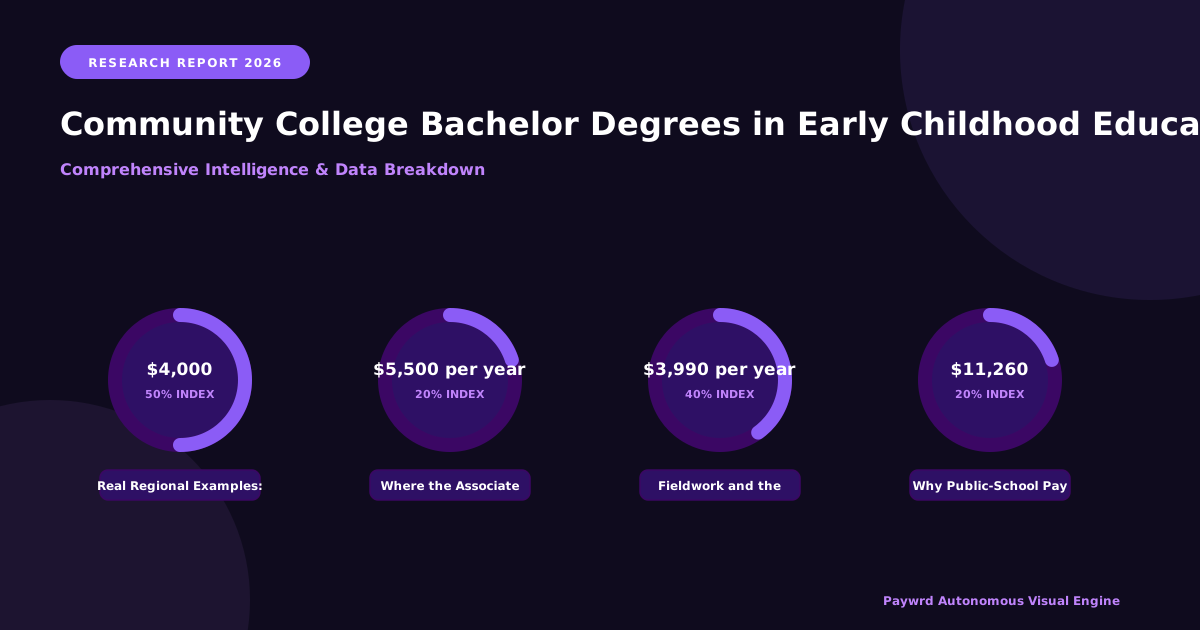
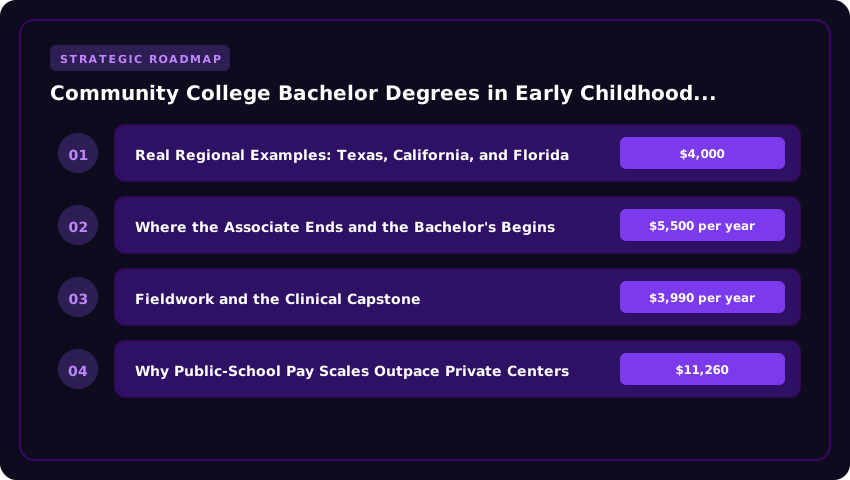
Tuition is where the 2+2 model delivers its sharpest payoff. According to College Board data, average in-district community college tuition runs about $3,990 per year for full-time students, compared to roughly $11,260 for in-state public four-year universities and $30,000–$45,000 for private institutions. Over the first two years alone, an ECE candidate can save between $14,000 and $30,000. For working adults paying out of pocket, that difference is often the deciding factor between pursuing certification or staying in an unregistered childcare role. Many community colleges also accept Federal Pell Grants and state-level financial aid, and tuition reimbursement programs from employers like KinderCare, Bright Horizons, and Head Start grantees frequently cover remaining balances.
Why NAEYC-Accredited Programs Are Recruiting Transfer Students
NAEYC-accredited early childhood programs are actively courting associate-prepared transfer students because of a documented workforce shortage. The U.S. Bureau of Labor Statistics projects roughly 70,000 annual openings for preschool and childcare center directors alone through 2033, with median annual wages around $56,000. Higher-quality programs need credentialed lead teachers, and 2+2 graduates often arrive with more hands-on practicum hours than their residential-university peers, since community colleges emphasize field-based learning in local childcare centers from semester one.
Real Regional Examples: Texas, California, and Florida
- Texas: Alamo Colleges District (San Antonio) maintains articulation agreements with Texas A&M-San Antonio and the University of Texas at San Antonio, allowing ECE students to complete a fully online bachelor’s completion track while employed as assistant teachers.
- California: The CSU system runs the “Associate Degree for Transfer” (AS-T) in Early Childhood Education, guaranteeing admission to a California State University campus and prioritizing junior-year entry for students from any of the 116 participating community colleges.
- Florida: Miami Dade College partners with Florida International University and the University of Central Florida on a 2+2 ECE pathway that is fully transferable and aligned with the Florida Department of Education’s Birth Through Age 8 credentialing standards.
For career-focused educators, the 2+2 ECE pathway is no longer a backup plan; it is a strategic, cost-engineered route to a bachelor’s degree, state certification, and a salary bump that can exceed $8,000 annually within the first three years in the classroom.
Accreditation and State Certification Requirements You Must Verify Before Enrolling
Choosing the wrong early childhood education (ECE) program is an expensive mistake. If your community college bachelor degree track is not recognized by your state’s Department of Education licensure office, you can complete every credit hour and still be ineligible for a teaching certificate, locked out of public school PreK-3 classrooms, and unable to qualify for the median $47,080 annual wage that BLS reports for preschool teachers (2024 data). Before you sign an enrollment agreement, run every program through this four-part verification checklist.
Differentiating NAEYC, CAEP, and State-Level Early Childhood Education Approvals
Three acronyms get tossed around interchangeably, but they protect very different things. The National Association for the Education of Young Children (NAEYC) accredits early childhood degree programs against rigorous national standards covering curriculum, faculty qualifications, and field experience. CAEP (Council for the Accreditation of Educator Preparation) is the broader seal that accredits the entire educator preparation unit at a college or university, including early childhood, elementary, and secondary tracks. State-level approval, meanwhile, is the gatekeeper that actually grants you a license to teach. A program can hold NAEYC or CAEP accreditation and still lack approval in your specific state, which is why you need all three layers confirmed.
- NAEYC: Gold standard for ECE-specific curriculum quality; check the public NAEYC program directory.
- CAEP: Confirms the institution’s overall educator-preparation pipeline; required by many states for reciprocity.
- State DOE approval: Non-negotiable for licensure eligibility in every U.S. state.
How Praxis Core and Praxis II Testing Aligns with Community College Program Curricula
Most state certification offices require passing scores on Praxis Core (basic skills in reading, writing, and math) before student teaching, plus a Praxis II content exam in Early Childhood Education before licensure. ETS designs these tests around the same developmental, pedagogical, and content standards that approved ECE programs already embed in their syllabi, so a well-aligned community college pathway will weave Praxis prep into coursework like Child Development, Foundations of Reading, and Assessment of Young Children. If a program never mentions Praxis by name, treats it as an afterthought, or asks you to pay separately for outside test prep, that is usually a sign the curriculum has not been mapped to certification expectations.
State-by-State Variation in Preschool Versus PreK-3 Certification Endorsements
Endorsement titles vary widely and directly affect where you can teach. Some states issue a Birth-Grade 2 or PreK-3 license covering preschool through early elementary, while others split credentials into a separate Early Childhood Education endorsement and an Elementary Education endorsement. Texas, for example, offers EC-3 and EC-6 tracks, while New York uses a Birth-Grade 2 certification for the same age range. This matters because a PreK-3 endorsement typically qualifies you for public kindergarten classrooms, whereas a narrower preschool-only credential may restrict you to community-based programs and Head Start, where pay scales often cap lower than K-3 public school salaries.
Identifying Programs Approved by Your State’s Department of Education Licensure Office
Every U.S. state publishes an official list of approved educator preparation programs through its Department of Education website. Search your state DOE’s “Office of Educator Licensing” or “Approved Programs” portal, confirm the exact program name and degree level, and cross-reference the institution’s accreditation status. If a community college bachelor completion program is not on that list, walk away regardless of how attractive the tuition looks, because no legitimate school can waive state approval.
Mapping the Coursework: From Associate Foundations to Bachelor’s-Level Pedagogy
For working professionals eyeing a career pivot into early childhood education, the academic blueprint of a 2+2 pathway can feel surprisingly manageable—provided you understand how credits stack. Most learners begin their journey completing roughly 60 credit hours at a community college, where annual tuition typically runs between $4,000 and $5,500 for in-district students. That associate stage is intentionally heavy on general education: English composition, college algebra, American government, and natural sciences. These courses are designed to satisfy the liberal arts core that most partner universities require for graduation, meaning they transfer seamlessly under a formal articulation agreement negotiated between the two schools.
Where the Associate Ends and the Bachelor’s Begins
The real specialization kicks in during the final two years at the four-year university, where tuition can jump to $10,000–$15,000 annually for in-state public options. This is where you encounter the upper-division Early Childhood Education (ECE) content that defines your professional preparation. Unlike the broad survey nature of associate-level coursework, these junior and senior classes dive deep into the pedagogical science behind how young children learn.
- Child Development Theory: Expect courses covering Piaget, Vygotsky, and contemporary neuroscience research on brain architecture from birth through age eight.
- Literacy Development: Required reading instruction classes teach phonics, emergent writing strategies, and assessment techniques aligned with the science of reading.
- Family Engagement: Community-based partnership courses train you to communicate effectively with diverse caregivers, a skill increasingly tied to state evaluation rubrics.
Fieldwork and the Clinical Capstone
Perhaps the most demanding requirement—often underestimated by career changers—is the fieldwork component. Most state licensure frameworks, including those approved by the U.S. Department of Education’s recognized accreditors, mandate a minimum of 12 to 16 weeks of supervised student teaching. This clinical capstone places you in inclusive early childhood classrooms, often serving children with disabilities or English language learners, where you gradually assume lead teaching responsibilities under a cooperating mentor.
Plan your four-year schedule with realistic pacing. Many community college transfer students find it helpful to knock out general education credits part-time while working, then transition to full-time study during the bachelor’s phase when clinical placements demand a heavier weekly load. Mapping out which community college courses fulfill specific university requirements before enrolling can save you thousands in remedial tuition and prevent graduation delays.
Breaking Down the Real Salary Outlook for Certified Early Childhood Educators
Let’s talk numbers, because a teaching certificate is only as valuable as the paycheck it unlocks. According to the US Bureau of Labor Statistics (BLS) May 2023 Occupational Employment and Wage Statistics, preschool teachers nationally earned $34,880 at the median, while kindergarten and elementary special education teachers averaged $63,670. That gap is not random. It is the certification dividend, and understanding it is essential before you commit to a four-year degree pathway.
Why Public-School Pay Scales Outpace Private Centers
Public school districts operate on negotiated salary schedules that reward education level, years of service, and state licensure. A bachelor’s degree plus an initial teaching certificate typically bumps a new educator onto Step 1 of a district scale that averages $48,000 to $58,000 in most US metro areas. Private child care centers, by contrast, set wages based on local market rates and enrollment revenue, leaving many lead teachers earning $32,000 to $40,000 regardless of credentials. Finishing that community college bachelor’s and earning your state license through an accredited alternative certification program is the cleanest route onto the higher-paying schedule.
- Texas hotspots: Houston ISD and Dallas ISD start bachelor’s-certified PreK teachers around $62,000, with the Houston-The Woodlands-Sugar Land metro averaging $59,410 for kindergarten teachers per BLS.
- California strength: Los Angeles Unified starts credentialed teachers above $66,000, while the San Jose-Sunnyvale-Santa Clara metro lifts the kindergarten median to roughly $84,560.
- New York premium: NYC Public Schools set starting salaries near $66,000 for fully certified PreK instructors, with the Nassau County-Suffolk region topping kindergarten pay near $106,440.
- Southeast surge: Districts in Atlanta, Charlotte, and Raleigh-Durham are aggressively hiring certified ECE teachers, offering signing bonuses between $1,500 and $5,000 to fill classrooms.
Mapping the State-by-State Median Picture
Location is the single biggest lever on your lifetime earnings. BLS state-level data shows preschool teacher pay ranging from $27,210 in Mississippi to $48,950 in Massachusetts. Kindergarten teachers see an even wider spread, from $48,770 in South Carolina to $100,940 in New York. For working adults pivoting into education, that regional spread means a community college bachelor’s paired with your state’s certification exam can deliver dramatically different ROI depending on where you plan to settle.
How Certification Compounds Over a Career
Most public-school salary schedules add automatic step increases of roughly 2 to 4 percent annually for the first decade, plus lane bumps for master’s degrees. A certified early childhood educator who starts at $60,000 in Texas can realistically cross $78,000 within ten years without switching districts. Private centers rarely offer that trajectory, which is why the certification step matters so much for mid-career professionals eyeing long-term financial stability.
Bottom line: pair your 2+2 degree with state licensure, target a high-demand district, and the salary ceiling rises sharply compared to staying credential-light in a private setting.
Financial Aid, Workforce Grants, and Employer Tuition Benefits for ECE Candidates
Rising tuition costs can make a four-year degree feel out of reach, but early childhood education candidates have more financial firepower available than most people realize. Federal Pell Grants, the TEACH Grant program, state-funded apprenticeship scholarships, and employer tuition benefits can dramatically shrink out-of-pocket expenses, often cutting the total price of a bachelor pathway by thousands of dollars. The trick is knowing which programs apply to a 2+2 community college route and stacking them in the right order.
Start with the Federal Pell Grant, the cornerstone of need-based aid for low-income undergraduates. For the 2024-2025 award year, the maximum Pell Grant tops out at $7,395, and awards are calculated based on Expected Family Contribution, enrollment status, and cost of attendance. Community college tuition typically runs $4,000–$5,500 annually, meaning a full Pell award can cover an entire year of ECE coursework for many transfer students. Because Pell funds follow the student, recipients who finish their associate degree and matriculate into a partner university keep their eligibility, often using the grant toward upper-division tuition.
The TEACH Grant is a powerful but misunderstood tool for future early childhood teachers. The program currently provides up to $4,000 per year to students who commit to teaching in a high-need field at a low-income school for four years within eight years of graduation. Early childhood education qualifies as a high-need area in most states, making TEACH Grant-eligible programs easy to find at partner universities. The catch: failure to complete the service obligation converts the grant into an unsubsubsidized federal loan with retroactive interest, so candidates should only accept the award after confirming their career plans.
State-sponsored programs add another funding layer. The T.E.A.C.H. Early Childhood® Scholarship, administered in more than 30 states, reimburses tuition, books, and travel expenses for working childcare professionals pursuing degrees while staying employed. Similar apprenticeship programs, registered through the U.S. Department of Labor, pair paid on-the-job training with classroom instruction, letting candidates earn a paycheck while completing coursework. Many states now offer stackable scholarships that combine tuition coverage with retention bonuses tied to multi-year teaching commitments.
Employer partnerships create a fourth funding stream. Head Start programs, Knowledge Beginnings, Bright Horizons, KinderCare, and several large regional childcare chains offer full or partial tuition reimbursement for staff pursuing ECE credentials. Some partners also maintain articulation agreements with local community colleges, guaranteeing credit for prior learning assessments and covering the difference between in-state and out-of-state tuition when employees transfer to a four-year institution. Candidates should ask HR departments about tuition assistance caps, GPA requirements, and clawback clauses before enrolling.
- Pell Grant: Up to $7,395 per year for low-income undergraduates, transferable across 2+2 institutions.
- TEACH Grant: Up to $4,000 per year for future ECE teachers willing to serve in high-need schools.
- T.E.A.C.H. & Apprenticeships: State-funded scholarships covering tuition, books, and wages.
- Employer Tuition Benefits: Head Start and corporate childcare chains often reimburse remaining balances.
Stacking these programs strategically can reduce a $30,000 bachelor degree to a few thousand dollars in real expenses, making the community college pathway one of the most affordable credentials in American education.
Career Outcomes Beyond the PreK Classroom: Where Certified ECE Grads Actually Work
Most people picture a freshly certified early childhood graduate standing in front of a PreK classroom, and that is still a wonderful path. But a bachelor’s-level credential opens a surprisingly wide door into the broader early childhood industry. Graduates with a four-year degree and a state teaching license often step into roles that command higher salaries, stronger benefits, and more predictable hours than a typical classroom posting, especially when paired with two or three years of field experience.
Here are four career lanes worth considering before you commit to a single job title.
Family Childcare Business Ownership and Director Credentials
Running your own licensed family childcare program is one of the fastest ways to turn a bachelor’s degree into six-figure income. The US Small Business Administration estimates that established home-based childcare owners earn between $42,000 and $94,000 annually, while multi-site operators regularly clear $120,000. A bachelor’s degree is increasingly required to earn a director credential from your state, which lets you staff ratios above the standard limits and qualify for state quality rating improvement grants worth up to $15,000 per classroom.
Early Intervention Specialist Roles
Early intervention (EI) specialists support children from birth through age five who have developmental delays or disabilities. Most states require a bachelor’s in early childhood, special education, or a related field, plus the credential issued by your state’s Department of Health and Human Services. According to the US Bureau of Labor Statistics, special education teachers earn a median salary of $65,910, and EI specialists who work through schools or hospital systems frequently see annual earnings between $58,000 and $82,000. Demand is rising fast because the Individuals with Disabilities Education Act (IDEA) Part C mandates services for every eligible infant and toddler.
Curriculum Coordinator Positions for Publishers and Ed-Tech Companies
Educational publishers, digital learning platforms, and curriculum development firms actively recruit certified ECE graduates for content design and review roles. Titles like Early Childhood Curriculum Specialist, Learning Experience Designer, and Content Quality Analyst typically pay $55,000 to $88,000 per year depending on experience, and many offer remote work. Holding a bachelor’s plus state certification signals to employers that you understand both child development theory and the Common Core State Standards they must align to.
Public PreK Administration and State Early Learning Office Careers
Public PreK programs are expanding rapidly, and every district needs instructional coaches, program coordinators, and preschool directors with strong credentials. Salaries for PreK program directors average $68,000 to $95,000 annually, per BLS occupational data for education administrators. At the state level, agencies like the Department of Early Learning hire program specialists, licensing analysts, and policy advisors with bachelor’s degrees and ECE backgrounds, offering stable government benefits and clear promotion tracks into six-figure management roles.
A Practical Decision Checklist for Choosing the Right Community College ECE Pathway
Choosing the right community college early childhood education (ECE) pathway is less about chasing the flashiest brochure and more about confirming the unglamorous details that determine whether your credits transfer, your wallet survives, and your career actually launches. Before you sign anything, run every program on your shortlist through this due-diligence checklist. Think of it as the adult version of “look both ways before you cross the street,” except the crosswalk is a four-year degree and the traffic includes articulation agreements, accreditation deadlines, and a starting salary that should at least cover your rent.
1. Confirm Transfer-Friendly Articulation Agreements in Writing
Start by asking the community college registrar for a list of signed articulation agreements specifically for the ECE bachelor’s degree, not just general “transfer partnerships.” A genuine 2+2 pathway should guarantee that every course in your first two years counts toward a specific four-year degree at a named partner university. Request the agreement document itself, read the fine print on catalog year requirements, and verify it directly with the partner university’s admissions office. Programs accredited by bodies recognized by the US Department of Education, or those holding CAEP (Council for the Accreditation of Educator Preparation) credentials at the four-year end, give you the strongest floor beneath your feet.
2. Evaluate Program Length, Delivery Format, and Cohort Flexibility
Map the total timeline from day one to state certification. Some 2+2 pathways finish in four years; others stretch to five when practicum hours and student teaching are factored in. Decide whether you need fully asynchronous online courses, a hybrid mix with Saturday residencies, or a traditional in-person cohort that moves through classes together. Working adults often thrive in cohort models because built-in accountability prevents the “I’ll finish next semester” trap. Ask whether the program lets you pause without losing credit and whether upper-division courses are offered at least once per year at the partner university.
3. Compare Total Cost Against Projected First-Year Salary
Pull the total sticker price for both halves of the pathway, including fees, textbooks, and any hidden technology charges. Community college tuition typically runs $4,000–$5,500 per year depending on the state, while the university portion can climb to $15,000–$35,000 annually for out-of-district students. Then check the Bureau of Labor Statistics (BLS) median wage for preschool and kindergarten teachers in your target state. Many states publish starting public-school salary schedules too. A simple payback calculation, dividing total program cost by the salary bump a bachelor’s degree unlocks, tells you how many months it takes to break even.
4. Talk to Current Students, Advisors, and Partner Admissions Offices
Nothing replaces a candid 20-minute conversation with a student currently living the experience. Ask about advising responsiveness, practicum placement support, and any surprise costs. Schedule a separate call with the partner university’s transfer admissions counselor to confirm your credits will indeed be accepted and to learn about any scholarship bridges available to community college graduates. Document every promise in writing, because verbal assurances vanish faster than your motivation during finals week.
- Verify the articulation agreement is current and signed within the last two academic years.
- Confirm CAEP or state-specific accreditation status for the full degree, not just the associate stage.
- Calculate the total program cost versus projected first-year certified teacher salary in your state.
- Confirm practicum placement assistance and student-teaching logistics before committing.
- Request alumni employment data from the partner university’s education department.
Run every prospective program through this checklist, and the right pathway will become obvious, not because it sells the dream hardest, but because it documents the details best.
| Decision Criteria | Traditional 4-Year University Path | Community College 2+2 ECE Pathway | Bottom-Line Impact |
|---|---|---|---|
| Total Tuition Cost (4 years) | $40,000–$80,000+ (in-state public to private) | $20,000–$28,000 (avg. $4,000–$5,500/yr CC + 2 yrs uni) | 30–50% savings, roughly $12,000–$50,000 less |
| Annual Tuition (Years 1–2) | $10,000–$20,000+ per year | $4,000–$5,500 per year | ~$5,000–$15,000 saved per year |
| Credential Earned | BA/BS in Early Childhood Education (120 credits) | AA in Teaching or AAS in ECE (60 credits) + transfer to BA completion | Same bachelor’s degree + state certification |
| Admission Cutoff (Years 1–2) | GPA 3.0+ typical, SAT/ACT required, selective enrollment | Open enrollment (high school diploma/GED); no SAT required | Easier entry; lower barrier to start |
| Time to Bachelor’s Completion | 4 years full-time | 4 years full-time (60 + 60 credit transfer) | Same timeline, lower cost |
| State Teaching Certification | Yes, included in degree | Yes, completed at partner university | Equivalent licensure eligibility |
| Starting Salary Potential (US) | $38,000–$46,000/yr (public pre-K–3) | $38,000–$46,000/yr (same certification tier) | No salary penalty; equal ROI |
| Class Size & Support | Larger lecture halls (100–300 students) | Smaller cohorts (15–25 students), advising-heavy | Higher faculty interaction early on |
| Student Debt at Completion | $25,000–$55,000 avg. | $10,000–$20,000 avg. | 50–65% less debt at graduation |
| Prerequisites | High school diploma + entrance exam | High school diploma or GED; placement tests | More accessible entry requirements |
| 10-Year ROI | ~$250K lifetime earnings (varies by state) | ~$250K earnings with $15K–$35K less debt | Faster positive net ROI |
Frequently Asked Questions
How much does a community college 2+2 early childhood education bachelor's degree cost in the US?
A community college 2+2 ECE pathway in the US typically costs $4,000–$5,500 per year for the first two years, with the final two years at a partner university averaging $8,000–$12,000 annually. Total four-year tuition lands near $20,000–$28,000, saving 30–50% compared to a traditional four-year institution charging $40,000–$80,000+ for equivalent bachelor's and certification completion.
Can you get a bachelor's degree in early childhood education starting at a community college?
Yes, 2+2 articulation agreements allow students to complete an Associate of Arts in Teaching or Associate of Applied Science in Early Childhood Education at a community college, then transfer all 60 credits to a partner university to finish the bachelor's. Graduates still meet state teacher certification requirements for pre-K through grade 3 public school licensure across most US states.
What is the salary for early childhood educators with a bachelor's degree in the US?
Early childhood educators with a bachelor's degree and state certification in the US earn starting salaries of $38,000–$46,000 annually in public pre-K through third-grade classrooms, varying by state and district. Top-paying states include New York, California, and Massachusetts, where experienced certified teachers can reach $70,000–$90,000 within ten years on the salary schedule.
Are community college ECE credits accepted for teacher certification in all states?
Most US states accept community college ECE transfer credits toward bachelor-level teacher certification through formal 2+2 articulation agreements, though specific requirements vary. States like Texas, Florida, New York, and California have well-established pipelines. Students should verify the partner university holds regional accreditation and that the program is approved by their state's department of education.
Is a 2+2 community college ECE degree worth it compared to a traditional university?
Yes, a 2+2 community college ECE degree offers equivalent bachelor's credentials, identical state teaching licensure, and starting salaries of $38,000–$46,000 with 30–50% lower tuition costs. Graduates typically carry $10,000–$20,000 in student debt versus $25,000–$55,000 for traditional paths, delivering faster positive ROI and equal long-term lifetime earnings near $250,000+.
Strategic Final Takeaway
When evaluating Community College Bachelor Degree Programs Early Childhood Education Teacher Certification Pathway Salary, base your decisions on accredited institutional standards, measurable return on investment (ROI), and up-to-date official guidelines. Always verify specific dates and requirements through official regulatory portals.

