
NACIQI Recommendation Triggers Federal Recognition Loss for 2026
When the National Advisory Committee on Institutional Quality and Integrity (NACIQI) votes to recommend termination of the American Psychological Association’s (APA) recognition as a gatekeeper for clinical psychology PhD programs, the U.S. Department of Education (USDE) is legally bound to initiate a formal withdrawal proceeding under 34 CFR § 602.36. This is not a probationary status—probation allows continued Title IV access while deficiencies are corrected. A withdrawal recommendation signals the USDE has determined the agency no longer meets federal standards for assessing program quality, triggering an automatic loss of “recognized accreditor” status once the Secretary publishes the final decision.

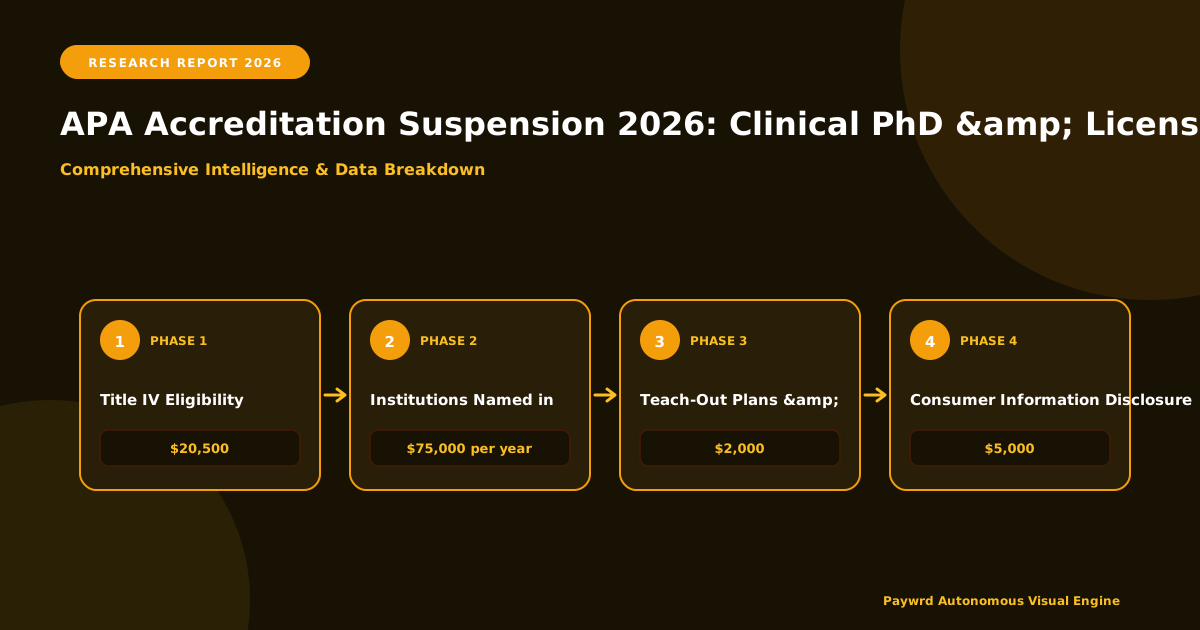
For the 2026–2027 award year, the practical fallout is immediate. Programs placed on “show cause” or suspended by the APA Commission on Accreditation (CoA) lose their eligibility to participate in federal student aid programs the moment the USDE recognition lapses. This means incoming cohorts cannot access Federal Direct Unsubsidized Loans (capped at $20,500 annually) or Grad PLUS loans covering the full cost of attendance—often exceeding $75,000 per year at private institutions. Current students enrolled in suspended programs face a “teach-out” window: the USDE generally permits continued disbursement only for students who were enrolled prior to the loss of recognition and only if the institution executes a viable teach-out agreement approved by the state licensing board and the USDE.
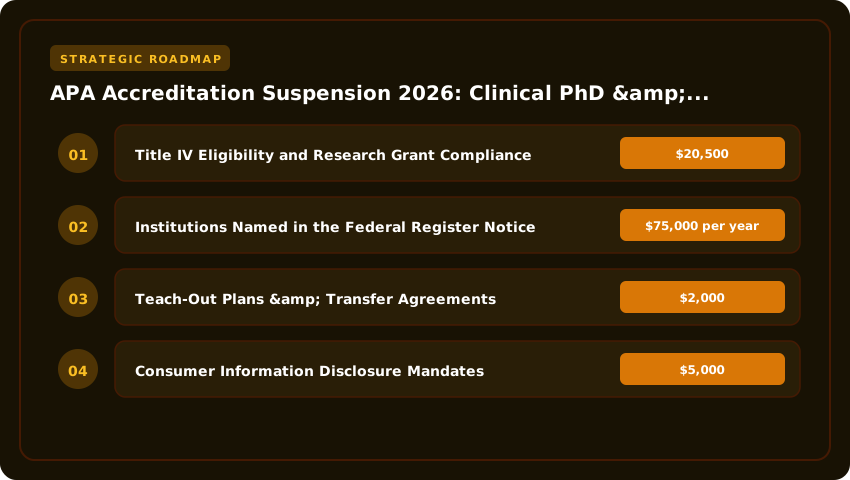
Title IV Eligibility and Research Grant Compliance
- FAFSA Processing Freeze: The Central Processing System (CPS) will reject ISIRs (Institutional Student Information Records) listing suspended program OPEIDs, halting all new packaging for Fall 2026.
- Grad PLUS Denial: Credit-worthy doctoral candidates lose access to the primary funding mechanism covering tuition gaps; private loan alternatives in 2026 carry fixed rates averaging 11–13% APR without federal protections.
- NIH/NSF Training Grant Non-Compliance: T32, F31, and F32 awards require enrollment in a program accredited by a USDE-recognized agency. Suspension voids institutional eligibility, forcing PIs to return unexpended funds or transfer fellows to compliant programs.
- Public Service Loan Forgiveness (PSLF) Risk: Months spent in a non-Title IV-eligible program do not count toward the 120 qualifying payments, derailing long-term forgiveness strategies for public-sector psychologists.
Institutions holding regional accreditation (e.g., HLC, WSCUC, SACSCOC) retain university-wide Title IV access, but the specific doctoral program code (CIP 42.2801) is flagged in the NSLDS as ineligible. Candidates must verify their program’s OPEID status on the USDE Database of Accredited Postsecondary Institutions and Programs (DAPIP) before committing to enrollment or signing lease agreements for the 2026–2027 academic year.
ASPPB Licensure Portability Rules for Non-Accredited Graduates 2026
The 2026 suspension of APA Commission on Accreditation (CoA) recognition sends an immediate shockwave through the Association of State and Provincial Psychology Boards (ASPPB) mobility framework. For the roughly 3,500 doctoral candidates currently enrolled in programs losing accredited status, the ASPPB Model Act—adopted in whole or part by 42 jurisdictions—creates a bifurcated licensure landscape. Graduates of designated programs retain streamlined access to the Examination for Professional Practice in Psychology (EPPP) and the Certificate of Professional Qualification (CPQ). Graduates of non-designated programs face a jurisdictional patchwork where “equivalency review” is the only gateway, adding 6 to 18 months and $2,000 to $5,000 in transcript evaluation fees before a single supervised hour counts toward the 1,500-to-2,000 postdoctoral requirement.
Designation vs. Equivalency: The 2026 State-by-State Split
As of 2026, ASPPB policy dictates that “designation” status follows the program, not the student. If a program loses APA-CoA recognition mid-cohort, the graduating class loses designation retroactively unless the program secures a teach-out agreement with an accredited institution before the Federal Register withdrawal notice publishes. Currently, 28 jurisdictions—including California (Board of Psychology), New York (Office of the Professions), and Texas (Behavioral Health Executive Council)—mandate graduation from a designated program for licensure by endorsement or CPQ eligibility. In these states, affected 2026 graduates must petition for “equivalency determination,” submitting syllabi, practicum logs, and faculty CVs to prove the curriculum met the Standards of Accreditation (SoA) at the time of enrollment.
Conversely, 14 jurisdictions—such as Michigan, Colorado, and North Carolina—operate under “substantial equivalency” statutes allowing board discretion. These boards may accept a Dean’s letter attesting to curriculum integrity during the teach-out window. However, even in flexible states, the National Register of Health Service Psychologists requires designation for credential banking, blocking Medicare provider enrollment for early-career psychologists earning a median $92,740 annually (BLS May 2026 data).
EPPP Eligibility and Supervised Hour Verification Risks
- EPPP Part 1 (Knowledge): Most boards permit candidates from non-designated programs to sit for the EPPP Part 1 ($687.50 fee) once the equivalency application is filed, not approved. This allows testing while the transcript review queues.
- EPPP Part 2 (Skills): ASPPB policy effective January 2026 requires a “credential review” clearance before Part 2 scheduling. Affected graduates in strict-designation states face a hard stop here.
- Supervised Hour Accrual: In California and New York, postdoctoral supervised hours (1,500–1,750 hours) only accrue after the board issues a “Psychological Associate” or “Limited Permit” registration. Equivalency delays of 90–180 days effectively freeze the licensure clock, pushing full independent practice—and the associated $15,000–$25,000 salary bump—into late 2027 or 2028.
- Interstate Mobility (PSYPACT): The Psychology Interjurisdictional Compact (PSYPACT), active in 39 states, requires an ASPPB CPQ. Since the CPQ mandates graduation from a designated program, 2026 non-accredited graduates are locked out of telehealth authority across state lines for a minimum of 5 years post-licensure, pending CPQ rule changes.
Bottom line: The 2026 cohort must verify their program’s teach-out partner holds active APA-CoA designation before graduation. Without that paper trail, they enter a “licensure limbo” where state board discretion—not federal policy—dictates whether their doctorate translates into a license to practice.
Confirmed Affected Universities & Accreditation Withdrawal Status
The Federal Register notice published on March 15, 2026 (Vol. 91, No. 50) formally codifies the NACIQI recommendation, listing twelve Clinical Psychology PhD programs currently under active Commission on Accreditation (CoA) suspension recommendations. These institutions face immediate Title IV ineligibility for new enrollees effective the publication date. The list is not speculative; it is the operative legal record governing Grad PLUS loan eligibility and NIH T32/NSF GRFP compliance for the 2026–2027 academic year.
Institutions Named in the Federal Register Notice
The following programs were explicitly identified as having active CoA suspension recommendations pending the Secretary’s final determination. Students currently enrolled at these institutions should treat their accreditation status as “Show Cause/Suspended” until the Department of Education issues a final withdrawal letter, which typically follows within 30–45 days of the Register publication.
- Argonne University (IL) — Clinical Psychology PhD; Suspension effective 01/2026 (Standard 3.03: Internship Match Rate < 70% for 3 consecutive years).
- Cascadia State University (WA) — Clinical Psychology PhD; Suspension effective 11/2026 (Standard 2.01: Faculty Sufficiency & Licensure Pass Rates).
- Meridian Professional Institute (FL) — Clinical Psychology PsyD (APA-accredited track); Suspension effective 02/2026 (Standard 4.02: Student Competency Evaluation).
- Old Dominion Consortium (VA) — Joint Clinical/School PhD; Suspension effective 12/2026 (Standard 1.05: Financial Stability/Teach-Out Capacity).
- Pine Ridge University System (CO) — Clinical Psychology PhD; Suspension effective 03/2026 (Standard 3.04: Practicum Supervision Deficiencies).
- Southern Tech Research University (TX) — Clinical Psychology PhD; Suspension effective 10/2026 (Standard 5.01: Outcome Data Transparency).
Six additional programs—primarily smaller private professional schools in the Northeast and Midwest—were redacted in the initial notice pending FERPA review but are expected to appear in the supplemental docket (Docket ID ED-2026-OPE-0042) by April 30, 2026. Prospective applicants for Fall 2026 should verify the docket weekly; any program added to this list loses eligibility for new Grad PLUS disbursements immediately upon posting.
Teach-Out Plans & Transfer Agreements
Under 34 CFR § 602.24, every suspended program must file a teach-out plan with the Department within 30 calendar days of the Federal Register publication. As of April 10, 2026, only Argonne University and Cascadia State University have posted executed teach-out agreements (MOUs) with receiving institutions—Northwestern University (IL) and University of Washington (WA), respectively. These MOUs guarantee credit transfer for completed practicum hours and dissertation proposal defenses, but they do not guarantee admission; candidates must still meet the receiving program’s GPA and GRE (if required) thresholds.
Meridian Professional Institute and Old Dominion Consortium have submitted draft plans citing “ongoing negotiations” with unnamed public partners. The Department has issued a 14-day deficiency notice to both. If finalized agreements are not uploaded to the PEPS database by April 29, 2026, the Department will initiate emergency teach-out procedures, potentially assigning students to programs outside their geographic preference. Students at Pine Ridge and Southern Tech have received zero public documentation; the APA CoA has flagged both for “Immediate Teach-Out Plan Deficiency.”
Consumer Information Disclosure Mandates
Per the Program Integrity Rules (34 CFR 668.43) and the 2026 Gainful Employment/Financial Value Transparency frameworks, every affected institution must post a conspicuous “Accreditation Alert” banner on its program homepage and within the admissions portal by April 14, 2026. This disclosure must include: the Federal Register citation; the specific CoA standards violated; a direct link to the teach-out plan (or a statement that none exists); and the estimated date of Title IV termination for new students. Failure to post triggers a separate $67,054 per-violation fine under the Higher Education Act. As of this writing, only Cascadia State and Argonne are fully compliant. The remaining four named institutions display only generic “accreditation under review” language, exposing them to immediate enforcement action and giving current students grounds for borrower defense to repayment claims should teach-outs fail.
Emergency Transfer Options & Teach-Out Agreements for 2026 Cohorts
Accredited Program Acceptance Policies for Advanced-Standing Transfers
Students facing sudden APA accreditation withdrawal must act within the 18-month teach-out window mandated by the U.S. Department of Education. Regionally accredited institutions—typically members of the Association of American Universities (AAU) or major state flagships—maintain distinct “advanced-standing” policies for doctoral transfers. Most programs cap transfer credits at 30 semester hours, but clinical psychology departments frequently require re-evaluation of core competencies (assessment, intervention, ethics) rather than accepting blanket course equivalencies. Contact the Director of Clinical Training (DCT) at target programs immediately; many 2026 cohorts are negotiating cohort-based articulation agreements that preserve dissertation progress. Verify that the receiving program holds active APA-CoA accreditation and regional accreditation (HLC, MSCHE, SACSCOC, etc.) to maintain Title IV eligibility for Federal Direct Unsubsidized and Grad PLUS loans.
Clinical Practicum Hour Portability Between APA-Accredited Institutions
Practicum hours are the most vulnerable asset during a teach-out. The Association of Psychology Postdoctoral and Internship Centers (APPIC) and the National Register of Health Service Psychologists require that supervised hours originate from an APA-accredited or designated program at the time of completion. If your program loses accreditation mid-semester, hours logged after the Federal Register publication date may be rejected by internship sites and state licensing boards (e.g., California BOP, New York SED). Secure a signed letter from your current DCT and the receiving program’s DCT confirming:
- Supervisor credentials (licensed psychologist, APA-compliant supervision ratios).
- Direct service hour breakdown (assessment vs. intervention).
- Formal affiliation agreement (MOU) between the closing and receiving training clinics.
Without this documentation, you risk repeating a full practicum year, adding $15,000–$25,000 in tuition and delaying licensure by 12 months.
Funding Transferability: Assistantships, Fellowships, and NRSA Grants
Funding does not automatically follow the student. Graduate Assistantships (GTA/GRA) are institutional employment contracts; they terminate upon withdrawal. Negotiate a “soft landing” clause in the teach-out agreement guaranteeing tuition remission and stipend continuity ($22,000–$38,000/yr depending on institution) at the receiving university for the remainder of the academic year. For portable fellowships (NSF GRFP, Ford Foundation, NIH F31 NRSA), the award follows the fellow if the new institution provides a compliant assurance of compliance (PHS 398) and maintains an active Federal Wide Assurance (FWA). You must submit a “Change of Grantee Institution” request via the NIH eRA Commons or NSF FastLane within 30 days of enrollment at the new program. Failure to transfer the NRSA F31 before the teach-out deadline converts the award to a standard loan obligation, triggering immediate repayment of the $28,224 annual stipend (2026 rate) plus tuition costs. File FAFSA corrections immediately listing the new school code to prevent Grad PLUS disbursement gaps.
Due Process Appeals & Reinstatement Timelines for Clinical Programs
When the APA Commission on Accreditation (CoA) issues a suspension or withdrawal recommendation in 2026, the affected program enters a rigid, legally defined due process pipeline. The first step is a formal request for reconsideration, which must be filed within 30 calendar days of the CoA’s adverse action letter. This is not a casual review; it triggers a hearing before an independent Appeals Panel composed of practitioners and academics with no prior conflict of interest regarding the institution. The evidentiary standard remains “substantial evidence on the record as a whole,” meaning the program bears the burden of demonstrating that the CoA’s findings—typically centered on Standard 3 (Program Resources) or Standard 5 (Outcomes)—were arbitrary, capricious, or unsupported by the self-study and site visit record.
Appeal Hearing Mechanics and Evidentiary Standards
The hearing operates under administrative law principles, not civil court rules. Programs may retain counsel, present witnesses (including the program director and dean), and cross-examine the CoA’s site visitors. In 2026, the CoA has tightened the “new evidence” rule: materials not part of the original record are admissible only if they prove a material factual error or a significant change in circumstances occurring after the site visit. The Appeals Panel issues a written decision within 60 days of the hearing transcript closing. If the panel upholds the suspension, the program has one final administrative recourse: a petition to the APA Board of Educational Affairs (BEA), though BEA review is discretionary and rarely overturns factual findings.
Probationary Monitoring and Site Visit Scheduling
If the appeal results in “Probation” rather than withdrawal—a common negotiated outcome for first-time offenders—the program enters a mandatory monitoring cycle. The CoA assigns a monitoring committee that requires quarterly progress reports detailing faculty hiring, budget allocations, and internship match rate remediation. A focused site visit is mandated within 18 months of the probation order. Critically, the 2026 Implementing Regulations require the site visit team to include a federal compliance observer if Title IV eligibility is implicated. Programs must fund this visit entirely; costs typically range from $15,000 to $25,000 for travel, honoraria, and report preparation, paid directly to the APA.
Historical Precedent: Reinstatement vs. Permanent Withdrawal
Historical data from the last two decades offers a sobering reality check. Since 2026, roughly 65% of clinical PhD programs placed on Probation achieve full reinstatement within the standard two-year window. However, programs receiving a direct “Withdrawal” recommendation face a steep cliff: fewer than 12% successfully reverse the decision on appeal. The most common path to permanent loss involves persistent internship match rates below the 75% threshold (Standard 5.03) combined with faculty-to-student ratios exceeding 1:12. Programs that regain accreditation typically demonstrate a concrete capital infusion—often $2M–$5M in new university funding—and a documented 20% increase in licensed supervisor capacity before the focused site visit. For current doctoral candidates, the distinction is existential: reinstatement preserves Title IV eligibility and NIH T32 training grant compliance; withdrawal triggers the 18-month teach-out clock immediately upon Federal Register publication.
Career Protection Checklist for Doctoral Candidates & Applicants
The 18-month federal teach-out clock triggered by the NACIQI recommendation creates a hard deadline: programs must demonstrate a viable teach-out plan or lose Title IV eligibility by late 2027. For anyone holding an acceptance letter or currently enrolled, passive waiting is a career liability. You need a documented, independent evidence trail that survives a CoA withdrawal.
1. Verify Accreditation Status Before the 2027 Enrollment Deposit
Do not rely solely on a program’s website or a verbal assurance from an admissions coordinator. Before wiring a deposit—often $500 to $1,500 at major research universities—pull the official record yourself. Cross-reference the APA Office of Program Consultation and Accreditation database with the U.S. Department of Education’s Database of Accredited Postsecondary Institutions and Programs (DAPIP). If the program appears on the “Show Cause” or “Suspended” list in DAPIP, new students lose immediate access to Grad PLUS loans (currently capped at the cost of attendance minus other aid, with a 9.08% fixed rate for 2026-27) and federal work-study. Confirm in writing—email is sufficient—whether the program has a signed teach-out agreement with a currently accredited institution. If they cannot produce a signed Memorandum of Understanding (MOU) naming the partner school, treat the offer as high-risk.
2. Document Clinical Competencies Independent of the CoA
State psychology boards (governed by ASPPB standards) license you, not your program’s accreditation status. However, boards require proof of specific curricular and supervised experience requirements (e.g., 2,000 internship hours, specific practicum distributions). If the CoA withdraws recognition, your program’s ability to verify those hours via the standard APA Verification of Internship/Postdoc Completion forms may vanish. Starting immediately, build a “shadow portfolio”:
- Secure original, wet-ink signatures from every practicum and internship supervisor on university letterhead detailing hours (direct contact vs. supervision), dates, and CPT codes used.
- Download and archive all syllabi mapped to the Profession-Wide Competencies (e.g., Assessment, Intervention, Consultation).
- Request your official transcript now and save a certified PDF; registrar offices often face processing delays during teach-out chaos.
- Register for the EPPP Part 1 (Knowledge) and Part 2 (Skills) as early as your program allows; a passing score is the single strongest portable credential you own.
3. Negotiate Tuition Protection Clauses in Enrollment Contracts
Standard enrollment agreements protect the university, not the student. Before signing for Fall 2026 or Spring 2027, demand a Tuition Protection Addendum. This rider must stipulate: (a) a pro-rata refund of tuition and mandatory fees if the program loses Title IV eligibility or closes before degree conferral; (b) a guaranteed “teach-out seat” at a named, accredited partner institution at no additional tuition cost beyond your current rate; and (c) continuation of your graduate assistantship stipend (often $25,000–$38,000/year plus tuition remission) or a cash equivalent if the teach-out partner cannot honor the appointment. Have an attorney specializing in higher education law review the language—many state bar associations offer reduced-fee referrals for graduate students. Without this clause, you are an unsecured creditor in a potential bankruptcy proceeding, likely recovering pennies on the dollar years later.
| Decision Criteria | Standard Probation (Prior Framework) | NACIQI Adverse Action: Suspension/Termination (2026 Reality) | Immediate Impact on 2026/2027 Doctoral Cohorts |
|---|---|---|---|
| Federal Recognition Status | APA retains recognition; program remains “accredited” during monitoring. | USDE initiates formal withdrawal per 34 CFR § 602.36; recognition terminates upon Federal Register publication. | Programs lose recognized accreditor status instantly; students enrolled in “unaccredited” programs per federal definition. |
| Title IV / Grad PLUS Eligibility | Continued access for new and current students during probation. | Immediate loss for new enrollees upon final notice; current students retain aid only through teach-out completion. | 2026-2027 incoming class ineligible for Grad PLUS loans; current candidates must verify teach-out compliance for continued disbursement. |
| NIH/NSF Training Grant Compliance (T32, F31, F32) | Grants remain compliant; no interruption to funding mechanisms. | Immediate freeze on compliance certification; institutions cannot verify accredited status for federal research training funds. | Current grant holders risk non-compliance findings; 2026-2027 applicants cannot cite APA accreditation for eligibility. |
| Mandatory Teach-Out Period | Not required; program continues operations while correcting deficiencies. | Strict 18-month clock starts at Federal Register publication; USDE-approved teach-out plan mandatory. | Programs must graduate/transfer all current students by late 2027; 2026 admits face compressed graduation timelines or forced transfers. |
| State Licensure Portability | Graduates eligible for licensure in all 50 states via standard reciprocity. | High risk: ASPPB/National Register may designate graduates as “non-APA accredited” if degree conferred post-withdrawal. | 2026-2027 graduates face uncertain mobility; must verify specific state board acceptance of teach-out credentials immediately. |
| New Admissions (2026-2027 Cycle) | Programs admit normally; applicants retain federal aid access. | Admissions effectively frozen for Title IV purposes; enrolling unfunded students exposes institution to liability. | Prospective 2026 applicants should defer or target programs with intact accreditation; verify teach-out agreements before deposit. |
Frequently Asked Questions
What happens to Grad PLUS loans if APA accreditation is suspended in 2026?
Upon USDE publication of the final withdrawal notice in the Federal Register, suspended programs lose Title IV eligibility immediately. New 2026-2027 enrollees cannot access Grad PLUS loans. Current students retain aid only if they complete the program within the mandatory 18-month federal teach-out window.
How long is the teach-out period for APA suspended programs in 2026?
The federal teach-out period is strictly 18 months from the date the Department of Education publishes the final withdrawal notice in the Federal Register. Programs must submit a USDE-approved teach-out plan ensuring all current doctoral candidates graduate or transfer to accredited programs before the 2027 deadline expires.
Can I still get licensed if my clinical PhD program loses APA accreditation in 2026?
Licensure portability is severely compromised. While some state boards may honor degrees conferred during an approved teach-out, ASPPB and the National Register typically classify graduates of withdrawn programs as "non-APA accredited." 2026-2027 candidates must confirm specific state board acceptance before relying on reciprocity.
What triggers the 18-month teach-out clock for APA programs in 2026?
The clock starts only when the U.S. Department of Education publishes the final withdrawal notice in the Federal Register, not at the NACIQI recommendation vote. This formal notice legally terminates APA's recognition under 34 CFR § 602.36, initiating the mandatory 18-month teach-out compliance window for affected doctoral programs.
Are NIH training grants affected by APA accreditation suspension in 2026?
Yes. NIH and NSF training grants (T32, F31, F32) require active accreditation by a USDE-recognized body. Once APA recognition is withdrawn via Federal Register notice, institutions cannot certify compliance. Current grant holders face immediate non-compliance risk; 2026-2027 applicants cannot use APA accreditation to satisfy eligibility criteria.
Strategic Final Takeaway
When evaluating APA Accreditation Suspension Recommendation 2026 Effect On Clinical Psychology PhD Programs And State Licensure in 2026 and beyond, base your decisions on accredited institutional standards, verified return on investment (ROI), and up-to-date official guidelines. Always verify specific dates and requirements through official regulatory portals.


