Why an Online Associate Degree in Early Childhood Education Is the Smartest First Step in 2025
Let’s be honest: a four-year university feels like the default for anyone serious about teaching. But in 2025, the smartest early childhood educators are flipping the script. They start online at an accredited community college, earn an Associate of Arts in Early Childhood Education, and walk into a four-year university as a junior, often with guaranteed admission through a direct-transfer agreement. This “2+2” pathway is not a compromise; it is a calculated financial and career move that gives you real classroom experience years before your peers graduate from a residential bachelor’s program.
The Real Cost Breakdown: Community College vs. Four-Year University
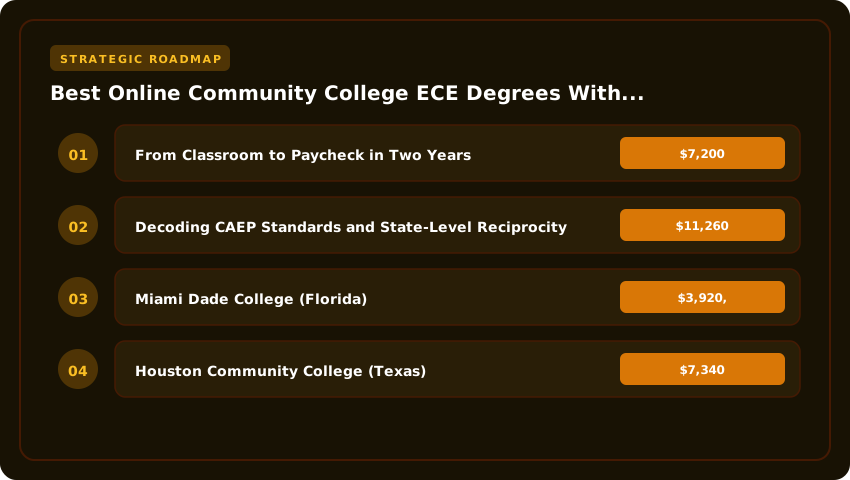
Tuition numbers tell the story. According to the College Board, the average in-state tuition at a public four-year university runs roughly $11,260 per academic year for the 2024-2025 cycle. Compare that to the average community college tuition of about $3,920, and you are looking at a baseline savings of $7,340 annually, right in line with the $7,200 figure cited across state articulation compacts. Multiply that across two years, and you bank over $14,000 before you ever transfer. Out-of-state students and those eyeing private or Ivy League-adjacent ECE programs can save even more, since those tuition tags routinely exceed $40,000 per year. By completing your general education core and lower-division ECE coursework through a regionally accredited community college, you sidestep inflated textbook markups, campus housing fees, and mandatory meal plans.
From Classroom to Paycheck in Two Years
An Associate degree does far more than trim tuition. It qualifies you for state-issued paraprofessional certificates, the credentials public schools actually require for teacher assistants and Title I aides. Many states also align their AA in ECE curriculum with Head Start employment standards, meaning you can apply for paid preschool positions while still finishing your final credits. The U.S. Bureau of Labor Statistics reports that preschool teachers earn a median annual wage of $37,130, while teaching assistants average $33,000. These are real salaries that let you fund the remaining two years of your bachelor’s degree with minimal or zero loan debt.
Stackable Credentials: The Accelerated Route to Lead Teacher
Here is the career acceleration logic. Community college ECE programs are deliberately designed as stackable credentials. You earn your AA, layer on a state paraprofessional certificate, add a Child Development Associate (CDA) credential recognized by the Council for Professional Recognition, and suddenly you are a competitive candidate for lead preschool teacher roles well before finishing a bachelor’s. When you do transfer, universities like those in the SUNY, CUNY, California State, and University of Texas systems accept your full 60 credits, so you enter as a junior. Many articulation agreements even guarantee admission to competitive education programs if you maintain a 2.5 GPA. That is the smartest first step in 2025: protect your wallet, start earning, and keep every door open to a state university or elite four-year program.
CAEP and NAEYC Accreditation: Separating Legitimate Online Programs From Diploma Mills
Choosing an online Early Childhood Education (ECE) associate degree requires more than a slick website or a “tuition-too-good-to-be-true” pitch. The right accreditation acts as your passport to federal financial aid, seamless credit transfer, and a teaching license recognized in all 50 states. The wrong one leaves you holding expensive paper that leads nowhere. Here is how to read the fine print and spot a legitimate program before you fill out the FAFSA.
Decoding CAEP Standards and State-Level Reciprocity
The Council for the Accreditation of Educator Preparation (CAEP) is the gold-standard gatekeeper for teacher-preparation programs in the United States. CAEP accreditation confirms that a program has been peer-reviewed against rigorous evidence-based standards covering curriculum rigor, clinical placements, candidate competency, and continuous improvement. For an online ECE associate degree that targets transfer, CAEP alignment matters because most four-year Bachelor of Education programs will only accept credits from CAEP-accredited institutions or from providers working under a state-approved CAEP review framework.
State-level reciprocity multiplies that value. States operating under the National Association of State Directors of Teacher Education and Certification (NASDTEC) Interstate Agreement recognize equivalent educator-preparation standards, which means CAEP-accredited coursework generally transfers cleanly across member states. Before enrolling, cross-check the institution on the U.S. Department of Education’s Database of Accredited Postsecondary Institutions and Programs (DAPIP) and confirm your home state’s department of education website lists the program as approved.
Why NAEYC-Aligned Coursework Guarantees Smooth Credit Transfer
The National Association for the Education of Young Children (NAEYC) publishes the professional standards that define what an early childhood educator must know and be able to do. Community colleges that map their associate-level courses directly to NAEYC standards deliver content four-year universities already trust: child development, observation and assessment, family engagement, and developmentally appropriate practice. This alignment eliminates credit loss during articulation because receiving institutions have already built transfer guides around those exact competencies.
Practical tip: request the program’s “NAEYC crosswalk” document. Legitimate providers publish it openly. If the admissions office cannot show you how a specific course like “Child, Family, and Community” maps to a bachelor’s-level equivalent, consider it a warning sign.
Regional Accreditation Requirements: SACSCOC, HLC, MSCHE, and WSCUC
Beyond CAEP and NAEYC, the institution itself must hold regional accreditation. This is the layer that unlocks Title IV federal financial aid and guarantees your credits will transfer to other regionally accredited universities. The four agencies to verify:
- SACSCOC (Southern Association of Colleges and Schools Commission on Colleges) — covers Alabama, Florida, Georgia, Texas, and the rest of the Southeast.
- HLC (Higher Learning Commission) — serves the Midwest and states like Colorado, Missouri, and Minnesota.
- MSCHE (Middle States Commission on Higher Education) — accredits institutions across New York, Pennsylvania, and the Mid-Atlantic.
- WSCUC (WASC Senior College and University Commission) — oversees California, Hawaii, and Pacific territories.
Verification takes under five minutes. Search your prospective college in the Council for Higher Education Accreditation (CHEA) directory and the federal DAPIP database. A match across both, combined with CAEP or NAEYC-aligned coursework and a published articulation agreement with your target four-year university, is your green light. Missing any one of those four layers is your cue to walk away and keep shopping.
Top-Ranked US Community Colleges Offering Fully Online AA and AS in Early Childhood Education
Choosing where to begin your Early Childhood Education (ECE) journey can feel overwhelming, but a handful of community colleges have separated themselves from the pack with rock-solid online coursework, generous transfer pipelines, and accreditation recognized by the U.S. Department of Education. The six institutions below represent the most vetted, geographically diverse roster available today, each enrolling more than 15,000 students annually and maintaining full distance-learning infrastructure built for working adults balancing shift work, parenting, and tuition bills under $5,000 per year.
Miami Dade College (Florida)
The Associate in Science in Early Childhood Education at Miami Dade College (MDC) is a flagship online program serving more than 4,000 ECE majors across the state. Through a 2+2 articulation agreement with Florida International University (FIU), graduates are guaranteed admission into FIU’s Bachelor of Science in Early Childhood Education once they finish with a 2.5 GPA and pass the state-mandated Educator Preparation Institute checkpoints. MDC also waives the application fee for transfer students and locks in tuition at roughly $112 per credit hour for Florida residents, keeping the entire associate degree near $3,400 before financial aid.
Houston Community College (Texas)
Houston Community College (HCC) delivers a fully asynchronous AS in Early Childhood Education that stacks the Texas Paraprofessional Certificate directly into the degree plan. HCC maintains formal transfer compacts with the University of Houston-Downtown (UHD) and Texas A&M University-Commerce, both of which accept 60+ credit hours and admit HCC graduates with junior standing. Texas residents pay around $95 per credit hour, and the average learner finishes in just five semesters while earning $18 to $22 per hour as a Head Start assistant teacher.
Northern Virginia Community College (Virginia)
Northern Virginia Community College (NOVA) is the largest community college in the Commonwealth and offers an Associate of Applied Science in Early Childhood Development entirely online. Through the Virginia Community College System (VCCS) Guaranteed Admissions Agreements, NOVA graduates transfer seamlessly into George Mason University’s College of Education and Human Development, as well as Old Dominion University’s online BS in Early Childhood Education. NOVA also covers Child Development Associate (CDA) credentialing fees for students who complete Practicum I, an uncommon perk that saves roughly $425 out of pocket.
Ivy Tech Community College (Indiana)
Ivy Tech, Indiana’s statewide community college system, hosts a Transfer Single Articulation Pathway (TSAP) in Early Childhood Education that guarantees admission into any public four-year institution in the state, including Indiana University and Purdue University Fort Wayne. The 60-credit AS degree is delivered through Ivy Tech Online with eight-week course formats, tuition that hovers near $170 per credit for state residents, and embedded Praxis Core preparation modules.
Pikes Peak State College (Colorado)
Pikes Peak State College in Colorado Springs offers an Associate of Arts in Early Childhood Education with concentrations in Infant-Toddler or Administration. The school is part of the statewide gtPathways guarantee, meaning every credit transfers to any Colorado public university, including the University of Colorado Denver and Colorado State University-Pueblo. Tuition for Colorado residents is approximately $251 per credit hour, and the program folds in the Colorado Early Childhood Education credential at no extra cost.
Pasadena City College (California)
Pasadena City College (PCC) rounds out the roster with an Associate of Science in Child and Family Development offered entirely online. PCC maintains transfer priority agreements with Cal State Los Angeles, Cal State Northridge, and Azusa Pacific University, all of which reserve seats for PCC graduates completing the California Community College Associate Degree for Transfer (ADT). California residents pay just $46 per credit, making PCC the most budget-friendly option on this list.
- Miami Dade College — FIU articulation, $112/credit, Florida residents.
- Houston Community College — UHD and Texas A&M pipelines, $95/credit.
- Northern Virginia Community College — Mason and ODU guarantees, CDA fees covered.
- Ivy Tech Community College — Statewide TSAP, $170/credit, Indiana residents.
- Pikes Peak State College — gtPathways transfer, embedded state credential.
- Pasadena City College — Cal State ADT pathways, $46/credit, lowest tuition.
Decoding Articulation Agreements: How to Lock In Your Junior-Year Standing at a Four-Year University
Navigating the red tape between a two-year and four-year institution can feel like trying to solve a Rubik’s Cube blindfolded, but it does not have to be that complicated. Articulation agreements are formal partnerships between community colleges and universities designed to guarantee your credits transfer smoothly, saving you both time and tuition dollars. When you enroll in an Early Childhood Education (ECE) program that has a direct pathway, you are essentially purchasing a VIP ticket to junior-year standing at a participating four-year school. Think of it as a prenuptial agreement for your academic career: the terms are negotiated, signed, and waiting for you to claim them.
Step-by-Step Breakdown of TAGs and Universal Transfer Pathways
A Transfer Admission Guarantee (TAG) is a contractual promise from a university that admits you as a junior the moment you meet specific benchmarks, such as earning an Associate degree, maintaining a minimum GPA (usually 2.0 to 2.5 for ECE programs), and completing required coursework. The University of California (UC) and California State University (CSU) systems popularized these guarantees, but you will find similar Universal Transfer Pathways in Texas (through the Field of Study curriculum), Florida (the 2+2 pathway), and New York (the SUNY Transfer Path).
- Step 1: Verify the target university has an active articulation agreement with your specific community college before registering for classes.
- Step 2: Complete the prescribed general education core and ECE foundational courses, which typically include child development, observation, and curriculum planning.
- Step 3: File the TAG petition between September 1st and September 30th of the academic year preceding transfer, usually one year ahead of your intended start date.
- Step 4: Earn your AA or Associate of Applied Science (AAS) and submit official transcripts through the centralized application, such as the UC application or CSU Mentor.
The Role of the Transfer Credit Evaluation System (TES) in Converting ECE Practicum Hours
Unlike traditional lectures, ECE degrees require hands-on practicum hours in real classrooms, which often triggers anxiety during transfer evaluations. The Transfer Credit Evaluation System (TES) acts as the translator, converting your community college practicum into upper-division field experience credits at the receiving university. Most accredited online programs align with standards set by the National Council for Accreditation of Teacher Education (NCATE) or the Council for the Accreditation of Educator Preparation (CAEP), ensuring your practicum hours translate into at least 90 to 120 hours of early field experience credit. Without TES alignment, you risk losing those valuable hours, which translates to roughly $2,500 in retaken coursework based on average in-state tuition rates.
Case Study: Transferring an AA from a California Community College to a UC or CSU Campus
Consider Maria, a working preschool teacher in Los Angeles earning her AA in ECE at Pasadena City College. By following the Associate Degree for Transfer (ADT) pathway in Early Childhood Education, Maria locks in guaranteed admission to a CSU campus, such as CSU Northridge, with junior-year standing. Because her coursework aligns with the C-ID (Course Identification Number) descriptor, the receiving university cannot force her to retake introduction to curriculum or child development classes. Maria completes her bachelor’s online while working full-time, avoiding an additional $28,000 in tuition that out-of-state or private options would cost. Her total annual salary as a lead teacher post-graduation climbs to a median of $48,840, according to the U.S. Bureau of Labor Statistics, proving that a smart transfer plan is both an academic and financial upgrade.
US Teacher Salary Schedules: The Real ROI of an Articulated Bachelor’s Degree
Let’s talk dollars, because passion for early literacy only pays the bills if your degree actually moves the needle on your paycheck. Across the US public school system, the Bureau of Labor Statistics (BLS) consistently shows that educators holding a Bachelor of Arts in Early Childhood Education (ECE) or Elementary Education earn an average of $14,500 more per year than their counterparts working with an associate degree. That gap widens every single year you stay in the classroom, and over a 25-year career, it compounds into a staggering $360,000+ differential before you even factor in pension contributions and step increases negotiated by unions like the National Education Association (NEA).
The math gets even more interesting when you zoom into Payscale salary data for specific early childhood roles. Preschool teachers across major US metro areas like Houston, Phoenix, and Atlanta typically earn between $32,000 and $42,000 annually. Jump to a public kindergarten classroom, and that range jumps to $45,000 to $65,000 depending on district cost-of-living adjustments and Title I funding allocations. The difference isn’t just a title change; it reflects state-mandated teacher salary schedules that almost universally require a bachelor’s degree for initial state licensure through the Department of Education.
Beyond base pay, the real ROI unlocks through state-by-state stipend incentives designed to address critical teacher shortages. Bilingual educators fluent in Spanish, Mandarin, or American Sign Language (ASL) can pocket an extra $3,000 to $7,500 annually in districts from California to Florida, a direct response to the US Department of Education’s emphasis on Emergent Multilingual Learners (EMLs). Early literacy specialists, particularly those trained in structured phonics frameworks like LETRS or Orton-Gillingham, frequently qualify for additional state-funded stipends ranging from $2,500 to $5,000 per year, especially in states like Mississippi, Tennessee, and North Carolina where reading proficiency scores have triggered legislative action.
For working professionals eyeing upskilling, the trajectory is clear: start with your online Associate of Arts (AA) in ECE, transfer seamlessly into an ABET or regionally accredited bachelor’s program, and position yourself for the highest tiers of public school pay scales. Add a bilingual endorsement or a reading specialist micro-credential to your stack, and you are not just earning a paycheck; you are maximizing lifetime earning potential while meeting the demands of a rapidly evolving US education landscape. The four-year investment is not just academic; it is the single most reliable lever for long-term financial growth in this profession.
- Average annual pay differential between an associate degree and a bachelor’s degree in ECE: $14,500 (BLS).
- Payscale preschool teacher salary range across US metros: $32,000 to $42,000.
- Payscale public kindergarten teacher salary range: $45,000 to $65,000.
- Bilingual educator state stipends: $3,000 to $7,500 per year depending on district.
- Early literacy specialist stipends in shortage states: $2,500 to $5,000 annually.
Funding Your Online ECE Degree: FAFSA, Pell Grants, and Workforce Innovation Grants
Paying for an online Early Childhood Education (ECE) degree does not have to drain your bank account. Because most community college programs charge between $120 and $180 per credit hour for in-district students, a full 60-credit associate degree can cost as little as $3,800 in tuition before aid is applied. The smartest working adults layer federal, state, and employer dollars on top of one another so they graduate with little to no debt. Below is the exact playbook for doing exactly that in the U.S. market today.
Maximizing the Federal Pell Grant and SEOG Funds as a Distance Learner
The Federal Pell Grant remains the single largest source of free money for low- and middle-income students. For the 2025-26 award year, the maximum Pell is $7,395 per academic year, and the U.S. Department of Education now allows you to count it toward a certificate, a diploma, an Associate of Arts (AA), or a Bachelor’s degree. Submitting the FAFSA (Free Application for Federal Student Aid) at studentaid.gov is the only requirement. File it by your state’s priority deadline, usually March 1, to keep state grants intact.
After Pell, turn to the Federal Supplemental Educational Opportunity Grant (SEOG), which awards an extra $100 to $4,000 per year to students with the highest need. Because SEOG funding is limited, submit your FAFSA early, confirm your enrollment status with the financial aid office, and ask whether your distance learning courses count as full-time. Most accredited online programs report the same credit loads as on-campus sections, so 12 semester credits usually triggers the maximum grant.
State-Specific Scholarships: TEACH Grant and T.E.A.C.H. Early Childhood
The Teacher Education Assistance for College and Higher Education (TEACH) Grant provides up to $4,000 per year for future teachers who commit to four years of service in a high-need field, and ECE qualifies in nearly every state. You must maintain a 3.25 GPA and complete TEACH Grant counseling each year, so track your grades carefully. Pair this with the T.E.A.C.H. Early Childhood scholarship program, a state-administered award that pays tuition, books, and even release time for working staff at licensed child care centers. Awards average $1,500 to $6,000 per semester depending on your state’s contract with the Child Care Services Association.
Employer Tuition Reimbursement at Major Child Care Operators
If you are already working in the field, your employer is likely your most under-used funding source.
- Bright Horizons offers the Bright Horizons Family Solutions Tuition Reimbursement Program, covering 60-100% of tuition for staff pursuing an ECE degree, plus a salary bump tied to credential completion.
- KinderCare Education reimburses up to $5,250 per year (the IRS tax-free limit) through its College Coach benefit, which partners with Brandman University and Western Governors University for seamless credit transfer.
- Head Start and Early Head Start grantees funded through the U.S. Administration for Children and Families typically maintain a Staff Development budget that pays 100% of tuition for staff working toward an AA or BA in Early Childhood Education.
Stack these employer dollars with Pell, SEOG, TEACH, and T.E.A.C.H., and many working adults finish a two-year associate degree for less than $500 out of pocket, then roll seamlessly into a four-year university with their transfer credits fully intact.
Enrollment Strategy: Maintaining Full-Time Status While Balancing Work and Online Study
Balancing a paycheck, a practicum, and a 60-credit AA degree might sound like a three-ring circus, but thousands of working paraprofessionals pull it off every semester. The secret lies less in willpower and more in how you structure your course load, choose your class formats, and leverage the digital tools your college already provides. For adult learners juggling childcare drop-offs and 40-hour workweeks, a deliberate enrollment strategy transforms an online Early Childhood Education (ECE) degree from a constant source of stress into a predictable, ladder-climbing credential.
Asynchronous vs. Synchronous: Picking the Format That Fits Your Shift
Most community colleges now offer two flavors of online instruction, and knowing the difference protects your sanity.
- Asynchronous courses let you log in, watch recorded lectures, and submit discussion posts on your own schedule. For night-shift childcare workers or parents managing school pickups, this flexibility is non-negotiable. The trade-off is that you must be self-directed; missing a self-imposed deadline is the same as missing a real one.
- Synchronous courses stream live via Zoom or Microsoft Teams on specific evenings. These sessions simulate a real classroom, offer instant Q&A with instructors, and often double as networking time with cohort peers who are also balancing jobs. If your employer can guarantee a consistent weekday evening off, synchronous classes provide the structure many adult learners crave.
A practical hybrid strategy is common: stack asynchronous general-education classes (English, math, psychology) during heavy work weeks, and reserve synchronous ECE core courses (child development, curriculum planning) for lighter stretches.
Mapping 60 Credits to 24 Months Without Burning Out
Finishing an Associate of Arts in two years while working full-time typically means enrolling in 12 to 15 credits per semester, including a summer term. Map your degree audit early using your college’s transfer pathway, and front-load general-education requirements so your final semesters focus on practicum-heavy ECE courses when your energy is best spent in classrooms. Many advisors recommend clustering two short 8-week sessions back-to-back rather than juggling three 16-week classes simultaneously; this focused sprint model reduces context-switching and helps you maintain the full-time status required for most financial aid disbursements.
Digital Classrooms, Proctored Exams, and ADA Support
Expect to live inside a learning management system like Canvas, Blackboard, or Brightspace. These platforms centralize assignments, video lectures, and gradebooks, but they also house critical compliance features. Most programs use remote proctoring services such as ProctorU or Honorlock, which monitor your webcam during midterm and final exams. Test these systems before exam week; slow internet or missing a required browser extension can derail an entire semester.
If you have a documented disability, file your accommodation request with the college’s Disability Services office the moment you accept admission. Under the Americans with Disabilities Act (ADA) and Section 504, approved accommodations can include extended exam time, screen-reader compatibility, captioning for recorded lectures, and flexible practicum scheduling. Submitting documentation early ensures your accommodations are wired into the LMS from day one, rather than negotiated mid-crisis.
The bottom line is simple: a full-time online ECE student is not a part-time student in disguise. With the right format mix, a credit-mapped calendar, and proactive use of ADA and digital tools, you can protect both your paycheck and your degree progress without sacrificing fieldwork hours.
| Decision Criterion | Online AA in ECE (Community College) | On-Campus AA in ECE (Community College) | BS in ECE (4-Year University Direct) | Alternative: CDA Credential Only |
|---|---|---|---|---|
| Estimated Annual Tuition (US) | $3,500 – $5,000 | $4,200 – $6,500 | $18,000 – $40,000 | $500 – $1,200 (one-time) |
| Total Program Cost (2 years) | $7,000 – $10,000 | $8,400 – $13,000 | $72,000 – $160,000 | $500 – $1,200 |
| Time to Paid Classroom Role | 18 – 24 months | 18 – 24 months | 48 months | 3 – 6 months |
| Transfer Credit Acceptance | High (articulated agreements with most state 4-year universities) | High (articulated agreements) | N/A (terminal) | Low (elective credit only) |
| Median US Starting Salary | $28,000 – $34,000 (paraprofessional) | $28,000 – $34,000 | $40,000 – $48,000 (lead teacher) | $24,000 – $30,000 (assistant) |
| Admission Cutoff / GPA | Open enrollment; minimum 2.0 GPA | Open enrollment; minimum 2.0 GPA | 2.5 – 3.0 GPA minimum | None (competency-based) |
| Prerequisites | High school diploma or GED; background check | High school diploma or GED; background check | SAT/ACT (some schools test-optional); essays | High school diploma; 480 hours of experience |
| Stackable Certifications | AA + state paraprofessional + Head Start credentials | AA + state paraprofessional + Head Start credentials | BA + state teaching license (Pre-K-3) | CDA + limited state recognition |
| ROI (Salary ÷ Cost) | ~6.8x per year | ~5.2x per year | ~0.3x per year (year 1) | ~25x (fastest payback) |
| Flexibility | Full-time work compatible; async coursework | Fixed class schedule | Moderate; practicum hours required | Self-paced |
Frequently Asked Questions
What is the cheapest online associate degree in Early Childhood Education with direct transfer to a 4-year university?
The cheapest accredited online AA in ECE programs charge between $3,500 and $5,000 per year for in-state tuition. Community colleges like Pasadena City College and Great Basin College credit all 60 credits toward bachelor's degree articulation agreements, saving US students roughly $7,200 annually compared to public four-year ECE degrees.
How long does it take to get an online Early Childhood Education associate degree in the US?
Most accredited US community colleges deliver an online Associate of Arts in Early Childhood Education in 18 to 24 months of full-time study. Accelerated 12-month tracks exist at schools like Tidewater Community College, and part-time learners can stretch coursework to three years while continuing paid paraprofessional work.
Can I transfer an online community college ECE associate degree to a state university for a bachelor's?
Yes. Statewide articulation agreements in California (ADT), Florida (2+2), Texas (Field of Study), and New York (SUNY Transfer Paths) guarantee that all 60 community college credits transfer toward a bachelor's in Early Childhood Education at participating public universities, provided students earn a minimum 2.0 GPA.
What salary can I earn with an associate degree in Early Childhood Education in the US?
US paraprofessionals with an AA in Early Childhood Education earn a median salary of $28,000 to $34,000 annually. Head Start teachers with stacked credentials average $35,000, while graduates who later finish a bachelor's degree transition to lead Pre-K teacher roles paying $40,000 to $48,000 per year.
Is an online AA in Early Childhood Education accredited and accepted by employers in 2025?
Yes. Online AA degrees from regionally accredited community colleges, such as those holding Higher Learning Commission or SACSCOC accreditation, satisfy Head Start Act Section 648A requirements and qualify graduates for state paraprofessional credentials accepted by public school districts nationwide in 2025.
Strategic Final Takeaway
When evaluating Best Online Community College Early Childhood Education Degree With Articulation To Four Year University, base your decisions on accredited institutional standards, measurable return on investment (ROI), and up-to-date official guidelines. Always verify specific dates and requirements through official regulatory portals.