

How US Employers Actually View an Associate Degree in Early Childhood Education
Let’s be honest: the way a hiring manager in a Head Start office views your Associate degree is not the same as how a public school principal or a corporate preschool chain recruiter sees it. That nuance matters more than any glossy brochure from a community college will tell you.

Head Start programs are where the Associate in Early Childhood Education earns its highest return on investment. Because Head Start is federally funded through the US Department of Health and Human Services, the program must comply with the Head Start Act, which mandates that at least 50% of classroom staff hold a minimum of an Associate degree in Early Childhood Education or a related field. Translation: your two-year credential is not just accepted, it is often the baseline for employment. Salaries in this sector typically range from $31,000 to $38,000 annually, with benefits that frequently outpace the private market.
Private preschools and childcare centers tell a more mixed story. Large corporate chains (think Bright Horizons, KinderCare, and Primrose Schools) actively recruit Associate degree holders because the credential meets state licensing requirements for lead teacher positions in most states. However, pay scales vary dramatically, with the BLS reporting a median wage of $33,820 for preschool teachers nationally as of May 2023. Smaller, boutique preschools may prefer candidates with a Bachelor’s or even a Child Development Associate (CDA) credential if they are paying above-market wages in affluent suburbs.
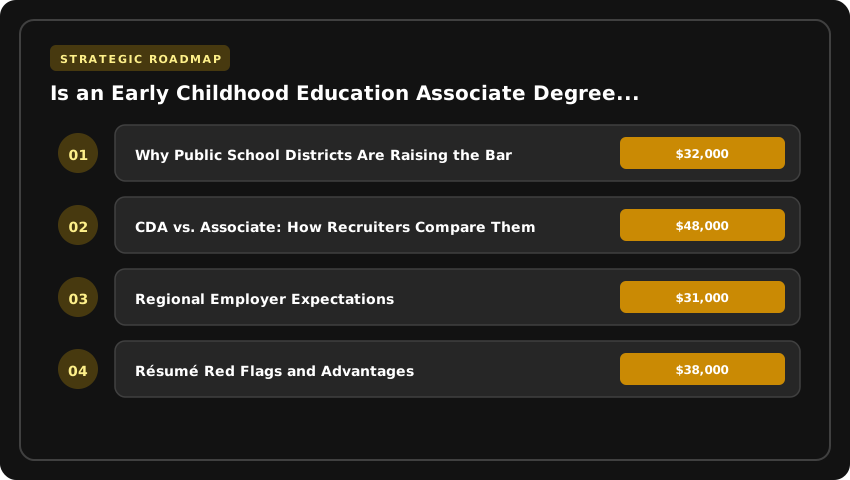
Why Public School Districts Are Raising the Bar
If your career goal is a lead Pre-K teacher position inside a public K-3 district, you will hit a ceiling quickly. Public Pre-K programs funded through state legislatures (think Georgia’s Pre-K Program, Florida’s Voluntary Prekindergarten, or California’s TK expansion) increasingly require a Bachelor’s degree in Early Childhood Education, Elementary Education, or Child Development for lead teachers. Associate degree holders are often hired as paraprofessionals or teaching assistants, with salaries ranging from $28,000 to $35,000 rather than the $48,000 to $65,000 a credentialed lead teacher commands.
CDA vs. Associate: How Recruiters Compare Them
The Child Development Associate (CDA) credential, awarded by the Council for Professional Recognition, is a 120-hour competency-based certification that takes 9-12 months to complete and costs roughly $1,500-$3,000 total. Many employers view it as equivalent to, or slightly below, an Associate degree for entry-level roles. However, the Associate typically wins out for advancement opportunities, because most state childcare licensing regulations treat the CDA as a stepping stone toward the Associate, not a substitute.
Regional Employer Expectations
Geography shapes acceptance more than most students realize:
- The South (Texas, Georgia, Florida, North Carolina) is the strongest market for Associate degree holders, with state-funded Pre-K expansion driving consistent demand.
- The Midwest tends to favor Bachelor’s-prepared teachers, particularly in Illinois, Michigan, and Ohio, though Head Start remains a reliable employer.
- The West Coast (California, Washington, Oregon) shows the strictest Bachelor’s preference, driven by higher unionization and stricter Title 22 licensing requirements.
Résumé Red Flags and Advantages
From a recruiter’s perspective, Associate degree holders should avoid listing themselves as “lead teacher qualified” on a résumé when applying to public district roles, that signals a mismatch that lands applications in the reject pile fast. Instead, emphasize your practicum hours, your CDA if you hold one, your state-specific childcare credentials, and any bilingual proficiency. These details move Associate degree holders from “meets minimum” to “interview-ready” in the eyes of hiring managers across the $34,000-$42,000 ECE job market.
Community College vs. For-Profit ECE Programs: Accreditation That Employers Trust
Walk into any public preschool interview in the US, and the first thing a hiring committee checks is not your GPA. It is the name of your school and whether the National Association for the Education of Young Children (NAEYC) has accredited its Early Childhood Education program. Because the NAEYC seal is voluntary and tough to earn, it signals to directors that your coursework covered child development theory, curriculum design, and supervised practicum hours at a level non-accredited alternatives rarely match. When you compare a community college ECE track against a glossy for-profit diploma, this single credential often determines who gets the callback and who gets passed over.
Regionally Accredited 2-Year Programs vs. Non-Accredited Alternatives
Regional accreditation, granted by one of six bodies recognized by the US Department of Education (such as SACSCOC or HLC), is the baseline standard every hiring manager expects. A regionally accredited community college degree transfers cleanly to state universities, qualifies for Title IV federal financial aid, and is accepted by every public school district. Many for-profit ECE programs hold only national or programmatic accreditation, which can fail to satisfy state licensing boards or four-year transfer pathways. Before you enroll, search your school’s name in the Council for Higher Education Accreditation (CHEA) database and confirm NAEYC alignment. That ten-minute check can save you two years of unusable credits.
Transfer Pathways That Convert an Associate Into a Teaching License
Most states have formal articulation agreements that allow Associate of Applied Science (AAS) or Associate of Arts (AA) holders in ECE to transfer as juniors into bachelor’s programs in Elementary Education or Early Childhood Special Education. In Texas, the Field of Study curriculum guarantees credit acceptance at all public universities. In Florida, the 2+2 pathway does the same. These agreements are critical if you plan to earn a state teaching license, which almost always requires a Bachelor’s plus completion of a state-approved educator preparation track. Without an articulation contract, you risk losing 30 to 60 credits when you transfer.
Hidden Costs and Financial Aid Eligibility
Community college tuition for an in-district ECE associate typically runs $3,500 to $5,500 per year, and FAFSA Pell Grants can cover a large portion for low-income students. For-profit ECE programs often charge $15,000 to $30,000 for a comparable credential, with shorter financial aid windows. Watch for hidden fees: background checks, fingerprinting for practicum placement, and mandatory technology bundles can quietly add $500 to $1,200. Accredited community colleges disclose them in the net-price calculator on their website, which is required by federal law.
State-by-State Articulation Agreements That Protect Your Credit Hours
- California: The Early Childhood Education AS-T guarantees CSU admission as a junior.
- New York: SUNY’s Transfer Path locks in credit acceptance across 64 campuses.
- Illinois: The Illinois Articulation Initiative (IAI) ensures general education credits transfer statewide.
- Ohio: The Ohio Transfer Module plus TAG (Transfer Assurance Guide) locks ECE coursework into public universities.
Bottom line, picking a regionally accredited, NAEYC-aligned community college program protects your wallet, your transcript, and your career trajectory in ways that for-profit alternatives simply cannot match in the current US hiring market.
2025 Salary Outcomes for Associate-Level Childcare Workers Across US States
Let’s talk dollars, because a degree program only makes sense when the math works. According to the latest Bureau of Labor Statistics (BLS) Occupational Employment and Wage Statistics, preschool teachers nationally pull a median wage of about $37,120 per year, which translates to roughly $17.85 an hour. Childcare workers, by contrast, sit noticeably lower at around $32,050 annually, or about $15.41 hourly. That gap matters because an Associate of Applied Science (AAS) in Early Childhood Education (ECE) typically qualifies you for both job families, but the preschool teacher track is where your two-year credential gets real traction. Without that Associate, many candidates cap out at the lower childcare worker band.
Geography changes the picture dramatically. In California, preschool teacher median pay climbs to roughly $45,880, and metro areas like San Jose and San Francisco push well past $55,000 thanks to strong union representation and costly-of-living adjustments. Texas, particularly Houston and Dallas-Fort Worth, hovers around $34,500 to $36,200 for preschool roles, while Austin is emerging as a standout with competitive early childhood programs and median wages closer to $38,400. New York State sits at approximately $44,610, with New York City districts and private centers frequently posting $48,000 to $52,000 for credentialed lead teachers. Florida lands in the $33,000 to $35,000 range, though Miami-Dade and Broward counties often exceed that thanks to growing pre-K expansion funding.
Where Metropolitan Markets Reward Your Associate
Chicago stands out as a prime example of how urban markets boost associate-level earnings. The BLS reports Chicago-area preschool teachers earning a median of $42,760, with many center-based postings from large providers like Bright Horizons and Chicago Public Schools’ network offering $45,000 to $50,000 plus benefits. Austin mirrors that trajectory, where a booming tech-driven population has created demand for high-quality early learning programs, pushing wages roughly 8% above the Texas state average. If you’re weighing where to plant your career post-graduation, these metros typically reward your credential more aggressively than rural counties.
The Paraprofessional Alternative Worth Considering
Here’s a career path many students overlook: public school paraprofessional roles. Districts across the US, from Los Angeles Unified to Houston ISD to the New York City Department of Education, hire instructional aides and pre-K paraprofessionals with as little as an Associate degree, plus passing a paraprofessional assessment. Pay scales generally range from $28,000 to $38,000 annually depending on district, with collective bargaining in places like Chicago Public Schools pushing starting salaries toward $36,500 plus pension contributions. It’s a practical bridge if you plan to pursue a Bachelor’s later, and many districts offer tuition reimbursement that can ease the financial lift.
The Credential Hierarchy in Real Earnings
The hourly earnings gap between credential levels is stark and worth memorizing. A CDA (Child Development Associate) credential alone typically maxes out around $14 to $16 an hour in most markets, roughly $29,000 to $33,000 annually. Adding an Associate degree bumps you into the $17 to $21 hourly band, equating to $35,000 to $44,000 per year. A Bachelor’s in ECE or Child Development pushes median earnings to $22 to $28 an hour, or $46,000 to $58,000 annually, especially in Head Start leadership roles and public school PreK classrooms. The real ROI calculation? An Associate costing roughly $8,000 to $15,000 in community college tuition can deliver a 20% to 35% wage premium over CDA-only peers within the first year of employment, making it one of the faster-paying credentials in the professional upskilling space.
State Licensing Rules That Determine Whether Your Associate Degree Qualifies You to Teach
If you are weighing whether an Associate degree in Early Childhood Education (ECE) is worth the roughly $8,000–$12,000 community college investment, the honest truth is this: your zip code matters more than your diploma. The United States has no single federal mandate for early educators, so licensing authority sits with each state’s Department of Education or Department of Human Services. That patchwork creates dramatically different career ceilings for the exact same credential.
States Where an Associate Degree Satisfies Lead Teacher Licensing
Dozens of states still allow an Associate of Applied Science (AAS) or Associate of Arts (AA) in Early Childhood Education to satisfy lead teacher requirements in licensed childcare centers and many private preschool settings. Texas, Florida, and Pennsylvania, for example, classify an Associate degree plus documented field hours as meeting the “qualified lead teacher” threshold under their child care licensing rules. In these markets, you can expect starting salaries of about $31,000–$36,000 per year, per Bureau of Labor Statistics (BLS) data for preschool teachers, and immediate eligibility to count toward staff-child ratios in regulated classrooms.
States Mandating a Bachelor’s for Publicly Funded Pre-K
The picture changes sharply once public funding enters the room. Massachusetts, Oklahoma, and New Jersey require a Bachelor’s degree in ECE or a related field for lead teachers in state-funded pre-K classrooms. Georgia’s Pre-K program and New York City public pre-K expansion similarly default to a Bachelor’s. If your goal is a public school paycheck averaging $45,000–$55,000, an Associate alone will stall your application, and many districts will not count it toward a “highly qualified” designation under the Every Student Succeeds Act (ESSA) reporting standards.
Compensation Incentives Tied to Degree Level
Federal policy amplifies these gaps through the Child Care and Development Block Grant (CCDBG). States receiving CCDBG funds must establish career pathways that reward higher credentials with higher subsidy reimbursement rates. States like North Carolina issue $750–$1,500 annual supplements, plus tiered reimbursement bumps, to teachers who upgrade from a Level I (CDA) to a Level II (Associate) or Level III (Bachelor’s) on the Early Childhood Credentials chart. Your Associate degree can literally raise your hourly wage by $1–$3 per hour depending on the state’s reimbursement tier.
Background Checks and Practicum Hour Variability
Expect uneven requirements on the supporting requirements, too.
- Fingerprinting and background checks are universal, but FBI-channel livescan is mandatory only in 18 states.
- Practicum hours range from 120 clock hours in California community college ECE programs to 480 hours in Vermont-approved programs.
- CPR/First Aid certification is required in 39 states before a lead teacher can be alone with children.
- Mandated reporter training must be renewed every 1–3 years depending on the state.
Reciprocity Challenges When Moving Across State Lines
Finally, plan for reciprocity friction. ECE licenses transfer poorly across state lines because no compact agreement exists, unlike nursing’s NLC. A licensed lead teacher in Pennsylvania moving to Colorado may need to complete additional coursework, a new background check, and a state-specific orientation module, adding 3–12 months and $200–$800 in fees. If relocation is on your horizon, research the destination state’s ECE credentialing catalog through its Department of Education website before accepting a job offer, so your Associate degree does not quietly downgrade to “assistant teacher” the moment you cross state borders.
FAFSA, Pell Grants, and Tuition Costs for a 2-Year ECE Degree at US Community Colleges
Financing a two-year Early Childhood Education (ECE) associate degree at a US community college remains one of the most affordable onramps into the childcare workforce, but the sticker price varies wildly depending on where you live and whether you carry in-district residency. According to the College Board, the average in-district tuition and fees at a public two-year college runs roughly $3,800 per year, while out-of-state students often pay $8,000 to $11,000 annually for the same coursework. Add another $1,400 for textbooks and supplies, and a complete 60-credit ECE associate typically lands between $7,600 (in-district) and $22,000 (out-of-state) before any aid is applied.
For low-income adult learners entering the field, the Federal Pell Grant is the single most powerful funding lever. Awarded through FAFSA, the maximum Pell for the 2025-26 award year reaches $7,395, which can effectively cover tuition for many in-district students with money remaining for books and childcare costs that often prevent adult learners from enrolling. Eligibility is determined by Expected Family Contribution (EFC) and Adjusted Gross Income; single parents working full-time at a $32,000 preschool wage frequently qualify for the full award. State-level supplementary grants, such as the California College Promise Grant or the New York Tuition Assistance Program (TAP), can stack on top of Pell to wipe out remaining balances.
The Workforce Innovation and Opportunity Act (WIOA) offers a second major pipeline, specifically routed through American Job Centers under the US Department of Labor. WIOA Title I funding is designed for adults facing barriers to employment, and childcare workers re-entering the workforce or upgrading credentials qualify under multiple eligible categories. Approved participants receive tuition coverage, required fees, and often stipends for books, uniforms, and state-mandated background checks. Because ECE is classified as a high-demand industry sector in most state workforce plans, WIOA approval rates for ECE associate seekers are notably high.
Large US childcare chains have also entered the tuition reimbursement arena. Bright Horizons, KinderCare Learning Companies, and Learning Care Group (the parent of Childtime and Tutor Time) now offer structured employer tuition assistance programs that reimburse 50% to 100% of approved ECE coursework for staff working a minimum of 25 to 30 hours weekly. These programs typically require a post-completion retention period of 12 to 24 months, but the net effect can reduce an employee’s out-of-pocket cost to zero while they continue earning a paycheck.
When stacked against a private four-year institution charging $30,000 to $55,000 annually for an Early Childhood Education bachelor’s track, the community college pathway routinely saves students $40,000 to $90,000 over the same credit volume. For budget-conscious adults pivoting into a stable, BLS-projected growth field, that math is hard to argue with, especially once Pell, WIOA, and employer reimbursement are layered into the calculation.
- In-district community college ECE total: roughly $7,600 for two years
- Out-of-state community college ECE total: roughly $18,000 to $22,000 for two years
- Private four-year ECE early start total: $60,000 to $110,000 for two years
- Maximum Federal Pell Grant (2025-26): up to $7,395 per academic year
- WIOA coverage: full tuition, fees, and books for eligible adults via American Job Centers
Career Mobility After the Associate Degree: Director, Special Education Aide, and Beyond
A two-year Early Childhood Education (ECE) associate is widely misunderstood as a terminal credential. In reality, the most ambitious graduates treat it as a strategic launchpad. The U.S. Bureau of Labor Statistics (BLS) reports that preschool teachers earn a median annual wage of around $37,000, but the same foundation can carry you into director roles averaging $52,000 to $65,000, paraprofessional positions with union-protected step increases, or even licensed family childcare businesses pulling six figures in high-demand metros. Mobility depends less on the diploma itself and more on how deliberately you stack credentials, experience, and licensing on top of it.
From Lead Teacher to Licensed Center Director
Most states allow educators with an associate degree plus documented field experience (often 2 to 5 years) to sit for the Child Development Associate (CDA) credential or a state-level director qualification. Pair those with 30 credit hours of approved administration coursework, and you become eligible to lead a licensed center. Nationally, center directors in for-profit chains earn $48,000 to $58,000, while nonprofit and Head Start directors in high-cost states like California, New York, and Massachusetts frequently clear $70,000. The BLS projects 8% growth for preschool and childcare center directors through 2032, faster than the 3% average across all occupations.
Transitioning into K-12 Paraprofessional Roles
Public school districts increasingly hire associate-degree holders as Title I paraprofessionals, special education aides, and ELL (English Language Learner) assistants. These roles typically start at $32,000 to $40,000 with strong union step-and-lane pay scales; in districts affiliated with National Education Association (NEA) or AFT locals, longevity raises can push annual pay above $55,000 without a bachelor’s. Title I paraprofessionals must also meet the federal “highly qualified” standard, which an ECE associate satisfies under the U.S. Department of Education’s ESSA (Every Student Succeeds Act) paraprofessional requirements.
Launching Into Social Work and Family Services
Many ECE graduates pivot into case management, child welfare, and family advocacy roles at agencies like ChildCare Aware, Catholic Charities, and state-run early intervention programs. An associate transfers cleanly into a Bachelor of Social Work (BSW), where you can step up to a licensed social worker (LSW) earning $48,000 to $60,000. Early intervention service coordinators, who work with infants and toddlers with developmental delays, often start at $45,000 with an associate plus the required credentialing hours.
Entrepreneurial Path: Licensed Home Daycare
States like Texas, Florida, Colorado, and Arizona maintain strong demand for licensed family childcare. Startup costs typically range from $5,000 to $15,000 (insurance, safety renovations, licensing fees, curriculum materials), and a licensed home provider caring for 6 to 8 children at $1,200 per month per slot can gross $86,000 to $115,000 annually, often netting $60,000+ after expenses. The associate degree satisfies state licensing requirements in most states and positions you for state-funded pre-K contracts worth $9,000 to $14,000 per enrolled child.
Bachelor’s Bridge: The 30-50% Salary Jump
Continuing education remains the highest-leverage move. An ECE associate transfers fully into a Bachelor of Early Childhood Education or Bachelor of Education at most Regionally Accredited institutions. Graduates with a bachelor’s and state certification earn $48,000 to $60,000 as lead public school pre-K teachers, a 30-50% jump over associate-level pay. For working adults, US Dept of Education-recognized competency-based programs (like those through Western Governors University or College Unbound) let you finish the bachelor’s in 12-18 months while staying employed. Filling out the FAFSA (Free Application for Federal Student Aid) each year unlocks Pell Grants up to $7,395 and subsidized loans that make the bridge financially manageable.
- Director track: $52K-$70K with associate + admin coursework + experience
- Paraprofessional: $32K-$55K with strong union step raises
- Family services: $45K-$60K after BSW credentialing
- Home daycare: $60K-$115K net in high-demand states
- Bachelor’s completion: 30-50% salary lift within 2 years
ABET, AACSB, and Other Accreditations: Which Ones Actually Matter for Early Childhood Careers
If you have been Googling accreditation while shopping for an Early Childhood Education (ECE) program, you have probably tripped across names like ABET and AACSB and wondered whether they matter. They do not, and confusing them with the right accreditors is one of the most common mistakes future ECE students make, often resulting in wasted FAFSA dollars or credentials that do not transfer.
Why ABET and AACSB Are the Wrong Accreditations to Look For
ABET accredits engineering, computing, and applied science programs, while AACSB accredits business and accounting degrees. Neither body evaluates teacher preparation, child development coursework, or practicum requirements. A two-year ECE program carrying an ABET or AACSB seal would be a red flag, signaling that the institution is mixing credentials or marketing outside its expertise. Instead, ECE programs fall under regional institutional accreditors (such as the Higher Learning Commission or SACSCOC) and specialized programmatic bodies that review teacher-preparation quality.
The Accreditations That Actually Apply to a 2-Year ECE Degree
Two credentials carry real weight in the US early childhood workforce. First, CAEP accreditation (Council for the Accreditation of Educator Preparation) signals that the program’s curriculum, faculty qualifications, and field experiences meet national teacher-preparation standards, a useful marker for transferability into a bachelor’s completion program. Second, state Department of Education approval is non-negotiable if you intend to teach in publicly funded Pre-K or earn a state teaching permit. Employers, especially Head Start grantees, verify this approval before hiring.
Beyond CAEP and state approval, look for NAEYC alignment. The National Association for the Education of Young Children does not formally accredit associate programs, but its standards shape Head Start, state Pre-K expansion grants, and many Quality Rating and Improvement Systems (QRIS). Programs that publish NAEYC-aligned competency maps make you a stronger candidate for federal- and state-funded classrooms.
Accreditation Signals That Matter for Federal and Military-Spouse Career Tracks
If you are a military spouse leveraging the MyCAA scholarship ($4,000 career-seeker cap) or pursuing federal childcare positions on installations, programmatic recognition from NAEYC, CAEP, or a state-approved Child Development Associate (CDA) pathway accelerates credential review under the Interstate Compact and OPM qualification standards. Regional accreditation alone is rarely enough for these fast-track federal pipelines.
Questions to Ask Admissions Advisors Before You Enroll
- Who is your regional institutional accreditor, and is the program currently in good standing?
- Is the ECE program CAEP-accredited or state DOE-approved for lead-teacher eligibility?
- Does the curriculum map explicitly to NAEYC standards for associate-level preparation?
- Will credits transfer under state articulation agreements toward a bachelor’s in ECE or Elementary Education?
- Is the practicum coordinated with a licensed QRIS-rated early learning site?
Asking these five questions upfront separates a marketable credential from a tuition receipt you cannot use.
| Decision Criterion | Associate Degree in ECE (AA/AAS) | Bachelor’s Degree in ECE (BS/BA) | Child Development Associate (CDA) Credential |
|---|---|---|---|
| Typical Program Length | 2 years (60 credit hours) | 4 years (120 credit hours) | 12–18 months (120 clock hours + portfolio) |
| Average US Tuition Cost | $3,500–$11,000 (community college) | $28,000–$60,000 (public 4-yr; private higher) | $500–$2,000 (assessment + coursework) |
| Entry-Level US Salary (2024) | $32,000–$38,000 (daycare/Head Start) | $42,000–$50,000 (public school Pre-K) | $28,000–$33,000 (assistant teacher) |
| Mid-Career US Salary (5–10 yrs) | $40,000–$48,000 | $55,000–$68,000 | $35,000–$40,000 (ceiling without AA) |
| Employer Acceptance Rate (US) | ~42% of center postings; required by Head Start | Default minimum for public school districts | Accepted in private centers; rarely public K–12 |
| Public School Lead Teacher Eligibility | Limited (paraprofessional or aide roles) | Yes, in nearly all 50 US states | No |
| Prerequisites to Enroll | High school diploma or GED; placement tests | HS diploma + SAT/ACT; transfer if AA earned | HS diploma + work experience hours |
| Typical ROI Timeline | 2–4 years to recoup tuition | 5–7 years to recoup tuition | Under 1 year to recoup cost |
Frequently Asked Questions
Is an Associate degree in Early Childhood Education worth it in the US?
Yes, an Associate degree in ECE is worth it for roughly 42% of US center-based job postings that explicitly require it. It qualifies you for Head Start lead teacher roles paying $40,000–$48,000 mid-career, recouping the $3,500–$11,000 community college investment within 2–4 years.
Can you be a lead preschool teacher with an Associate degree in the US?
You can be a lead teacher in private childcare centers and federally funded Head Start programs with an Associate degree, but most US public school districts require a Bachelor's for lead Pre-K roles. State licensing rules vary, with Head Start's federal mandate being the strongest Associate-friendly policy nationwide.
How much does an Early Childhood Educator with an AA degree make in the US?
Early Childhood Educators with an Associate degree in the US earn $32,000–$38,000 entry-level and $40,000–$48,000 after 5–10 years. Head Start and state-funded Pre-K programs pay the highest, averaging $44,000–$48,000, while private daycare centers typically offer $30,000–$36,000 starting.
What is the difference between a CDA credential and an Associate degree in ECE?
A Child Development Associate (CDA) credential requires 120 clock hours and a portfolio, costing $500–$2,000, qualifying you for assistant roles at $28,000–$33,000. An Associate degree takes two years, costs $3,500–$11,000, and opens lead teacher positions paying $32,000+ across more US employers.
Do US public schools hire teachers with only an Associate degree in Early Childhood Education?
US public schools rarely hire lead teachers with only an Associate degree in ECE; nearly all 50 state districts require a Bachelor's for licensed Pre-K positions. However, an Associate qualifies graduates for paraprofessional, teaching aide, and Title I preschool assistant roles paying $30,000–$38,000.
Strategic Final Takeaway
When evaluating Early Childhood Education Associate Degree At US Community Colleges Employer Acceptance And Salary Outcomes, base your decisions on accredited institutional standards, measurable return on investment (ROI), and up-to-date official guidelines. Always verify specific dates and requirements through official regulatory portals.


