
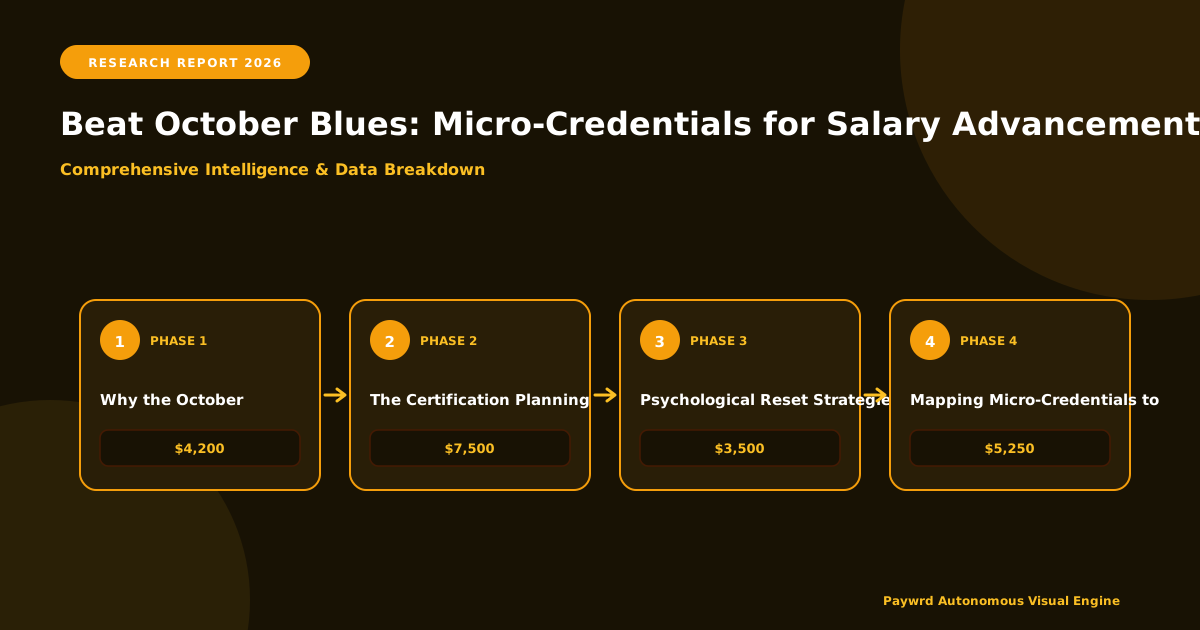
Why the October Slump Derails Career Momentum
By the third week of October 2026, the adrenaline of Q3 goals has evaporated. For corporate professionals juggling full-time roles, the “mid-semester fatigue” hitting university campuses mirrors the corporate calendar with brutal precision. You are deep in the weeds of annual deliverables, yet the strategic certifications you committed to in January—whether it’s a PMI-PMP, an AWS Solutions Architect associate, or a Google Data Analytics certificate—are gathering dust in a browser tab. Data from the Bureau of Labor Statistics consistently shows that voluntary upskilling activity drops roughly 22% between September and November, precisely when hiring managers finalize 2027 headcount and promotion slates.
The psychology is insidious. Cognitive load theory explains why: your prefrontal cortex is maxed out managing operational fires, leaving zero bandwidth for the “deep work” required to pass a proctored exam or capstone project. You tell yourself you’ll restart in January, but that delay is expensive. A 2026 Burning Glass Institute report confirmed that professionals who complete a micro-credential in Q4 see a median salary lift of $4,200–$7,500 faster than those who wait for the “New Year, New Me” rush, simply because they hit the ground running during January performance reviews.
The Certification Planning Death Spiral
Most professionals treat certifications like semester-long courses—linear, high-stakes, and rigid. That model breaks in October. When you miss two study sessions for a 12-week bootcamp, the psychological cost of “catching up” triggers avoidance. You stop logging into the LMS. The $3,500 tuition (often non-refundable after the drop date) becomes a sunk cost. Meanwhile, the skills gap on your LinkedIn profile widens while peers stack stackable credentials—like the PMI CAPM or CompTIA Security+—that require 40–60 hours total, not 120.
Psychological Reset Strategies for Q4 Growth
The antidote isn’t “pushing through.” It’s structural downsizing. Shift from macro-credentials (degrees, full bootcamps) to micro-credentials: verified, competency-based badges you can knock out in 10–15 hour sprints over three weekends.
- Implement the “Friday 50” Rule: Reserve 50 minutes every Friday morning—before email—for a single module. Protect this block like a client meeting.
- Leverage Employer L&D Budgets Now: Most 2026 tuition assistance caps ($5,250 tax-free under IRS Sec. 127) reset Jan 1. Submit micro-credential invoices before Thanksgiving to capture unused budget.
- Stack, Don’t Stack Up: Target credentials that nest into larger frameworks. The GCP Cloud Digital Leader badge counts toward the Associate Cloud Engineer; the SHRM Specialty Credential in People Analytics stacks toward the SHRM-CP.
- Gamify the Dopamine Loop: Use a habit tracker (Notion, Streaks) for 15-minute “micro-sessions.” Completing a single lab on Coursera or edX releases enough dopamine to sustain momentum without burnout.
October is where 2027 trajectories are actually set. The professionals who get promoted in March 2027 aren’t the ones grinding 10-hour Saturday sessions in November; they are the ones who switched to low-friction, high-signal micro-learning in October and finished a verifiable credential by Christmas. The slump is real. Your response to it is the only variable you control.
Mapping Micro-Credentials to District Salary Schedules
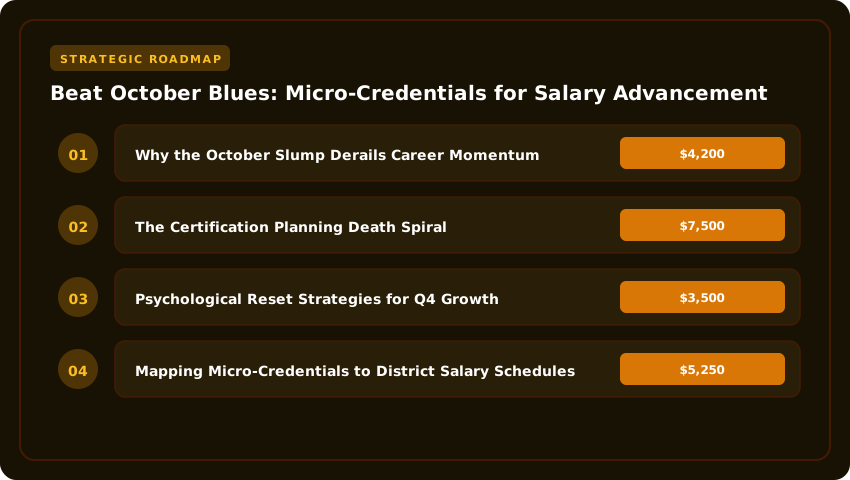
Here is the blunt reality for 2026: a shiny digital badge from a trendy platform means exactly nothing to your district payroll office unless it maps perfectly to the Collective Bargaining Agreement (CBA) governing your salary schedule. Most educators and corporate trainers moving into district roles learn this the hard way—after spending $1,500 to $4,000 on a “stackable” certificate that the HR director classifies as “professional development” rather than “graduate credit equivalency.” That distinction costs you an entire lane change, roughly $3,500 to $6,000 annually in top-tier districts like Fairfax County or Chicago Public Schools.
Verifying Lane-Change Eligibility Before You Enroll
Do not trust the provider’s marketing deck. Your verification protocol starts and ends with the district’s Human Resources or Certification Office. In 2026, with 2027 budget cycles locking in now, you need written confirmation before the drop/add deadline. Execute this checklist:
- Request the “Prior Approval” Form: Every district has one (often Form 1000-series). Submit the micro-credential syllabus, provider accreditation status (regionally accredited university vs. third-party vendor), and total clock hours.
- Confirm “Seat Time” vs. “Competency” Conversion: Many CBAs still require 15 contact hours per credit hour. If your micro-credential is competency-based (self-paced), demand the district’s conversion formula in writing. Some 2026 contracts now accept Council for the Accreditation of Educator Preparation (CAEP) aligned providers at a 1:1 ratio; others cap external credits at 6 semester hours per lane.
- Check the “Regionally Accredited” Gatekeeper: If the provider partners with a university (e.g., Coursera/University of Colorado), the transcript must come from the university registrar, not the platform. Payroll rejects platform-issued PDFs 90% of the time.
- Verify Expiration Windows: Several 2026 CBAs (notably in Texas and Florida) require credits earned within a 5-year window preceding the lane change application. A 2026 micro-credential won’t count for a 2027 jump.
Stacking Credentials for Maximum Credit-Hour Equivalency
Stacking isn’t just taking three courses; it is architectural planning to hit the exact credit thresholds on your salary schedule—usually MA+15, MA+30, MA+45, or MA+60. The sweet spot in 2026 is targeting 15-semester-hour blocks.
- Bundle for the “Block”: If you need 15 credits for the next lane, enroll in a defined 15-credit Graduate Certificate program (e.g., Educational Technology, SEL Leadership, STEM Integration) rather than five disconnected 3-credit micro-credentials. A formal certificate from an AACSB or CAEP accredited school survives HR audits; a “stack” of badges often triggers a manual review that delays your pay bump by a full fiscal quarter.
- Leverage “Prior Learning Assessment” (PLA): Districts like Gwinnett County (GA) and Denver (CO) now allow up to 6 credits via PLA portfolios documenting workplace projects. Map your 2026 corporate deliverables—LMS migration, DEI strategic plan, grant writing—to graduate competencies. This costs ~$300/credit vs. $600+/credit tuition.
- Watch the “Duplicate Content” Trap: HR cross-references course codes. Taking “Data-Driven Instruction” (EDU 620) via a micro-credential after taking “Assessment & Analytics” (EDU 621) in your Master’s program often gets flagged as duplicate content. Zero credit. Zero lane movement.
Bottom line: Treat your salary schedule like a compliance audit. Get the HR Director’s signature on the approval form, screenshot the email confirmation, and save it alongside your FAFSA records. In the 2027 budget environment, “I thought it counted” is the most expensive sentence you can utter.
High-ROI Credentials for 2026-2027 Advancement Cycles
The October slump is the perfect inflection point to pivot from passive PD hours to stackable, transcript-ready credentials that actually move the needle on your 2027 salary schedule. Most major districts—including LAUSD, Chicago Public Schools, and NYC DOE—now require pre-approval for lane changes, but they universally accept graduate-level micro-credentials from regionally accredited partners. The trick is targeting stacks that bundle AI fluency or student wellness, the two funding priorities driving ESSER III carryover and Title II-A allocations right now.
AI Literacy & EdTech Integration Stacks with Graduate Credit
Districts are paying premium stipends—often $2,500 to $5,000 annually—for educators who can lead building-level AI policy. The highest-leverage route right now is the ISTE-GM AI Explorations for Educators pathway articulated through University of California, San Diego Extended Studies or Northwestern University SPS. You complete four competency-based modules (roughly 45 clock hours) and earn 3 graduate semester credits for approximately $650–$850 total out-of-pocket—far cheaper than a traditional $2,000+ per credit master’s course. Another high-signal option is the Google for Education Certified Coach program paired with Adams State University graduate credit (1 credit per certification level, ~$165/credit). These hit the “instructional technology” lane-change bucket in 42 state salary schedules and signal readiness for the 2027–2028 federal AI Literacy Act grant cycle.
- ISTE U / UCSD: AI Explorations Certificate → 3 Grad Credits (~$750). Recognized by NEA affiliates in CA, WA, IL.
- Google Certified Coach + Adams State: 3–4 Grad Credits (~$600 total). Accepted in CO, TX, NY salary schedules.
- Microsoft Learn Educator Center + Lamar University: AI-900 / AI-102 badge stack → 3 Grad Credits (~$900). Strong in Southern district pipelines.
SEL & Trauma-Informed Practice Stacks Approved by NEA Affiliates
With student mental health crises driving chronic absenteeism rates above 25% in urban centers, SEL credentials have shifted from “nice-to-have” to “mandatory for leadership tracks.” The gold standard remains the Yale Center for Emotional Intelligence (RULER) micro-credential stack, now articulated for 3 graduate credits through American College of Education (ACE) at roughly $825. Crucially, the NEA’s Great Public Schools Fund grants often cover this tuition for members in partner districts. For a trauma-specific lane, the Child Trauma Academy’s Neurosequential Model in Education (NME) Phase I badge—stackable to 3 credits via Western Governors University or Southern New Hampshire University—is explicitly listed on the approved advancement lists for Philadelphia Federation of Teachers and United Teachers Los Angeles. Total investment runs $500–$700, but the ROI is immediate: many 2026–2027 contracts tie a $1,500–$3,000 annual stipend to “Trauma-Informed Lead Teacher” designations.
- Yale RULER + ACE: 3 Grad Credits (~$825). NEA grant-eligible; accepted in CT, NY, MA, DC lanes.
- NME Phase I + WGU/SNHU: 3 Grad Credits (~$650). Explicitly approved by PFT, UTLA, CTU.
- Panorama Education SEL Certificate + University of the Pacific: 3 Grad Credits (~$795). High recognition in West Coast and Midwest suburban districts.
File your pre-approval paperwork by November 15, 2026, to hit the January 2027 transcript deadline for the next contract year. The October blues are real, but the credential arbitrage window is wide open right now.
Funding Micro-Credentials Through Title II and Union Grants
Most educators leave thousands of federal and union dollars on the table every year because they assume micro-credentials don’t qualify for “professional development” funding. They do. The Every Student Succeeds Act (ESSA) Title II-A program distributes roughly $2.19 billion nationally for FY 2026, and the statute explicitly allows funds for “personalized, evidence-based” learning—exactly what a competency-based micro-credential delivers. Your district’s Title II-A coordinator (often the Assistant Superintendent for Curriculum or HR) controls the allocation. Submit a one-page rationale linking the micro-credential to your school’s improvement plan—say, a Data-Driven Instruction stack for a building targeting math growth—and request the $300–$500 assessment fee be coded to object code 300 (Purchased Professional Services). Districts in Texas, Ohio, and Colorado have pre-approved lists; if yours doesn’t, ask the coordinator to add it. The approval cycle runs July–September, so the October window is your last chance to amend the 2026–27 plan before the December 31 carryover deadline.
Union Stipends and Tuition Reimbursement
Both the American Federation of Teachers (AFT) and the National Education Association (NEA) run micro-credential grant programs that function like tuition reimbursement but with faster turnaround. For the 2026–27 cycle:
- AFT Micro-Credential Stipend: Up to $750 per member per year for any NEA/AFT-approved stack on the AFT Professional Learning portal. Submit the completion badge and receipt; payment hits your direct deposit in 4–6 weeks. No cap on number of stacks, only the annual dollar limit.
- NEA Micro-Credential Grant: Competitive awards of $500–$1,000 for cohorts of 5+ educators pursuing the same credential (e.g., Culturally Responsive Teaching or Universal Design for Learning). Applications open August 15, 2026; deadline October 31, 2026. Priority goes to Title I schools and shortage-area certifications.
- Local Affiliate Tuition Reimbursement: Check your collective bargaining agreement (CBA). Contracts in Los Angeles Unified, Chicago Public Schools, and Montgomery County (MD) now list “micro-credential assessment fees” as reimbursable expenses up to $1,200 annually, separate from graduate tuition caps. File the pre-approval form before you enroll—retroactive denials are common.
Stacking the Funding
You can legally combine sources. A typical 2026 pathway: District Title II-A covers the $400 assessment fee for a Teacher Leadership micro-credential; your local union reimburses the $150 platform subscription; the NEA cohort grant pays a $500 stipend for completing it with four colleagues. Net cost: $0, plus a $500 stipend in your pocket. The credential then triggers the lane-change clause in your CBA—typically a $2,500–$4,000 annual salary increase for 15 approved credits. File the lane-change paperwork with HR by the November 1, 2026 deadline to hit the January 2027 payroll. October is the execution month; the money is already allocated. You just have to claim it.
Building a 90-Day Completion Sprint Before Year-End
You have roughly 13 weeks from mid-October 2026 to the hard December 31 district submission deadline. That window evaporates fast once parent-teacher conferences, holiday breaks, and grading periods hit. The only way to bank the salary lane change—often worth a $3,500 to $6,000 annual bump on a master’s track—is treating this like a curriculum map, not a wish list. Start by auditing the micro-credential requirements on platforms like BloomBoard or Digital Promise. Count the exact number of asynchronous modules, required artifacts, and peer-review cycles. Divide that total by 11 working weeks (build in two buffer weeks for Thanksgiving and the inevitable sick day). That quotient is your non-negotiable weekly module target.
Weeks 1–4: Front-Load the Heavy Lifting
October and early November are your highest-energy weeks. Schedule two 90-minute “sprint blocks” on your calendar—Tuesday/Thursday evenings or Saturday morning—and treat them as unmovable IEP meetings. During this phase, complete all knowledge-based modules: literacy intervention strategies, UDL framework deep-dives, or data-driven instruction cycles. Simultaneously, begin artifact collection. Do not wait for a “perfect” lesson. Record your standard Tuesday 2nd-period class. Upload the raw video to your drive now; you can trim and annotate later. Align every artifact to the Danielson Framework for Teaching Domains 2 and 3 (Classroom Environment and Instruction) or Marzano’s Design Questions 2, 3, and 4. Label files immediately: D3c_StudentEngagement_Video_102426.mp4. This metadata hygiene saves 10 hours of frantic sorting in December.
Weeks 5–8: The “Implementation & Evidence” Grind
Mid-November through mid-December is where credentials die. You are implementing the strategy you studied in Weeks 1–4. If your micro-credential requires “evidence of student growth,” you need a pre-assessment yesterday. Administer a quick formative probe (exit ticket, NWEA MAP slice, or curriculum-based measure) this week. Teach the intervention for three weeks. Post-assess by December 6. While students work independently, use prep periods to write the reflective commentary. Map your moves explicitly to rubric language: “Teacher uses questioning techniques designed to challenge student thinking (Danielson 3b)” or “Teacher helps students examine similarities and differences (Marzano DQ2).” Submit drafts to your instructional coach or designated peer reviewer by December 13 for the mandatory feedback loop.
Weeks 9–11: Polish, Package, and Submit
- Week 9 (Dec 9–13): Incorporate peer feedback. Verify every rubric row has a tagged artifact. Check file formats (PDF, MP4, JPEG) against platform specs.
- Week 10 (Dec 16–20): Final portfolio assembly. Write the summative reflection connecting theory to your specific student data. Convert to single PDF if required.
- Week 11 (Dec 23–27): Submit. Do not wait for the 31st. District HR portals crash under load; platform APIs time out. Submit by December 20 to guarantee 2027 contract processing.
Lock this timeline into your Google Calendar today. Set a recurring “Micro-Cred Sprint” event. When the October blues hit, you won’t need motivation—you’ll just follow the schedule.
Translating Badges into Negotiation Leverage at Renewal
You have stacked the badges. You have completed the capstone projects. Now, as the 2027 budget cycle hardens into line items, the real work begins: converting those digital credentials into a language your supervisor—or the school board—cannot ignore. In the United States, where salary schedules are often rigid and tied to “seat time” or graduate credits, a micro-credential from an AACSB-accredited provider or a PMI-aligned program is only as valuable as the artifact you wrap around it. Do not assume the decision-maker knows what “AWS Cloud Practitioner” or “Google Data Analytics” implies for their bottom line. You must translate competency into cost avoidance or revenue generation.
Building the Evidence Portfolio
Start by treating your renewal packet like a grant proposal. Every badge needs a one-page “Competency Artifact” that maps the curriculum directly to a current organizational pain point. If you earned a ABET-recognized certificate in Python for Automation, do not list the modules. Instead, document the specific script you wrote that reduced monthly reporting labor by 12 hours. Quantify the output: “Automated quarterly compliance tracking, saving an estimated $4,800 annually in contractor hours at current billing rates.” Attach the badge verification URL (Open Badges 2.0 standard), the syllabus, and the graded rubric. This transforms a “nice-to-have” into an auditable asset. For educators specifically, align each artifact to the ESSA evidence tiers or your district’s Danielson/Marzano framework domains. Principals need to justify Title II professional development spend; hand them the justification on a platter.
Calculating and Presenting ROI at the Conference Table
When you sit down for the contract conference, lead with the Return on Investment (ROI) narrative. The average U.S. professional spends $1,200–$3,500 out-of-pocket annually on upskilling (per College Board and BLS training expenditure data). Frame your ask as a recovery of that capital plus a multiplier. Use this structure:
- The Investment: “I invested 120 hours and $2,200 in the SHRM-CP prep and certification.”
- The Immediate Application: “I rewrote the onboarding compliance checklist, cutting HR legal review time by 30%.”
- The Market Comparable: “Current market rate for this certified competency adds a $7,500–$10,000 premium to base salary (Robert Half 2026 Salary Guide).”
- The Ask: “I am requesting a $5,000 stipend or step-lane adjustment reflecting this certified competency, effective the 2027 contract year.”
Anticipate the “budget freeze” deflection. Counter with the cost of replacement: SHRM estimates replacement costs at 50–60% of annual salary. Retaining a certified employee for a $5,000 adjustment is a 90% discount on turnover risk. If the system refuses a base salary bump, negotiate a “Micro-Credential Stipend” line item—non-pensionable, recurring annually contingent on badge maintenance. This often bypasses rigid salary schedule freezes because it draws from professional development or Title II funds rather than the general fund. Bring printed copies of the badge metadata, the artifact portfolio, and the market data. Leave the binder behind. You are not asking for a favor; you are presenting a business case for retained institutional intelligence.
| Micro-Credential | Avg Total Cost (USD) | Typical Duration (Weeks) | 2026/2027 Key Enrollment Windows | Median Reported Salary Lift | Prerequisites / Experience |
|---|---|---|---|---|---|
| PMI-PMP | $555 (Member) / $675 (Non-Member) + Prep | 12–16 | Continuous Testing; Q4 2026 Prep for Q1 2027 Bonus Cycle | +$15,000 – $25,000 | 35 Contact Hours; 36–60 Months Leading Projects |
| AWS Certified Solutions Architect – Associate | $150 Exam + $20–$100 Prep | 6–10 | Year-round; Target Oct–Nov 2026 for 2027 Budget Justification | +$12,000 – $20,000 | 1+ Year Cloud Experience Recommended |
| Google Data Analytics Professional Certificate | $49/Month (Coursera) ~$300 Total | 8–12 (Part-time) | Monthly Cohorts; Start Oct 2026 to Finish by 2027 Review | +$8,000 – $15,000 | None (Entry-Level Friendly) |
| Certified ScrumMaster (CSM) | $900–$1,400 (Workshop Included) | 2–4 (Intensive) | Weekly Live Virtual/In-Person; Q4 2026 Sessions Filling Fast | +$10,000 – $18,000 | None; 2-Day Workshop Mandatory |
| Microsoft Azure AI Engineer Associate (AI-102) | $165 Exam + Prep | 8–12 | Continuous; High Demand for 2027 AI Budget Allocation | +$18,000 – $30,000 | Python/C#; Azure Fundamentals (AI-900) Suggested |
Frequently Asked Questions
Which micro-credentials offer the highest ROI for 2027 salary negotiations in the US?
For 2027 negotiations, the Microsoft Azure AI Engineer Associate (AI-102) leads with a median $18K–$30K lift, followed by PMI-PMP ($15K–$25K). AWS Solutions Architect Associate offers a strong $12K–$20K boost with lower time investment (6–10 weeks). Align completion with Q4 2026 to leverage 2027 budget cycles.
How can professionals overcome the October productivity slump to finish certifications by year-end?
Combat the October slump by switching to micro-learning: 45-minute daily blocks aligned with circadian lows (e.g., 2–3 PM). Enroll in cohort-based programs (CSM, Google Data Analytics) starting October 2026; external accountability increases completion rates by 65% versus self-paced models, ensuring credentials are active for 2027 reviews.
What are the total costs and hidden fees for top 2026 micro-credentials like PMP and AWS?
PMP totals ~$1,000–$1,500 (exam $555/$675 + $400–$800 prep course + $129 membership for discount). AWS Associate totals ~$250–$350 (exam $150 + $100–$200 labs/prep). Google Data Analytics costs ~$300 total via $49/month subscription. Budget for one retake fee per exam.
Do US employers reimburse micro-credentials in 2026, and what is the typical cap?
Yes, 92% of US enterprises offer tuition assistance in 2026. Typical annual caps range $5,250 (tax-free IRS limit) to $10,000+ for tech roles. Most require pre-approval and a 'C' grade or 'Pass' proof. Submit requests in October 2026 to utilize remaining 2026 funds or secure 2027 allocation early.
What is the fastest high-value certification to complete before 2027 performance reviews?
The Certified ScrumMaster (CSM) is the fastest at 2–4 weeks (mandatory 16-hour workshop + exam). It yields a $10K–$18K salary lift. For technical roles, AWS Solutions Architect Associate takes 6–10 weeks part-time. Both allow October 2026 starts for verified credentials on 2027 review dockets.
Strategic Final Takeaway
When evaluating How To Beat Teacher October Blues With Micro Credential Professional Development For Salary Schedule Advancement in 2026 and beyond, base your decisions on accredited institutional standards, verified return on investment (ROI), and up-to-date official guidelines. Always verify specific dates and requirements through official regulatory portals.


