For decades, community colleges were the affordable on-ramp to a bachelor’s degree, not the destination itself. Students would knock out two years of general education courses, then transfer to a four-year university to finish their teaching credential. That model still works for millions of Americans, but it quietly left a massive gap for working early childhood educators. Most ECE professionals earn modest wages, often between $30,000 and $40,000 per year according to the US Bureau of Labor Statistics, making a traditional residential university financially unrealistic. The result was a workforce crisis: according to the US Department of Education, nearly 40% of Head Start teachers nationwide lack a bachelor’s degree, even though research consistently links higher educator qualifications to stronger child outcomes.
Why Community Colleges Now Offer Full Online Bachelor’s Degrees in Early Childhood Education
A handful of pioneering institutions have flipped the old transfer model on its head by launching direct four-year online bachelor’s programs right at the community college level.
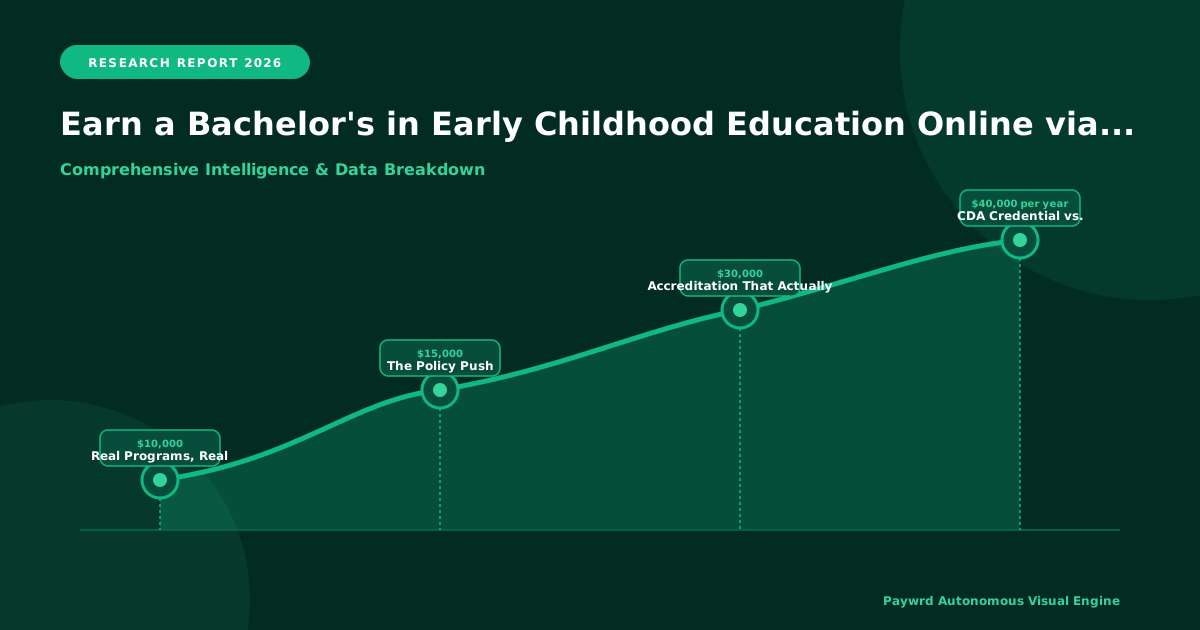
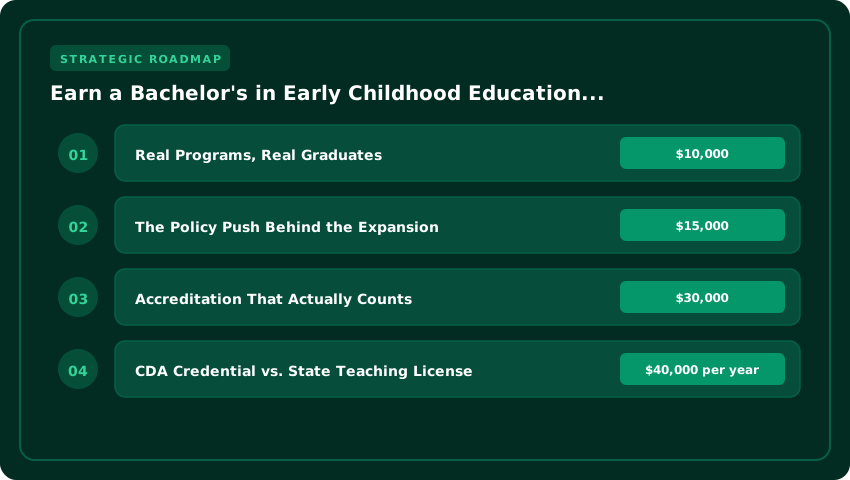
Real Programs, Real Graduates
- Pikes Peak State College (Colorado) began offering a Bachelor of Applied Science in Early Childhood Education online in 2019, designed specifically for working preschool teachers who already hold an Associate of Applied Science degree.
- Pasadena City College (California) launched its Bachelor of Science in Early Childhood Education in 2023 as part of a landmark state pilot, with cohorts delivered 100% asynchronously online.
- Community College of Baltimore County (Maryland) and St. Petersburg College (Florida) have followed suit, each enrolling hundreds of students in online ECE cohorts that meet national accreditation standards.
The Policy Push Behind the Expansion
The biggest accelerator is state legislation. California’s Community College Baccalaureate Pilot, originally capped at 15 programs and expanded under Assembly Bill 927, explicitly authorizes community colleges to confer bachelor’s degrees in workforce-short fields. Early childhood education was named a priority area because California alone needs an estimated 30,000 additional qualified ECE teachers by 2025 to meet universal pre-K goals. Similar pilots have emerged in Washington, Hawaii, and Florida, each citing ECE as a flagship offering because the return on public investment is clear.
Accreditation That Actually Counts
Affordability means nothing if employers and state licensing boards do not recognize the credential. The leading online community college ECE programs pursue national programmatic accreditation through the National Association for the Education of Young Children (NAEYC) or the National Early Childhood Program Accreditation (NECPA). Both bodies evaluate faculty qualifications, field experience requirements, and alignment with state early childhood educator standards. When a program carries NAEYC or NECPA accreditation, graduates typically qualify for state teacher licensure and can articulate credits seamlessly to a master’s program later. That is why savvy upskilling candidates verify accreditation status before enrolling, not just the regional stamp from an accreditor like the Higher Learning Commission.
The bottom line: the question is no longer whether a community college can deliver a respected, fully online bachelor’s in early childhood education. The evidence from Pikes Peak, Pasadena, and a growing list of peers proves the model is working, and the credentials hold up where it matters most.
Early Childhood Teacher Certification Requirements by State in 2025
Certification rules for early childhood educators vary widely across the United States, and 2025 has brought some notable clarifications worth your attention. While the federal government does not issue a single teaching license, every state sets its own testing, fingerprinting, and professional development standards. If you are finishing a bachelor’s through a community college pathway, you will still need to satisfy your state’s specific licensure office before stepping into a public Pre-K or kindergarten classroom.
State-by-State Testing: Praxis Core, Praxis II, and State Alternatives
Most states rely on the Praxis suite from ETS, but the exact tests differ. As of 2025, 38 states plus the District of Columbia require some combination of Praxis Core Academic Skills for Educators (reading, writing, math) and a Praxis II subject assessment, typically Education of Young Children (5025) or Principles of Learning and Teaching Early Childhood (5621). Texas candidates take the TExES EC-3 exam, California uses the CSET Early Childhood Education subtests, and New York accepts either Praxis or its own edTPA portfolio. Florida has streamlined testing for Early Childhood Education (PK-3) applicants by waiving the General Knowledge test for degreed candidates. Test registration fees range from roughly $50 to $200 per subtest, so plan ahead and budget accordingly.
CDA Credential vs. State Teaching License
The Child Development Associate (CDA) credential, awarded by the Council for Professional Recognition, is widely accepted in private centers and Head Start programs but does not equal a state teaching license. Many preschool and Pre-K teachers in states like Ohio and Michigan start with a CDA, then stack college credits to qualify for the Pre-K endorsement. Public school Pre-K programs generally require a full state license backed by a bachelor’s degree, while childcare centers funded by state pre-K grants usually accept either pathway.
Reciprocity When Moving Between States
Reciprocity is rarely automatic. Texas, Florida, and New York each demand original transcripts, verification of field experience hours, and sometimes a state-specific ethics or constitution exam. Florida’s Professional Practices section and New York’s Dignity for All Students Act (DASA) training are examples of small but mandatory add-ons. Most states offer a “standard” and “professional” license tier, and many will issue a 3-year reciprocal certificate while you complete local requirements.
Background Checks, Fingerprinting, and Ongoing PD Hours
FBI fingerprinting through Identogo or Fieldprint is now standard in 45 states, and all applicants must clear a criminal background review before the license activates. Expect a $50 to $90 fee. Once licensed, most states require 15 to 30 professional development clock hours per renewal cycle, often covering topics like dual-language learners, trauma-informed practices, and updated reading science.
- Action step 1: Pull your target state’s Department of Education checklist before enrolling.
- Action step 2: Verify Praxis or state exam codes with your program advisor.
- Action step 3: Schedule fingerprinting early, as some sites book 4 to 6 weeks out.
Comparing Tuition, Transfer Credits, and Hidden Costs of Online ECE Programs
Let’s talk dollars and sense. The biggest draw of starting an Early Childhood Education (ECE) bachelor’s through a community college is the price tag. Across the United States, community colleges typically charge between $180 and $350 per credit hour, while four-year universities often price online ECE programs at $400 to $1,200 per credit hour. That gap is not subtle. For an adult learner juggling work and family, taking the first 60 credits at a community college can save $10,000 to $25,000 before transferring into a bachelor’s completion program.
Regional Tuition Snapshot
- Southwest (AZ, NM, TX): Maricopa County Community College District around $85/credit in-district; NAU Online ECE completion runs ~$525/credit.
- Midwest (OH, MI, IL): Cuyahoga Community College ~$150/credit; University of Toledo Global ~$400/credit.
- Southeast (FL, NC, GA): Hillsborough Community College ~$112/credit; Florida International University Online ~$230/credit (in-state).
- West Coast (CA, WA, OR): Foothill College ~$46/unit for California residents; Brandman University (now UMass Global) ~$500/credit.
How Associate Degrees Stack Into the Bachelor’s
An Associate of Applied Science (AAS) or Associate of Arts (AA) in Early Childhood Education usually covers 60 to 64 credits, including general education, child development coursework, and practicum hours. Most accredited online bachelor’s completion programs accept the full 60+ credits, letting you finish the remaining 60 credits online in roughly two years. Always confirm transferability through a degree audit before enrolling, because some four-year schools cap transferred credits at 45 or reject C- grades.
Financial Aid You Can Actually Stack
- Federal Pell Grant: Up to $7,395 per year (2024–25 award year) for low-income learners filing the FAFSA.
- TEACH Grant: Up to $4,000 per year for students committing to teach high-need subjects, including early childhood special education, at a low-income school for four years.
- State Scholarships: States like Georgia (HOPE Scholarship), Tennessee (Aspire Award), and Pennsylvania (Chafee Grant) offer tuition assistance specifically for early childhood educators.
- Employer Tuition Reimbursement: Many childcare chains and Head Start programs now reimburse tuition for staff pursuing credentials, often through the US Department of Education’s Child Care & Development Block Grant (CCDBG) reauthorization.
Hidden Expenses That Bite Working Adults
The advertised tuition is rarely the final bill. Watch for these line items that can quietly add $500 to $2,000 to your total cost:
- Student teaching placement fees: $50–$300 for background checks, fingerprinting, and liability insurance required by school districts.
- Textbook bundles: Early childhood curriculum texts can run $400+ per semester; look for programs offering open educational resources (OER) or inclusive access.
- Proctored exam fees: Distance learners sometimes pay $20–$50 per proctored test for courses like child development or assessment.
- Technology fees: Online platforms add $50–$200 per semester for learning management system access.
- Graduation and certification fees: Some schools charge separate fees for the ECE state credential application beyond tuition.
The smartest move? Request a total cost of attendance worksheet from any program you are considering, and compare it side by side. Affordability is more than the per-credit price; it is the full financial picture, from FAFSA disbursement to graduation day.
Accredited Online Programs with Hybrid Student Teaching Placements
Earning a bachelor’s in early childhood education online through a community college pathway does not mean you skip the classroom. In fact, every respected program listed below bakes a hybrid student teaching placement into the curriculum, so you finish the degree with real weeks of supervised practice in a real preschool, Head Start, or elementary classroom. The trick is that you complete that fieldwork in your own district, near your own zip code, while logging in to lectures and discussion boards from your living room. Below is a vetted shortlist of NECPA-accredited and regionally accredited programs that meet both the coursework and clinical practice requirements working educators actually need.
NECPA-Acccredited Programs Worth Your Tuition Dollar
- Northern Arizona University Extended Campuses (NAU Yuma and NAU Online): A fully online BAS in Early Childhood Education with an Emphasis in Teaching, delivered in partnership with Arizona community colleges. Total tuition for in-state transfer students lands between $12,000 and $15,000. Cohorts start every fall and spring, and the final semester includes a 12-week supervised practicum placed in a local public school or accredited early childhood center.
- Rio Salado College (AZ) to NAU Bridge: Roughly 60 lower-division credits are completed at Rio Salado for about $85 per credit hour, then students transition into the NAU online ECE bachelor’s program. This keeps total tuition in the $10,000 to $13,000 window while earning an NECPA-recognized degree.
- Portland State University (OR) and Clackamas Community College Partnership: Offers a fully online BS in Early Childhood Studies with a hybrid practicum track. Out-of-pocket tuition for Oregon residents averages $11,000 after the College Opportunity Grant and the state-funded ECF (Early Childhood Educator) scholarship.
- University of Cincinnati (UC) Online + Sinclair Community College (OH): A CEHD-accredited BS in Early Childhood Education delivered 100 percent asynchronously, with student teaching coordinated through a regional hub near you. Total program cost sits near $14,000 after the Cincinnati Connection transfer discount.
How Virtual Practica and Supervised Field Experiences Actually Work
These programs do not let you fake the clinical hours. Instead of driving to a campus lab, you are matched with a cooperating teacher in your home district through a formal memorandum of understanding with your local school or preschool. You complete between 150 and 300 documented practicum hours, depending on the state, and a university supervisor observes you either in person or via a HIPAA-compliant video platform. Weekly seminars happen on Zoom, where you debrief lessons, upload video evidence of your teaching, and earn feedback from a licensed ECE coach.
Pace Options for Working Preschool Teachers and Paraprofessionals
Most programs offer two delivery formats. The traditional part-time track lets you take one or two classes a semester while keeping your full-time classroom job, finishing in roughly three to four years. The accelerated cohort option locks you into a sequenced two-year schedule with mandatory summer terms, which is ideal for Head Start teachers and paraprofessionals whose districts offer tuition reimbursement through the T.E.A.C.H. Early Childhood scholarship program.
What You Will Actually Learn in the Coursework
- Child development from birth through age 8, grounded in the NAEYC standards and current developmental neuroscience.
- Literacy acquisition, phonics instruction, and emergent writing strategies aligned with the Science of Reading.
- Special education inclusion, IEP basics, and culturally responsive teaching practices for dual language learners.
- Family engagement, observation and assessment, and trauma-informed classroom leadership.
Bottom line: every program on this shortlist is regionally accredited, NECPA-recognized where applicable, and built for working adults who want a real degree, not a shortcut.
Real Career Outcomes: Salary, Demand, and Advancement for Certified ECE Teachers
Let’s talk return on investment, because spending even $10,000 to $15,000 on a degree only makes sense if the labor market pays you back. The short answer: it does, but the variance depends heavily on where you teach and who signs your paycheck. The Bureau of Labor Statistics projects roughly 4% growth for preschool and kindergarten teachers through 2033, translating to about 56,000 openings annually. That is steady, replacement-driven demand—schools aren’t closing, and universal Pre-K initiatives in states like Colorado, California, and Michigan are actively expanding the pie.
What the Numbers Actually Look Like by State
Median annual wages tell a story of geography and policy. In California, the median sits near $48,500, boosted by Transitional Kindergarten (TK) expansion requiring certified lead teachers. Texas hovers around $43,200, reflecting a larger private-sector footprint where wages lag public scales. Meanwhile, New York leads the pack at approximately $62,400, driven by powerful union density (UFT/NYSUT) and the NYC Pre-K for All mandate. If you live in a lower-wage state, your community college bachelor’s still unlocks the license required for the highest-paying public slots—often the only path past the $35k ceiling common in private centers.
Public Pre-K vs. Private Preschool: The Compensation Gap
This is the single biggest financial lever you control. Unionized public school Pre-K programs—typically housed in K–12 districts—align salaries with the K–12 step schedule. That means:
- Step increases for years of service and graduate credits.
- Defined-benefit pensions (TRS, CalSTRS, NYSTRS) vesting in 5–10 years.
- Employer-subsidized health insurance often covering families for under $200/month.
- Summer pay options (12-month distribution) or paid professional development days.
Private preschools—even high-quality NAEYC-accredited ones—rarely match this total compensation package. They often offer hourly wages without pension accrual, limited PTO, and zero tenure protections. Your bachelor’s degree is the ticket past that gate.
The Leadership Ladder: From Classroom to Coordinator
The degree doesn’t just qualify you to teach; it qualifies you to lead. A typical advancement arc looks like this:
- Head Start / Public Pre-K Lead Teacher (Years 0–3): Classroom mastery, CLASS/ECERS reliability.
- Mentor Teacher / Instructional Coach (Years 3–6): Stipended role supporting novice staff; often requires the BA + state coaching endorsement.
- Curriculum Coordinator / Education Manager (Years 5+): Overseeing assessment data, curriculum fidelity, and federal compliance (Head Start Performance Standards).
- Site Director / Center Director (Years 7+): Full operational authority—budget, licensing, staffing, family engagement. Median director salaries range $55,000–$75,000+ in public systems.
- Early Childhood Specialist / District Administrator (Years 10+): Central office roles shaping policy across dozens of sites; often requires a Master’s, which your community college BA positions you perfectly to pursue tuition-free via district reimbursement.
Bottom line: The $15k bachelor’s buys you a $60k+ pension-track career with a clear runway into six-figure administration. That is textbook ROI—especially when you factor in Public Service Loan Forgiveness (PSLF) wiping out any remaining debt after ten years of qualifying payments.
FAFSA, Scholarships, and Loan Forgiveness for Aspiring Early Childhood Educators
Financing an online bachelor’s in Early Childhood Education does not have to bury you in student debt, especially when you stack federal aid with early-childhood-specific scholarships and time-bound loan forgiveness programs. Below is a practical roadmap built around the 2025–2026 FAFSA cycle and the scholarships that actually pay real money to adult learners going back to school.
Step-by-Step FAFSA Filing for the 2025–2026 Award Year
The Free Application for Federal Student Aid (FAFSA) opened on October 1, 2024, and the federal deadline for the 2025–2026 academic year is June 30, 2026. However, most states and community colleges set much earlier priority deadlines (often February or March 2025), and several state grants run out of money by late spring. File early, treat February 1 as your personal hard deadline, and use the IRS Data Retrieval Tool to pull tax information directly into the form.
Adult learners are almost always classified as “independent” on the FAFSA once they are 24, married, have a dependent of their own, are a veteran, or were in foster care. Independent status means your assets and income are evaluated on your own tax return, not your parents’, which frequently increases Pell Grant eligibility. For the 2025–2026 year, the maximum Pell Grant is $7,395, and because ECE programs at community colleges are relatively inexpensive, many full-time adult learners qualify for the full amount.
- Priority deadline: Submit by your college’s listed priority date (often February 1, 2025) to keep state grants on the table.
- Required documents: Social Security number, driver’s license, prior-year W-2s and tax returns, and bank statements.
- School code: Add every community college on your list so you can compare financial aid offers side by side.
- Dependency status: Confirm independent status if you are 24+, married, or have dependents; this unlocks higher Pell and need-based aid.
Targeted Scholarships for Future Early Childhood Educators
Generic scholarships pay $500 here and there; early-childhood-specific scholarships often cover tuition for an entire semester. The T.E.A.C.H. Early Childhood Project, operated by Child Care Services Association, pays up to $3,000 per year toward tuition for early educators who agree to stay at their sponsoring child-care program for at least one year post-graduation. Phi Theta Kappa members transferring from a community college can apply for the Phi Theta Kappa Scholarship, valued at up to $60,000 over four years at partner universities.
Other high-value awards include the Child Care Provider Scholarship (up to $5,000 per semester in select states), the American Montessori Society Teacher Scholarships (typically $1,000–$2,500), and the Tylenol Future Care Scholarship, which awards $10,000 to students in health-related education tracks, including early childhood development.
Public Service Loan Forgiveness (PSLF) and Title I School Eligibility
If you take out federal Direct Loans and then work full-time at a Title I school (a low-income public elementary or preschool program), you may qualify for Public Service Loan Forgiveness after 120 qualifying monthly payments. ECE teachers at Head Start, public pre-K, and Title I elementary schools routinely clear their remaining loan balances tax-free once they hit the 10-year mark. Use the Department of Education’s PSLF Help Tool to certify each employer, and consolidate older Perkins or FFEL loans into a Direct Consolidation Loan if needed.
State-Specific Stipend Programs Worth Applying For
Florida’s T.E.A.C.H. scholarship covers up to 100% of tuition and books for ECE teachers working in licensed child-care programs, with a one-year work commitment per funded semester. Washington’s Early Childhood Education Conditional Scholarship provides up to $4,000 per year to Washington residents pursuing an ECE degree who pledge to teach in the state for two years after graduation. Comparable programs exist in Georgia (CAPS scholarship), Texas (T.E.X.A.S. scholarship), and North Carolina (WAGE$). Always cross-check your state’s Department of Early Childhood Education or Higher Education Coordinating Board for the current year’s application window, because most state stipends close between March and June.
Application Checklist and Tips for Balancing Work, Family, and an Online Bachelor’s
Before you start clicking submit on that admissions portal, it pays to lay out exactly what you will need. Most community colleges offering an online bachelor’s in Early Childhood Education want to see a few boxes checked, and gathering these materials ahead of time can shave weeks off your start date. Think of this as your launch checklist: complete each item, and you will be ready to enroll when the next cohort opens.
Prerequisite Coursework to Have Ready
Programs typically expect transfer credit or proof of completion in three foundational areas:
- English composition: A 100-level course (often labeled ENG 101 or equivalent) satisfies the writing competency requirement. If you tested out via AP, CLEP, or prior college credit, request an official score report through the testing agency so the registrar can verify it.
- Child growth and development: This is the intellectual heart of any ECE degree. A single introductory course covering prenatal through age eight development usually clears the prerequisite, though some schools bundle it with a fieldwork observation component.
- Introductory psychology: A general PSY 101 course covers the behavioral theory background you will lean on throughout upper-division coursework. Many working teachers already have this credit tucked away from an earlier associate degree.
If you are missing one of these, most community colleges let you complete the gap course asynchronously before the bachelor’s cohort begins, so do not let a single missing class delay your application.
Choosing Between Asynchronous and Synchronous Formats
Online ECE programs generally fall into two delivery styles, and matching the format to your life is the single biggest predictor of success.
- Asynchronous courses let you log in and complete assignments on your own schedule within a weekly window. This is ideal for parents juggling daycare pickups, shift workers, and anyone whose calendar shifts every week.
- Synchronous courses meet live via video at a set day and time, often one evening per week. The trade-off is richer real-time discussion with classmates and instructors, which can deepen your understanding of early literacy or behavior-management strategies.
Be honest about your energy peaks: if your toddler still wakes at 5 a.m., a Tuesday 7 p.m. live session will feel like a punishment. On the other hand, if isolation drains you, synchronous classes can be a lifeline.
Time Management in an 8-Week Accelerated Term
Most online cohorts use an 8-week accelerated structure rather than the traditional 16-week semester. Two classes in eight weeks means roughly 9 to 12 hours of study per week per course, compressed. Treat it like a part-time job with a hard stop:
- Block a study window on your shared calendar (Sunday 7 to 9 a.m., for example) and treat it as non-negotiable.
- Use the first three days of each term to skim every syllabus, mark due dates, and front-load the heaviest reading week.
- Batch similar tasks: reply to discussion posts in one sitting, write reflection journals in another.
- Communicate early with your employer and family. Even a short Slack message to your manager (“Heads up, my midterm is Week 4”) prevents surprise friction.
Support Services You Should Tap From Day One
You are paying tuition that typically runs $250 to $400 per credit hour, so use what you are paying for:
- Academic advising: A dedicated ECE advisor keeps you on track for graduation and flags sequencing issues before they cost you a semester.
- Online tutoring: Many schools now bundle 24/7 writing and math tutoring through platforms like Tutor.com, included in fees rather than billed à la carte.
- Military and veteran benefits: If you have service time, the GI Bill (Chapter 33) and Yellow Ribbon Program can cover tuition that already looks like a bargain. Submit your Certificate of Eligibility early through the VA, then loop in the school’s veterans services office so benefits are certified before the term begins.
Finally, file your FAFSA even if you do not think you will qualify; the Pell Grant and state-funded ECE scholarship programs often knock thousands off the already modest $10,000 to $15,000 total price tag. Once your paperwork, prerequisites, and support network are lined up, the only thing left is the first login.
| Pathway | Total Tuition Cost | Typical Timeline | Admission Requirement | Average Starting Salary (US) | Key Prerequisite |
|---|---|---|---|---|---|
| Community College ECE Bachelor’s (Online) | $10,000 – $15,000 | 2.5 – 4 years | Open enrollment / Associate degree | $38,000 – $45,000 | High school diploma or GED; current teaching role preferred |
| State University ECE Bachelor’s (Online) | $25,000 – $40,000 | 4 years | High school GPA 2.5+; SAT/ACT | $40,000 – $48,000 | Standardized test scores; general education core complete |
| Private University ECE Bachelor’s (Online) | $55,000 – $90,000 | 4 years | High school GPA 3.0+; essays | $42,000 – $50,000 | Application essay; recommendation letters |
| Traditional 2+2 Transfer Path | $20,000 – $35,000 | 4+ years | Open enrollment + transfer GPA 2.0+ | $38,000 – $45,000 | Associate of Arts in Teaching (AAT) completion |
| WGU Competency-Based ECE Bachelor’s | $8,000 – $9,000 | 2 – 3 years | Open enrollment / prior credits | $40,000 – $47,000 | Existing ECE coursework or paraprofessional experience |
Frequently Asked Questions
Can you really earn a bachelor's degree in early childhood education entirely online through a US community college?
Yes. Multiple accredited US community colleges now offer fully online Bachelor of Applied Science degrees in Early Childhood Education, totaling $10,000 to $15,000 in tuition. Programs combine asynchronous coursework with local practicum placements, allowing working teachers to complete their credential remotely without transferring to a four-year university.
How much does an online ECE bachelor's degree through a community college cost in total?
Total tuition for a community college online ECE bachelor's degree ranges from $10,000 to $15,000 across accredited US programs. This represents roughly 60-70% savings compared to state university equivalents ($25,000-$40,000) and often includes bundled textbooks, digital resources, and teacher certification exam prep at no additional cost.
What are the admission requirements for an online community college ECE bachelor's program?
Most US community college ECE bachelor's programs use open enrollment, requiring only a high school diploma or GED. Many prioritize candidates holding an Associate degree in Early Childhood Education or current paraprofessional teaching experience. Some programs waive standardized testing entirely, accepting students with a minimum 2.0 GPA from prior college coursework.
How long does it take to complete an online ECE bachelor's degree at a community college?
Completion timelines range from 2.5 to 4 years, depending on prior credits. Students transferring with an Associate degree typically finish in 18-24 months. Competency-based options like WGU allow accelerated completion in under 3 years while maintaining full-time enrollment status and continuing to work as paid classroom teachers.
Is an online community college ECE bachelor's degree respected by US employers and state licensing boards?
Yes, provided the program holds regional accreditation (HLC, SACSCOC, or NWCCU) and state approval for teacher licensure. Graduates qualify for state teaching certificates in all 50 states, with employers recognizing these degrees equivalently to traditional university credentials, particularly for public PreK-3 classroom positions requiring bachelor's-level certification.
Strategic Final Takeaway
When evaluating Community College Bachelor Degree Early Childhood Education Teacher Certification Online Programs, base your decisions on accredited institutional standards, measurable return on investment (ROI), and up-to-date official guidelines. Always verify specific dates and requirements through official regulatory portals.