Why an Associate Degree in Early Childhood Education From a US Community College Is a Smart First Step
If you are pivoting into education, social services, or childcare management, the associate degree pathway offers one of the cleanest return-on-investment profiles in the entire US workforce. Community colleges deliver the same foundational coursework as a bachelor’s program—child development theory, curriculum planning, observation techniques, and family engagement—but at a fraction of the cost and time commitment. You graduate in roughly 24 months, ready to sit for the CDA credential assessment, which the Council for Professional Recognition treats as a nationally recognized industry standard.
Accreditation Matters More Than the Name on the Diploma
Not every program is created equal, which is why accreditation should be the first filter on your shortlist. Look for institutions holding regional accreditation through bodies recognized by the US Department of Education, such as the Higher Learning Commission (HLC) or the Southern Association of Colleges and Schools Commission on Colleges (SACSCOC). Programs aligned with the National Association for the Education of Young Children (NAEYC) standards go a step further, signaling that the curriculum meets the rigorous professional benchmarks employers actually respect.
Consider Pasadena City College in California, whose ECE program is recognized by the California Commission on Teacher Credentialing and follows NAEYC associate-degree standards. On the East Coast, Northern Virginia Community College (NOVA) offers a similarly respected AAS track, with articulation agreements that let graduates transfer seamlessly into bachelor’s programs at George Mason University or Virginia Commonwealth University should they decide to keep climbing.
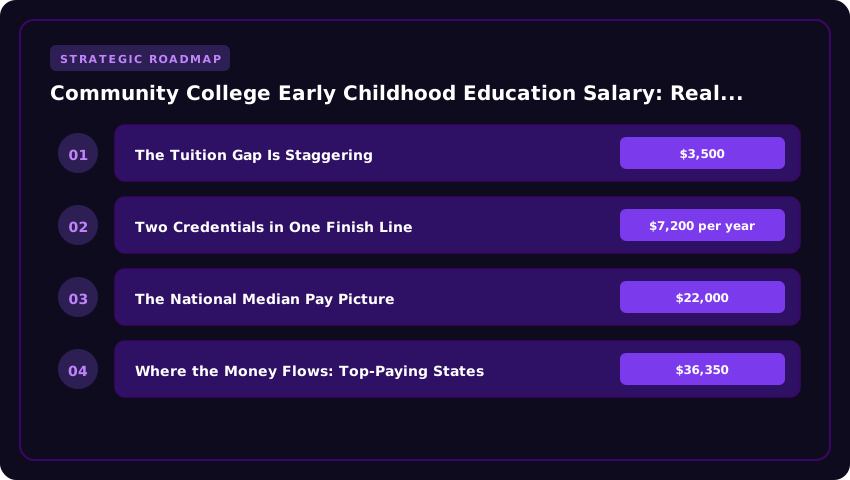
The Tuition Gap Is Staggering
According to College Board data, the average annual tuition and fees at a public two-year college run about $3,990 for in-district students, while out-of-district public four-year schools average $11,260, and private nonprofit four-year institutions climb above $41,540. Over a standard two-year ECE associate program, that translates to average savings exceeding $15,000—money that can go toward a car, childcare for your own family during clinical practicums, or simply reducing student loan debt.
Don’t forget that financial aid through the Free Application for Federal Student Aid (FAFSA) often flows to community college students just as readily as to four-year enrollees. Pell Grants, state-level promise scholarships, and workforce development grants (especially in high-demand “care economy” states like California, New York, and Virginia) can further slash out-of-pocket costs.
Two Credentials in One Finish Line
Many accelerated ECE associate programs, including those at NOVA and Houston Community College, embed the CDA credential requirements directly into the degree plan. That means you complete 120 hours of formal early childhood settings through practicum coursework, build the professional portfolio, and walk out of graduation eligible to apply for CDA verification—often before your official transcript even arrives. Holding both the AAS and the CDA expands your job pool dramatically, qualifying you for lead teacher positions, Head Start employment, and early-intervention paraprofessional roles that pay on the higher end of the preschool teacher wage scale.
BLS Salary Benchmarks for Associate-Level Early Childhood Educators in the United States
If you are weighing an Associate of Applied Science in Early Childhood Education against a four-year degree, the paycheck matters just as much as the tuition bill. The Bureau of Labor Statistics released its most current Occupational Employment and Wage Statistics report in May 2023, and the numbers tell a surprisingly optimistic story for two-year graduates entering the classroom.
The National Median Pay Picture
Across the country, preschool teachers earn a median annual wage of $33,620, which translates to roughly $16.16 per hour. The top 10 percent of earners in this category break past $50,000 annually, while the bottom 10 percent start near $23,000. Teaching assistants, a common first role for associate-level graduates, post a median wage of $30,210 per year, or about $14.53 hourly. Both figures are pulled directly from the BLS Occupational Employment Statistics survey and represent full-time, year-round compensation before benefits.
To put those salaries in context, the current federal minimum wage sits at $7.25 per hour, meaning an entry-level preschool teacher earns more than double that baseline within their first year on the job. Many community college alumni also layer in a Child Development Associate credential, which typically nudges starting offers upward by $1,500 to $3,000 depending on the employer.
Where the Money Flows: Top-Paying States
Geography reshapes the paycheck dramatically. According to the BLS state-level breakdown, three jurisdictions stand out for lead preschool teacher compensation:
- New York: Annual mean wage of approximately $48,680, fueled by New York City’s universal pre-K expansion and higher cost-of-living adjustments.
- Massachusetts: Annual mean wage near $46,920, supported by the state’s strong public preschool infrastructure and competitive union contracts.
- District of Columbia: Annual mean wage of roughly $52,310, the highest in the nation, driven by federal early-learning grants and the DC Public Schools salary schedule.
Conversely, states in the Southeast and Mountain West regions cluster closer to the $28,000 mark, so relocation flexibility can add $15,000 or more to a graduate’s lifetime earnings.
Job Growth That Outpaces the Average
The BLS Occupational Outlook Handbook projects 8 percent employment growth for preschool teachers through 2032, a rate faster than the 3 percent average projected for all occupations combined. Roughly 47,000 new openings are expected each year on average, replacing workers who transition into elementary education, administration, or family leave. That growth is anchored in expanded state-funded pre-K programs, Head Start expansions, and rising employer demand for center-based childcare as more mothers re-enter the workforce.
For prospective students comparing the associate-degree route to a bachelor’s pathway, the math is straightforward: two years of in-district community college tuition often totals under $7,000, while projected earnings start within months of graduation rather than four years down the road. The BLS data confirms that associate-level early childhood educators step into a labor market that is not just hiring, but actively competing for credentialed talent.
NAEYC Accreditation and State Licensure Reciprocity: What Associate Holders Must Verify
When you finish a two-year Early Childhood Education (ECE) program at a US community college, the diploma itself is not a license to teach. To work in regulated settings—public pre-K classrooms, Head Start centers, licensed child care programs, and many private preschools—you must clear a layered compliance checklist. Understanding the difference between NAEYC program accreditation and state-level teaching permits is the first step, and confusing the two is the most common mistake new graduates make when applying for their first job.
The National Association for the Education of Young Children (NAEYC) accredits college-level ECE programs, not individual teachers. A degree earned through an NAEYC-accredited pathway signals that your coursework—child development theory, practicum hours, curriculum planning—meets a recognized national benchmark. State teaching permits, by contrast, are issued by departments of education or child care licensing boards and authorize you to work in specific roles. For example, the California Commission on Teacher Credentialing issues the Child Development Teacher Permit under Title 5, while Texas uses the Texas Educator Certification system for early childhood roles under Title 22 administrative code. An associate degree that satisfies NAEYC standards does not automatically satisfy state permit requirements, and vice versa. You need both layers aligned.
Reciprocity Mapping for the Child Development Associate (CDA) Credential
The Child Development Associate (CDA) credential, awarded by the Council for Professional Recognition, is widely portable across states. However, reciprocity is partial. Several Title 22 states—including California and Texas—treat the CDA as a stepping-stone qualification that counts toward, but does not replace, a state permit or degree-mandated position. In California’s Title 22 child care programs, a CDA plus relevant experience can qualify you for a Child Development Associate Teacher permit, but Title 5 public preschool sites still require a full Child Development Teacher Permit, which typically requires an associate degree with specific coursework.
If you hold a CDA and plan to move between states, verify how the receiving state treats it:
- California (Title 22): CDA plus 12 college ECE units can qualify for the Associate Teacher permit, but a full Teacher permit requires a degree.
- Texas: CDA is accepted in licensed child care centers but does not substitute for the state paraprofessional or teacher certification required in public schools.
- New York, Florida, Illinois: Generally accept CDA for licensed center employment, but salary scales tied to public funding often require an associate or bachelor degree.
Head Start and Public Pre-K Employment Requirements
Federally funded Head Start and Early Head Start programs follow the Head Start Act, which mandates that lead teachers in center-based programs hold at least an associate degree in ECE or a related field, with at least 50% of lead teachers across a program holding a bachelor’s degree. Programs prefer or require NAEYC-aligned degrees because Head Start monitoring reviews—conducted by the Office of Head Start within the US Department of Health and Human Services—look for alignment between a teacher’s academic preparation and the NAEYC position statements and standards.
Public pre-K is stricter. State-funded pre-K classrooms generally require a state-issued teaching certificate or license, which almost always demands a bachelor’s degree for the lead role. However, the associate degree opens doors as an assistant teacher, paraprofessional, or family childcare provider—positions that, according to the US Bureau of Labor Statistics May 2023 Occupational Employment and Wage Statistics, paid median annual wages of $30,440 for childcare workers and $36,350 for preschool teachers. Before enrolling, confirm your community college’s ECE program carries both regional accreditation (from a body recognized by the US Department of Education or CHEA) and, when possible, NAEYC accreditation, so credits transfer cleanly into a future bachelor’s program and satisfy state permit coursework requirements.
Articulation Agreements: Transferring From Community College to a State University Teaching Program
An associate degree in Early Childhood Education is rarely the final stop for ambitious educators. Across the United States, formal articulation agreements between community colleges and state universities create predictable 2+2 pathways, allowing students to apply their first 60 semester hours directly toward a Bachelor of Science in Early Childhood Education and ultimately pursue PK-3 teacher licensure. For career-changers balancing tuition costs with full-time employment, these partnerships function like a financial GPS, eliminating redundant coursework and protecting junior standing at the receiving institution.
Real-World 2+2 Pathway Examples
Houston Community College (HCC) maintains a tightly mapped transfer pipeline with the University of Houston-Downtown (UHD). Students complete the Associate of Applied Science in Early Childhood Education, then move directly into UHD’s Bachelor of Applied Arts and Sciences with an ECE concentration, entering with full junior standing. Tuition at HCC runs roughly $2,820 per year for in-district students (College Board, 2023-24), while UHD averages $9,300 for Texas residents, meaning the entire bachelor’s pathway costs under $25,000, a fraction of the $80,000+ charged by private teacher-prep programs.
On the East Coast, Northern Virginia Community College (NOVA) has built a similarly strong pipeline with George Mason University. NOVA’s AAS in Early Childhood Development transfers fully into Mason’s Bachelor of Education in ECE, with courses like Foundations of Early Childhood Education, Child Growth and Development, and Curriculum for Young Learners recognized for transfer credit. Because Mason is an R1 research institution with Virginia’s largest teacher-preparation program, NOVA graduates gain access to high-quality practicum placements in Fairfax County Public Schools, the 10th-largest district in the nation.
Maximizing Transfer Credits and Junior Standing
The smartest move a community college student can make is preserving all 60 transferable semester hours. At institutions like the University of North Texas (UNT) and George Mason University, advisors will only honor credits that align with the receiving program’s general education core and major prerequisites. Students who pile up unrelated electives risk losing credit, which adds semesters and tuition costs. Working with a transfer advisor early, ideally by the second semester, ensures every course counts toward the bachelor’s.
For Texas residents, the Texas Transfer Framework and the Field of Study curriculum in Early Childhood Education guarantee that completing the AAS at any public community college satisfies lower-division requirements at any Texas public university offering the matching bachelor’s degree. UNT, Texas State University, and Sam Houston State University all participate, which means a student in El Paso can plan to finish in Houston without losing credit.
Online Finishers for Working Educators
Most state universities now offer the final two years of the ECE bachelor’s fully online, designed specifically for working paraprofessionals, Head Start teachers, and child-care center staff. Mason’s ECED Online Completion Program charges roughly $625 per credit hour for out-of-state students and delivers asynchronous coursework in eight-week blocks, allowing educators to log in after their shifts end. UNT’s EC-4 Online Program offers synchronous evening classes plus two short on-campus residencies, paired with paid practicum experiences in the student’s home district.
For career-changers worried about debt, these online finishers preserve employment income while moving toward a median kindergarten teacher salary of $67,790 (BLS May 2023) and eventual PK-3 licensure through the state’s Department of Education.
Career Advancement Beyond the Classroom: Specializations That Boost Associate-Degree ECE Salaries
An Associate of Applied Science (AAS) in Early Childhood Education is often framed as a terminal credential for assistant teachers, but that perception undersells the degree’s true earning potential. Within just three to five years of graduation, most career-changers pivot into specialized roles that command measurable salary premiums. The two-year investment keeps paying dividends long after the last tuition payment clears.
Lead Teacher and Center Director Tracks
The most common vertical move is stepping up to Lead Teacher, a role that typically adds $4,000 to $8,000 annually over standard instructor pay. Lead Teachers mentor newer staff, design age-appropriate curricula, and serve as the primary point of contact for parents during developmental conferences. From there, the Center Director pathway offers the most dramatic salary climb for associate-degree holders, with metropolitan markets like Boston, Seattle, San Francisco, and the Washington DC suburbs pushing compensation into the $48,000 to $55,000 range.
Directors oversee licensing compliance under state departments of education, manage enrollment pipelines, and handle staff scheduling for centers that may employ 15 to 30 educators. Many community colleges embed director-track coursework directly into the AAS curriculum, covering business operations, HR fundamentals, and accreditation standards from the National Association for the Education of Young Children (NAEYC). That built-in scaffolding means graduates can often qualify for director positions within 24 months of hire.
Bilingual Premium Differentials
For Spanish-English bilingual educators, the salary math gets even more attractive. Districts and childcare networks across California, Texas, Florida, New York, and Illinois routinely offer premium differentials of 5% to 10% for verified bilingual proficiency. In high-need urban districts, that premium can translate into an extra $2,500 to $4,800 annually, on top of regular step increases.
Verification typically requires passing a standardized language assessment such as the Language Testing International (LTI) Oral Proficiency Interview or the California Spanish Assessment. Many community colleges now offer bilingual ECE concentrations that satisfy both credentialing and language requirements simultaneously, making the premium accessible without extending the two-year completion timeline.
Lateral Moves into Non-Instructional Roles
Not every ECE graduate thrives in daily classroom interaction, and the degree’s transferability opens strong lateral doors. Three non-instructional specializations consistently deliver above-median wages:
- Curriculum Coordinator: These professionals design lesson frameworks for entire school districts or large childcare chains, typically earning $45,000 to $58,000. The role suits detail-oriented educators who enjoy research and writing over hands-on teaching.
- Family Services Specialist: Working for Head Start programs, county social services, or community-based nonprofits, these specialists earn $42,000 to $52,000 while connecting families with housing, healthcare, and nutrition resources. The role often qualifies for Public Service Loan Forgiveness (PSLF) after 120 qualifying payments.
- Early Intervention Paraprofessional: Supporting children with developmental delays alongside occupational therapists and speech-language pathologists, these specialists earn $38,000 to $48,000. Many states require additional credentialing, but the AAS foundation dramatically shortens the certification timeline.
Each pathway demonstrates the same core principle: the AAS in ECE functions less as a finishing point and more as a launchpad. Career-changers who treat the degree as a foundation for specialization consistently out-earn peers who stop at the entry-level preschool teacher role, often recouping their entire tuition investment within 18 months of graduation.
Tuition at US community colleges remains a bargain compared to four-year universities, but the final out-of-pocket cost for an Early Childhood Education (ECE) associate degree depends heavily on how aggressively a student pursues federal and state aid. According to the US Department of Education and the Free Application for Federal Student Aid (FAFSA), qualifying learners can routinely knock $4,500 to $5,500 off their annual tuition bill through the Federal Pell Grant program alone, which is a need-based award that does not require repayment. For students whose families fall under the qualifying income threshold, this single form can cover a substantial portion of an associate degree priced near the $3,500 to $7,200 in-district range we covered earlier, sometimes leaving only book fees and a small balance remaining.
Beyond Pell, the Teacher Education Assistance for College and Higher Education (TEACH) Grant offers up to $4,000 per year for students who commit to serving in high-need early childhood classrooms after graduation. The trade-off is a service obligation: recipients must work in a qualifying low-income school or designated shortage area for at least four academic years within eight years of completing their program. ECE students should weigh this carefully, because the grant converts into an unsubsidized federal loan if the service requirement is not satisfied.
State-Level Scholarships Worth Applying For
- California ECE Workforce Development Grants: Administered through the California Department of Education, these grants subsidize tuition and materials for students enrolled in approved child development permit programs at community colleges across the state.
- Virginia Child Care Subsidy Program: While primarily a workforce support tool for childcare providers, Virginia uses a portion of its funding to reimburse tuition for current ECE professionals pursuing credentials, including associate degrees.
- T.E.A.C.H. Early Childhood Project: Operating in more than a dozen states including Colorado, Pennsylvania, and Ohio, this scholarship model pays tuition upfront in return for a commitment to remain employed at a participating childcare center for a defined period.
Career-changers should also explore their employer’s tuition reimbursement benefits, since many Head Start programs, YMCAs, and corporate childcare chains now partner with community colleges to cover remaining balance after Pell funds are applied. When stacking FAFSA, a TEACH Grant, and a state scholarship, the realistic out-of-pocket cost for an ECE associate degree can fall to under $1,000 total, making the two-year path to a $36,350 median preschool teacher salary (per the Bureau of Labor Statistics May 2023 data) one of the strongest returns on investment in the professional upskilling market today.
Job Placement Realities: Where Associate-Level ECE Graduates Actually Get Hired
Landing your first paid role after earning an Associate of Applied Science in Early Childhood Education rarely happens through a single job board application. Most graduates find their footing inside a tight-knit ecosystem of public programs, private operators, and faith-based networks that already know they need credentialed teachers. Knowing exactly where the hiring managers sit changes the entire search from a guessing game into a targeted, almost clinical effort.
Top Employers Recruiting AAS Graduates Right Now
- Head Start and Early Head Start grantees — Community Action Agencies, school districts, and nonprofit operators funded through the US Department of Health and Human Services consistently hire associate-level teachers because federal performance standards require at least 50% of Head Start staff to hold a degree in ECE or a related field.
- Public pre-K classrooms — State-funded pre-K expansion in Texas, Florida, and California has created thousands of openings for lead teachers with an AAS credential, often with paraprofessional-to-teacher pipelines built right into district HR portals.
- Faith-based childcare networks — Church-affiliated preschools and early learning centers (Bright Horizons partners, Cadence Education sites, and independent ministries) hire heavily because they balance tuition affordability with credentialed instructional staff.
- Montessori and private early learning centers — AMI or AMS-affiliated schools frequently pair an associate degree with Montessori credentialing, creating a faster route into lead-guide roles than a four-year path.
Geographic Hotspots Where Demand Outpaces Supply
Four US regions consistently run short of associate-level ECE talent. The Texas Triangle (Houston, Dallas-Fort Worth, Austin, San Antonio) continues posting double-digit growth in pre-K enrollment. Southern California’s Riverside-San Bernardino and Inland Empire corridors have absorbed waves of substitute shortages. Florida’s I-4 corridor from Tampa through Orlando keeps expanding VPK classrooms, and the Mid-Atlantic cluster — particularly Northern Virginia, suburban Maryland, and the DC metro — competes fiercely for bilingual lead teachers. In each of these markets, starting offers routinely climb $2 to $4 above the BLS median once benefits and sign-on bonuses are factored in.
Networking Resources That Actually Move the Needle
- NAEYC’s Job Board — The National Association for the Education of Young Children runs the largest ECE-specific job marketplace in the country, and employers list openings there before pushing them to Indeed or LinkedIn.
- State workforce development boards — Every US state operates a Workforce Innovation and Opportunity Act (WIOA) board that funds free training, apprenticeship stipends, and direct placement for ECE candidates.
- Local Child Care Resource and Referral (CCR&R) agencies — These regional hubs maintain real-time supply-and-demand dashboards and actively refer graduates to hiring directors.
- Community college career services and practicum supervisors — Many AAS programs place students directly into the classrooms where they later receive job offers, making practicum performance the single strongest networking asset available.
Treat the job hunt like a referral-based profession rather than a résumé-submission process. The graduates who convert their credential into a $38,000 to $44,000 starting salary almost always do so because they showed up to NAEYC affiliate events, registered with their CCR&R, and treated every practicum day as an audition. The demand is real; the placements favor the prepared.
| Decision Criteria | Community College AAS ECE (In-District) | Public 4-Year Bachelor’s (In-State) | Private 4-Year Bachelor’s |
|---|---|---|---|
| Annual Tuition & Fees | $3,500 – $7,200 | $10,000 – $12,000 | $35,000 – $55,000+ |
| Est. Total Program Cost | $7,000 – $14,400 | $40,000 – $48,000 | $140,000 – $220,000+ |
| Time to Workforce Entry | 2 Years (Full-time) | 4 Years (Full-time) | 4 Years (Full-time) |
| Stackable Credentials Included | CDA Credential, State Director Credential prep | State Teaching License (Birth–Grade 3) | State Teaching License (Birth–Grade 3) |
| Median Entry Salary (Preschool Teacher) | $36,350 (BLS May 2023) | $36,350 – $45,000+ (License differential) | $36,350 – $45,000+ (License differential) |
| Transfer Pathway to Bachelor’s | Seamless 2+2 Articulation Agreements | N/A (Terminal Degree) | N/A (Terminal Degree) |
| Typical Admission Requirements | HS Diploma/GED, Placement Test, Background Check | HS Diploma, GPA 2.5+, SAT/ACT, Essays | HS Diploma, GPA 3.0+, SAT/ACT, Essays, Recs |
| ROI Advantage (5-Year Horizon) | High (Low debt, 2-yr head start earning) | Moderate (Higher debt, license ceiling higher) | Low (High debt, same entry license ceiling) |
Frequently Asked Questions
What is the average salary for community college early childhood education graduates?
Graduates with an AAS in Early Childhood Education earn a median annual wage of $36,350 as preschool teachers, per BLS May 2023 data. With the embedded CDA credential, many secure lead teacher roles at $38,000–$42,000 in Head Start or public pre-K programs, outpacing non-credentialed peers by 10–15%.
How much does an associate degree in early childhood education cost at community college?
In-district tuition for an AAS in ECE ranges from $3,500 to $7,200 per year, totaling $7,000–$14,400 for the full program. This is roughly 80% less than public four-year tuition ($40k+) and 95% less than private institutions ($140k+), making it the lowest-cost entry point to a licensed teaching pathway.
Can you get a CDA credential while earning an associate degree in ECE?
Yes, most regionally accredited community college AAS programs embed the 120-hour formal education requirement for the Child Development Associate (CDA) credential into coursework. Students typically compile their professional portfolio and complete the verification visit during their final semester, graduating with both the degree and the nationally recognized CDA.
Does an associate degree in early childhood education transfer to a bachelor's program?
Most community colleges maintain 2+2 articulation agreements with public universities, allowing seamless transfer of 60–66 credits into a Bachelor’s in Early Childhood Education or Birth-Kindergarten Licensure. Graduates enter as juniors, cutting bachelor’s completion time and cost in half while retaining the CDA and work experience.
What jobs can you get with an associate degree in early childhood education?
Qualifying roles include Lead Preschool Teacher ($36k–$42k), Head Start Teacher ($38k–$45k), Childcare Center Assistant Director ($40k–$48k), Early Intervention Assistant ($35k–$40k), and Family Childcare Owner. State licensing often requires the CDA or AAS for director credentials, giving associate holders a regulatory edge over certificate-only staff.
Strategic Final Takeaway
When evaluating Community College Early Childhood Education Associate Degree Salary And Career Path, base your decisions on accredited institutional standards, measurable return on investment (ROI), and up-to-date official guidelines. Always verify specific dates and requirements through official regulatory portals.