Why Starting at a Community College Slashes the Cost of an ECE Bachelor’s Degree
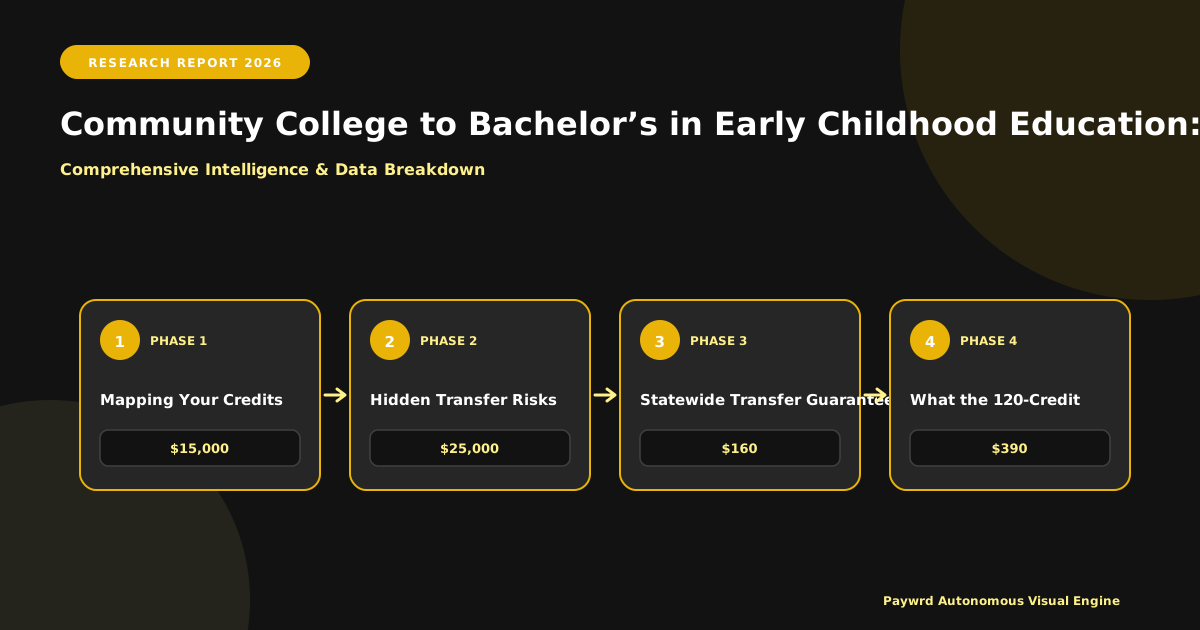
Let’s talk raw numbers, because that is where the community college advantage hits hardest. The College Board reports that in-state public community college tuition averages around $160 per credit hour, while a public four-year university charges roughly $390 per credit hour for in-state undergraduates. If you complete your first 60 credits at a community college before transferring, that 60-credit head start saves you approximately $13,800 in tuition alone. Factor in campus fees, parking passes, and overpriced textbooks at four-year schools, and the real-world savings routinely climb past the $20,000 mark, especially when you stack in lost earning potential from delaying workforce entry.
An Associate of Arts in Teaching (AAT) or a standard AA in Early Childhood Education does more than save money; it is a passport to junior-year standing. These degrees are specifically engineered to satisfy the lower-division general education and introductory pedagogy coursework that a Bachelor of Science in ECE requires. When you transfer with an AAT, you walk onto the receiving campus (or log into its online portal) with two full years already checked off, meaning you only need 60 more credits to graduate, not 120.
Mapping Your Credits to Junior-Year Standing
Before you sign that enrollment agreement, you need a credit-by-credit map. Most ECE bachelor’s programs expect transfer students to arrive with completed coursework in:
- English Composition I & II (6 credits)
- College Algebra or Statistics (3 credits)
- U.S. History and Government (6 credits)
- Natural Sciences with labs (8 credits)
- Introduction to Early Childhood Education and Child Development (6 credits)
Notably, many schools require a minimum 2.5 to 2.75 GPA for admission into the teacher preparation track. Fall below that threshold, and your credits may transfer, but your major acceptance could be denied.
Hidden Transfer Risks You Must Audit
Transferring is rarely as seamless as the glossy brochure suggests. The three most common derailers are general-education mismatches, capstone credits, and GPA cutoffs. A capstone or practicum at your community college, for instance, rarely substitutes for the senior-year student teaching required for state licensure. Additionally, some receiving universities will only accept a “C” or better, meaning a “C-minus” in a transfer course can quietly evaporate from your transcript.
Statewide Transfer Guarantee Policies Worth Leveraging
To protect your investment, lean on formal articulation agreements already on the books. Texas’s Field of Study in Early Childhood Education, the Illinois Articulation Initiative (IAI), and Florida’s 2+2 pathways all guarantee that an AA or AAT from an accredited community college transfers as a block to participating four-year state universities. Run your planned coursework through the receiving institution’s transfer evaluator, usually staffed by an academic advisor in the Education department, and get the agreement in writing before you enroll. That single document is the difference between a $25,000 save and a costly semester of repeat coursework.
Inside the Online Bachelor’s in Early Childhood Education with State Licensure

Once you have stacked up your Associate of Arts in Teaching (AAT) or an equivalent transfer-focused degree, the next move is choosing a four-year completion program that is genuinely built for working early-childhood professionals. A high-quality online bachelor’s in Early Childhood Education (ECE) is not simply a traditional program uploaded to a learning management system. The best options weave together developmental theory, classroom-ready pedagogy, and the specific state benchmarks you need to walk into your own PreK–3 classroom with a recommendation for licensure in hand.
What the 120-Credit Curriculum Actually Looks Like
Most online ECE completion degrees are structured around 120 total semester hours, with roughly 60 already satisfied by your associate degree. The remaining upper-division coursework is typically divided into five core pillars:
- ECE Core (18–24 credits): child development from birth through age 8, family systems, and observation-based assessment.
- Pedagogy and Methods (15–18 credits): play-based curriculum design, classroom management, and developmentally appropriate practice.
- Literacy and Language Arts (9–12 credits): emergent literacy, phonics, balanced reading instruction, and English-Learner supports.
- Special Education and Inclusion (6–9 credits): IEP basics, Universal Design for Learning, and serving students with exceptionalities in inclusive settings.
- Practicum and Student Teaching (9–12 credits): supervised field hours culminating in a full-semester lead-teaching placement.
Formats That Respect a Working Aide’s Schedule
Head Start staff, paraprofessionals, and lead teachers rarely get a 9-to-5 release to study. That is why the strongest programs lean into two delivery models. Asynchronous cohorts let you log in at 10 p.m. after bedtime routines, watching recorded lectures and posting in discussion boards on your own clock. Hybrid cohorts pair that same online flexibility with one or two Saturday residencies per semester, often held at regional partner sites. Either way, expect to commit 15 to 20 hours per week over eight-week accelerated terms or traditional 16-week semesters.
Accreditation Markers That Protect Your License
Before you fall in love with a tuition price, verify two specific credentials. First, look for CAEP (Council for the Accreditation of Educator Preparation) accreditation, the field’s gold standard and a prerequisite for licensure reciprocity in most states. Second, confirm regional accreditation through bodies like the Higher Learning Commission (HLC) or SACSCOC. A program lacking either flag will not pass a state Department of Education background check, regardless of how polished the website looks.
How Field Placement Actually Works Online
Yes, you still need in-person student teaching, and universities handle the logistics for you. Admission coordinators typically tap into networks of partner school districts, Head Start grantees, and licensed child-care centers within a 60-mile radius of your home. You will work with a site-based mentor teacher and a university supervisor who observes via video or occasional site visits. This hub model means an aide in rural Mississippi can complete the same accredited practicum sequence as a peer in suburban Phoenix, without relocating.
State-by-State Teaching License Reciprocity After an Online ECE Bachelor’s
Earning an online bachelor’s in Early Childhood Education (ECE) is only half the battle; the license you ultimately hold dictates where you can actually teach. Because each U.S. state runs its own Department of Education or Office of Educator Certification, reciprocity is rarely automatic. Understanding the three credential tiers, the exam stack, and the NASDTEC Interstate Agreement can save you months of paperwork and, more importantly, keep your paycheck moving if you relocate from Houston to Sacramento or from Albany to Tampa.
Initial vs. Professional vs. PreK Endorsement: Know Your Credential
An initial license (sometimes called a Provisional or Tier I license) is your entry-level ticket. It is typically valid for three to five years and is non-renewable in perpetuity; you must complete a state-approved induction program and graduate coursework to advance. A professional license (Tier II or Standard) is the renewable career credential that signals you have cleared those early hurdles. Layered on top of either is a PreK-specific endorsement, which authorizes you to teach children from birth through age five or eight, depending on the state. Texas calls it the “EC-3 Generalist,” Florida labels it “Prekindergarten/Primary,” and New York uses “Early Childhood Education (Birth-Grade 2).” Your online program must lead to the endorsement your target state recognizes, so map the credential to the zip code before you enroll.
The Exam Stack: Praxis Core, Praxis II 5025, and edTPA
Most states will not issue even an initial license until you pass three gates:
- Praxis Core Academic Skills for Educators (reading, writing, math) or equivalent SAT/ACT scores meeting state cutoffs.
- Praxis II Early Childhood Education (5025) with passing scores ranging from 156 (Georgia) to 162 (California).
- edTPA portfolio, a video-recorded teaching submission scored by Pearson, required by 600+ teacher-prep programs nationwide.
Budget roughly $300 to $550 in testing fees and a six- to nine-month window to complete all three while finishing your student teaching semester.
Compact Rules: How NASDTEC Eases Interstate Moves
The NASDTEC Interstate Agreement is a 50-state compact that lets educators transfer a “clear” license without re-testing, provided their original state signed the reciprocity clause. Texas, California, New York, and Florida are all signatories, so a Texas-certified PreK teacher with a clean record can typically apply for a California Preliminary credential through a streamlined NASDTEC pathway, bypassing the full Praxis Core requirement. However, you still must complete state-mandated modules on local standards and may need to take a state-specific pedagogy exam.
Background Checks, Fingerprinting, and CPR
Every state requires fingerprint-based criminal background clearance through FBI channeling, with fees between $40 and $100. Plan a 30- to 45-day processing window. In addition, eight states (including New York and Florida) mandate a current Pediatric CPR/First Aid micro-credential for any educator working with children under five, often a two- to four-hour online certification costing under $60.
Decision Matrix
- Texas resident: Target an Initial EC-3 certificate; expect $300+ in test fees and TExES exams instead of Praxis II.
- California resident: Pursue a Preliminary credential with a PreK authorization; pass the California Basic Educational Skills Test (CBEST) or Praxis Core plus edTPA.
- New York resident: Earn Initial certification for Birth-Grade 2; New York State Education Department requires three edTPA tasks and 100 hours of practicum.
- Florida resident: Secure a Professional certificate with a PreK/Primary endorsement; complete the Florida Teacher Certification Examinations (FTCE) and a Department of Children and Childcare provider background screening.
Match your state of residence to the credential above, schedule Praxis Core in your first semester, Praxis II in semester five, and edTPA during student teaching, and you will graduate fully licensure-eligible, ready to teach on day one in any signatory state.
Articulation Agreements That Guarantee Junior-Year Admission
Not all “transfer-friendly” programs are created equal. The gold standard in the early childhood education (ECE) world is a formal articulation agreement, sometimes called a “2+2” deal, signed between your community college and a specific four-year university. These signed contracts spell out exactly which Associate of Arts (AA) or Associate of Arts in Teaching (AAT) credits transfer, and they guarantee junior-year admission once you hit the GPA threshold and finish your prescribed coursework.
Here are a few named, verifiable examples you can model your own research on:
- Northern Virginia Community College (NOVA) to George Mason University (GMU): NOVA’s AAT in Education feeds directly into GMU’s Bachelor of Education in ECE, with the catalog outlining exactly which courses satisfy the lower-division requirements.
- Houston Community College (HCC) to the University of Houston (UH): HCC offers a tagged Teacher Education AAT that pairs with UH’s College of Education, letting you start as a junior once your transcript posts.
- Miami Dade College (MDC) to Florida International University (FIU): MDC’s Associate in Arts in Teaching transfers into FIU’s Bachelor of Science in Early Childhood Education, provided you complete the state-mandated common prerequisites.
Reverse-Transfer: Your Workforce Safety Net
Before you commit, ask the university admissions advisor one smart question: “Does your institution honor a reverse-transfer policy?” A reverse-transfer agreement lets you retroactively combine your university credits with earlier community college work to earn the AA degree after you transfer. If life happens, a job change, a move, or a pause in enrollment, that AA credential lets you re-enter the workforce as a qualified early-childhood educator without having to finish the full bachelor’s. Programs at many US public universities have this policy built in, but you must explicitly request the audit through your registrar.
Front-Loading Credits in High School
High school juniors and seniors in dozens of US states can front-load college ECE credits through dual-enrollment. Because state-funded programs often waive tuition, you can graduate high school with half of your AA already complete, shortening both time and total tuition cost. Check your state Department of Education portal for the dual-enrollment reciprocity list, and confirm the credits articulate into your target university’s ECE degree path before signing up.
Advisor Red Flags to Watch For
If an admissions advisor says the program accepts “up to 60 credits” from your associate degree, press for the fine print. Many institutions apply only 45 credits toward graduation, forcing you to repeat coursework or pad your schedule with electives. Ask: “Of those 60 transferable credits, how many count toward the 120-credit ECE degree requirement?” A signed articulation agreement will give you a guaranteed number; a vague “up to” statement is a negotiation, not a guarantee.
Bottom line: get the agreement in writing, confirm the reverse-transfer policy, and verify the credit-by-credit application before you enroll. Then send that email to your advisor today.
Paying for the Degree: FAFSA, TEACH Grants, and ECE Scholarships
Tuition sticker shock is real, but the funding puzzle for an online ECE bachelor’s degree almost always adds up to a near-zero net price when you stack federal, state, and employer dollars the right way. The trick is treating financial aid like a semester project: file early, read every comment, and chase every scholarship your state and employer quietly offer.
FAFSA First: Beat the Priority Deadline and Decode Your SAR
Every fall transfer student should submit the Free Application for Federal Student Aid (FAFSA) by the institutional priority date, typically March 1 or April 1 for most four-year universities. File the FAFSA at studentaid.gov using your prior-prior year tax returns, and list your four-year school code first even if you are still finishing your associate degree. Once processed, the Department of Education issues a Student Aid Report (SAR) packed with “comments” that often delay disbursement. Comment codes like C-code flags for verification or unresolved match issues with the Social Security Administration can hold up Pell Grants, work-study, and even subsidized loans until you submit tax transcripts or a verification worksheet. Pro tip: refresh your email the day after filing and clear every SAR flag within 72 hours, or risk a late disbursement that forces you to pay out of pocket while waiting for the refund.
TEACH Grant: Free Money That Bites Back
The Teacher Education Assistance for College and Higher Education (TEACH) Grant converts up to $4,000 per year into an unsubsidized loan if you skip the service obligation. To keep it as a grant, you must teach full time for four complete academic years within eight years of finishing your program, in a low-income school (Title I) serving high-need students such as early childhood special education or ELL. Skip the obligation and the entire grant retroactively becomes a $16,000+ Direct Unsubsidized Loan with interest capitalized from the original disbursement date. Counselors must sign off annually, and you must submit ACT or SAT scores above the 75th percentile or maintain a 3.25 GPA, so verify eligibility through your university’s financial aid office before committing.
State ECE Scholarships You May Be Leaving on the Table
State-funded programs frequently subsidize the exact pathway you are walking. California’s Child Development Permit stipend reimburses permit fees and offers early childhood mentor teacher stipends through the Commission on Teacher Credentialing. Nationwide, the T.E.A.C.H. Early Childhood® scholarship, administered through the Child Care Services Association, pays tuition and books for working childcare professionals pursuing an associate, bachelor’s, or credential, with a one-year employer retention contract. Texas, New York, and Illinois run parallel stipend programs, so always check your state Department of Education portal.
Employer Tuition Reimbursement: Your Hidden Raise
Major ECE employers fund the degree themselves. Bright Horizons offers up to $5,250 annually in tuition reimbursement for coursework leading to a degree in early childhood or elementary education. KinderCare runs a similar program that pays tuition upfront at partner universities. Public PreK districts, including Head Start grantees, frequently reimburse coursework under the federal Head Start Act professional development budget. Stack these employer dollars on top of Pell, TEACH, and state scholarships, and your net out-of-pocket cost can realistically land at zero.
Career Outcomes and US Salary Benchmarks for Licensed ECE Teachers
Let’s talk about the return on investment, because that’s the real question for any professional upskilling journey. According to the US Bureau of Labor Statistics (BLS), preschool teachers across the United States earned a median annual wage of $47,640 in 2023, while kindergarten teachers averaged $61,620. Both fields project steady employment growth between 4% and 5% over the coming years, slightly outpacing the national average across all occupations. That stability translates directly into reliable demand for licensed educators, particularly those holding a bachelor’s degree and state certification. When you anchor your degree plan to verifiable BLS Occupational Outlook data, you remove the guesswork from your long-term financial planning.
The Public vs. Private Sector Pay Gap
Where you teach matters as much as what you teach. Head Start programs, often federally administered through grants and nonprofit partnerships, typically compensate lead teachers in the $33,000 to $45,000 range. By contrast, licensed kindergarten teachers in urban public school districts frequently command salaries between $55,000 and $78,000, depending on the state salary scale and local cost-of-living adjustments. Public sector roles also tend to offer more predictable step increases, pension eligibility, and comprehensive benefits packages that significantly boost total compensation beyond the base paycheck.
Salary Bumps Tied to a Bachelor’s Degree
Finishing your bachelor’s after an associate credential isn’t just a formality. It delivers measurable financial leverage. Most school districts pay 8% to 15% more to fully licensed teachers with a bachelor’s degree compared to associate-level lead teachers working under provisional permits. That salary differential compounds year over year, frequently adding up to tens of thousands of dollars across a full career, not counting enhanced job security and access to tenure-track positions.
Career Ladders Beyond the Classroom
A bachelor’s in Early Childhood Education opens doors well beyond daily instruction. Experienced teachers frequently transition into roles like curriculum specialist, instructional coordinator (BLS median salary of $66,490 in 2023), or PreK program director overseeing multi-site operations. Each of these advancement tracks requires the bachelor’s credential as a baseline, which means stopping at the associate level effectively caps your upward mobility before you even begin climbing.
- Preschool teacher median wage: $47,640 annually (BLS 2023)
- Kindergarten teacher median wage: $61,620 annually (BLS 2023)
- Head Start lead teacher range: $33,000 to $45,000
- Urban public kindergarten range: $55,000 to $78,000
- Instructional coordinator median: $66,490 annually (BLS 2023)
- Bachelor’s pay bump vs. associate: 8% to 15% typical increase
| Decision Criterion | Community College Start (AA/AAT) | Direct 4-Year University Path |
|---|---|---|
| Total Tuition Cost (4-Year Degree) | $25,000 – $35,000 | $40,000 – $60,000+ |
| Cost Per Credit Hour (In-State) | ~$160 | ~$400 – $1,200 |
| Total Estimated Savings | $15,000 – $25,000 | $0 (Baseline) |
| Admission Requirement (Year 1-2) | Open Enrollment / High School Diploma/GED | Competitive GPA (2.5-3.0+), SAT/ACT often required |
| Transfer Requirement (Year 3-4) | GPA 2.0-2.5 minimum (varies by state articulation agreement) | Not Applicable |
| Average Timeline to Bachelor’s | 4 Years (2+2 Model) | 4 Years (Traditional) |
| State Licensure Eligibility (ECE) | Yes (via accredited transfer pathway) | Yes (standard pathway) |
| Average Starting U.S. Salary (PreK-3 ECE Teacher) | $38,000 – $45,000 | $38,000 – $45,000 |
| Prerequisite Credential | None (Dual enrollment available) | High School Diploma / Standardized Tests |
| Financial Aid / FAFSA Eligibility | Yes (Federal Pell Grant common) | Yes (Federal & Institutional Aid) |
| ROI (Year 1 Earnings vs. Total Cost) | ~110% – 180% | ~63% – 95% |
Frequently Asked Questions
How much does an online bachelor's in Early Childhood Education cost if I start at a US community college?
Starting at an in-state US public community college at roughly $160 per credit hour saves students between $15,000 and $25,000 over a traditional four-year university path. Completing an Associate of Arts in Teaching (AAT) guarantees a 2+2 transfer to a four-year institution for state licensure.
What is the difference between an Associate of Arts (AA) and an Associate of Arts in Teaching (AAT) for ECE teachers?
An Associate of Arts (AA) is a general transfer degree requiring manual course-by-course articulation, while an Associate of Arts in Teaching (AAT) in Early Childhood Education is a state-prescribed curriculum guaranteeing seamless junior-year transfer to participating US four-year universities for licensure.
What GPA do I need to transfer from a community college to an online ECE bachelor's program?
Most US four-year universities require a minimum transferable GPA of 2.0 to 2.75 for Early Childhood Education articulation agreements. However, competitive online programs, especially those leading to initial state licensure, often prefer a 3.0 GPA to ensure passing Praxis Core scores.
Can you get an Early Childhood Education teaching license fully online in the US?
Yes, many US regionally accredited universities offer fully online Bachelor's in Early Childhood Education completion programs for transfer students. These hybrid pathways use virtual coursework combined with local in-person student teaching placements to satisfy state Department of Education licensure requirements.
What is the average salary for a preschool teacher with a bachelor's degree in the US?
According to the US Bureau of Labor Statistics, preschool teachers with a bachelor's degree earn a median annual salary of approximately $39,000, with top-paying states like Massachusetts, New York, and California offering starting ECE salaries between $45,000 and $55,000 annually.
Strategic Final Takeaway
When evaluating Community College Early Childhood Education Bachelor's: Community College vs University Salary & Perception 2026">Early Childhood Education Bachelors Degree Licensure Pathway Online, base your decisions on accredited institutional standards, measurable return on investment (ROI), and up-to-date official guidelines. Always verify specific dates and requirements through official regulatory portals.