Decoding the ‘Community College Baccalaureate’ Landscape in 2024
If you still picture community colleges as nothing more than stepping stones to a state university, the 2024 legislative map will genuinely surprise you. Over the past decade, a quiet revolution has swept through state capitols from Olympia to Tallahassee, quietly reclassifying community colleges as baccalaureate-granting institutions. Today, professionals evaluating upskilling options can pursue a fully accredited bachelor’s degree from a school that costs roughly $4,000–$5,000 per year in tuition, often while continuing to work full-time close to home.
Where the Community College Bachelor’s Degree Is Actually Legal
The patchwork of state authorization is everything. Washington State paved the way back in 2007 with its Workforce Bachelor’s degree legislation, and Florida quickly followed with its Statute 1007.33 framework, which now allows its 28 state colleges to offer dozens of baccalaureate tracks. Colorado has emerged as another powerhouse, with institutions like Colorado Mesa University (formerly Mesa State) and the Community College of Aurora pushing applied bachelor’s enrollment past 5,000 students annually. Texas, California, and Georgia round out the most active jurisdictions, though California’s approval process remains notoriously slower due to its 117-campus California Community Colleges system coordinating through the Chancellor’s Office. Before enrolling anywhere, verify your target program appears on your state’s Board of Higher Education approved-degree list, because unauthorized programs won’t qualify for federal FAFSA financial aid or professional licensure.
Applied Baccalaureate (BAS) vs. Traditional BS/BA: What Actually Matters
The terminology alone trips up most prospective students. A traditional Bachelor of Science (BS) or Bachelor of Arts (BA) emphasizes theoretical frameworks, general education breadth, and research methodology. The Bachelor of Applied Science (BAS), by contrast, stacks technical associate-degree credits underneath and builds upward into management, advanced clinical practice, or systems design. For working professionals, the BAS route typically translates to 60+ credits already completed, cutting both time-to-degree and total cost by roughly half. The degree itself, when awarded by a regionally accredited institution, carries identical weight for federal employment, graduate school admission, and industry credentialing.
Where the Hiring Demand Actually Lives: Nursing, IT, and Cybersecurity
The community college baccalaureate isn’t expanding equally across disciplines; it’s concentrating aggressively where the Bureau of Labor Statistics projects the steepest workforce shortages through 2032. Registered Nursing (RN-to-BSN) programs remain the single largest enrollment category, directly addressing hospital Magnet status requirements and the BSN-in-10 legislation now active in New York, New Jersey, and Massachusetts. Information Technology and Cybersecurity tracks rank second, designed in close consultation with ABET-aligned competency standards and often mapped to CompTIA, AWS, and Cisco certifications embedded into the curriculum. Education, specifically K-12 teaching through alternative-certification pathways, rounds out the top three concentrations, particularly in states like Texas where teacher shortages have crossed critical thresholds.
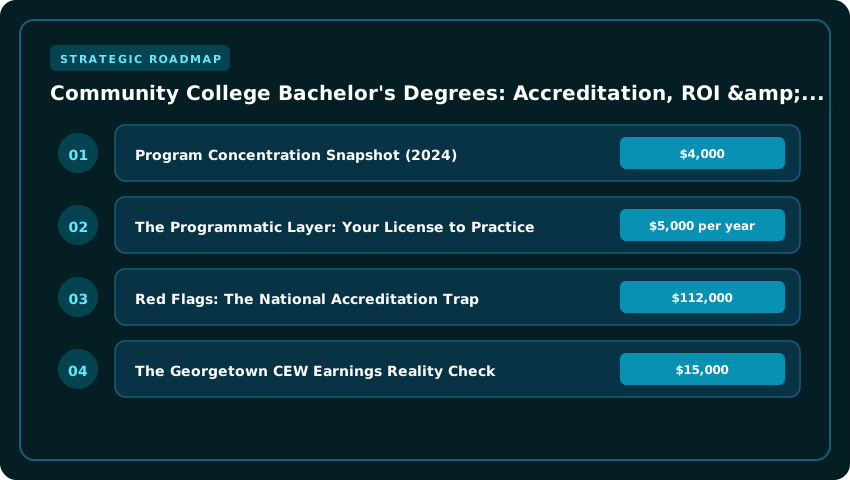
Program Concentration Snapshot (2024)
- Nursing (RN-to-BSN): Highest enrollment volume; BSN now required for many hospital positions
- Cybersecurity & IT: Fastest growth sector; median salary $112,000 per BLS 2024 data
- Education & Teaching: Alternative-certification pathways addressing K-12 shortages
- Health Information Management: Rising field blending clinical knowledge with data analytics
- Industrial & Construction Management: Trades-focused bachelor’s addressing infrastructure workforce gaps
The strategic takeaway here is straightforward: the community college baccalaureate is no longer an experiment. It is a deliberate state-level economic development strategy targeting the middle-skill labor gap, and for career-switchers weighing tuition ROI, the math increasingly favors this route over traditional four-year residential programs.
Accreditation Hierarchy: Regional vs. Programmatic vs. National Risks
Let’s cut through the bureaucracy: if your community college bachelor’s program lacks regional accreditation, stop reading and look elsewhere. In the United States, the seven regional accreditors—HLC (Higher Learning Commission), MSCHE (Middle States), SACSCOC (Southern Association), WSCUC (WASC Senior), NWCCU (Northwest), NECHE (New England), and ACCJC (Western Junior/ACCJC)—are the gold standard. This stamp is non-negotiable for three reasons: it unlocks federal financial aid (FAFSA), it satisfies prerequisite checks for virtually every legitimate master’s program, and it ensures your credits transfer if you relocate. Without it, you are essentially buying an expensive certificate that graduate admissions committees and HR departments will likely ignore.
The Programmatic Layer: Your License to Practice
Regional accreditation covers the institution; programmatic accreditation covers the major. If you are targeting a licensed profession, this second layer is mandatory. Nursing students need ACEN (Accreditation Commission for Education in Nursing) or CCNE (Commission on Collegiate Nursing Education) approval to sit for the NCLEX-RN in most states. Engineering and technology grads require ABET accreditation to pursue Professional Engineer (PE) licensure later. Business majors should verify AACSB (Association to Advance Collegiate Schools of Business) status—while ACBSP and IACBE are recognized, AACSB remains the tier-one signal for corporate rotational programs and elite MBA pipelines. Pro tip: Check the specific program page on the accreditor’s website; colleges sometimes advertise “candidacy status,” which is not full accreditation.
Red Flags: The National Accreditation Trap
You will encounter schools touting “national accreditation” from bodies like DEAC (Distance Education Accrediting Commission) or, historically, ACICS (Accrediting Council for Independent Colleges and Schools). Treat these with extreme caution. While DEAC is recognized by the Department of Education, credits from nationally accredited schools rarely transfer to regionally accredited universities. If you plan to pursue a master’s degree—or if your state licensing board requires a regionally accredited degree (common in teaching, engineering, and clinical health)—a nationally accredited bachelor’s is a dead end. ACICS lost federal recognition in 2021 (though it has undergone legal battles), serving as a stark reminder that national accreditors carry higher volatility risk.
- Verification Checklist: 1) Confirm Regional Accreditor on ED Database. 2) Search Programmatic Accreditor directory (ABET, CCNE, AACSB, etc.). 3) Call your target state licensing board to confirm degree acceptance. 4) Ask the community college registrar for a “transfer articulation agreement” list with state universities.
Bottom line: Regional accreditation gets you in the door; programmatic accreditation lets you practice. Skip either, and you risk a degree that costs $15,000–$30,000 but carries zero portable value.
Hard ROI Math: Tuition Arbitrage vs. Lifetime Earnings Delta
Let’s talk raw numbers, because “affordable” is a relative term until you model the actual delta. The tuition arbitrage between a Community College Baccalaureate (CCB) and a traditional four-year pathway is stark. According to the College Board’s Trends in College Pricing 2023, the average published tuition and fees for in-district students at public two-year institutions sits around $3,990 per year (roughly $133 per credit). Compare that to the $11,260 average at public four-year in-state schools ($375+ per credit) or the staggering $41,540 at private non-profits ($1,380+ per credit). For a 120-credit bachelor’s degree, you are looking at a sticker price delta of roughly $30,000 to $100,000+ before a single dime of financial aid is applied.
The Georgetown CEW Earnings Reality Check
Cost is only half the equation; the numerator is lifetime earnings. The Georgetown University Center on Education and the Workforce (CEW) consistently shows that the bachelor’s holder earns a median $2.8 million over a lifetime versus $1.6 million for an associate degree holder—a $1.2 million premium. However, the major drives the bus. A CCB in RN-to-BSN Nursing or Cybersecurity often yields early-career salaries ($65k–$85k) that rival or exceed generic bachelor’s degrees from flagship universities. Conversely, a CCB in Liberal Arts may not move the needle significantly over an Associate of Arts. You must run the numbers on your specific CEW major-specific data, not the aggregate median.
Calculating Your Personal Break-Even Timeline
For the working adult, the “opportunity cost” of reduced hours is the silent killer of ROI. If you cut from 40 to 20 hours a week at $30/hour to attend class, you forfeit $31,200 annually in gross income. That dwarfs the tuition savings. The break-even formula for a career switcher looks like this:
- Total Direct Cost: (Tuition + Fees + Books) minus (Employer Tuition Assistance + Pell Grants + Scholarships).
- Total Opportunity Cost: (Current Hourly Wage × Hours Reduced × 52 Weeks) × Years to Completion.
- Net Investment: Direct Cost + Opportunity Cost.
- Annual Wage Lift: (Projected Post-Degree Salary) minus (Current Salary).
- Break-Even Point (Years): Net Investment ÷ Annual Wage Lift.
Pro Tip: If your employer offers $5,250 in tax-free tuition assistance (IRS Section 127) and you stay full-time, your break-even on a $15k CCB program with a $15k salary bump is effectively Year 1. If you quit to study full-time, that same degree might take 5–7 years to pay back. The math favors the “learn while you earn” model almost exclusively for CCB candidates.
Labor Market Signaling: How Employers Actually View the CC Bachelor’s
Let’s cut through the polished marketing language and talk about what happens when your resume lands on a hiring manager’s desk. A bachelor’s degree from a community college carries distinct signaling weight depending on exactly who is reading it. The concept of an “applied degree” is genuinely double-edged in the United States labor market. On one side, it signals practical readiness and a no-nonsense educational path. On the other, it occasionally triggers an institutional pedigree filter that has very little to do with your actual competency.
Corporate hiring managers tend to sort candidates through a mix of credential recognition and role-specific technical validation. In sectors where output is measurable—think information technology, advanced manufacturing, and skilled trades—recruiters typically care far more about your certifications, portfolio, and demonstrable skills than the letterhead on your diploma. However, in client-facing professional services such as management consulting, investment banking, and elite law pipelines, the perception of an “applied” degree can still trigger subtle bias. These industries operate heavily on legacy networks and Ivy League or top-tier institutional signaling, meaning your Bachelor of Applied Science from a community college may simply be screened out by automated applicant tracking systems (ATS) before a human ever reads your qualifications.
Federal Hiring and the OPM GS Scale Reality
For professionals eyeing government careers, the news is significantly more encouraging. The U.S. Office of Personnel Management (OPM) sets the qualification standards for General Schedule (GS) positions, and their framework is refreshingly institutional-agnostic. To qualify for GS-7, GS-9, and GS-11 grade levels—which represent the typical entry-to-mid career federal pipeline—candidates generally need a bachelor’s degree, a master’s, or a combination of education and specialized experience. Crucially, the OPM does not differentiate between a Bachelor of Arts from a state flagship university and a Bachelor of Science in Nursing from a regional community college, provided the institution holds proper regional accreditation recognized by the U.S. Department of Education.
This means your CC bachelor’s unlocks the same GS pay bands as any four-year graduate. In 2024, a GS-7 step 1 employee in the Rest of the U.S. locality pay zone earns approximately $41,966 annually, while a GS-11 step 1 brings in roughly $72,553. For federal resumes, the pedigree question effectively vanishes.
Industry-Specific Acceptance: The Honest Breakdown
Signaling acceptance varies dramatically by vertical. Here is where the credential holds the most and least weight in the current market:
- Healthcare, Tech, and Skilled Trades (High Acceptance): Employers in these fields actively recruit CC graduates. Nursing BSN programs, cybersecurity, and applied engineering roles prioritize ABET-aligned competencies, stackable credentials, and clinical or technical proficiency over institutional prestige.
- Finance, Law, and Management Consulting (Low Acceptance): Traditional corporate law firms, quantitative finance roles, and top-tier strategy consulting (think McKinsey, Bain, or Big Four advisory) still heavily filter for elite institutional pedigree. Your CC bachelor’s is likely to face a higher signaling hurdle here, regardless of accreditation status.
- Public Sector and Government Contracting (Strong Acceptance): With regional accreditation verified, your credential satisfies baseline qualification standards for federal GS scales, state agencies, and defense contractors who prioritize cleared, qualified candidates.
Ultimately, the signaling power of a community college bachelor’s is dictated entirely by the gatekeeper. If you are targeting healthcare, technology, or federal roles, the degree is a legitimate, high-ROI credential. If your sights are set on legacy industries with rigid pedigree filters, you will need to pair the degree with exceptional performance metrics, networking, and industry certifications to bypass the bias.
The Transfer Trap: Articulation Agreements vs. Guaranteed Admission
If you are mapping out a community college bachelor’s degree, the real friction rarely lives in the classroom. It lives in the registrar’s office, buried inside dense policy language about credit transfer, residency, and credential stacking. Understanding these structural differences now can save you thousands of dollars and prevent a delayed graduation.
Navigating ‘2+2’ Pathways vs. the Full Four-Year Community College Route
The traditional ‘2+2’ pathway relies heavily on articulation agreements. These are formal partnerships between a community college and a four-year university that promise your associate degree credits will count toward a bachelor’s. When they work, they work beautifully. When they break down, students often lose an entire semester of momentum, paying tuition for credits that simply will not transfer.
A growing alternative is the full four-year community college route. Because more than 25 U.S. states now legally authorize community colleges to confer bachelor’s degrees, you can complete all 120 credits under one administrative roof. This eliminates handoff friction entirely, since there is no receiving institution evaluating your transcript. For working professionals balancing a corporate schedule, that single-institution simplicity is often worth more than a prestigious university name on the diploma.
Credit Leakage: Upper-Division Residency Requirements
Even with a signed articulation agreement, many four-year universities enforce an upper-division residency requirement. This means you must complete a specific number of your final 60 credits directly through them, regardless of how many community college credits you bring in. The receiving university wants to ensure you paid tuition for their higher-margin courses.
For example, a university might accept 60 transfer credits but still require 45 of your final 60 credits to be earned in residence. If your major requires a senior capstone, advanced electives, or specialized practicums, you cannot substitute those with community college equivalents. Factor this into your ROI calculations, because those residency credits often cost $400 to $800 per credit hour compared to $100 to $200 at the community college level.
Reverse Transfer: Securing Your Associate Credential Mid-Bachelor’s
Here is where strategic professionals find hidden value. Reverse transfer policies allow you to retroactively combine university credits with your earlier community college coursework to earn an associate degree while still enrolled in your bachelor’s program. Most state higher education systems, including the US Department of Education’s recognized reverse transfer networks, support this pathway.
This creates a powerful safety net. If life happens, a corporate layoff, a relocation, or a pivot back into the trades, you walk away with a credential at every stage. An associate degree alone can unlock positions paying $50,000 to $65,000 annually according to Bureau of Labor Statistics data, giving you a marketable credential long before the four-year degree is complete. Always confirm your community college offers a reverse transfer coordinator before assuming the credits you earn later will automatically roll back into an associate credential.
Funding the Gap: FAFSA Limits, Employer Tuition Assistance & State Grants
For working adults eyeing a community college bachelor’s degree, the most pressing question is rarely about accreditation or academic rigor—it is about how to pay for the final two upper-division years without drowning in student loan principal. Fortunately, three powerful funding streams can dramatically reduce or even eliminate out-of-pocket costs: federal Pell Grants, employer tuition assistance under IRS Section 127, and state-funded “Promise” programs. Understanding how to stack these resources is the difference between graduating with debt and graduating with a paycheck.
Maximizing the Federal Pell Grant and Lifetime Eligibility
The Federal Pell Grant remains the cornerstone of need-based aid for low-income learners. For the 2024–25 award year, the maximum Pell award sits at $7,395, with the Department of Education projecting a boost to roughly $7,500 in 2025–26 following the FAFSA Simplification Act recalculations. However, Pell is governed by a strict Lifetime Eligibility Used (LEU) cap of 600%, equivalent to six full-time years. Because community college tuition averages between $3,500 and $5,000 annually for in-district students, many learners burn through a large portion of their LEU during their associate degree phase—leaving little Pell remaining for the bachelor’s years.
Strategic learners can preserve eligibility by attending part-time, which counts proportionally against the LEU cap. A student enrolled half-time draws only 50% of Pell in a semester, effectively stretching federal dollars across more terms. For non-traditional students juggling full-time work and family obligations, this slower pace often aligns better with life realities while keeping the Pell pipeline open for years three and four.
Leveraging Section 127 Employer Tuition Assistance
One of the most underutilized tax benefits in the U.S. tax code is IRS Section 127, which allows employers to reimburse up to $5,250 per calendar year in tuition, fees, books, and supplies—completely tax-free. This dollar cap has remained static since 1986, a point of frustration for policy advocates, but for community college bachelor’s pathways it is remarkably powerful. Because upper-division tuition at many community colleges falls under $5,000 annually, a working nurse pursuing a BSN or an IT technician earning a BAS in Cybersecurity can realistically have the entire year funded by their HR department.
To qualify, the coursework must maintain a reasonable relationship to the employee’s current job or a documented career path within the organization. Human resources directors generally require course pre-approval, a passing grade (typically a C or better), and proof of payment. The benefit does not count as taxable wages, meaning both the employee and employer save on payroll taxes—a 7.65% mutual advantage that often makes managers more willing to approve requests.
State “Promise” and Last-Dollar Programs
More than twenty states now operate some form of Promise or last-dollar scholarship, designed to cover remaining tuition after federal aid is applied. The Washington College Grant is a standout example, serving income-eligible residents with awards that adjust by income bracket and follow the student to approved community college bachelor’s programs. Similarly, Oregon’s Promise Grant, Tennessee Reconnect, and New York’s Excelsior Scholarship each offer pathways that, when combined with Pell and Section 127 benefits, can fully fund a four-year applied degree for thousands of adult learners.
Non-traditional students should always file the FAFSA—even if they think they earn too much—because many state programs use the FAFSA’s Student Aid Index (SAI) to determine eligibility. Missing the priority deadline can mean walking away from thousands in free money.
- Pell Grant: Up to $7,395 in 2024–25; preserves LEU through part-time enrollment.
- Section 127: $5,250 annual tax-free employer reimbursement; requires job-related coursework.
- State Programs: Washington, Oregon, Tennessee, and New York offer last-dollar grants covering community college bachelor’s degrees.
Decision Matrix: 5 Scenarios Where the CC Bachelor’s Wins (And 3 Where It Fails)
Choosing between a community college bachelor’s and a traditional four-year university isn’t about prestige—it’s about fit. After crunching tuition data from College Board, salary projections from the Bureau of Labor Statistics (BLS), and accreditation standards, a clear pattern emerges: the community college baccalaureate delivers exceptional return on investment in applied, licensure-driven fields, but falters when your career path demands institutional signaling or specialized accreditation.
Use this matrix to map your specific career vector to the right educational vehicle.
5 Scenarios Where the Community College Bachelor’s Wins
- RN-to-BSN Completion: If you’re a working registered nurse, a CC bachelor’s typically costs between $8,000–$18,000 total, compared to $30,000+ at a state university. Many programs partner with local hospitals for clinical credit. You keep earning (median RN salary: $86,070 per BLS) while upgrading to the BSN that magnet hospitals now require.
- Cybersecurity BAS: With the BLS projecting 33% growth for information security analysts through 2033, a Bachelor of Applied Science in Cybersecurity from an NSA/NSA-designated center of academic excellence gives you the same industry certifications (CompTIA Security+, CISSP prep) at roughly 40% of a private university tuition.
- Early Childhood Education Licensure: State-approved CC programs in ECE lead directly to teaching licensure, with tuition often under $10,000. You’ll fill a critical teacher shortage and start earning a median K–6 salary of $63,670 faster than your university-bound peers.
- Respiratory Therapy and Allied Health: These specialized BAS tracks combine associate-level clinical hours with bachelor’s-level management training, fast-tracking you into supervisory roles in hospitals.
- Information Technology Management: When employers want CompTIA, AWS, or Cisco certs plus a degree, a CC BAS delivers both, often with evening or hybrid schedules designed for working adults.
3 Scenarios Where the CC Bachelor’s Fails
- Pre-MBA or Pre-Law Preparation: Top business and law schools recruit from four-year institutions with robust alumni networks, case-method curriculum, and pre-law advising offices. A CC bachelor’s won’t close that door permanently, but it makes the path measurably harder.
- Engineering (Non-ABET Programs): Most CC engineering bachelor’s degrees are not ABET-accredited. If you plan to pursue a Professional Engineer (PE) license or work in regulated civil or mechanical engineering roles, employers and state boards will likely reject your degree.
- Academic Research or Ph.D. Pathways: Graduate admissions committees expect research mentorship, lab access, and faculty-led publications. CC teaching-focused faculty rarely offer these, making the research track a dead end.
Checklist: 10 Questions to Ask Your CC Advisor Before Depositing
- Is the specific bachelor’s program accredited by a regional body recognized by the U.S. Department of Education, and is it programmatically accredited (e.g., ACEN for nursing, ABET for engineering)?
- What is the total all-in tuition, including fees, books, and lab costs?
- Does the FAFSA filing process cover this program, and are there institutional grants available?
- What is the articulation agreement with local four-year universities if you later decide to transfer credits?
- What is the graduation rate within 150% of normal time for this specific bachelor’s program?
- What is the median first-destination salary for graduates six months after completion?
- Will my existing associate degree credits transfer in full, or only partially?
- Are classes offered evenings, weekends, or fully online to fit my work schedule?
- Does the program include industry certifications or stackable credentials?
- Is there a dedicated career services office, or am I routed to the general college center?
Run your career goal through this matrix, check your state’s authorization list, and verify accreditation. If the box aligns, the community college bachelor’s is arguably the smartest financial decision in American higher education today.
| Decision Criteria | Community College Bachelor’s Degree (CCB) | Traditional 4-Year University (State/Public) | Online For-Profit University (e.g., WGU, SNHU) |
|---|---|---|---|
| Average Total Tuition | $10,000 – $25,000 (In-state) | $40,000 – $110,000 (4 years) | $30,000 – $60,000 |
| Typical Admission Requirements | Open enrollment / High school diploma or GED. Placed into college-level coursework via Accuplacer. | GPA 3.0+, SAT/ACT scores, essays, extracurriculars. Highly competitive for nursing/CS. | Open enrollment. Requires high school diploma; some programs require prior college credits. |
| Time to Completion | 2.5 – 4 years (often faster with prior Associate credits) | 4 years standard | 2 – 4 years (accelerated/competency-based) |
| Key Accreditation | Regional (HLC, SACSCOC, etc.) + Programmatic (ACEN, ABET) | Regional (HLC, SACSCOC, MSCHE, NECHE, NWCCU, WSCUC) | Regional (HLC, NECHE) or National (DEAC) |
| Avg. Entry-Level Salary (Nursing/IT grads) | $65,000 – $80,000 (varies by region) | $68,000 – $82,000 | $55,000 – $75,000 |
| Format & Flexibility | Hybrid (Evenings/Weekends). Local campus access. | Primarily in-person, daytime. | Fully asynchronous online, self-paced. |
| Prerequisites | None typically. Direct pathway from local workforce. | Advanced high school coursework, AP credits recommended. | None typically. Prior work/life experience can substitute credits. |
| 5-Year ROI Estimate | ★★★★★ (High; lowest debt-to-income ratio) | ★★★ (Moderate; varies heavily by major) | ★★ (Mixed; depends heavily on the specific institution) |
Frequently Asked Questions
Are community college bachelor's degrees legitimate and accredited?
Yes, community college bachelor's degrees are fully legitimate. They are granted by public community colleges that have achieved regional accreditation (such as the HLC or SACSCOC). Additionally, specialized programs like Nursing often hold separate programmatic accreditation from bodies like the ACEN, ensuring the degree meets the same federal and employer standards as a traditional four-year university.
How much does a community college bachelor's degree cost compared to a university?
A community college bachelor's degree typically costs between $10,000 and $25,000 in total tuition. In contrast, a traditional four-year public university degree in the US averages $40,000 to $110,000. The CCB pathway drastically reduces student loan debt, often offering the lowest debt-to-income ratio for working professionals seeking a four-year degree.
What is the ROI of a community college bachelor's degree?
The ROI of a community college bachelor's degree is highly favorable for US professionals. Because tuition is roughly one-third of standard universities, graduates experience significantly lower debt. Combined with workforce-aligned degrees in nursing, IT, or cybersecurity, starting salaries typically range from $65,000 to $80,000, yielding excellent long-term financial returns and rapid debt repayment.
Which states allow community colleges to offer bachelor's degrees in 2024?
As of 2024, over 25 US states legally authorize community colleges to confer bachelor's degrees. Prominent states include Florida, Washington, California, Texas, New York, Hawaii, Georgia, and Nevada. These legislative changes allow local institutions to offer applied baccalaureate programs tailored specifically to high-demand regional workforce shortages.
Do employers respect a bachelor's degree from a community college?
Yes, employers generally respect a community college bachelor's degree, particularly in applied, technical fields like nursing and IT. Regional accreditation ensures the credential is equivalent to a university degree for licensing and HR screening purposes. Many hiring managers prioritize the specific skill set and lower debt-to-income ratio of CCB graduates over traditional institutional prestige.
Strategic Final Takeaway
When evaluating Community College Bachelor Degree Programs Accreditation And ROI For US Students, base your decisions on accredited institutional standards, measurable return on investment (ROI), and up-to-date official guidelines. Always verify specific dates and requirements through official regulatory portals.