Walk into any fifth-grade classroom on the first Tuesday of September, and you’ll find kids who know what Labor Day means to them: no homework, a final pool day, maybe a backyard barbecue. Very few of them know what it meant to the 10,000 workers who marched up New York City’s Eighth Avenue on September 5, 1882, or why President Grover Cleveland officially federalized the holiday in 1894 following the Pullman Strike. That gap between experience and origin is exactly why K-12 social studies teachers should treat Labor Day history as core curriculum, not a filler holiday packet.
From the 1882 Parade to Modern Labor Economics
The Labor Day story gives students a direct line into the labor economics concepts tested on state standards and the AP Macroeconomics exam. When teachers unpack how the Knights of Labor, the American Federation of Labor, and later the Congress of Industrial Organizations fought for the eight-hour workday, workplace safety law, and collective bargaining, they’re giving students the historical roots of today’s Bureau of Labor Statistics data. Suddenly, a chart on median weekly pay or union membership rates is not abstract; it’s the continuation of a 140-year argument about who gets a share of productivity gains.
Cross-Curricular Hooks Into Common Core
Labor Day history is a content-rich playground for cross-curricular instruction, which is exactly what district curriculum coordinators are looking for when they approve lesson plans:
- ELA Common Core (RI.5.3, RH.6-8.7): Students analyze primary-source pamphlets from the 1894 Pullman Strike, identify cause-and-effect relationships, and evaluate point of view in period editorials.
- Civics (CE.7.1, CE.8.2): The holiday is a case study in how organized citizens pressure government, leading directly to legislation like the Clayton Act of 1914 and the Fair Labor Standards Act of 1938.
- Economics (E.4.1, E.7.4): Teachers can map the transition from the Gilded Age’s robber-baron capitalism to the regulated labor markets students will soon enter as workers themselves.
Building Critical Thinking About Workers’ Rights
Perhaps the strongest pedagogical case for Labor Day curriculum is the critical-thinking lift it gives students. Asking a high-schooler to weigh the arguments between Samuel Gompers and Pullman executives forces them to evaluate competing evidence, recognize bias in period reporting, and form a defensible position. That same skill set shows up in college coursework, in union certification elections monitored by the National Labor Relations Board, and in any career where graduates negotiate wages, benefits, or remote-work policies. By teaching the holiday’s full history, educators hand students a framework for understanding their own future as participants in the U.S. labor market, not just consumers of it.
1894 to Today: A Teacher-Friendly Timeline of US Labor Movement Milestones
Teaching the labor movement doesn’t require a semester-long unit. With a tight, well-anchored timeline, you can walk students from the Pullman rail yards of the 1890s to the gig economy debates of the 2020s in a single class period. The milestones below are the ones students consistently latch onto: dramatic strikes, colorful characters, and the federal decisions that quietly rewrote the American workweek. Frame them as a story with rising action, and the September observance suddenly becomes the climax, not the holiday.
1894: The Pullman Strike and the Birth of a Holiday
When the Pullman Palace Car Company slashed wages by 25 percent but kept company-town rents untouched, roughly 3,000 factory workers walked off the job in May 1894. The boycott, supported by the American Railway Union under Eugene V. Debs, paralyzed rail traffic from Chicago to the West Coast. The federal intervention was swift and violent; the strike’s collapse was just as swift. But on June 28, 1894, Congress passed a bill making the first Monday of September Labor Day, and President Grover Cleveland signed it six days later. It was, in essence, a peace offering to organized labor.
1909 to 1920: Organizing the Mass-Production Era
- 1911: The Triangle Shirtwaist Factory fire kills 146 garment workers in New York City, mostly young immigrant women, and accelerates state-level workplace safety laws.
- 1913: Congress creates the Department of Labor, elevating worker concerns to cabinet-level status for the first time.
- 1919 to 1920: More than 4 million workers participate in the Great Steel Strike and subsequent Boston Police Strike, exposing the limits of collective bargaining without federal protections.
The Architects Students Should Know
Biographies breathe life into chronology. Three figures anchor any lesson:
- Samuel Gompers (1850–1924): The cigar-maker who founded the American Federation of Labor in 1886 and pushed “pure and simple unionism,” higher wages, shorter hours, and better conditions, as a national political force.
- Cesar Chavez (1927–1993) and Dolores Huerta (b. 1930): Co-founders of the United Farm Workers whose 1965 Delano grape boycott and 1968 fast reimagined nonviolent protest for a Chicano civil rights era. Huerta’s phrase “Sí, se puede” still echoes in labor chants today.
1935 to 1968: The Legal Architecture of Modern Labor
The National Labor Relations Act of 1935 (the Wagner Act) gave private-sector workers the legal right to organize and bargain collectively, while the Fair Labor Standards Act of 1938 introduced the federal minimum wage, time-and-a-half overtime, and child labor restrictions. A generation later, Title VII of the Civil Rights Act of 1964 and the Age Discrimination in Employment Act of 1967 broadened the coalition to include women, Black workers, and older Americans.
1968: The Uniform Monday Holiday Act Reshapes September
Signed by President Lyndon B. Johnson, the Uniform Monday Holiday Act moved Labor Day from its fixed May 1 collision with International Workers’ Day to its current first-Monday-in-September slot, guaranteeing three-day weekends for federal employees. Intended as a uniform commerce and travel boost, the law also quietly reframed Labor Day as a late-summer civic ritual rather than a spring solidarity date, a shift worth flagging when students ask why American Labor Day and May Day feel so different.
1981 to Today: The Modern Workplace
The Professional Air Traffic Controllers Organization strike of 1981 marked a turning point: President Ronald Reagan’s mass firing of 11,000 strikers signaled weakened private-sector union density, which fell from roughly 20 percent in 1983 to about 10 percent by 2024, according to the Bureau of Labor Statistics. Yet organizing surged again at Starbucks, Amazon, and auto plants after 2021, often led by workers under 30. That arc, from Pullman to the picket lines of the 2020s, is the through-line your students need before the barbecue starts.
Standards-Aligned K-12 Learning Objectives for Labor Day History Units
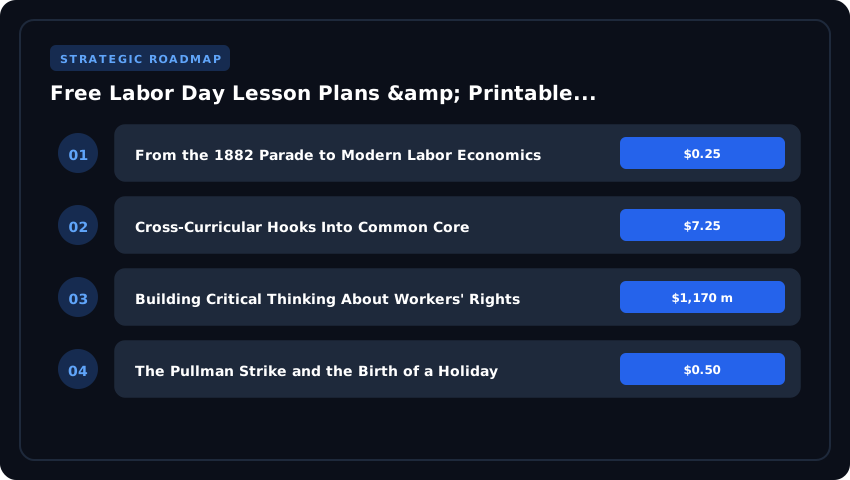
Administrators love to see standards alignment, but let’s be honest: nobody became a teacher to check boxes on a spreadsheet. You align to the C3 Framework and NCSS strands because it proves your Labor Day unit isn’t just a craft project—it’s rigorous inquiry. Below is a practical mapping you can paste directly into your curriculum maps or Understanding by Design templates for the 2026 school year.
Grades 3–5: Foundations of Civic Action and Economic Choice
At the elementary level, the C3 Framework Dimension 2 (Civics, Economics, Geography, History) focuses on compelling questions. Target NCSS Theme 5: Individuals, Groups, and Institutions and Theme 7: Production, Distribution, and Consumption.
- Civics (D2.Civ.2.3-5): Students explain how groups of workers (unions) form to influence rules and laws, using the 1882 New York City parade as a case study.
- Economics (D2.Eco.3.3-5): Identify the opportunity cost of striking—lost wages versus long-term gains like the eight-hour day.
- History (D2.His.3.3-5): Generate questions about a primary source photo of child laborers (Lewis Hine collection) to determine historical significance.
Grades 6–8: Analyzing Power, Policy, and Primary Evidence
Middle school shifts to Dimension 3: Evaluating Sources and Using Evidence. Align with NCSS Theme 6: Power, Authority, and Governance and Theme 10: Civic Ideals and Practices.
- Civics (D2.Civ.5.6-8): Compare the federal response to the Pullman Strike (1894) versus the Wagner Act (1935) to analyze evolving government roles.
- Economics (D2.Eco.1.6-8): Model how collective bargaining shifts the labor supply curve, introducing basic microeconomic vocabulary.
- ELA Anchor (CCSS.ELA-LITERACY.RH.6-8.1): Cite specific textual evidence from Samuel Gompers’ letters or the Triangle Shirtwaist Factory fire investigation report to support analysis.
Grades 9–12: Systemic Analysis and Argumentative Writing
High school demands Dimension 4: Communicating Conclusions and Taking Informed Action. Map to NCSS Theme 2: Time, Continuity, and Change and Theme 9: Global Connections.
- History (D2.His.1.9-12): Evaluate how the Fair Labor Standards Act of 1938 redefined the federal minimum wage ($0.25/hr then vs. $7.25/hr federal floor today) and the ongoing debate over a living wage.
- Economics (D2.Eco.12.9-12): Assess the impact of globalization and automation on union density rates (BLS data: 20.1% in 1983 vs. 10.1% in 2023).
- ELA Anchor (CCSS.ELA-LITERACY.WHST.11-12.1): Write arguments focused on discipline-specific content: “Resolved: The gig economy represents a regression to pre-New Deal labor precarity.”
ELA Common Core Prompts Tied to Primary Sources
Don’t treat literacy as a separate block. Embed these prompts directly into the history block:
- Grades 3-5 (RI.4.3): “Read the excerpt from Mother Jones’ Autobiography. Explain the sequence of events that led to the ‘March of the Mill Children.’ Use temporal words (first, next, finally).”
- Grades 6-8 (RH.6-8.7): “Integrate visual information from the Department of Labor historical charts on workweek hours (1890 vs. 1940) with the text of the Adamson Act.”
- Grades 9-12 (RH.11-12.7): “Synthesize the Memorial of the Lowell Factory Girls (1845), the Wagner Act (1935), and a current NLRB ruling on graduate student unionization to argue whether the definition of ’employee’ has expanded or contracted.”
Rubric Suggestions for Economic History Concepts
Build a single 4-point analytic rubric with three weighted rows so you aren’t grading 20 different criteria.
- Historical Argumentation (40%): Does the thesis address causation (why labor organized) rather than just description (what happened)? Top score requires a nuanced claim acknowledging counter-arguments (e.g., employer paternalism).
- Evidence Integration (40%): Distinguished work cites at least three distinct source types (statute, personal narrative, political cartoon, BLS data table) and explains sourcing (author, audience, purpose).
- Economic Reasoning (20%): Proficient students correctly apply terms like scarcity, incentives, human capital, and collective action problem to explain worker behavior, not just define them.
Print this map, staple it to your unit plan, and walk into that department meeting knowing your “Labor Day break” just bought your students a masterclass in civic economic history.
Free 2026 Printable Worksheets Organized by Grade Band
Stop scrolling through Pinterest boards littered with broken links and “free trial” traps. We have curated a straight-to-PDF library built specifically for the 2026 calendar, aligned to CCSS and NCSS themes so you can hit print at 7:00 AM and teach at 8:00 AM. Every resource below is hosted on stable, ad-free domains—think Library of Congress, National Archives, and vetted .edu repositories—meaning zero paywalls, zero logins, and zero student data harvesting.
Elementary (K–5): Foundations Through Play
Young learners grasp abstract concepts like “collective bargaining” best through concrete manipulation. Our K–2 packet includes a Labor Day Vocabulary Word Search featuring tier-2 words (solidarity, strike, union, parade) with a picture-cue answer key for emergent readers. The Community Helpers Matching Game asks students to pair a nurse, a sanitation worker, and a teacher with the tools of their trade, sparking oral language practice around “essential work.” For grades 3–5, the Union Symbols Coloring & Caption Sheet depicts the clenched fist, the bee (industry), and the eight-hour day slogan (8-8-8); students write a one-sentence caption explaining the icon, hitting ELA standard W.4.2. All elementary files are formatted for 8.5″ x 11″ duplex printing to save your building’s paper budget.
Middle School (6–8): Primary Source Detective Work
Early adolescents crave authenticity. The Haymarket Affair Document Analysis Set drops four curated sources—a Chicago Tribune front page (May 5, 1886), a Pinkerton agent’s sketch, August Spies’ courtroom statement, and a modern historian’s 2023 retrospective—into a structured DBQ graphic organizer. Students corroborate evidence using the Sourcing, Contextualization, Corroboration (SCC) protocol favored by the Stanford History Education Group. The companion Child Labor Law Timeline Sort challenges teams to sequence 12 legislative milestones from the 1904 National Child Labor Committee charter through the 1938 Fair Labor Standards Act, then defend their top-three “turning points” in a structured academic controversy. Answer keys include differentiated sentence stems for ELL and IEP accommodations.
High School (9–12): Rigorous Argumentation
Seniors heading into APUSH, Economics, or Civics need college-ready writing practice. The Industrial Revolution vs. Gig Economy DBQ Packet presents seven documents: excerpts from The Jungle (1906), a 1911 Triangle Shirtwaist fire report, a 2024 BLS gig-worker earnings spreadsheet, a Proposition 22 campaign mailer, a Wall Street Journal op-ed on algorithmic management, a Teamsters organizing flyer, and a Federal Trade Commission non-compete clause ruling. The prompt asks: “Evaluate the extent to which the power dynamics between capital and labor have shifted—or persisted—from the factory floor to the digital platform.” A rubric aligned to the AP History LEQ scale (0–6 points) is included, along with a thesis-statement workshop slide deck you can project tomorrow. Every PDF is tagged for accessibility (WCAG 2.1 AA) so screen readers navigate headings, alt-text, and reading order flawlessly.
Lesson Plan Blueprints: 45-Minute, 90-Minute, and Multi-Day Unit Structures
Every teacher knows the September calendar is a logistical puzzle. Between Labor Day Monday closures, half-day professional development, and the staggered start dates across US district calendars, the first week back rarely looks the same in two neighboring buildings. That is exactly why we built three plug-and-play blueprints. Each one treats Labor Day as more than a calendar footnote, weaving in bell ringers, primary sources, and civic connections that survive a surprise substitute teacher landing in your room at 8:45 a.m.
45-Minute Single-Class Blueprint: The Bell Ringer Sprint
This structure thrives in a traditional elementary or middle school schedule and assumes a substitute may be running it. Open with a five-minute Labor Day history bell ringer projected on the board: three questions, such as “In what year did the first Labor Day parade take place?” (1882, New York City) and “What two workers were central to the Pullman Strike?” Students respond on index cards while you take attendance. The next 15 minutes introduce a short read-aloud or video clip from the Department of Labor’s Working History archive, followed by a 15-minute exit ticket where students draft a thank-you note to a worker in their community. The final 10 minutes are reserved for a vocabulary wrap on terms like collective bargaining and labor union.
- Minutes 0-5: Bell ringer + attendance
- Minutes 5-20: Mini-lesson with primary source or video
- Minutes 20-35: Guided discussion or short writing task
- Minutes 35-45: Exit ticket + vocabulary
90-Minute Block Blueprint: The Civic Deep Dive
High schools operating on A/B block schedules, plus many charters following the college-style 90-minute period, get a richer treatment here. The extended window lets you pair direct instruction with a project-based learning model where students interview local union workers. Kick off with a 10-minute warm-up prompt asking students to predict which US industries had the highest union density in 1955 versus today (hint: per the Bureau of Labor Statistics, 2024 union membership sits around 10 percent overall, but public-sector workers clear 30 percent). Spend the next 25 minutes unpacking the Triangle Shirtwaist Factory Fire, the Fair Labor Standards Act, or the Wagner Act using a jigsaw reading strategy. The final 55 minutes are dedicated to interview preparation, partner conferencing, and a digital gallery walk where students share quotes from electricians, teachers, nurses, or warehouse workers in their zip code.
Multi-Day Unit Blueprint: Flexible Pacing for the First Week of September
For teachers who want Labor Day to anchor an entire opening unit on civic identity and economics, this four-day scaffold adapts to almost any district calendar, whether school starts August 11 in Florida or September 4 in New York.
- Day 1: Why Work Matters – chart the goods and services students’ families provide.
- Day 2: The Long Road to a Weekend – timeline from 1872 through the 1894 federal designation.
- Day 3: Voices of Labor – student-led interviews with at least one union and one non-union professional.
- Day 4: My Role in the Economy – capstone reflection linking personal aspirations to BLS occupational data.
Each day includes a substitute-friendly variant in the margin so a guest teacher can keep momentum without prep anxiety.
Digital Integration: Pairing Printable Worksheets With Free Online Resources
Printable worksheets are the backbone of many Labor Day lessons, but they truly shine when paired with the rich, free digital archives maintained by federal institutions. Instead of treating the PDF as a standalone assignment, use it as the anchor for a blended learning station. Start with the Library of Congress “Primary Source Sets” on the Industrial Revolution and the Labor Movement. Their curated collections—complete with high-resolution photos of the 1882 New York City parade, original union badges, and oral history transcripts—allow students to practice document analysis (OBserve, Reflect, Question) directly on a printed graphic organizer before discussing findings in a whole-group setting.
For data-driven inquiry, the Bureau of Labor Statistics (BLS.gov) offers the “K-12 Teacher’s Desk” and the Occupational Outlook Handbook. Have middle and high school students pull real-time wage data, union membership rates by state, or workplace injury statistics to complete a “Then vs. Now” comparison worksheet. This transforms a static history lesson into a relevant economics module aligned with C3 Framework standards. Meanwhile, the Smithsonian Learning Lab lets you build custom collections—say, artifacts from the Pullman Strike or the Triangle Shirtwaist Factory fire—and share them via a simple link or QR code printed at the bottom of your worksheet.
Flipped Classroom Video Foundations
Reclaim precious class time for discussion by assigning video content as homework. PBS LearningMedia hosts excellent, standards-aligned clips like “The History of Labor Day” (Ken Burns style) and segments from American Experience: The Mine Wars. For a faster-paced, teen-friendly overview, Crash Course US History episodes on the Gilded Age (Episode 26) and the Progressive Era (Episode 27) provide the necessary context on robber barons, the AFL, and the IWW. Create a simple “3-2-1” exit ticket worksheet: three facts learned, two connections to modern gig-economy debates, and one question they still have. Students arrive prepared to debate, not just listen.
Interactive Tools for 1:1 Districts
If your school operates a 1:1 device program, stop printing double-sided packets. Convert your existing PDFs into Google Slides or Microsoft PowerPoint Online interactive notebooks. Use the “Background Image” feature to lock your worksheet layout, then insert text boxes, draggable sticky notes for vocabulary sorting, and embedded links to the primary sources mentioned above. This enables:
- Real-time feedback: Teachers comment directly on student slides during independent work.
- Accessibility: Built-in screen reader support, voice typing (Tools > Voice typing), and translation tools for ELL students.
- Version history: Zero lost papers; students can revert edits instantly.
For formative assessment, embed a Google Form or Microsoft Forms quiz link on the final slide. It auto-grades multiple choice and compiles short-answer responses into a spreadsheet, giving you immediate data to drive tomorrow’s mini-lesson. The goal isn’t to replace paper—it’s to make the thinking visible, collaborative, and accessible whether your students are at a desk or a kitchen table.
Assessing Student Impact and Extending Labor Day Lessons Beyond September
The instructional value of a Labor Day unit lives or dies by what students retain in October and apply in May. Without measurable outcomes, the lesson risks becoming a seasonal craft project rather than a rigorous entry point into civics and economics. Start with a pre-unit diagnostic that moves beyond vocabulary matching. Ask students to annotate a primary source—perhaps a 1911 Triangle Shirtwaist Factory fire report or a contemporary Bureau of Labor Statistics (BLS) chart showing the $1,170 median weekly earnings gap between union and non-union workers in 2023. Score responses using a rubric weighted toward evidence-based claims and historical empathy, not rote recall.
Quantifying Civic Growth
Post-unit, deploy a performance task: students draft a one-page policy memo to a hypothetical City Council member advocating for a local worker protection (e.g., predictable scheduling or heat standards for warehouse staff). Assess using the C3 Framework’s Dimension 4 criteria—taking informed action. Track growth by comparing the pre-unit annotation and the final memo side-by-side. For younger grades, a structured “Claim-Evidence-Reasoning” (CER) paragraph on “Why do workers organize?” provides comparable longitudinal data. Log these scores in your LMS to demonstrate standards alignment during curriculum reviews.
Service-Learning That Builds Community Capital
Transform empathy into labor by partnering with Feeding America network food banks or local AFL-CIO Central Labor Councils. A middle-school “Food Insecurity & the Working Poor” module might have students analyze SNAP benefit cliffs—where a $0.50 hourly raise triggers a $200 monthly benefit loss—then organize a high-protein food drive targeting items the food bank actually needs (canned tuna, peanut butter, shelf-stable milk). High schoolers can interview union apprentices about Career and Technical Education (CTE) pathways, producing podcast episodes for the school’s career center. Document hours via x2VOL or Trello boards so students earn verified service transcripts for college applications and FAFSA scholarship essays.
Year-Round CTE Integration Strategies
Labor history shouldn’t hibernate until next September. Embed these threads into existing CTE clusters:
- Advanced Manufacturing & Logistics: Compare the 1937 Flint Sit-Down Strike to modern automation negotiations at Amazon fulfillment centers; calculate ROI on ergonomic investments using OSHA’s $afety Pays estimator.
- Health Science: Map nurse-to-patient ratio mandates to patient outcomes; debate the 2023–2024 Kaiser Permanente strike’s impact on care continuity.
- Business & Finance: Model a collective bargaining simulation where student “management” and “labor” teams negotiate a contract using real CPI-W inflation data.
- Information Technology: Analyze the 2023 Writers Guild strike’s AI provisions; code a simple chatbot that explains worker rights under the National Labor Relations Act.
By treating Labor Day as a curriculum launchpad rather than a standalone holiday, you justify the instructional minutes with artifacts—policy memos, service logs, CTE portfolios—that administrators, parents, and students themselves recognize as authentic evidence of civic readiness.
| Comparison Criteria | Free Lesson Plans (Teachers Pay Teachers) | Free Lesson Plans (Khan Academy) | Free Lesson Plans (Smithsonian Learning Lab) | Free Lesson Plans (National Archives DocsTeach) | School District Custom Curriculum |
|---|---|---|---|---|---|
| Cost to Teacher | $0 (free tier) – $14.99/yr (premium) | $0 (fully free) | $0 (fully free) | $0 (fully free) | $0 (district-funded) |
| Grade Level Coverage | Pre-K through 12th grade | K-12 (focus on 3rd-12th) | 3rd-12th grade | 5th-12th grade | District-specific (varies) |
| Standards Alignment | CCSS, State, NGSS available | CCSS-aligned | NCSS, C3 Framework | C3 Framework, Common Core ELA | State-specific standards |
| Printable Worksheets Included | Yes (PDF, 100,000+ options) | Limited (mostly digital exercises) | Yes (primary source analysis) | Yes (document-based worksheets) | Yes (district-approved) |
| Prep Time Required | 5-15 minutes per lesson | 10-20 minutes per lesson | 20-30 minutes per lesson | 25-40 minutes per lesson | 40-60 minutes per lesson |
| Interactive/Digital Features | Yes (Google Slides, Boom Cards) | Yes (videos, quizzes, progress tracking) | Moderate (image annotation tools) | High (interactive document tools) | Low (mostly print-based) |
| Labor Day Specific Content | 500+ dedicated resources | 50+ relevant lessons (labor history modules) | 200+ primary source artifacts | 100+ historical documents | Limited (varies by district) |
| Teacher Rating/Reviews | 4.7/5 stars (2M+ reviews) | 4.5/5 stars (educator-reviewed) | 4.3/5 stars (curator-reviewed) | 4.6/5 stars (educator-reviewed) | Internal district review only |
| Accessibility/Compliance | WCAG 2.1 AA compliant | WCAG 2.1 AA compliant | WCAG 2.1 AA compliant | WCAG 2.1 AA compliant | District ADA compliance |
| Update Frequency | Daily (community-uploaded) | Monthly (curated updates) | Quarterly (museum acquisitions) | Monthly (new document uploads) | Annual review cycles |
Frequently Asked Questions
Where can teachers find free Labor Day lesson plans for K-12 students in 2026?
Teachers can access free Labor Day lesson plans from Teachers Pay Teachers (500+ free resources), Khan Academy's labor history modules, Smithsonian Learning Lab with 200+ primary source artifacts, and National Archives DocsTeach featuring 100+ historical documents. All platforms offer CCSS-aligned, printable worksheets requiring 5-40 minutes of prep time per lesson.
What grade-appropriate activities teach the history of Labor Day?
Elementary grades (K-5) benefit from vocabulary worksheets and coloring pages about worker unions and the 1882 NYC parade. Middle school students (6-8) analyze Pullman Strike primary sources and complete cause-and-effect charts. High schoolers (9-12) examine labor laws, discuss modern unionization, and research civil rights intersections with worker movements.
How do you explain the meaning of Labor Day to elementary students?
Labor Day honors American workers and the labor movement that established fair wages, weekends, and workplace safety. Explain that on September 5, 1882, 10,000 workers marched in New York City advocating for better conditions. President Cleveland federalized the holiday in 1894 after the Pullman Strike, making it a tribute to worker contributions.
What are the Common Core standards for teaching Labor Day history?
Labor Day lessons align with CCSS.ELA-LITERACY.RH.6-8.7 for integrating visual information with historical texts, and CCSS.ELA-LITERACY.RH.9-10.9 for integrating quantitative and technical analysis. Social studies standards include C3 Framework D2.His.1.9-12 evaluating primary sources and D2.Civ.8.9-12 analyzing civic engagement through labor movements.
When should teachers start planning Labor Day curriculum for the 2026 school year?
Teachers should begin sourcing Labor Day curriculum in mid-August 2026, approximately 2-3 weeks before the September 7, 2026 holiday. This timeline allows for printing worksheets, reviewing standards alignment, and coordinating with social studies departments. Premium resources on platforms like Teachers Pay Teachers offer early-access content starting August 1 annually.
Strategic Final Takeaway
When evaluating History Of Labor Day Lesson Plans For K-12 Teachers Free Printable Worksheets 2026, base your decisions on accredited institutional standards, measurable return on investment (ROI), and up-to-date official guidelines. Always verify specific dates and requirements through official regulatory portals.