

US Bureau of Labor Statistics Salary Outlook for ECE Associate Degree Holders
If you have been weighing the financial return on a two-year Early Childhood Education program at your local community college, the federal wage data tells a compelling story. The US Department of Labor, through its Bureau of Labor Statistics, tracks preschool and childcare center educators as a distinct occupational category, and the numbers consistently favor credentialed professionals over those who enter the classroom with only a diploma in hand.
Associate Degree vs. High School Diploma: The Wage Gap
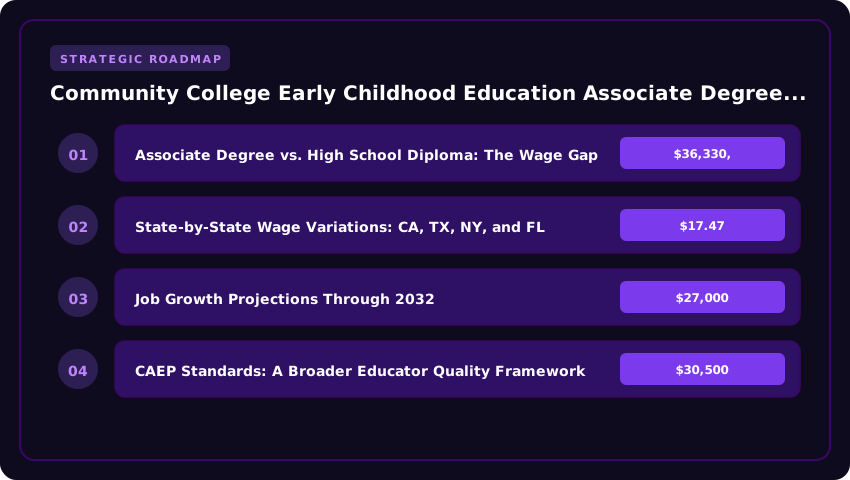
The BLS Occupational Employment and Wage Statistics (OEWS) survey reports that preschool teachers across all education levels earn a median annual wage of roughly $36,330, or about $17.47 per hour. However, that single number masks an important credential premium. Workers who hold only a high school diploma typically start near the 10th percentile, earning closer to $27,000 annually, while associate degree holders frequently land between the 25th and 50th percentiles ($30,500 to $36,330). The top 10% of preschool teachers exceed $50,000 per year, and most of those higher earners hold at least an associate credential combined with documented fieldwork hours. In short, the associate degree does not just open doors; it moves you measurably up the pay scale on day one of employment.
State-by-State Wage Variations: CA, TX, NY, and FL
Where you work matters as much as what you hold. BLS state-level data reveals dramatic regional differences:
- California: Mean annual wage of approximately $43,560, with metropolitan areas like San Jose and San Francisco pushing experienced ECE professionals past $55,000. Public preschool initiatives such as the California State Preschool Program continue to drive demand.
- New York: Mean wage around $44,880, with New York City and Long Island leading the nation. Head Start expansion and Universal Pre-K funding keep wages climbing.
- Texas: Mean wage near $33,210, lower in cost-of-living terms but supported by rapidly growing metropolitan districts in Houston, Dallas, and Austin. Texas is actively recruiting bilingual ECE educators.
- Florida: Mean wage of approximately $32,580, with the Voluntary Prekindergarten (VPK) program ensuring steady enrollment growth across Miami-Dade, Orange, and Hillsborough counties.
Job Growth Projections Through 2032
The BLS Employment Projections program forecasts 7% job growth for preschool and childcare workers between 2022 and 2032, faster than the 3% average for all US occupations. This translates to roughly 58,400 annual openings, driven by expanded public pre-K access, rising parental workforce participation, and a nationwide push for early learning standards. For community college graduates, that growth equates to both job security and genuine upward mobility, particularly for those who later pursue a bachelor’s degree and move into lead teacher or program director roles earning $55,000 to $75,000+.
NAEYC and CAEP Accreditation Standards for Two-Year ECE Programs
When you are evaluating a community college Early Childhood Education (ECE) associate degree, accreditation is not a marketing flourish—it is the structural backbone that determines whether your credits travel, your degree holds weight with employers, and your path to a state teaching license remains open. Two organizations sit at the top of the quality hierarchy for two-year ECE programs in the United States: the National Association for the Education of Young Children (NAEYC) and the Council for the Accreditation of Educator Preparation (CAEP). Understanding how their standards differ, and how they interact, is essential for anyone serious about career mobility.
NAEYC Standards: Focused on the Early Childhood Workforce
NAEYC accreditation is specifically designed for associate, baccalaureate, and graduate programs preparing educators to work with children from birth through age eight. Its standards emphasize child development knowledge, culturally responsive practice, family engagement, and assessment literacy. For a community college program, NAEYC evaluates curriculum alignment with developmentally appropriate pedagogy, faculty qualifications, field experience quality, and continuous improvement processes. Because NAEYC is recognized by many state departments of education, graduating from an NAEYC-accredited program often streamlines the application process for state teaching licenses and the Child Development Associate (CDA) credential.
CAEP Standards: A Broader Educator Quality Framework
CAEP accreditation applies to educator preparation providers across grade bands, from PK–12 to post-secondary. It focuses on evidence-based outcomes: candidate performance, clinical partnerships, program impact, and continuous improvement. A community college seeking CAEP accreditation must demonstrate rigorous data collection on graduate effectiveness, employer satisfaction, and student learning benchmarks. CAEP is the accreditation body preferred by many state education agencies for licensure reciprocity decisions, particularly when teachers move across state lines.
How Accreditation Impacts State License Reciprocity
Teaching licenses are issued by individual states, and reciprocity agreements vary. However, completing a program accredited by either NAEC or CAEP dramatically improves portability. Many states, including Florida, Ohio, and Washington, treat completion of a CAEP- or NAEYC-accredited associate degree as a baseline qualification for the early childhood education endorsement. This means your credential is more likely to be accepted when relocating for higher-paying districts or specialized roles. Without accreditation, you may face additional coursework, competency exams, or supervised teaching hours before a new state will recognize your degree.
Identifying Regionally Accredited Community Colleges with Verified ECE Quality
Before enrolling, confirm that your community college holds regional accreditation from one of the six US regional accrediting bodies recognized by the US Department of Education and FAFSA. Regional accreditation ensures your credits transfer to four-year institutions if you later pursue a bachelor’s degree. Then, verify whether the ECE program itself holds NAEYC or CAEP accreditation by searching the NAEYC Accredited Program Directory or the CAEP Accredited Institution Finder. Cross-reference both lists with your state’s department of education licensing database to confirm the program aligns with current licensure pathways. This three-step verification protects your tuition investment and ensures your associate degree functions as a true launchpad for upward mobility in the US education workforce.
Head Start Performance Standards and the Child Development Associate Credential Pathway
For community college graduates entering early childhood education, federally funded Head Start programs represent one of the most structured environments for rapid career advancement in the United States. Because these classrooms operate under the Head Start Act and the Office of Head Start’s Performance Standards, program directors are required to maintain specific staffing ratios and qualifications, which directly shapes hiring preferences nationwide. When a center receives federal dollars, it must demonstrate that lead teachers hold at least an associate degree in Early Childhood Education (ECE) or a closely related field, with a significant portion of staff nationwide required to hold a baccalaureate degree. This federal mandate effectively converts an associate degree from a nice-to-have credential into a mandatory gatekeeper qualification for lead teacher roles in subsidized preschool settings.
This is where stacking the Child Development Associate (CDA) credential with an associate degree becomes a genuine career accelerant. The CDA, awarded by the Council for Professional Recognition, signals competency in twelve functional areas of early childhood practice, from physical development to curriculum planning. Many community colleges now align their ECE associate programs so that students can earn both credentials simultaneously, often without adding extra semesters. The practical value of this stack is immediate: Head Start grantees recognize the CDA as a mark of competency, and several state childcare licensing systems tie higher pay grades to its completion. In federally funded programs, this combination frequently qualifies educators for pay differentials that can add roughly $1.50 to $3.00 per hour over the standard entry-level rate, translating into an additional $3,000 to $6,000 in annual earnings.
Within the Head Start career ladder itself, the credential stack opens clear promotional pathways. Many educators begin as Teacher Assistants or Associate Teachers, roles that typically require a CDA or equivalent coursework. With an associate degree plus CDA in hand, the promotion timeline to Lead Teacher is often compressed from several years to a single program year, because the federal staffing requirements prioritize degree-holding staff for those roles. From Lead Teacher, experienced educators frequently advance to Education Manager or Center Director positions, with salaries rising into the $48,000 to $65,000 range depending on region and program size, according to data compiled from Head Start workforce surveys and the US Department of Labor.
- Head Start Act staffing rules require that at least 50% of center-based lead teachers nationwide hold a baccalaureate degree, creating steady demand for associate-degreed educators stepping into assistant and float teacher positions.
- Dual credentialing strategy allows students to complete the 120 hours of CDA professional preparation and 480 hours of verified work experience while enrolled in their associate coursework.
- Pay scale recognition varies by Head Start grantee, but most public and private nonprofit operators place CDA-plus-associate candidates on a higher rung than those holding only a diploma.
- Career ladder checkpoints typically progress from Assistant Teacher ($28,000–$33,000) to Lead Teacher ($36,000–$45,000) to Education Manager ($48,000–$65,000), with each transition accelerated by the combined credential stack.
For working adults considering an upskilling investment through a US community college, the Head Start pathway offers a rare combination: federal funding stability, clearly defined promotion criteria, and salary growth that is directly tied to credential milestones rather than tenure alone.
Articulation Agreements That Transfer ECE Credits to Four-Year Universities
For many aspiring educators, the smartest financial move is starting at a community college and finishing a bachelor’s degree online or on weekends. The good news? Most US states have formal articulation agreements that let your Early Childhood Education (ECE) associate degree transfer as a block of credit toward a four-year teaching license or non-licensure bachelor’s in child development. The trick is knowing which agreements are guaranteed, which courses actually transfer, and how to finish your bachelor’s without pausing your paycheck.
Spotting Guaranteed Junior-Year Admission at State Universities
Not every “transfer agreement” is created equal. A guaranteed admission or “2+2” articulation means that if you earn an Associate of Arts (AA) or Associate of Science (AS) in ECE from a participating community college, you are accepted as a junior at the partnering four-year institution provided you meet a minimum GPA (usually 2.5–2.75) and finish the required general-education core. Examples widely cited by education writers include:
- Florida – the state-wide Articulation Agreement guarantees AA holders admission to one of the 12 State University System schools, including the University of Central Florida and Florida International University.
- Texas – the Field of Study Curriculum for Early Childhood Education is accepted in full at most public universities, so an Associate of Applied Science (AAS) in ECE transfers as 42–60 credit hours.
- California – the CSU Associate Degree for Transfer (AA-T/AS-T) program reserves junior admission spots for ECE transfer students at California State University campuses.
- New York – SUNY Transfer Paths let community college graduates enter a SUNY four-year school with at least 60 credits already posted to their transcript.
Before enrolling, ask the community college registrar whether its ECE program carries a “TAG” (Transfer Admission Guarantee), “AA-T,” or formal 2+2 designation with your target university. If the answer is vague, you’re probably looking at a course-by-course review that can lose you a full semester of credits.
Mapping Common Course Equivalencies
The courses that almost always transfer cleanly across ECE articulation agreements sit in three buckets. First, child development foundations – Intro to Early Childhood Education, Child Growth and Development, and Curriculum Planning for ages birth through eight. Second, general-education psychology and human-services courses like Developmental Psychology, Abnormal Psychology, and Introduction to Sociology. Third, liberal studies distribution – English Composition I and II, College Algebra or Quantitative Reasoning, U.S. History, and a lab science such as Introduction to Biology.
Where transfer headaches usually appear is in practicum hours, state-specific health-and-safety modules, and pedagogy courses tied to a state’s preschool teaching standards. A course titled “Early Childhood Practicum” at one college may be accepted as an elective rather than a methods requirement at the university, pushing graduation back by one term. Submitting your community college syllabus to the four-year institution’s education department during your first semester saves time.
A Realistic Timeline for Working Lead Teachers
Plan on six years total from first enrollment to bachelor’s completion if you keep working full time as a lead teacher. Years one and two cover the 60-credit associate, with evening and Saturday coursework stacked around your classroom schedule. Year three is the bridge semester where you take upper-division writing and statistics while transferring. Years four through six finish the remaining 60 credits, usually two classes per fall and spring term plus one summer course, with field placements scheduled near your current center so you don’t lose income during student teaching.
Many lead teachers compress this schedule by choosing an online bachelor’s completion program accredited by CAEP (Council for the Accreditation of Educator Preparation). Federal Financial Aid through the FAFSA still applies after your associate degree, and employer tuition-reimbursement programs – common among Head Start grantees and corporate childcare chains – typically cover $3,000–$5,250 per year, enough to pay for one course per semester out of pocket. The result is a bachelor’s that bumps your salary closer to the $50,000 mark and unlocks lead instructional coach or public-school Pre-K teacher roles.
Tuition Costs, FAFSA Eligibility, and Pell Grant Funding for ECE Students
For most adult learners eyeing an Early Childhood Education (ECE) associate degree, the first financial reality check is surprisingly gentle. According to the College Board and the US Department of Education, average in-district tuition at US community colleges typically ranges from $3,000 to $5,000 annually, which represents roughly one-quarter of what a four-year public university charges in-state. Add another $1,500 for books, supplies, and mandatory background checks, and a working professional can complete a two-year ECE program for $9,000 to $13,000 total. That price point makes this credential one of the most cost-effective career pivots in the modern US labor market, especially when you compare it to the $36,330 median annual salary published by the Bureau of Labor Statistics for preschool teachers.
Maximizing Federal Aid: FAFSA and Pell Grants
The smartest move a future ECE student can make is completing the Free Application for Federal Student Aid (FAFSA) as early as October 1 each year, well before state priority deadlines. Most community college students qualify for the federal Pell Grant, which awards up to $7,395 per academic year for the 2024-2025 award year. Unlike loans, Pell dollars never need to be repaid. For a single parent earning $35,000 with two dependents, the expected family contribution often drops to zero, meaning tuition, fees, and a modest living stipend may all be covered.
- Step 1: Gather Social Security numbers, tax returns, and W-2 forms for both student and parents if dependent.
- Step 2: File at studentaid.gov using the IRS Data Retrieval Tool for accuracy.
- Step 3: Confirm the community college’s federal school code so the financial aid office receives your file.
- Step 4: Layer state need-based scholarships on top of the Pell award to shrink out-of-pocket costs further.
Many state agencies also offer early childhood workforce scholarships that forgive remaining tuition if the graduate commits to teaching in a licensed childcare center for two to three years.
Employer Tuition Reimbursement Programs
Major US childcare corporations are aggressively recruiting credentialed teachers, and several advertise robust tuition benefits. KinderCare Education, for instance, provides full tuition coverage for employees pursuing an ECE degree through partner community colleges, while Bright Horizons offers a Back-Up Care and educational assistance program that reimburses up to $5,250 per year in qualified tuition expenses, matching the federal tax-free cap under Internal Revenue Code Section 127. Other large employers such as Learning Care Group and Primrose Schools run similar upskilling pipelines, often pairing tuition reimbursement with automatic raises and promotion tracks once the associate credential is conferred.
Combining Pell Grant funding, state scholarship top-ups, and an employer reimbursement benefit can realistically reduce a $10,000 degree to a $0 net cost, turning the ECE associate into the rare professional credential that pays you to earn it.
Career Advancement Tracks Beyond the Classroom: Director and Specialist Roles
While many early childhood education (ECE) professionals start their journey in the classroom, an associate degree from a community college does much more than qualify you to be a lead teacher. It serves as a critical launchpad into leadership and specialized roles. For professionals looking to maximize their long-term earnings trajectory without immediately pursuing a four-year degree, several distinct advancement tracks offer both professional prestige and a significant salary bump.
Becoming a Center Director: Credentials and the Salary Premium
In almost every US state, stepping into a Childcare Center Director role requires specific state-issued credentials. For example, states like Florida and Texas require directors to hold a foundational credential—such as the Florida Director Credential or the Texas Child Care Director Certificate—which mandates a minimum number of college credit hours in early childhood education. A community college associate degree perfectly aligns with these requirements, pairing the necessary academic credits with the practical experience needed to secure state licensure through the US Department of Education or local licensing boards.
The financial return on this credentialing leap is substantial. According to the US Bureau of Labor Statistics (BLS), the median annual wage for preschool and childcare center education administrators is approximately $54,000. However, in high-demand metropolitan markets like New York City, Boston, and San Francisco, directors routinely earn between $65,000 and $80,000. When compared to the median lead teacher salary of roughly $36,330, transitioning to a director role represents a salary uplift of nearly 50% or more, depending on the local cost of living and center size.
Transitioning into Specialist and Coordination Roles
Beyond administration, associate-credentialed educators frequently pivot into specialized positions that support child development from a different angle. These roles leverage the pedagogical foundation built during a community college program while focusing on targeted interventions and family dynamics.
- Curriculum Coordinators: These professionals design and evaluate educational programs across multiple classrooms, ensuring alignment with state early learning standards. They often earn between $45,000 and $55,000 annually.
- Family Advocates: Acting as a bridge between the school and the home, family advocates connect parents with community resources and support at-risk children. This role typically commands a median salary of around $42,000.
- Early Intervention Specialists: Working with infants and toddlers who have developmental delays, these specialists often require additional state certifications but build directly upon an ECE associate degree. Salaries in this niche frequently range from $48,000 to $60,000.
Ultimately, an associate degree in early childhood education is not a terminal endpoint for your career. By leveraging state director credentials or pivoting into specialized advocacy and coordination roles, professionals can dramatically increase their earning potential while shaping the broader landscape of American early childhood education.
| Decision Criterion | High School Diploma Only | ECE Associate Degree (2-Year) | ECE Bachelor’s Degree (4-Year) |
|---|---|---|---|
| Median Annual Salary (BLS) | ~$30,000 | ~$36,330 | ~$45,000 – $52,000 |
| Tuition Cost (Community College / Public) | $0 | $3,000 – $8,000 total | $20,000 – $40,000 total |
| Program Length | 0 months | 24 months | 48 months |
| Job Growth Projection (2022-2032) | Limited | +58,000 jobs (3% growth) | Faster than average (8%) |
| Prerequisites Required | None | High school diploma, GED, or equivalent | High school diploma, associate degree preferred |
| Entry-Level Roles Available | Assistant Teacher, Aide | Lead Preschool Teacher, Director I | Kindergarten Teacher, Curriculum Specialist |
| 5-Year ROI Potential | Low ($0-$5K raise) | Moderate ($15K-$25K cumulative gain) | High ($60K-$100K cumulative gain) |
| Licensure/Credential Required | None (state varies) | CDA credential eligible, state teaching cert. | State teaching license required (public K-12) |
Frequently Asked Questions
What is the average salary with an Early Childhood Education associate degree in the US?
According to the US Bureau of Labor Statistics, preschool teachers with an Early Childhood Education associate degree earn a median annual salary of approximately $36,330. This represents roughly a 20% wage premium compared to workers entering the same role with only a high school diploma, making it a strong financial return.
How much does an ECE associate degree cost at a US community college?
An Early Childhood Education associate degree at a US community college typically costs between $3,000 and $8,000 in total tuition for in-state students over two years. Many states offer free community college programs, workforce development grants, and Pell Grant eligibility that can significantly reduce or eliminate out-of-pocket costs.
Is an Early Childhood Education associate degree worth it in 2024?
Yes, an Early Childhood Education associate degree is widely considered worth the investment due to low tuition costs averaging $3,000-$8,000 and a median salary boost of roughly $6,000 annually compared to high school-only credentials. The field is projected to add over 58,000 jobs nationally through 2032, ensuring stable demand.
What jobs can you get with an ECE associate degree?
With an Early Childhood Education associate degree, graduates qualify for roles including lead preschool teacher, Head Start educator, childcare center director, family support specialist, and curriculum coordinator. The credential fulfills CDA equivalency requirements in most states, expanding eligibility for publicly funded early learning programs nationwide.
Can you transfer an ECE associate degree to a four-year university?
Yes, most US community colleges structure their Early Childhood Education associate degrees as transferable programs aligned with state articulation agreements. Graduates can typically transfer 60 credits to a four-year institution to pursue a bachelor's in Early Childhood Education or Elementary Education, saving approximately $20,000-$30,000 in tuition costs.
Strategic Final Takeaway
When evaluating Community College Early Childhood Education Associate Degree Salary And Career Advancement In The US, base your decisions on accredited institutional standards, measurable return on investment (ROI), and up-to-date official guidelines. Always verify specific dates and requirements through official regulatory portals.


