

Why Community Colleges Are Launching Bachelor of Applied Science (BAS) Teaching Tracks in 2026
The landscape of teacher preparation in the United States is undergoing a seismic structural shift. For decades, the Bachelor of Education (B.Ed.) at a four-year university was the singular gold standard. But in 2026, the math simply doesn’t work for thousands of aspiring educators—and state legislatures know it. With the National Education Association (NEA) estimating over 55,000 vacant teaching positions nationwide and the Bureau of Labor Statistics (BLS) projecting roughly 109,000 annual openings for K–12 teachers through 2032, the pipeline is broken. Community colleges are stepping in to weld it shut, leveraging their existing workforce infrastructure to deliver Bachelor of Applied Science (BAS) degrees built specifically for licensure.

The “Grow Your Own” Federal Catalyst
The acceleration isn’t organic; it is heavily subsidized. The U.S. Department of Education has expanded eligibility for Teacher Quality Partnership (TQP) grants and SEED (Supporting Effective Educator Development) funding to explicitly include community college baccalaureate programs. These “Grow Your Own” initiatives prioritize candidates already embedded in local districts—paraprofessionals, substitutes, and career-changers—who cannot uproot their lives for a residential university experience. In 2026, over $120 million in competitive federal grants are earmarked for these alternative pipelines, making BAS programs financially viable for institutions and nearly tuition-free for eligible students via FAFSA-linked aid and TEACH Grants.
Labor Market Reality: Metropolitan Desperation Meets Rural Access
This isn’t just a rural phenomenon. Major metropolitan regions—Houston, Phoenix, Las Vegas, and Orlando—are importing teachers internationally because local universities cannot produce enough graduates fast enough. BAS programs solve the “last mile” problem: they sit inside the districts that need teachers. Curriculum is co-designed with superintendents, clinical practice happens in the schools where candidates will eventually work, and the ABET-style applied focus ensures graduates hit the classroom with classroom management and differentiated instruction competencies, not just theory.

The Tuition Arbitrage: BAS vs. B.Ed.
The financial argument is the closer. Consider the 2024–25 College Board data:
- Public 4-Year University (In-State B.Ed.): Average tuition & fees $11,260/year ($45,040 total).
- Community College BAS (Upper-Division): Average tuition & fees $4,500–$6,500/year ($18,000–$26,000 total).
That represents a potential savings of $20,000 to $27,000 before room, board, and lost wages. For a profession where the BLS reports a median annual wage of $63,670 (Elementary) to $65,220 (High School), graduating with minimal debt changes the lifetime earnings calculus entirely. In 2026, the BAS isn’t a “lesser” degree—it is the strategically superior ROI for the modern American teacher.
State-by-State Approval Matrix: CA, TX, FL, and NY Licensure Bodies in 2026
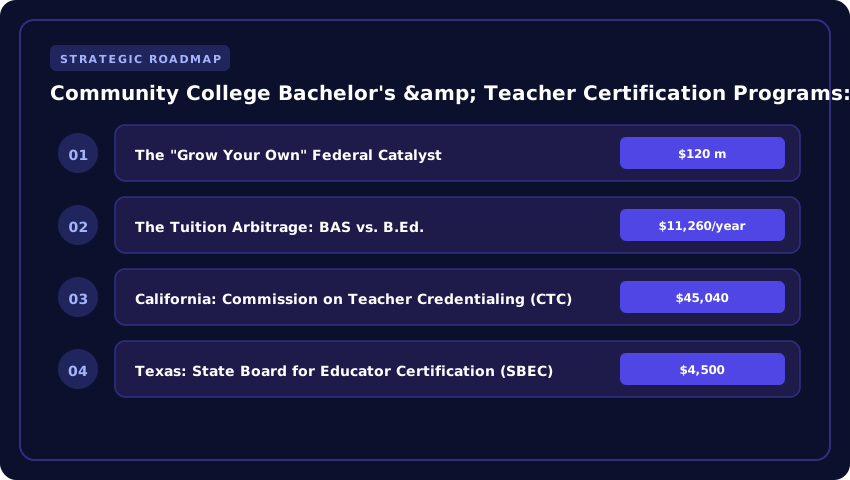
Navigating the patchwork of state licensure boards is the single biggest hurdle for graduates of community college bachelor’s programs. While the Bachelor of Applied Science (BAS) or Bachelor of Science in Education (B.S.Ed.) carries the same regional accreditation weight as a university degree, each state gatekeeper evaluates clinical hours, exam mandates, and program approval status differently. Below is your 2026 jurisdictional decision matrix for the four largest markets.
California: Commission on Teacher Credentialing (CTC)
California remains the gold standard for rigor. The CTC currently authorizes specific community college districts—such as San Diego Mesa College, West Los Angeles College, and Bakersfield College—to confer the B.S. in Early Childhood Education or B.S. in Health Science with an embedded preliminary credential pathway. You cannot simply graduate from any BAS program and apply; the program must hold active CTC Program Approval.
- Clinical Hours: Minimum 600 hours of supervised student teaching (often exceeding university minimums).
- Testing: Passing scores on the CalTPA (Teaching Performance Assessment) and relevant CSET subject matter exams are non-negotiable.
- Cost Advantage: Total tuition typically runs $10,000–$14,000 for the upper-division coursework, roughly 55% less than CSU equivalents.
Texas: State Board for Educator Certification (SBEC)
Texas operates a more decentralized “Grow Your Own” model. The Texas Higher Education Coordinating Board (THECB) authorizes community colleges—like Dallas College, Austin Community College, and South Texas College—to offer the Bachelor of Applied Technology (BAT) or BAS in Early Childhood–Grade 6. SBEC treats these graduates identically to university completers if the program holds THECB approval and the candidate passes the TExES exams.
- Clinical Hours: Roughly 14–16 weeks of full-time clinical teaching (approx. 560+ hours).
- Testing: TExES Pedagogy and Professional Responsibilities (PPR) EC–12 plus content exams.
- Reciprocity Note: Texas offers a streamlined Out-of-State Certificate for BAS holders from other states, but transcript evaluation fees apply ($164–$200).
Florida: Department of Education (FL DOE)
Florida’s State College System (formerly community colleges) is the most mature pipeline. Institutions like Miami Dade College, Broward College, and St. Petersburg College offer fully approved B.S. in Education degrees leading directly to a Professional Florida Educator’s Certificate. The FL DOE maintains a public Approved Program List; if your program is on it, you are eligible for certification upon graduation.
- Clinical Hours: Minimum 12 weeks (full-time) or equivalent part-time integration.
- Testing: FTCE General Knowledge, Professional Education, and Subject Area Exams.
- Reading Endorsement: Mandatory for most elementary/reading tracks—often embedded in the BAS curriculum.
New York: State Education Department (NYSED)
New York does not currently authorize its own community colleges (SUNY/CUNY two-year sectors) to confer bachelor’s degrees leading directly to initial certification. However, NYSED maintains robust interstate reciprocity agreements. If you earn a BAS/B.S.Ed. from a regionally accredited program in CA, TX, or FL that leads to licensure in that home state, you can apply for a New York Initial Certificate via the “Approved Teacher Preparation Program – Out of State” pathway.
- Critical Gap: You must hold the license from the state where the degree was granted first. NYSED will not evaluate the degree alone.
- Exams: EAS (Educating All Students), CST (Content Specialty Test), and edTPA (or edTPA Safety Net if applicable).
- Workshop Requirements: Mandatory DASA, Child Abuse, and Violence Prevention workshops (approx. $150–$250 total) before issuance.
Quick-Reference Comparison Matrix
| State | Licensure Body | Degree Types Approved | Key Exam Suite | Clinical Minimum |
|---|---|---|---|---|
| California | CTC | B.S. (Specific Districts Only) | CalTPA, CSET | 600 Hours |
| Texas | SBEC / THECB | BAT, BAS | TExES PPR + Content | ~560 Hours |
| Florida | FL DOE | B.S. in Education | FTCE (GK, PEd, SAE) | 12 Weeks FT |
| New York | NYSED | Reciprocity Only (Out-of-State License Required) | EAS, CST, edTPA | Per Home State |
Bottom Line: If you want the fastest, cheapest route to a license in the state where you live, Florida and Texas currently offer the most seamless community-college-to-classroom pipelines. California offers high-quality options but with stricter program-specific gatekeeping. New York requires you to “import” a license earned elsewhere—plan your clinical hours and exam schedule accordingly.
CAEP Accreditation Standards: What US Aspiring Teachers Must Verify Before Enrolling
Before signing an enrollment agreement or committing to a tuition path that can run between $10,000 and $25,000 for a Bachelor of Applied Science (BAS) teaching degree, prospective educators across the United States need to confirm one critical credential: CAEP accreditation. The Council for the Accreditation of Educator Preparation serves as the gold-standard national accreditor for teacher preparation programs, and understanding how it functions can save students years of frustration and thousands of dollars in non-transferable credits.
Decoding CAEP’s Seven-Year Site Visit Cycle
CAEP evaluates educator preparation programs through a rigorous multi-year review process culminating in an on-site visit every seven years. During this cycle, programs must continuously demonstrate candidate competency, partnership quality with P-12 schools, and clinical practice effectiveness. For community college BAS programs—which are relatively new entrants to baccalaureate education—this accreditation timeline matters enormously. A program seeking its initial CAEP accreditation will typically hold “state-only” approval status during the candidacy phase, which carries significant implications for graduates seeking licensure reciprocity between states like Texas, California, Florida, and New York.
- Verify the accreditation status type: Look for language distinguishing “CAEP accredited” from “state-approved” or “CAEP candidate” on the institution’s educator preparation page.
- Confirm the next site visit date: Programs between site visits maintain full accreditation; programs approaching review may face conditional status.
- Request the CAEP annual report: Accredited programs publish outcome data, including graduation rates, employment placement, and employer satisfaction scores.
National Accreditation Versus State-Only Approval
The distinction between CAEP national accreditation and state program approval is where many prospective teachers encounter costly confusion. State-only approval means a program meets minimum requirements to recommend candidates for licensure within that specific state. While this status is legitimate and often necessary, it does not guarantee reciprocity. A teacher prepared under California’s Commission on Teacher Credentialing approval alone may face additional coursework, testing, or portfolio reviews when applying for an Ohio, Georgia, or Washington license.
CAEP-accredited programs, by contrast, satisfy standards recognized across most US states, dramatically streamlining interstate mobility—an increasingly important consideration given that the US Bureau of Labor Statistics reports median elementary teacher salaries ranging from roughly $49,000 to $69,000 depending on state cost-of-living adjustments.
Recognized Specialty Endorsements at Community Colleges
Community college BAS programs pursuing CAEP accreditation typically concentrate on high-demand shortage areas where the US Department of Education has flagged persistent staffing gaps. The most commonly recognized specialty pathways include:
- Early Childhood Education (ECE): Birth through grade 3 preparation, addressing the national pre-K expansion funded through Head Start and state pre-K grants.
- Elementary Education: Comprehensive K-6 preparation with embedded reading specialist coursework aligned to the Science of Reading legislation sweeping 30+ states.
- Special Education (SPED): Cross-categorical or specific learning disability endorsements targeting the 50-state shortage of qualified special educators.
- Career and Technical Education (CTE): Industry-credentialed endorsements pairing technical expertise with pedagogy coursework for high-demand fields.
Transferability: The Hidden Cost-Saving Variable
Perhaps the most financially significant verification step involves confirming how CAEP-accredited credits transfer to four-year public and private universities. Because CAEP standards align with state and national teaching frameworks, accredited community college credits generally transfer more cleanly than those from non-accredited programs. However, students pursuing eventual master’s degrees—where graduate programs often demand $15,000 to $35,000 in tuition—should request written transfer articulation agreements before enrolling.
The bottom line: CAEP accreditation functions as both a quality assurance mechanism and a portability insurance policy. Graduates of accredited programs move more freely between districts, states, and graduate programs, protecting their educational investment while expanding their career mobility in a profession where median salaries now range from approximately $47,000 for early-career teachers to over $98,000 for experienced educators in high-cost districts.
Total Cost of Attendance Breakdown: Earning a Teaching Degree Under $15,000 in USD
When you compare community college bachelor’s pathways with traditional four-year university B.Ed. programs, the dollar gap is staggering. According to the College Board’s 2025–26 national tuition averages, in-district students at public two-year colleges pay roughly $3,900 per year in tuition and fees. Stretch that across four years of a Bachelor of Applied Science (BAS) teaching track, and the baseline sticker price lands near $15,600. That figure already includes general fees, but most BAS cohorts compress upper-division coursework into a shorter window, frequently pushing the net tuition below the $15,000 ceiling.
In-District Versus Out-of-State Tuition Reality
Out-of-state tuition at the same institutions can balloon to $11,000+ per year, wiping out any savings advantage. Smart candidates establish residency 12 months before enrolling, apply for the regional Western Interstate Commission on Higher Education (WICHE) Professional Student Exchange Program, or pursue tuition reciprocity agreements through the Midwest Student Exchange Program. Each workaround can shave $7,000 to $10,000 off the total cost of attendance.
Financial Aid Stacking Strategies
The real affordability engine is layered funding. A full Federal Pell Grant delivers up to $7,395 annually for qualifying students, and stacking that with the TEACH Grant—worth up to $4,000 per year—forgives the obligation if you teach a high-need subject for four years in a Title I school. State-funded scholarship programs such as Texas’s Educators Program, Florida’s Effective Access to Student Education (EASE) grant, and California’s Classified School Employee Teacher Credentialing Program routinely cover $2,000 to $6,000 in remaining tuition. District-driven “Grow Your Own” tuition reimbursement programs, supported through the US Department of Education’s Teacher Quality Partnership (TQP) grants, frequently pay 100% of remaining balances for paraprofessionals committed to returning to the sponsoring district.
Hidden Costs That Catch Students Off Guard
- Praxis Core and Subject Assessments: $130–$300 per test attempt.
- edTPA Assessment: $300 for the portfolio submission required by many state boards.
- Fingerprinting and background checks: $50–$150 depending on the state.
- Clinical internship placement fees: $200–$500 covering cooperating teacher stipends and liability insurance.
Budget an extra $800 to $1,200 above tuition for these mandatory credentialing expenses, and you still land well under the $15,000 net price.
Cost Comparison Against University B.Ed. Programs
The national average for a four-year public university B.Ed. now exceeds $60,000 in tuition alone, according to the BLS Occupational Outlook Handbook data on postsecondary education spending. Private university pathways frequently cross $120,000. Against that backdrop, a community college BAS teaching degree delivers the same state licensure, the same ABET-adjacent competency alignment through state approval bodies, and the same classroom eligibility for a starting salary of $47,390 (BLS median for kindergarten teachers) to $62,870 (secondary subject specialists)—at roughly one-quarter the cost. For career-changers evaluating professional upskilling, that math makes the community college route an unrivaled return on investment in 2026.
Alternative Certification and Residency Models: Accelerating Classroom Placement
For working adults eyeing a pivot into K-12 teaching, the traditional four-year university path often feels impractical. Rent won’t wait, and classrooms desperately need qualified educators. That’s why community college-based Bachelor of Applied Science (BAS) programs across the United States are increasingly bundling alternative certification (alt-cert) tracks and year-long clinical residency models into a single accelerated pipeline. The result? Candidates who already hold an associate degree in a non-education field—say, accounting or biology—can often transition into a paid classroom role within 18 to 24 months rather than four years.
Embedded Clinical Residencies Inside the BAS Curriculum
The biggest bottleneck in teacher preparation has always beenthe gap between coursework and classroom reality. Newer BAS programs solve this by embedding a full-year clinical residency directly into the final two semesters of the degree. Students co-teach under a mentor educator from day one, earn a modest stipend (often $18,000–$25,000 annually depending on the district), and exit with both a bachelor’s degree and a state-issued teaching license. States like Texas, Florida, and Washington have codified these “residency year” models into their approval frameworks, making them especially attractive to districts staffing high-need subject areas such as special education, math, and bilingual instruction.
Alt-Cert Tracks for Career-Changers
Candidates arriving with an associate degree in a non-education discipline—a common profile among military veterans, former corporate professionals, and skilled tradesworkers—can enroll in alt-cert sequences that translate prior coursework into teaching standards. Programs typically require passage of a subject-matter exam (Praxis Core or state equivalents), completion of a pedagogy bridge course, and one to two years of supervised teaching. Salary outcomes remain competitive: the U.S. Bureau of Labor Statistics reports a median annual wage of $65,220 for elementary teachers and $69,990 for secondary teachers as of May 2024, with residency candidates often earning a prorated salary from their first day.
Paraprofessional-to-Teacher Ladders and Title II Funding
One of the fastest-growing enrollment routes is the paraprofessional-to-teacher ladder, which formalizes the path for school aides and substitute students to earn full licensure. These ladders are heavily supported by Title II, Part A funds under the U.S. Department of Education’s Every Student Succeeds Act (ESSA), channeled through state “Grow Your Own” (GYO) grant programs. Participants frequently receive tuition coverage, textbook stipends, and guaranteed interview rights in their employing district. For example, Illinois, Minnesota, and Virginia each administer multi-million-dollar GYO pipelines prioritizing bilingual and special-education candidates, with several anchored at local community colleges.
Testing Waivers and Portfolio-Based Assessment Alternatives
Standardized testing has long been a barrier for non-traditional candidates. In response, a growing number of states now permit portfolio-based assessment as a substitute for basic skills or subject-matter exams for residency candidates. Texas, for instance, allows residents to submit a teaching demonstration portfolio vetted by a campus principal. Similarly, several programs waive the edTPA requirement for candidates who successfully complete an embedded residency, recognizing that sustained clinical performance outweighs a single high-stakes evaluation. Prospective candidates should always verify current waiver policies through their state’s department of education website before enrolling, as rules frequently shift with each legislative session.
Reciprocity Agreements and Out-of-State Licensure Transfer Rules for 2026
For professionals leveraging a community college bachelor’s degree to enter the teaching profession, understanding the Interstate Teacher Qualification Reciprocity (ITQR) framework is just as critical as passing your initial certification exams. While the US Department of Education encourages portability, teaching licenses are fundamentally state-issued credentials. In 2026, graduates of community college Bachelor of Applied Science (BAS) programs must navigate specific portability constraints when crossing state lines.
NASDTEC Interstate Agreement Updates for 2026
The National Association of State Directors of Teacher Education and Certification (NASDTEC) Interstate Agreement acts as the foundational treaty for license reciprocity. For 2026, NASDTEC updates emphasize streamlined transcript analysis, but they do not guarantee a seamless 1:1 transfer. Community college graduates often face heightened scrutiny. Because BAS degrees are relatively new in the teacher preparation space, state licensing boards may require a course-by-course transcript review to verify that the community college’s pedagogy coursework matches their specific state standards. You might hold a valid license in one state, but transferring it to a state with stricter clinical hour requirements could necessitate additional coursework.
Navigating the Big Four: TX, FL, CA, and NY
Moving between high-population states like Texas, Florida, California, and New York presents a unique set of endorsement challenges. Texas and Florida maintain relatively flexible reciprocity pathways, generally accepting out-of-state licenses if the holder has passed comparable state board exams and holds a standard, professional certificate. However, moving into California or New York is notoriously rigorous.
- Texas to Florida: Generally smooth, requiring a background check and a formal endorsement application through the Florida Department of Education.
- Florida to California: California’s Commission on Teacher Credentialing (CTC) requires out-of-state applicants to verify their clinical practice hours and pass California-specific exams, such as the Reading Instruction Competence Assessment (RICA).
- New York Transfer Rules: The New York State Education Department (NYSED) requires out-of-state BAS holders to prove they have completed a state-approved teacher preparation program, which may require a letter from your community college confirming programmatic alignment.
Strategies for Military Spouses and Relocators
For military spouses and highly mobile professionals, maintaining an active teaching license across state lines requires proactive planning. Thanks to the Military Spouse Interstate Licensure Recognition Act, most states offer expedited licensure or temporary endorsements for military spouses. If you are relocating, request a provisional license immediately upon receiving orders. This allows you to teach legally while completing any state-specific requirements.
Additionally, relocators should leverage the DoD My Career Advancement Account (MyCAA) program, which can provide up to $4,000 in tuition assistance to cover prerequisite bridging courses if your new state demands additional credits. Always request official transcripts and letters of verification from your community college’s certification office before you move. State boards move slowly, and having a physical or digital portfolio ready can cut endorsement wait times from months to weeks.
Enrollment Action Plan: Selecting the Right Community College Teaching Program by State
Choosing a community college teaching program in 2026 is less about prestige and more about strategic fit. Prospective educators should treat the decision like a career investment: every dollar saved, every credit transferred, and every clinical hour completed either accelerates or delays the path to a state-issued teaching license. The most successful applicants use a disciplined framework that weighs accreditation, affordability, residency design, and graduate outcomes before submitting a single application.
The Core Decision Checklist
Before committing to any Bachelor of Applied Science (BAS) teaching track, run each program through this four-point filter. If a school fails even one criterion, it likely deserves a closer second look.
- CAEP Accreditation Status: Verify current recognition through the Council for the Accreditation of Educator Preparation. Programs operating without CAEP or legacy NCATE approval often cannot satisfy state licensure reciprocity requirements, which becomes a serious liability if you relocate.
- State Approval Body Confirmation: Cross-reference the institution on your state’s Department of Education website. Each state board (such as California’s Commission on Teacher Credentialing or Florida’s Department of Education) maintains a current roster of approved programs that supersedes any marketing claim.
- Total Cost Under $15,000: Using College Board tuition averages, a competitive BAS teaching track should price out between $10,000 and $15,000 for the full degree. Calculate the figure inclusive of fees, textbooks, and residency transportation. Anything above this range should demand strong justification.
- Residency Model Availability: “Grow Your Own” federal funding through the US Department of Education specifically rewards programs that embed paid clinical residencies in partner districts. Programs offering only short-term student teaching without a yearlong residency will underperform in both employment placement and Praxis or edTPA pass rates.
Fall 2026 Application Timeline
Community college BAS cohorts often run on compressed admissions calendars. Most priority deadlines for Fall 2026 fall between January 15 and April 1, 2026, with financial aid (FAFSA) submissions ideally completed by February 1 to maximize Pell Grant eligibility. Submit your FAFSA first, then apply to two or three programs simultaneously to preserve optionality. Many schools also host open enrollment information sessions in late winter where current cohort retention data is shared.
Questions Worth Asking Advisors
An admissions counselor should be able to answer these questions without hesitation. If responses feel vague or data is missing, consider it a warning signal.
- What is the program’s three-year aggregate licensure exam pass rate (Praxis Core, Principles of Learning and Teaching, and any state-specific tests)?
- Where do graduates actually get hired? Ask for partner district names and salary band information based on Bureau of Labor Statistics occupational codes for kindergarten, elementary, middle, and secondary teaching roles.
- How many candidates completed the BAS in four semesters versus five, and what academic supports are layered into the curriculum?
Red Flags to Avoid
Unaccredited programs promising “fast-track certification” frequently lack reciprocity agreements with other states, meaning your license may be useless if you relocate for a higher-paying district. Limited or unpaid clinical placements signal weak district partnerships and typically correlate with poor classroom readiness. Finally, programs that cannot produce transparent employment and exam data are hiding something: the best community college BAS teaching tracks publish their outcomes publicly, because strong results are their strongest recruitment tool.
| Program Pathway | Typical Duration | Estimated Total Tuition (USD) | Avg. Starting Salary (US) | Key Admission Requirement | Best For |
|---|---|---|---|---|---|
| Community College BAS in Teaching | 2.5–4 years (incl. Associate) | $15,000 – $25,000 | $42,000 – $48,000 | High school diploma/GED; passing basic skills exam (e.g., Praxis Core or state equivalent) | Aspiring K-12 teachers in shortage areas seeking low-debt pathways |
| Traditional University B.Ed. | 4 years | $40,000 – $80,000 (in-state public) | $43,000 – $49,000 | SAT/ACT scores; GPA ≥ 2.5–3.0; Praxis Core | Students wanting campus-based, research-focused preparation |
| Alternative State Certification (ABCTE) | 6–18 months | $3,500 – $8,500 | $40,000 – $46,000 | Bachelor’s degree in any field; pass subject-matter exam | Career-changers with a non-teaching bachelor’s degree |
| Teach for America / Federal ‘Grow Your Own’ | 2 years (commitment) | $0 – $5,000 (with stipend) | $38,000 – $45,000 | Bachelor’s degree; competitive application; commitment to high-need district | Graduates targeting critical-shortage subject areas (STEM, SPED, ELL) |
Frequently Asked Questions
What is a Bachelor of Applied Science (BAS) degree in teaching at a community college?
A BAS in Teaching is a four-year applied bachelor's degree offered by select community colleges in states like Texas, Florida, Washington, and Indiana. It combines an Associate of Arts in Education with upper-division coursework, culminating in state teacher certification. Tuition typically ranges from $15,000–$25,000 total, roughly 40–60% less than a traditional university B.Ed. program.
Which states currently allow community colleges to offer bachelor's degrees in 2026?
As of 2026, approximately 25 states permit community colleges to confer bachelor's degrees, including Texas, Florida, California, Washington, Oregon, Indiana, Georgia, Nevada, and Hawaii. Authorization typically requires state legislative approval and regional accreditation through SACSCOC, HLC, or NWCCU, with teaching tracks specifically aligned to state certification standards.
How much does a community college teaching bachelor's degree cost compared to a university?
Community college BAS teaching degrees average $15,000–$25,000 in total tuition, while a traditional four-year university B.Ed. averages $40,000–$80,000 at in-state public institutions. Federal 'Grow Your Own' grants in 2026 can further offset costs, making the community college pathway up to 70% more affordable for aspiring K-12 educators nationwide.
Can you get a teaching certificate from a community college without a bachelor's degree?
No. All 50 states require a bachelor's degree for initial teacher licensure. However, community colleges offer Associate of Arts in Education (AAE) transfer degrees that articulate into bachelor's programs. Some states allow substitute teaching permits after 30–60 college credits, providing classroom experience while pursuing full certification.
What are the 'Grow Your Own' teacher scholarship programs available in 2026?
'Grow Your Own' (GYO) is a federal and state-funded initiative helping districts train local community members as teachers. In 2026, over 30 states administer GYO programs, covering tuition, books, and stipends for paraprofessionals and community members pursuing certification in shortage areas like special education, bilingual education, and STEM subjects.
Strategic Final Takeaway
When evaluating Community College Bachelors Degree Teacher Certification Programs State Approval List 2026, base your decisions on accredited institutional standards, measurable return on investment (ROI), and up-to-date official guidelines. Always verify specific dates and requirements through official regulatory portals.

