Why DOL Registered Apprenticeships Are Reshaping the Early Childhood Workforce
For decades, the path to becoming an early childhood educator meant one thing: fronting tuition bills at a four-year university and completing unpaid student teaching hours. Today, a fundamentally different model is gaining serious momentum across the United States. The US Department of Labor Registered Apprenticeship program offers a hybrid approach that fuses paid, on-the-job learning with structured classroom instruction, creating a workforce pipeline that is faster, cheaper, and more inclusive than the traditional degree track.
The Hybrid Model: Earning While You Master the Craft
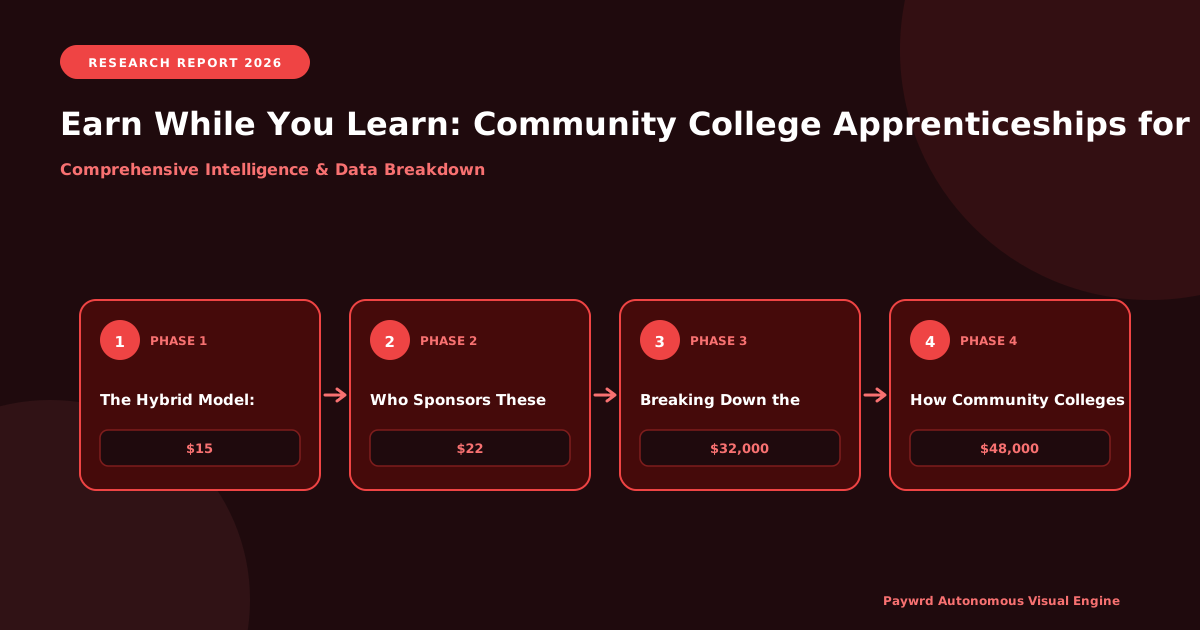
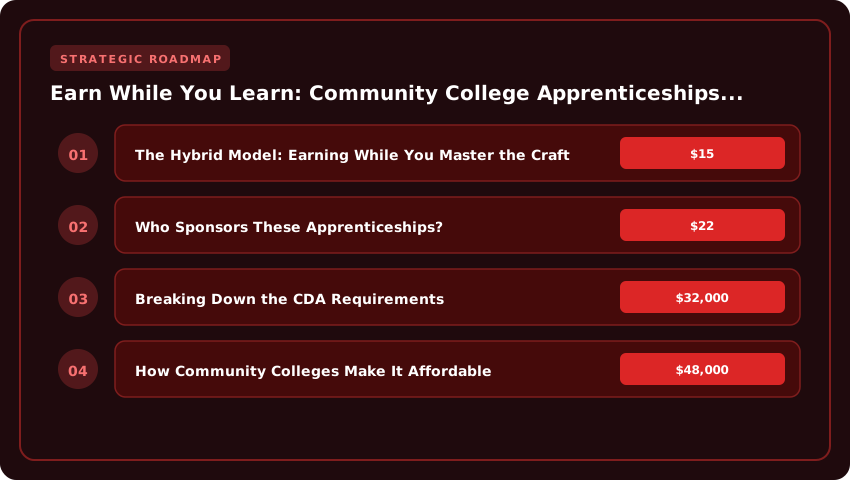
At its core, a Registered Apprenticeship is an “earn-and-learn” arrangement. Apprentices are full-time employees from their very first day, earning wages that typically start between $15 and $22 per hour depending on the state and sponsor. As they work, they complete the required 2,000 to 4,000 hours of paid on-the-job training under the mentorship of a seasoned lead teacher. Simultaneously, they fulfill roughly 144 hours of related technical instruction annually, which is delivered through partnered community colleges or workforce development boards.
This dual structure means apprentices are not sacrificing income to pursue credentials. By the end of their apprenticeship, participants typically earn between $32,000 and $48,000 annually while holding a Child Development Associate (CDA) credential, an Associate of Applied Science (AAS) degree, or even a bachelor’s pathway, depending on the program’s intensity.
How Apprenticeships Differ From a Traditional ECE Degree
Traditional ECE degree programs often require students to complete non-paid practicums and field observations, which can stretch the timeline to four years and rack up debt loads exceeding $25,000 for a bachelor’s degree. Apprenticeships, by contrast, are sponsored by the employer. That means tuition assistance is often covered through Workforce Innovation and Opportunity Act (WIOA) funding, employer tuition reimbursement, or state apprenticeship grants. Apprentices earn the degree without the sticker shock, and they graduate with a job offer already in hand.
Who Sponsors These Apprenticeships?
Major employers are stepping up to sponsor programs nationwide. Head Start programs, local YMCAs, Bright Horizons, KinderCare, and licensed family childcare networks are partnering with community colleges to build sustainable talent pipelines. In states like California, Washington, and North Carolina, public-private partnerships have made it possible for hundreds of adults to transition into ECE careers without ever leaving the classroom setting they train in.
For career changers and incumbent workers wondering whether to invest another four years in a degree, the math is straightforward: a Registered Apprenticeship delivers a paycheck, a credential, and a career, all at once. It is no wonder this model is rapidly becoming the preferred entry point into the early childhood profession.
The CDA Credential: Your First Stackable Milestone at a Community College
Before you can lead a classroom or command a six-figure salary as a center director, you have to master the fundamentals. For most aspiring preschool teachers, the Child Development Associate (CDA) credential serves as that critical first rung on the career ladder, and earning it through a community college apprenticeship is one of the smartest financial moves you can make.
Breaking Down the CDA Requirements
The Council for Professional Recognition administers the CDA, and the pathway is refreshingly transparent. Candidates must complete 120 hours of formal early childhood education covering eight subject areas, from child development and curriculum planning to health and safety. On top of that, you need 480 hours of professional work experience in a licensed childcare setting, a professional portfolio, parent observations, and a passing score on the CDA exam. The total investment of time typically spans nine to twelve months, aligning perfectly with a Registered Apprenticeship timeline.
How Community Colleges Make It Affordable
Here is where the apprenticeship model truly shines. Most public community colleges now package CDA preparation into credit-bearing certificate programs ranging from 9 to 18 credit hours. Because these courses carry college credit, they qualify for federal FAFSA aid, including Pell Grants that can cover tuition entirely for low-income students. Many apprentices pay zero out-of-pocket costs, and those who do typically spend less than $1,000 total, a fraction of what private CDA prep courses charge. Books, background checks, and exam fees are often bundled into the program’s sticker price.
Federal Recognition That Translates to a Paycheck
The CDA is not just a personal achievement. It is federally recognized as a qualifying credential for Head Start teachers and is embedded in the Child Care and Development Fund (CCDF) subsidy system that reimburses providers across all 50 states. This means employers are financially incentivized to hire CDA-credentialed staff, and many apprenticeship sponsors offer a wage bump of $1 to $3 per hour the moment candidates earn the credential. In high-demand states like California, Massachusetts, and Washington, a CDA plus apprenticeship experience can launch you into an entry-level lead teacher role earning $38,000 to $46,000 annually, per recent Bureau of Labor Statistics (BLS) data.
The T.E.A.C.H. Early Childhood Scholarship Boost
For students who need extra financial scaffolding, the T.E.A.C.H. Early Childhood scholarship program operates in nearly every state, often through partnerships with local community colleges. T.E.A.C.H. covers tuition, textbooks, and even provides paid release time from your apprenticeship site so you can attend class and study. In exchange, recipients typically commit to staying at their sponsoring childcare program for six to twelve months after credentialing. It is a win-win: employers retain trained talent, and apprentices graduate debt-free with a nationally portable credential.
- 120 hours of professional early childhood education
- 480 hours of verified work experience in a licensed setting
- Passing score on the national CDA exam administered by the Council for Professional Recognition
- Pell Grant eligibility through credit-bearing community college certificate programs
- Federal recognition by Head Start and the CCDF subsidy system for immediate employability
- T.E.A.C.H. Early Childhood scholarship coverage for tuition, books, and release time
From CDA to AAS Degree: Mapping the Two-Year Stackable Pathway
When comparing a standalone Child Development Associate (CDA) certificate against a full two-year degree, the long-term math almost always favors the degree. While the CDA—administered by the Council for Professional Recognition—takes roughly 120 hours of coursework and a few months to complete, an Associate of Applied Science (AAS) in Early Childhood Education opens a significantly wider earnings band. According to the US Bureau of Labor Statistics (BLS), preschool teachers with an associate degree earn a median annual wage of around $34,000, while those holding a bachelor’s degree push closer to $45,000 per year. Over a 30-year career, that $11,000 annual gap compounds to roughly $330,000 in additional lifetime earnings, before factoring in leadership roles that often require a four-year credential.
How Articulation Agreements Make the CDA Count Twice
The magic word for apprentices holding a CDA is articulation agreement. These formal contracts between two-year institutions and credentialing bodies guarantee that your existing 120 hours transfer directly into an AAS degree, shaving a full semester off your timeline. In Texas, the Texas Workforce Commission (TWC) has brokered statewide articulation pathways covering nine community college systems, meaning a CDA earned in El Paso travels cleanly to a degree program in Houston. In California, the Chancellor’s Office (CCCCO) operates a similar Child Development Permit alignment system where CDA holders enter the AAS track at the “Junior” standing. The State University of New York (SUNY) network takes this even further, allowing apprentices to stack a CDA, an AAS, and a bachelor’s degree from campuses like SUNY Buffalo or SUNY Westchester in roughly four years of part-time, paid study.
NAEYC Accreditation: The Hidden Portability Engine
Not all associate degrees are created equal. Programs accredited by the National Association for the Education of Young Children (NAEYC) meet rigorous standards covering curriculum, faculty qualifications, and practicum intensity. Crucially, NAEYC-accredited AAS credits transfer seamlessly into bachelor’s programs at four-year institutions, including many state universities and private colleges. This accreditation acts as a universal translator, preventing the dreaded credit-loss scenario where students must retake coursework after transferring. Apprentices should verify NAEYC Associate Degree Accreditation status before enrolling, since non-accredited programs may save tuition dollars upfront but cost semesters of progress later.
Sample Coursework Across State Systems
Typical AAS coursework across these networks includes:
- Child Growth and Development – 3 credits, covering developmental milestones from birth through age eight.
- Curriculum Planning for Early Childhood – 3 credits, focused on play-based and emergent curriculum design.
- Observation and Assessment – 3 credits, training educators to use authentic assessment tools like Teaching Strategies GOLD.
- Health, Safety, and Nutrition – 3 credits, aligned with Child Care Licensing requirements across all 50 states.
- Practicum / Field Experience – 4 to 6 credits, completed on-the-job as part of your registered apprenticeship hours.
Dual Enrollment: Finishing High School While Stacking Credentials
One of the most powerful yet underutilized options is dual enrollment. High school students aged 16 and older can enroll in community college ECE courses that count simultaneously toward a high school diploma (or HiSET equivalency) and an AAS degree. Programs in California, Texas, and New York explicitly waive tuition for dual-enrolled students, meaning a teen could exit high school with a year of college credit already paid for. For adult apprentices who never completed high school, many apprenticeship intermediaries partner with local adult education centers to fold GED preparation into the paid workweek.
The bottom line is straightforward: a certificate alone caps your ceiling, while a stackable AAS degree with NAEYC accreditation unlocks the full professional ladder, and articulation agreements ensure you never waste a single credit getting there.
Salary Reality Check: What BLS Data Says About Pay After Each Credential
Let’s talk real numbers, because a paycheck is the bottom line when you’re choosing a career path. According to the US Bureau of Labor Statistics (BLS), the median annual wage for preschool teachers reached $34,020 in 2023, while childcare workers earned a median of $29,780. That gap might look small on paper, but it represents thousands of dollars in real-world spending power, and it widens dramatically when you stack credentials underneath your name. The difference between a CDA (Child Development Associate credential) and an Associate of Applied Science (AAS) degree isn’t just a line on a resume; it’s a measurable boost to your biweekly direct deposit.
How Geography Reshapes Your Paycheck
Where you work matters just as much as what credentials you hold. BLS state-level data reveals significant variance across the four states where DOL-Registered Apprenticeship programs for early childhood educators cluster most heavily:
- California: Preschool teachers average $39,510 annually, with the San Francisco Bay Area and Los Angeles metro pushing experienced educators past $48,000.
- New York: The statewide median sits around $38,150, though New York City apprenticeship sponsors frequently advertise starting wages above $42,000 when benefits are factored in.
- Texas: Median pay lands near $31,420, but major districts in Houston, Dallas, and Austin have aggressively raised wages to combat turnover, often supplementing base salary with stipends.
- Illinois: Chicago-area programs report median earnings of $36,890, supported by state-funded early childhood expansion initiatives through the Illinois State Board of Education.
The takeaway? Geography can swing your annual earnings by $10,000 or more for identical credentials, making apprenticeship placement location a critical decision factor.
The Credential Premium: CDA vs. AAS Degree
Industry wage analyses consistently show that an AAS degree lifts earnings 15-25% above the CDA-only baseline. If you’re earning $29,780 as a CDA-credentialed childcare worker, an AAS degree could realistically push you into the $34,250 to $37,225 range, closing the gap toward the preschool teacher median without requiring a four-year bachelor’s degree. Programs accredited by bodies recognized by the US Department of Education ensure your credits transfer if you later pursue further study.
Total Compensation Beyond the Base Salary
Here’s where apprenticeship sponsors change the math entirely. Most DOL-Registered Apprenticeship programs, particularly those affiliated with major hospital systems, Head Start grantees, and public school districts, layer benefits on top of base wages:
- Employer-sponsored health insurance (valued at $6,000-$12,000 annually per BLS employer cost surveys)
- Tuition reimbursement covering remaining coursework after federal Pell Grants and FAFSA aid
- Retention bonuses ranging from $500 to $2,000 for completing program milestones
- Paid planning periods and holiday closures mirroring K-12 public school calendars
- State-funded stipend programs, such as California’s Child Development Permit stipends and New York’s Early Childhood Career Development Grants
When you calculate the full compensation package, an apprentice earning $18 per hour plus benefits often clears $48,000 in total value, competitive with many fields requiring a four-year degree, but achieved in roughly half the time and without the student loan debt that burdens many of today’s graduates.
Funding Your Apprenticeship: CCDF, WIOA, and Scholarship Stacking Strategies
Let’s talk about the part everyone really cares about: who is actually footing the bill. If the idea of earning a paycheck while completing your degree sounds almost too good to be true, that’s because most people don’t realize how many federal and state funding streams are quietly stacked together to make these programs possible. The math is genuinely impressive when you map it out, and thousands of early childhood apprentices across the country are graduating with zero student loan debt because they learned how to layer these resources.
Here’s how the major funding sources work together:
- Child Care and Development Fund (CCDF): Administered through the US Department of Health and Human Services and funneled down to state agencies, CCDF subsidies do more than just help parents afford care. A growing number of states now allow CCDF dollars to flow directly into apprenticeship programs, covering tuition, books, and credentialing fees for apprentices working in subsidized programs. If you’re already employed at a licensed center serving low-income families, your employer may already be receiving CCDF reimbursement that can be redirected toward your training costs.
- Workforce Innovation and Opportunity Act (WIOA) Title I: WIOA Title I funding through your local American Job Center covers tuition, required fees, uniforms, childcare during classes, transportation assistance, and even emergency needs like car repairs. Adults who qualify as low-income, basic-skills-deficient, or dislocated workers can access up to the full cost of an apprenticeship program, plus supportive services that remove the everyday barriers that cause so many adult learners to drop out.
- T.E.A.C.H. Early Childhood Scholarships: Operated in over 30 states by Child Care Services Association, T.E.A.C.H. is purpose-built for early educators. Award amounts typically range from $1,500 to $4,500 per year, and many state branches now stack directly onto registered apprenticeship frameworks, paying for CDA credentials, Associate degrees, and Bachelor’s degrees at partner community colleges.
- Child Care Aware® and State Apprenticeship Sponsorships: Local Child Care Aware resource and referral agencies often administer scholarship add-ons, while several states (including Iowa, Wisconsin, and Washington) now offer direct apprenticeship sponsorships that pair apprentices with mentor teachers. On the employer side, sponsorships unlock federal tax credits worth $4,000 to $8,000 per apprentice, depending on the program length and the apprentice’s age.
The smartest move is to sit down with your apprenticeship coordinator and build a personalized funding map. Most centers will help you fill out the FAFSA to unlock Pell Grants (currently up to $7,395 per year for two-year programs), apply through your state workforce board for WIOA Individual Training Accounts, and connect with your local Child Care Aware office for emergency assistance funds. When you combine Pell, WIOA, T.E.A.C.H., and employer tax-credit savings, the actual cost to you as an apprentice often drops to zero.
One last note that matters more than people realize: because these are DOL Registered Apprenticeships, your wages increase on a documented schedule as you hit milestones, meaning you are not waiting until graduation to see a return. Layered funding turns an ambitious career goal into a financially manageable, debt-free pathway that pays you from day one.
Articulating to a Bachelor’s Degree Through State University Systems
Earning your Associate of Applied Science (AAS) in Early Childhood Education through a registered apprenticeship is a powerful professional milestone, but for ambitious educators mapping out a 4- to 6-year career trajectory, the next step is even more critical: transferring those hard-earned credits into a bachelor’s degree completion program without losing momentum or money. The good news is that several major US university systems have specifically designed articulation pathways that respect the applied, workforce-driven nature of an apprenticeship degree. These programs understand that working educators need flexibility, recognition of prior learning, and tuition structures that fit a teacher’s paycheck.
Within New York, SUNY Empire State University and the CUNY School of Professional Studies have emerged as national leaders in this space. Both institutions actively recruit AAS graduates and accept their credits toward a Bachelor of Arts in Early Childhood Education. CUNY, in particular, has built flexible hybrid and asynchronous online formats aimed squarely at working adults, with tuition ranging roughly between $3,000 and $7,000 annually for in-state students, making a four-year bachelor completion highly affordable. SUNY Empire’s credit-for-experience policies further allow apprentice graduates to convert documented classroom hours into upper-division elective credits, shaving semesters off the typical graduation timeline.
Out west, the California State University (CSU) system offers targeted bachelor completion programs through campuses like CSU Sacramento and CSU Fullerton, while the University of California (UC) extension programs, including UCLA Extension and UC Berkeley Extension, provide rigorous, cohort-based online pathways for educators already in the field. CSU’s solid “2+2” articulation frameworks often guarantee full junior standing for AAS holders who complete a Transfer Model Curriculum, meaning apprentices can finish their BA in as little as two additional years while continuing to work full-time.
Nationally recognized institutions like the University of Cincinnati, the Erikson Institute in Chicago, and other NAEYC-accredited programs have leaned heavily into 100% online bachelor completion tracks tailored for AAS graduates. Erikson, in particular, is renowned for its graduate-level preparation in early childhood, but its undergraduate pathway is equally strong, offering online cohort models priced around $500-$700 per credit hour, with generous transfer credit limits that can absorb most of an AAS curriculum. The University of Cincinnati’s online Bachelor of Science in Early Childhood Education accepts up to 60 transfer credits and includes free electronic textbooks, dramatically lowering the total cost of a bachelor’s degree for registered apprentices.
The financial return on this investment is significant and well-documented by the US Bureau of Labor Statistics (BLS). Once an educator completes a bachelor’s degree and earns Lead Teacher qualification, pay differentials typically average $2 to $5 per hour above an associate-level wage. Over a standard 40-hour work week, that translates to an additional $4,000 to $10,000 in annual earnings, not counting expanded benefits, retirement contributions, and eligibility for administrative roles. For apprentices planning long-term financial stability, articulating an AAS into a full BA through any of these state university systems represents the most strategic, debt-conscious path forward in modern early childhood education.
Choosing the Right Apprenticeship Sponsor: A Decision Framework
Selecting the right apprenticeship sponsor is the single most important decision you will make on your journey from aspiring educator to credentialed professional. Because registered apprenticeships in early childhood education (ECE) are fundamentally employer-driven, the sponsor you choose shapes everything: the quality of mentorship you receive, the pace at which you advance, the college courses you take, and ultimately, the depth of your classroom competence. Treat this choice with the same rigor you would apply to picking a four-year university, because in many ways, your sponsor is your college.
Evaluating Employer Sponsors
The US early childhood landscape is a patchwork of sponsor types, each with distinct advantages. Head Start grantees, funded by the Administration for Children and Families, often provide the most structured apprenticeship experience. Because Head Start programs operate under federal performance standards, apprentices typically receive robust release time for college coursework, comprehensive onboarding, and clear pathways toward the Child Development Associate (CDA) credential and associate degree. According to the US Department of Labor, Head Start sponsors consistently rank among the highest-paying apprenticeship providers in the sector, with starting wages often between $18 and $22 per hour in 2025.
Corporate childcare chains such as Bright Horizons and KinderCare offer scale, standardized curriculum, and often tuition assistance that goes beyond the apprenticeship framework itself. Bright Horizons, for instance, frequently partners with community colleges to deliver cohort-based instruction on-site. The trade-off is that corporate environments can feel more standardized, with less flexibility in mentor matching and program pacing.
Independent centers and family child care networks can offer intimate learning environments where apprentices are immersed in a single mentor’s classroom from the start. These sponsors often excel in cultural responsiveness and individualized coaching but vary widely in compensation and release-time policies. Before enrolling, ask any potential sponsor for written documentation of their DOL registration number, recent wage schedules, and completion rates.
Questions to Ask About Mentor Quality, Cohort Structure, and Release Time
Your day-to-day mentor is the difference between a transformative experience and a wasted year. Probe sponsors with targeted questions: How many hours per week does the mentor spend directly coaching the apprentice? What is the mentor-to-apprentice ratio? Does the program use a structured coaching framework such as the Classroom Assessment Scoring System (CLASS), or is feedback informal? Inquire about cohort structure as well, since cohort-based programs allow apprentices to build professional networks that often last decades.
Release time is non-negotiable for academic success. Quality sponsors carve out a minimum of four to six paid hours per week for community college classes, plus dedicated study time. If a sponsor hesitates when you ask about release time, consider it a warning sign.
Red Flags to Avoid
Walk away from sponsors who lack verifiable DOL registration, partner with unaccredited colleges, or cannot articulate a clear degree pathway. Programs that charge upfront fees, promise suspiciously fast completion, or refuse to share apprenticeship completion data are not worth your time. The Department of Labor maintains a public Apprenticeship Finder tool that lets you confirm a sponsor’s registered status in minutes; use it.
Application Checklist: Health, Safety, and Compliance
Across all US programs, expect a standard set of pre-employment requirements:
- Federal and state background checks, including FBI fingerprinting and child abuse registry clearances
- TB testing, with results typically required within the past 12 months
- CPR and pediatric first-aid certification, often through the American Red Cross or American Heart Association
- Immunization records, including MMR, Tdap, and varicella
- FAFSA completion if seeking Pell Grants or state need-based aid to cover tuition costs averaging $3,500 to $5,000 per year at community colleges
Compile these documents before you apply. Sponsors move quickly through candidates who arrive prepared, and in a sector where 2025 BLS data reports a median early childhood educator wage of $34,650, rising to $46,000 or more with an apprenticeship-credentialed degree, that preparation translates directly into career momentum.
| Decision Criteria | Traditional 4-Year ECE Degree | DOL Registered Apprenticeship (Community College) |
|---|---|---|
| Total Tuition Cost | $40,000 – $100,000+ (avg. public/private) | $0 – $5,000 (often fully covered by DOL grants/employer) |
| Income During Training | $0 (unpaid student teaching) or minimum wage | $18,000 – $45,000+ annually (earn-while-you-learn wage) |
| Hands-On Hours Required | ~480 – 800 student teaching hours | 2,000 – 4,000 paid OJL hours |
| Program Timeline | 4 years (full-time) | 1 – 2 years |
| Credential Earned | BA/BS in Early Childhood Education | Associate Degree + DOL Journey-level Certificate |
| Starting Salary Post-Graduation | $32,000 – $38,000 (national avg.) | $38,000 – $52,000 (with apprenticeship credit) |
| Student Debt Upon Completion | $30,000+ average | $0 – $3,500 (debt-free path) |
| Prerequisites / Cutoff | High school diploma + SAT/GPA admission | 18+ years old, HS diploma/GED, passing skills assessment |
| Federal Backing | FAFSA loans required | US Department of Labor Registered Apprenticeship |
Frequently Asked Questions
What credential do you receive after finishing an ECE apprenticeship?
Graduates earn an industry-recognized US Department of Labor Journey-level Certificate plus an Associate degree in Early Childhood Education from their community college. This portable credential is nationally recognized and qualifies graduates for lead teacher positions earning $38,000–$52,000 annually.
Strategic Final Takeaway
When evaluating Early Childhood Educator Apprenticeship Programs At Community Colleges With Stackable Credentials And Salary Boost, base your decisions on accredited institutional standards, measurable return on investment (ROI), and up-to-date official guidelines. Always verify specific dates and requirements through official regulatory portals.