
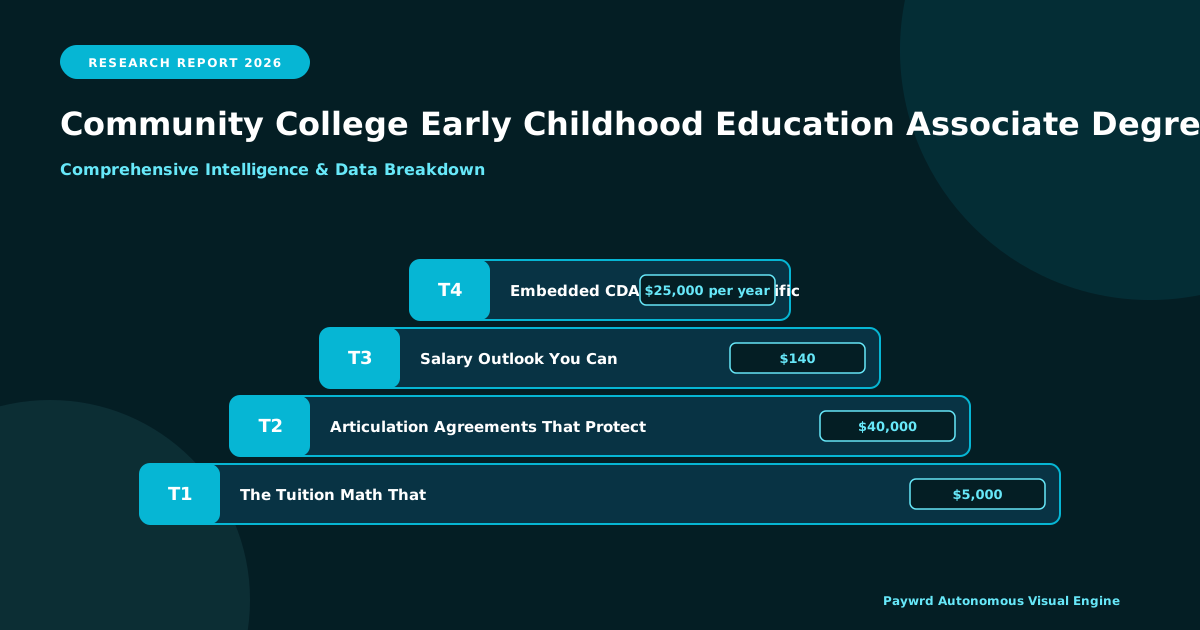
Why an Associate Degree in Early Childhood Education Is a Strategic US Career Launchpad
If you’re looking for a US career that combines genuine social impact with serious economic mobility, Early Childhood Education deserves a much closer look than it typically gets. Behind the familiar image of story time and finger paint lies one of the most resilient employment sectors in the American economy, and the two-year associate degree is its most underused on-ramp.
The demand signal is hard to ignore. According to the US Bureau of Labor Statistics, employment of preschool teachers is projected to grow roughly 8% through 2032, faster than the average for all occupations, while childcare administrators are seeing even steeper expansion as more states mandate lead teacher credentials for publicly funded programs. Head Start grantees, which operate in every US state under federal oversight, increasingly require at least an associate degree for lead teacher positions, and many are now requiring a bachelor’s within a few years of hire. That policy shift is quietly turning the associate degree into the new minimum standard for the floor of the profession, not the ceiling.
The Tuition Math That Changes the Decision
Cost is where the community college model becomes almost impossible to beat. The average in-district community college tuition in the United States sits around $140 per credit hour, according to College Board, pushing a full-time annual total comfortably below $5,000 for most students. Compare that to four-year institutions, where published tuition and fees routinely exceed $25,000 per year before room and board, and the financial logic writes itself. For working adults balancing jobs and family, the lower sticker price is only part of the story: many community colleges run evening, weekend, and hybrid cohorts specifically designed for career changers, and a growing number sit on the FAFSA priority list, meaning students can stack Pell Grants with state childcare workforce scholarships to push net tuition close to zero.

Articulation Agreements That Protect Your Credits
One of the smartest features of the US community college system is the articulation agreement, a formal transfer contract between a two-year school and a four-year state university that guarantees junior-year standing for graduates who meet GPA and coursework benchmarks. In early childhood education, these agreements are particularly mature in states like California, Texas, New York, and Illinois, where public university systems have built dedicated ECE transfer pathways aligned with state teaching licenses. The result is a stop-and-go bachelor’s completion model: you earn, work, and credential at the associate level, then layer a bachelor’s on top without losing a single credit, which dramatically shortens the time and cost to reach higher-paying roles such as preschool director or public pre-K lead teacher.
Salary Outlook You Can Actually Plan Around
The return on investment shows up quickly in the paycheck. BLS data pegs median annual wages for preschool teachers at roughly $37,130 nationally, but that’s pulled down by part-time workers; full-time lead teachers in public pre-K and Head Start commonly earn between $42,000 and $55,000 depending on state and district. Move up into center management, and childcare administrator salaries climb into the $55,000 to $75,000 range, with metropolitan markets paying toward the top of that band. For professionals eyeing a corporate pivot into education-adjacent roles, such as training and development, the US Bureau of Labor Statistics reports a median wage of $67,550, and an ECE background is increasingly treated as a qualifying credential.
Put simply, the associate degree pathway is not a consolation prize; it’s a calculated first move on a credential ladder that the US labor market is actively rewarding.
Inside the Community College ECE Associate Curriculum: CDA, State Credentials, and Transferable Credits
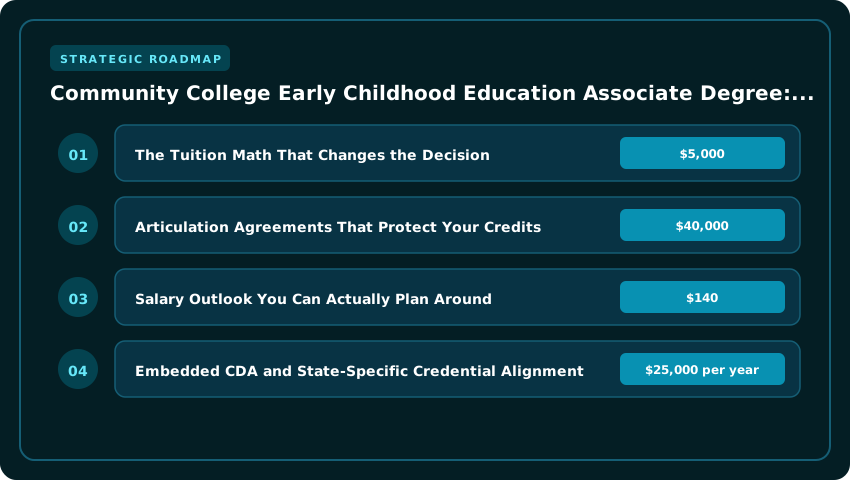
Walking into an Early Childhood Education (ECE) associate program at a US community college feels different from enrolling in a generic transfer track. The coursework is immediately practical, deeply developmental, and deliberately stacked with credentials that travel across state lines and straight into a four-year university registrar’s office. Most learners move through the 60-credit sequence in roughly two years, juggling core theory, hands-on practicum hours, and the exact modules required to sit for the Child Development Associate (CDA) credential administered by the Council for Professional Recognition.
Core Coursework: Where Theory Becomes Classroom Practice
The heart of the degree rests on four tightly woven content strands:
- Child Development Foundations: Courses like “Child Growth and Development” (often labeled CHD 1203 or equivalent) trace cognitive, social-emotional, and physical milestones from infancy through age eight, grounded in Piaget, Vygotsky, and current neuroscience.
- Emergent Literacy and Language Acquisition: Classes cover phonemic awareness, early reading intervention, dual-language support, and culturally responsive read-aloud strategies aligned with Common Core and state early learning guidelines.
- Classroom Behavior and Guidance: Rather than discipline-heavy models, programs teach proactive social-emotional frameworks (Conscious Discipline, Pyramid Model, and trauma-informed practices) that ECE educators actually use at the preschool or Pre-K level.
- Observation and Practicum: Every accredited program embeds a minimum of 180 documented practicum hours in a licensed early learning setting, where students apply developmental theory to real children and build the portfolio required by the CDA.
Embedded CDA and State-Specific Credential Alignment
What sets strong community college ECE programs apart is concurrent credentialing. The eight CDA subject areas (planning a safe environment, supporting physical and intellectual growth, and so on) are not an add-on; they are woven into courses such as “Curriculum for Young Children” and “Health, Safety, and Nutrition.” Graduates frequently walk across the commencement stage already holding a CDA plus a state-level credential, which translates to immediate eligibility for lead-teacher roles in subsidized programs like Head Start.
Because each state names its credential slightly differently, alignment matters financially:
- Texas: Texas Early Childhood Professional Development System (Texas Rising Star) certificates stack into the associate, often satisfying the Texas School Ready! pathway.
- California: California’s Child Development Permit (Teacher level) embeds directly through coursework at colleges like Mt. SAC and Pasadena City College.
- Florida: Florida’s Department of Children and Families Staff Credential and the Florida Early Childhood Professional Credential (FCCPC) map onto the same practicum hours.
- New York: The New York State Children’s Program Administrator Credential (level I/II) and the B-2 Assistant Teacher certificate route through courses at CUNY and SUNY community colleges.
General Education Packages That Travel
Beyond the ECE core, every associate includes roughly 30 credits of general education: English composition, college math, U.S. history, and lab science. Thanks to state-level articulation agreements and tools like the NJ Transfer, TIPS (Texas), ASSIST (California), and SUNY Transfer Path, these courses satisfy lower-division general education requirements at most public receiving universities. That means a graduate transferring to a Bachelor of Science in Early Childhood Education or Child Development typically enters as a junior, preserving time and tuition dollars. Private institutions and the eight Ivy League universities evaluate credits case-by-case, but most credit the full general education block.
The result is a degree that pays immediate dividends in the classroom while keeping the bachelor’s pathway affordable and largely visible from day one.
Decoding Transfer Pathways: How Articulation Agreements Move You From Community College to a Bachelor’s
Think of an articulation agreement as a pre-signed contract between your two-year community college and a four-year university. Instead of guessing whether your Introduction to Child Development course will transfer as an elective or a core requirement, the agreement locks down the answer before you even register. For working adults and career-changers eyeing a bachelor’s in Early Childhood Education (ECE), Elementary Education, or Human Development, these agreements are the single most powerful tool for saving both semesters and tuition dollars.
Guaranteed Admission and Reverse Transfer Under Statewide Agreements
More than 30 US states operate some form of statewide transfer guarantee, and these are often the first place adult learners should look. In Texas, the Field of Study curriculum ensures an Associate of Applied Science (AAS) in ECE transfers seamlessly into designated bachelor’s programs at public universities. California’s Associate Degree for Transfer (ADT) gives priority admission to California State University (CSU) campuses for students earning an AS-T in Elementary Education. Meanwhile, Florida’s 2+2 pathway and New York’s Transfer Pathways programs similarly guarantee junior-year standing. Don’t overlook reverse transfer: if you complete enough university credits to satisfy your associate degree requirements, your four-year school can send those credits back to your community college so you earn the two-year credential along the way, a smart move if you need a diploma on your resume while finishing the bachelor’s.
Mapping Associate Credits Into a Bachelor’s Major
Not every ECE associate degree feeds the same bachelor’s pipeline. An Associate of Arts (AA) typically aligns with Bachelor of Arts programs in Child Development or Human Development at regional universities, while an Associate of Applied Science (AAS) often pairs with Bachelor of Applied Science (BAS) tracks that emphasize early childhood leadership and curriculum design. Before committing, request an official transfer credit evaluation and confirm that courses like Child, Family, and Community or Curriculum Planning for Young Learners count toward your upper-division major requirements, rather than landing as generic electives.
Spotting CAEP and AAQEP Accreditation for Licensure Pathways
If your goal is state teacher licensure, the receiving university matters as much as the transfer agreement. Look for programs accredited by the Council for the Accreditation of Educator Preparation (CAEP) or the Association for Advancing Quality in Educator Preparation (AAQEP). Both are recognized by the US Department of Education, and graduating from a CAEP- or AAQEP-accredited program clears the path to a state teaching credential without re-taking subject-matter exams.
The Real-World Two-Year Timeline for Working Paraprofessionals
Here’s the part that surprises most people: full-time students who complete an associate degree can realistically cross the bachelor’s finish line in just two more years, even while working as paraprofessionals or substitute teachers. Picture the timeline. Year One after transfer focuses on core pedagogy, classroom management, and practicum hours. Year Two covers student teaching and capstone work, while FAFSA Pell eligibility often continues for part-time enrollment if your income stays under the threshold. Many districts even sponsor tuition reimbursement for paraprofessionals, stacking employer dollars on top of federal aid to keep the total cost manageable. With this roadmap, your associate degree becomes a launchpad, not a dead end.
- Verify statewide transfer guarantees (ADT, Field of Study, 2+2) before enrolling.
- Confirm CAEP or AAQEP accreditation at the receiving university for licensure eligibility.
- Map every community college course to upper-division requirements using a transfer credit evaluation.
- Use reverse transfer to lock in your associate credential mid-bachelor’s.
- Stack employer tuition reimbursement with FAFSA to fund Years Three and Four.
Employer Salary Outlook in the US: What Early Childhood Educators Actually Earn by State and Setting
Money talks, and early childhood education finally has a louder voice in US wage conversations. According to the Bureau of Labor Statistics May 2023 Occupational Employment and Wage Statistics, preschool teachers across the country earn a median annual wage of around $37,120, while kindergarten and elementary special education teachers command a significantly higher median of roughly $63,670. Childcare center directors, a role an associate degree can help you step into within just a few years, pull a median salary near $53,290 nationally. Those national medians, however, only tell half the story because geography and employer type can easily shift your paycheck by $15,000 to $25,000 in either direction.
State-by-State Snapshot: Where the Highest Salaries Actually Live
- California remains the heavyweight champion for preschool teacher pay, with annual mean wages climbing above $47,000 in metros like San Jose, San Francisco, and Oakland. Kindergarten teachers in California public schools routinely start above $60,000, and directors in larger urban centers cross $80,000.
- New York follows close behind, where preschool teachers average near $45,000 in the New York City metro, and center directors in Long Island and the five boroughs frequently report six-figure compensation in established programs.
- Massachusetts consistently ranks among the top three states for ECE compensation, with Boston-area preschool teachers earning mean wages around $46,000 and strong public school benefits layered on top.
- Illinois offers solid mid-tier wages, especially in the Chicago suburbs where preschool teachers average $38,000-$42,000 and public school kindergarten positions track the broader teacher salary schedule.
- Texas delivers high purchasing power with lower cost-of-living offsets; Houston, Austin, and Dallas preschool wages typically range from $32,000 to $40,000, and director salaries in large urban childcare chains regularly exceed $60,000.
Credentials That Move the Needle on Your Paycheck
Simply earning an associate degree is often the first salary bump, but stacking credentials can dramatically accelerate earnings. Many districts and states recognize that a bachelor’s degree adds roughly $5,000 to $12,000 annually over an associate-level placement on the salary schedule. Bilingual endorsements, particularly Spanish-English dual language credentials, can unlock an additional 3-7 percent stipend in districts serving diverse communities from Los Angeles to Chicago. The employer type matters just as much: public school employment typically delivers stronger base pay, predictable step increases, and richer benefits, while private childcare centers sometimes offer lower hourly wages but faster management promotion tracks for ambitious directors.
Benefits That Quietly Add 25-35 Percent to Total Compensation
Wages are only part of the equation. US school districts commonly provide pension enrollment through state retirement systems such as CalSTRS, NYSTRS, or TRS Illinois, often with employer contributions ranging from 8 to 12 percent of salary. Health insurance premiums are frequently covered at 70-90 percent for full-time staff, and continuing education reimbursement, sometimes called tuition remission, can pay $1,500 to $5,250 annually toward a bachelor’s or master’s program at a partner university. When you add paid time off, holiday breaks aligned with the academic calendar, and professional development days, the realistic total compensation for a public school ECE role frequently exceeds the sticker salary by a quarter or more, making return on investment calculations far more favorable than raw wage data suggests.
Financial Aid, Scholarships, and Workforce Funding That Cut the Cost of Your ECE Associate Degree
Let’s be honest: the sticker price on any degree program can feel intimidating, even at a community college where annual tuition frequently lands under $5,000 for in-district students. The good news? A robust network of federal aid, state scholarships, and employer-sponsored tuition programs exists specifically to make an Early Childhood Education (ECE) Associate Degree far more affordable than most prospective learners realize. Understanding how to stack these resources can literally cut your out-of-pocket cost in half, or eliminate it entirely.
Federal Aid: FAFSA, Pell Grants, and the TEACH Grant
Your first stop is the Free Application for Federal Student Aid (FAFSA), administered by the US Department of Education. For full-time ECE students demonstrating financial need, the Federal Pell Grant routinely provides more than $7,000 annually, and the maximum award currently sits near $7,395 for the 2024-2025 award year. Because ECE programs attract working adults and career-changers, many students qualify even with modest incomes. You don’t repay Pell Grants, which makes them the single most powerful tool in your financial aid toolbox.
If your career goals include teaching in a high-need public school or a specialized shortage area like early childhood special education, the TEACH Grant offers up to $4,000 per year. The catch? You must complete a service obligation: four years of teaching in a low-income school within eight years of graduation. Missing that obligation converts the grant into an unsubsidized loan, so read the fine print carefully. Still, for committed educators, this is essentially free money.
State Scholarships and Shortage-Area Incentives
Nearly every US state recognizes the early educator pipeline crisis and has responded with targeted scholarship programs. Examples include California’s Child Development Teacher and Supervisor Grant, Texas’s T.E.A.C.H. Early Childhood Scholarship, and New York’s Aspiring Early Childhood Educator Scholarship. These programs typically cover tuition, books, and sometimes even release time for current childcare employees. They prioritize specialization in infant-toddler care, bilingual education, and early intervention, areas where shortages hit hardest.
Employer Tuition Reimbursement at Major US Childcare Chains
Here’s a secret that career advisors rarely emphasize enough: major US employers like KinderCare Learning Centers and Bright Horizons Family Solutions operate robust tuition reimbursement programs for staff pursuing ECE credentials. KinderCare’s Learn. Grow. Lead. initiative, for instance, can cover a significant portion of associate degree coursework for full-time teachers, often paired with flexible scheduling that lets you attend community college classes during off-peak hours. Bright Horizons similarly invests in continuing education, viewing it as retention strategy and quality improvement combined. If you’re already working in a center, ask your director about these benefits before assuming you’ll pay out of pocket.
CCAMPIS: Support Specifically for Student Parents
Many ECE students are themselves parents of young children, which is precisely why the Child Care Access Means Parents in School (CCAMPIS) program exists. Administered by the US Department of Education, CCAMPIS grants fund on-campus or nearby childcare for student parents enrolled in higher education. Awards vary by institution, but participating community colleges often use CCAMPIS funds to subsidize infant and toddler care for students juggling coursework and parenthood. Ask your financial aid office whether your college participates.
Stacked strategically, these four funding streams, federal Pell and TEACH Grants, state early educator scholarships, employer tuition reimbursement, and CCAMPIS support, can transform an affordable community college degree into one that’s genuinely within reach. Your next step is simple: complete the FAFSA, schedule a financial aid appointment, and ask your employer what they already offer. You may be pleasantly surprised by how much of your ECE associate degree someone else is willing to pay for.
Career Outcomes and Advancement Routes After Completing the Associate-to-Bachelor’s ECE Pathway
Finishing an Associate Degree in Early Childhood Education (ECE) at a US community college and stacking a bachelor’s on top is more than just a credential upgrade; it’s a deliberate strategy to unlock long-term earning potential and leadership ceilings that simply do not exist at the two-year mark. According to the US Bureau of Labor Statistics (BLS), preschool teachers nationally earn a median wage of around $37,000, while kindergarten and elementary educators hover near $63,790. The jump from the associate to the bachelor’s tier often translates into a $15,000 to $25,000 annual salary lift within the first three to five years post-transfer.
Promotion Pathways Inside the Classroom and Beyond
For ambitious educators, the bachelor’s degree opens the door to roles that carry real budget authority and program influence. Lead Teacher is typically the first rung after earning your ECE bachelor’s, often accompanied by a $3,000 to $7,000 pay differential and responsibility for mentoring assistants. From there, the Center Director position in a private preschool or corporate childcare chain (such as KinderCare or Bright Horizons) routinely commands $55,000 to $85,000 annually, depending on enrollment size and region. Moving up to a District-Level Early Learning Coordinator, frequently employed by public school districts or county education offices, can push total compensation past $90,000, especially when paired with benefits packages offered through the public sector.
Alternative Career Tracks for Versatile Professionals
- Curriculum Specialist: Designing play-based and standards-aligned instructional frameworks for early learning publishers, Head Start grantees, or state education departments. Median pay typically lands between $60,000 and $78,000.
- Family Services Liaison: Bridging schools and underserved households through home-visitation programs, often funded by federal Title I dollars or nonprofits like Parents as Teachers.
- Nonprofit Program Management: Running grant-funded early literacy or food-security initiatives for organizations such as the YMCA, United Way, or local early-childhood advocacy groups. Salaries for program managers in the nonprofit ECE space range from $50,000 to $72,000.
Graduate Program Options for Leadership-Focused Educators
Educators who want to stay hands-on with children while shaping policy and practice often pursue a Master of Education (M.Ed.) in Curriculum and Instruction, an Education Specialist (Ed.S.) in Early Childhood, or even a doctorate in early childhood leadership. These graduate degrees position teachers for roles such as instructional coach, district curriculum director, or college-level adjunct instructor, with the Ed.S. frequently opening six-figure opportunities in large urban districts. Many universities now offer asynchronous online M.Ed. programs that respect working teachers’ schedules.
Professional Certifications Beyond State Licensure
State teaching licensure is just the baseline. Career-driven ECE professionals layer on national credentials to stand out in competitive markets. The National Board for Professional Teaching Standards (NBPTS) Early Childhood certificate is widely considered the gold standard and earns certified teachers an annual stipend ranging from $1,500 to over $10,000, depending on the state. Other respected additions include the Child Development Associate (CDA) Credential for paraprofessional advancement, the Program Administrator Credential through the National Association for the Education of Young Children (NAEYC), and credentials awarded by the Council for Professional Recognition.
The bottom line for working professionals: the associate-to-bachelor’s ECE pathway is not an endpoint. It is a launchpad into a layered career arc where advanced degrees, national certifications, and leadership ambition can collectively push lifetime earnings comfortably past $90,000, with top-tier directors and specialists in high-cost-of-living states exceeding $110,000 annually.
| Decision Criterion | Associate Degree (Community College) | Bachelor’s Degree (4-Year University) | Child Development Associate (CDA) Credential | High School Diploma + Certification |
|---|---|---|---|---|
| Estimated US Tuition Cost | $2,500 – $5,000/year (In-state) | $10,000 – $30,000/year | $400 – $1,500 (Total) | $500 – $2,000 (Total) |
| Program Timeline | 2 Years (60 Credits) | 4 Years (120 Credits) | 6 – 12 Months | 3 – 6 Months |
| Average US Salary Potential | $32,000 – $45,000/year | $45,000 – $60,000+/year | $28,000 – $38,000/year | $25,000 – $32,000/year |
| Admission Prerequisites | High School Diploma/GED; Placement Tests | High School GPA (3.0+); SAT/ACT | 480 hours of professional experience | None (Employer Sponsored) |
| ROI / Career Mobility | High (Direct workforce entry + 2+2 transfer) | Highest (Lead Teacher & Admin roles) | Moderate (Head Start eligibility) | Entry-level (Assistant Teacher) |
Frequently Asked Questions
How much does an Associate Degree in Early Childhood Education cost at a US community college?
An Associate Degree in Early Childhood Education typically costs between $2,500 and $5,000 per year for in-state students at US community colleges. Including books and fees, the total two-year investment generally remains under $10,000, making it significantly more affordable than a four-year university degree.
What is the average salary for someone with an Associate Degree in Early Childhood Education in the US?
Professionals holding an Associate Degree in Early Childhood Education earn an average annual salary ranging from $32,000 to $45,000 in the United States. Hourly wages typically fall between $15 and $22, depending on the state, employer type, and whether the individual works in public or private childcare settings.
Can you transfer an Early Childhood Education Associate Degree to a four-year university?
Yes, most US community colleges offer articulation agreements that allow graduates to seamlessly transfer their Early Childhood Education Associate Degree to a four-year institution. This 2+2 pathway enables students to complete a bachelor's degree with two additional years of coursework, often at reduced tuition rates.
How long does it take to complete an Early Childhood Education Associate Degree?
An Early Childhood Education Associate Degree generally requires two years of full-time study, encompassing approximately 60 credit hours. Many US community colleges also offer accelerated or part-time evening tracks, allowing working adults to finish the program within 18 to 24 months.
Is an Associate Degree enough to become a lead preschool teacher in the US?
Yes, an Associate Degree in Early Childhood Education meets the federal minimum qualification requirements for lead teacher positions in Head Start programs. Additionally, most US states recognize this two-year credential as sufficient for licensed preschool lead teacher roles in public and private early learning centers.
Strategic Final Takeaway
When evaluating Community College Early Childhood Education Associate Degree Transfer Pathway And Employer Salary Outlook US, base your decisions on accredited institutional standards, measurable return on investment (ROI), and up-to-date official guidelines. Always verify specific dates and requirements through official regulatory portals.


