
How the Registered Apprenticeship Model Rewires the ECE Career Ladder
For decades, the traditional path into early childhood education has looked like this: pay tuition upfront, complete a practicum that is essentially unpaid labor, graduate with a degree, and then pray a director takes a chance on you. The U.S. Department of Labor’s Registered Apprenticeship framework officially dismantled that sequence, fusing paid employment with classroom instruction into a single, wage-earning track. For community college students eyeing an Associate of Applied Science (AAS) in Early Childhood Education, this model represents the most structurally sound on-ramp to a teaching credential available in 2026.
The Federal Blueprint: What “Registered” Actually Means
A registered apprenticeship is not a state-recognized certificate or a private training program wearing a trendy name. It is a credential issued through the U.S. Department of Labor (USDOL) in partnership with the U.S. Department of Education, requiring sponsors — typically a community college, a Head Start grantee, or a licensed child care center — to meet rigorous standards for curriculum, mentorship, and progressive wage increases. Apprentices log a minimum of 2,000 hours of on-the-job learning alongside a minimum of 144 hours of related instruction, which in the ECE context maps directly to college coursework covered by FAFSA Pell Grants and state workforce funding.
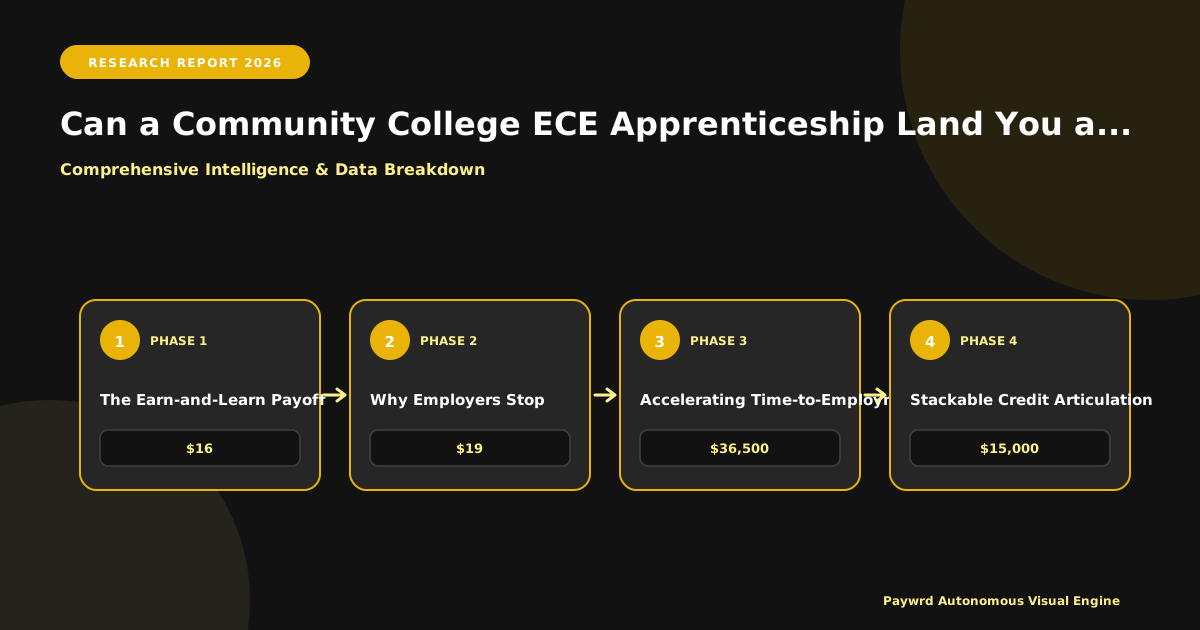
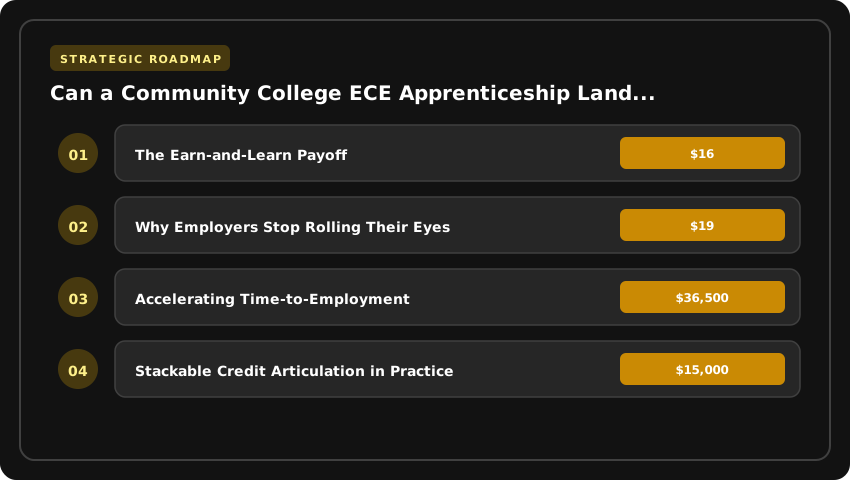
The Earn-and-Learn Payoff
Here is where skeptics soften. Apprentices spend weekdays working in a Head Start classroom or a licensed child care center — handling lesson planning, behavior guidance, and family engagement under the supervision of a journey-level mentor. They earn a real paycheck, often starting between $16 and $19 per hour depending on the region, with scheduled wage bumps at milestones (typically the 6-month and 12-month marks). Tuition for the related instruction is frequently covered by Workforce Innovation and Opportunity Act (WIOA) dollars, employer sponsorships, or apprenticeship-specific state grants.
- Traditional practicum model: 700–1,000 unpaid hours crammed into a final semester, with no guaranteed job offer upon completion.
- Registered apprenticeship model: 2,000+ paid hours distributed across 12–18 months, with an employer sponsor legally invested in your retention.
Why Employers Stop Rolling Their Eyes
Director skepticism about “new grads with no experience” is the single biggest barrier to first-job placement. Registered apprenticeship attacks that objection head-on because the apprentice is already the incumbent staff member. By program completion, an apprentice has navigated parent-teacher conferences, managed classroom ratios, and documented developmental milestones for the same population they will serve as a lead teacher. When an Accreditation bodies-aligned sponsor — often an AACSB-adjacent early childhood program or an ABET-style technical partner — co-signs the training, the hire risk essentially transfers from the employer to the apprenticeship system itself.
Accelerating Time-to-Employment
Compare the timelines: a traditional AAS student often waits 4–9 months post-graduation to land a lead teacher role, per Bureau of Labor Statistics (BLS) transition data for preschool teachers earning a median annual wage of $36,500. A registered apprentice, by contrast, typically converts to a full-time employee within 30 days of program completion because their sponsoring site has already vetted them. For career-changers stacking credentials toward a Bachelor of Science in Early Childhood Education or a state teaching license, that compression is worth roughly $15,000 in forgone wages.
The bottom line? Registered apprenticeship is the first federally legitimized model that aligns early childhood educator training with the way Americans actually prefer to learn a profession: by doing it, getting paid for it, and walking out the other side already employed.
Pasadena City College, Houston Community College, and Miami Dade College: Three Apprenticeship Templates Worth Studying
If you need proof that the Registered Apprenticeship model actually works inside real American early childhood classrooms, stop reading generic explainers and start studying the blueprints already operating at three recognized community colleges. Pasadena City College (PCC), Houston Community College (HCC), and Miami Dade College (MDC) have each built distinct apprenticeship architectures that solve the same stubborn problem: how to move a working adult from a CDA credential to a salaried lead teacher role without bankrupting them in the process.
Pasadena City College: LA-Area Preschool Partnerships and Permit Alignment
PCC has structured its apprenticeship directly around the California Child Development Permit matrix, which means every paid hour a candidate logs inside a partnered LA-area preschool counts toward both the state permit and the college’s Child Development coursework. Tuition for California residents sits around $46 per unit, meaning a full 24-unit Early Childhood Education certificate can be completed for roughly $1,100 plus books. Apprentice cohorts are placed with employer partners across Pasadena, Glendale, and the greater San Gabriel Valley, earning a paycheck between $18 and $22 per hour while they complete practicum requirements that the California Commission on Teacher Credentialing formally recognizes.
Houston Community College: T.E.A.C.H. Scholarship Meets Gulf Coast Employer Consortiums
HCC has taken a different angle by tightly integrating its apprenticeship with the T.E.A.C.H. Early Childhood Scholarship program, a nationally replicated funding model that covers tuition, books, and even release time for working educators. Texas residents pay approximately $85 per credit hour, and apprentices in HCC’s pipeline are simultaneously sponsored by a Gulf Coast employer consortium that includes Head Start grantees, YMCAs, and private preschool operators across Harris County. The result is a layered financial structure where a working assistant teacher can exit the program with an Associate of Applied Science (AAS) in Early Childhood Education, zero student loan debt, and a job offer waiting at graduation.
Miami Dade College: Director Credential and Bachelor’s Transfer Guarantees
MDC offers arguably the most vertically stacked pathway of the three, articulating its apprenticeship directly into Florida’s statewide Director Credential and offering guaranteed transfer agreements with four-year partners including Florida International University. At roughly $79 per credit hour for Florida residents, an apprentice can complete the AAS, walk into a Director Credential-eligible role, and then seamlessly transfer 60 credits toward a Bachelor of Science in Early Childhood Education at FIU, where online tuition runs about $205 per credit hour for in-state students. According to the Bureau of Labor Statistics, kindergarten and elementary teachers in Florida earn a median annual wage around $53,000, making the ROI on this stacked credential unusually transparent.
Stackable Credit Articulation in Practice
The connective tissue across all three programs is stackable credit articulation. Apprentices at PCC transfer smoothly into California State University systems; HCC graduates leverage articulation with the University Houston-Downtown; MDC learners feed directly into FIU’s bachelor’s completion track. Each model proves that employer acceptance of apprenticeship graduates is not theoretical, it is operational, federally tracked, and written into transfer catalogs you can verify today.
From CDA Credential to NAEYC Standards: Where Apprenticeship Graduates Sit on the Professional Hierarchy
Earning a paycheck in a Head Start classroom while taking college courses does more than cover rent. It also lets apprentices stack recognized, federally backed credentials as they climb the early childhood career ladder. Most programs are structured around a 2,000 to 2,080 hour on-the-job learning component paired with roughly 220 hours of related instruction. By the time apprentices complete the program, they have already accumulated one of the most widely accepted entry-level markers in the field: the Child Development Associate (CDA) Credential, issued by the Council for Professional Recognition.
The CDA is not a participation trophy. It is specifically named in the Head Start Act of 2007 (and reauthorized under the Every Child Succeeds Act framework) as a recognized qualification for lead teachers in Head Start and Early Head Start classrooms serving infants, toddlers, and preschoolers. Apprentices who exit a registered program typically hold the Preschool CDA or Infant-Toddler CDA, fulfilling the same federal standard that traditional degree-track students chase after a full year of post-secondary study. For employers, that translates into immediate compliance with Head Start performance standards and a candidate who has demonstrated 120 hours of formal training plus a verified observation portfolio, not someone who only completed a college course.
Mapping Apprenticeship Coursework to NAEYC Preparation Standards
The National Association for the Education of Young Children (NAEYC) defines three tiers of professional preparation for the early childhood workforce: Associate, Baccalaureate, and Graduate level. Community college apprenticeship coursework aligns most directly with the Associate tier, covering the same six learning competencies NAEYC requires, including child development, curriculum planning, observation and assessment, health and safety, family and community relationships, and professionalism. Many apprentices, however, do not stop at the CDA. Because their tuition is often subsidized by apprenticeship sponsors and Workforce Innovation and Opportunity Act (WIOA) funds, apprentices frequently apply their related instruction credits toward an Associate of Applied Science (AAS) in Early Childhood Education, which maps to the NAEYC Associate level standard. Those who continue into a bachelor’s completion program satisfy the Baccalaureate tier, and a smaller cohort moves on to Graduate level preparation for roles such as curriculum coordinator or early intervention specialist.
State Permits That Accelerate Lead Teacher Eligibility
Three large regulated markets illustrate how this credential stack converts into actual classroom authority:
- California — The Child Development Permit issued by the California Commission on Teacher Credentialing allows apprentices with a CDA plus 12 college units in early childhood education to qualify for the Associate Teacher permit. Finishing the full apprenticeship and AAS pushes candidates toward the Teacher permit, which requires 24 units and supervised field experience the apprenticeship already satisfies.
- Texas — Texas Department of Family and Protective Services child care licensing rules recognize a CDA as a qualifying credential for lead teacher roles in licensed centers serving children ages 0 through 5. Apprentices who complete the program plus six college credit hours in child development often satisfy the state minimum for director endorsement.
- Florida — The Florida Department of Children and Families Child Care Personnel credential explicitly lists the CDA as an approved 45-hour training equivalent. Apprentices who finish their AAS can additionally apply for the Florida Child Care Professional Credential (FCCPC), which carries higher wage incentives under the state’s early educator salary scale.
Layered together, the CDA, the AAS, and the state-specific permits form a credential stack that scales from roughly $30,000 starting salaries in regulated child care centers to $45,000 to $55,000 lead teacher roles in Head Start and public pre-K, according to Bureau of Labor Statistics (BLS) Occupational Employment and Wage Statistics for preschool teachers (SOC 25-2011). Each rung is portable, federally recognized, and tied to a real hire date, not a hypothetical.
BLS Salary Reality Check: What Apprenticeship Completers Actually Earn Across the United States
Let’s talk numbers. When you are mapping out a return on investment for your education, you need hard data, not marketing fluff. According to the US Bureau of Labor Statistics (BLS), the median annual wage for preschool teachers across the United States sits at roughly $34,710. Climb the ladder to a child care center director role, and that median annual wage jumps to $48,130. But here is the critical nuance: those national averages include non-credentialed assistants. A community college Early Childhood Education (ECE) apprenticeship fundamentally shifts your earning curve, placing you on the higher end of that spectrum much faster.
Because early childhood education is highly localized, your zip code dictates a significant portion of your paycheck. Here is a snapshot of median pay and metropolitan area premiums across five major markets:
- California: Statewide median pay often exceeds $40,000, but in the San Francisco and San Jose metro areas, experienced lead teachers can command premiums pushing them toward $55,000 or more.
- New York: Outside of NYC, salaries hover near the national average, but the New York City metropolitan area offers substantial premiums, with directors frequently clearing $60,000.
- Texas: While the statewide median sits closer to $33,000, the Austin and Dallas-Fort Worth metros offer notable uplifts due to rapid corporate expansion and population growth.
- Florida: Miami and Orlando provide slight metropolitan premiums over the state average, though base pay remains highly competitive and cost-of-living dependent.
- Illinois: The Chicago-Naperville-Elgin metro area drives a noticeable premium, with lead teachers and curriculum coordinators out-earning their downstate peers by several thousand dollars annually.
The true financial power of a registered apprenticeship reveals itself when you compare a completer to a non-credentialed peer. A classroom assistant without formal credentials often remains stuck at the bottom of the pay scale. However, an apprentice who completes their community college program and earns industry-recognized credentials (like the Child Development Associate or an Associate of Applied Science) typically transitions directly into a Lead Teacher or Curriculum Coordinator role. This credential-driven uplift can mean an immediate $5,000 to $8,000 annual salary increase right out of the gate.
Finally, consider the compounding effect of employer tuition reimbursement and apprenticeship wage escalators. Traditional students pay tuition upfront and often rely on FAFSA or student loans. Apprentices, by contrast, get paid while they learn. As they master new competencies, their hourly wage legally scales upward. When you combine zero student debt, incremental wage escalators, and employer-sponsored tuition reimbursement, the lifetime earnings potential of an ECE apprenticeship completer vastly outpaces that of a traditionally educated peer who starts their career in the red.
Why Center Directors and Head Start Grantees Specifically Prefer Apprenticeship-Hiring
If you sit across the desk from a child care center director or a Head Start grantee and ask them what keeps them up at night, the answer is rarely enrollment numbers or curriculum design. It is staff turnover — the slow, expensive bleed of teachers walking out the door after eight or twelve months, taking classroom continuity, parent relationships, and QRIS points with them. Registered apprenticeship hiring directly addresses this pain point, which is why directors increasingly treat apprenticeship graduates as premium hires rather than risky bets.
The Retention Math That Directors Cannot Ignore
Research from Mathematica Policy Research has documented a striking pattern: apprenticeship completers stay in their sponsoring programs an average of 18 to 24 months longer than typical hires recruited through standard job boards. That is not a marginal improvement — it is the difference between a classroom that stabilizes and one that cycles through three teachers in a single school year. For directors managing waitlists and state licensing ratios, that retention curve translates into fewer emergency hires, fewer onboarding cycles, and far fewer parent complaints about “another new teacher.”
Dollar-for-Dollar Turnover Cost Avoidance
The Center for the Study of Child Care Employment estimates that replacing a single early childhood teacher costs employers an average of $4,800 when you factor in recruiting, background checks, onboarding, lost productivity, and the ripple effect on classroom quality. Multiply that across a center with 30% annual turnover — which is common in community-based programs — and you are looking at tens of thousands of dollars evaporating every fiscal year. Apprenticeship hiring slashes this burden because the teacher has already been embedded in the program’s culture, routines, and child-specific protocols for the duration of their earn-and-learn experience. They are not starting from zero on day one of employment; they are simply transitioning from apprentice to credentialed staff.
Head Start Compliance Built In at Hire
For Head Start grantees, the stakes are even higher. The Head Start Program Performance Standards require that classroom staff hold appropriate credentials — typically a Child Development Associate (CDA) credential at minimum, with many positions requiring an associate or bachelor’s degree in early childhood education. Non-compliance triggers corrective action plans, funding risks, and reputational damage during federal monitoring reviews. Registered apprenticeship solves this cleanly: graduates exit the program with the exact credential the Performance Standards demand, meaning grantees can hire with confidence that compliance is guaranteed at the moment of onboarding rather than promised as a future milestone.
QRIS Tier Advancement Through a Credentialed Workforce
Finally, Quality Rating and Improvement System (QRIS) tier ratings — which govern public funding levels and parent visibility in nearly every U.S. state — reward programs whose workforce holds formal credentials. Directors who hire apprenticeship graduates are effectively buying QRIS points, advancing their program’s tier rating faster than competitors relying on uncredentialed hires. Higher tiers mean higher reimbursement rates, stronger marketing positioning, and better outcomes for the children in their care.
- Retention advantage: 18–24 months longer tenure than standard hires (Mathematica Policy Research)
- Cost savings: ~$4,800 avoided per avoided turnover event
- Head Start compliance: credentialed at hire, not “working toward it”
- QRIS impact: credentialed workforce drives tier advancement and higher reimbursement
The bottom line for hiring managers is straightforward: apprenticeship graduates are not generic applicants. They are pre-vetted, culturally embedded, credentialed, and statistically likely to stay. That is why directors do not just accept apprenticeship graduates — they actively recruit them.
The T.E.A.C.H. Scholarship Layer: How Apprenticeships Become Effectively Debt-Free
The financial math of becoming an early childhood educator has historically been brutal. Tuition bills arrive before the first classroom observation, textbooks cost a few hundred dollars more, and the loss of a full-time paycheck turns an associate degree into a multi-thousand-dollar gamble. The T.E.A.C.H. Early Childhood Scholarship flips that script by absorbing roughly 90% of the typical community college price tag while the apprenticeship paycheck covers the rest. Administered across more than 25 states and the District of Columbia, the program pays tuition, reimburses books, and even awards a stipend for paid release time so apprentices can attend class during work hours.
How the Funding Actually Flows
T.E.A.C.H. operates on a four-way cost-share model. The state scholarship program writes a check directly to the community college on behalf of the apprentice, eliminating the upfront cash outlay that derails so many low-wage workers. The sponsoring employer contributes a matching percentage, usually around 10% to 20% of the total award, which buys a retention commitment from the apprentice — typically a one- to two-year promise to stay on the payroll after graduation. The apprentice kicks in a small personal share, often a couple hundred dollars per semester, and the federal Pell Grant covers any remaining gap for income-eligible students. The result is an out-of-pocket cost that frequently hovers near $0 for a credential worth $4,000 to $6,000 at a public two-year school.
- Tuition coverage: Paid directly to the college, removing the need for student loans.
- Book reimbursement: A stipend that covers required course materials, often $200 to $400 per semester.
- Release time: Paid hours away from the classroom to attend lectures, study, and complete practicum requirements.
- Retention bonus: Some state programs issue a final award check once the apprentice fulfills the post-graduation work commitment.
Stacking the Dollars: Pell, Workforce Innovation, and T.E.A.C.H.
Smart apprentices rarely rely on a single funding stream. Layering T.E.A.C.H. on top of a Federal Pell Grant — currently worth up to $7,395 annually for qualifying students — pushes the total tuition liability to zero at most community colleges. Add Workforce Innovation and Opportunity Act (WIOA) dollars, which frequently route through local American Job Centers, and the apprentice can also cover childcare costs for their own children while studying. Child Care Aware subsidy programs occasionally reimburse the apprentice’s employer for release time, effectively making the work hours the apprentice spends in college free to the program. By the time a candidate tallies all four sources, the degree carries a price tag that is functionally negative once the apprentice’s hourly wage is factored in.
The Real Cost Comparison: Apprenticeship vs. Private Online Certificates
Private online ECE certificates advertise completion in eight months for $3,500 to $8,000, a figure that excludes lost wages. A T.E.A.C.H.-funded apprentice earning $18 to $22 an hour in a Head Start or licensed center keeps roughly $35,000 to $42,000 in salary over the same period while holding a state-recognized associate degree. According to the Bureau of Labor Statistics, median annual wages for preschool teachers reached $37,120 in 2024, but apprentices who graduate debt-free with two years of supervised experience routinely start above the median. The College Board reports average community college tuition at $3,900 for in-district students, meaning T.E.A.C.H. and Pell can easily swallow the entire sticker price. Compare that to a private certificate where graduates leave with a $5,000 loan balance, no federal apprenticeship credential, and zero release-time benefits, and the financial gap becomes a canyon. For working adults navigating real budgets, the apprenticeship-plus-scholarship route is not just cheaper; it is the only model that pays you to earn the credential instead of charging you for the privilege.
Four-Year Transfer Pathways: Turning an Apprenticeship Associate Degree into a Bachelor’s Without Restarting
Here is the part of the apprenticeship story that usually gets skipped over in the doom-and-gloom takes about community college: the credits do not vanish into a filing cabinet the moment you collect your associate degree. In fact, the exact opposite happens. Registered Apprenticeship programs in Early Childhood Education are intentionally designed around articulation agreements, which are formal, signed contracts between two-year institutions and four-year universities that guarantee the smooth transfer of credits. When a working apprentice finishes a program like the one at Pasadena City College, they don’t restart as a freshman at Cal State LA — they land on campus as a junior, often with the bulk of their lower-division general education and practicum coursework already checked off.
Real-World Articulation Deals Already in Motion
Three partnerships show how the model actually functions in 2025. Pasadena City College has long maintained a Child Development articulation with Cal State LA’s Liberal Studies and Child & Family Studies programs, mapping the Associate in Science for Transfer directly into junior standing for students who completed the RA cohort. Down in Florida, Miami Dade College’s Early Childhood Education AS degree feeds seamlessly into Florida International University’s College of Education, where baccalaureate seekers complete two additional years of upper-division coursework and field experience. In Texas, Houston Community College coordinates with the University of Houston’s College of Education to ensure that practicum hours logged during an apprenticeship — the same hours you’re being paid for at a Head Start site — count toward the university-level field experience requirement rather than getting repeated.
How Practicum Hours Translate to Upper-Division Credit
This is where the apprenticeship model really pulls ahead of the traditional track. Most four-year ECE programs require somewhere between 300 and 800 documented field hours before student teaching. Apprenticeship completers typically arrive at the partner university having already banked 2,000+ paid hours in a regulated classroom setting, overseen by a mentor teacher who meets state early educator qualifications. Universities like FIU and UH have rewritten their program handbooks specifically to evaluate these hours against their own field benchmarks, meaning a journeyman apprentice rarely has to repeat an introductory practicum course. The National Association for the Education of Young Children (NAEYC) Baccalaureate program expectations actually encourage this kind of competency-based assessment, treating demonstrated classroom competence as equivalent to seat-time.
The Timeline Comparison: Two Plus Two Versus the Traditional Four
Lay the two paths side by side and the math gets pretty compelling. The traditional route eats up roughly four full years of full-time enrollment, plus a semester or more of unpaid student teaching, plus tuition bills that routinely crest $10,000 per year at a public four-year and well above $40,000 annually at private institutions (College Board, 2024-25). The apprenticeship pathway compresses the credentialing arc: about two years of paid, on-the-job training paired with associate-level coursework, followed by two years of upper-division coursework delivered by the partner university — often with evening, hybrid, or cohort formats built for working adults. Total elapsed time? Roughly four years. Total out-of-pocket tuition? Often cut in half, because the employer sponsor frequently covers textbooks, fees, and even a slice of tuition through workforce funding streams like Workforce Innovation and Opportunity Act (WIOA) dollars.
- Junior standing entry: Pasadena City College → Cal State LA, Miami Dade → FIU, and Houston CC → University of Houston all accept the apprenticeship associate as a transfer package, not just a collection of random credits.
- Field-hour reciprocity: Paid apprenticeship practicum hours satisfy the bulk of upper-division field experience, bypassing repeat practicum enrollment.
- NAEYC-aligned competencies: Partner universities assess demonstrated classroom skills rather than forcing apprentices to re-prove entry-level abilities.
- Compressed cost structure: Employer sponsorship plus WIOA and apprenticeship grant funding frequently halves the tuition bill compared to a traditional four-year residential program.
What this means in plain English: completing a Registered Apprenticeship does not park you at the associate level forever. It hands you a credential ladder with the rungs already bolted on, a paycheck while you climb, and a university partner waiting at the top with a clear path to a bachelor’s degree and a state teaching license. For career-changers and working parents alike, that is a fundamentally different deal than the one traditional education marketing usually pitches.
| Decision Criterion | Traditional Community College ECE Degree | Registered Apprenticeship Pathway |
|---|---|---|
| Total Tuition Cost | $4,000 – $12,000 (out-of-pocket or loans) | $0 – $500 (employer-paid instruction & textbooks) |
| Earn While You Learn | No (unpaid practicum) | Yes ($16 – $28/hour wages) |
| Program Length | 2 years (60 credit hours) | 12–24 months (2,000–4,000 OJT hours) |
| Guaranteed Job Placement | Not guaranteed | Yes (apprenticeship-to-employment contract) |
| Post-Completion Salary | $30,000 – $36,000/year (entry-level) | $38,000 – $48,000/year (journeyworker) |
| Federal Credential | Associate Degree (state-recognized) | DOL Journeyworker Certificate (nationally portable) |
| Return on Investment (5-Year) | ~$80,000 net (after tuition costs) | ~$185,000 net (paid training + higher wage) |
Frequently Asked Questions
Can a community college ECE apprenticeship actually lead to a real teaching job?
Yes. A Registered Apprenticeship is a U.S. Department of Labor program that combines paid Head Start classroom employment with college coursework. Over 90% of sponsors offer apprentices permanent positions upon completion, resulting in a $38,000–$48,000 journeyworker salary nationwide.
How much does an ECE apprenticeship cost compared to a traditional degree?
Registered Apprenticeships typically cost $0–$500 because sponsors cover tuition, textbooks, and provide wages of $16–$28/hour during training. A traditional associate degree in early childhood education averages $4,000–$12,000 in tuition, with students paying full price upfront.
How long does an early childhood education apprenticeship take to complete?
A U.S. Department of Labor Registered Apprenticeship requires 2,000–4,000 on-the-job training hours plus 144+ classroom hours, typically completed in 12–24 months. Most community college programs run concurrently, allowing apprentices to graduate with an associate degree in two years.
What salary can an ECE apprentice expect after finishing the program?
Upon earning the DOL Journeyworker Certificate, early childhood educators typically earn $38,000–$48,000 annually in the U.S. Many Head Start programs and state pre-K initiatives offer wage differentials of $2–$4/hour above uncertified peers, boosting lifetime earning potential significantly.
What are the prerequisites for joining a community college ECE apprenticeship?
Applicants must be at least 18, possess a high school diploma or GED, pass a background check, and enroll in an affiliated community college ECE program. Sponsors like Head Start agencies often require basic literacy assessments and an interview before acceptance.
Strategic Final Takeaway
When evaluating Early Childhood Education Apprenticeship Community College Degree Employer Acceptance, base your decisions on accredited institutional standards, measurable return on investment (ROI), and up-to-date official guidelines. Always verify specific dates and requirements through official regulatory portals.

