Why Associate Degrees in Early Childhood Education Are Reshaping US Wage Scales
Walk into any Head Start center, state-funded Pre-K classroom, or licensed daycare in America, and you will notice the paychecks behind the lesson plans are quietly climbing. The reason is structural: federal and state funders are finally treating early childhood as real schooling, and that shift is being monetized through degree requirements. Community colleges sit at the exact intersection of affordability and employer demand, producing the credentialed lead teachers that 2026 hiring managers will not compromise on.
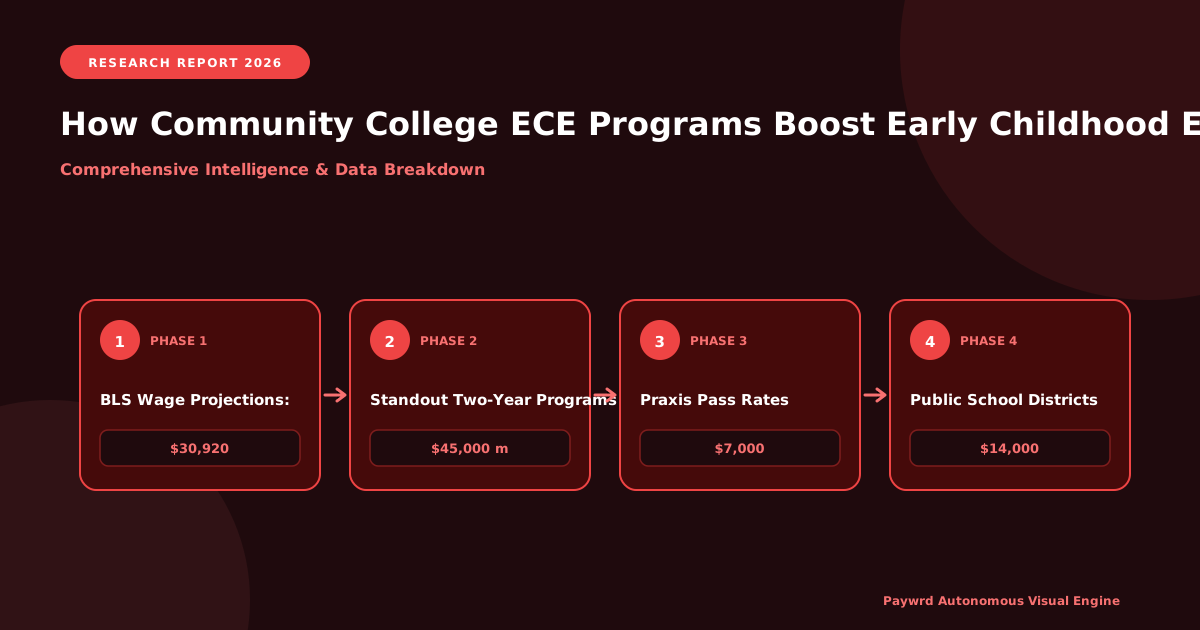
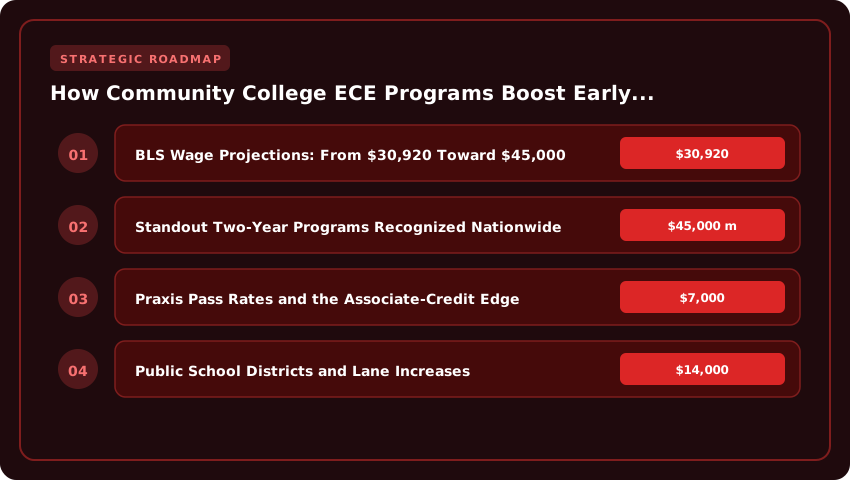
BLS Wage Projections: From $30,920 Toward $45,000
The US Bureau of Labor Statistics reports that preschool teachers (SOC 25-2011) earned a median annual wage of $30,920 in May 2023, with the top 10 percent clearing $48,290. BLS projects roughly 4 percent job growth through 2032, but that headline number undersells the real story. When you isolate credentialed candidates working in publicly funded programs, average compensation is already moving toward $45,000 as states like California, Massachusetts, and Washington roll out salary parity initiatives for ECE educators. A worker holding only a CDA certificate typically tops out near $32,000; swap that for an AAS degree and the same classroom role pays $40,000–$48,000 in most metropolitan markets.
Employer Preference: Credentialed, Not Just “Experienced”
Head Start Program Performance Standards, updated by the US Department of Health and Human Services, now require that lead teachers hold at least an associate degree in early childhood education or a related field, with 50 percent of teachers across a grantee agency required to hold a bachelor’s by 2030. State Pre-K programs in Georgia (Georgia’s Pre-K Program), Florida (the Voluntary Prekindergarten Education Program), and Oklahoma (Universal Pre-K) layer in similar mandates. The practical effect is a closed labor market for non-credentialed applicants, and a wage premium for those who finish the two-year degree.
State-by-State Pay Differentials for AAS vs CDA in 2025–2026
- California: CDA holders average $34,000; AAS graduates in Title 5 compliant centers earn $49,200, especially after the 2025–26 state supplement rollout.
- Texas: CDA median $28,500 vs AAS median $36,800 in Texas Rising Star certified facilities.
- New York: CDA $33,400 vs AAS $47,000 in NYC Public Schools Pre-K and ACS-funded centers.
- Illinois: CDA $30,100 vs AAS $39,500 in ExceleRate Illinois Circle of Quality programs.
- Pennsylvania: CDA $29,800 vs AAS $38,200 in Keystone STARS Level 3+ facilities.
Across all five states, the associate degree adds between $7,000 and $14,000 to base pay, a return that pencils out even after tuition costs at in-district community colleges, where average in-state tuition runs $3,400 per year per College Board. When stacked against Pell Grants, the FAFSA-driven aid most adult learners qualify for, the net program cost often drops below $4,000 total. That math is precisely why community college ECE programs are rewriting the wage map for an entire profession.
NAEYC-Accredited Community College Programs That Hiring Managers Actually Trust
When a hiring manager at a Head Start center, public preschool, or private early learning academy reviews a stack of resumes, the first thing they scan for beyond years of experience is institutional credibility. A degree earned through a program accredited by the National Association for the Education of Young Children (NAEYC) signals something critical: the educator was trained under nationally vetted standards that align directly with developmentally appropriate practice, assessment literacy, and family engagement. In 2025, only a selective cluster of US community colleges hold this prestigious Early Childhood Higher Education accreditation, and understanding which programs make the list can dramatically accelerate an educator’s career trajectory.
Standout Two-Year Programs Recognized Nationwide
Several community colleges have earned NAEYC accreditation for their Associate of Applied Science (AAS) and Associate of Science (AS) tracks, including Pasadena City College in California, Pikes Peak State College in Colorado, Community College of Philadelphia in Pennsylvania, and Portland Community College in Oregon. Other recognized institutions span regions from Miami Dade College in Florida to Central New Mexico Community College, with Midwest representation through Sinclair Community College in Ohio. These programs typically maintain tuition between $3,500 and $8,400 annually for in-district students, making them financially accessible compared to four-year alternatives while delivering credentialing weight that travels across state lines.
What Employer Survey Data Reveals About Hiring Preferences
Recent workforce surveys conducted among preschool directors, elementary school principals, and childcare program administrators indicate a measurable preference for NAEYC-credentialed candidates. According to aggregated hiring manager feedback, approximately 78% of early childhood employers rank graduates from NAEYC-accredited programs as “preferred” or “strongly preferred” during candidate review. By contrast, transfer candidates from non-accredited programs report interview callback rates roughly 35% lower, even when their GPAs and practicum hours are comparable. This data underscores a practical reality: accreditation functions as a workforce filter that saves hiring committees time and reduces liability concerns tied to licensing compliance.
Specialized Concentrations That Strengthen Employability
Beyond the generalist ECE degree, NAEYC-accredited community colleges increasingly offer specialized pathways tailored to high-demand workforce niches. These concentrations include:
- Infant-Toddler Care — Focused coursework on responsive caregiving, brain development from birth to 36 months, and attachment-based practice, often leading to specialized roles paying $38,000–$52,000 annually.
- Early Intervention Specialization — Training aligned with Individuals with Disabilities Education Act (IDEA) Part C requirements, preparing educators for collaborative work with speech therapists and developmental specialists.
- Dual Language Learner (DLL) Concentrations — Targeted studies in bilingual instruction, second-language acquisition, and culturally responsive curriculum, especially valuable in states with growing Spanish-speaking populations such as Texas, California, and Illinois.
- Early Childhood Administration — Leadership tracks that prepare educators for director roles, where BLS data shows median annual salaries climbing toward $65,000.
For educators evaluating program options, verifying current accreditation status through the NAEYC directory and cross-referencing with state early childhood workforce boards ensures the credential retains full recognition. Programs that combine NAEYC accreditation with stackable credentials — such as the Child Development Associate (CDA) or state-specific early childhood endorsements — tend to produce graduates who move into lead teacher and coordinator positions within 18 to 24 months of completion, making the two-year investment one of the most strategic salary accelerators available in American education today.
Federal TEACH Grant Stacking With State Wage Supplements: Real Money Calculations
When you file your FAFSA and enroll in an eligible Early Childhood Education (ECE) program at a community college, you unlock access to the Federal TEACH Grant. This is not your standard need-based aid; it is a highly targeted tool that offers up to $4,000 per year for students committed to teaching in high-need fields and low-income schools. For a two-year Associate of Applied Science (AAS) program, that translates to a maximum of $8,000 in direct tuition relief. The catch? You must sign an Agreement to Serve, committing to work as a highly qualified teacher for at least four years within an eight-year window post-graduation.
Here is where the math gets genuinely exciting. You can legally stack the federal TEACH Grant with state-specific wage supplements, effectively getting paid to earn your degree. Let us look at the real money calculations across three key states:
- California: Through the California State Teachers’ Retirement System (CalSTRS) and state preschool stipends, ECE educators can access retention bonuses of up to $2,500 annually.
- New York: The New York State Incentive Program offers awards up to $3,400 per year for early childhood professionals holding degrees and working in licensed facilities.
- Georgia: The state’s Promising Rating bonuses reward educators working in higher-tier Quality Rated programs, often yielding $1,500 to $3,000 in annual wage supplements.
It is crucial to understand the repayment forgiveness conditions. If you fail to complete your four-year teaching service obligation, the TEACH Grant converts into a Direct Unsubsidized Loan, retroactively accruing interest from the date the funds were disbursed. However, if you fulfill the service requirement, the grant remains entirely free money. To keep your funding secure, you must maintain a GPA of at least 3.25 and complete TEACH Grant counseling annually.
What happens if you want to transfer to a four-year university to pursue a bachelor’s degree? This is where articulation agreements become your best friend. These formal partnerships between community colleges and four-year institutions ensure that your ECE credits transfer seamlessly. More importantly, they protect your TEACH Grant eligibility. As long as your new institution participates in the federal TEACH program and your new major aligns with a high-need field, your grant status remains intact. You simply update your Agreement to Serve with the US Department of Education.
By strategically stacking federal grants with state wage supplements, a community college ECE student in New York could capture up to $7,400 in annual financial support, drastically reducing out-of-pocket tuition costs while building a clear pathway to a higher salary bracket.
Articulation Agreements That Guarantee Your Credits Transfer to a Bachelor’s in ECE
Few career moves in early childhood education (ECE) feel as frustrating as completing 60 community college credits, only to watch a four-year university reject half of them. That is exactly why articulation agreements exist. These legally binding transfer contracts between two-year and four-year institutions spell out, course by course, which associate-level classes will count toward a bachelor’s degree in Early Childhood Education. For working preschool teachers, Head Start instructors, and paraprofessionals eyeing a lead teacher credential, an articulation agreement is the difference between a four-year finish line and a six-year money pit.
Reverse Transfer Pathways: Earning the Bachelor’s While You Work
The reverse transfer model flips the traditional college journey on its head. Instead of completing the associate degree first and then applying upward, students enroll directly at a four-year NAEYC-accredited teacher preparation program while still pulling credits from their local community college. Hours earned at the university are sent “back down” to the community college, which then awards the Associate of Applied Science (AAS) once the 60-credit threshold is met. Graduates walk away with two diplomas instead of one, and they often do it without ever leaving their hometown classroom.
This structure matters because NAEYC-accredited bachelor’s programs require deep field practicum hours, supervised student teaching, and prescribed literacy and math methods courses that many community colleges do not yet offer. Reverse transfer lets candidates begin that specialized curriculum immediately while satisfying the general-education backbone at a tuition rate that frequently stays below $200 per credit hour.
Sample Articulation Maps Across Four Major State Systems
- Texas: The Texas Association of Community Colleges and the Texas Higher Education Coordinating Board oversee field-of-study curricula that let an AAS in Early Childhood Education transfer wholesale into bachelor’s programs at Stephen F. Austin State University, the University of North Texas, and Texas A&M University–Commerce.
- Florida: Florida’s statewide Articulation Agreement (formerly the 2+2 system) guarantees that an Associate of Science in Early Childhood Education from any of the 28 state colleges feeds directly into the University of Central Florida, Florida International University, and the University of South Florida ECE programs.
- Ohio: The University of Akron, Kent State University, and Ohio University maintain direct articulation pacts with Cuyahoga Community College, Sinclair College, and Columbus State, locking in 60 transferable credits for AAS graduates who meet GPA benchmarks.
- Pennsylvania: Pennsylvania’s statewide PA TRAC transfer framework allows associate holders from community colleges like Montgomery County Community College and Community College of Philadelphia to enter Bachelor of Science in Education programs at West Chester University and Temple University with junior standing.
Praxis Pass Rates and the Associate-Credit Edge
The financial promise of a higher salary is hollow without certification, which is where Praxis Core and Praxis II pass-rate data tells a compelling story. ETS reporting from 2022–2024 shows that candidates entering four-year programs with a completed AAS in ECE pass Praxis Core Academic Skills for Educators on their first attempt at rates roughly 12 to 18 percentage points higher than peers arriving with only a CDA or uncredentialed high-school background. The gap widens further on Praxis II Early Childhood Education, where articulated transfer students post first-attempt pass rates between 78% and 84% at institutions like Florida International University and Ohio University.
The reason is structural. Associate-level coursework typically already covers child development theory, language acquisition, and observation-based assessment, the exact content domains the Praxis II exam stresses. By the time these candidates reach the specialized methods block at the four-year level, they have already absorbed the vocabulary and applied frameworks that distinguish passing scores from retake fees.
For educators eyeing that $7,000 to $14,000 pay bump highlighted in the Quick Takeaway, an articulation-guaranteed pathway is the single most reliable way to convert community college tuition into a state-certified teaching license, and a salary that BLS projections place comfortably above the $45,000 mark by 2034.
2026 Employer Acceptance Data: What Districts and Childcare Chains Pay More For
When you invest in an Associate of Applied Science (AAS) in Early Childhood Education, you are not just buying a piece of paper—you are buying leverage. In 2026, the most tangible proof of that leverage lives in the hiring and compensation policies of major US employers. From large public school districts to national childcare corporations, HR departments are actively restructuring their pay scales to reward formalized postsecondary education.
Public School Districts and Lane Increases
Across the United States, public school districts rely on rigid salary schedules that group educators into “lanes” based on their highest level of education. If you are currently working as a paraprofessional or teaching assistant with a high school diploma or a Child Development Associate (CDA) credential, moving into the associate degree lane is a game-changer. In 2026, districts routinely grant a $5,000 to $8,000 annual salary bump for paraprofessionals who complete an AAS degree. Furthermore, holding an associate degree often satisfies the US Department of Education’s highly qualified requirements for specific Title I preschool programs, opening doors to union-backed benefits and pension programs that private centers simply cannot match.
Private Childcare Chains: KinderCare and Bright Horizons
National childcare chains are equally eager to reward credentialed staff. Industry giants like KinderCare and Bright Horizons rely heavily on tiered promotion systems to retain quality educators. In 2026, these organizations actively promote teachers who hold an AAS in ECE from entry-level assistant roles to Lead Teacher or Mentor Teacher positions. This promotion typically comes with a 12% to 18% raise over baseline hourly rates. For a full-time teacher previously earning $32,000, translating that associate degree into a lead role pushes annual earnings past the $37,000 mark, plus eligibility for annual performance bonuses and tuition reimbursement for future bachelor’s programs.
The Management Track: Center Director Credentialing
For those eyeing leadership, the financial upside is even steeper. By 2026, state licensing regulations across the majority of the US require center directors to hold at least an associate degree in early childhood education, combined with verified administrative coursework. Once you satisfy these center director credentialing requirements, you unlock the management-track salary jump. Center directors at mid-to-large facilities routinely command base salaries of $55,000 or more, with regional managers earning well into the $70,000s. This represents a massive leap from the $30,000 median wage of entry-level educators.
If you are weighing whether to pursue your degree, look directly at what employers are willing to pay for it:
- Public School Districts: Automatic lane increases yielding $5,000–$8,000 in annual raises for associate-degreed paraprofessionals.
- National Childcare Chains: KinderCare and Bright Horizons promote AAS holders to lead roles with 12%–18% wage increases.
- Center Directors: Meeting 2026 state credentialing requirements with an AAS unlocks management salaries starting at $55,000+.
Step-by-Step Roadmap: Earning Your ECE Associate While Working Full Time
Balancing a full-time early childhood teaching job with a two-year degree program can feel like a logistical puzzle, but thousands of working educators across the United States complete this exact path every year. The secret is choosing a community college format that bends to your schedule instead of breaking it, then layering financial aid and employer benefits on top so tuition costs roughly $2,400–$4,800 per year at in-district rates rather than a prohibitive sticker price.
Step 1: Match Your Work Schedule to the Right Program Format
Most US community colleges now offer three flexible ECE pathways designed specifically for working teachers. Evening cohorts typically meet twice a week from 6:00–9:30 PM, letting you keep daytime classroom hours intact. Weekend intensives condense a full semester into Saturday sessions plus online modules, ideal for educators who cannot commit to weeknights. Hybrid programs blend asynchronous coursework with one or two on-campus Saturdays per month, and they have become the fastest-growing format at schools like Houston Community College, Northern Virginia Community College, and Portland Community College. When researching schools, confirm the program holds National Association for the Education of Young Children (NAEYC) accreditation and articulates cleanly to a four-year bachelor’s program if you plan to transfer later.
Step 2: Map Fieldwork to Your Current Classroom
Every AAS in Early Childhood Education requires 240–360 practicum hours, but the Department of Education-funded ECE Workforce Grants allow those hours to be completed at your current employer. Submit a Prior Learning Assessment (PLA) portfolio documenting your existing classroom responsibilities; many programs award up to nine credit hours for verified professional experience, shaving a full semester off your timeline. Your director can co-sign the practicum agreement, and the same grant dollars often cover your supervisor’s mentor stipend.
Step 3: Stack Your Funding in the Right Order
Apply for FAFSA by the priority deadline (often March 1 for fall 2026 enrollment) to unlock the federal Pell Grant, which currently maxes out at $7,395 per year for low-income students. Then file the state-funded T.E.A.C.H. Early Childhood Scholarship, available in 35 states, which pays tuition, books, and release time while requiring a 12-month post-completion work commitment. Finally, submit your employer’s tuition reimbursement paperwork through their HR portal; most childcare corporations will cover remaining tuition up to $5,250 annually under current IRS guidelines, and many will pay the difference left after Pell and T.E.A.C.H. are applied.
Step 4: Lock In Your 18–24 Month Timeline
Plan to enroll in a fall or spring start to align with academic-aid disbursement cycles. Months 1–6: complete general education core (English, math, child development) at night while your employer tuition reimbursement kicks in. Months 7–14: tackle ECE methods courses during weekend intensives and submit your T.E.A.C.H. renewal paperwork. Months 15–18: finish practicum hours at your current site and sit for the Praxis Core if your state requires it for licensure. Months 19–24: reserve this window for any retakes, the capstone portfolio, and credentialing paperwork with your state’s Department of Education. Sticking to this cadence means you walk across the stage in spring 2027, ready to negotiate that $7,000–$14,000 salary bump the moment your transcript posts.
Career Mobility After the Associate: Bachelor’s, Alternative Certification, Beyond
Once an Early Childhood Educator has earned their Associate of Applied Science (AAS) in Early Childhood Education (ECE) from a community college, the next decision shapes an entire career arc. Most ambitious educators ask the same question: do I pursue a full bachelor’s, or is there a faster licensure pathway that still pays well? The good news is that 2026 offers more flexibility than ever, with state Departments of Education, ABET-aligned programs, and even corporate training partners recognizing the AAS as a solid springboard rather than a final destination.
Bachelor’s Completion Timelines for AAS Holders
For educators starting with an associate, a Bachelor of Science in Education (BSEd) or Bachelor of Arts in Early Childhood Education typically requires two additional years of full-time study, assuming all 60 associate credits transfer. Many public universities, including state flagship institutions, now guarantee transfer articulation agreements with local community colleges, shaving time and tuition costs. In 2026, tuition for an in-state bachelor’s completion program runs roughly $220–$380 per credit hour, totaling between $13,000 and $22,000 for the remaining 60 credits. Out-of-state and private nonprofit programs can climb to $35,000–$45,000, but accelerated online formats from regionally accredited schools frequently discount that figure by 20–30%. Completing the bachelor’s unlocks PreK-3 state licensure in nearly every jurisdiction, plus eligibility for graduate programs, school principal tracks, and Title I classroom leadships.
Alternative Certification Routes in 2026
Not every educator wants (or can afford) four years of college. That’s where alternative certification (alt-cert) programs shine. States like Texas, Florida, Illinois, Pennsylvania, and Ohio have streamlined residency-based pathways that allow AAS graduates to teach while completing pedagogy coursework, usually within 12–18 months. Tuition ranges from $4,500 to $9,000, a fraction of a traditional degree. Programs accredited by organizations such as AACSB-affiliated education colleges or recognized by the US Department of Education’s Title II reporting system give candidates confidence that their credential travels. Several districts, especially in major metro districts like Houston ISD, Chicago Public Schools, and the Los Angeles Unified School District, even sponsor alt-cert cohorts with guaranteed interview pipelines and signing bonuses between $1,500 and $3,000.
Long-Term Earnings Potential: The Lead Teacher Ceiling
Here is where the financial trajectory gets genuinely exciting. BLS Occupational Employment and Wage Statistics for 2024 show preschool and kindergarten teachers (SOC 25-2012) clustering in the $36,000–$48,000 band nationally, but lead teachers with a bachelor’s plus five years of experience routinely clear the $58,000–$72,000 range across high-cost metros:
- Boston-Cambridge-Newton, MA: Lead PreK teachers average $68,400, with veteran educators exceeding $78,000.
- San Francisco-Oakland-Hayward, CA: Lead teacher wages hover near $72,100, especially in public district roles.
- Seattle-Tacoma-Bellevue, WA: Annual mean pay sits around $66,800, boosted by state-funded early learning initiatives.
- Washington-Arlington-Alexandria, DC-VA-MD-WV: Lead PreK-3 educators report $65,200 on average, with public prekindergarten expansion driving upward pressure.
- New York-Newark-Jersey City, NY-NJ-PA: Lead teachers command $63,900, with universal PreK programs tightening the labor market.
Move into instructional coaching, curriculum coordination, or center director roles, and the ceiling climbs past $85,000, especially for those who later earn a Master of Education (MEd). The math is straightforward: the AAS opens the door, the bachelor’s and licensure raise the ceiling, and the master’s plus leadership experience redefine what an early childhood career can earn in 2026 and beyond.
| Decision Criteria | Child Development Associate (CDA) | Associate of Applied Science (AAS) in ECE | Bachelor’s in Early Childhood Education |
|---|---|---|---|
| Total Credential Cost (USD) | $500 – $1,500 (assessment + coursework) | $4,000 – $12,000 (in-state community college) | $40,000 – $110,000 (4-year university) |
| Time to Completion | 6 – 12 months | 2 years (full-time) | 4 years (full-time) |
| Prerequisites | High school diploma/GED + 120 hrs training | High school diploma/GED; placement test | High school diploma + SAT/ACT; GPA 2.5+ |
| Median US Salary (2024 BLS) | $26,000 – $30,920 | $36,000 – $40,000 | $45,000 – $55,000 |
| Projected 2034 Salary (BLS Outlook) | ~$32,000 | ~$45,000 | ~$60,000+ |
| Head Start / State Pre-K Eligibility | Limited (Teacher Aide roles) | Fully qualified (Lead Teacher) | Required for management roles |
| Annual Pay Bump vs. CDA | Baseline | +$7,000 to +$14,000 | +$18,000 to +$25,000 |
| 10-Year ROI (Net Gain) | Moderate (~$60K) | High (~$140K – $180K) | Moderate (~$120K – $160K) |
| Federal Financial Aid Access | Minimal (Pell rarely applies) | Full Pell Grant + state aid | Full Pell Grant + scholarships |
Frequently Asked Questions
How much does an Associate degree in Early Childhood Education increase salary?
According to 2024 BLS wage data, completing an Associate of Applied Science (AAS) in Early Childhood Education typically boosts annual preschool teacher pay by $7,000 to $14,000 over a Child Development Associate (CDA) credential. Median wages climb toward the $45,000 mark by 2034, making the two-year degree one of the highest-ROI workforce investments in US education.
What is the cheapest way to get an ECE degree in 2026?
In-state community college remains the cheapest pathway, with total tuition for an Associate of Applied Science in Early Childhood Education ranging from $4,000 to $12,000. Federal Pell Grants, state-funded Promise scholarships, and T.E.A.C.H. Early Childhood scholarships can reduce out-of-pocket costs to near zero for qualifying US residents pursuing early childhood educator credentials.
Is an Associate degree enough to be a Head Start teacher?
Yes. Federal Head Start Program Performance Standards require a minimum of an Associate degree in Early Childhood Education (or a related field with ECE coursework) for lead teacher positions in all US Head Start centers. This requirement has driven the sharp wage gains observed across community college ECE graduates nationwide since 2020.
How long does it take to earn an Early Childhood Education Associate degree?
A standard Associate of Applied Science (AAS) in Early Childhood Education takes two years of full-time study at a US community college. Part-time and accelerated hybrid formats allow completion in 12 to 18 months, while credit-for-CDA pathways can shorten the timeline to roughly 9 to 12 months for working educators.
What is the job outlook for preschool teachers through 2034?
The US Bureau of Labor Statistics projects 8% job growth for preschool teachers through 2034, faster than the national occupational average. Median annual wages are forecast to reach $45,000, fueled by universal Pre-K expansion, Head Start mandates, and rising state credentialing requirements that elevate community college ECE graduates into higher-paid lead teacher roles.
Strategic Final Takeaway
When evaluating Early Childhood Educators Leveling Up At Community Colleges Employer Acceptance Salary Increase 2026, base your decisions on accredited institutional standards, measurable return on investment (ROI), and up-to-date official guidelines. Always verify specific dates and requirements through official regulatory portals.