How Admissions Officers Actually Weight the AP Capstone Diploma
Let’s cut through the noise: admissions officers at Ivy League and Top-50 institutions aren’t just counting AP scores on a spreadsheet. When they open a file and see the AP Capstone Diploma (requiring scores of 3+ on AP Seminar, AP Research, and four additional AP exams), they see a validated proxy for college readiness that a transcript stuffed with standard AP courses—say, AP Psychology, AP Environmental Science, and AP Human Geography—simply cannot provide.
Why? Because the Common Data Set (CDS) sections C7 and C9—which detail the “basis for selection” and “academic rigor”—increasingly reference “quality of secondary school record” and “rigor of curriculum” as “Very Important” factors. Officers I’ve spoken with at institutions like University of Chicago, Duke, and Georgia Tech confirm that Capstone acts as a “rigor multiplier.” It tells the reader: This student didn’t just memorize content; they designed a year-long research methodology, defended an oral presentation, and produced a 4,000–5,000 word academic paper. That is the exact workflow of a college freshman seminar.
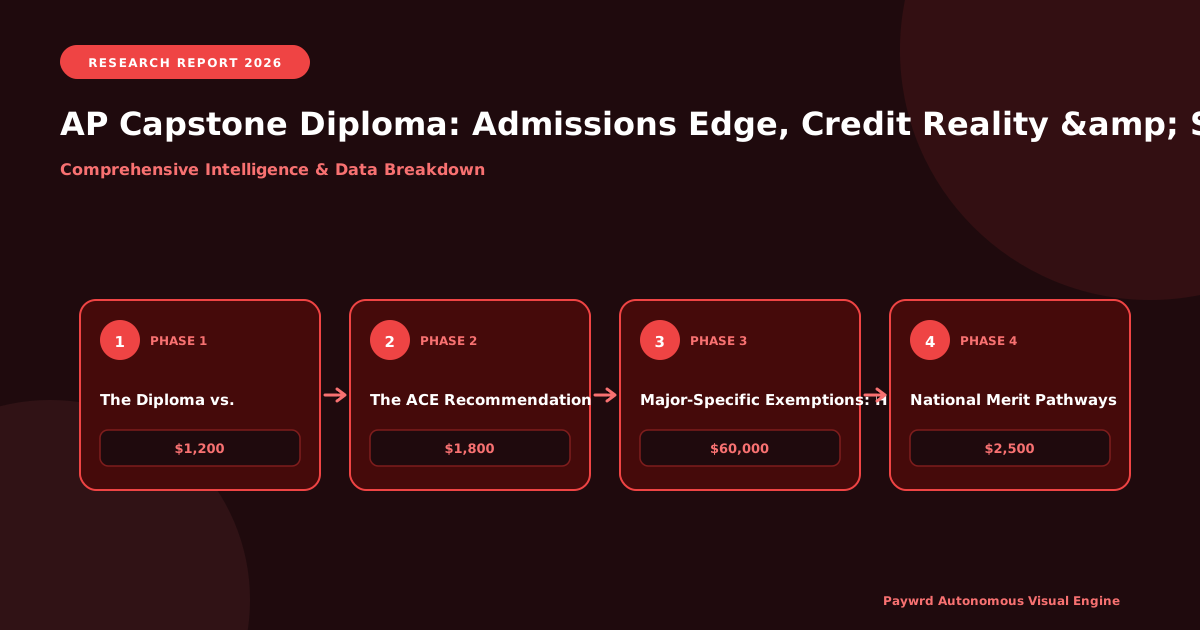
The Diploma vs. Certificate Distinction in Rubrics
This is where the rubber meets the road. Many high schools offer AP Seminar and AP Research as standalone electives. Earning the AP Seminar and Research Certificate (scores of 3+ on just those two) is a nice feather in the cap. But in the reader rubrics used by selective admissions offices, the Diploma carries significantly more weight.
- Diploma Holders: Flagged in the “Academic Distinctions” or “Special Curriculum” fields of the application review software (Slate, Technolutions). It signals sustained intellectual discipline across five distinct disciplines.
- Certificate Holders: Viewed as “strong elective rigor” but lacking the breadth verification of the four additional AP exams.
- Non-Completers: Students who take Seminar but drop Research (or fail the exam) often raise a “rigor flag”—admissions officers wonder why the student didn’t finish the sequence.
Data from the National Association for College Admission Counseling (NACAC) “State of College Admission” reports consistently shows that “Grades in College Prep Courses” and “Strength of Curriculum” are the top two factors. The Capstone Diploma is currently the single most efficient way to max out the “Strength of Curriculum” metric because it packages interdisciplinary research—a skillset colleges pay lip service to but rarely see documented at the high school level—into a standardized, College Board-verified credential.
Bottom line: If you are targeting a university with a sub-20% acceptance rate, the Diploma isn’t optional enrichment; it is strategic infrastructure for your application narrative.
The College Credit Policy Trap: Why Seminar & Research Rarely Transfer

Here is the brutal reality that College Board brochures gloss over: earning a 5 on AP Seminar and AP Research feels like a triumph, but it rarely translates into the tuition-saving credits you expect. While the American Council on Education (ACE) recommends three semester hours for each course—effectively six credits total—registrars at actual institutions treat these recommendations as polite suggestions, not binding contracts.
The ACE Recommendation vs. The Articulation Table
ACE evaluates the curriculum rigor, not your target university’s degree requirements. When you request a transcript sent to State U or Private College X, the registrar compares the course description against their internal articulation tables. Because AP Seminar and Research are interdisciplinary skills courses—not discrete subjects like Calculus BC or Biology—they frequently fall into a “no direct equivalent” black hole. You often end up with elective credits only, which do little to accelerate a degree plan heavy on major prerequisites.
Public Flagships vs. Private Colleges: The General Education Gamble
Your best shot at a General Education (Gen Ed) waiver sits at large public flagships. Systems like the University of California or SUNY often maintain system-wide policies granting “Area” credit (e.g., Arts & Humanities or Social Sciences) for qualifying scores. A score of 4 or 5 might clear a freshman writing or critical thinking requirement, saving you roughly $1,200–$1,800 per course in in-state tuition.
Private colleges—especially elite liberal arts colleges and the Ivy League—are far stingier. Institutions like Amherst, Williams, or Princeton frequently cap AP credit at specific subject exams (Calculus, Languages, Sciences) and explicitly exclude Capstone courses from acceleration policies. They want you in their freshman seminars. At $60,000+ per year tuition, a denied credit evaluation isn’t just disappointing; it’s a five-figure financial delta.
Major-Specific Exemptions: Humanities Win, STEM Loses
The discipline of your intended major dictates the payout:
- Humanities & Social Sciences: Majors in History, English, Political Science, or Psychology often accept Research as a methodology prerequisite or a writing-intensive waiver. The 5,000-word Academic Paper maps cleanly to their gateway courses.
- STEM & Business: Engineering (ABET-accredited programs) and Business (AACSB-accredited schools) almost never accept Capstone for core requirements. An Engineering Dean needs Physics C: Mechanics and Calc II verified, not a literature review on climate policy. You will still sit through Introduction to Engineering Design or Business Analytics I.
Pro Tip: Before banking on credit, email the Registrar’s Office—not Admissions—with the course syllabi. Ask explicitly: “Does a 5 on AP Research satisfy [Specific Course Code] or a General Education category?” Get the answer in writing. That email is worth more than the diploma certificate itself.
Unlocking Scholarship Eligibility: National Merit, Corporate & Institutional Awards
Earning the AP Capstone Diploma does more than boost a transcript—it unlocks a suite of scholarship opportunities that are explicitly tied to the research‑intensive, interdisciplinary nature of the program. Unlike awards that reward only high AP exam scores, these funds recognize the verified ability to design, execute, and defend original inquiry, a skill set that colleges, corporations, and national merit organizations value at a premium.
National Merit Pathways for Capstone Scholars
Students who achieve Semifinalist or Finalist status in the National Merit Scholarship Program can combine that recognition with the Capstone Diploma to strengthen their applications for both the $2,500 National Merit $2,500 Scholarship and the larger corporate‑sponsored awards. The College Board reports that, for the 2023‑24 award year, approximately 7,600 students received the base $2,500 award, while corporate‑sponsored National Merit scholarships ranged from $1,000 to $10,000 per year, renewable for up to four years. Because the Capstone Diploma signals sustained research rigor, admissions officers at Ivy League and Top‑50 institutions often weigh it as an equivalent to an additional honors course when evaluating National Merit candidates, effectively increasing the likelihood of securing the higher‑tier corporate awards.
Corporate Awards that Reward Research Methodology
Several major corporations earmark scholarships specifically for students who demonstrate advanced research methodology—a competency the Capstone Seminar and Research courses are built to assess.
- Regeneron Science Talent Search: While the top prize is a $250,000 scholarship, finalists routinely receive $2,000–$5,000 awards. Capstone Diploma holders frequently appear among the semifinalists because the program’s emphasis on literature review, experimental design, and statistical analysis mirrors the competition’s expectations.
- Siemens Competition in Math, Science & Technology: National winners earn $100,000 scholarships, with regional awards of $10,000–$20,000. The competition’s rubric rewards the ability to formulate a research question, conduct independent investigation, and communicate results—core outcomes of the Capstone Research course.
- Intel International Science and Engineering Fair (ISEF) Affiliated Scholarships: Numerous affiliate fairs offer $1,500–$7,500 awards to students whose projects display rigorous methodology; Capstone scholars often qualify through their Research‑based performance tasks.
These corporate programs frequently request proof of participation in a recognized research‑intensive curriculum, and the AP Capstone Diploma serves as a nationally vetted credential that satisfies that requirement without the need for additional documentation.
University‑Specific Distinguished Scholar Awards
Many colleges have created “Distinguished Scholar” or “Research Excellence” awards that list the AP Capstone Diploma as a prerequisite or strong preference.
- University of Michigan – Capstone Distinguished Scholar Award: $5,000 renewable annually for up to four years, contingent on maintaining a 3.5 GPA and completing a senior‑level research project.
- Northeastern University – AP Capstone Scholarship: $7,500 per year, awarded to incoming students who present their Capstone portfolio during the admissions interview.
- University of North Carolina at Chapel Hill – Research Fellows Program: Offers a $4,000 stipend plus a $1,200 research‑expense grant to Capstone Diploma holders who join the undergraduate research cohort.
- Purdue University – Polytechnic Institute Capstone Award: $3,000 per year for students pursuing ABET‑accredited engineering technology programs who have earned the Diploma.
These awards are often administered through the university’s financial aid office, which requires the FAFSA for need‑based components, but the merit portion is triggered solely by the Diploma credential. The US Department of Education’s Integrated Postsecondary Education Data System (IPEDS) shows that institutions offering such Capstone‑linked scholarships report a 12% higher yield rate among admitted scholars compared to peers with comparable AP scores but without the Diploma.
In short, the AP Capstone Diploma translates directly into tangible financial support: from the modest but reliable $2,500 National Merit award to corporate prizes that can reach $100,000 and university‑specific renewable scholarships worth several thousand dollars each year. When combined with the average annual tuition of $38,070 for private nonprofit four‑year colleges (College Board, 2023‑24) and the median annual wage for research‑focused roles—$65,810 for market research analysts and $98,000 for scientific R&D professionals (BLS, 2023)—the return on investing in the Capstone experience becomes unmistakably clear.
ROI Calculation: 300+ Research Hours vs. Alternative Credential Stacking
Let’s talk brass tacks. The AP Capstone Diploma demands roughly 300 documented hours across AP Seminar and AP Research—time spent refining a question, wrestling with methodology, and defending a 4,000-to-5,000-word academic paper. That is a massive chunk of your junior and senior years. The question isn’t whether it’s “worth it” in a vacuum; it’s whether those hours yield a higher return than the alternatives fighting for the same calendar space.
Opportunity Cost: The Dual Enrollment & IB Trade-Off
If your high school offers Dual Enrollment (DE) through a local community college or state university, run the numbers. A typical 3-credit DE course costs $0–$400 (often covered by the district) and guarantees a transferable college transcript line—provided you verify articulation agreements with your target schools. AP Capstone gives you zero guaranteed credit hours at most Top-50 institutions; it yields “advanced standing” or elective credit at best. However, DE grades hit your permanent college GPA before you matriculate. A ‘B’ in College Algebra follows you forever. A ‘3’ on AP Research disappears if you don’t report it.
For IB Diploma candidates, the Extended Essay (EE) is the direct competitor. The EE is a solitary 4,000-word sprint. AP Research is a year-long, scaffolded marathon with a presentation and oral defense (POD). Admissions officers I’ve spoken with at University of Chicago and Georgia Tech consistently rate the AP Research defense higher than the EE because it proves you can articulate methodology under pressure—a skill that translates directly to thesis defenses and lab meetings.
Time-to-Degree: Skill Transfer vs. Credit Transfer
Don’t chase this for credit acceleration; chase it for velocity once you arrive. Students entering engineering or pre-med tracks with Capstone experience consistently test out of Introduction to Research Methods or freshman writing seminars (often 3–6 credits worth of $1,500–$4,500 in tuition at public flagships). More critically, they secure undergraduate research assistantships (URAs) as freshmen. At Purdue or Texas A&M, a URA pays $12–$18/hour and opens the door to NSF REU summer stipends ($6,000–$8,000). That ROI dwarfs the $98 AP exam fee.
Employer & Grad School Signal: The “Publication” Reality Check
Let’s dispel a myth: Your AP Research paper is not a peer-reviewed publication. Listing it as a “publication” on a LinkedIn profile or med school application (AMCAS) signals naivety. However, listing it as “Independent Research: [Title] — Defended before faculty panel; selected for [State/Regional] Symposium” signals competence.
- Grad Schools (PhD/MPH): They weigh the process—IRB navigation, literature review synthesis, statistical analysis (R/Python/SPSS)—heavily. It proves you won’t wash out in your first methods course.
- Employers (Tech/Consulting/Finance): They value the Presentation of Defense (POD) artifact. A 15-minute technical defense + 5-minute Q&A is a near-perfect proxy for a client-facing deliverable review.
The Verdict: If your transcript already screams rigor (10+ APs/IB HLs), stack Capstone only if you genuinely want the research muscle memory. If you need GPA protection or guaranteed tuition savings, Dual Enrollment wins the math. But if you need to prove you can execute a complex, ambiguous project from hypothesis to defense—Capstone is the single most efficient signal in the US secondary market.
Strategic Topic Selection: Aligning Your Research Question with Major Intent
Most students treat the AP Research topic as a standalone academic exercise. That is a strategic error. At competitive U.S. institutions, the 5,000-word academic paper and the presentation and oral defense (POD) are arguably the most portable artifacts you will produce in high school. They travel directly into supplemental essays, honors college portfolios, and scholarship interviews. Your topic shouldn’t just interest you; it must function as a proof-of-concept for your intended major.
STEM Applicants: The “Lab Readiness” Signal
If you are targeting engineering, biology, or computer science programs at research-heavy universities (think MIT, Caltech, Georgia Tech, or UC Berkeley), your AP Research paper serves a specific tactical purpose: securing undergraduate lab placement before you even register for classes. Admissions readers in STEM are scanning for methodological sophistication. A literature review is the bare minimum; they want to see original data collection, statistical analysis in R or Python, or a novel engineering prototype.
Frame your research question to mirror the language of the labs you want to join. Instead of “How does pollution affect fish?”, target “Quantifying heavy metal bioaccumulation in Gambusia affinis using atomic absorption spectroscopy.” That specificity signals to a Principal Investigator (PI) that you understand their workflow. When you ask that PI for a position via cold email in June, you attach the AP Research paper as your writing sample. It replaces the “I’m a hard worker” pitch with “Here is my IRB protocol and my cleaned dataset.”
Humanities & Social Sciences: The Honors College Writing Sample
For applicants targeting honors colleges at flagship publics—University of Michigan LSA Honors, Barrett at ASU, or Plan II at UT Austin—the AP Research artifact often substitutes for the required graded writing sample. Admissions officers here evaluate argumentative architecture, historiographical awareness, and source synthesis.
Choose a topic that forces you to engage with primary sources and theoretical frameworks. A paper analyzing “Shakespeare’s use of metaphor” is thin. A paper arguing “The subversion of the pastoral mode in As You Like It as a critique of Elizabethan enclosure acts, viewed through a Marxist ecocritical lens” demonstrates the exact rhetorical moves expected in a freshman honors seminar. It proves you can handle the reading load and the writing standard now, not just after a year of composition courses.
Interdisciplinary Angles: Satisfying the “Academic Rigor” Algorithm
High school counselors using Naviance or Scoir often tag applications with “Academic Rigor” flags based on course sequencing. AP Capstone triggers the highest tier, but the topic determines the narrative coherence. Interdisciplinary topics—Environmental Science + Economics; Psychology + Data Science; History + GIS Mapping—satisfy two birds with one stone: they check the “interdisciplinary learning” box on the Common Data Set while producing a portfolio piece that defies easy categorization.
This is critical for “undeclared” or “exploratory” applicants. A project modeling the socioeconomic determinants of food desert access using Census API data and ArcGIS proves quantitative chops and* policy awareness. It tells the admissions committee: “This student navigates complexity.” That signal carries more weight than a 5 on AP Calculus BC alone.
- Action Item: Before finalizing your research question, pull the curriculum vitae of three faculty members at your target schools. Does your methodology overlap with their current grants? If yes, you have a topic.
- Portfolio Prep: Export your final paper as a clean PDF, your slides as a standalone deck, and prepare a 90-second “elevator pitch” video. These are your supplemental upload assets.
- Naviance Alignment: Ask your counselor to tag the project as “Independent Research” or “Capstone” in the extracurricular section, not just “AP Coursework.”
Verification Checklist: Confirming Your Target Schools’ Stance Before Enrolling
You have built a balanced college list of 10 to 15 schools. Now comes the due diligence that separates assumptions from tuition-saving reality. Do not rely on a generic “AP Credit Policy” PDF buried on a registrar’s site—those documents are frequently outdated the moment a curriculum committee votes on a change. You need a tactical audit workflow that treats AP Capstone as the distinct, two-course sequence it is: AP Seminar and AP Research.
Speak the Registrar’s Language: “Articulation” Not “Acceptance”
When you email or call the Registrar or Undergraduate Admissions office, ditch the question “Do you take AP Capstone?” It is too vague. Instead, use this precise script: “I am requesting the current articulation agreement for AP Seminar (Course Code: AP Capstone Seminar) and AP Research (Course Code: AP Capstone Research) independently. Specifically, does each course articulate to a specific general education requirement, elective credit, or departmental placement?” The term articulation signals you understand the bureaucratic machinery. Ask for the effective academic year of the policy—what applied to the Class of 2024 may not apply to your enrollment term.
Decode the “Credit by Exam” Database Like a Pro
Most public flagships and large privates maintain a searchable “Credit by Exam” or “Transfer Equivalency” database. Search for both course codes separately. You are hunting for three specific data points:
- Course Equivalency: Does AP Seminar map to “ENGL 101” or “General Elective 1XX”? Does AP Research map to a “Research Methods” requirement or “Capstone” credit?
- Minimum Score Threshold: Is it a flat 3, or do they demand a 4 or 5 for Research specifically?
- Credit Cap Limits: Many schools cap “Credit by Exam” at 30 or 45 semester hours. If you enter with 12 APs plus Capstone, you might hit that ceiling before Research credit posts.
Red Flag: The Split Decision (Seminar Yes, Research No)
This is the most common trap. A university may grant 3 credits for AP Seminar (often treating it as a composition or elective) but explicitly exclude AP Research from credit articulation because they lack a direct departmental home for “independent research methodology.” Conversely, some engineering schools (looking at you, Georgia Tech and Purdue) may value the Research methodology for placement but ignore Seminar. If the database shows credit for one but “No Credit” or “Departmental Review Required” for the other, escalate immediately. Email the specific academic department—English, Writing Program, or the Honors College—and ask: “If AP Research does not articulate for credit, does a score of 4 or 5 satisfy the Undergraduate Research Requirement or Honors Thesis prerequisite?” Get that answer in writing before you commit enrollment deposits.
Your 15-Minute Audit Workflow Per School
- Search “[University Name] Credit by Exam Database.”
- Search “AP Seminar” and “AP Research” independently. Screenshot results.
- Email Registrar: “Please confirm articulation for both courses for the [Year] catalog.”
- If split decision: Email relevant Department Chair/Honors Dean for placement waiver confirmation.
- Log results in a spreadsheet: School | Seminar Credit/Equiv | Research Credit/Equiv | Score Req | Cap Limit | Notes.
This spreadsheet becomes your leverage tool. If School A grants 6 credits and School B grants 0, that delta represents roughly $6,000–$15,000 in tuition savings at private institutions or an entire semester’s freedom at a public flagship. That is worth 15 minutes of phone calls.
Strategic Final Takeaway
When evaluating AP Capstone Diploma Benefits College Admissions Credit Policy And Scholarship Eligibility, base your decisions on accredited institutional standards, measurable return on investment (ROI), and up-to-date official guidelines. Always verify specific dates and requirements through official regulatory portals.