

Key Takeaway: The 2026/2027 fee surge isn’t arbitrary—it’s a lagging indicator of Nigeria’s macroeconomic shock. Understanding the specific cost drivers (FX-linked curriculum imports, regulatory compliance, and the “Japa” salary premium) gives you the leverage to audit school proposals line-by-line at the next PTA meeting.
Decoding the 2026/2027 Fee Surge: Macro Drivers Behind the Hike
If you’ve received the fee schedule for the upcoming session and felt your stomach drop, you aren’t alone. Top-tier private schools in Lagos, Abuja, and Port Harcourt are announcing increases ranging from 15% to 35%. Before you accuse the proprietor of profiteering, you need to see the balance sheet. Three structural forces are pushing operational costs up faster than most household incomes can absorb.

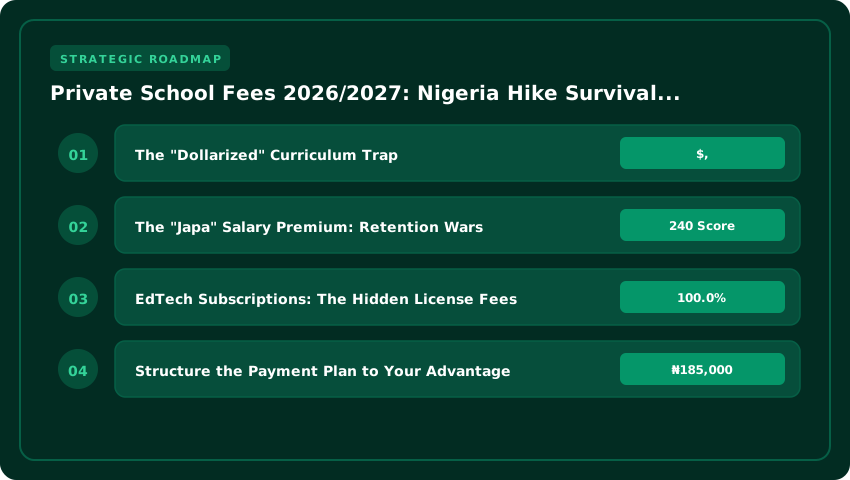
The “Dollarized” Curriculum Trap
This is the single biggest hidden cost. Most elite Nigerian schools run the British (IGCSE/A-Levels), American (AP), or IB curricula. Every textbook, exam registration fee, lab consumable, and software license (think Turnitin, ManageBac, or Century Tech) is priced in USD or GBP. When the Naira moved from ~₦460/$ to averaging ₦1,500+/$, the landed cost of a single Year 10 Physics textbook or an IB Diploma registration fee effectively tripled. Schools cannot “buy local” here—accreditation bodies like Cambridge Assessment International Education (CAIE) or the IB Organization mandate specific imported resources. That 20% hike in “Tuition” often masks a 200% jump in “Curriculum Delivery Costs.”
Regulatory Compliance: The NUC & State Ministry Tax
It’s not just the curriculum. The National Universities Commission (NUC) via CCMAS (Core Curriculum Minimum Academic Standards) and State Ministries of Education have tightened accreditation screws. We’re talking mandatory upgrades: CCTV coverage for exam halls (JAMB/WAEC compliance), biometric attendance systems, fire suppression systems, and the new Teacher Professional Development logbooks mandated by the Teachers Registration Council of Nigeria (TRCN). A mid-sized secondary school in Lagos recently spent ₦12 million just upgrading science labs to meet the 2024 WAEC specification changes. Those capital expenditures (CAPEX) are amortized into your termly fees.
The “Japa” Salary Premium: Retention Wars
This is the most volatile line item. A qualified Physics or Further Maths teacher with 5 years’ experience is now a global commodity. To stop them from relocating to the UK (Skilled Worker Visa) or Canada, schools are benchmarking salaries against international conversion rates, not local inflation. We are seeing ₦400k–₦700k/month for core subject leads—up from ₦180k–₦250k two years ago—plus “retention bonuses” paid in hard currency equivalents. Add the new Contributory Pension Scheme enforcement and NHIS contributions, and the wage bill has become the single largest expense head, often exceeding 55% of total revenue.
- Actionable Insight: Ask the bursar for the “Cost per Pupil” breakdown separating Academic Delivery (curriculum, exams, staff) from Overheads (admin, marketing, transport). Justified hikes live in the first bucket.
- Red Flag: If “Administrative Charges” or “Development Levy” spikes higher than “Staff Costs” or “Exam Fees,” you are likely subsidizing infrastructure debt or profit margins, not the “Japa” premium.
Tuition Forecast by Tier: Lagos vs Abuja vs Regional Hubs (₦ Estimates)
Let’s talk numbers—specifically, the figures that will hit your bank statement come September 2026. Geography is the single biggest variable in Nigerian private education. A “mid-range” school in Ikeja costs vastly different from its counterpart in Ibadan or Enugu, driven largely by real estate overheads, expatriate staff housing allowances, and the logistics of importing British or American curriculum resources through the ports.
Top-Tier: British & American Curriculum Flagships (₦4.5M – ₦9M+)
This is the domain of the British International Schools, American International Schools, Grange, Lekki British, and AISA Abuja. For the 2026/2027 session, budget a minimum of ₦4.5 million for Day students in Year 7/Grade 6, scaling to ₦9 million – ₦11 million for Boarding or Sixth Form (A-Levels/AP). Lagos schools (Victoria Island, Lekki, Ikoyi) command a 15–20% premium over Abuja equivalents purely on land lease costs. These fees typically exclude external exam entries (IGCSE/Checkpoint ≈ ₦150k–₦250k per subject), uniform kits (₦120k+), mandatory international trips, and the “Capital Development Levy” (often ₦500k–₦1M one-off for new intakes). If you are targeting this tier, verify if the quoted fee is “all-inclusive” or “tuition-only”—the delta is where budgets break.
Mid-Range: Montessori & Nigerian-British Blend (₦1.2M – ₦3.5M)
This is the sweet spot for the professional middle class—schools like Chrisland, Greensprings (Anthony/Ikoyi campuses), Corona, Premiere Academy (Abuja), and Lead British International. Expect ₦1.2M – ₦1.8M for Primary in regional hubs (Ibadan, Port Harcourt, Enugu) and ₦2.2M – ₦3.5M for Secondary in Lagos/Abuja. The “blend” model saves you the full Cambridge affiliation fee but retains UK textbooks and Checkpoint exams. Watch for the “Resource & Technology Fee” (₦150k–₦300k/term) which many schools now separate to keep headline tuition looking lower. Boarding here averages ₦2.5M–₦4M inclusive of feeding, but confirm if “feeding” covers special diets or weekend snacks—hidden canteen top-ups are a common pain point.
Faith-Based & Community Private Schools (₦400k – ₦1.1M)
Do not confuse “lower fee” with “lower quality.” Schools run by Catholic dioceses (e.g., Loyola Jesuit Abuja, St. Gregory’s), Baptist/Methodist missions, and reputable Muslim foundations often deliver the strongest WAEC/NECO outcomes per Naira spent. Fees range from ₦400k – ₦700k in the Southwest/South-South to ₦600k – ₦1.1M in Abuja/Lagos for Day Secondary. They follow the Nigerian curriculum enriched with British textbooks. The trade-off? Usually stricter discipline, mandatory religious observance, and less “bells and whistles” infrastructure (Olympic pools, robotics labs). However, their teacher retention is often higher because mission schools offer non-monetary incentives (housing, community) that buffer the “Japa” brain drain affecting secular mid-tier schools.
- Lagos Premium: Add 20–30% to any tier baseline for Victoria Island/Ikoyi/Lekki Axis.
- Abuja Stability: Fees in Gwarinpa/Wuse/Katampe are 10–15% lower than Lagos Island equivalents for same-tier schools.
- Regional Hubs (Ibadan, Enugu, Port Harcourt, Kaduna): Expect 25–40% discount on Lagos pricing for identical curriculum brands.
- Hidden Cost Buffer: Always add 15% to the published tuition for PTA levies, inter-house sports kits, yearbook, and “graduation fees” that appear in Term 3.
The Hidden Cost Iceberg: Development Levies, Tech Fees & Uniform Inflation
When a school’s tuition invoice lands in your inbox, the headline figure often tells only part of the story. Beneath the surface lie a series of compulsory and quasi‑compulsory charges that can add ₦300,000–₦600,000 to a family’s annual outlay. Understanding each line‑item empowers you to question, negotiate, or seek alternatives before signing the next fee schedule.
Capital Development Levy vs. Building Fund: What’s Really Mandatory?
Many private schools label a “Capital Development Levy” (CDL) as non‑negotiable, citing infrastructure expansion, laboratory upgrades, or sports‑field refurbishment. In Nigeria’s regulatory framework, the CDL is treated as a mandatory charge only when the school’s proprietor has obtained a formal approval from the State Ministry of Education and the amount is stipulated in the school’s approved fee schedule. By contrast, a “Building Fund” is frequently presented as voluntary, yet some institutions embed it in the same invoice line, creating confusion.
- Typical CDL range (2026/2027): ₦120,000 – ₦180,000 per term (≈ ₦360,000 – ₦540,000 per annum).
- Optional Building Fund: Often quoted at ₦80,000 – ₦120,000 per year; parents can request a waiver or redirect the amount to a PTA‑managed savings scheme.
- Verification tip: Ask for the school’s JAMB CAPS‑linked fee approval document or the latest Ministry of Education circular; if the CDL isn’t listed there, it may be negotiable.
EdTech Subscriptions: The Hidden License Fees
The pandemic accelerated the adoption of learning platforms, and many schools now bundle access fees into the tuition bill. While tools like Google Classroom and Seesaw enhance pedagogy, the licensing costs are frequently passed on to families without transparent breakdowns.
- Google Classroom (G Suite for Education): Schools usually pay an institutional license of roughly ₦25,000 – ₦35,000 per student per year; this often appears as a “Technology Fee” of ₦30,000.
- Seesaw: Annual student licence averages ₦20,000 – ₦28,000; some schools charge a flat ₦25,000.
- Coding/Robotics kits (e.g., LEGO Education SPIKE, Arduino starter packs): A shared kit program can cost ₦70,000 – ₦90,000 per annum per pupil, reflected under “STEM/Tech Levy.”
- Cost‑saving angle: Request a copy of the vendor invoice or negotiate a bulk‑license discount; many platforms offer reduced rates for NGOs or parent cooperatives.
Uniform & Shoe Monopolies: Paying a Premium for Branding
Uniform policies are a classic revenue stream. Schools often designate a single supplier—sometimes a related entity—resulting in price inflation far above open‑market rates.
- Blazer: School‑approved price ₦45,000 – ₦55,000; identical polyester‑blend blazers in Lagos markets sell for ₦25,000 – ₦30,000.
- Trousers/Skirts: ₦18,000 – ₦22,000 versus market ₦10,000 – ₦13,000.
- School shoes (leather, black): ₦30,000 – ₦38,000; comparable durable shoes from reputable brands (e.g., Bata, Telemart) cost ₦16,000 – ₦22,000.
- Regulatory note: The National Universities Commission’s CCMAS guidelines encourage transparency in ancillary charges; while primarily for tertiary institutions, the principle of full disclosure applies across education levels.
By dissecting these hidden costs—development levies, EdTech licences, and uniform monopolies—you gain the leverage to request itemised receipts, explore alternative suppliers, or even propose a PTA‑funded bulk purchase that could save families tens of thousands of naira each year. Armed with this knowledge, the next PTA meeting becomes less about accepting a fee hike and more about shaping a fairer, more transparent cost structure for your child’s education.
Negotiation Playbook: Leveraging Sibling Discounts, Early Bird & Loyalty Clauses
Most parents treat the fee schedule as a final judgment. It isn’t. It is an opening bid. In the 2026/2027 cycle, where schools are desperate to maintain enrollment numbers against a backdrop of mass emigration (Japa) and shrinking disposable income, you hold more cards than you think. The trick is moving from pleading to contractual negotiation.
Structure the Payment Plan to Your Advantage
Schools prefer annual lump sums because it solves their cash flow for CAPEX projects (new labs, buses, roof repairs). That preference is your leverage. Annuitized discounts (paying the full year upfront) typically unlock 5–10% off the headline figure. If you can swing it, do it. But if liquidity is tight, reject the standard termly split. Push for a monthly direct debit mandate tied to your salary date—zero interest, zero admin fees. Many mid-tier schools in Lagos and Abuja will quietly agree to 10 or 11 monthly installments if you sign a standing order mandate on the spot. It guarantees them revenue; it preserves your cash flow. Get the specific dates and amounts written into the addendum, not just a verbal promise.
The ‘Fee Freeze’ Clause: Marketing Fluff or Legal Shield?
You’ll see “Fee Freeze Guaranteed for 2 Years” on glossy brochures. Here is the reality: unless that promise is embedded in the signed Admission Contract or a sealed Addendum, it is legally toothless. Nigerian contract law (Sale of Goods Act / Common Law principles) requires consideration and certainty. A brochure is an “invitation to treat,” not a binding term. Before you sign re-enrollment forms, demand a clause stating: “Tuition fees for the 2026/2027 and 2027/2028 sessions shall not exceed ₦[Specific Amount] per annum, excluding statutory government levies.” If the registrar hesitates, ask them to initial the specific figure on your copy. That initialed document is your evidence in a Small Claims Court or Consumer Protection Council (FCCPC) petition.
Collective Muscle: PTA Executive vs. Solo Appeals
An individual parent asking for a discount is a “special case.” A PTA Executive Committee presenting a signed petition from 60% of parents is a “business risk.” For 2026/2027, organize before the PTA AGM. Agree on three non-negotiables: (1) Sibling discounts applied automatically (not on application), minimum 15% for the 3rd child; (2) Early bird deadline extended to 4 weeks post-resumption; (3) Transparent breakdown of “Development Levy” vs. “Tuition.” Present a unified front. Schools budget for 5–10% bad debt/attrition; they will concede structured discounts to avoid the PR nightmare and revenue hit of mass withdrawal. Remember: the Principal reports to the Board/Proprietor. Give the Principal the cover they need to approve your terms by showing them the collective numbers.
- Action Item: Request the school’s “Schedule of Fees” (not the summary) – audit line items like “ICT Levy” or “Sports Development” for duplication.
- Action Item: Submit a formal “Fee Review Request” letter on PTA letterhead, citing current CBN inflation data and NBS household expenditure reports.
- Red Flag: Schools demanding full payment before releasing transfer certificates or report cards – this violates FCCPC guidelines on consumer rights.
Exit Strategy Matrix: Switching Schools Mid-Stream Without Academic Loss
Moving your child to a cheaper school isn’t just a financial decision; it’s a high-stakes academic maneuver. Get the timing wrong on exam registrations or curriculum alignment, and you risk a “gap year” that no fee savings can justify. Here is the risk-assessed roadmap for the 2026/2027 session.
The Exam Registration Trap: Hard Deadlines You Cannot Miss
This is the single biggest dealbreaker. For the 2027 diet, WAEC SSCE registration typically closes in January/February 2027, while NECO SSCE often extends to March/April 2027. If you move a child in SS2 (Year 11) after the new school has submitted their nominal roll to the exam body, your child sits out a year. No exceptions.
Action Item: Before paying a kobo in acceptance fees, demand written confirmation from the prospective school’s Exams Officer that your child’s data can be uploaded to the WAEC e-Registration portal or NECO Offline/Online portal before the deadline. For IGCSE (Cambridge/Edexcel), the “Entry Deadline” for the June 2027 series is usually mid-February 2027; late entries attract punitive fees (often double) and require Centre Exams Officer approval. If the new school is not a registered British Council attached centre, you cannot transfer entries—you must withdraw and re-register, losing the forecast grades.
Curriculum Mapping: The Silent Grade Killer
Switching curricula mid-stream is where GPAs go to die. Here is the risk hierarchy:
- British (IGCSE) → Nigerian (WAEC/NECO): High Risk. The British curriculum is deeper but narrower. A Year 11 student moving to SS2 will miss core SS1/SS2 topics in Further Maths, Civic Education, and Nigerian History/Geography—subjects WAEC examines heavily. Remediation requires intense holiday coaching.
- Nigerian → American (AP/High School Diploma): Moderate Risk. Credit transfer is negotiable. The new school evaluates transcripts for “Carnegie Units.” Your child may need to “validate” credits via placement tests or summer school to graduate on time.
- Nigerian → British (Year 10/11): Very High Risk. Entering IGCSE Year 11 (the exam year) without completing Year 10 coursework is academic suicide. Coursework components (Art, Geography, ICT) cannot be “crammed.”
Transfer Certificate (TC) & Ministry Clearance: The Bureaucratic Gauntlet
Do not assume the old school will release the TC immediately. Many private schools withhold Transfer Certificates until all arrears are cleared—including the term you are leaving mid-way, bus fees, and “development levies.”
Once you have the TC, the State Ministry of Education (e.g., Lagos State Ministry of Education, Alausa) must endorse it for public/private school admission validity. Current timelines in Lagos average 2–4 weeks for “Letter of Attestation” processing if you walk in with complete docs (Birth Cert, Last Result, TC, Parent ID). Abuja (FCT) and Rivers have similar bottlenecks. Pro Tip: Apply for the Ministry clearance before you resign from the old school. Use the receipt as leverage to speed up the TC release.
Bottom Line: If you are in SS2/Year 11 right now, the window for a safe switch has likely closed for 2027 exams. Target a move at the start of SS1/Year 10 (Sept 2026) where you have a full two-year runway. Anything else is gambling with your child’s certificate.
Alternative Funding Rails: NELFUND-Eligible Pre-Degree, Scholarships & Ed-Fintech
When savings and salary advances hit a wall, Nigerian parents need to pivot from scraping together to structuring capital. The 2026/2027 session demands a diversified funding stack—one that blends federal credit, corporate philanthropy, and the new wave of education fintech. Ignoring these rails means leaving money on the table while fees compound.
Unlocking NELFUND for Foundation & A-Level Programmes
Most parents assume the Nigerian Education Loan Fund (NELFUND) is strictly for 100-level university freshers. That is outdated intel. Under the revised Student Loans (Access to Higher Education) Act, 2024, the fund covers tuition at any NUC-accredited institution—including approved Pre-Degree, Foundation, and JUPEB centres attached to federal universities. If your ward is targeting a Foundation year at UNILAG, OAU, or ABU to bypass JAMB UTME bottlenecks, that tuition (often ₦350,000–₦600,000) is now financeable.
The playbook: Secure admission first, generate the invoice on the school portal, then apply via the NELFUND portal using the student’s NIN and BVN. Repayment only kicks in two years post-NYSC, indexed to income. It effectively converts a crushing upfront cash call into a deferred, income-contingent liability. Pro tip: Confirm the specific centre is on the NUC’s CCMAS approved list before committing; unaccredited “miracle centres” disqualify the loan.
Corporate CSR Scholarships: The Banking, Oil & Telco Pipeline
Nigeria’s blue-chip foundations deploy billions annually in education CSR, yet application rates remain surprisingly low because parents treat them as lotteries rather than pipelines. Structure your hunt:
- Banking & Fintech: The GTCO (GTBank) Scholarship, Access Bank/Herbert Wigwe Foundation, and First Bank SPARK Scholarship often prioritize STEM and indigent students. Deadlines typically close Q1 (Jan–March) for the September session.
- Oil & Gas Majors: NNPC/SNEPCo, Chevron, TotalEnergies, and Seplat run robust undergraduate schemes. Many require specific CGPA thresholds (usually 3.5/5.0 or 4.0/5.0) and NYSC discharge certificates for post-grad awards, but the undergraduate grants cover full tuition plus stipends (₦150k–₦300k/year).
- Telco & Tech: MTN Foundation Scholarship (Science & Tech, Blind Students) and AirTel Touching Lives are recurring. The MTN portal opens around May/June; have WAEC/UTME results and admission letters scanned and ready.
Strategy: Build a Scholarship Calendar in Google Sheets tracking portal open/close dates, required essays, and referee contacts. Treat it like a JAMB registration—miss the deadline, wait another year.
Ed-Fintech BNPL: Convenience vs. Compound Risk
Platforms like EdFin, Schoolable, Paystack (School Fees), and Flutterwave Tuition now offer “Buy Now, Pay Later” (BNPL) for school fees. The pitch is seductive: split ₦1.2M into 3–6 monthly instalments at 2–4% monthly flat rate. Do the math: a 3% flat monthly rate on a 6-month tenor equals an APR north of 40%. That is commercial bank overdraft territory, not “convenience.”
Default risks are structural. Most BNPL contracts auto-debit linked BVN accounts. A failed debit triggers penalty fees (often ₦5,000–₦10,000 per event) and immediate reporting to credit bureaus (CRC, FirstCentral), damaging the parent’s credit score for future mortgages or SME loans. Only use BNPL if: (a) You have a guaranteed inflow matching the debit dates (e.g., confirmed bonus, maturing Treasury Bill), and (b) You have read the Key Facts Statement for the Effective Interest Rate (EIR), not just the marketed “monthly fee.”
Bottom line: NELFUND is your cheapest capital (zero interest, income-contingent). CSR scholarships are free money—if you treat applications like a part-time job. BNPL is expensive bridge financing; use it only to smooth cash-flow timing, never to afford a school you fundamentally cannot sustain.
2026/2027 Calendar Countdown: Critical Action Dates for Fee Payment & Admission
In the Nigerian academic ecosystem, timing isn’t just about punctuality—it’s about protecting your wallet. Miss a deadline by 48 hours, and you’re not just paying a penalty; you’re potentially losing a Early Bird discount worth ₦150,000–₦300,000 per child or, worse, disqualifying a candidate from WAEC/NECO 2027. The 2026/2027 session creates a unique “triple collision” of cash outflows: Senior Secondary final-year fees, JAMB/Post-UTME processing, and external exam registration. Here is your chronological defense strategy.
April – May 2026: The Early Bird Window (Do Not Sleep)
Most top-tier private schools in Lagos, Abuja, and Port Harcourt publish fee schedules by late March. The “Early Bird” discount—typically 5% to 10% off tuition—usually expires June 30, 2026. For a ₦3.5M annual fee, that’s ₦175,000–₦350,000 saved instantly.
- Action: Pay 60–100% of tuition before June 30. If cash flow is tight, negotiate a formal written commitment letter with the bursar by May 15 to lock the rate while you stagger payments.
- Watch Out: Schools increasingly tie “Early Bird” to full payment, not just a deposit. Read the fine print on the 2026/2027 fee schedule PDF.
June – July 2026: The JAMB/Post-UTME & SS3 Fee Clash
This is the danger zone. JAMB 2026 registration (typically April–June) overlaps with Post-UTME screening fees (₦2,000–₦5,000 per institution) just as Senior Secondary schools demand Term 1 (September) fees by July 31 to guarantee a seat.
- Strategy: Prioritize JAMB profile code creation and NIN verification by March 2026. Complete UTME registration the week the portal opens to avoid the late registration surcharge (often ₦10,000+).
- Cash Flow Hack: Use the JAMB “Mock Exam” period (usually June) as your trigger: the moment your child sits the mock, pay the Post-UTME fees for your top 3 university choices immediately. Do not wait for results.
August – September 2026: The “Late Penalty” Cliff Edge
By September 15, 2026, most private schools impose a 10–15% late payment surcharge. Simultaneously, WAEC/NECO 2027 registration opens for SS3 students (usually late August/early September). The standard WAEC fee is approx. ₦27,000 (subject to 2026 review), but the late registration window attracts a penalty of ₦10,000–₦15,000 per candidate.
- Critical Date: Target September 1–10, 2026 for WAEC/NECO payment via the school. Do not rely on the school’s “bulk payment” deadline; pay directly into the school’s designated exam account and demand the WAEC e-Registration photocard printout immediately as proof.
- NECO Specific: NECO SSCE Internal registration usually closes earlier than WAEC. Confirm the exact 2027 deadline with the State Ministry of Education or the school’s Exam Officer by August.
October 2026 Onwards: Admission & Clearance
Once JAMB CAPS opens for 2026 admissions (usually August/September), monitor “Admission in Progress” status daily. If admitted, you face Acceptance Fees (₦30,000–₦100,000) and School Fees payable within 2–3 weeks. NELFUND student loan applications (for tertiary) should be submitted the moment the portal opens for the 2026/2027 cycle to bridge this gap.
Pro Tip: Build a shared Google Sheet with columns for “Due Date,” “Amount (₦),” “Portal/Account Details,” and “Receipt Status.” Set calendar alerts for 14 days, 7 days, and 48 hours before every single deadline listed above. In this economy, a missed deadline is a self-inflicted wound you cannot afford.
Strategic Final Takeaway
When evaluating Private School Fees Increase 2026 2027 Session Nigeria Parents Guide, base your decisions on accredited institutional standards, measurable return on investment (ROI), and up-to-date official guidelines. Always verify specific dates and requirements through official regulatory portals.

