Federal & State Mandates Driving 2026 Adoption Deadlines
The regulatory landscape for K–12 AI education has shifted from voluntary frameworks to funded mandates faster than most procurement cycles can handle. If you are a curriculum director or CTO mapping out the 2026–27 school year, you are not just choosing a vendor—you are navigating a convergence of federal funding cliffs and state legislative deadlines that leave zero margin for delay.

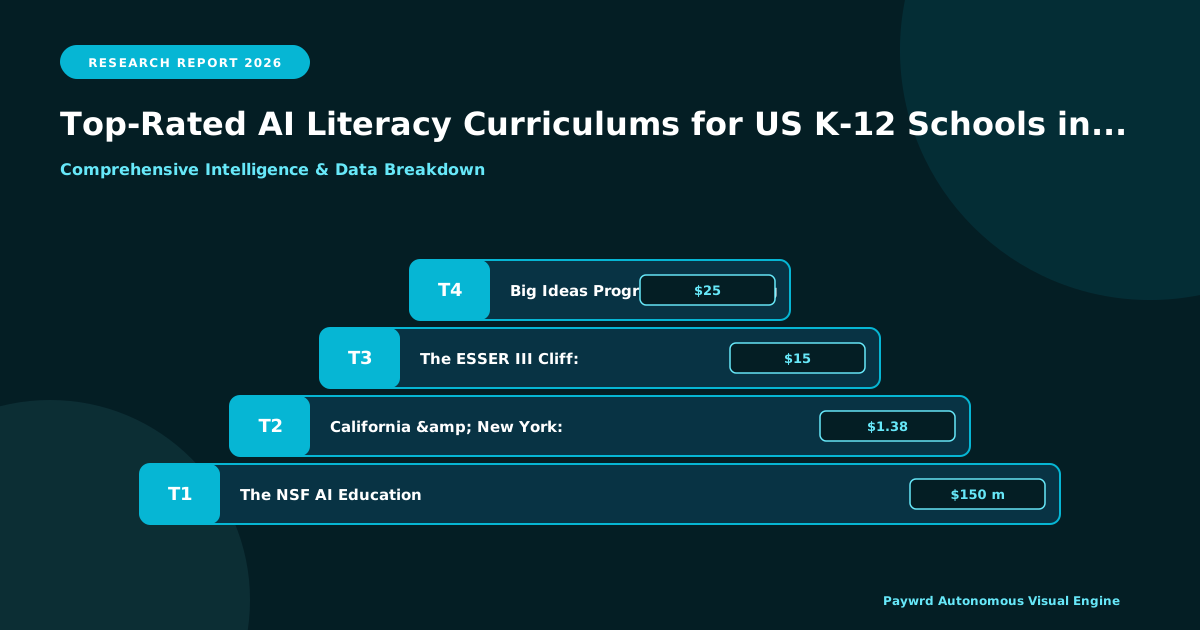
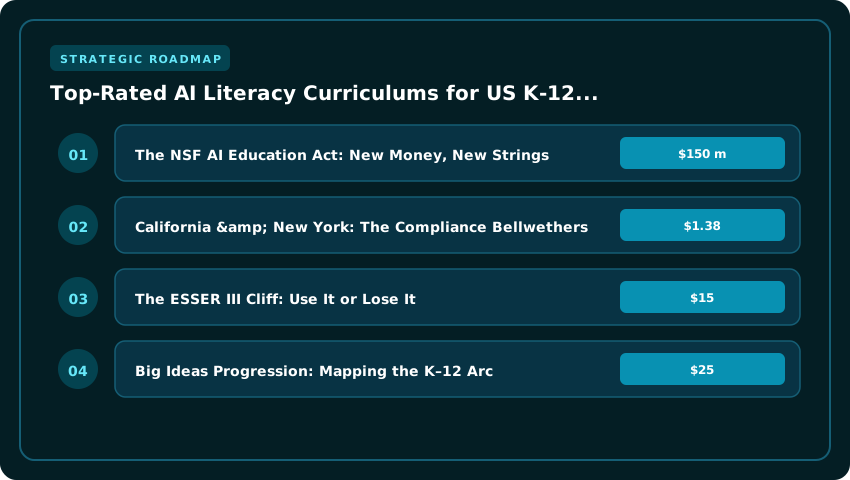
The NSF AI Education Act: New Money, New Strings
The National Science Foundation (NSF) AI Education Act (signed into law late 2024) authorizes approximately $150 million annually through FY2029 specifically for K–12 AI workforce development. Crucially, this is not block grant money; it flows through competitive grants (like the CSforAll and ITEST programs) that require evidence-based curricula aligned to the AI for K–12 Guidelines (Five Big Ideas). Districts applying for the 2025 grant cycle (deadlines typically Q1/Q2 2025) must demonstrate that their chosen curriculum addresses algorithmic bias, data ethics, and societal impact—not just coding syntax. If your current vendor cannot map their scope and sequence to these five pillars, you will not score the funding.
California & New York: The Compliance Bellwethers
Two massive markets have codified computer science—and by extension, AI literacy—into graduation requirements, forcing vendor alignment:

- California CS Standards (CDE, 2023/2024 Implementation): The state now requires CS offerings in grades 9–12. The 2026–27 year is the enforcement target for “substantial alignment.” The California Computer Science Strategic Implementation Plan explicitly calls out AI/ML modules in the Data & Analysis and Impacts of Computing concepts. Adoption lists are forming now.
- NYSED Computer Science & Digital Fluency Standards: New York’s framework mandates K–12 integration by September 2026. The “Computational Thinking” and “Impacts of Computing” strands demand age-appropriate AI literacy (e.g., training data bias in Grade 5, generative AI ethics in Grade 10). NYSED’s upcoming curriculum guidance (expected late 2025) will likely reference approved vendor lists.
If you operate in these states—or the 15+ others mirroring their frameworks—procurement decisions made in Spring 2025 determine compliance for Fall 2026.
The ESSER III Cliff: Use It or Lose It
This is the hardest deadline on the calendar. The ESSER III (ARP ESSER) obligation deadline was September 30, 2024, with a liquidation extension only for specific construction/contractual obligations. For curriculum licenses, professional development, and hardware bundles, the money is effectively gone if not already obligated.
However, many districts carry Title IV-A (Student Support and Academic Enrichment) allocations (~$1.38B nationally FY24) and Perkins V reserves that can fund AI literacy if coded to “well-rounded education” or “CTE pathways.” The playbook for 2025: braid Title IV-A carryover with new NSF grant awards to cover the multi-year license fees that ESSER would have absorbed. Waiting for the 2026–27 budget cycle means paying full sticker price—often $15–$25 per student/year for top-tier platforms—out of unrestricted general funds.
Bottom line: The compliance window for 2026–27 opens in Q1 2025. Align your RFP language to the NSF “Five Big Ideas,” cross-walk to CA/NY standards, and obligate Title IV/Perkins dollars before June 30, 2025. Anything later is reactive budgeting.
Head-to-Head: AI4K12 vs. ISTE vs. Code.org Curriculum Frameworks
Choosing a framework isn’t just about picking a vendor; it’s about aligning your district’s instructional reality with a pedagogical architecture that teachers can actually execute. The three dominant national players—AI4K12, ISTE, and Code.org—share a common DNA (several authors overlap), but they diverge sharply on scope, sequencing, and the “lift” required from your staff.
Big Ideas Progression: Mapping the K–12 Arc
AI4K12 remains the gold standard for conceptual coherence. Its Five Big Ideas (Perception, Representation & Reasoning, Learning, Natural Interaction, Societal Impact) spiral explicitly across four grade bands. In K–2, students classify objects by sensory attributes—laying groundwork for perception. By 9–12, they are auditing algorithmic bias in hiring tools. ISTE’s Standards for Students take a broader competency approach. Rather than a dedicated AI scope-and-sequence, they embed “Computational Thinker” and “Knowledge Constructor” indicators across subjects. You get flexibility, but you lose the guaranteed vertical alignment that AI4K12 guarantees. Code.org splits the difference: their AI and Machine Learning module (part of CS Discoveries/Principles) offers a tight 15–20 hour sequence focused heavily on how models train—think TensorFlow.js in the browser—making it the most technically concrete but narrowest in societal scope.
Integration Depth: Standalone vs. Core Infusion
- AI4K12: Designed for cross-curricular infusion. The framework assumes a 4th-grade social studies teacher discusses “Societal Impact” during a civics unit, while the science teacher covers “Perception” via sensor labs. This demands a district-wide curriculum mapping effort—often 40+ hours of admin planning—but yields systemic literacy.
- ISTE: Agnostic by design. Works equally well as a standalone Digital Citizenship/AI Ethics elective (semester-long) or as “power standards” woven into existing ELA and STEM units. Lowest barrier to entry; highest risk of “check-the-box” compliance.
- Code.org: Standalone CS pathway first. Their AI units live inside Computer Science Discoveries (Grades 6–10) and CS Principles (AP). If your district lacks a certified CS teacher, implementation stalls immediately. However, for schools with CS capacity, it delivers the deepest technical rigor—students actually build classifiers, not just discuss them.
Teacher Prerequisites & PD Hour Commitments
This is where procurement budgets live or die. AI4K12 assumes zero CS background but requires 16–24 hours of sustained PD per teacher (ideally split across a semester) to internalize the Big Ideas and design interdisciplinary lessons. ISTE’s AI Explorations PD is lighter—roughly 6–10 hours of asynchronous modules—but relies heavily on teacher self-efficacy to translate standards into lesson plans. Code.org demands the heaviest lift: their Professional Learning Program runs 5 days (35 hours) summer intensive plus quarterly workshops, and teachers must pass a content knowledge assessment. The payoff? A teacher who can debug a student’s neural net in real time. Budget roughly $1,800–$2,500 per teacher for Code.org’s full cycle versus $600–$1,200 for AI4K12 consortium-led cohorts.
Bottom line: If you have CS teachers and want technical depth, Code.org wins. If you need every 5th-grade teacher fluent in AI ethics by 2026, AI4K12’s spiral is your roadmap. If you need a compliance-safe baseline yesterday, ISTE gets you through the door.
Vendor Evaluation Scorecard: Proprietary Platforms vs. OER Resources
Feature Matrix
When you line up Carnegie Learning, AIEDU, and Google Applied Digital Skills side‑by‑side, the differences in pedagogical depth and integration readiness become clear. Carnegie Learning’s MATHia‑AI module ships with adaptive mastery paths aligned to CCSS and costs roughly $12 per student per year for a district‑wide license. AIEDU offers a modular AI‑ethics curriculum that can be dropped into existing STEM blocks; its site license runs about $8 per student per year but requires a separate PD package priced at $2,500 for a two‑day on‑site workshop. Google Applied Digital Skills is free, cloud‑native, and maps to ISTE standards, yet it lacks built‑in assessment dashboards, forcing districts to bolt on third‑party analytics at an average $3 per student per year.
Data‑Privacy Compliance
All three vendors claim FERPA, COPPA, and SOPIPA adherence, but the implementation details matter. Carnegie Learning stores student PII on AWS GovCloud and provides a signed Data Processing Addendum (DPA) that references the USDE model contract. AIEDU encrypts data at rest with AES‑256 and offers a student‑data deletion API that meets California’s SOPIPA “right to be forgotten” clause. Google’s platform inherits the G Suite for Education privacy framework, which is FERPA‑certified, yet districts must still configure admin console policies to disable third‑party app access—an often‑overlooked step that can expose metadata.
Total Cost of Ownership
- Licensing: Carnegie Learning $12 / student / yr; AIEDU $8 / student / yr + $2,500 PD; Google free + $3 / student / yr for analytics.
- Hardware specs: Carnegie and AIEDU run on any Chromebook ≥ 4 GB RAM; Google requires Chrome OS 100+ and a stable 5 Mbps per device for real‑time collaboration.
- Hidden PD costs: Carnegie includes 8 hours of virtual coaching in the license; AIEDU’s on‑site workshop adds travel and substitute teacher expenses (~$1,200 per site); Google’s free PD is limited to self‑paced modules, so many districts budget $1,800 / school for facilitator stipends.
Procurement Rubric Checklist
Use the following weighted rubric (total 100 points) to score each option before the ESSER III deadline on September 30, 2024:
- Curriculum alignment to state AI mandates – 25 pts
- FERPA/COPPA/SOPIPA documentation completeness – 20 pts
- Total 3‑year TCO (license + hardware + PD) – 20 pts
- Interoperability with existing LMS (Canvas, Schoology, Google Classroom) – 15 pts
- Vendor support SLA (response ≤ 4 hrs, uptime ≥ 99.5 %) – 10 pts
- Equity features (offline mode, multilingual UI) – 10 pts
Score each vendor, multiply by the weight, and select the solution that clears a 70‑point threshold while staying within your remaining federal relief allocation. This scorecard turns a subjective “feel” into a defensible, board‑ready decision.
Assessing Computational Thinking vs. Critical AI Literacy Outcomes
For decades, K–12 technology assessment meant checking if a student’s Python script compiled or their Scratch sprite moved correctly. That paradigm is obsolete. In 2026, colleges and employers—from Ivy League admissions offices to Fortune 500 HR departments—are signaling a clear preference: they need graduates who can interrogate an algorithm, not just write one. The College Board’s recent revisions to AP Computer Science Principles reflect this, weighting “impacts of computing” and “data ethics” far heavier than syntax memorization. If your district’s rubric still awards 80 percent of the grade for functional code, you are measuring the wrong variable.
From Syntax to Scrutiny: The New Rubric Architecture
Effective AI literacy assessment separates computational thinking (decomposition, pattern recognition, abstraction) from critical AI literacy (bias detection, hallucination awareness, provenance verification). A modern rubric treats the LLM output as a primary source document requiring the same scrutiny as a historical text. Look for curricula that embed these three non-negotiable performance indicators:
- Bias Detection Protocols: Students must demonstrate they can stress-test a model’s output across demographic variables—race, gender, socioeconomic status—and document disparate impact in a structured audit log.
- Hallucination Awareness Workflows: Assessment requires a “verify-before-trust” routine: lateral reading, citation tracing, and confidence scoring. Points are awarded for the process of catching the error, not just the correct final answer.
- Prompt Engineering as Rhetoric: Treat prompting as a writing discipline. Rubrics should evaluate clarity, constraint-setting, iterative refinement, and the student’s ability to explain why a specific prompt structure yielded a better result.
Empowering Non-CS Teachers with Performance Tasks
The teacher shortage makes dedicated CS hires impossible for most districts. The solution is performance-based assessment design that lives inside existing subjects. An English teacher can assess “hallucination awareness” by having students fact-check a generated essay against primary sources. A History teacher evaluates “bias detection” by comparing AI-generated summaries of the Civil Rights era against archival footage. The US Department of Education’s 2024 Artificial Intelligence and the Future of Teaching and Learning report explicitly endorses this cross-curricular model. Curricula worth buying provide ready-to-deploy “assessment kits”—student-facing checklists, teacher calibration guides, and exemplar portfolios—so a Social Studies lead can implement them on day one without a weekend of PD.
Portfolio Artifacts That Open Doors
Admissions officers at competitive universities and CTE pathway coordinators want evidence of judgment, not just code repositories. The winning artifacts are:
- Algorithmic Audit Reports: A 2–3 page PDF analyzing a real-world tool (e.g., a college admissions predictor or a hiring screener) for fairness, transparency, and appeal mechanisms.
- Iterative Prompt Chains: Version-controlled logs showing a student’s evolution from vague query to precise, verified output, annotated with metacognitive reflections.
- Ethical Impact Statements: Briefs written for a specific stakeholder audience (school board, city council) proposing guardrails for a proposed AI deployment.
These artifacts map directly to the ABET student outcomes now filtering down into high school CTE standards and the PMI project management fundamentals increasingly embedded in career academies. When a student submits an algorithmic audit with their FAFSA package or scholarship portfolio, they signal a maturity level that a GitHub link simply cannot convey. Procure curricula that build the portfolio into the scope and sequence, not as a capstone afterthought.
Bridging the Teacher Readiness Gap: Certification & Micro-Credentials
Even the most sophisticated AI curriculum sits inert without a confident educator at the helm. Right now, the single biggest bottleneck for 2026 implementation isn’t software procurement—it’s human capital. Most states still treat AI literacy as a subset of Computer Science (CS), forcing districts to navigate a patchwork of certification rules that were written before ChatGPT existed. If you are waiting for your state department of education to issue clean guidance, you are already behind.
ISTE-GM AI Explorations vs. State CS Endorsements
The ISTE-GM AI Explorations credential has emerged as the de facto national micro-credential because it is vendor-agnostic, pedagogy-first, and stackable. It costs roughly $300–$400 per teacher and requires 15–30 hours of asynchronous work plus a portfolio review. Contrast that with a full state CS endorsement: typically 12–18 graduate credit hours, a $10,000–$25,000 tuition bill, and a two-year timeline. For a district needing 50 teachers AI-ready by August 2026, the math is brutal. The strategic move? Use the ISTE micro-credential as your “surge capacity” baseline for immediate compliance, while simultaneously building a tuition-reimbursement pipeline for the full state endorsement to satisfy long-term HR requirements and salary lane advancement.
Train-the-Trainer: The Only Scalable Model
You cannot send every teacher to a national conference. You need a Train-the-Trainer (T3) cascade. Identify 5–10% of your staff—librarians, instructional coaches, and early-adopter STEM leads—to complete the deep-dive ISTE or AI4K12 facilitator training first. These leads then deliver contextualized, job-embedded professional development (PD) during existing PLC blocks or early-release days. This model slashes external consultant fees (often $2,500–$5,000 per day) and builds internal ownership. Crucially, write the T3 leads a $1,500–$2,500 annual stipend into the Title II-A budget; without compensated leadership, the cascade collapses by November.
Funding the Pipeline with Title II-A
Stop treating Title II-A as a slush fund for generic workshops. The Every Student Succeeds Act (ESSA) explicitly allows “evidence-based professional development” for “effective integration of technology.” Structure your 2025–26 Title II-A application around a three-year Sustained Professional Learning Community (PLC) framework:
- Year 1 (2025–26): Micro-credential completion + monthly PLCs focused on prompt engineering pedagogy and bias detection.
- Year 2 (2026–27): Action research cycles where teachers pilot AI-assisted lesson design, measuring student engagement metrics.
- Year 3 (2027–28): Cohort mentors new hires; district applies for Teacher Quality Partnership (TQP) grants to fund master’s coursework for endorsement completion.
Districts that treat certification as a compliance checkbox will recycle the same “substitute teacher” problem every fall. Districts that treat it as a funded, stipended career pathway will own the AI literacy space for the next decade.
Equity Audits: Ensuring Access for Title I, Rural, and ELL Populations
Procuring an AI literacy curriculum without a rigorous equity audit isn’t just an oversight—it’s a potential Office for Civil Rights (OCR) violation waiting to happen. The “AI divide” threatens to calcify existing achievement gaps faster than any technology shift in recent memory. If your Title I schools, rural districts, and English Language Learner (ELL) populations cannot access the same depth of instruction as affluent suburban peers, you are effectively widening the opportunity gap with federal dollars. A compliant 2026 procurement strategy demands proof of parity before a single purchase order is signed.
Offline Parity for Broadband Deserts
Roughly 15 million K–12 students still lack reliable high-speed home internet, according to the FCC’s latest Broadband Deployment Report. Any curriculum reliant on cloud-based model inference or heavy video streaming fails these learners immediately. Demand full offline/unplugged parity: the vendor must provide downloadable model weights (quantized for local CPU inference), printable computational thinking modules, and USB-bootable environments that function identically on a $200 Chromebook without Wi-Fi. If the “lite” version strips out the capstone projects or assessment dashboards, it is not parity—it is a separate, inferior track. Verify this with a pilot in your most connectivity-challenged building before district-wide rollout.
Culturally Responsive Data & Multilingual Interfaces
Bias audits cannot be a checkbox. Require vendors to disclose the provenance of every training dataset used in student-facing tools. Are the computer-vision examples dominated by Western landmarks? Do the NLP prompts assume Standard American English syntax? For ELL populations—now over 5.3 million students per the National Center for Education Statistics—the interface must support full multilingual navigation (Spanish, Mandarin, Arabic, Vietnamese, Haitian Creole at minimum) with toggles for simplified language modes, not just machine-translated tooltips. Culturally responsive datasets mean agricultural AI case studies for the Central Valley, hurricane-resilience modeling for Gulf Coast districts, and Indigenous language preservation modules for Bureau of Indian Education schools.
Assistive Technology & WCAG 2.1 AA Compliance
Special Education (SPED) inclusion is non-negotiable under IDEA and Section 504. Every student-facing component—code editors, data visualization dashboards, chatbot tutors—must meet WCAG 2.1 Level AA without exceptions. Test with JAWS, NVDA, and VoiceOver; verify keyboard-only navigation for motor-impaired learners; confirm screen-reader announcements for dynamic AI-generated content (e.g., “Model confidence: 87 percent, classification: oak tree”). Vendors should provide a Voluntary Product Accessibility Template (VPAT) 2.4 dated within the last 12 months. If they cannot produce one, remove them from the shortlist immediately.
- Require a written Equity Impact Statement from each finalist vendor, signed by their Chief Accessibility Officer.
- Allocate 5–10% of your ESSER III or Title IV-A budget for third-party accessibility audits (typical cost: $8,000–$15,000 per platform).
- Build contract clauses that trigger liquidated damages if offline parity or WCAG compliance lapses during the license term.
Equity isn’t a post-launch patch. It is the procurement spec that protects your district from OCR complaints, protects your students from technological redlining, and ensures the AI literacy mandate lifts every learner—not just the connected ones.
Implementation Roadmap: Pilot to District-Wide Scale in 18 Months
You have roughly 18 months to move from a signed contract to full district-wide adoption before the 2026–27 compliance mandates lock in. This isn’t a software rollout; it’s a change-management initiative that touches collective bargaining agreements, student data privacy addendums (DPA), and instructional minutes. Below is the battle-tested sequence used by districts like Gwinnett County (GA) and Anaheim Union (CA) to hit the ground running.
Phase 1: Stakeholder Coalition Building (Months 1–4)
Start by formalizing an AI Literacy Steering Committee with voting power, not just advisory status. You need the School Board policy chair, the Chief Technology Officer (CTO), a lead negotiator from the local teachers’ union (NEA/AFT affiliate), your Director of Curriculum, and—critically—two student representatives. In Month 1, execute a Memorandum of Understanding (MOU) defining scope: this curriculum does not replace teacher FTEs; it augments instructional capacity. Month 2 is for union bargaining on professional development (PD) stipends—budget $500–$800 per teacher for the 15-hour micro-credential. By Month 3, present the Board with a resolution adopting the ISTE Standards for Students 1.1 (Empowered Learner) and 1.2 (Digital Citizen) as the instructional north star. Month 4 locks in your pilot cohort: select three demographically distinct schools (one Title I, one suburban, one magnet) representing 8–10% of total enrollment.
Phase 2: LMS Interoperability & Technical Validation (Months 5–9)
Technical debt kills pilots. Before a single student logs in, your CTO must validate LTI 1.3 Advantage certification and OneRoster compliance against your core stack—whether that’s Canvas, Google Classroom, Schoology, or a Clever/ClassLink portal. Run a Data Privacy Impact Assessment (DPIA) against FERPA, COPPA, and your state’s student privacy law (e.g., SOPIPA in CA, Ed Law 2-d in NY). Key milestones:
- Month 5: Sandbox provisioning—push rostered courses via Clever Secure Sync; verify grade passback writes to the SIS (PowerSchool/Infinite Campus) without manual CSV uploads.
- Month 6: Accessibility audit—run WCAG 2.1 AA testing (screen readers, keyboard nav, color contrast) with your Special Education director sign-off.
- Month 7: Offline sync validation for 1:1 take-home devices (Chromebooks/iPads) in low-connectivity homes.
- Month 8: Teacher “sandbox sprint”—48-hour unrestricted access for pilot teachers to break the platform; log every bug in Jira/ServiceNow.
- Month 9: Go/No-Go gate review with the Steering Committee. If SIS write-back failure rate exceeds 2%, pause and remediate.
Phase 3: Continuous Improvement Cycles & Student Voice (Months 10–18)
Launch the pilot at the start of Semester 2 (January 2026). Implement a Plan-Do-Study-Act (PDSA) cycle every three weeks. Don’t just track usage logs; capture student voice data via quarterly Panorama-style surveys measuring “Algorithmic Awareness” and “Agency in AI Decision-Making.” Correlate survey shifts with formative assessment data (NWEA MAP Growth or i-Ready) to prove academic ROI to the Board. Month 12: Publish a public Pilot Transparency Dashboard showing usage minutes, bias-incident reports, and PD completion rates. Month 14: Negotiate volume licensing—leverage pilot efficacy data to secure 15–20% district discount off list price. Month 16: Finalize the Board Policy 6142.10 (AI Literacy) revision mandating K–12 scope and sequence. Month 18: Full-scale rostering for Day One of the 2026–27 academic year.
| Curriculum / Provider | Grade Band Coverage | Alignment Standards | Annual Cost (Per Student/Site) | PD Requirements (Hours) | ESSER III Eligible | State Mandate Ready (2026-27) | Integration Model |
|---|---|---|---|---|---|---|---|
| AI4K12 / ISTE Standards | K-12 (Modular) | CSTA, ISTE, AI4K12 Five Big Ideas | $0 (Open Source) / PD Costs Apply | 15-30 hrs (Train-the-Trainer) | Yes (PD & Resources) | High (Framework Basis) | Cross-curricular / Standalone |
| Code.org AI & ML Modules | 3-12 | CSTA, NGSS, Common Core Math | $0 (Free Platform) | 6-12 hrs (Self-paced + Workshops) | Yes | High | Integrated CS / Science |
| MIT RAISE (Day of AI) | K-12 | AI4K12, ISTE, State CS Standards | $0 (Free Curriculum) | 2-10 hrs (Optional Live PD) | Yes | High | Annual Event + Modular Units |
| Google Experience AI (w/ Raspberry Pi) | 6-12 | CSTA, UK/US CS Standards | $0 (Free) | 8-16 hrs | Yes | Medium-High | Computing / STEM Elective |
| Amazon Future Engineer (AI Ready) | K-12 | CSTA, State Mandates (CA, FL, TX) | $0 (Free Access) | 10-20 hrs (Scholarship PD avail.) | Yes (Hardware/PD Grants) | High | Career Pathways / CS Classes |
| CoderZ / Intel AI for Youth | 6-12 | CSTA, NGSS, CTE Standards | $15-$25 / student/yr | 20-40 hrs (Certified) | Yes (Hardware/Software) | High (CTE Alignment) | CTE / Robotics / CS |
| Carnegie Learning / Zorbit’s (AI Math) | K-8 | State Math Standards, NCTM | $20-$35 / student/yr | 6-10 hrs (Implementation) | Yes (Intervention) | Medium (Math Focus) | Core Math Supplement |
Frequently Asked Questions
What is the deadline to use ESSER III funds for AI curriculum procurement?
ESSER III funds must be obligated by September 30, 2024. Districts have until January 28, 2025, for liquidation extensions. Procurement for 2026-27 AI literacy mandates must be contracted now to legally expend remaining relief dollars before the funding cliff.
Which states have mandatory K-12 AI literacy laws effective for the 2026-27 school year?
As of 2025, California (AB 2876), Florida (HB 1361), Tennessee, West Virginia, and Colorado have enacted legislation requiring AI literacy integration by the 2026-27 academic year. Over 15 additional states have pending bills modeled on the AI4K12 framework.
How much does a comprehensive K-12 AI literacy curriculum cost per student annually?
Costs range from $0 for open-source frameworks (AI4K12, Code.org, MIT RAISE) to $15-$35 per student/year for proprietary platforms with LMS integration, simulation environments, and certified professional development (e.g., CoderZ, Carnegie Learning).
What professional development hours are required for teachers to implement AI literacy standards?
Most state mandates require 15-30 hours of initial PD covering AI ethics, bias detection, and pedagogical integration. Vendors like Intel AI for Youth require 40 hours for certification, while Code.org and MIT RAISE offer 6-12 hour self-paced pathways.
Does the NSF AI Education Act provide direct funding to school districts for curriculum?
The NSF AI Education Act (2024) authorizes grants for curriculum development, teacher training, and research partnerships via NSF directorates. It does not provide formula funding directly to LEAs; districts must apply for competitive grants or partner with funded IHEs/nonprofits.
Strategic Final Takeaway
When evaluating Best AI Literacy Curriculum For K-12 Schools In The United States 2026, base your decisions on accredited institutional standards, measurable return on investment (ROI), and up-to-date official guidelines. Always verify specific dates and requirements through official regulatory portals.