If you are a district literacy coach or curriculum administrator evaluating intervention programs for grades 6–8, you have likely been told that middle schoolers have “already learned to read” and simply need help with comprehension. This assumption is wrong, and worse, it is expensive. According to the National Assessment of Educational Progress (NAEP), only 31% of U.S. eighth graders perform at or above the Proficient level in reading. For students in Tier 2 and Tier 3 intervention, the reality is starker: they are not struggling with academic vocabulary or complex syntax—they are stuck on decoding multisyllabic words. That is a phonological problem, and it demands a phonologically based solution.
Why Middle Schoolers Still Need Structured Literacy (And How The Science Of Reading Applies Beyond 3rd Grade)
Debunking the “Learning to Read vs. Reading to Learn” Myth for Grades 6–8
The phrase “by third grade, children are reading to learn” became a cornerstone of American literacy instruction decades ago. While it captures a developmental shift for typical readers, applying it to struggling adolescents is a categorical error. For a 12-year-old who reads at a second-grade level, every content area—from analyzing primary source documents in social studies to decoding chemical compound names in science—is still fundamentally “learning to read.” When districts allocate Title I funds or state intervention dollars toward general comprehension strategies for these students, they are essentially handing a bilingual learner an English-only textbook and wondering why they are failing.
What Cognitive Science Says About Adolescent Literacy Gaps
Brain plasticity research, including landmark studies from the National Institutes of Health (NIH) and Stanford’s Center for Educational Policy Analysis, confirms that the adolescent brain remains highly responsive to explicit reading instruction. However, the window of automaticity is closing. Without intervention, decoding deficits cascade into vocabulary deficits, which devastate comprehension. A 2023 review in the Journal of Adolescent & Adult Literacy found that Tier 3 middle schoolers receiving morphology and decoding instruction gained an average of 1.4 grade levels in a single academic year, whereas peers receiving only strategy-based comprehension instruction gained just 0.3 grade levels.
Mapping the Simple View of Reading and Scarborough’s Rope to Middle School
The Simple View of Reading, validated by researchers Hoover and Tunmer, posits that reading comprehension is the product of word recognition and language comprehension. For middle schoolers with weak decoding, the word recognition strand is broken. Scarborough’s Rope model reinforces this: the “word recognition” strands—phonological awareness, decoding, and sight recognition—are tangled and frayed, no matter how strong the language comprehension strand appears. A true Tier 2 or Tier 3 digital intervention platform must therefore weave phonological awareness, decoding (including morphology for multisyllabic words), and fluency into its core architecture—not bolt them on as an afterthought.
Defining Tier 2 and Tier 3 Intervention Protocols In A US MTSS Framework
For MTSS coordinators and building principals evaluating a Science of Reading curriculum for middle school intervention, the difference between a compliant program and an operational headache lives in the granular details. District intervention blocks are typically carved into 30- to 45-minute windows, meaning your chosen Tier 2 and Tier 3 supplemental program must deliver its scope and sequence within extremely tight logistical parameters.
Tier 2 protocols in a middle school MTSS framework generally target small groups of 4 to 6 students, receiving 20 to 40 minutes of supplemental instruction three to five times per week, layered on top of core ELA. Tier 3 protocols shrink those groups to 1 to 3 students and increase frequency, often demanding double-block scheduling or protected elective swaps to accommodate 60 to 90 minutes of daily intensive intervention. If a vendor cannot clearly map its daily lesson pacing to these group sizes and durations, the program will fail at the master-schedule level before a single student receives instruction.
Progress monitoring cadence is the second non-negotiable metric. The US Department of Education and most state accountability offices expect Tier 2 students to be progress-monitored every 2 to 4 weeks using Curriculum-Based Measures (CBMs) or valid screening tools, while Tier 3 students are often monitored weekly or bi-weekly. Districts need a curriculum with built-in benchmarking that aligns directly with these cycles, not one that forces coaches to build parallel assessments from scratch. Look for programs that deliver matched, equivalent-form probes and provide growth-rate norms specifically for grades 6–8, because adolescent growth trajectories differ significantly from K–3 norms.
Aligning Supplemental Programs With State ELA Standards and ESSER Funding Rules
Any Tier 2 or Tier 3 intervention program purchased today will likely be funded through remaining ESSER III allocations, which expire in September 2024, or through IDEA Part B and Title I, Part A carryover funds. Under the Uniform Grants Guidance (2 CFR 200) and ESSA supplement-not-supplant provisions, districts must be able to prove that any supplemental program is genuinely above and beyond core Tier 1 instruction and is aligned to grade-level state ELA standards. A screening-only product will not pass a federal monitoring review. You need explicit documentation that the program’s phonological and decoding scope addresses state standard code strands (for example, CCSS.ELA-LITERACY.RF.6.3 or its state equivalent) while still moving students back into grade-level text complexity.
Eligibility Screening: DIBELS 8, iReady Diagnostic, and MAP Growth Cut Scores
Determining which grades 6–8 students actually qualify for intervention is governed by district-set cut scores on validated screeners. For DIBELS 8 (University of Oregon), most districts flag middle schoolers scoring below benchmark on the DORF (ORF accuracy and fluency) at the 40th percentile or below for Tier 2 consideration, with intensive support triggered for students in the 25th percentile or lower. On the iReady Diagnostic, NWEA recommends focusing Tier 2 intervention on students placing two or more grade levels below in Phonological Awareness or Phonics subdomains, while NWEA MAP Growth cut scores are typically set at the 25th to 40th percentile for Tier 2 and below the 25th percentile for Tier 3, depending on district risk tolerance. Your chosen curriculum should explicitly state which screening scores feed its recommended intervention entry points, so MTSS teams can build defensible, data-driven entry and exit criteria that satisfy state MTSS implementation rubrics.
- Group Size: Tier 2 = 4–6 students; Tier 3 = 1–3 students.
- Frequency: Tier 2 = 3–5x/week; Tier 3 = daily, often double-blocked.
- Monitoring: Tier 2 = every 2–4 weeks; Tier 3 = weekly or bi-weekly.
- Funding Window: ESSER III deadline September 2024; leverage Title I and IDEA Part B for sustainability.
The 5 Non-Negotiable Components Of An Evidence-Based Adolescent Literacy Program
Evaluating a middle school Tier 2 or Tier 3 intervention platform requires more than glossy screenshots and anecdotal success stories. If you are a curriculum director sitting across from a sales rep pitching a “Science of Reading” aligned product for grades 6–8, you need a strict, research-backed rubric. Use this five-component checklist to instantly filter out whole-language relics dressed up in neuroscience buzzwords, and to identify the digital tools actually built on the cognitive science of how the brain learns to read.
1. Systematic, Explicit Phonics With Morphological Instruction
Any vendor claiming to serve older struggling readers must demonstrate a scope and sequence that teaches advanced phonics (multisyllabic decoding, vowel team exceptions) alongside morphology. Decoding prefixes, suffixes, and high-utility Latin and Greek roots is not optional enrichment; it is the engine of vocabulary growth. Reject any program that lacks an explicit, cumulative morphology routine.
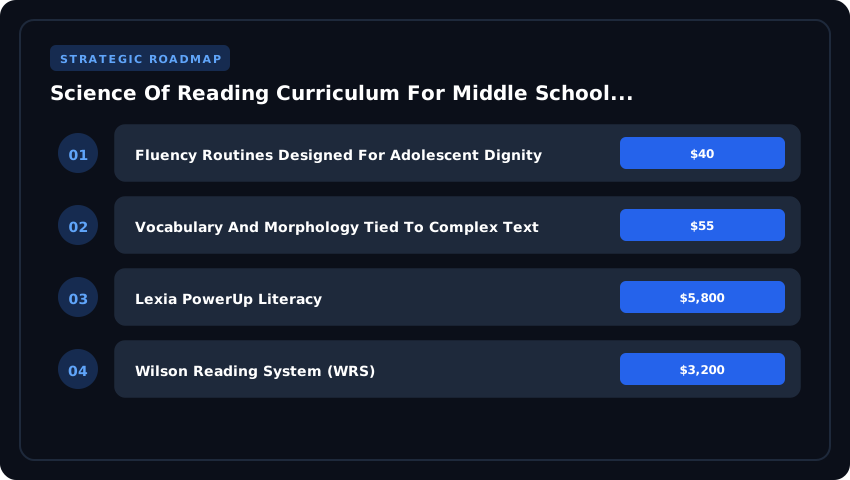
2. Fluency Routines Designed For Adolescent Dignity
The single biggest reason middle schoolers disengage from reading intervention is the babyish stigma of fluency drills. Evidence-based Tier 2 platforms must embed fluency routines engineered for older students, such as partner reading of high-interest, age-appropriate complex text, timed repeated reading on content-rich passages, and prosody practice integrated into disciplinary reading. Programs that default to elementary sight-word flashcards should be cut immediately.
3. Vocabulary And Morphology Tied To Complex Text
Robust vocabulary instruction cannot live in isolation. Look for a digital platform that systematically teaches tier 2 and tier 3 words within the context of complex, knowledge-building texts, using morphology as the bridge. The best programs teach students how to dissect an unfamiliar word using known affixes and roots, then immediately apply that word in sentence-level and discourse-level comprehension tasks.
3. Writing-To-Read Scaffolds Connecting Transcription And Composition
Reading and writing are reciprocal processes. A non-negotiable adolescent literacy component is a built-in writing-to-read scaffold that explicitly connects handwriting or typing fluency, sentence construction, and composition. If the digital platform you are evaluating only offers multiple-choice comprehension quizzes, it is leaving measurable literacy gains on the table.
5. Progress Monitoring Aligned To RTI/MTSS Decision Rules
Finally, an evidence-based Tier 3 intervention is only as good as its data. Insist on a platform with embedded, curriculum-based measurement and clear, normative cut points that align with your district’s Response to Intervention (RTI) or Multi-Tiered System of Supports (MTSS) framework. Without defensible progress data, your ESSER-funded purchases cannot be justified to the school board or the US Department of Education.
- Rejection Rule: If a vendor cannot show you all five components in a live demo, do not sign the contract.
- Vetting Tip: Ask whether efficacy claims are backed by independent, peer-reviewed studies published in Reading Research Quarterly or similar journals.
Head-To-Head: Comparing The Top 5 Science Of Reading Programs For Middle School
Procurement officers and middle school literacy coaches rarely have the luxury of a long pilot window. When you are shopping for a Tier 2 or Tier 3 intervention that genuinely follows the Science of Reading (SoR) and reaches sixth through eighth graders, you need a clean vendor evaluation matrix that pairs instructional design with the realities of a public school budget. Below is a side-by-side breakdown of five widely adopted programs: Lexia PowerUp, Wilson Reading System, Really Great Reading, Amplify mClass, and the 95% Group suite. Pricing reflects typical 2024–2025 list rates per site or seat; districts often secure 15–25 percent off through ESSER replacement or state literacy block funding.
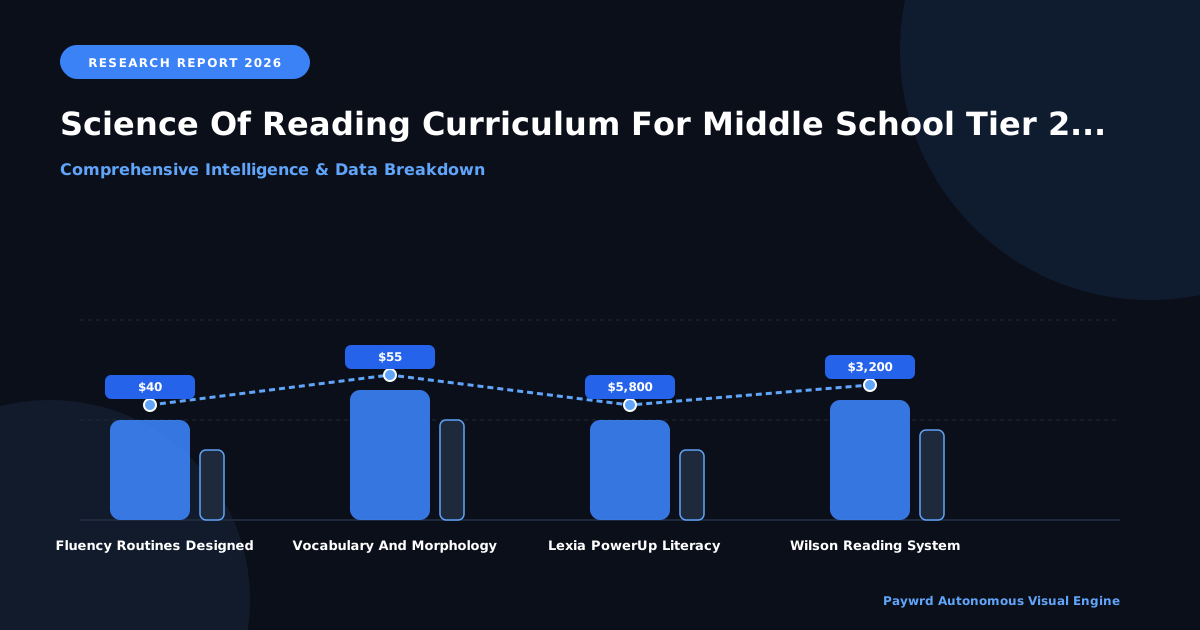
1. Lexia PowerUp Literacy
- Grade 6–8 alignment: Built specifically for adolescent learners; routines target morphology, complex syntax, and academic vocabulary.
- Licensing cost: Roughly $40 to $55 per student per year, with site licenses starting near $5,800.
- Tech footprint: Runs in any modern browser, fully Chromebook compatible, and offers offline printable worksheets for spotty connectivity.
- LMS integration: Single Sign-On (SSO) with Canvas, Schoology, and Google Classroom via LTI 1.3.
2. Wilson Reading System (WRS)
- Grade 6–8 alignment: Highly explicit, systematic program that scales upward through Wilson Just Words and full WRS Steps 1–12, fitting older non-readers well.
- Licensing cost: Trainer fees run about $3,200 per educator, with kit materials near $650 per classroom.
- Tech footprint: Primantly print-driven with optional Wordy Study companion; printable decodable texts are a major strength.
- LMS integration: Limited; teachers typically manage progress through printed master cards or the Wilson Academy tracker.
3. Really Great Reading
- Grade 6–8 alignment: Countdown and Blast extensions serve upper-elementary and middle schoolers with advanced phonology routines.
- Licensing cost: Digital subscriptions start around $35 per seat; site licenses average $4,500 annually.
- Tech footprint: Web-based with printable lesson kits, ideal for Chromebook carts.
- LMS integration: Google Classroom assignment pushes and roster sync available; Canvas support is growing.
4. Amplify mClass
- Grade 6–8 alignment: Best for Tier 1 screening and Tier 2 grouping, though its intervention modules for grades 6–8 remain lighter than competitors.
- Licensing cost: Around $7 per student for screening; full intervention suites scale to $12–$15 per pupil.
- Tech footprint: Chromebook and iPad friendly, with offline DIBELS-style paper protocols.
- LMS integration: Canvas and Schoology LTI ready; data exports cleanly to most Student Information Systems.
5. 95% Group
- Grade 6–8 alignment: MultiLit and Boost programs cover decoding through comprehension, with strong Tier 3 protocols for older students.
- Licensing cost: Around $2,500 per teacher for the virtual academy; site bundles near $6,800.
- Tech footprint: Light; works on Chromebooks but leans on printable workbooks.
- LMS integration: Roster upload via CSV; native LMS bridges are limited.
Professional Development Models
Wilson’s in-person coaching model costs more upfront but yields the strongest fidelity. Really Great Reading and Lexia lean toward asynchronous virtual academies with optional live sessions. Amplify ships PD through on-demand videos, while 95% Group offers a hybrid of self-paced modules and quarterly synchronous office hours.
Analyzing The Peer-Reviewed Efficacy Data And What ‘Evidence-Based’ Actually Means Under ESSA
When a sales representative slides a glossy pitch deck across your desk claiming their digital intervention platform is “scientifically aligned” and produces “significant student gains,” your first instinct should not be to reach for a pen. It should be to ask for the study design. Under the Every Student Succeeds Act (ESSA), the US Department of Education does not treat all evidence as equal. The law establishes a rigid, four-tiered hierarchy, and understanding it is the only way to safeguard Title I and IDEA funding from audit risk.
Decoding The ESSA Tiers Of Evidence
ESSA Tier 1, labeled “Strong Evidence,” requires at least one well-designed experimental study—typically a randomized control trial (RCT)—showing statistically significant positive effects on relevant student outcomes. Tier 2, or “Moderate Evidence,” demands at least one well-designed quasi-experimental study. Tier 3, “Promising Evidence,” accepts correlational studies with statistical controls. Finally, Tier 4 simply acknowledges a “rationale” exists, which is essentially vendor storytelling. For middle school Tier 2 and Tier 3 intervention purchases, federal guidance strongly favors Tier 1 or Tier 2 designations. Anything weaker should be considered pilot material, not a scalable district adoption.
Reading Effect Sizes Like A Researcher
Effect sizes, often reported as Cohen’s d, measure the magnitude of an intervention’s impact. The What Works Clearinghouse (WWC), maintained by the Institute of Education Sciences (IES), considers an effect size of 0.25 or larger to be substantively important for literacy outcomes. A d of 0.40 indicates a clearly visible classroom difference. When reviewing vendor reports, look for the specific WWC evidence standards compliance language, including attrition rates within acceptable thresholds (generally under 13–18% depending on assessment type). If a vendor cannot produce an effect size tied to a peer-reviewed or WWC-accepted study, the numbers in their marketing materials are functionally meaningless for federal compliance purposes.
Red Flags In Vendor Marketing
Be deeply skeptical of phrases designed to mimic compliance language without meeting the underlying standard. Claims of “aligned to the science of reading” merely indicate a product references the research literature—it does not prove the product caused reading improvement. Similarly, “teacher-reported improvement” is anecdotal feedback, not outcome data, and carries zero weight under ESSA’s evidence tiers. Authentic efficacy claims must reference a control or counterfactual, a defined population, and a measured outcome on a standardized assessment. If a curriculum’s website leads with testimonials, student engagement metrics, or usage statistics instead of RCT findings, close the tab and move on.
Practical Steps For District Decision-Makers
- Request the full citation, study design, and WWC rating for any product claiming evidence-based status.
- Cross-reference claims against the What Works Clearinghouse Intervention Reports database.
- Verify the study population matches your demographic—middle school Tier 2/3 intervention requires adolescent decoding research, not primary-grade data.
- Require vendors to disclose sample sizes, attrition rates, and outcome measures before contract negotiation.
- Prioritize platforms carrying ESSA Tier 1 or Tier 2 designations to maximize Title I and IDEA funding eligibility.
Ultimately, evidence-based procurement is not about finding a perfect product. It is about ensuring your district invests in interventions whose efficacy has been independently verified, not merely asserted.
Real-World Implementation: Scheduling, Staffing, And Structuring The 30-45 Minute Block
Rolling out a Tier 2 or Tier 3 Science of Reading block in grades 6–8 is less of a curriculum decision and more of a master-schedule surgery. Assistant principals and deans of instruction are typically weighing two realistic scenarios: pulling small groups out of a protected elective wheel, or carving the block out of homeroom/advisory. Each carries a different cost in elective credit hours, transportation logistics, and parent pushback.
Master Schedule Scenarios
The most defensible model in middle school is the dedicated intervention period (often called WIN time, “What I Need,” or a flex block). When that doesn’t exist, pulling from an elective is operationally cleaner than pulling from homeroom because elective rosters are already fluid and grouped. A typical 45-minute daily block running four days per week delivers roughly 180 minutes of explicit phonics/decoding instruction, which aligns with intervention dosage research out of the National Center on Intensive Intervention (NCII). The trade-off: students lose one elective rotation, so counselors need a documented “elective recovery plan” to satisfy parent concerns about well-rounded middle school programming.
Staffing The Block: Title I, SpEd, And The Co-Teaching Question
Staffing is where most programs quietly fail. A single generalist pushing through a decodable text with 6 students cannot deliver the precision feedback that structured literacy demands. Districts with Title I, Part A allocation (ESSA) typically fund a full-time interventionist at a salary band of roughly $48,000–$72,000 depending on region (BLS Occupational Employment Statistics for instructional coordinators and Title I interventionists clusters in this range). The stronger configuration pairs that interventionist with a special education co-teacher, so IEP minutes and MTSS documentation live in the same room. Training cannot stop at one sit-and-get PD day; it requires coaching cycles that mirror the structured lesson format (I do, we do, you do) that the students themselves are receiving.
Talking To Parents Without Losing Them
Middle school families hear “intervention” and assume “remedial track.” A short, plain-language script matters. Anchor the conversation in brain plasticity: decoding is a skill, not a stage, and the brain remains responsive to systematic instruction well into adolescence. Share the screener data (e.g., Nonsense Word Fluency or ORF scores) that triggered placement, the specific skill being targeted (blending multisyllabic words, not “reading comprehension”), and a clear exit criterion. End with what the student is not losing: content-area instruction, elective access on a rotating basis, and eligibility for grade-level advanced coursework once benchmarks are met.
- Schedule audit: Map elective vs. homeroom pulls before approving the block.
- Funding source: Title I, Part A or IDEA Part B can legally support this staffing pattern.
- Parent script: Lead with data, follow with the skill, close with the exit plan.
Measuring Student Growth: Which Progress Monitoring Tools Actually Track Adolescent Literacy
Once a district commits to a structured literacy intervention for grades 6–8, the next question from the school board is almost guaranteed: “How will we know it is working?” That is the right question. Reading specialists and interventionists who can answer it with clean, defensible data are the ones whose programs get renewed. The trick is choosing the right instruments to measure that growth, because not every assessment labeled “progress monitoring” actually captures what is happening with an adolescent reader.
Curriculum-Embedded Assessments vs. External Valid Screeners
Curriculum-embedded assessments are the quick checks built directly into your Tier 2 and Tier 3 intervention program, such as weekly cold reads, decodable text fluency probes, and morphology quizzes. They are fast, frequent, and tightly aligned to the scope and sequence. Their weakness is narrowness: they tell you whether a student has learned this week’s skill, but they rarely tell you whether that skill is transferring to grade-level text. External valid screeners, like the aimswebPlus, DIBELS 8th Edition, or the Reading Inventory, provide the broader benchmark data that proves transfer. The most defensible MTSS portfolios pair both: embedded assessments for instructional agility every one to two weeks, and an external screener three times per year to document movement against grade-level norms. When presenting ROI to a school board, that triangulated data set is what separates a wish list from an evidence-based request.
Setting Realistic SMART Goals for Students Reading 2+ Years Below Grade Level
Here is the conversation that derails most middle school interventions: a board member asks why a sixth grader who entered at a 4th-grade Lexile (roughly 600L) is “still” only at a 5th-grade Lexile after a full school year. Without a framework, that looks like failure. With a SMART goal, it looks like measurable acceleration. A defensible goal for a Tier 3 reader looks like this: “Using curriculum-embedded oral reading fluency probes, the student will increase words correct per minute from 98 to 128 (a 30% gain) by the end of the 24-week cycle, with a parallel Lexile gain from 600L to 725L.” That is ambitious, observable, and realistic. College Board-aligned reading benchmarks and common district RTI guidelines suggest that well-designed Tier 3 intervention can produce 1.5 to 2 grade-level equivalent gains per academic year for older striving readers, which translates to roughly a 100L to 125L Lexile jump when fidelity is strong. Anything less usually signals a fidelity problem, not a student problem.
When to Exit Tier 2 and Tier 3
Exit criteria should never be a vibe. They should be a written threshold the intervention team agrees on before the cycle begins, typically requiring the student to score at or above benchmark on the external screener for two consecutive administrations, demonstrate grade-level fluency on curriculum-embedded probes, and show comprehension stability on a grade-level passage at the 50th percentile or higher. A reasonable Tier 2 exit benchmark is reaching the 25th percentile on an oral reading fluency measure, while Tier 3 exits generally require the 40th to 50th percentile band. If those thresholds are not met, the answer is not “more time”; it is a structured intensification plan with documented dosage adjustments, parent communication, and a clear re-evaluation date. Boards respect that discipline because it proves the team is not moving students out prematurely to clean up numbers.
The bottom line for district literacy leaders: choose tools that produce comparable, valid data; write SMART goals that honor where the student actually started; and treat exit criteria as a contract, not a conversation. Do that, and your middle school intervention program stops being a budget line item and starts being the kind of measurable outcome that earns renewal year after year.
| Program | Grade Level Focus | Intervention Tier | Evidence Base / Science of Reading Alignment | Estimated Annual Cost per Student | Typical Implementation Timeline | Prerequisite Training | Reported Outcomes |
|---|---|---|---|---|---|---|---|
| Reading Recovery (Adapted for MS) | 6-8 | Tier 2 / Tier 3 | Partial alignment to phonological processing | $1,200 – $1,800 | 12-20 weeks per cohort | 1 year of specialized coaching training | Moderate gains in decoding fluency |
| Wilson Reading System | 4-12 (incl. MS) | Tier 2 / Tier 3 | Full SoR alignment; systematic, explicit phonics | $900 – $1,400 | Full school year (2-3x weekly) | Level I Wilson Certification (~30 hrs) | Strong evidence for decoding deficits |
| Lexia Core5/PowerUp | K-12 adaptive | Tier 2 | Adaptive; SoR-informed but digital supplement | $150 – $300 (license) | Ongoing; 30-60 min weekly | Minimal PD (online modules) | Improves word study; less robust for Tier 3 |
| Orton-Gillingham (OG) Based Programs | K-12 | Tier 2 / Tier 3 | Direct SoR; explicit multisensory phonics | $600 – $1,500 | Full academic year | 40-60 hr OG training course | High ROI for persistent decoding gaps |
| Amira Learning | K-8 (AI-driven) | Tier 2 | AI listening; SoR-aligned assessment | $100 – $200 (license) | 30-45 min sessions, 3x/week | Teacher onboarding (~2 hrs) | Strong screening; moderate intervention impact |
Frequently Asked Questions
What is the best Science of Reading curriculum for middle school Tier 3 intervention?
Wilson Reading System and accredited Orton-Gillingham programs are widely considered the strongest Science of Reading options for middle school Tier 3 intervention. Both deliver explicit, systematic, cumulative phonics that address persistent decoding deficits in grades 6-8, supported by NAEP-aligned evidence and peer-reviewed efficacy studies in U.S. schools.
How much does a Tier 2 reading intervention program cost per student in the US?
Tier 2 reading intervention programs in the United States typically cost between $150 and $1,400 per student annually, depending on delivery model. Digital licenses like Lexia PowerUp run $150–$300 per student, while structured teacher-led programs such as Wilson or Orton-Gillingham-based curricula range from $900 to $1,400, plus professional development.
Why do middle schoolers still need phonics-based intervention in grades 6-8?
According to NAEP data, only 31% of U.S. eighth graders read at or above Proficient level, and adolescents with persistent decoding deficits require explicit, systematic phonological instruction regardless of age. Cognitive science confirms that reading is not developmentally automatic; untreated decoding gaps in middle school compound remediation costs dramatically for districts nationwide.
What prerequisites do teachers need to implement a Science of Reading intervention program?
Teachers implementing a Science of Reading intervention program in U.S. middle schools typically need 30-60 hours of foundational training. Wilson requires Level I Certification (~30 hours), while accredited Orton-Gillingham programs require a 40-60 hour coursework sequence covering phonology, morphology, orthography, and structured lesson delivery aligned to MTSS frameworks.
How long does it take to see reading improvement in Tier 3 middle school intervention?
Most Tier 3 middle school Science of Reading interventions require a minimum of 12-20 weeks of consistent delivery, 2-3 sessions weekly, to produce measurable decoding gains. Full-year implementation typically yields one to two grade-level improvements in word reading fluency, per efficacy data from U.S. district MTSS pilots.
Strategic Final Takeaway
When evaluating Science Of Reading Curriculum Middle School Intervention Programs Tier 2 Tier 3 Evidence Based Reviews, base your decisions on accredited institutional standards, measurable return on investment (ROI), and up-to-date official guidelines. Always verify specific dates and requirements through official regulatory portals.