Why K12 Districts Are Now Funding AI Credentials for Teachers
Five years ago, an “AI certificate for teachers” lived in the same category as decorative classroom posters—technically interesting, practically optional. That era is officially over. Walk into any large urban district HR office today, and you will find AI literacy folded into job descriptions, salary schedules, and even collective bargaining agreements. The question is no longer whether teachers should learn to use generative AI tools; the question is who is going to pay for the credential and how fast can onboarding begin.

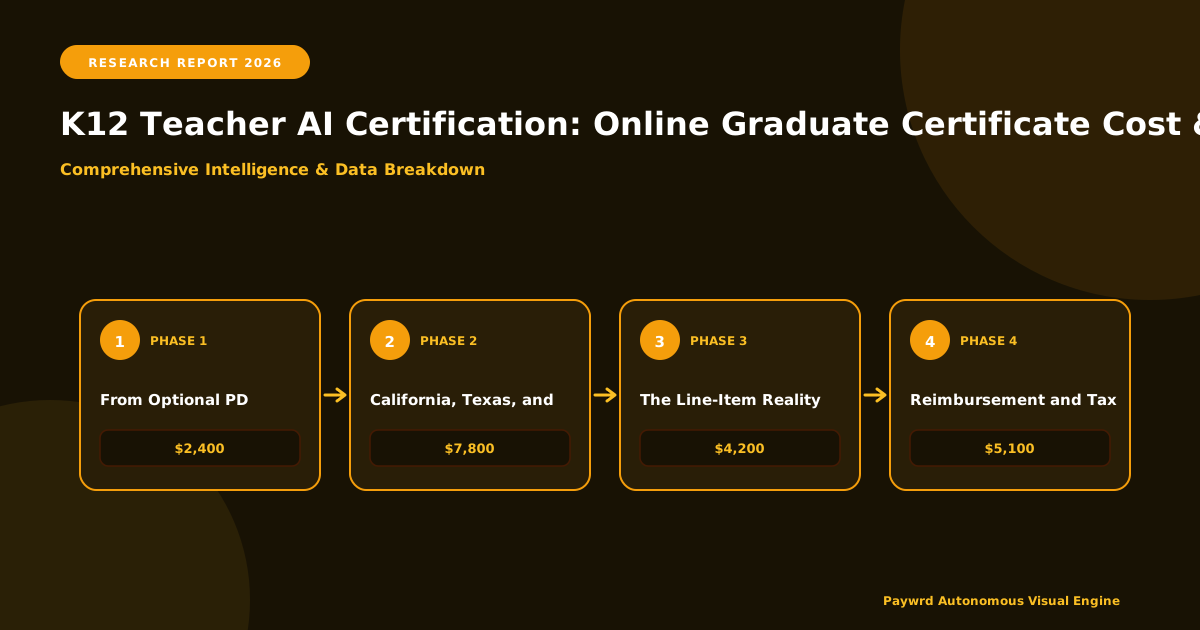
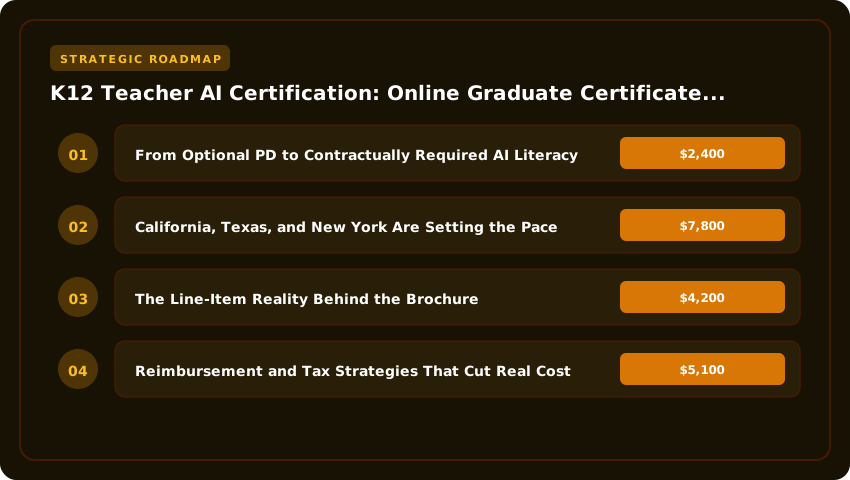
From Optional PD to Contractually Required AI Literacy
The pivot started quietly during the 2023-2024 school year. Many districts began adding “demonstrated competency in AI-augmented instruction” to evaluation rubrics. By fall 2024, that soft language hardened into contract language. In districts like Miami-Dade and Houston ISD, new teacher contracts include AI fluency as a continuing employment condition. This is not a seminar you attend once and forget. It is a paid-for, transcripted graduate certificate that becomes part of your permanent personnel file. According to the US Department of Education, competency-based add-ons are increasingly replacing seat-time requirements, and districts are using that flexibility to push micro-credentials over traditional PD hours.
How ESSER Rollovers and Title II Dollars Are Fueling the Shift
The funding mechanism is just as important as the policy shift. Federal ESSER (Elementary and Secondary School Emergency Relief) funds technically expired in September 2024, but many districts still hold unspent rollover allocations earmarked for “technology integration and instructional continuity.” Simultaneously, Title II, Part A dollars under the Every Student Succeeds Act (ESSA) continue to flow toward teacher quality and effectiveness. Smart Chief Academic Officers are redirecting both streams toward AI certificate cohorts rather than one-off workshops, because the certificate generates a transferable, stackable credential that survives budget cycles.

California, Texas, and New York Are Setting the Pace
California’s Credentialing Commission now lists AI-integrated pedagogy as an eligible subject for salary differential credits. Texas districts, operating under the T-TESS evaluation framework, have begun granting AI certificate holders priority placement on career ladder tracks. New York’s NYSED approved several online graduate certificates in AI-in-education for in-service salary increments under its professional development framework. The pattern is clear: states with the largest teacher payrolls are the first to bake AI credentials into compensation formulas.
- California: Salary differential credits via approved graduate AI certificates
- Texas: Career ladder placement priority under T-TESS evaluation cycles
- New York: NYSED-approved certificates unlock in-service salary increments
- Federal Backbone: Title II and remaining ESSER rollover funds subsidize tuition
The bottom line for educators: this credential is not vanity. It is a funded line item in a district budget, increasingly tied to your next contract renewal.
Decoding the Cost Structure of Online Graduate AI Certificates
Smart educators don’t budget by sticker price; they budget by total cost of ownership. When comparing online graduate AI certificates side-by-side, the advertised tuition figure is often the least accurate number on the brochure. Across US accredited providers—including institutions approved under Title-IV federal student aid guidelines—tuition typically lands between $2,400 and $7,800 for a 12-to-18 credit program. Public university extensions tend to anchor the lower end, while private nonprofit competitors and Ivy League continuing education divisions sit comfortably at the top.
The Line-Item Reality Behind the Brochure
Here is where the math gets interesting—and where many teachers get financially surprised. A program quoted at $4,200 can easily balloon to $5,100 once the following line items appear on your student account statement:
- Proctoring fees: Remote exam supervision typically runs $25 to $75 per assessment, and most AI certificates require 3 to 5 proctored checkpoints.
- Platform licensing: Access to proprietary AI sandbox tools, GPU cloud credits, and integrated labs frequently carries a $150 to $400 semester surcharge.
- Digital badge issuance: Credentialing through Credly, Parchment, or proprietary blockchain verification adds $25 to $75 per certificate plus annual maintenance fees.
- Technology and course materials: Some programs bundle e-textbooks; others hit you with $120 to $300 in separate digital content charges.
- Capstone or applied project defense: A final evaluative review can carry a one-time $150 to $300 grading fee.
Reimbursement and Tax Strategies That Cut Real Cost
The good news? Almost no K12 teacher pays the full sticker price anymore. Employer reimbursement clauses under collective bargaining agreements have become standard in mid-sized and large districts, with many covering 80% to 100% of tuition upon successful course completion (typically a B or better). Under Section 127 of the Internal Revenue Code, up to $5,250 per year in employer-provided educational assistance remains federally tax-free, meaning your district can fund the entire certificate without it appearing on your W-2 as taxable income.
On top of that, state-level educator tax credits can slash out-of-pocket expenses dramatically. States like Illinois, Minnesota, and Massachusetts offer classroom supply and professional development credits worth $150 to $500 annually, while several states now permit deductions specifically for technology-focused continuing education. When stacked strategically, teachers frequently reduce their net personal cost by 50% to 60%—turning a $6,000 program into a $2,400 reality.
The takeaway: always request a sample student ledger from the registrar’s office before signing an enrollment agreement, and simultaneously schedule a benefits review with your HR department. The cheapest advertised certificate is rarely the cheapest completed one.
Accreditation Standards That Separate Legitimate Certificates from Diploma Mills
Here is the hard truth about AI credentials for teachers: a glossy landing page and a downloadable PDF do not equal a graduate certificate. When a school district promises salary lane advancement, the credential must clear the same accreditation gates that any traditional graduate program crosses. Without that foundation, the “certificate” functions as a receipt for participation, not a transcripted academic achievement.
Regional Accreditation: The Non-Negotiable Foundation
Before evaluating curriculum quality, verify that the issuing institution holds regional accreditation from one of the six recognized bodies: the Higher Learning Commission (HLC), the Southern Association of Colleges and Schools Commission on Colleges (SACSCOC), the Middle States Commission on Higher Education (MSCHE), the Northwest Commission on Colleges and Universities (NWCCU), the New England Commission of Higher Education (NECHE), or the WASC Senior College and University Commission (WSCUC). The U.S. Department of Education recognizes these agencies as the gatekeepers of legitimate postsecondary credit. Anything outside this framework, particularly the “national accreditation” labels pushed by many online bootcamps, fails to meet HR audit standards in nearly every public school district in the country.
National accreditors such as the Distance Education Accrediting Commission (DEAC) operate under a fundamentally different credibility model, one often designed for vocational and trade institutions. While DEAC itself has DOE recognition, many districts will not accept credentials from institutions accredited only by lesser-known national bodies, particularly when stacking them against a Master of Education salary track.
Why CAEP and AACTE Endorsements Matter for Salary Lane Advancement
Regional accreditation confirms institutional legitimacy. Two additional endorsements confirm that the program itself meets the educator-specific rigor that HR departments expect:
- CAEP accreditation (Council for the Accreditation of Educator Preparation) signals that the certificate program has been reviewed against the same standards applied to traditional teacher preparation programs. Districts following InTASC-aligned frameworks prioritize CAEP-vetted credentials.
- AACTE membership (American Association of Colleges for Teacher Education) confirms alignment with the broader research university ecosystem, the same ecosystem that feeds doctoral programs and tenure pipelines.
When a graduate certificate carries both regional accreditation and CAEP or AACTE endorsement, it becomes transcripted graduate credit, credit that HR offices can convert into salary lane movement, graduate transcripted hours, and even doctoral program transferability.
Red Flags in AI Bootcamps Marketing Graduate-Level Credit
The fastest-growing red flag in the educator AI space is the bootcamp that promises “graduate-level credit” without issuing an actual transcript. Watch for these warning signs:
- Certificates of completion instead of official transcripts with credit hours and grade notation.
- Partnership claims with unnamed “accredited universities” that lack verifiable articulation agreements.
- Stacking CEUs (Continuing Education Units) and labeling them as graduate credit. CEUs do not count toward salary lanes.
- Missing CAEP, AACTE, or programmatic accreditation language on the program page.
- No published faculty credentials or no listed institution of record.
The simplest protection: ask the registrar for a sample transcript before paying tuition. If the document does not show a credit hour total with a letter grade, walk away. Your district is funding a credential that will sit in a desk drawer rather than move you up the salary schedule.
Salary Differential Analysis: Pre-Certification vs Post-Certification Pay
Let’s talk dollars and cents, because the romantic appeal of “transforming your classroom with AI” only matters if the credential actually pays your mortgage. The baseline reality for K12 teachers in the United States remains anchored to the Bureau of Labor Statistics median annual wage of $65,220 for elementary, middle, and high school educators. That figure represents the 50th percentile across public and private institutions, though experienced educators in high-cost metropolitan districts frequently clear $85,000 to $95,000 before adding any supplemental credentials. Without intervention, salary growth typically follows a rigid step-and-lane schedule—incremental bumps tied to years of service and earned graduate credit hours, often capping out long before inflation catches up.
This is precisely why the documented salary differential following an AI-focused graduate certificate has become such a compelling data point for working educators. Districts and collective bargaining agreements across at least fourteen states now recognize 12 to 18 graduate credits in instructional technology or AI integration as a triggering event for lane movement on the salary schedule. The financial impact is concrete: teachers completing a 12 to 18-credit graduate certificate typically see annual salary increases ranging from $1,200 to $4,500, depending on the district’s step-and-lane structure and whether the credits push them into a new lane entirely. A mid-career teacher earning $72,000 in a district that awards $2,400 per lane crossing recovers a $3,600 graduate certificate in roughly eighteen months of after-hours paychecks—before factoring in any one-time signing bonuses or recruitment incentives that frequently accompany these credentials.
Case Study: Massachusetts and Ohio Premium Stipends
The most aggressive financial incentives have emerged in Massachusetts and Ohio, where competitive labor markets and aggressive district initiatives have created documented premium pay structures for AI-fluent instructional coaches. Several districts in these states now offer annual stipends ranging from 8 to 12 percent above base salary for teachers who complete approved AI certification pathways and transition into coaching or curriculum-design roles. Translated onto the BLS median, that 10 percent midpoint represents an additional $6,522 per year—effectively recouping the cost of an $8,400 online graduate certificate in roughly fifteen months, while simultaneously opening doors to lateral moves into instructional technology coordination, district-level curriculum positions, or higher-education adjunct teaching opportunities that frequently carry their own salary premiums.
Calculating Your Personal ROI Break-Even Point
- Total Tuition Investment: Subtract any district tuition reimbursement, federal TEACH Grant eligibility, or employer-sponsored cohort discounts from the sticker price of your program.
- Annual Salary Increment: Identify your district’s lane schedule and determine whether 12 or 18 credits trigger movement, then calculate the dollar differential.
- Add Supplemental Income: Include any stipend, coaching differential, or summer curriculum work tied to the credential.
- Divide Tuition by Annual Lift: The resulting number of months represents your realistic break-even timeline, which most candidates hit between twelve and twenty-four months post-completion.
The honest calculation favors action. Teachers who delay the credential typically forgo between $3,600 and $13,000 in cumulative salary differential over a two-year window—an opportunity cost far exceeding the actual tuition burden of most accredited online programs.
Curriculum Comparison: What Top US Programs Actually Teach
Ask any district curriculum director what separates a meaningful AI certificate from a glorified webinar series, and they’ll point straight to the syllabus. Not the marketing brochure, not the partnership logos, but the actual modules a teacher completes before earning that line on their resume. Across US graduate certificate programs—from offerings housed in Schools of Education at state flagships to professional tracks run through extended learning divisions—the core architecture has converged around three intellectual pillars.
Core Modules: Ethics, Prompting, and Adaptive Logic
Every credible program now anchors itself in generative AI ethics, and the strongest versions go far beyond a single week on academic integrity. Expect deep engagement with bias auditing, student data privacy under FERPA, and the philosophical limits of AI-mediated assessment. Prompt engineering for lesson design typically follows as the applied counterpart—teachers learn to architect multi-step queries, scaffold student-facing AI interactions, and build reusable prompt libraries aligned to specific standards like NGSS or Common Core. The third pillar, adaptive learning algorithms, often intimidates generalists the most, but programs increasingly frame it through a teacher’s lens: How does the algorithm decide what Suzzy sees next? When should a teacher override the recommendation engine? Understanding the black box matters more than building one.
Practicum Requirements vs. Asynchronous Completion
Here is where the cost calculus gets interesting. A fully asynchronous certificate from a provider like Coursera or a regional university extension might run $1,200 to $3,500 total and wrap up in four months flat—zero practicum, zero classroom observation, zero real feedback on your AI-integrated lesson. Programs requiring a capstone practicum—think University of Florida’s online AI in Education certificate or similar state-university offerings—typically charge $5,500 to $9,000 and demand 40 to 60 hours of applied implementation in your own classroom, complete with mentor evaluation and a defended portfolio. The price gap is real, but so is the salary bump differential: administrators recognize supervised practicum hours on a transcript in ways they cannot for a self-paced badge.
Specialized Tracks: STEM, Humanities, and Elementary Generalists
Choosing the wrong track depth is the single most common mistake teachers make. STEM-focused certificates emphasize coding-adjacent tools, simulation environments, and data visualization pipelines—valuable if you teach high school physics or middle school robotics, but overscoped (and frankly exhausting) for a third-grade generalist. Humanities tracks concentrate on AI-augmented writing instruction, source evaluation in the age of synthetic text, and discussion facilitation when half the class used ChatGPT to draft their essays. Elementary certificates, the newest and often most thoughtfully designed, focus on age-appropriate AI literacy, early-reading adaptive platforms, and ethical framing accessible to eight-year-olds. Match your certification depth to your daily instructional reality, not the version that looks most impressive on LinkedIn.
- Ethics-first programs typically allocate 25-30% of credit hours to policy, bias, and FERPA-compliant data handling.
- Prompt engineering modules average 15-20 hours of hands-on lab work across most accredited certificates.
- Adaptive algorithm literacy is taught through teacher-facing dashboards, never through raw Python code.
- Practicum-bearing certificates correlate with stronger contract language when districts fund tuition reimbursement.
Enrollment Logistics: Timing, Transferability, and Salary Schedule Alignment
Most teachers treat enrollment like a semester start date. Districts treat it like a payroll cutoff. That disconnect costs you money. If your collective bargaining agreement (CBA) locks lane changes to a September 1 or February 1 deadline, starting a 12-credit certificate in October guarantees you miss the next fiscal year’s bump. You need to reverse-engineer the calendar from the contract, not the university catalog.
Hit the Salary Schedule Anniversary, Not the Semester Start
Pull your district’s Salary Schedule Advancement Policy—usually buried in Article 12 or Appendix B of the CBA. Look for the phrase “credits earned prior to.” If the language reads “credits earned prior to September 1,” you must have the official transcript posted by August 31. That means grades submitted, registrar processed, and PDF delivered to HR. For a typical 15-week graduate term, you need to enroll no later than the January term for a September lane change, or the Summer I session for a February adjustment. Missing this window by two weeks delays the raise 12 months—a $3,500 to $6,000 opportunity cost on a standard MA+30 lane jump.
Secure Transfer Portability Before You Pay
Do not assume credits from University A transfer into University B’s Master’s program later. Verify articulation agreements inside your state’s public system. In the California State University (CSU) system, a graduate certificate from a CSU campus typically feeds seamlessly into an MA in EdTech. In Texas, the Texas Common Course Numbering System (TCCNS) governs lower-division work, but graduate transfer is strictly at the receiving department’s discretion. Request a pre-enrollment degree audit in writing from the target Master’s program director. If they won’t commit to accepting all 12 credits, you are buying a dead-end credential.
Negotiate Lane Movement with a Transcript Evaluation Before You Sign
HR analysts evaluate transcripts against rigid rubrics: “Graduate-level,” “Regionally Accredited,” “Relevant to Assignment.” Ambiguity kills speed. Before you wire tuition, email your HR Certification Officer a draft course list with catalog descriptions and ask for a preliminary equivalency ruling. Say: “I plan to enroll in Course X (Description). Will this satisfy the ‘Relevant Graduate Credit’ requirement for Lane 4 advancement?” Get the email confirmation. This creates a paper trail that forces HR to honor the lane change upon completion. If they refuse to pre-approve, escalate to your union rep—before you enroll. A $15,000 certificate that HR later deems “instructional technology” rather than “curriculum integration” is a sunk cost with zero ROI.
- Action Item: Calendar the district’s “Transcript Deadline” as your program completion target date.
- Action Item: Secure written transfer guarantees from the Master’s program you intend to finish.
- Action Item: Obtain HR pre-approval on specific course codes, not just program titles.
Career Trajectory Beyond the Classroom: Administrative and Coaching Premiums
Most teachers calculate the ROI of a graduate certificate against the next column on the salary schedule—a $2,000 to $4,000 annual bump for “MA+15” credits. That math is valid, but it severely undervalues what an AI credential actually unlocks. This certification isn’t just a lane change; it is a passport out of the single-salary schedule entirely. When you add “Certified AI Instructional Strategist” to a résumé backed by classroom experience, you stop competing for step increases and start competing for entirely different pay bands.
The Instructional Technology Coordinator Pipeline
The most direct leap is into the Instructional Technology Coordinator (ITC) role. According to the Bureau of Labor Statistics (BLS), instructional coordinators earn a median annual wage of $74,620, but specialists in educational technology in major metros—think Fairfax County, VA, or Austin, TX—routinely command $78,400 to $92,000 base salaries on 11- or 12-month contracts. Unlike classroom roles, these positions often include summer pay, district-issued laptops, and travel budgets for conferences like ISTE. Districts are explicitly writing “AI integration competency” into these job descriptions now; a graduate certificate from an accredited provider (look for CAEP or regional accreditation) satisfies the “advanced coursework” requirement instantly, putting you ahead of peers relying solely on workshop hours.
High-Value Adjunct and Vendor-Side Work
If you aren’t ready to leave the classroom, the gig economy for certified AI educators is surprisingly lucrative. EdTech vendors—Curriculum Associates, Nearpod, MagicSchool AI, and the major LMS providers—need practitioners to build prompt libraries, vet model outputs for bias, and design professional development modules. These contract roles pay $45 to $95 per hour for curriculum design and “red-teaming” AI tools. Adjunct positions at community colleges or university schools of education teaching “AI in the K12 Classroom” typically run $3,000 to $5,000 per course per semester. Because you hold the graduate certificate, you meet the Southern Association of Colleges and Schools Commission on Colleges (SACSCOC) faculty credentialing guidelines (18 graduate hours in the discipline), making you hirable the moment the catalog opens.
The Long Game: District Innovation Leadership
The ceiling is higher than most realize. Superintendents are creating Cabinet-level roles—Chief Innovation Officer, Director of Digital Transformation, Director of AI Strategy—that did not exist three years ago. These positions sit on 12-month administrator contracts starting at $110,000 and scaling to $165,000+ in large districts. They require a blend of pedagogical credibility, technical fluency, and change-management chops. An AI graduate certificate, stacked on a Master’s in Ed Leadership or an MBA, signals you can bridge the gap between the server room and the faculty lounge. It transforms your narrative from “teacher with a tech interest” to “systems-level strategist.” That framing shift is worth far more than any single stipend check.
| Credential Pathway | Typical Cost (USD) | Primary Funding Source | Time to Complete | Salary Impact Mechanism | Contractual Recognition |
|---|---|---|---|---|---|
| University Graduate Certificate (e.g., ISTE/University partners) | $2,500 – $6,000 | District PD Funds / Title II / Teacher | 6–12 Months (9–15 Credits) | Lane Change / Step Increase (MA+15/30) | High (Explicit in CBA Salary Schedules) |
| Major Vendor Certifications (Google, Microsoft, AWS Educator) | $10 – $150 (Exam Fees) | Teacher Out-of-Pocket / District Vouchers | 20–40 Hours Prep | Stipend ($500–$2,000/yr) or PD Hours | Medium (Often listed as ‘Preferred’ in JDs) |
| District-Sponsored Micro-Credentials / Badges | $0 (District Funded) | District Operating Budget / Grants | 10–30 Hours (Job-Embedded) | Recertification Points / Internal Promotion | High (Mandatory for Tenure/Promotion in early adopters) |
| Non-Profit / EdOrg Programs (e.g., AI for Education, Code.org) | $0 – $500 | Philanthropy / District Partnership | 15–50 Hours | PD Credits / Portfolio Artifact | Low–Medium (Recognized for PD Hours, rarely for Lane Change) |
Frequently Asked Questions
How much does a K12 AI graduate certificate cost?
University-based K12 AI graduate certificates typically cost between $2,500 and $6,000 for 9–15 credit hours. Many districts cover this via Title II funds, professional development budgets, or tuition reimbursement clauses in collective bargaining agreements, reducing teacher out-of-pocket expense to near zero.
Does an AI certification increase teacher salary?
Yes, graduate-level AI certificates frequently trigger 'lane changes' on district salary schedules (e.g., moving from MA to MA+15), yielding annual increases of $1,500–$4,000. Some districts offer flat annual stipends ($500–$2,000) for specific vendor certifications like Google Certified Coach or ISTE credentials.
Are school districts requiring AI certification for teachers?
Leading districts (e.g., NYC, LAUSD, Chicago) are embedding AI literacy into job descriptions and tenure requirements. While universal mandates are rare in 2024, collective bargaining agreements in tech-forward districts now classify AI competency as a core instructional skill for contract renewal.
What is the fastest AI certification for teachers?
Vendor certifications (Google AI Essentials, Microsoft AI Classroom, MagicSchool AI) require 10–20 hours and cost under $100. They provide immediate classroom ROI and PD credits but rarely count for salary lane changes, which require accredited graduate semester hours.
Can I use Title II funds for AI teacher certification?
Yes. Title II, Part A funds explicitly support 'evidence-based professional development' for effective instruction. Since the 2024 ED guidance on AI in education, state agencies approve AI literacy courses as allowable expenses for both graduate credit and high-quality micro-credentials.
Strategic Final Takeaway
When evaluating K12 Teacher AI Certification Programs Online Graduate Certificate Cost And Salary Increase Analysis, base your decisions on accredited institutional standards, measurable return on investment (ROI), and up-to-date official guidelines. Always verify specific dates and requirements through official regulatory portals.