Decoding the Community College Baccalaureate Model for ECE
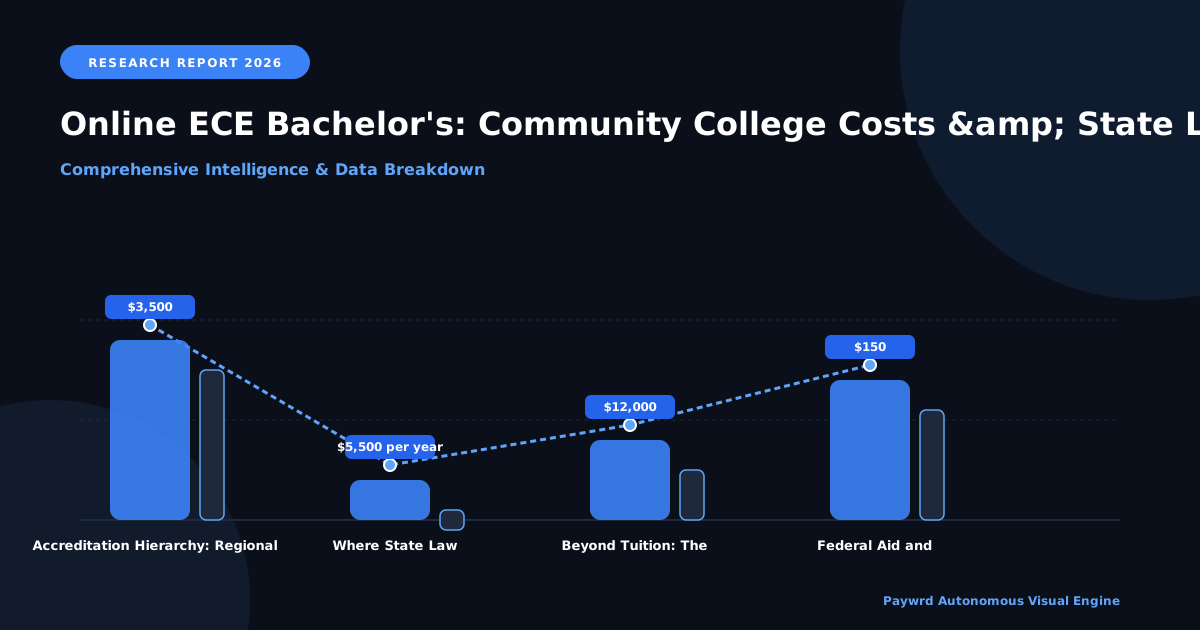
For decades, the “2+2” articulation agreement was the only bridge between an associate degree and a bachelor’s credential. You completed 60 credits at a community college, hoped your credits transferred cleanly, and finished the final two years at a university. The Community College Baccalaureate (CCB) model upends that pipeline entirely. Authorized by state legislatures in places like Washington, Florida, Colorado, Texas, and California, these programs allow the college itself to confer the Bachelor of Applied Science (BAS) or Bachelor of Science (BS) in Early Childhood Education. You enroll once, pay community college tuition rates for all four years—often $3,500 to $5,500 per year versus $12,000+ at public universities—and graduate with a degree that carries the exact same legal weight for state licensure.
CCB vs. 2+2 Transfer: Structural Differences That Matter
The distinction is structural, not just semantic. In a 2+2 model, you are subject to two separate admissions processes, two financial aid offices, and the risk of “credit leakage”—where 10 to 15 credits fail to apply to the major. A CCB eliminates that friction. The curriculum is designed as a cohesive 120-credit continuum from day one. Upper-division coursework (300/400 level) is taught by faculty who meet the same terminal degree requirements (typically a doctorate or master’s plus 18 graduate hours in the discipline) mandated by regional accreditors like the Higher Learning Commission (HLC) or WASC Senior College and University Commission (WSCUC). For working professionals, this means you can often remain employed in your current center while completing practicum requirements on-site, avoiding the disruptive residency requirements common at four-year campuses.
Accreditation Hierarchy: Regional vs. Programmatic
Employers and state licensing boards look for a dual layer of quality assurance. First, the institution must hold regional accreditation—the gold standard recognized by the U.S. Department of Education for federal financial aid (FAFSA) eligibility. Every legitimate CCB program holds this. Second, the ECE program itself should hold specialized accreditation from NAEYC (National Association for the Education of Young Children) via the CAEP (Council for the Accreditation of Educator Preparation) review process. This programmatic stamp verifies that field experiences, assessment systems, and curriculum align with the Professional Standards and Competencies for Early Childhood Educators. Before enrolling, verify the program appears on both the CHEA database and the NAEYC accredited program search tool. If a CCB lacks NAEYC/CAEP recognition, your path to a standard teaching license in many states will hit a wall.
Where State Law Opens the Door
As of 2024, 24 states have explicit statutory authority allowing community colleges to award bachelor’s degrees, with ECE being one of the most prevalent high-demand fields authorized. Florida leads with over 30 colleges offering BAS degrees; Washington State’s community and technical colleges confer more applied baccalaureates than any other system. California launched a pilot program (SB 850) specifically targeting workforce gaps in ECE. Colorado and Texas have expanded authority to address teacher shortages in rural districts. Always confirm authorization via the state’s Higher Education Coordinating Board or Community College System Office—do not rely solely on the college’s marketing materials.
True Cost Breakdown: Tuition, Fees, and Hidden Expenses

One of the strongest financial arguments for pursuing a Community College Baccalaureate (CCB) in Early Childhood Education is the radical transparency of its cost structure. Unlike four-year universities or private online providers that often bundle sticker prices with campus-specific fees, community colleges publish line-item tuition rates that make calculating your total cost of attendance (COA) refreshingly predictable. For working professionals considering an upskilling path, this clarity is essential for calculating return on investment (ROI) and comparing apples-to-apples alternatives.
Generally, online learners at public community colleges pay in-district tuition regardless of their physical address, a major shift from legacy policies. Expect per-credit rates to range from $150 to $250 for in-district students, while out-of-state online learners typically fall into a second tier between $300 and $450 per credit. For a standard 120-credit bachelor’s degree, that translates to a tuition baseline of roughly $18,000 to $54,000 over four years, often 40–60% lower than equivalent state university online programs.
Beyond Tuition: The Hidden Cost Layer
The sticker tuition figure rarely tells the whole story. Budget-conscious students must also account for several fee categories that quietly inflate the bottom line:
- Technology Fees: Online students are often billed $25 to $75 per semester to support the learning management system (Canvas, Blackboard, etc.), virtual libraries, and 24/7 tech support.
- Proctoring Costs: Many programs now use third-party services like ProctorU or Honorlock. Expect exam proctoring fees ranging from $15 to $40 per assessment, which can add $150 to $300 across a degree.
- Field Placement Insurance: ECE licensure requires practicum hours in licensed childcare or public school settings. Liability insurance, background checks, and immunization tracking add between $50 and $150 per semester.
- Digital Textbooks and e-Learning Platforms: While some CCBs adopt Open Educational Resources (OER), many programs still require courseware bundles costing $80 to $200 per term.
Federal Aid and Scholarship Access
Unlike many bootcamps or non-accredited alternatives, CCB programs are FAFSA-eligible, opening the door to Title IV federal aid. The maximum Pell Grant award for the 2025-2026 award year stands at $7,395, which can cover the majority of tuition for the lowest-income students. Working educators pursuing a bachelor’s may also qualify for the T.E.A.C.H. Early Childhood Scholarship, a workforce-funded program operating in over 30 states that covers tuition, books, and release time for currently employed early childhood staff.
When stacking a realistic COA—factoring tuition, fees, proctoring, and field-placement insurance—most students can complete a CCB in ECE for between $20,000 and $30,000 total, a figure that strengthens the value narrative against both state university and for-profit competitors.
Navigating State Licensure: Does This Degree Qualify You?
Here is the blunt reality: a regionally accredited degree does not guarantee a teaching license. Every state Department of Education sets its own non-negotiable checklist for initial certification, and they do not rubber-stamp out-of-state transcripts. Before you commit a single dollar—whether that is $4,500 per year at a Florida CCB or $12,000 at a state university—you must treat the program’s licensure disclosure page like a legal contract.
Mapping Curriculum to State Mandates
Most CCB programs build their curriculum around NAEYC (National Association for the Education of Young Children) standards, which align with CAEP accreditation. That is a strong baseline, but states layer on specific requirements that can trip you up. California demands a specific course on the U.S. Constitution; Texas requires the Science of Teaching Reading (STR) exam and specific dyslexia training; New York mandates workshops on Dignity for All Students Act (DASA), child abuse identification, and school violence prevention. If your online CCB is based in Washington State but you live in Ohio, the program might not include the Ohio Assessment for Educators (OAE) prep modules or the required 12-week reading core. Always request a “crosswalk document” from the program coordinator mapping every course to your target state’s administrative code.
The Student Teaching Placement Trap
This is where fully online, out-of-state students lose the most time. You cannot student-teach in your local district unless your college has a signed Memorandum of Understanding (MOU) with that specific school district. Many community colleges lack the administrative bandwidth to negotiate these agreements across state lines. If your program cannot place you, you are stuck. Action item: Ask the admissions office for a list of active MOUs in your zip code. If the list is empty, ask for the name of the Field Placement Coordinator and verify they have successfully placed an out-of-state student in your district within the last 12 months. Do not accept “we usually figure it out.”
Reciprocity: The NASDTEC Interstate Agreement Is Not Automatic
You will hear advisors cite the NASDTEC Interstate Agreement. Treat this as a framework, not a guarantee. It facilitates application review; it does not waive testing or coursework deficits. If you earn your license in Arizona (which has broad reciprocity) and move to Massachusetts (which has strict transcript analysis), you will likely face “deficiency letters” requiring additional SEI (Sheltered English Immersion) endorsements or specific history coursework. Pro tip: Apply for your initial license in the state where you completed the program first. Holding a valid, active license in the program’s home state significantly smooths the pathway for a reciprocal license elsewhere, often reducing the requirement to just passing the new state’s required exams (like the Praxis or MTEL).
- Verify Program Approval: Check the state Department of Education website (not the college site) for “Approved Educator Preparation Programs.”
- Background Checks: Budget $50–$100 per state for fingerprinting/clearance cards; some states require FBI checks even for student teaching.
- Testing Windows: Align your graduation date with testing windows for required exams (Praxis II, edTPA, state-specific tests) to avoid a semester gap in employment eligibility.
Accreditation Deep Dive: NAEYC, CAEP, and Regional Body Alignment
Accreditation is the non-negotiable backbone of any legitimate Online ECE Bachelor’s program. For working educators and career advancers, understanding the difference between professional recognition and institutional approval is the only reliable way to separate a quality degree from an expensive PDF. Before you enroll in any program advertising “NAEYC-aligned” or “CAEP-approved” status, you need a clear-eyed look at what those badges actually mean and where to find them.
Verifying Programmatic Accreditation Status
The two gold-standard programmatic accreditors in Early Childhood Education are the National Association for the Education of Young Children (NAEYC) and the Council for the Accreditation of Educator Preparation (CAEP). NAEYC accreditation specifically evaluates early childhood degree through degree through the curriculum’s alignment with developmental best practices, faculty qualifications, and field-experience rigor. CAEP, meanwhile, focuses on educator preparation programs more broadly, assessing outcomes data, clinical partnerships, and continuous improvement processes. To verify a program’s standing, use the NAEYC and CAEP online directories directly. Never rely on screenshots or marketing copy hosted on the school’s own website, since those can become outdated or selectively edited. Cross-reference every claim against the U.S. Department of Education’s Database of Accredited Postsecondary Institutions and Programs, which lists both institutional and programmatic accreditors recognized by the federal government.
Regional Body Alignment and Federal Funding Eligibility
Alongside programmatic accreditation, every reputable online program must hold regional institutional accreditation from one of the seven federally recognized bodies: HLC, MSCHE, NECHE, NWCCU, SACSCOC, WASC, or WSCUC. This layer is what unlocks Title IV federal financial aid, including Pell Grants and Federal Direct Loans, processed through the FAFSA. Without regional accreditation, your degree may look the same on paper but will be functionally invisible to graduate schools, state licensure boards, and most employers. When a community college offers a CCB in Early Childhood Education, it must operate under the same regional accreditor as a four-year university, which is why these programs can articulate cleanly into master’s programs and meet state teaching license requirements.
Red Flags: Candidacy vs. Full Accreditation
This is where many upskilling professionals get burned. A program in “candidacy” or “pre-accreditation” status is not yet accredited; it is merely applying. Candidacy means a peer review team has scheduled a visit, but no final determination exists. If you enroll during this window and the program fails to achieve full accreditation, your credits may not transfer, your degree may be rejected by state boards, and you will be ineligible for federal financial aid retroactively. Always ask admissions counselors point-blank: “Is the accreditation current and unconditional, or is the program in candidacy?” Document the answer in writing. A legitimate program will have no issue providing the exact accreditation letter, expiration cycle, and the accreditor’s public listing URL.
Your Verification Checklist
- Confirm the institution appears in the U.S. Dept of Education accreditation database with an active regional accreditor.
- Confirm the specific ECE program is listed in the NAEYC and/or CAEP directory as fully accredited, not candidate.
- Ask for the Title IV participation agreement status to verify FAFSA eligibility.
- Search your state DOE licensure site to confirm the program appears on the approved teacher preparation list.
- Request the most recent accreditation review letter or summary report for transparency.
Curriculum Rigor: Upper-Division Coursework & Field Experience Logistics
When evaluating an online ECE bachelor’s degree for career advancement, working professionals need absolute confidence that the upper-division coursework matches what they’d encounter at a four-year state university. Community College Baccalaureate (CCB) programs must satisfy the same regional accreditation standards and NAEYC (National Association for the Education of Young Children) standards as any flagship institution—which means the final 60 credit hours deliver genuine academic substance, not watered-down content.
Typical 300/400-Level Course Architecture
The senior-year curriculum typically compresses advanced ECE theory into five core domains. Expect rigorous coursework in Authentic Assessment & Curriculum Design, where you analyze standardized observation tools, construct developmental continua, and align learning objectives with state early-learning standards. Program Administration & Leadership covers budgeting, staff supervision, accreditation compliance, and grant writing—essential if you’re moving from lead teacher to director. Inclusion & Special Needs examines Individualized Education Programs (IEPs), Response to Intervention (RTI) frameworks, and culturally responsive pedagogy for children with developmental delays or disabilities. Most programs also require Early Literacy & Language Acquisition (often paired with a science of reading module) and a capstone Child & Family Systems seminar.
Securing Your Supervised Practum in Your Local Community
Here’s the part that trips up most online learners: the practicum isn’t remote. Even when coursework is 100% asynchronous, every accredited ECE program requires documented field experience in a licensed early childhood setting—typically 120–180 clock hours spread across two semesters. You’ll need to identify an approved site within commuting distance (usually within a 50-mile radius of your campus). Most institutions maintain partnership agreements with local Head Start grantees, public pre-K programs, and NAEYC-accredited childcare centers, but you can often propose an alternative site if it meets state licensing requirements. Working professionals have an edge here—your current employer may already qualify as a host site if you can document supervision by a credentialed mentor teacher who is separate from your direct supervisor.
Portfolio Requirements: edTPA and State Performance Assessments
All teacher preparation programs leading to state licensure now require a performance-based portfolio. For ECE candidates, that almost universally means edTPA—a standardized, nationally scored assessment developed by Stanford and Pearson. You’ll submit video recordings of your teaching, lesson plans aligned to edTPA rubrics, student work samples, and reflective commentaries across three tasks: Planning, Instruction, and Assessment. Most community college programs integrate edTPA preparation into the final semester rather than charging extra fees (unlike many for-profit alternatives). Some states supplement edTPA with additional artifacts: California’s Child Development Permit, for example, requires a completed Associate Teacher or Teacher level application with verified work experience hours.
Logistical Reality Check for Full-Time Workers
Plan for roughly 10–15 hours weekly per 3-credit course during the practicum semester—manageable alongside a full-time ECE position, but tight. The edTPA portfolio alone demands 40+ hours of work on top of practicum obligations. Schedule your field experience semesters strategically: avoid combining them with major life transitions or peak work seasons.
Career ROI: Salary Steps, Master’s Pathways, and Leadership Roles
Earning a Bachelor of Applied Science or Bachelor of Science in Early Childhood Education does far more than check an HR box. For working educators, it is a documented earnings catalyst that opens the door to administrative licensure and graduate-level specialization. Let’s break down exactly how much that four-year credential is worth on a paycheck in the United States, and where it can take your career over the next decade.
Base Salary Differential: BA vs. AA in Head Start and Public Pre-K
The pay gap between an associate degree and a bachelor’s in early childhood education is substantial, particularly in publicly funded programs. According to the U.S. Bureau of Labor Statistics (BLS), preschool teachers across the country earn a median annual wage of around $37,000, but that figure climbs noticeably once you isolate educators with a four-year credential. In Head Start programs, which are governed by the Office of Head Start under the U.S. Department of Health and Human Services, the federal pay scale historically pegs BA-prepared teachers at roughly $3 to $6 per hour more than AA-prepared peers, translating to an additional $6,000 to $12,000 in annual gross income.
Public Pre-K classrooms follow a similar pattern. Districts reimbursed through state-funded pre-kindergarten grants typically structure their salary schedules around college credit hours. A teacher with a bachelor’s degree often starts on Step 1 of a district scale earning $44,000 to $52,000, while an associate-degree assistant might cap out near $36,000 with no upward lane. Over a 10-year career, that compounding differential can exceed $80,000 in cumulative earnings, even before factoring in stronger retirement matches and healthcare tiers tied to credential level.
Articulation into M.Ed. Educational Leadership or Curriculum & Instruction
Once you hold a regionally accredited BA in ECE, you unlock a direct pipeline to Master of Education programs at universities and even some community college graduate tracks. Two concentrations dominate the upskilling market for working educators: Educational Leadership, which prepares you for principal or program director roles, and Curriculum and Instruction, which positions you as an instructional coach or curriculum specialist.
Tuition for these M.Ed. pathways generally falls between $15,000 and $35,000, depending on whether the learner pursues in-state public university pricing or private nonprofit options. Many employers reimburse 50% to 100% of these costs through federal Title II professional development funds or state-sponsored grow-your-own teacher leader grants. Completing an M.Ed. typically adds another $8,000 to $15,000 in annual salary within two to four years of finishing the degree, especially when paired with a state principal or supervisor endorsement.
Qualification for Director Credentials: NAEYC Administrator Credential
The bachelor’s is the non-negotiable gateway to the NAEYC Early Childhood Administration Credential, which is widely considered the gold standard for leading licensed childcare centers and early learning programs. Without a four-year degree, candidates are ineligible to even apply for the assessment-based portfolio process.
Once credentialed, directors commonly step into salaries ranging from $55,000 to $85,000 annually, depending on program size and region. Many states, including Florida, Georgia, and North Carolina, also tie their state director qualifications directly to a bachelor’s in ECE or a closely related field, meaning the BA is what separates a lead teacher from a licensed program administrator. For ambitious educators, that single credential shift can move annual earnings by 40% or more while establishing a clear runway toward district early childhood coordinator and early learning director roles.
- Immediate ROI: Bachelor’s-prepared ECE teachers earn $6,000–$12,000 more annually than AA peers in Head Start and public Pre-K.
- Mid-term ROI: M.Ed. articulation adds $8,000–$15,000 in salary within 2–4 years of graduate study.
- Leadership ROI: NAEYC Administrator Credential eligibility unlocks director salaries of $55,000–$85,000+.
Top 5 Community Colleges Offering Accredited Online ECE Bachelor’s (2024)
Choosing the right online Early Childhood Education (ECE) bachelor’s program can feel like navigating a maze of accreditation jargon, residency waivers, and state-specific licensure pathways. To accelerate your application decision, we have vetted five standout community colleges delivering fully accredited, four-year online ECE baccalaureates in 2024. Each program is regionally accredited, aligned with NAEYC and CAEP standards, and structured to accommodate working professionals balancing shifts, family, and tuition budgets. Below, you will find transparent tuition data, residency rules, graduation rates, and direct accreditation verification links to eliminate guesswork.
1. St. Petersburg College (Florida) – B.S. in Early Childhood Education
- Tuition: Approximately $112 per credit hour for Florida residents; out-of-state students pay around $380 per credit. Total program cost lands near $13,500 for in-state learners, one of the lowest in the nation.
- Residency & Licensure: Florida residency waivers available for online learners in participating states. Graduates qualify for the Florida Professional Educator Certificate (Birth–Age 5).
- Graduation Rate: 58% part-time completion within six years, with median time-to-degree of 4.5 years for working educators.
- Accreditation Verification: Southern Association of Colleges and Schools Commission on Colleges (SACSCOC) accredited.
2. Oregon Coast Community College – BAS in Early Childhood Development & Family Studies
- Tuition: Roughly $120 per credit for Oregon residents and $200 for non-residents, totaling about $14,400 in-state.
- Residency & Licensure: Online-friendly policy for students across the Pacific Northwest. Meets Oregon’s Office of Child Care licensing requirements and aligns with Washington and Idaho ECE credentials.
- Graduation Rate: 62% within five years for part-time cohorts.
- Accreditation Verification: Northwest Commission on Colleges and Universities (NWCCU).
3. Monroe Community College (New York) – B.S. in Early Childhood Education
- Tuition: $5,250 annually for SUNY residents; out-of-state tuition averages $10,800 yearly. Significant savings compared to private universities exceeding $40,000.
- Residency & Licensure: SUNY residency waivers allow distance learners from 14 states to pay in-state rates. Satisfies New York State Education Department (NYSED) initial certification requirements.
- Graduation Rate: 54% finish within six years part-time.
- Accreditation Verification: Middle States Commission on Higher Education (MSCHE).
4. Pikes Peak State College (Colorado) – BAS in Early Childhood Education
- Tuition: $258 per credit in-state, $398 out-of-state, positioning total cost near $18,500 for Colorado residents.
- Residency & Licensure: WICHE-region reciprocity for Western states. Aligns with Colorado’s Early Childhood Education credential (Birth–Age 8).
- Graduation Rate: 60% within five years for working professionals.
- Accreditation Verification: Higher Learning Commission (HLC).
5. Great Plains Technology Center (Oklahoma) – Online B.S. in Early Childhood Education
- Tuition: $120 per credit for Oklahoma residents, $215 non-resident, yielding roughly $14,400 in-state total.
- Residency & Licensure: Open to military-affiliated and out-of-state distance learners with tuition waivers. Approved for Oklahoma’s Early Childhood Certification and Kansas reciprocity.
- Graduation Rate: 65% within four years, the strongest in this shortlist.
- Accreditation Verification: Higher Learning Commission (HLC) and Oklahoma State Regents for Higher Education oversight.
Actionable Tip: Before applying, verify each program’s CAEP accreditation status directly through the Council for the Accreditation of Educator Preparation database. Confirm state-specific licensure reciprocity with your state’s Department of Education to ensure seamless certification transfer. These five programs deliver four-year degrees, not transfer pathways, providing unmatched value for professional upskilling in early childhood education.
| Decision Criterion | Community College Baccalaureate (CCB) in ECE | Traditional State University B.Ed. in ECE |
|---|---|---|
| Total Tuition Cost (In-State) | $14,000 – $28,000 total (4 years) | $40,000 – $80,000 total (4 years) |
| Average Cost Per Credit Hour | $120 – $210 | $300 – $600 |
| Admissions Cutoff (GPA) | Open Enrollment / 2.0 GPA typical | 2.5 – 3.0 GPA competitive |
| Program Duration | 4 years (sequential, no transfer gap) | 2+2 years (transfer risk for AA holders) |
| Accreditation & Licensure | NAEYC/CAEP accredited; state-approved teaching cert eligibility | NAEYC/CAEP accredited; state-approved teaching cert eligibility |
| Salary Potential (Year 1, Public K-3) | $42,000 – $48,000 (identical state scale) | $42,000 – $48,000 (identical state scale) |
| Prerequisite Requirement | High school diploma / GED | SAT/ACT scores + essays (selective) |
| 4-Year ROI (Net Savings vs. Earnings) | ~$30,000 – $50,000 saved upfront | Baseline (higher student debt load) |
Frequently Asked Questions
How much does an online Early Childhood Education bachelor's degree cost at a community college?
An online Community College Baccalaureate (CCB) in Early Childhood Education typically costs between $14,000 and $28,000 in total tuition for in-state students over four years. This represents a 40% to 60% savings compared to traditional state universities, which average $40,000 to $80,000 for the same accredited degree program.
Is a Community College Baccalaureate in ECE the same as a university bachelor's degree for state licensure?
Yes. In 24+ states including Washington, Florida, Colorado, Texas, and California, Community College Baccalaureate degrees hold identical regional accreditation and meet NAEYC or CAEP standards. Graduates qualify for the same state teaching licensure exams and receive identical starting salaries on the public school pay scale as university counterparts.
What GPA do you need to get into an online ECE bachelor's program at a community college?
Most Community College Baccalaureate programs in Early Childhood Education use open enrollment or require only a 2.0 high school GPA for admission. This eliminates the competitive 2.5 to 3.0 GPA thresholds, SAT/ACT scores, and admission essays typically required by selective four-year state universities.
Do credits from a Community College Baccalaureate transfer to a university if I want a master's degree later?
Yes, credits earned in an accredited CCB program transfer seamlessly to accredited universities for graduate study. Because the CCB is a standalone four-year baccalaureate degree rather than an associate, it carries the same upper-division credit weight as any state university bachelor's degree.
How long does it take to complete an online ECE bachelor's degree through a community college?
An online Community College Baccalaureate in Early Childhood Education takes four years of full-time sequential study to complete. Unlike the traditional 2+2 transfer model, students enroll directly in a four-year cohort with no transfer-application gap, articulation risk, or loss of credits between institutions.
Strategic Final Takeaway
When evaluating Accredited Early Childhood Education Bachelor Degree Community College Online Cost And Licensure, base your decisions on accredited institutional standards, measurable return on investment (ROI), and up-to-date official guidelines. Always verify specific dates and requirements through official regulatory portals.