

Why the Community College-to-Bachelor Pipeline Is the Fastest US Route into Early Childhood Education
If you have ever pictured yourself leading a pre-K classroom or directing a Head Start site, you have probably assumed the path starts with a hefty tuition bill at a four-year university. The reality in 2025 looks strikingly different. The community college-to-bachelor pipeline has quietly become the structural backbone of America’s early childhood workforce, and educators who understand how articulation agreements, stackable credentials, and tuition differentials actually work are completing bachelor’s degrees faster, with far less debt, and often with stronger field experience than their peers who went the traditional route.

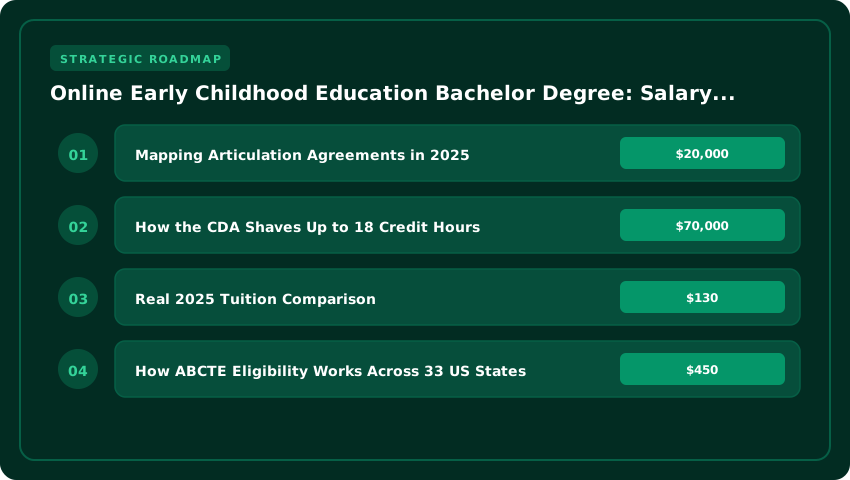
Mapping Articulation Agreements in 2025
Articulation agreements are formal transfer pacts between a community college and a four-year institution that guarantee course-by-course credit acceptance. In Early Childhood Education (ECE), these agreements are particularly generous because the field shares a tightly defined knowledge base across Child Development, Curriculum Design, and Family Engagement. State systems in California, Texas, Florida, New York, and Virginia have published statewide ECE transfer compacts that allow an Associate of Arts in Early Childhood Education or an Associate of Applied Science in Child Development to transfer as the full junior year at partnering universities. Schools like Brandman University (now UMass Global), the University of Cincinnati Online, and several California State University campuses actively recruit transfer students who arrive with their Associate for Teacher Preparation (ATP) or Child Development permits already in hand.
- Guided Pathways reduce credit loss, often letting students transfer 60 credits cleanly toward a 120-credit bachelor’s.
- 2+2 Structured Programs let students finish general education and lower-division ECE coursework at community college tuition rates.
- Embedded Practica at the associate level mean students enter the bachelor’s with real classroom hours already documented.
How the CDA Shaves Up to 18 Credit Hours
The Child Development Associate (CDA) credential, awarded by the Council for Professional Recognition, is more than a résumé line. It is a federally recognized stackable credential that many accredited bachelor’s programs accept for prior learning credit. Depending on the receiving institution, a current CDA can translate into 9 to 18 credit hours of ECE coursework, covering foundations of child development, health and safety, and observation. For working preschool teachers, this credit is essentially free, paid for by their employing district, a TEACH Grant, or a state scholarship like T.E.A.C.H. Early Childhood.
Real 2025 Tuition Comparison
The math is where this pathway becomes undeniable. According to College Board data, in-district community college tuition averages $130 per credit hour, while private university ECE programs range from $450 to $1,200 per credit hour. Completing the first 60 credits at a community college costs roughly $7,800, compared with $27,000 to $72,000 at a private institution, savings that can fund a master’s degree or a first home.
ABCTE, Praxis, and State Certification: Which Credentials Actually Unlock a Public-School Teaching Seat
Earning an online bachelor’s in Early Childhood Education is a major milestone, but in the United States the diploma alone will not hand you a classroom key. To legally instruct PreK-3 students in a public school, candidates must stack three independent credentials: a state-issued teaching license, a verified background check, and a subject-matter assessment that the state actually accepts. Understanding how the American Board for Certification of Teacher Excellence (ABCTE), the Praxis Core, and the Praxis II Early Childhood Education exam fit into that stack is the difference between getting hired in August and getting a polite rejection letter in July.
How ABCTE Eligibility Works Across 33 US States
The American Board for Certification of Teacher Excellence operates in 33 states and the District of Columbia, offering an alternative route for career changers who already hold a bachelor’s degree in something other than education. Instead of enrolling in a teacher-preparation program, ABCTE candidates document subject-matter competency and then complete a state-specific classroom readiness course plus a mentored teaching experience. States such as Florida, Texas, Pennsylvania, Ohio, and South Carolina actively recruit ABCTE candidates to fill PreK-3 shortages, while California, New York, and Illinois largely do not recognize the credential. If you graduate from an online ECE bachelor’s program, you will typically pursue a traditional state license rather than ABCTE, but knowing whether your target state accepts ABCTE matters if you plan to move later in your career.
Praxis Core and Praxis II Early Childhood Education: 2025 Cut Scores by State
Most states require two Praxis batteries. Praxis Core Academic Skills for Educators covers reading (passing range 156-169 by state), writing (162-170), and mathematics (150-164). After Core, candidates sit for Praxis II Early Childhood Education (5025), which tests child development, language and literacy, mathematics, science, social studies, the arts, health, and professional practice. The raw-to-scaled score range is 143-185, but the cut score you must clear depends entirely on where you plan to teach. For 2025, Florida and Texas both require a 156, Georgia requires a 157, North Carolina accepts a 158, and highly competitive states like Massachusetts and New York often look for 160 or higher before approving the license. Failing to research the exact cut score is the single most common reason qualified graduates stall out six months before payday.
Why Online Bachelor Graduates Still Need an In-State Residency Practicum
Even when your coursework is delivered asynchronously through an online program, every US state department of education requires a supervised clinical residency in a real PreK-3 classroom within that state. Federal Title II reporting and Council for the Accreditation of Educator Preparation (CAEP) standards both mandate direct, on-site evaluation by a cooperating teacher and a university supervisor. Out-of-state or fully remote practicums are routinely rejected by licensure officers. Plan on completing at least 12-16 weeks of full-time student teaching in a district that matches your state’s endorsement codes, and budget for relocation costs if your program does not arrange a host site near you.
- Document every credential: ABCTE certificate, Praxis Core passing scores, Praxis II ECE scores, background clearance, and residency completion must be filed with your state’s Office of Educator Certification.
- Match cut scores to state, not federal guidelines: There is no single national passing standard for Praxis II Early Childhood Education.
- Budget $100-$300 per Praxis test: ETS charges $146 for Praxis Core and $199 for Praxis II, plus optional score-reporting fees.
- Stack a CDA credential early: Many articulation agreements convert a Child Development Associate (CDA) into 9-12 college credits, accelerating licensure timelines.
What a 2025 US Early Childhood Educator Actually Earns (By State, Setting, and Degree Level)
If you are weighing the tuition cost of an online Early Childhood Education bachelor’s against the salary you will actually take home, the smartest move is to anchor every projection in real Bureau of Labor Statistics (BLS) numbers rather than vague national averages. The May 2024 Occupational Employment and Wage Statistics release, which is the benchmark most career counselors and FAFSA financial aid planners are using throughout 2025, shows a meaningful pay gap between preschool teachers and kindergarten teachers that directly rewards the bachelor’s degree.
BLS Preschool Teacher vs Kindergarten Teacher Pay: The $11,400 Annual Gap
According to the US Bureau of Labor Statistics, preschool teachers (SOC 25-2011) earn a national median wage of $37,120 per year, or roughly $17.85 an hour. Kindergarten teachers (SOC 25-2012), who typically work in public elementary schools and are required to hold at least a bachelor’s degree plus state licensure, earn a national median of $48,530 annually, or about $23.33 an hour. That is a difference of $11,410 per year before taxes, and over a standard 30-year career it compounds into more than $340,000 in additional lifetime income** simply by holding the four-year credential. The gap exists because kindergarten teachers fall inside the K-12 public school salary schedule, which the US Department of Education tracks through the National Center for Education Statistics (NCES), while preschool teachers operate in a more fragmented market of private child care, Head Start grantees, and community-based centers.
Top 5 Highest-Paying US States for ECE Bachelor’s Holders in 2025
Where you teach matters as much as what you teach. Based on BLS OEWS May 2024 data projected into 2025 hiring cycles, the five states paying the highest median wages to early childhood educators with a bachelor’s degree are:
- Massachusetts — Kindergarten teachers: $72,680 median; preschool teachers: $46,210. Boston-area districts and Cambridge Public Schools routinely pay above $80,000 with a bachelor’s plus one licensure area.
- New York — Kindergarten teachers: $68,410 median; preschool teachers: $51,990. New York City Public Schools and Westchester districts lead the nation in step-and-lane salary scales.
- Connecticut — Kindergarten teachers: $67,250 median; preschool teachers: $44,780. Strong union contracts in Fairfield County push starting pay above $55,000.
- California — Kindergarten teachers: $66,890 median; preschool teachers: $43,150. California’s Transitional Kindergarten expansion is creating immediate openings for credentialed graduates.
- Washington State — Kindergarten teachers: $65,470 median; preschool teachers: $40,310. Seattle and Bellevue districts top the West Coast after adjusting for cost of living.
Lower-cost states such as Mississippi, West Virginia, and Arkansas still hire aggressively, but kindergarten median pay in those regions drops to the $44,000–$47,000 range, which compresses the ROI on tuition considerably.
How Head Start, Private Child Care, and Public Schools Differ in Compensation and Benefits
The employer setting you choose will dramatically reshape your total compensation package, and prospective ECE students should map this out before signing a tuition agreement with their online program.
Public K-12 schools are the clear financial winner for bachelor’s holders. Salaries follow district salary schedules, with annual step increases of 2-4 percent, defined-benefit pension plans through state retirement systems (CalSTRS, NYSTRS, MassTeachers), and employer-paid health insurance averaging $12,000–$18,000 per year in value. Summers off offer optional supplemental income through curriculum work or summer school.
Head Start programs, administered through the US Department of Health and Human Services’ Office of Head Start, pay preschool teachers a median of roughly $38,500 nationally, but they offset lower base wages with strong federal benefits packages. Full-time Head Start staff typically receive paid planning time, tuition reimbursement for continuing education, and access to the federal Employee Retirement System. Many Head Start grantees now require or strongly prefer a bachelor’s degree, especially for lead teacher roles in center-based programs serving 3- to 5-year-olds.
Private child care centers, including national chains like Bright Horizons, KinderCare, and Primrose Schools, offer the widest pay variance. Entry-level lead teachers with an associate degree start near $32,000, while bachelor’s-credentialed curriculum coordinators and assistant directors at premium urban centers can earn $55,000–$65,000. Benefits are inconsistent: corporate-owned centers often provide health insurance and 401(k) matching after 90 days, while independent nonprofit providers may offer only partial coverage.
The bottom line for ROI planning: a bachelor’s degree in Early Childhood Education is most valuable when paired with state teacher licensure and a public school contract, where the $11,400 kindergarten premium, state pension, and robust benefits package can repay community-college-to-university tuition investments within three to five working years.
Online vs. Hybrid vs. Brick-and-Mortar ECE Bachelor Programs: Where the Real Trade-Offs Hide
Choosing between an online, hybrid, or fully seated Early Childhood Education (ECE) bachelor program is rarely about which format is “best.” It is about which one fits the life you are already living. For working paraprofessionals, Head Start teachers, and nannies pursuing certification through the US Department of Education–approved pathway, the format decision can mean the difference between finishing in three semesters and burning out in five years.
Field Placement Flexibility: The Make-or-Break Variable
Every NAEYC-accredited bachelor program, regardless of modality, requires documented field hours in authentic birth-through-age-eight settings. The difference lies in how those hours get scheduled.
- Online programs typically let you complete practicum hours in your current employer site, which is a genuine lifeline for assistants who cannot relocate.
- Hybrid programs usually require two to three weekends per semester at a partner lab school, plus local placements coordinated by a university field supervisor.
- Brick-and-mortar programs lock students into cohort schedules, often eight full days per term, which complicates life for anyone holding a 40-hour workweek.
Synchronous vs. Asynchronous Observation Hours in 2025 Curricula
Updated 2025 NAEYC standards push programs toward competency-based evidence rather than seat time. That shift is reshaping how observation hours get verified. Most online ECE bachelor programs now bundle asynchronous video analysis modules using recorded classroom footage, while reserving synchronous Zoom check-ins for coaching and reflection. Hybrid and seated programs, by contrast, still rely heavily on live peer debriefs. For working adults juggling shift work, that asynchronous latitude is the single biggest accelerator.
How US Districts Actually Perceive Online ECE Degrees
Here is the honest answer: most public school districts do not differentiate between accredited online and seated ECE bachelor programs once the credential carries state licensure and a NAECY stamp. Human resources directors in states like Texas, Florida, and Ohio routinely confirm that pay scales reference the degree itself, not the delivery format. However, some private preschool chains and Montessori employers still quietly favor in-person graduates, citing mentorship culture. If your target role is a public pre-K or Head Start center director position, an online ECE degree from a regionally accredited institution is functionally equivalent in the hiring room.
The Real Trade-Off
Online saves time and money, hybrid offers the middle ground of networking and flexibility, and brick-and-mortar delivers the deepest cohort bonds but at the highest opportunity cost. Working professionals earning less than $48,000 annually, the 2025 median for childcare workers per the Bureau of Labor Statistics, usually find the online route pays for itself within one promotion cycle.
FAFSA, Pell Grants, and TEACH Grants: How to Cut a 4-Year Online ECE Degree Down to a Sub-$10K Out-of-Pocket Cost
The sticker price on an online Early Childhood Education bachelor’s can look intimidating, often landing somewhere between $30,000 and $60,000 before aid. The good news? Federal and state aid programs can quietly chop that number down to a few thousand dollars out of pocket, especially when you route your first two years through a community college and lean on scholarships designed for working child care professionals.
Step 1: File the FAFSA During the 2025-2026 Window
The Free Application for Federal Student Aid opened on October 1, 2024, and most states set their priority deadlines between February 1 and April 15, 2025. Submit through the official US Department of Education portal at studentaid.gov, and list every school you are considering, including your community college and the four-year university accepting your transfer credits. The FAFSA determines your eligibility for the Pell Grant, which currently maxes out at $7,395 per award year. For an ECE student coming from a low- or middle-income household, that single grant can cover most tuition at an in-district community college for two years, and the unused portion often carries forward when you transfer.
Step 2: Stack the TEACH Grant on Top
If you plan to teach early childhood in a low-income public school or qualifying Head Start program after graduation, the federal TEACH Grant can deliver up to $4,000 per year, or roughly $16,000 over a four-year degree. The catch is a strict service obligation: complete a four-year teaching commitment within eight years of finishing your program, and maintain a 3.25 GPA throughout. ECE majors often qualify because Title I schools and Head Start centers count as high-need, low-income placements. One missed deadline converts the grant into an unsubsidized loan, so calendar reminders are non-negotiable.
Step 3: Tap WIOA Scholarships in Your State
The Workforce Innovation and Opportunity Act funds state-level scholarships for child care workers in at least 14 states, including California, New York, Texas, Illinois, and Pennsylvania. If you already work in a licensed child care setting, your local American Job Center can cover tuition, books, and even certification exam fees for an ECE degree. Combine WIOA funding with Pell and TEACH, and most working educators graduate with debt under $10,000, sometimes under $4,000.
- FAFSA priority window: File by March 1, 2025 for maximum state aid in most regions.
- Pell Grant ceiling: $7,395 for 2025-2026, renewable for six years.
- TEACH Grant cap: $4,000 annually, contingent on four years of high-need teaching.
- WIOA eligibility: Currently employed child care staff in 14 participating states.
Stack these three levers, and the once-daunting cost of an online ECE bachelor’s becomes a realistic, budget-friendly investment.
Career Mobility After the Bachelor’s: From Lead Teacher to Center Director in Under 5 Years
Earning an online bachelor’s in Early Childhood Education (ECE) is rarely the end goal for ambitious educators; it is a launchpad. In the US labor market, the credential you finish with directly determines whether you cap out at an assistant teacher salary near $30,000 or break into the $80,000-to-$110,000 director and corporate child care bracket within a half-decade. The math is straightforward: every rung up the state licensure ladder usually correlates with a $15,000 to $25,000 pay jump, and the right bachelor’s can fast-track that climb.
Bachelor’s vs. Master’s: Which Degree Unlocks State Pre-K Director Licensure?
Across most US states, a bachelor’s degree in Early Childhood Education combined with supervised teaching experience is the minimum threshold for a center director license. According to the US Bureau of Labor Statistics (BLS), preschool and childcare center directors earn a median annual wage of $63,290, but the top 10% of earners pull in over $100,000, especially in metropolitan districts like San Francisco, Boston, and Washington, DC.
Here is the trade-off working educators should weigh:
- CDA + Bachelor’s (most common path): A Child Development Associate (CDA) credential stacks as college credit at hundreds of community colleges, allowing an early childhood teacher to enter a bachelor’s completion program as a junior. This route satisfies state pre-K director requirements in roughly 30 states.
- Master’s in ECE or Educational Leadership: A master’s degree is required only in states with stricter director credentialing rules, such as Massachusetts, New York, and parts of Illinois. It also unlocks principal-level roles in public school pre-K programs, where salaries can exceed $110,000.
For most professionals targeting private and corporate child care, the bachelor’s alone is the credential ceiling. For those eyeing public school district leadership or higher education, the master’s degree is non-negotiable.
NAEYC Director Credential Stacking: A National Fast-Track
The National Association for the Education of Young Children (NAEYC) offers a stackable director credential that pairs cleanly with an accredited bachelor’s. Because NAEYC recognition is respected across state licensing boards, stacking the credential onto your degree compresses a typical five-year director eligibility timeline into roughly three years of post-bachelor work. Employers increasingly view this dual credential as a hiring mandate, not a bonus.
Corporate Child Care and Creative Employer Roles: The $80K-$110K Tier
Beyond traditional centers, Fortune 500 employers are recruiting ECE-trained leaders to run on-site child care, family resource hubs, and early learning content strategy roles. Tech and media companies, including Disney, Pinterest, Amazon, and Salesforce, frequently post director-level early learning positions in the $90,000-to-$110,000 range. These roles typically require a bachelor’s, NAEYC alignment, and experience managing multi-classroom operations.
For working educators, the promotion timeline looks like this. Year one, lead teacher salary averaging $36,000. Years two through three, move into an assistant director role earning $48,000 to $55,000. Year four, center director averaging $63,000 nationally, or a corporate employer role pushing past $85,000. Year five, regional director or curriculum strategist clearing $100,000.
The bachelor’s is the credential that unlocks every single one of those doors.
Accreditation Red Flags: Spotting Diploma Mills Before You Enroll in an Online ECE Program
Picture this: you spend three years and roughly $45,000 earning an “online bachelor’s in Early Childhood Education,” only to discover that no public school district, Head Start grantee, or licensed childcare center in the United States will touch your transcript. Unfortunately, this nightmare plays out for hundreds of adult learners every year, and the culprit is almost always accreditation fraud dressed up in glossy website design.
Protecting your time, money, and career trajectory starts with understanding one crucial hierarchy in American higher education. Regional accreditation, granted by bodies like the Higher Learning Commission (HLC), the Southern Association of Colleges and Schools Commission on Colleges (SACSCOC), or the Middle States Commission on Higher Education (MSCHE), is the gold standard. Employers, state licensing boards, and transfer-credit evaluators recognize and trust it. Programmatic credentials, such as CAEP for teacher preparation or NAEYC recognition for early childhood programs, are valuable add-ons, but they cannot rescue a degree from a school that lacks regional accreditation. If you must choose between the two, regional wins every time.
Verify Title IV Eligibility Before You Enroll
Any legitimate school that participates in federal financial aid will appear in the U.S. Department of Education’s Federal Student Aid database, and you can cross-check it in under two minutes at studentaid.gov. Title IV eligibility is a powerful filter because the Department only certifies schools that have earned recognized accreditation, maintain acceptable cohort default rates, and comply with federal financial responsibility standards. If your chosen online program is missing from the database, you cannot use FAFSA, your credits likely will not transfer to a state university, and your future employer will treat your degree as a liability rather than a credential.
Three Warning Signs of a Diploma Mill
- Accreditation from a non-recognized body. Watch for names like the “Accrediting Council for Independent Colleges and Schools” successor shells or any agency not listed on the Council for Higher Education Accreditation (CHEA) database. A real seal on a slick webpage means nothing without a verifiable parent institution.
- Degrees awarded in unusually short timeframes. If a program promises a full bachelor’s in Early Childhood Education in under 18 months with no prior college credit, or offers “life experience” substitutions for student teaching practica, the institution is selling paperwork, not education.
- No public contact information, no state authorization, and aggressive recruitment. Diploma mills often operate from P.O. boxes, lack a physical campus, and push you toward enrollment through high-pressure sales calls. Legitimate online universities will be transparent about their state authorization reciprocity (SARA) status and willing to mail you sample syllabi.
Run every prospective online ECE program through this checklist before you submit a single form or pay a deposit. Your future salary, licensure portability, and ability to transfer credits toward a master’s degree all depend on the legitimacy of the institution you choose today.
| Pathway | Total Tuition (USD) | Time to Complete | Median Salary (2025) | Transferable Credits | Best For |
|---|---|---|---|---|---|
| Community College AA → State University BAE | $18,000 – $28,000 | 3 years | $47,320 (Pre-K Lead Teacher) | 60+ credits | Budget-conscious in-state students |
| CDA Credential + Bachelor Completion | $22,000 – $32,000 | 2.5–3 years | $45,680 (Head Start Teacher) | 9–12 stackable credits | Current childcare workers |
| Private 4-Year University (On-Campus) | $88,000 – $140,000 | 4 years | $48,100 (Early Childhood Director) | 0 transfer credits | Students seeking campus experience |
| Public 4-Year University (Out-of-State) | $64,000 – $96,000 | 4 years | $47,320 (Pre-K Lead Teacher) | 0–30 credits | Non-resident applicants |
| Online BAE (State Public University) | $30,000 – $45,000 | 4 years (accelerated: 2.5) | $52,400 (ECE Program Coordinator) | Up to 90 credits | Working adults and parents |
Frequently Asked Questions
How much does a bachelor's in Early Childhood Education cost through a US community college pathway?
In 2025, completing an Early Childhood Education bachelor's through a community college articulation agreement costs between $18,000 and $32,000 total. This includes two years of in-district tuition averaging $130/credit hour plus two years at a state public university averaging $330/credit hour, saving students $20,000–$70,000 versus private institutions.
How long does it take to get a bachelor's in Early Childhood Education online?
An online Bachelor of Arts in Early Childhood Education typically takes 4 years for traditional students but can be completed in 2.5 years through accelerated formats. Students transferring 60 community college credits or holding a Child Development Associate (CDA) credential can finish in roughly 24–30 months while maintaining full-time employment.
What salary can you earn with an Early Childhood Education bachelor's degree in the US?
BLS 2024 occupational data (released 2025) shows median annual wages of $47,320 for preschool teachers, $48,100 for preschool and childcare center directors, and up to $61,930 for education administrators in kindergarten through elementary settings. Head Start lead teachers in federal programs average $54,200 with bachelor's credentials.
Can you transfer community college credits into an Early Childhood Education bachelor's degree?
Yes. Most US state universities hold articulation agreements with community colleges, accepting 60–90 transferable credits toward a Bachelor of Arts in Early Childhood Education. The Child Development Associate (CDA) credential stacks 9–12 credits, while an Associate of Arts (AA) in Early Childhood typically transfers as a junior-year block.
What are the admission requirements for an online Early Childhood Education bachelor's program?
Most accredited online BAE programs require a 2.5 minimum GPA, SAT/ACT scores (sometimes waived for transfer students), official community college transcripts, a background check for field placements, and prerequisite coursework in child development, English composition, and college mathematics. CDA holders often receive automatic conditional admission.
Strategic Final Takeaway
When evaluating Early Childhood Education Bachelor Degree Online Community College Certification Pathway Salary, base your decisions on accredited institutional standards, measurable return on investment (ROI), and up-to-date official guidelines. Always verify specific dates and requirements through official regulatory portals.

