

Why Choose a Community College Pathway for a Bachelor’s in Early Childhood Education in 2026?
If you are currently working in a preschool, Head Start classroom, or after-school program, the traditional four-year residential route to a bachelor’s degree often feels impossible. Between rent, childcare costs for your own kids, and the salary reality of early childhood educators (the BLS reports a 2024 median pay of just $36,440 for preschool teachers and $47,460 for kindergarten teachers), stepping away from full-time work is rarely an option. That is exactly why the community college 2+2 transfer model has become the dominant upskilling pathway for adult learners targeting Early Childhood Education (ECE) credentials in 2026.

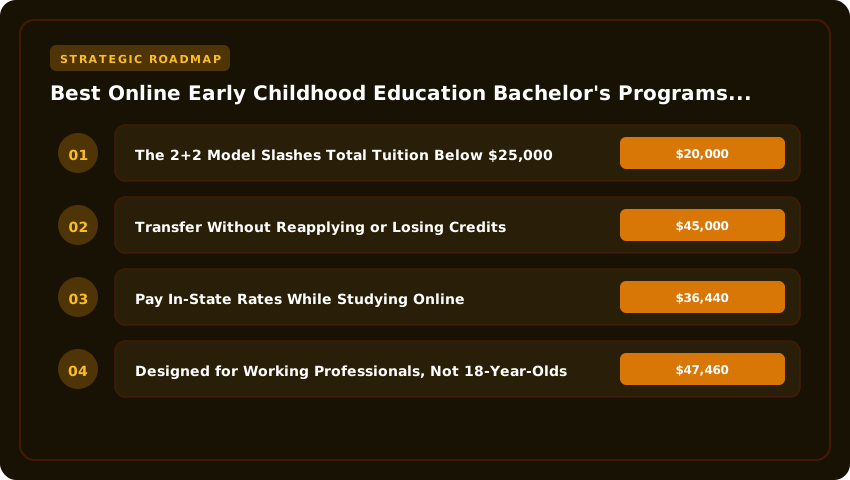
The 2+2 Model Slashes Total Tuition Below $25,000
Tuition math makes the case almost instantly. According to College Board, the average 2024–2025 in-district community college tuition hovered around $3,730 per year, while in-state public university upper-division coursework averaged $11,260. By completing the first 60 credit hours at the community college rate, then transferring online to finish the final 60 credits at a partner state university, students can realistically finish the entire bachelor’s for under $25,000. Compare that to a four-year private university, which frequently tops $180,000 in total sticker price, and the ROI becomes obvious.
Transfer Without Reapplying or Losing Credits
The most overlooked advantage is academic security. When you enroll in a regionally accredited “guided pathway” or “transfer compact” with a state university system (think Florida’s State College System + USF, California’s ADT + CSU, or Texas’ Core Curriculum + Texas A&M-Commerce), the acceptance of your Associate of Arts in Teaching or Associate of Science in Early Childhood is guaranteed. You skip the Common App, skip the admission essay, and skip the transfer-credit audit anxiety. Your credits move with you, which protects your GPA and your financial aid standing with the U.S. Department of Education.
Pay In-State Rates While Studying Online
Because community colleges are funded by local property taxes and state appropriations, distance learners who complete their associate degree while living out of state still typically qualify for in-state tuition at the receiving public university, especially when the upper-division ECE program is delivered 100% online. This means a preschool lead teacher in rural Tennessee can finish a bachelor’s offered by a flagship public university without paying non-resident surcharges that can exceed $20,000 annually.
Designed for Working Professionals, Not 18-Year-Olds
Unlike on-campus cohorts, online completion programs are built around asynchronous lectures, evening Zoom practicums, and embedded field experiences you can complete at your current employer. For paraprofessionals seeking a state teaching license, or lead teachers working toward a CDA Credential plus a bachelor’s, the asynchronous structure means the program bends to your classroom schedule, not the other way around. In 2026, this flexibility is not a perk; it is the baseline expectation for any upskilling degree worth its cost.
NAEYC and Regional Accreditation Standards Every Online ECE Bachelor’s Must Meet
If you are investing four years and roughly $40,000 into an online Early Childhood Education (ECE) bachelor’s degree, the single most expensive mistake you can make is graduating from a program that your state licensing board, a Head Start grant reviewer, or a future school district will not recognize. Before you fill out a single FAFSA form, you need to confirm that your chosen online program meets two layers of accreditation: a regional body that validates the institution itself, and a specialized body that validates the teacher-preparation quality.
Mapping NAEYC Standards to Online Program Outcomes
The National Association for the Education of Young Children (NAEYC) published its landmark Standards for Early Childhood Professional Preparation (2020 revision), which replaced the 2012 framework. Every reputable online bachelor’s program now aligns its coursework, practicum hours, and student teaching to these six standards: child development and learning in context, family–community partnerships, equity, teaching practices, assessment, and professional leadership. When reviewing a program’s website, look for course descriptions that explicitly cite NAEYC Standard 1 (Child Development), Standard 4 (Teaching Practices), and Standard 5 (Assessment), and confirm that the required practicum is at least 300 supervised hours in a birth-through-age-8 setting. If the language is vague, the program likely has not completed the alignment work.
Regional Accreditation Recognition on Your Transcript
Regional accreditation is the non-negotiable credential that determines whether your credits transfer and your degree is hired. The U.S. Department of Education recognizes seven regional accreditors; the four most relevant for online ECE bachelor’s programs are the Higher Learning Commission (HLC), the Southern Association of Colleges and Schools Commission on Colleges (SACSCOC), the Middle States Commission on Higher Education (MSCHE), and the WASC Senior College and University Commission (WSCUC). These accreditors verify institutional mission, faculty credentials, and student outcomes. A regionally accredited online ECE bachelor’s signals to employers and licensing boards that your degree has passed the same rigor as a campus-based program at a public university.
Why State Licensure Requires CAEP or NCATE Accreditation
State Departments of Education (PDE in Pennsylvania, DOE in New York, TEA in Texas, and so on) do not license graduates, they license preparation programs. That means a state will only issue you an early childhood teaching certificate if the bachelor’s program itself holds specialty accreditation from either the Council for the Accreditation of Educator Preparation (CAEP) or the legacy National Council for Accreditation of Teacher Education (NCATE). Head Start grantees operating under the U.S. Department of Health and Human Services (HHS) also require this credential for lead teacher positions, which now mandate a bachelor’s degree. Skipping this step can lock you into a degree that is academically excellent but professionally unusable.
Verifying Accreditation Before You Enroll
The fastest way to protect yourself is a three-minute database check. Run the institution’s name through the U.S. Department of Education’s Database of Accredited Postsecondary Institutions and Programs, then confirm the CAEP/NCATE accreditation through the Council’s own program directory. Do not rely on screenshots, marketing copy, or PDF certificates embedded in admissions emails. If the school cannot be found in either database, walk away, no matter how low the tuition appears.
- Confirm NAEYC alignment: Look for explicit language citing the 2020 Standards in course descriptions and practicum manuals.
- Confirm regional accreditation: HLC, SACSCOC, MSCHE, or WSCUC must appear on the ED database, not just the school’s brochure.
- Confirm specialty accreditation: CAEP or legacy NCATE recognition is mandatory for state ECE licensure and Head Start lead-teacher eligibility.
- Confirm transferability: Ask whether the online program has articulation agreements with your community college so you preserve the $20,000–$45,000 tuition savings without losing credit.
Curriculum Breakdown: Foundational Courses, Practicum Hours, and State Licensing Alignment
A typical online Early Childhood Education (ECE) bachelor’s pathway at a US community college follows a deliberate 2+2 structure, where the first two years establish a broad liberal-arts foundation and the final two years layer in age-3-to-grade-3 specialization. For working paraprofessionals and preschool lead teachers, this split matters enormously: the lower-division general education core is almost always transferable, so students rarely lose credits when they move from an accredited community college into a four-year online completion program.
Foundational General Education Core (Lower Division)
Expect roughly 30 to 36 semester hours of general education built around three anchor disciplines:
- Child Development — usually a two-course sequence covering prenatal through age-eight theory, with attention to Piaget, Vygotsky, and contemporary brain-based research.
- Linguistics and Language Acquisition — a transfer-friendly course that satisfies both general education and ECE major requirements, especially valuable for future ESL or dual-language classroom work.
- Applied Statistics for Educators — a non-calculus statistics course that meets quantitative literacy requirements while preparing students to read assessment data, which the US Department of Education increasingly expects of all credentialed teachers.
Specialized Upper-Division ECE Coursework
Once admitted to the online bachelor’s completion major, students tackle roughly 36 upper-division hours of specialized content. Common required courses include:
- Emergent Literacy and Reading Foundations — phonemic awareness, alphabet principles, and the science-of-reading frameworks now mandated in over 35 states.
- Early Mathematics Foundations — number sense, subitizing, and concrete-representational-abstract sequencing aligned with the National Association for the Education of Young Children (NAEYC) standards.
- Trauma-Informed Practice in Early Childhood — a relatively new but fast-growing course that addresses adverse childhood experiences (ACEs), co-regulation, and resilience-building strategies.
- Inclusive Environments and Differentiated Instruction — designing Individualized Education Programs (IEPs) and supporting children with disabilities alongside typically developing peers.
Embedded Supervised Practicum (300–600 Hours)
The single biggest workload consideration is the practicum. Most accredited online ECE bachelor’s programs require between 300 and 600 supervised field hours, completed at NAEYC-accredited early childhood centers, Head Start sites, or public pre-K classrooms. For working educators, this is usually the make-or-break planning variable: a 300-hour practicum spread over two semesters averages roughly 10 hours per week, while a 600-hour version can climb to 20. Many community-college transfer students negotiate with their current employer to count existing supervised hours toward this requirement, which can shave an entire semester off the timeline.
Alignment With CDA Renewal and State Pre-K–3 Certificates
Accredited programs deliberately design coursework to double-count for professional credentials. A bachelor’s that meets ABET-equivalent regional accreditation standards through bodies such as the Council for the Accreditation of Educator Preparation (CAEP) will typically satisfy the 120-hour annual training requirement for Child Development Associate (CDA) credential renewal. More importantly, the degree’s practicum and methods courses map directly onto state pre-K through grade-3 teaching certificate competencies, so graduates can sit for the Praxis Early Childhood Education exam (often code 5025) and apply for state licensure without re-entering a teacher-preparation program.
Transfer Credit Maximization: Turning an Associate Degree into a Four-Year ECE Credential
If you are currently working in a preschool, Head Start classroom, or family childcare setting, every credit you have already earned should count toward your bachelor’s degree. The difference between a smart 2+2 transfer and a costly four-year restart often comes down to a single document: the official transcript evaluation. When you understand how an Associate of Arts (AA), Associate of Science (AS), or Associate of Applied Science (AAS) in Early Childhood Education maps onto a four-year ECE curriculum, you can shave $20,000 to $45,000 off your total tuition and finish your degree in 24 to 30 months instead of four full years. That is not a marketing pitch. It is the math behind the articulation agreements that community colleges across the US have spent decades negotiating with regional universities.
Know Your Degree Type Before You Enroll
The first rule of transfer credit maximization is matching the right associate degree to the right bachelor’s program. An AA or AS in Early Childhood Education is designed to satisfy most of the lower-division general education requirements at a four-year school, meaning nearly all 60 credits typically transfer. An AAS, by contrast, is a terminal technical degree, so only 30 to 45 of its credits usually articulate to a Bachelor of Science in Early Childhood Education. Before you commit to a community college program, pull the receiving university’s transfer guide and confirm whether your intended AAS is on the approved list. If it is not, you may need to complete a few bridge courses to reach the 60-credit threshold that unlocks junior standing.
Use TES and State Articulation Guarantees to Lock In Credits
Most accredited US institutions publish their course-by-course equivalencies through the Transfer Evaluation System (TES), a database maintained by the American Association of Collegiate Registrars and Admissions Officers. Run your community college courses through TES before you register for any class. In parallel, check whether your state participates in a guaranteed transfer initiative. States like Florida (the statewide Articulation Agreement), Texas (the Field of Study Curriculum), and Washington (the Direct Transfer Agreement) legally require public universities to accept an entire associate degree as lower-division credit. Filing your intent to transfer early, often during your first semester at the community college, freezes those credits at current catalog year and protects you from sudden policy changes.
Translate Your CDA and Field Experience Into College Credit
A Child Development Associate (CDA) credential issued by the Council for Professional Recognition can be worth up to 9 college credits at many online ECE programs, particularly those aligned with National Association for the Education of Young Children (NAEYC) standards. Some universities will also evaluate non-credit coursework from organizations like the National Head Start Association or state-recognized apprenticeship programs. Submit your CDA portfolio, professional development certificates, and supervisor verification letters alongside your transfer petition. Documentation is everything: an ECE director who can articulate 60 prior-learning credits effectively starts a bachelor’s program as a junior.
Cut Time-to-Degree From 48 Months Down to 24
Two semesters of full-time enrollment at the receiving university, layered on top of two years of community college work, is the standard 2+2 timeline. If you transfer with 60 credits that satisfy all general education and core ECE foundations, you spend the final two semesters focused only on upper-division coursework like curriculum design, assessment, and administration. Working educators can stack 7-week accelerated terms to graduate in 18 months. The result is a regionally accredited bachelor’s degree that qualifies you for lead teacher roles paying $48,000 to $62,000 annually, according to the US Bureau of Labor Statistics, without ever putting your classroom career on hold.
Career Outcomes and Salary Outlook for Bachelor’s-Prepared Early Childhood Educators in 2026
The math has finally caught up with the mission. After decades of being treated as glorified babysitters, early childhood educators with a four-year degree are stepping into a job market that rewards their credentials with measurable raises, stronger job security, and a clearer ladder into administration. If you are weighing whether to invest the next two to four years finishing your bachelor’s while working in a classroom, the 2026 wage data from the U.S. Bureau of Labor Statistics makes the case in dollars and cents.
BLS Projections Through 2032: Steady Demand, Not a Fad
The BLS Occupational Outlook Handbook tracks preschool teachers and kindergarten teachers as two distinct categories, and both look healthy. Employment of preschool teachers is projected to grow roughly 8 percent through 2032, faster than the average for all occupations, while kindergarten and elementary special education teachers are expected to grow about 4 percent. Roughly 120,000 openings per year are projected across both groups, driven by enrollment expansion in public PreK programs and ongoing turnover in a chronically understaffed field. Translation: a bachelor’s-prepared educator is not chasing a shrinking pipeline. You are stepping into a labor shortage that state legislatures keep trying to fix.
Median Pay and Where the Money Lives
Nationally, preschool teachers earned a median annual wage of $37,130 in the most recent BLS release, with kindergarten teachers landing closer to $60,000 because most work in public school districts. Geography, however, dramatically reshapes that paycheck. The top-paying metropolitan areas for early childhood educators include San Jose-Sunnyvale-Santa Clara, where preschool teacher averages routinely clear $48,000, and the Washington-Arlington-Alexandria corridor, where Head Start and Title I PreK positions start between $42,000 and $55,000 depending on credentials. Boston, Seattle, and the San Francisco Bay Area round out the metros where a bachelor’s lifts you into the upper quartile of the BLS wage distribution almost immediately.
From Lead Teacher to Center Director: The Administrative Lift
The single biggest salary unlock for working professionals is the move from lead teacher to center director or program coordinator. Childcare center directors with a bachelor’s degree in Early Childhood Education or Child Development earn average salaries between $58,000 and $72,000 nationally, according to aggregated BLS and industry compensation surveys. In large metro markets and at corporate-run chains (Bright Horizons, KinderCare, Primrose), directors with a four-year degree plus three to five years of teaching experience frequently cross the $80,000 mark, plus benefits and tuition reimbursement for their own staff. The promotion also typically moves you off the floor and into a salaried role with predictable hours, a change working parents in the field consistently call a quality-of-life upgrade.
The Public School Door: PreK-3 Licensure and District Salaries
Here is where the 2+2 community college pipeline pays off twice. Completing a bachelor’s in Early Childhood Education from a regionally accredited program typically makes you eligible for a state PreK-3 or Birth-Grade 3 teaching license, the credential public school districts require to run their own PreK classrooms. Starting salaries for licensed PreK-3 teachers in 2026 generally fall between $48,000 and $65,000 depending on the district, with public school schedules, pension eligibility, and step-and-lane raises attached. Compare that to the private childcare center median, and the bachelor’s unlocks a $10,000 to $25,000 annual premium in year one alone, before counting summer pay, health benefits, and loan forgiveness eligibility through programs like Public Service Loan Forgiveness (PSLF) and TEACH Grant conversions.
The Bottom Line for Working Professionals
If you are currently earning the national preschool median of $37,130, the four-year degree is not an expense. It is a salary escalator. Most working educators recover tuition costs within two to three years of finishing their program, and the credential compounds: every raise, every promotion, every district step becomes available to you in a way it simply is not with a CDA or associate degree alone. In 2026, finishing the bachelor’s is the single highest-return credentialing move available in the early childhood workforce.
Comparing Tuition, Financial Aid, and FAFSA Eligibility for Online ECE Programs
Let’s talk numbers, because this is where most working educators either freeze up or push forward. The average community college tuition for the 2026 academic year sits at roughly $3,990 for in-district students, according to College Board data. Compare that to the $11,260 average at four-year public universities, or the $44,000-plus at private institutions, and the savings start to look life-changing. For an Early Childhood Education (ECE) bachelor’s specifically, where many students complete an associate degree first, that two-year gap can mean keeping $14,000 to $20,000 in your own pocket before the bachelor’s transfer even begins.
Now here’s the part that genuinely surprises people: the Federal Pell Grant covers up to $7,395 per year for low-income ECE students, and unlike a loan, this money does not need to be repaid. Submitting the FAFSA (Free Application for Federal Student Aid) through the U.S. Department of Education is the gateway to Pell, work-study, and most state aid. Even working professionals who think they earn too much should still file, because the Expected Family Contribution formula changes with household size and dependent status. Many Head Start teachers and preschool assistants qualify for at least partial Pell awards, and that award travels with them to the accredited online program where they finish their bachelor’s.
Scholarships and Grants That Target Early Childhood Educators
Beyond federal aid, there is a layer of funding that exists specifically because America faces a teacher shortage in early childhood education:
- PTEF (Paraprofessional Teacher Education Fund): State-administered awards for classified school employees pursuing licensure, often worth $1,000 to $4,000 per academic year.
- TEACH Grant: A federal program offering up to $4,000 annually for students who commit to teaching in a high-need field like ECE at a low-income school for four years.
- State-funded ECE scholarships: Programs such as T.E.A.C.H. Early Childhood, Child Care WAGE$, and the Early Childhood Educators Scholarship Program exist in most states and frequently cover tuition, books, and even release time.
- Institutional aid: Many online bachelor’s programs stack their own merit and need-based awards on top of federal aid, so always ask an admissions counselor what is available before assuming the listed price is final.
Employer Tuition Reimbursement Worth Real Money
Finally, do not overlook the employers who are quietly writing checks for your degree. Bright Horizons offers tuition assistance through its Horizons Teacher Degree Program, often covering 100% of coursework for staff pursuing a bachelor’s in early childhood. KinderCare Education partners with several accredited online universities, providing direct tuition payments and schedule flexibility. Head Start agencies, funded through the U.S. Department of Health and Human Services, frequently reimburse tuition for employees working toward an ECE degree, especially when paired with a CDA credential upgrade.
Stack a Pell Grant with a TEACH Grant and employer reimbursement, and many ECE students find their online bachelor’s costs less than zero, meaning the degree essentially pays them to stay in the field they already love.
State-by-State Licensing Considerations for Online Early Childhood Education Graduates
Earning your bachelor’s degree online from a community college partner is a massive financial win, but the diploma is only half the battle. The real complexity sits with state licensing boards, and the rules shift dramatically the moment you cross a state line. If you are completing a 2+2 pathway in Texas but plan to teach in New York, you cannot afford to assume your curriculum checks every box. Understanding the landscape now prevents a frantic scramble for missing coursework or exams right before a job offer expires.
Five Major Markets, Five Distinct Rulebooks
Let’s look at the heavy hitters where many online graduates seek employment. In Texas, the TEA requires a bachelor’s degree, completion of an Educator Preparation Program (EPP), and passing scores on the TExES Pedagogy and Professional Responsibilities EC–12 (160) plus the Core Subjects EC–6 (391) exams. California operates differently; the Commission on Teacher Credentialing (CTC) issues a Child Development Permit at multiple levels. For a Site Supervisor or Master Teacher permit, you need specific semester units in ECE/CD—often 24 units plus 16 general education units—and experience hours that your online practicum must document meticulously.
Florida demands a passing score on the Florida Teacher Certification Examinations (FTCE) General Knowledge, Professional Education, and Prekindergarten/Primary PK–3 Subject Area exams. The state offers a Temporary Certificate valid for three years while you clear the testing hurdle. New York is notoriously rigorous: the NYSED requires the edTPA portfolio, the Educating All Students (EAS) test, and the Content Specialty Test (CST) for Early Childhood, plus mandatory workshops in Dignity for All Students Act (DASA), child abuse identification, and school violence prevention. Pennsylvania requires the PECT PreK–4 modules and a 3.0 GPA or qualifying Praxis Core scores for basic skills exemption.
Reciprocity: The “Moving Target” Myth
Many graduates assume NASDTEC Interstate Agreement means automatic portability. It does not. It is a framework, not a guarantee. Most states grant a provisional or temporary license based on your out-of-state credential, giving you one to three years to satisfy local testing deficits—often a specific reading instruction course or a state history exam. If you hold a Pennsylvania Instructional I and move to California, you will likely start on a Preliminary Credential with a list of “deficiencies” to clear. Always contact the destination state’s certification office before you pack the moving truck.
Public K–3 Endorsement vs. Private Sector Credentials
This distinction dictates your ceiling. A public school license (often labeled Early Childhood Education PreK–3 or PreK–4) allows you to teach kindergarten through third grade in a district setting, tying you to a union salary schedule, tenure track, and state pension systems like TRS or CalSTRS. A non-public certification—such as a Child Development Associate (CDA) upgrade, a Director’s Credential, or a state-issued Child Development Permit—qualifies you for Head Start lead teacher roles, private preschools, and childcare center directorships. The coursework overlaps, but the student teaching placement matters: public licensure almost always requires a supervised placement in a public elementary school (K–3), whereas private permits may accept hours in a licensed childcare center.
Renewal Cycles, CEUs, and the Testing Treadmill
Licenses expire. In Texas, the Standard Certificate renews every five years with 150 Continuing Professional Education (CPE) hours. California’s Child Development Permit renews every five years with 105 hours of professional growth. New York’s Professional Certificate requires 100 CTLE hours every five years, with specific mandates for ELL and CTLE language acquisition. Pennsylvania requires 180 Act 48 hours (or 6 college credits) every five years. Budget roughly $200–$500 per renewal cycle for fees and transcript processing. Keep a digital “licensure binder” from day one: syllabi, practicum verification letters, and exam score reports. It turns a five-year renewal from a panic attack into a 30-minute administrative task.
| Decision Criteria | Community College 2+2 Online Pathway | Traditional 4-Year University (Online/On-Campus) | Strategic Advantage |
|---|---|---|---|
| Total Tuition Cost (Est. 2026) | $12,000 – $22,000 (Associate + Bachelor’s completion) | $40,000 – $65,000+ (Four years tuition) | Save $20,000–$45,000+ total |
| Time to Degree (Working Full-Time) | 3.5–4.5 Years (Seamless transfer, no reapplication) | 4–6 Years (Often requires leave of absence) | Zero career interruption |
| Admission / Screening Cutoffs | Open enrollment AA; 2.0–2.5 GPA for BAS transfer | 3.0+ GPA, SAT/ACT, essays, competitive cohorts | Lower barrier to entry |
| State Licensure Eligibility | Full eligibility (CAEP/AAQEP accredited BAS programs) | Full eligibility | Identical credential outcome |
| CDA / Prior Learning Credits | 9–18 credits for CDA + work experience | 3–9 credits (often limited) | Faster completion via portfolio |
| Median Salary Uplift (Post-BA) | +$8,000–$15,000/yr (Lead Teacher/Dir. roles) | +$8,000–$15,000/yr | ROI achieved 2–3x faster |
Frequently Asked Questions
How much money can I save getting an Early Childhood Education bachelor's via community college?
Students save $20,000 to $45,000 in total tuition by completing an associate degree at a community college ($3k–$6k/yr) and transferring into an online Bachelor of Applied Science (BAS) completion program ($6k–$10k/yr), versus four years at a public university averaging $12k–$18k annually.
Does a community college bachelor's degree meet state teacher licensure requirements?
Yes. Regionally accredited community college Bachelor of Applied Science (BAS) programs in Early Childhood Education hold CAEP or AAQEP accreditation, satisfying identical state licensure standards as university degrees for Pre-K–3 certification and Head Start lead teacher mandates.
Can I transfer my Child Development Associate (CDA) credential for college credit in a 2+2 program?
Most 2+2 pipelines award 9 to 18 prior learning credits for a valid CDA credential combined with verified work experience, potentially shaving one full semester off the associate degree and accelerating the bachelor’s timeline significantly.
What GPA do I need to transfer from a community college to an online bachelor's completion program?
Transfer admission into online BAS completion programs typically requires a cumulative 2.0 to 2.5 GPA from the associate degree, with no standardized testing (SAT/ACT) required, removing the competitive bottleneck common in traditional university junior-year admissions.
How long does it take to finish an online ECE bachelor's while working full-time as a preschool teacher?
Working educators typically finish in 3.5 to 4.5 years total: two years for the associate (often part-time) plus 18–24 months for the online bachelor’s completion, allowing continuous income and immediate application of coursework to current classroom practice.
Strategic Final Takeaway
When evaluating Early Childhood Education Bachelors Degree Community College Online Programs Accreditation 2026, base your decisions on accredited institutional standards, measurable return on investment (ROI), and up-to-date official guidelines. Always verify specific dates and requirements through official regulatory portals.


