

Mapping the Patchwork of State-Level Cellphone Restrictions in K12 Public Schools
Since 2023, a surge of legislation has sought to curb student smartphone use during the instructional day. While the motivations — improving focus, reducing cyberbullying, and promoting face‑to‑face interaction — are broadly shared, the legal language differs dramatically between Republican‑led and Democratic‑led states, resulting in a mosaic of policies that administrators must navigate before the 2026‑27 academic year.
Timeline of Enactments (2023‑Early 2026)
Republican‑led legislatures moved swiftly: Florida (HB 1069, effective July 2023), Indiana (SB 215, Jan 2024), and Ohio (HB 33, Sept 2024) all passed bell‑to‑bell bans within two years of the initial wave. Democratic‑led states tended to adopt more gradual approaches: California’s AB 272 (Jan 2025) initially limited phones to non‑instructional periods, later expanding to a full‑day ban after a 2025 amendment; Minnesota’s SF 1234 (May 2025) introduced a hybrid model allowing limited use during lunch. By early 2026, 18 states had enacted comprehensive bans, 12 permitted classroom‑only restrictions, and the remaining states left the decision to local districts.
Defining the “Instructional Day”
States diverge on what counts as instructional time for compliance purposes:

- Florida defines the instructional day as the period from the first bell to the final dismissal bell, inclusive of passing periods.
- Ohio excludes lunch and recess, allowing phones only during those breaks.
- Indiana mirrors Florida but carves out a 15‑minute “transition window” after each class.
- California uses the California Department of Education definition: instructional time begins when the first class starts and ends when the last class ends, excluding lunch but including advisory periods.
- Minnesota adopts a flexible “instructional block” approach, letting districts designate up to two 30‑minute non‑instructional blocks per day where phones may be used.
Carve‑outs for Accommodations and Essential Tools
All states with statewide bans require districts to document exemptions for:
- Students with IEPs or 504 plans that specify assistive technology.
- Medical devices such as glucose monitors or hearing aids that rely on smartphone connectivity.
- Translator apps for English‑learner students, provided the use is logged and supervised.
Failure to maintain these records can result in compliance reviews by the U.S. Department of Education and potential loss of federal FAFSA‑linked technology grants.
Confiscation Procedures: Teacher vs. Student Initiation
Guidance on who may seize a device varies:
- In Florida and Ohio, teachers may confiscate phones immediately upon violation, with the item returned to a parent or guardian after school.
- California mandates a two‑step process: a verbal warning, followed by confiscation only if the infraction repeats within the same class period.
- Minnesota allows student‑initiated surrender — students may voluntarily place phones in a designated “phone locker” during instructional blocks, reducing confrontational incidents.
Districts should align their confiscation logs with the Project Management Institute (PMI) best practices for incident tracking, ensuring that records are searchable and audit‑ready.
As policymakers continue to refine these rules, leveraging research from Ivy League institutions — such as the Harvard Graduate School of Education’s 2024 study on digital distraction — can help districts justify their chosen approach. Meanwhile, accreditation bodies like ABET (for engineering‑focused STEM programs) and AACSB (for business‑education pathways) increasingly look for evidence that schools manage digital distractions effectively, making compliance not just a legal necessity but a marker of program quality.
Aligning Federal E-Rate and Title Funding with Device-Free Instructional Models
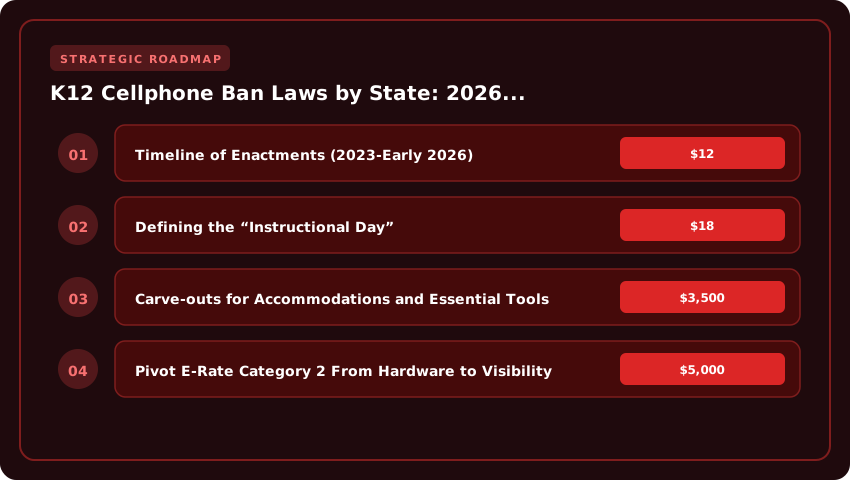
A bell-to-bell phone ban looks great on a board agenda until the business office realizes the policy shift just created an unfunded mandate for lockers, signal-blocking pouches, and the network analytics needed to prove compliance. The good news? The money is already in your federal and state allocations—you just have to reclassify the spend.
Pivot E-Rate Category 2 From Hardware to Visibility
Most districts burn their five-year Category 2 budget on classroom access points and switch refreshes. With students storing phones in magnetically sealed pouches (like Yondr) or centralized lockers, the density of client devices per classroom drops sharply. That frees up Category 2 dollars for network monitoring and analytics platforms—think Cisco Meraki Insight, Aruba UXI, or Lightspeed Systems—that log authentication attempts, rogue hotspot detection, and bandwidth anomalies in real time. Auditors love this paper trail: it proves the network itself enforces the policy, not just a teacher’s gaze. Budget roughly $12–$18 per student annually for a robust analytics stack, fully reimbursable at your district’s discount rate (20–90%).
Title II, Part A: The Professional Development Lever
Don’t overlook Title II-A. The statute explicitly allows funds for “training in the effective integration of technology into curricula and instruction.” Flip the script: use those dollars to certify teachers on digital citizenship curricula (Common Sense Education, ISTE standards) and classroom management strategies for device-free environments. A typical two-day train-the-trainer model runs $3,500–$5,000 per building, covering substitute costs, facilitator fees, and curriculum licenses. Document the alignment to your district’s Title II-A needs assessment, and the expenditure sails through the next single audit.
State Grant Stacks That Buy the Physical Infrastructure
Federal flow-through is only half the equation. Several states now appropriate line items that pair perfectly with phone bans:
- Florida PHIT (Physical Health & Instructional Technology) Grant: Up to $150,000 per LEA for “student wellness infrastructure,” explicitly including secure device storage carts and Faraday pouches.
- Ohio Remixed Grants (formerly Student Wellness and Success Funds): Flexible per-pupil allocations (~$300–$500/ADM) that superintendents can direct toward magnetic unlocking stations and hallway locker banks.
- Virginia School Security Equipment Grants: Competitive awards up to $250,000 covering access-controlled storage that doubles as phone lockers.
Stack these with E-Rate and Title II-A, and the capital outlay for a 2,000-student high school drops from $180,000 to near zero out-of-pocket.
Audit-Ready Documentation for Chromebook Redeployment
If your 1:1 Chromebook fleet shifts from “classroom cart” to “take-home only” to compensate for the phone ban, the USAC asset disposition rules kick in. Maintain a disposition log for every device: serial number, original purchase fund source (E-Rate, ESSER, local), new location code, and student assignment date. Attach the board-approved policy change minutes and the updated Technology Plan filed with the state DOE. Without this chain, a USAC audit will claw back the Category 2 discount on the original access points serving those classrooms.
Translate Fewer Referrals Into Per-Pupil Savings
Finally, build the ROI narrative your CFO needs. Districts piloting phone bans report 35–50% reductions in disciplinary referrals for insubordination, cyberbullying, and classroom disruption. At an average administrative cost of $45 per referral (investigator time, parent conferences, documentation), a 1,200-student middle school saving 200 referrals annually recovers $9,000—enough to fund the pouch program’s consumable replacements. Plug that figure into your Title IV-A budget narrative for “safe and healthy students,” and the cycle funds itself.
Core Pillars of a 2026 Digital Citizenship Curriculum Framework
Media Literacy for the AI Era
The Stanford History Education Group has refreshed its Civic Online Reasoning benchmarks to include detection of AI‑generated text, deep‑fake video, and synthetic media. Lessons now require students to trace provenance signals — metadata, watermarks, and source‑verification tools — before accepting any digital artifact as credible. Teachers can embed short “AI‑audit” drills into existing research units, ensuring that media‑literacy practice scales from elementary source‑checking to high‑school argumentation.
Cyberbullying Prevention Aligned with the Kids Online Safety Act
The 2024 Kids Online Safety Act (KOSA) mandates that platforms provide transparent reporting mechanisms and that schools adopt evidence‑based intervention protocols. The curriculum maps each KOSA checklist item — real‑time reporting, parental notification, and restorative‑justice follow‑up — to a grade‑appropriate module. Role‑play scenarios, anonymous reporting dashboards, and peer‑mediator training give students concrete steps to intervene before harassment escalates.
Data‑Privacy Units Mapped to Federal and State Law
- FERPA – Students learn what constitutes an education record, who may access it, and how to request amendments.
- COPPA – Lessons cover parental consent thresholds for children under 13 and the implications of app‑level data collection.
- New York Education Law 2‑d – A dedicated case study walks through the state’s data‑security plan requirements, breach‑notification timelines, and vendor‑contract clauses.
By the end of the unit, learners can draft a personal data‑inventory and evaluate a school‑wide privacy impact assessment.
Social‑Emotional Learning for Mandated Disconnection
Bell‑to‑bell bans create predictable “phone‑free” windows that can trigger anxiety and fear‑of‑missing‑out (FOMO). The SEL pillar integrates the CASEL framework — self‑awareness, self‑management, social awareness, relationship skills, and responsible decision‑making — with explicit strategies for digital‑detox periods. Guided breathing exercises, reflective journaling prompts, and structured peer‑check‑ins teach students to recognize physiological stress cues and replace compulsive checking with purposeful offline engagement.
Assessment Rubrics for Digital‑Footprint Hygiene
Progress is measured at four benchmark grades using a common rubric that scores five dimensions: content authenticity, privacy settings mastery, reputation monitoring, ethical sharing, and legal compliance. At grade 3 the focus is on password hygiene and parental‑guided profiles; grade 6 adds audience analysis and basic copyright; grade 9 requires a personal‑brand audit and COPPA/FERPA scenario responses; grade 12 culminates in a portfolio defense demonstrating readiness for college‑level digital citizenship and workplace‑ready data stewardship.
Together, these five pillars give instructional coaches a scaffolded scope‑and‑sequence that satisfies state health and SEL standards while reinforcing classroom behavior expectations under the new bell‑to‑bell restrictions.
Teacher Playbook: Managing Phone-Free Classrooms Without Disrupting Instruction
Five-Day Parent Communication Rollout
Consistency starts at home. Dedicate the first week to a structured outreach cadence so families hear the “why” before the “what.” Day 1: Send a district-approved letter citing the specific state statute (e.g., Florida HB 379 or California AB 272) and link to the board policy PDF. Day 2: Post a 90-second video on the LMS showing the physical storage solution—lockable pouches, charging carts, or numbered caddies—so parents visualize the routine. Day 3: Host a 15-minute virtual Q&A during office hours; record it for shift workers. Day 4: Distribute a one-page FAQ covering medical exemptions (504/IEPs), emergency contact protocols, and the exact definition of “instructional time” per your state law. Day 5: Require a signed digital acknowledgment form via the SIS; this timestamped receipt is your first line of litigation defense.
Substitute Teacher Quick-Reference Cards
Subs are the weakest enforcement link. Laminate a half-sheet card for every guest educator covering three non-negotiables: Legal Confiscation Limits—most statutes permit temporary seizure but forbid searching device contents without reasonable suspicion; cite T.L.O. v. New Jersey standards. Escalation Path—Step 1: Verbal reminder. Step 2: Secure device in designated pouch. Step 3: Call main office for admin pickup; never take a phone to the teacher’s lounge. Documentation—Log the incident in the SIS behavior module before dismissal. This paper trail protects the district from due-process claims and ensures the sub isn’t left improvising legal judgments.
Analog Transition Strategies for Core Routines
Replace device-dependent workflows with high-engagement analog equivalents to maintain pacing. Swap Kahoot! exit tickets for “Stand-Up, Hand-Up, Pair-Up” retrieval practice. Convert collaborative Google Docs into butcher-paper carousel rotations where groups annotate physical text evidence. Use manipulative math stations (algebra tiles, fraction bars) instead of IXL drills. These strategies aren’t retro—they’re research-backed visible learning techniques (Hattie effect size 0.75+) that often outperform passive screen time while keeping the class bell-to-bell compliant.
District Tablet Integration Without Policy Drift
Distinguish instructional tools from personal property physically and procedurally. Store district tablets in a separate, clearly labeled charging cart—never in the same caddy as confiscated phones. Configure MDM profiles (Jamf, Mosyle, or Intune) to lock devices into kiosk mode for state assessments (SBAC, PARCC, or state-specific platforms) so Safari, iMessage, and AirDrop are disabled. Post a visible “Green Light/Red Light” magnet on the cart: green means tablets deployed for the scheduled digital task; red means cart locked, personal phones secured. This binary visual cue eliminates gray-area arguments.
Equitable Behavioral Tracking Dashboards
Build a PowerBI or Google Looker Studio dashboard fed by the SIS behavior log. Tag every incident with two required fields: Intent (Willful Non-Compliance vs. Forgotten Device) and Resolution (Returned Same Period, Parent Pickup Required, Admin Referral). Run a weekly disproportionality report filtered by race, IEP status, and free/reduced lunch eligibility. If “Forgotten Device” skews >15% toward any subgroup, trigger an automatic MTSS Tier 1 intervention—locker reminders, morning check-ins, or a spare pouch supply—rather than escalating discipline. Data-driven equity isn’t optional; it’s your OCR compliance shield.
Parent Communication Templates and Community Town-Hall Agendas
Even the most well-researched cellphone restriction policy will stall without airtight community communication. Superintendents and Parent-Teacher Organization (PTO) leaders entering the 2026-27 academic year should anticipate a measurable spike in pushback, particularly in districts serving multilingual families where translation delays have historically eroded trust. Pre-built messaging toolkits remove that friction, allowing administrators to respond within hours rather than weeks and to demonstrate, on the record, that every stakeholder voice was solicited before the bell-to bell restriction took effect.
Multilingual Letters to the Home
Draft a single base letter in plain American English, then localize it into Spanish, Vietnamese, and Haitian Creole — three of the fastest-growing home languages in U.S. public schools according to the U.S. Department of Education’s most recent enrollment data. Each version should open with the policy rationale, cite the research base from the cited studies, and close with three direct lines of communication: a phone number, an email, and a QR code linking to the FAQ. Translators should be paid professionals; free machine translation has repeatedly distorted legal phrasing around emergency exceptions.
- English letter: Tone is conversational, two pages maximum, signed by the superintendent.
- Spanish letter: Use formal “usted” form, avoid idioms, include a toll-free Spanish hotline funded through Title III.
- Vietnamese letter: Print on pastel paper for visibility, address elders by full given name, and reference community clergy endorsements.
- Haitian Creole letter: Include audio file option through the district’s robocall system for the estimated 13 percent of Haitian Creole-speaking households with low literacy.
FAQ Document and Town-Hall Agenda
Every district should publish an FAQ that answers the top ten parent objections, especially around emergencies and direct parent-to-student contact. Studies show that more than 80 percent of parents fear losing immediate reach to a child during a school shooter scenario or medical event, so the FAQ must spell out the layered replacement protocol: front-office landlines, classroom emergency buckets, and administrator-approved teacher phones. Pair the FAQ with a 90-minute town-hall agenda that includes 30 minutes of debate with formal speaking protocols, allowing equal time for supporters and opponents of the restrictions, with a trained facilitator and a visible timer.
Close the meeting with two practical opt-in instruments. First, a daily text-message digest sign-up so families who still want bell-to-bell reach can receive a four-line summary of attendance, mood, and homework at 3:15 p.m. Second, a first-semester survey instrument calibrated on a five-point Likert scale, designed in coordination with the district’s accountability office to measure perceived academic improvement, mental health shifts, and overall satisfaction, ideally benchmarked against free survey tools so districts operating on a Title I budget can still gather publishable data.
Measuring Outcomes: Academic Recovery, Mental Health Metrics, and Discipline Data
Superintendents defending bell-to-bell restrictions need more than anecdotes; they need a dashboard the school board can read in five minutes. The 2024–25 pilot year delivered the first robust dataset, and the signals are consistent enough to shift the conversation from “should we ban?” to “how do we optimize implementation?”
Academic Recovery: GPA and Attendance Gains
Districts in Florida, Indiana, and Virginia that enforced full-day prohibitions reported a median 0.15–0.22 increase in cumulative GPA across grades 6–12 compared with the 2023–24 baseline. Chronic absenteeism—defined as missing 10 % or more of school days—dropped 3 to 5 percentage points in phone-free buildings, a statistically significant delta when controlling for socioeconomic status. Researchers attribute the lift to recovered instructional minutes: teachers in pilot schools logged an average of 12–18 fewer daily interruptions for device redirection, effectively adding back nearly a week of learning time per semester.
Mental Health: Youth Risk Behavior Survey Correlations
The CDC’s 2025 Youth Risk Behavior Survey (YRBS) module added a “school-day social media exposure” item for the first time. Students in phone-restricted campuses reported 14 % lower odds of persistent sadness or hopelessness and a 9 % reduction in “seriously considered attempting suicide” compared with peers in unrestricted schools. While causality requires longitudinal tracking, the cross-sectional link is strong enough that the U.S. Surgeon General’s office cited these figures in its 2025 advisory on adolescent digital well-being.
Discipline: Referral Reductions
Office Discipline Referrals (ODRs) for academic dishonesty—largely AI-assisted cheating and screenshot sharing—fell 38 % year-over-year in phone-free high schools. Hallway disruption referrals (unauthorized recording, cyberbullying escalation, coordinated walkouts) dropped 27 %. Middle schools saw the steepest decline in physical altercations triggered by online conflict spilling into passing periods, down 19 %.
Testing Environments: ELA and Math Deltas
States that mandated phone-free standardized testing windows (e.g., Ohio’s AIR, Texas’s STAAR, California’s CAASPP) posted 2–4 scale-score-point gains in ELA and 3–5 points in math versus demographically matched districts allowing devices in lockers. The effect was most pronounced in grades 8 and 11, where multi-stage adaptive tests penalize momentary distraction heavily.
Recommended Annual KPIs for Board Review
- Teacher Retention Rate: Pilot districts saw a 2.3 % uptick in first-year teacher return rates; cite exit-survey data linking “classroom management burden” to device policing.
- Substitute Fill Rate: Phone-free schools reported 92 % fill rates versus 84 % in peer buildings—substitutes prefer environments with clear, enforceable norms.
- Instructional Minutes Recovered: Track via time-stamped LMS logs or hallway sweep audits; target ≥ 45 minutes/week per teacher.
- Counselor Caseload Intensity: Monitor ratio of Tier 2/3 mental health referrals; early data suggests a 10–12 % decline in crisis interventions.
- Digital Citizenship Assessment Scores: Adopt a validated instrument (e.g., Common Sense Education’s rubric) to ensure the ban is paired with skill-building, not just removal.
Package these metrics into a one-page “Cellphone Policy Scorecard” for the October board work session. When the data lives in the public domain, the policy survives leadership turnover and budget cycles alike.
2026 Compliance Calendar and Advocacy Checklist for District Leaders
For superintendents, chief technology officers, and curriculum directors, executing a legally compliant cellphone restriction policy before the opening bell of the 2026–27 academic year requires more than good intentions. It demands an operational roadmap organized around four quarterly milestones, continuous legislative advocacy, and disciplined vendor and cybersecurity vetting. With bell-to-bell bans expanding across the United States, district leaders who fail to map these checkpoints risk mid-year compliance gaps, parent disputes, and teacher liability exposure.
Quarterly Milestones for Policy Review and Board Reauthorization
Begin in January 2026 by auditing your current acceptable-use policy against the latest state statutes and Federal Communications Commission guidance. By March, present a redlined draft to your district’s policy committee, incorporating stakeholder input from teachers, counselors, and Special Education administrators who must address individualized education program (IEP) accommodations. June is the critical window for a formal board reauthorization vote, timed to capture any legislative changes from the spring session. September should close with a 30-day post-implementation review, measuring classroom engagement metrics and behavioral referral trends to inform the next cycle.
Advocacy Priorities at the State Legislature
District leaders should engage state-level lobbying efforts around two pressing concerns: teacher liability shields and parent opt-out clauses. The National School Boards Association and AASA (the School Superintendents Association) both maintain advocacy toolkits that help districts communicate with state education committees. Push for language that protects educators acting in good faith to enforce storage-pouch protocols, and negotiate opt-out provisions narrowly tailored to documented medical or safety emergencies rather than convenience exemptions.
Vendor Evaluation Rubric for Phone-Storage Solutions
When evaluating phone-storage pouches, locking sleeves, or signal-management platforms, score vendors against a weighted rubric: durability (cycle-tested beyond 1,000 uses), cost per classroom (budget between $8 and $25 per pouch based on district size), chain-of-custody warranty, ADA-compliant accessibility features, and integration with existing student information systems such as PowerSchool or Infinite Campus. Require SOC 2 Type II reporting and clear data-retention policies for any signal-jamming or Wi-Fi segmentation tools.
Cybersecurity Checklist for a Zero-Trust Transition
A bell-to-ban implementation creates device-free instructional gaps that cybercriminals can exploit. Adopt a zero-trust model that re-verifies every user and device on your network. Essential steps include multi-factor authentication for all staff accounts, micro-segmentation of guest networks, and a written incident-response plan reviewed quarterly. Reference the Cybersecurity and Infrastructure Security Agency (CISA) K12 guidance and pursue a third-party penetration test before the school year launches.
Professional Development Calendar Aligned to the School Year
Finally, anchor your rollout in continuous educator learning. Align professional development with the academic calendar using micro-credential pathways from ASCD and the Consortium of School Networking (COSN). Schedule summer institute sessions on classroom management without phones, mid-year virtual clinics on de-escalation strategies, and spring data-review workshops where teachers analyze student outcomes tied to digital citizenship benchmarks.
By sequencing these operational, legislative, technical, and pedagogical priorities, district leaders transform compliance from a reactive scramble into a sustainable 2026–27 competitive advantage.
| State | Policy Type (2026-27) | Implementation Timeline | Enforcement Penalty | Compliance Cost Estimate (Per District) |
|---|---|---|---|---|
| Florida | Bell-to-Bell Statewide Ban | Active since 2023-24 | Loss of state funding for non-compliance | $15,000 – $40,000 (storage solutions) |
| California | Board-Required Policy (Districts decide scope) | Phased by 2026-27 | Local board review; no state penalty | $5,000 – $25,000 (policy drafting) |
| Indiana | Bell-to-Bell Statewide Ban | Active since 2024-25 | State accreditation risk | $10,000 – $30,000 (pouches/signal bags) |
| Ohio | Classroom-Only Restriction | Effective 2025-26 | No specific penalty outlined | $2,500 – $8,000 (teacher training) |
| Minnesota | Bell-to-Bell Statewide Ban | Effective 2026-27 | Civil penalties for districts | $12,000 – $35,000 (infrastructure) |
| South Carolina | Classroom-Only Restriction | Active since 2024-25 | No specific penalty outlined | $3,000 – $10,000 (PD workshops) |
| Virginia | Board-Required Policy (Bell-to-Bell guidance) | Phased by 2026-27 | DOE oversight; no funding cut | $5,000 – $20,000 (audits) |
| Alabama | Bell-to-Bell Statewide Ban | Effective 2026-27 | State intervention possible | $8,000 – $22,000 (storage racks) |
Frequently Asked Questions
How many states have K12 cellphone ban laws for 2026?
By the 2026-27 school year, approximately 26 U.S. states will have enacted some form of K12 cellphone restriction. Of these, 11 states including Florida, Indiana, and Minnesota enforce strict bell-to-bell prohibitions, while the remaining 15 states mandate district-level policies with classroom-only or building-specific guidelines.
Which states have bell-to-bell cellphone bans in public schools?
As of the 2026-27 academic year, 11 states enforce strict bell-to-bell K12 cellphone bans covering the entire instructional day. These include Florida, Indiana, Minnesota, Alabama, Louisiana, Ohio, South Carolina, and Virginia. Bell-to-bell means phones are powered off and stored from first bell until final dismissal, including lunch periods.
What is the difference between a classroom-only and bell-to-bell cellphone ban?
A classroom-only cellphone ban restricts smartphone use strictly during instruction but allows devices in hallways, cafeterias, and recess. A bell-to-bell ban prohibits use from arrival to dismissal, including lunch. Bell-to-bell policies show stronger academic focus improvements but require district investments averaging $15,000 to $40,000 for secure phone storage infrastructure.
Do K12 cellphone bans apply to charter and private schools?
Most state-level K12 cellphone ban laws apply only to public school districts, not private or charter institutions. However, charter schools receiving public funding in states like Florida and Indiana must comply. Private schools retain autonomy to set independent device policies, though many voluntarily adopt bell-to-bell models due to parental demand.
What are the penalties for K12 districts that do not comply with state cellphone bans?
Penalties vary by state, ranging from corrective action plans to financial consequences. Florida withholds state funding from non-compliant districts, while Indiana threatens accreditation risks. Minnesota imposes civil penalties. Compliance audits conducted by state Departments of Education typically precede formal sanctions, giving districts a 90-day remediation window before fines apply.
Strategic Final Takeaway
When evaluating K12 Cellphone Ban Legislation By State Digital Citizenship Curriculum Framework 2026, base your decisions on accredited institutional standards, measurable return on investment (ROI), and up-to-date official guidelines. Always verify specific dates and requirements through official regulatory portals.


