

The Rise of Community College Bachelor’s Programs in Early Education
The landscape of teacher preparation has shifted decisively. For decades, the associate degree was the terminal credential at two-year colleges, forcing aspiring lead teachers into expensive university transfer pipelines. Today, 24 states—led by Washington, Florida, Colorado, and Texas—have passed legislation authorizing community colleges to award full Bachelor of Applied Science (BAS) or Bachelor of Science (BS) degrees in Early Childhood Education. This isn’t a “lesser” degree; it is a regionally accredited, four-year credential designed explicitly to meet state teacher licensure standards at a fraction of the cost.
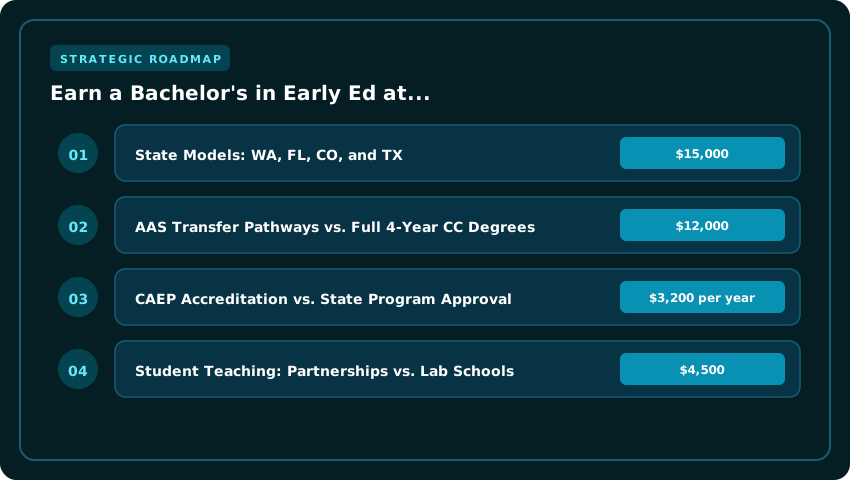
State Models: WA, FL, CO, and TX
Washington State pioneered the model in 2005; its 34 community and technical colleges now produce hundreds of certified teachers annually, with total tuition often under $12,000 for the full four years. Florida’s “2+2” system evolved into direct-entry BAS programs at colleges like Miami Dade and Broward College, where in-district tuition runs roughly $3,200 per year. Colorado’s legislation (HB 12-1236) authorized BAS degrees at Aims and Red Rocks Community Colleges, aligning curriculum tightly with the Colorado Department of Education’s Early Childhood Professional Credential 3.0. Texas, the latest major adopter via HB 3348 (2023), permits colleges like Dallas College and Austin Community College to offer BAS degrees targeting the critical EC-3 certification gap, locking tuition at roughly $4,500 annually for in-district residents.
AAS Transfer Pathways vs. Full 4-Year CC Degrees
Understanding the structural difference saves you time and money. The traditional Associate of Applied Science (AAS) is a workforce terminal degree. While credits can transfer via articulation agreements, you frequently lose 15–30 credits moving to a university Bachelor of Science, adding a semester or two. In contrast, the new Community College Baccalaureate (CCB) is a cohesive 120-credit program. You enter as a junior (or freshman in direct-entry models) and stay put. The curriculum integrates upper-division pedagogy, action research, and the required student-teaching residency without the “transfer shock” or credit leakage common in the AAS-to-university handoff.

Programmatic Approval: NAEYC Recognition vs. Regional Accreditation
This is the legitimacy checkpoint. Regional accreditation (HLC, SACSCOC, NWCCU, WSCUC) is non-negotiable—it unlocks Federal Student Aid (FAFSA) and ensures your degree is recognized by every state licensing board and graduate school. However, for ECE specifically, NAEYC Accreditation of Early Childhood Higher Education Programs is the gold-standard programmatic seal. It signals your coursework meets the Professional Standards and Competencies for Early Childhood Educators. Critical nuance: A program can be regionally accredited without NAEYC recognition. For licensure portability and employer preference—especially in Head Start or public Pre-K—verify the program holds both. Check the NAEYC Accredited Program Directory and the college’s accreditation page before enrolling.
Accreditation Hierarchy: Regional, NAEYC, and CAEP Standards
When you are vetting a community college bachelor’s in Early Childhood Education, the alphabet soup of accreditors can feel overwhelming. But here is the hard truth: not all seals of approval are created equal, and stacking them in the wrong order can quietly sabotage your financial aid, your license portability, and your long-term pay. Understanding this hierarchy is the single most practical skill you can develop before enrolling.
Regional Accreditation is Non-Negotiable for Federal Aid
Before you ever look at a specialized early childhood seal, confirm the institution itself holds regional accreditation from one of the seven U.S. Department of Education–recognized bodies: the Higher Learning Commission (HLC), the Southern Association of Colleges and Schools Commission on Colleges (SACSCOC), the WASC Senior College and University Commission (WSCUC), the Middle States Commission on Higher Education (MSCHE), the New England Commission of Higher Education (NECHE), the Northwest Commission on Colleges and Universities (NWCCU), or the Accrediting Commission for Community and Junior Colleges (ACCJC). Without this baseline, your FAFSA® submissions will be dead on arrival.
Only regionally accredited schools can disburse Title IV federal student aid, accept Pell Grants, and certify GI Bill® benefits. A programmatically accredited program sitting inside a nationally accredited shell can technically exist, but it will block federal loans and most state scholarships. If you see the words “national accreditation” or “accrediting commission” without a regional prefix, treat it as a red flag and walk away.
NAEYC Accreditation: The Gold Standard for ECE Specifics
The National Association for the Education of Young Children (NAEYC) Accreditation of Early Childhood Higher Education Programs targets the curriculum itself, not the institution. Programs earning this voluntary seal have been independently evaluated against rigorous standards in areas like fieldwork intensity, faculty qualifications, and assessment of young children from infancy through age eight.
For working educators, NAEYC accreditation signals that your degree covers the developmentally appropriate practices employers actually want, which directly influences your starting salary on the K-12 or preschool corporate ladder. Because the review process is thorough and costly, only a fraction of community college programs pursue it. When you find one that holds both regional and NAEYC accreditation, you have located a credential that travels well across districts and states.
CAEP Accreditation vs. State Program Approval
The Council for the Accreditation of Educator Preparation (CAEP) is the national gatekeeper for teacher preparation programs, while individual state education departments issue the program approvals that lead to a teaching license. Many aspiring teachers assume a CAEP stamp guarantees reciprocity, but that is a costly misconception.
- State approval is what authorizes you to apply for an initial teaching license in the issuing state. It is the legal floor for classroom employment.
- CAEP accreditation layers a nationally vetted quality mark on top, often easing the path to an interstate license through reciprocity agreements.
If you plan to teach in more than one region during your career, prioritize programs that hold CAEP accreditation alongside their state approval. It is the difference between a credential that ends at your state line and one that opens doors across the country.
Navigating State Teacher Licensure from a Community College Degree
Earning the diploma is only half the battle; the license is what unlocks the classroom. Because community college bachelor’s programs are relatively new in many states, you must act as your own compliance officer. Do not assume regional accreditation alone guarantees a standard Birth–Grade 3 license. Some programs culminate in a “certificate of completion” or an “early childhood credential” that qualifies you for childcare directorships but not for public school kindergarten or first grade. Your first move: search your state’s Department of Education website for the phrase “approved educator preparation program” (EPP) and verify the specific community college program appears on that list by name and CIP code.
Student Teaching: Partnerships vs. Lab Schools
Traditional universities often operate campus laboratory schools, giving candidates a controlled, supervised environment. Community colleges rarely have this luxury. Instead, they rely on Memoranda of Understanding (MOUs) with local districts. Ask the program director for the current placement list. A strong program guarantees placement within a 30-mile radius and provides a university-trained field supervisor who observes you at least four times per semester. If the answer is “you find your own cooperating teacher,” walk away—that is a red flag for licensure delays.
Praxis Pass Rates: The Transparency Test
Title II reporting requires institutions to publish pass rates for Praxis Core (basic skills) and Praxis Subject Assessments (5025 Early Childhood Education). Request the last three years of data disaggregated by attempt (first-time vs. best attempt). A first-time pass rate below 80% on the Subject Assessment suggests curriculum misalignment. Compare these figures against the nearest state university; the gap should be negligible. If the college refuses to share raw data, cite the Higher Education Act’s consumer information requirements.
Traditional vs. Alternative Tracks at the CC
Some community colleges now host “Grow Your Own” alternative certification residencies alongside the traditional bachelor’s track. The distinction is critical for your wallet and timeline:
- Traditional Bachelor’s (120+ credits): Includes full student teaching semester. Eligible for federal TEACH Grant ($4,000/year) and standard FAFSA aid. Leads directly to a Tier 1/Initial Professional License.
- Alternative/Residency (Post-Bacc or Embedded): Often requires a bachelor’s in another field first. You teach as teacher-of-record on a provisional license while completing pedagogy coursework. Higher immediate salary, but intense workload and often ineligible for TEACH Grants.
Your Verification Checklist
- Confirm the program is on the State DOE Approved EPP List for Birth–Grade 3.
- Verify the degree title reads “Bachelor of Science in Early Childhood Education” or “Bachelor of Applied Science in Teacher Education”—not “Early Childhood Development.”
- Ensure the curriculum includes a minimum of 12 weeks of full-time student teaching (600+ clock hours) supervised by certified faculty.
- Check that coursework covers Science of Reading mandates now required in 38+ states.
- Ask for the Title II Report Card link; review Praxis pass rates and employer satisfaction surveys.
If the program checks every box, you are looking at a legitimate, sub-$15,000 pathway to a license that carries identical legal weight to a $60,000 university degree. If a single box goes unchecked, you risk graduating with an expensive associate-degree equivalent that keeps you out of the public school salary schedule.
ROI Analysis: Tuition Savings vs. Lifetime Earnings Potential
The financial calculus for a community college bachelor’s in Early Childhood Education (ECE) is staggering. According to the National Center for Education Statistics (NCES), the average total tuition for a four-year degree at a public two-year institution hovers between $10,000 and $15,000. Contrast that with the $40,000 to $50,000+ price tag at a traditional public university—before room, board, or fees—and the arithmetic writes itself. You are effectively buying the exact same state teaching license for roughly 25 to 30 cents on the dollar.
Crunching the Tuition Numbers
Let’s be precise. If you finance a university degree through federal loans, a $45,000 principal at current Direct Loan rates accrues significant interest over a standard 10-year repayment plan. A community college bachelor’s often allows students to pay cash or leverage Pell Grants and employer tuition assistance to graduate debt-free. That delta—$30,000+ in avoided principal—isn’t just savings; it’s a down payment on a home, a seed for a retirement account, or the capital to start a private tutoring business.
BLS Wage Data: Where the License Takes You
The Bureau of Labor Statistics (BLS) May 2023 Occupational Employment and Wage Statistics (OEWS) clarifies why that license matters. The median annual wage for Preschool Teachers (SOC 25-2011) was $37,130, but the top 10% earned over $60,900. However, securing a public school Kindergarten or Elementary license (SOC 25-2012) jumps the median to $63,670, with the top 10% exceeding $101,310. That community college bachelor’s is the specific bridge from the lower bracket to the higher one.
- Preschool Median (25-2011): $37,130
- Kindergarten/Elementary Median (25-2012): $63,670
- Lifetime Earnings Gap: Roughly $1.1M+ over a 30-year career before raises.
The PSLF Multiplier
Here is the hidden accelerator: Public Service Loan Forgiveness (PSLF). If you take any loans—and many CC students borrow zero—working for a qualifying public or non-profit employer (virtually every public school district) wipes the remaining balance after 120 qualifying payments. A university grad paying off $45,000 on an income-driven plan might pay $30,000 out of pocket before forgiveness hits. A CC grad with $5,000 in loans pays a fraction. The net present value of that forgiveness, combined with the lower upfront cost, makes the community college pathway the highest-ROI teacher prep route in the American higher education system today.
Articulation Agreements & Graduate School Pathways
The most persistent myth surrounding a community college bachelor’s degree is the so-called “dead-end degree” fear. Working educators often worry that a Bachelor of Applied Science in Early Childhood Education will close the door to graduate study, advanced endorsements, or administrative credentials. In practice, the opposite is true—provided students plan early and verify the fine print. The modern articulation map links two-year institutions directly to Master of Education (M.Ed.) programs in Curriculum & Instruction, Educational Leadership, and Early Childhood Administration, often with guaranteed admission seats reserved for transfer cohorts.
Guaranteated Admission Pacts for M.Ed. Programs
Regional university systems increasingly codify transfer pathways through formal articulation agreements. A student graduating from a community college bachelor’s program in Texas, for example, may carry an automatic admission contract to a partnering state university’s M.Ed. in Curriculum & Instruction, provided they hit a 3.0 GPA threshold and complete the Texas Education Agency (TEA) standards. Similar pacts exist through the Connecticut State Colleges & Universities system, the Florida State College System + University of Florida pathway, and Washington State’s direct-transfer agreements with Central Washington University and Eastern Washington University. These contracts typically waive the GRE, preserve junior-senior standing, and lock in tuition at the receiving institution’s graduate rate rather than charging non-resident surcharges. For an educator targeting a school principal license or district-level curriculum coordinator role, this streamlined access can save $8,000 to $14,000 in redundant coursework.
Credit Transfer Risks and Upper-Division Residency
Not every partnership is airtight, and credit transfer risk remains the single biggest planning hazard. Many four-year universities impose an upper-division residency rule, requiring that a minimum of 30 to 36 credit hours at the 300/400 level be completed at the receiving institution—even if equivalent coursework was already finished at the community college. Early Education bachelor’s programs largely solve this problem because they are already upper-division by design, but students eyeing out-of-state or private university graduate programs must request a transcript evaluation through services like the American Association of Collegiate Registrars and Admissions Officers (AACRAO) before enrolling. Skipping this step can result in 18 to 24 credits being rejected, delaying graduation and adding $6,000+ in retaken tuition.
Impact on Master’s-Level Certification Stacking
Perhaps the most compelling financial case for the community college route is certification stacking. Early Childhood Education graduates frequently pursue add-on endorsements that command measurable salary bumps under district step-and-lane schedules:
- Reading Specialist Endorsement: Adds roughly $2,400 to $7,100 annually, depending on the state scale, and requires an M.Ed. concentration in literacy.
- Special Education Endorsement (SpEd): Tacks on $3,000 to $9,000 per year and is increasingly required for inclusion-model preschool classrooms serving IDEA Part B eligible children.
- Educational Leadership / Principal Certification: Unlocks administrative pay bands that begin around $78,200 for assistant principals (BLS Occupational Employment Statistics, 2024) and scale toward six figures for elementary principals in suburban districts.
Because the bachelor’s degree is regionally accredited by bodies recognized by the U.S. Department of Education and the Council for the Accreditation of Educator Preparation (CAEP), graduate programs honor it as equivalent credit. Educators should still confirm that their specific pathway meets state-specific rules published by their Department of Education, but the “dead-end” label no longer applies. With the right articulation agreement in place, a sub-$15,000 bachelor’s becomes a launchpad—not a ceiling.
Red Flags: Programs to Avoid and Questions for Admissions
Not every Early Childhood Education (ECE) bachelor’s track delivered by a community college will clear the bar for state licensure, and assuming so can drain your wallet while leaving you uncertified. Before signing an enrollment agreement, treat your program like an investor treats a pitch deck: poke at the financials, interrogate the leadership, and verify the accreditation trail directly with your state’s Department of Education office. A degree that looks identical on a transcript can mean absolutely nothing if the program lacks the right approvals.
Missing the Two Non-Negotiables: NAEYC and State Approval
The single biggest red flag is the absence of NAEYC accreditation or formal State Program Approval. These are not interchangeable honors. NAEYC (National Association for the Education of Young Children) accreditation signals that the curriculum, practicum hours, and student-teaching placements meet nationally recognized quality benchmarks, and most states require their own parallel approval before you can sit for a licensure exam. If a recruiter cannot immediately point you to a public approval document on the state’s education website, walk away. You will not be able to add the “Birth through Age 8” credential to your résumé, and any tuition savings evaporate the moment you have to repeat coursework at an approved school.
The Sneaky Line Items That Inflate Tuition
Community college bachelor’s programs are famous for transparent pricing, often advertised under $15,000 total. Yet the sticker price rarely captures the full cost of becoming employable. Budget an extra $1,200 to $2,500 for items that frequently catch students off guard:
- Background checks and fingerprinting: Required by every state before you can enter a K-12 classroom, usually $50 to $150 per cycle.
- Portfolio and assessment platform fees: Programs using digital evaluation tools (e.g., Watermark, LiveText) often charge $100 to $200 per semester.
- Certification exam prep: State-specific Praxis, edTPA, or ILTS exams carry registration fees of $120 to $300, and most students invest in prep books or boot camps.
- Transportation to practicum sites: Student-teaching placements may sit 40+ miles from campus, and commuting costs add up fast.
Faculty Credentials: The 50% Rule and Classroom Currency
Ask directly: “What percentage of your full-time faculty hold a terminal degree, and how many are actively teaching in a K-12 classroom right now?” Regional accreditors like HLC or SACSCOC generally expect at least 50% of full-time faculty to hold a doctorate or equivalent terminal credential. Equally important is pedagogical currency. A professor who last ran a preschool room in 2005 cannot accurately coach you on today’s trauma-informed practices, dual-language learner strategies, or the latest ed-tech tools. Current K-12 classroom experience keeps coursework aligned with what hiring principals actually expect.
Your 60-Second Admissions Audit Checklist
Before committing, demand documentation for three items: (1) a copy of the program’s NAEYC accreditation letter or a current State Program Approval status letter, (2) the official state licensure exam pass rate for recent graduates, and (3) a line-itemized cost sheet covering every hidden fee listed above. If any of those three arrive with hesitation or vague language, that is your cue to keep shopping. Protecting your early childhood teaching career starts before the first syllabus download.
| Decision Criterion | Community College BAS/BS in ECE | Traditional University BS in ECE |
|---|---|---|
| Average Total Tuition (In-State) | $10,000 – $14,900 (over 4 years) | $40,000 – $80,000 (over 4 years) |
| Admissions Cutoff (GPA) | Open enrollment / 2.0 GPA baseline | Competitive / 2.75 – 3.5 GPA required |
| Program Length | 4 years (125-130 credit hours) | 4 years (120-125 credit hours) |
| State Licensure Eligibility | Yes (identical legal weight in 24 states) | Yes (nationwide) |
| Entry-Level ECE Salary Potential (US Avg) | $36,000 – $42,000 annually | $36,000 – $42,000 annually |
| Prerequisites | High School Diploma/GED; Praxis Core waived | SAT/ACT required; Praxis Core required |
| 10-Year ROI (Net vs. Tuition) | ~$250,000 (minimal debt burden) | ~$160,000 (high loan debt) |
Frequently Asked Questions
Can you get a bachelor's degree in Early Childhood Education from a community college?
Yes. Currently, 24 US states—including Washington, Florida, Texas, and Colorado—have passed legislation authorizing community colleges to confer Bachelor of Applied Science (BAS) or Bachelor of Science (BS) degrees in Early Childhood Education, bypassing traditional university transfer pipelines.
Is a community college bachelor's degree in early education accredited for state licensure?
Yes. Community college bachelor's in ECE programs carry identical legal weight to university degrees because they hold regional accreditation. Graduates qualify for the same state-issued Pre-K-3 lead teacher licensure and are eligible for public school employment nationwide.
How much does a community college bachelor's in Early Childhood Education cost?
Total in-state tuition typically ranges from $10,000 to $14,900 across the four-year program. This represents a 60-80% cost reduction compared to university tuition, which averages $40,000 to $80,000, while yielding identical licensure credentials.
What GPA do you need to get into a community college ECE bachelor's program?
Most two-year colleges utilize open enrollment, requiring only a high school diploma or GED with a baseline 2.0 GPA for unconditional admission. This contrasts sharply with competitive universities, which typically mandate a 2.75 to 3.5 GPA.
Can you earn over $40,000 with an early childhood education degree from a community college?
Yes. Because state licensure requirements are identical regardless of institution, graduates earn the same public school salaries. Entry-level lead Pre-K-3 teachers in the US earn an average of $36,000 to $42,000 annually, scaling to $60,000+ with experience.
Strategic Final Takeaway
When evaluating Early Childhood Education Bachelor Degree At Community College Accreditation Licensure And Salary Outcomes, base your decisions on accredited institutional standards, measurable return on investment (ROI), and up-to-date official guidelines. Always verify specific dates and requirements through official regulatory portals.

