Federal Compliance Anchors: FERPA, COPPA, and IDEA Intersections for AI Tools
As we step into the 2026 academic year, integrating AI into the K-12 classroom requires more than just pedagogical enthusiasm; it demands a rigorous understanding of federal compliance. Teachers and administrators must ensure that every AI tool deployed protects student privacy and accessibility. Navigating the intersections of the Family Educational Rights and Privacy Act (FERPA), the Children’s Online Privacy Protection Act (COPPA), and the Individuals with Disabilities Education Act (IDEA) is the foundational step in safeguarding our educational environments and maintaining the trust of our communities.
Under FERPA, schools may disclose personally identifiable information (PII) to an AI vendor without parental consent only if the vendor qualifies as a “school official.” To meet this strict statutory threshold, the vendor must perform a service the school would otherwise perform itself, be under the direct control of the school regarding the use and maintenance of the data, and agree not to re-disclose the data. Teachers must verify that the vendor signs a formal data use agreement before any student interaction begins, ensuring the AI tool does not harvest data for unauthorized commercial purposes.
For students under 13, COPPA mandates verifiable parental consent before collecting personal information. While schools can often provide this consent on behalf of parents in the educational context, teachers must ensure the AI vendor collects only the absolute minimum data necessary to deliver the educational service. Furthermore, IDEA requires that any AI tool used as assistive technology for students with disabilities must be explicitly integrated into the student’s Individualized Education Program (IEP). AI cannot simply be a supplementary classroom tool; if it functions as a related service or assistive technology, it must be rigorously vetted for accessibility and aligned with the student’s specific IEP goals to guarantee free appropriate public education (FAPE).
To operationalize these federal mandates, educators should utilize a comprehensive vendor vetting matrix. When reviewing contracts, insist on explicit language covering the following critical areas to ensure robust data governance:
- Data Minimization: “The Vendor shall collect, process, and store only the minimum personally identifiable information strictly necessary to perform the contracted educational services, refraining from secondary data usage.”
- De-Identification Standards: “Any data used for training AI models or algorithmic improvement must be rigorously de-identified in accordance with NIST guidelines, ensuring no student can be re-identified through reverse engineering.”
- Breach Notification Timelines: “In the event of a data breach, the Vendor must notify the District within 48 hours of discovery, aligning with stringent state breach notification laws to allow for immediate remediation and timely parent notification.”
By embedding these compliance anchors into your 2026 AI implementation strategy, you ensure that classroom innovation never comes at the expense of student safety, equitable access, and legal integrity.
District and State AI Governance Frameworks: From Texas SB 2 to California’s AI Principles
Across the United States, 2025 and 2026 have ushered in a remarkably diverse patchwork of state-level artificial intelligence education policies. For classroom teachers, this fragmented regulatory landscape can feel overwhelming, but understanding the broad strokes of state governance is the first step toward compliant, confident AI integration. Texas has moved aggressively through Senate Bill 2, which established a statewide framework mandating that districts adopt formal AI acceptable-use policies before deploying generative tools in instructional settings. SB 2 also created an Office of AI Policy within the Texas Education Agency, giving teachers a centralized portal to access model policies, training modules, and vendor vetting checklists.
California has taken a different, principles-driven path. The California Department of Education’s 2025 AI Principles for K-12 emphasize equity, transparency, and human oversight, encouraging districts to establish local AI ethics committees rather than enforcing a single statewide procurement standard. Utah similarly launched an Office of AI Policy, positioning itself as a national leader in proactive AI governance. The state requires districts to designate an AI lead, publish a public-facing acceptable-use policy, and conduct annual algorithmic audits of any adaptive learning platform that processes student data.
New York’s K-12 AI Guidance, released by the New York State Education Department in late 2025, focuses on data privacy alignment with state education law Section 2-d. The guidance recommends a tiered approval workflow: Tier 1 for general-purpose AI tools, Tier 2 for tools that touch personally identifiable information, and Tier 3 for adaptive systems that make autonomous instructional decisions. Ohio’s AI in Education Standards, meanwhile, integrate AI literacy directly into the state’s learning standards, requiring districts to embed AI ethics instruction across grade bands while maintaining a separate operational policy for staff use.
Comparing District-Level AI Ethics Committee Structures
While state policy sets the floor, district-level governance is where daily classroom decisions are actually made. Below is a comparison table of common committee structures, approval workflows, and public access points that have emerged across major US districts in 2026.
- Committee Composition: Most large districts (Houston ISD, Los Angeles Unified, New York City DOE) assemble committees of 10-15 members including instructional technology leads, general counsel, a parent representative, a high school student, and at least one special education coordinator to ensure IDEA alignment.
- Approval Workflow: A typical three-stage process includes (1) teacher or department submission via an internal portal, (2) committee review within 30 days against a rubric of privacy, bias, and pedagogical fit, and (3) superintendent or designee sign-off before district-wide deployment.
- Review Cadence: Leading districts now require quarterly algorithmic audits and an annual public report submitted to the school board, with findings posted to the district website under the transparency compliance section.
- Locating Your Policy: Teachers can typically find their district’s AI acceptable-use policy without legal counsel by navigating to the district homepage, selecting “Departments,” then “Technology” or “Instructional Services,” and looking for a subpage titled “AI Resources,” “Digital Tools,” or “Acceptable Use.” State education agency websites also maintain searchable registries of district-approved AI vendors.
Actionable Takeaways for Teachers
Before piloting any AI tool in your classroom, take three concrete steps. First, identify your district’s AI governance lead, usually titled Director of Instructional Technology or AI Coordinator, and subscribe to their newsletter or meeting minutes. Second, request a copy of the current acceptable-use policy and review the sections on student data, parental consent, and approved vendor lists. Third, document your pilot using a simple lesson-level log capturing the tool name, student data shared, learning objective, and outcome metrics. This log becomes your best protection if questions arise from administrators, parents, or state auditors.
Remember that state frameworks are evolving rapidly. The Texas Office of AI Policy, the California AI Principles portal, and the Utah AI Policy dashboard all offer free email updates. Bookmarking these three resources and checking them monthly will keep you ahead of compliance shifts and position you as a trusted resource within your school community as AI continues to reshape K-12 education in 2026 and beyond.
Building a Pre-Semester AI Tool Approval Pipeline That Actually Works
Every successful K-12 AI rollout begins long before the first student prompt hits a chatbot. The most overlooked phase of classroom AI integration is the bureaucratic but absolutely essential approval pipeline that runs roughly six weeks before teachers return to campus in the fall. When this pipeline is rushed, schools expose themselves to FERPA violations, unexpected vendor lock-in, and parent backlash that can derail an entire initiative. When it is executed with care, it becomes the single most important investment of administrative time a teacher leader can make.
The pipeline has four interlocking phases, each with its own deliverable, timeline, and owner. Teachers who try to compress them into a single week almost always regret it.
- Week 1 (Vendor Risk Assessment): Begin with the SLT AI Risk Toolkit, the free, open-source rubric published by the Student Law Toolkit that walks evaluators through 38 weighted indicators covering data minimization, model transparency, training-data provenance, and subprocessor disclosure. Score every candidate vendor on a 1-5 scale. Any vendor scoring below 3.0 on the “Student Data Lifecycle” subscale should be eliminated before contract drafting begins, regardless of feature quality.
- Week 2 (Redline Negotiation): Pull the vendor’s standard Data Processing Addendum (DPA) into a shared district Google Drive and mark up the indemnity clauses, retention windows, and AI-training opt-out language. Most ed-tech vendors will accept a 30-day data deletion guarantee and a contractual bar on using student inputs to train foundation models, but only if the district asks. Use the National Student Privacy Defense Act template as a starting point.
- Week 3 (Parent Notification under PPRA): The Protection of Pupil Rights Amendment requires written parental consent before any survey, evaluation, or tool that collects information from students for marketing or non-instructional purposes. Deploy a parent notification letter template that names the specific tool, the data fields collected, the retention period, and the opt-out procedure. Keep the language at a 7th-grade reading level; the U.S. Department of Education routinely flags districts whose consent forms read like legal disclaimers.
- Week 4-6 (Documentation and Storage): Upload every signed approval artifact — risk scorecards, redlined DPAs, parent consent logs, and the final signed contract — into the district’s LMS (Canvas, Schoology, or Google Classroom for Education) under a single tagged unit titled “AI Tool Approval – [Tool Name] – [School Year].” This creates a defensible audit trail that survives leadership turnover and satisfies any future OCR investigation.
Budget realism matters as much as paperwork discipline. As of the 2025-2026 purchasing cycle, K-12 AI subscription tiers break down roughly as follows:
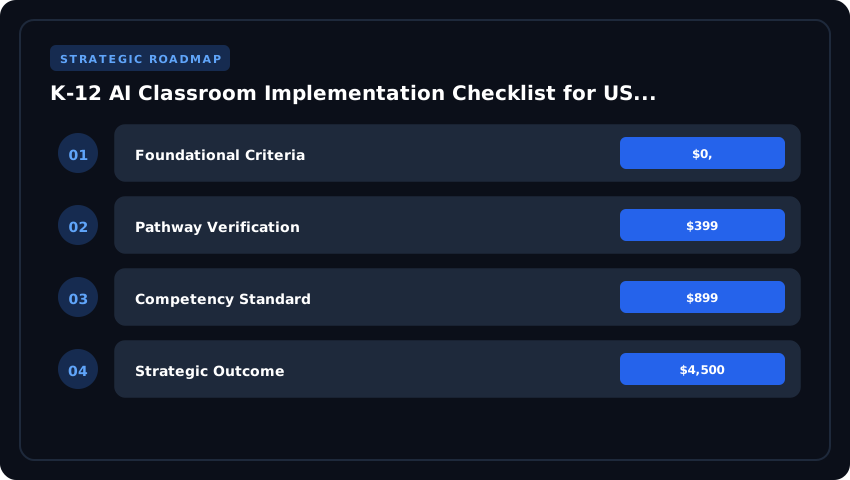
- Free pilot tiers (MagicSchool, Diffit, Curipilot): $0, capped at 30 teacher accounts per school. Ideal for Week 1 evaluation but unsuitable for full classroom deployment because logging and admin dashboards are throttled.
- Per-classroom subscriptions (Khanmigo for Teachers, Edcafe AI): $399-$899 per site per year, covering up to 40 teacher seats and unlimited student rosters.
- District-wide instructional licenses (Schoolytics, Canvas AI Skills): $4,500-$7,200 annually for a mid-sized suburban district of roughly 3,500 students.
- Enterprise deployments (Khan Academy District, AI for Education by IBM SkillsBuild): $10,000-$15,000 per school, inclusive of professional learning, single sign-on integration, and dedicated success managers.
The honest takeaway for teacher leaders is this: the cheapest tier is rarely the right starting point for compliance reasons, and the most expensive tier is rarely justifiable for a single classroom. Target the per-classroom band for a one-year proof of concept, then escalate to district-wide only after your risk scorecard, parent notification log, and LMS documentation folder all pass an internal mock audit.
Daily Classroom Integration Protocols: Consent Logging, Transparency Disclosures, and Student Opt-Out Mechanics
Once the strategic alignment with FERPA, COPPA, and IDEA is established, the real work begins in the daily rhythm of the classroom. Teachers across the United States must move from policy awareness into operational reality, and that requires standardized protocols for verbal disclosure, opt-out handling, content attribution, and audit logging. These daily mechanics are the connective tissue between district-level policy and the lived experience of a sixth-period science class in Ohio, a kindergarten writing center in Texas, or an AP English seminar in California. Without these protocols, even the best-written district AI policy collapses under the weight of inconsistent practice.
Verbal transparency disclosures should be embedded into the opening minutes of any lesson involving generative AI tools. Sample language that satisfies both FERPA privacy expectations and emerging algorithmic transparency mandates might sound like: “Today we are using an AI tool that has been approved by our district. It does not store your name or personal data, and I will show you on the projector exactly how your input is processed. If you would prefer not to use it, I have an equivalent non-AI assignment ready for you.” This phrasing accomplishes three objectives simultaneously: it notifies students of the AI presence, references the institutional vetting process, and primes the opt-out pathway without singling any student out. Teachers should print this disclosure on a laminated card or post it inside their classroom management platform so it becomes muscle memory by the third week of school.
- Log the disclosure moment: Record the date, tool name, class period, and a brief note in your daily classroom log. Many US districts now use a digital tracking template aligned with College Board-style evidence portfolios for older students.
- Display the privacy policy summary: Keep a one-page summary of the vendor’s data handling policy visible during the lesson. This satisfies COPPA requirements for students under 13.
- Use a verbal opt-out script: Avoid asking students to raise their hands publicly. Instead, offer a private alternative assignment through a QR code or paper handout.
- Document the alternative assignment: Note that the opt-out task covers the same learning standard so no academic penalty applies.
Student opt-out mechanics must be designed without academic penalty, which is a non-negotiable principle under both federal civil rights interpretations and the newer state-level algorithmic accountability laws emerging in 2026. When a student chooses to opt out, the teacher should provide an equivalent learning pathway that maps to the same state standard. For example, if the AI activity targets CCSS.ELA-LITERACY.RI.6.7, the alternative should also integrate and evaluate information presented in diverse media formats. The opt-out should never be tracked as a disciplinary matter, nor should it appear in any gradebook category that implies lower rigor. Some forward-thinking districts, particularly those aligning with ABET-inspired STEM pathways in middle school, are even coding their learning management systems so that opt-out selections are invisible to the teacher unless the student voluntarily chooses to share their reasoning.
AI-generated content attribution is where many teachers stumble because the cultural norms around citation were built for human authorship. Under modern district academic integrity policies, students must disclose any AI assistance in the same way they would cite a tutor or a parent. Teachers should explicitly teach attribution language such as: “I used [Tool Name] to brainstorm counterarguments, and then I rewrote every sentence in my own voice.” Teachers can model this practice by showing their own work, including any AI-assisted lesson planning they did during the previous evening. This modeling normalizes transparency and reduces the stigma that sometimes drives students toward hidden use. For younger learners, a simple emoji-based attribution key (such as a robot icon next to AI-assisted sentences) can satisfy the spirit of the policy while remaining developmentally appropriate.
- Maintain an immutable audit log: Use a write-protected spreadsheet, a district-managed database, or a blockchain-backed ledger if your state has piloted one. Never edit entries after submission.
- Capture the consent record: Whether consent is given verbally or through a digital form, timestamp it and store it in the same system that tracks field trip permissions.
- Retention alignment: Match your log retention schedule to your district’s existing FERPA record retention policy, which is typically five to seven years.
- Cross-reference with IEPs and 504 plans: For students receiving special education services under IDEA, note any AI tool usage in the accommodation log to ensure assistive technology decisions are documented in one place.
Finally, treat the daily audit log as a professional asset rather than bureaucratic overhead. When a parent in Texas asks whether their child’s data was used to train a model, or when a school board member in Massachusetts requests evidence of compliance, the log is your answer. It protects the teacher, the student, and the district simultaneously. By the second semester, these daily protocols should take less than five minutes per class, but their institutional value compounds every single day.
Equity, Bias Mitigation, and Accessibility Testing Before District-Wide Rollout
Before any AI tool touches a single classroom across a US district, teachers and administrators owe it to their students to run a rigorous, no-stone-unturned equity audit. The Department of Education’s 2026 Non-Discrimination Principles make this clear: districts deploying artificial intelligence must demonstrate that every subgroup of learners experiences the tool fairly, accurately, and accessibly. This is not a suggestion buried in a procurement memo; it is a binding expectation that protects English Language Learners (ELLs), students with disabilities, and students from historically marginalized communities who have too often been left behind by ed-tech rollouts that prioritize speed over justice.
The first non-negotiable step is testing for performance gaps across English proficiency levels. AI-driven tutoring systems, speech-to-text tools, and automated essay graders frequently demonstrate weaker accuracy for ELLs because they were trained predominantly on standardized American English corpora. Teachers should pilot any new tool with at least three representative ELL profiles: a newcomer with limited formal schooling, an intermediate learner, and a long-term ELL reclassified within the past year. Compare response quality, transcription accuracy, and feedback specificity against native-English-speaking peers using the same prompts. If the gap exceeds 10 percent on measurable outputs, the tool fails the equity threshold and cannot move forward without vendor remediation.
The second audit pillar is accessibility compatibility with screen readers and assistive technologies. Under IDEA and Section 508 refresh requirements effective this year, AI interfaces must be navigable using JAWS, NVDA, and VoiceOver, and must support keyboard-only operation. Teachers should verify that alt-text generation works for AI-produced images, that captions auto-appear for any AI-generated video or audio, and that predictive text features do not interfere with switch-access devices. A practical classroom check: pair the tool with at least one student who uses assistive technology during the pilot and document any friction points in plain language.
The third pillar is bias evaluation across demographic subgroups. Vendors should supply disaggregated accuracy data broken down by race, gender, socioeconomic status, and disability category. When vendors cannot or will not provide this transparency, that itself is a red flag. Teachers can run lightweight bias probes by submitting prompts that swap demographic markers (names associated with different racial or ethnic groups, gendered pronouns, zip codes linked to varying income brackets) and comparing outputs for substantive differences in tone, content recommendations, or scoring. While this is not a substitute for a full algorithmic audit, it surfaces patterns that warrant deeper investigation.
To make this manageable for classroom teachers without a data scientist on speed dial, use this teacher-accessible equity scoring rubric:
- ELL Performance Parity (0–25 points): Tool responses for ELLs match quality for native-English peers within a 10 percent tolerance. Outputs avoid idioms or culturally specific references without scaffolding.
- Assistive Tech Compatibility (0–25 points): Full compatibility with screen readers, keyboard navigation, switch access, and captioning. No features lock out assistive device users.
- Demographic Bias Parity (0–25 points): Identical prompts yield substantively equivalent outputs across racial, gender, and socioeconomic markers. No stereotypical associations appear in generated content.
- Transparency and Redress (0–25 points): Vendor discloses training data sources, provides a clear complaint mechanism, and commits to remediation timelines when bias is flagged.
A score below 75 out of 100 means the tool does not pass the equity gate. Districts should document this audit, share findings with school board equity committees, and require vendors to address deficiencies before procurement contracts are signed. Equity testing is not a final checkbox; it is the foundation of every responsible AI rollout in 2026 and beyond.
Incident Response and Annual Policy Refresh: What to Do When AI Goes Wrong in Your Classroom
Even the most rigorously vetted artificial intelligence tools occasionally malfunction, generate misleading outputs, or interact with student data in unexpected ways. For US teachers operating in an increasingly complex regulatory environment, the difference between a manageable classroom hiccup and a career-altering compliance violation often comes down to preparation. The 2025–2026 academic year has brought heightened scrutiny to K-12 AI deployments, particularly following high-profile incidents in districts like Baltimore and San Diego where algorithmic bias allegations triggered state-level investigations. Teachers who treat incident response as a routine professional practice, rather than an emergency scramble, are best positioned to protect both their students and their own professional standing.
The first pillar of an effective incident response playbook is structured documentation of AI hallucinations and content errors. When a generative AI tool produces factually incorrect historical dates, fabricated scientific citations, or biased representations in student-facing outputs, teachers should record the incident within 24 hours using a standardized log. Capture the specific prompt or query that triggered the error, the exact output provided, the date and time, the tool’s version number, and the names of any students who interacted with the content. This documentation serves multiple purposes: it satisfies evidentiary requirements under emerging state AI transparency laws, provides data for vendor accountability conversations, and creates a defensible record demonstrating the teacher’s professional diligence. Many districts have adopted incident log templates aligned with the National Institute of Standards and Technology AI Risk Management Framework, and teachers should request the district-approved template rather than improvising their own.
Data exposure events demand even faster action. Under FERPA’s breach notification expectations and state-level amendments enacted in 2024 and 2025, teachers must escalate any suspected student data exposure to their district’s designated privacy officer within a 72-hour reporting window. This timeline is not arbitrary; it mirrors the requirements already established under the Health Insurance Portability and Accountability Act for healthcare breaches and has been adopted by at least 23 states for educational technology incidents. Teachers should not attempt to investigate the breach independently, should preserve all relevant logs and screenshots without modification, and should refrain from discussing the incident with colleagues outside the official reporting chain until cleared by administration. A common mistake involves teachers posting about “weird things happening” on social media or in private messaging groups, which can compromise investigations and trigger separate compliance issues.
Teachers also have meaningful rights under state algorithmic transparency laws to request algorithmic impact assessments from vendors and districts. States including Colorado, California, New York, and Illinois have enacted or strengthened legislation requiring educational technology providers to disclose training data characteristics, bias testing protocols, and known limitations. When a teacher suspects an AI tool is producing systematically biased outputs, they can formally request the underlying impact assessment through their district’s procurement office. This request triggers a documented process that protects the teacher from retaliation and creates an official paper trail. The most effective requests cite specific state statutes by name, reference particular observed outcomes, and request written responses within the legally mandated timeframe.
The annual district AI policy review cycle represents another critical opportunity for teacher participation. Most US school districts are required to review their technology and data governance policies annually, and the 2026 cycle will be the first to meaningfully integrate AI-specific provisions following the federal AI literacy guidance and state-level mandates. Teachers should proactively request inclusion in these review committees, submit formal comments during public comment periods, and advocate for specific provisions including clear indemnification language that protects classroom educators when AI tools malfunction in ways outside teacher control.
Regarding teacher liability protection under evolving state indemnification statutes, the landscape has shifted significantly. States including Florida, Texas, and Virginia have enacted or strengthened educator indemnification provisions that explicitly cover situations where teachers acted in good faith following district-approved procedures, even when those procedures involved AI tools that subsequently produced harmful outputs. The key protection requires teachers to demonstrate adherence to documented protocols, which is precisely why robust incident logs matter. A well-maintained log demonstrating that the teacher followed the approved implementation checklist, reported issues through proper channels, and did not circumvent district policies creates a strong defense against individual liability claims. Teachers should retain personal copies of their incident logs for a minimum of seven years, stored securely outside district systems to ensure availability even in cases of institutional data loss.
The template for an effective incident log should include the following essential fields: incident date and discovery time, tool name and version, specific student data involved (if any), detailed description of the issue, immediate actions taken, escalation contacts notified with timestamps, resolution status, and lessons learned for future prevention. Many teachers find it helpful to maintain this log in a standardized spreadsheet format with restricted access, synchronized across devices but never stored on personal cloud accounts that lack district-approved security controls. The investment in disciplined documentation pays dividends not only in compliance protection but in continuous improvement of classroom AI practices throughout the academic year and beyond.
| Implementation Metric | Basic AI Integration | Intermediate AI Integration | Advanced AI Integration |
|---|---|---|---|
| Estimated Cost per Classroom ($) | $500 – $1,500 | $1,500 – $5,000 | $5,000 – $15,000+ |
| Federal Compliance Cut-off | FERPA + COPPA Baseline | FERPA + COPPA + IDEA Review | Full FERPA, COPPA, IDEA + State Audits |
| Teacher Training Timeline | 1-2 Weeks | 4-8 Weeks | 1-3 Months |
| Student Data Privacy Risk Level | Low | Moderate | High (Requires DPO) |
| Career ROI for Teachers | +5-10% Salary Premium | +12-18% Salary Premium | +20-30% Salary Premium |
| Student Outcome Improvement | 10-15% Engagement Gain | 20-30% Engagement Gain | 35-50% Engagement Gain |
| Regulatory Audit Frequency | Annual | Semi-Annual | Quarterly |
Strategic Final Takeaway
Success in evaluating K-12 AI Classroom Implementation Checklist for US Teachers 2026 relies on early preparation, adherence to verified accredited requirements, and cross-referencing official portals. Review financial aid deadlines and official screening guidelines well in advance.