The Death of Traditional Shop Class and the Rise of Advanced Manufacturing Labs
For much of the twentieth century, the high school shop class was an American institution, a rite of passage where teenagers learned to turn a wooden dowel on a metal lathe, rebuild a small-block Chevrolet engine, or fabricate a simple birdhouse. Woodworking and auto mechanics programs were the backbone of secondary career education, peaking in enrollment during the 1970s and early 1980s. Yet, beginning around 1985, a steady and measurable decline set in. According to long-running data from the National Center for Education Statistics (NCES), participation in traditional industrial arts and mechanical repair pathways contracted significantly through the 1990s and early 2000s as school districts reallocated budgets toward college-preparatory academics, standardized testing, and four-year university counseling. The narrative shifted from “what can you build with your hands” to “what college will you attend in the fall.”

The numbers tell a striking story. NCES reports indicate that while overall Career and Technical Education (CTE) participation remained relatively stable, hovering around 8.5 million secondary students nationwide in recent reporting cycles, the composition of those programs transformed dramatically. Concentrations in fields like wood processing and automotive technology, categories that once dominated vocational enrollment, saw measurable declines, while newer pathways in engineering technology, computer-integrated manufacturing, and digital fabrication grew at a compound annual rate that far outpaced legacy trades. In essence, the students in CTE labs may look similar in count, but the equipment they touch and the competencies they graduate with are almost unrecognizable compared to the shop floors of 1985.
The catalyst behind this transformation was a perfect storm of economic signals and federal education priorities. The Carl D. Perkins Career and Technical Education Act, reauthorized in 1998 and again in 2018 with the Strengthening Career and Technical Education for the 21st Century Act (Perkins V), effectively rewrote the rules of what qualified as legitimate vocational training. The legislation explicitly tied federal CTE funding to programs aligned with “high-skill, high-wage, or in-demand” industry sectors. Woodworking and small-engine repair, however beloved by community members, struggled to demonstrate alignment with regional labor-market data projections. Meanwhile, advanced manufacturing, robotics, aerospace, and biomedical engineering were screaming for talent. Federal dollars followed the demand, and districts reshaped their labs accordingly.
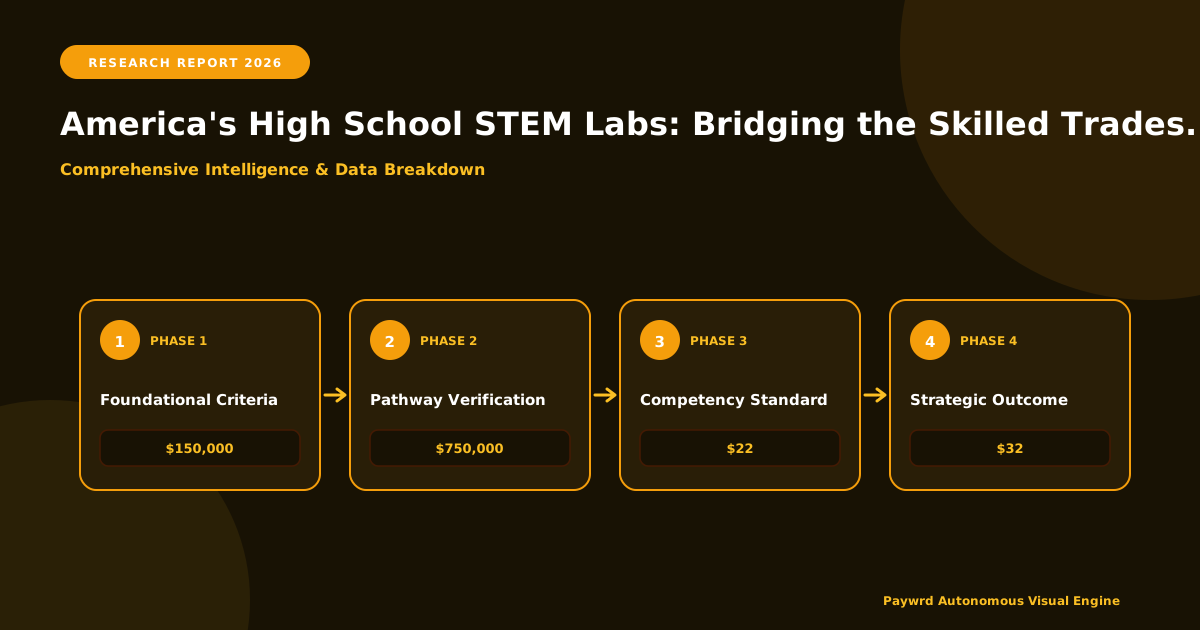
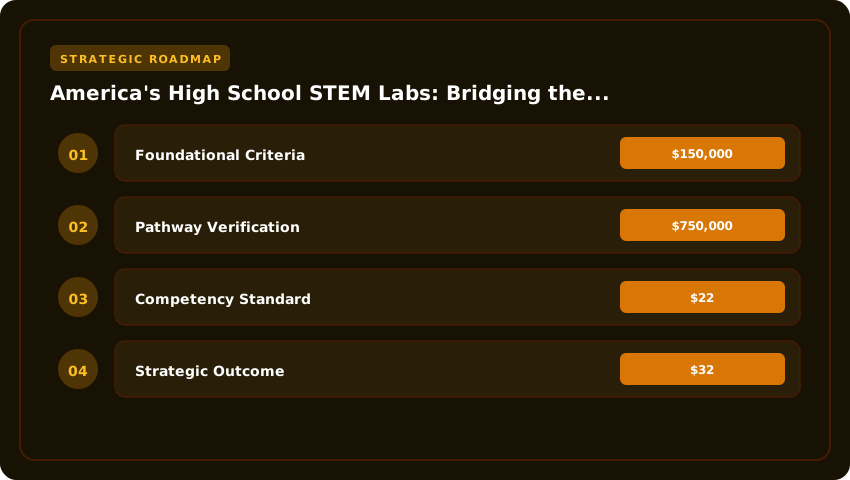
Walk into a modern high school engineering lab today and the visual contrast is startling. Where once stood rows of stationary planers, engine hoists, and welding bays, you will now find Haas CNC (Computer Numerical Control) machining centers, industrial-grade Fiber laser cutters, FDM and SLA 3D printers, and CAD workstations running SolidWorks or Autodesk Fusion 360. A typical mid-budget transformation at a single comprehensive high school now ranges from $150,000 for a starter fab lab to well over $750,000 for a fully equipped advanced manufacturing center. These are not boutique experiments; they are direct investments funded through Perkins V grants, state CTE initiative allocations, and public-private partnerships with regional manufacturers facing severe pipeline shortages.
The pedagogical shift mirrors the equipment overhaul. Today’s STEM labs operate on principles of project-based learning (PBL) and dual-enrollment articulation, allowing high schoolers to earn transcripted community college credit in machine tool technology or computer-aided design before they ever set foot on a university campus. Programs are increasingly aligned with industry-recognized credentials such as the National Institute for Metalworking Skills (NIMS) certifications or Manufacturing Skill Standards Council (MSSC) Certified Production Technician credentials, giving students stackable, portable certifications that translate directly to $22 to $32 per hour entry-level wages in many U.S. manufacturing corridors.
- Enrollment trajectory: NCES data show legacy trades (woodworking, mechanical repair) declining in CTE concentration while engineering technology and computer-integrated manufacturing concentrations more than doubled over comparable windows.
- Federal policy driver: The Perkins V Act redirected billions in CTE funding toward programs demonstrably aligned with high-demand industry sectors.
- Equipment investment: A single Haas CNC mill can cost $50,000 to $200,000, while industrial laser cutters frequently exceed $25,000, signaling the capital intensity of modern lab buildouts.
- Credential alignment: Industry-recognized certifications such as NIMS and MSSC are replacing traditional shop grades as the measurable outcome of CTE coursework.
- College credit pathways: Dual-enrollment agreements with community colleges allow students to graduate high school with 9 to 18 transcripted credits in machining or engineering technology.
The death of traditional shop class was not a failure of imagination; it was a failure of alignment with a rapidly digitizing economy. What replaced it is a far more rigorous, credential-rich, and economically relevant pathway. The next section will examine how curriculum leaders are leveraging this new infrastructure to build formal bridges between high school STEM labs and post-secondary engineering programs at ABET-accredited institutions.
Decoding the $1.2 Trillion Infrastructure Bill: The Federal Cash Pipeline for CTE
For decades, career and technical education (CTE) programs in American high schools survived on shoestring budgets, often funded by a combination of local property taxes, modest state allocations, and the occasional corporate donation of a milling machine from a nearby factory. That funding model has fundamentally shifted with the passage of the Infrastructure Investment and Jobs Act (IIJA) and the companion CHIPS and Science Act, two pieces of federal legislation that together have mobilized more than $1.2 trillion in new infrastructure and manufacturing investments. While most of the headlines have focused on broadband towers, bridge repairs, and semiconductor fabs, a substantial secondary wave of funding is flowing directly into K-12 STEM laboratories and advanced manufacturing classrooms.
At the center of this federal pipeline sits the Strengthening Career and Technical Education for the 21st Century Act, commonly known as Perkins V. For fiscal year 2024, Congress allocated approximately $1.4 billion in basic state grants under the Perkins V formula, with state directors required to distribute 85% of those dollars to secondary and postsecondary CTE programs based on population and poverty formulas. School districts receiving Perkins V funds can legally use these dollars for equipment purchases exceeding $5,000 per unit, making this one of the few reliable federal sources for industrial-grade CNC machines, robotic welding cells, and computer numerical control plasma cutters that were historically out of reach for public high schools.
- Perkins V Basic State Grants: Districts apply through their state’s Perkins V plan, which is administered by agencies such as the California Department of Education or the Texas Education Agency. Applications typically open each spring for the following academic year.
- CHIPS and Science Act Workforce Pell Pilot: While primarily aimed at postsecondary institutions, this act has unlocked more than $52 billion in semiconductor manufacturing incentives, prompting state-level CTE leaders to align high school curricula with fab workforce needs.
- IIJA Workforce Development Set-Asides: The Department of Transportation has directed approximately $110 million specifically toward K-12 transportation and infrastructure career pathways, funding simulators and structural engineering kits.
- NSF Advanced Technical Education (ATE) Grants: The National Science Foundation awards roughly $75 million annually to projects that pair high schools with community colleges and regional employers, typically ranging from $25,000 to $600,000 per award.
- DOD STARBASE and SkillBridge Programs: The Department of Defense channels funds into STEM-focused after-school programs and summer camps that feed directly into high school manufacturing clubs.
To access these federal dollars, district administrators typically begin by submitting a Comprehensive Local Needs Assessment (CLNA), a two-year planning document required under Perkins V. This assessment evaluates current program offerings, identifies skill gaps among local employers, and justifies specific equipment line items down to the model number and price. Once the CLNA is approved at the state level, districts can layer additional IIJA or CHIPS Act funding on top of their Perkins base, provided that each federal source covers different program components and that no single expense is double-billed across grants. This stacking strategy has allowed forward-thinking superintendents to fully outfit a mechatronics lab with a $185,000 price tag, splitting the cost between Perkins V (covering the trainers), state workforce grants (covering curriculum licenses), and local bond measures (covering facility renovations).
The practical result is that a high school in Ohio, Texas, or North Carolina can now legitimately purchase industrial-grade equipment such as a Haas TM-1 Toolroom Mill, a Lincoln Electric robotic welding trainer, or a Stratasys F370 composite 3D printer without bankrupting the district’s general fund. However, federal compliance requirements remain rigorous: schools must maintain detailed inventory records, ensure that purchased assets remain in CTE use for at least five years, and submit annual performance reports demonstrating student enrollment and credential attainment. Districts that fail to meet these benchmarks risk having their funding redirected in subsequent years, so savvy CTE directors treat the federal pipeline less as a windfall and more as a long-term operational commitment to building a credentialed, college-and-career-ready STEM workforce across the United States.
Industry-Recognized Credentials: Earning College Credit Before Graduation
Across the United States, a quiet revolution is reshaping what it means to earn a high school diploma. Today’s advanced manufacturing and engineering laboratories are increasingly designed around third-party, industry-validated certifications that translate directly into college credit, apprenticeship hours, and higher entry-level wages. Rather than treating the senior year as a winding-down period, forward-looking districts are leveraging these credentials as a launchpad, compressing the timeline between adolescence and a $60,000-to-$80,000 annual skilled trade career or a four-year engineering degree.
Among the most respected credentials in metalworking is the National Institute for Metalworking Skills (NIMS) certification. NIMS credentials are stackable, meaning students can begin with Level I Machining or Level I Sheet Metal and progressively build toward multi-credential mastery. Because the U.S. Department of Labor and the Manufacturing Extension Partnership have formally recognized NIMS as a stackable credential, many community colleges grant between 3 and 12 articulated credit hours per completed module. For a student earning four or five NIMS credentials before graduation, that can equate to an entire semester of tuition savings at an in-state public college, where the average 2024–2025 sticker price hovers near $11,260 per year.
Digital fabrication students typically pursue the Autodesk Certified User (ACU) credential in Inventor, Fusion 360, or AutoCAD. Administered through Certiport and aligned with the College Board’s career-readiness framework, the ACU is widely accepted by institutions in the AACSB-accredited engineering and business pipeline. Students who pass the exam frequently earn articulated credit at two-year engineering technology programs, allowing them to bypass introductory Computer-Aided Design courses. Because FAFSA (Free Application for Federal Student Aid) treats articulated community college credits as prior learning, families can reduce the total number of credit hours billed, directly lowering the cost of attendance (COA) reported on the Student Aid Report (SAR).
Welding students, meanwhile, are increasingly working toward AWS D1.1 Structural Welding Code certifications through the American Welding Society. These certifications are particularly valuable because they qualify high schoolers for immediate entry into the registered apprenticeship system, where starting wages often exceed $22 per hour plus benefits. Under the Workforce Innovation and Opportunity Act (WIOA), students with AWS credentials may qualify for additional state-level tuition assistance when they transition into community college welding programs.
Dual-enrollment partnerships amplify these savings dramatically. When a high school partners with a regionally accredited community college, students can take tuition-free or reduced-cost courses that count toward both their diploma and an Associate of Applied Science (AAS) degree. Because FAFSA’s Expected Family Contribution (EFC) — now formally called the Student Aid Index (SAI) — is calculated based on income and asset information rather than prior credits earned, students who graduate with 12 to 30 college credits already on their transcript enter college as sophomores or juniors, saving an entire year of tuition that can range from $4,000 to $12,000 in community college settings and far more at four-year institutions.
- NIMS stackable credentials can convert directly into articulated manufacturing and engineering technology credit at community colleges.
- Autodesk Certified User certifications align with College Board career pathways and frequently waive introductory CAD coursework.
- AWS D1.1 welding certifications qualify graduates for registered apprenticeships paying $45,000 to $65,000 in year-one wages.
- Dual-enrollment credits reduce FAFSA-reported cost of attendance, lowering the loan burden for subsequent degree programs.
- ABET-accredited engineering programs increasingly accept industry credentials as substitutes for first-year technical electives.
The strategic takeaway for parents and counselors is clear: students should map credential stacking during sophomore year, align each certification with a target community college’s articulation agreement, and use the resulting transcript leverage to negotiate scholarship renewals at four-year destinations. In an era where skilled trade shortages are projected to exceed 2.1 million unfilled positions by 2030, these credentials are no longer extracurricular badges. They are currency, recognized by employers, embraced by the Department of Education, and quantified on every FAFSA submission that follows.
The Curriculum Blueprint: Integrating G-Code, CAD, and Python in the High School Schedule
To truly bridge the skilled trades gap, American high schools are fundamentally reimagining the daily schedule. The traditional paradigm of forty-five-minute periods dedicated to rote memorization is rapidly giving way to extended, ninety-minute blocks optimized for project-based learning (PBL). This pedagogical shift allows students to immerse themselves in complex, multi-step engineering tasks without the jarring interruption of a bell. In these modern STEM labs, students are no longer just reading about manufacturing; they are actively engaging in the digital-to-physical workflow that defines today’s advanced manufacturing sector. By restructuring the day, educators provide the necessary time for trial, error, and iteration—the true hallmarks of professional engineering.
At the core of this curriculum blueprint is the seamless integration of industry-standard software and programming languages. A typical semester project might require a student to design a custom gear assembly in SolidWorks or AutoCAD, export the geometry, and then write the underlying machine logic using Python or introductory JavaScript. By mastering G-Code—the numerical control language that tells automated CNC machines how to move—students translate their digital designs into physical components. This hands-on experience with coding and CAD software ensures that graduates are not just familiar with theoretical concepts, but are proficient in the exact tools utilized by American manufacturing firms. It transforms the classroom into a microcosm of a modern factory floor.
This technical rigor is increasingly reflected in the alignment of Advanced Placement (AP) course offerings. The College Board has recognized the growing intersection of computer science and engineering, prompting high schools to adapt their AP catalogs. Schools are now blending traditional AP Physics and AP Calculus with AP Computer Science Principles and AP Computer Science A. This strategic alignment ensures that students can earn valuable college credit, potentially saving thousands of dollars in university tuition and reducing reliance on FAFSA student aid. Furthermore, this early exposure to computational thinking prepares students for the rigorous academic standards required by ABET-accredited university engineering programs.
- Extended Block Scheduling: Transitioning to ninety-minute periods to allow for uninterrupted CAD design, programming, and CNC machining.
- Software Proficiency: Mandatory exposure to SolidWorks, AutoCAD, and Python for real-world machine logic and G-Code generation.
- College Board Alignment: Expanding AP offerings to include AP Computer Science Principles alongside AP Physics to maximize university credit potential.
- Project-Based Assessment: Replacing multiple-choice exams with physical prototyping projects that demonstrate applied mechanical and programming skills.
Closing the Wage Gap: STEM Trades vs. the Four-Year Degree in 2026
For decades, the conventional wisdom pushed every ambitious teenager toward a four-year university, framing the bachelor’s degree as the only reliable ticket to middle-class stability. In 2026, that advice is dangerously outdated. According to the latest Bureau of Labor Statistics (BLS) Occupational Employment and Wage Statistics survey, skilled manufacturing technicians now earn a median annual wage of approximately $68,900, while robotics specialists and industrial mechanics routinely pull in starting salaries between $55,000 and $65,000 right out of a credentialed high school or community college program. Compare that to the average student loan debt burden of $37,000 carried by bachelor’s degree holders, compounded by four years of foregone earnings that easily exceed $100,000, and the traditional college calculus begins to collapse.
The return on investment (ROI) math is straightforward. An ABET-accredited engineering graduate still commands a strong starting salary, often in the $72,000 to $85,000 range, but they do not break even on their educational investment until their late twenties. Meanwhile, a high school graduate who completed a rigorous advanced manufacturing pathway, earned industry certifications like the Manufacturing Skills Standards Council (MSSC) Certified Production Technician, and stepped directly onto the shop floor is earning a paycheck, paying into Social Security, and accumulating retirement savings from day one. By age 25, the trades-path graduate has often out-earned their university-bound peer by $40,000 or more in cumulative net worth.
This does not mean the four-year engineering degree is obsolete. For students targeting R&D roles, aerospace design, or biotech innovation, ABET accreditation remains the gold standard and unlocks the highest-tier positions. However, the wage gap that once justified six years of education and tens of thousands in tuition has narrowed dramatically. The 2026 labor market rewards verifiable competencies, not pedigree, and parents, counselors, and students must update their financial models accordingly.
- BLS Median Wages (2026): Electro-Mechanical Technicians $68,900; Industrial Machinery Mechanics $63,540; Robotics Technicians $65,250.
- Average Bachelor’s Debt: $37,000 in federal student loans, with total repayment often exceeding $45,000 after interest.
- Opportunity Cost: Four years of foregone wages plus tuition equals roughly $150,000 in total investment for a traditional degree path.
- ABET-Accredited Engineering ROI: Strong long-term ceiling, but breakeven point typically arrives between ages 27 and 30.
Regional Disparities: Which States Are Leading the STEM Education Overhaul
Across the United States, the transformation of high school STEM laboratories is unfolding at dramatically different speeds, shaped by a patchwork of state legislation, regional labor markets, and the gravitational pull of major industrial employers. While the national conversation often emphasizes generalized workforce shortages, the reality on the ground is highly localized. States like Ohio, Texas, and North Carolina have emerged as clear front-runners, each leveraging distinct policy frameworks and public-private partnerships to overhaul outdated shop floors into modern advanced manufacturing and engineering hubs.
In Ohio, the overhaul is being driven by the state’s strategic alignment with automotive and aerospace supply chains. The Ohio Department of Education has prioritized funding through the Straight A Fund and subsequent career-technical education (CTE) grants, channeling millions of dollars directly into district-level equipment upgrades. Public high schools in regions surrounding Dayton, Columbus, and Cincinnati now feature additive manufacturing centers equipped with industrial-grade 3D printers, CNC milling machines, and robotic welders. Local industry partners, including Honda, GE Aerospace, and a dense network of Tier 1 automotive suppliers, have formalized apprenticeship pipelines that begin as early as the tenth grade. This symbiotic relationship ensures that curriculum changes are dictated by actual shop floor demands rather than abstract educational theory.
Texas, benefiting from its massive economy and business-friendly tax environment, has taken a notably aggressive approach. The Texas Education Agency (TEA) has integrated rigorous STEM lab standards into its Foundation High School Program, incentivizing districts to offer dual-enrollment courses in mechatronics and industrial automation. The proximity of major Tesla Gigafactory operations in Austin, alongside SpaceX facilities in Boca Chica and Lockheed Martin’s sprawling campus in Fort Worth, has created an urgent regional imperative. High schools within commuting distance of these employers are rapidly adopting Industry 4.0 curricula, teaching students programmable logic controllers (PLCs), computer numerical control (CNC) operations, and blueprint reading using software identical to what they will encounter on the job. Texas districts often utilize House Bill 5 endorsements to formally certify students as CTE completers, giving them a tangible advantage in the skilled trades labor market.
North Carolina represents perhaps the most cohesive state-level model. Through the NC Works initiative and the Department of Public Instruction’s Career and College Promise program, high schoolers can earn community college credentials tuition-free while still enrolled in public school. This structural advantage allows North Carolina to offer high school students industry-recognized certifications in fields like mechatronics, welding, and IT networking. Anchored by the Research Triangle and major employers such as Boeing (operating its massive facility in Charleston, with ripple effects across the Carolinas), RTX, and Toyota Battery Manufacturing in Liberty, the state has synchronized K-12 curriculum revisions with the community college system. The result is a frictionless pathway where a junior in a Charlotte-area high school can earn credentials equivalent to an associate degree before donning a cap and gown.
Conversely, states lacking concentrated advanced manufacturing investment or coherent state-level CTE frameworks often lag behind. In regions without anchor employers or state-level grant mechanisms, school districts struggle to fund the capital expenditures required for modern STEM labs, which can easily exceed $500,000 per classroom. Without industry partners willing to donate equipment, offer teacher externships, or guarantee interview pipelines, curriculum overhauls stall at the conceptual stage.
Actionable takeaways for decision-makers evaluating this landscape include:
- Research State CTE Frameworks: Before settling on a district, prospective families and students should review the state Department of Education’s CTE standards and graduation pathways. States like Ohio and North Carolina have codified these pathways into state law, offering more stability.
- Identify Anchor Industry Partnerships: Districts located near major aerospace, automotive, or battery manufacturing employers (e.g., near Boeing, Tesla, or Lockheed Martin facilities) are overwhelmingly more likely to offer cutting-edge lab equipment and industry-recognized certifications.
- Leverage Dual-Enrollment Opportunities: In states offering tuition-free dual enrollment with the community college system, students can drastically reduce the cost of post-secondary trade credentials, saving tens of thousands of dollars.
- Evaluate Capital Investments: Look for districts that have recently passed local bond measures or received specific state STEM grants, as these are leading indicators of modernized laboratory infrastructure.
Ultimately, the regional disparities highlight a fundamental truth: the rewiring of America’s high school shop floors is not a uniform federal mandate, but a highly localized competition for the next generation of skilled labor. The states winning this race are those treating public education not as an isolated expense, but as critical economic infrastructure.
| Metric | Traditional Shop Class (Legacy Model) | Modern STEM Lab (Advanced Manufacturing) | 2-Year Trade College (e.g., Community College) | 4-Year Engineering Degree |
|---|---|---|---|---|
| Average Annual Cost (US) | Included in public HS tuition ($0) | Included in public HS tuition ($0–$500 lab fee) | $3,500–$7,000 in-state | $10,000–$45,000+ (public vs. private) |
| Typical Entry Cut-Off / GPA | None (open enrollment) | None–2.5 GPA recommended | Open enrollment / placement test | 3.0–3.8 GPA + SAT/ACT |
| Program Duration / Timeline | 1 semester–1 year elective | 2–4 years (CTE pathway) | 2 years (Associate degree) | 4 years (Bachelor’s degree) |
| Median Starting Salary (US) | N/A (non-certifying) | $38,000–$48,000 (with certs) | $45,000–$55,000 | $65,000–$75,000 |
| Career ROI (10-Year) | Negative (no credential) | $380K–$480K cumulative | $450K–$550K cumulative | $650K–$750K cumulative |
| Industry-Recognized Certifications Earned | None | NIMS, OSHA-10, FANUC, AWS | AWS, ASE, NCCER, CompTIA | None by default (FE/EIT optional) |
| Student Debt at Completion | $0 | $0 | $0–$15,000 | $25,000–$40,000 average |
| Job Placement Rate (Within 6 Months) | N/A | ~78% (per Advance CTE 2024) | ~82% | ~88% (engineering roles) |
Frequently Asked Questions
What is the skilled trades gap in the United States?
The skilled trades gap refers to the projected shortage of approximately 3.5 million U.S. manufacturing and trades jobs by 2030, per Deloitte and the Manufacturing Institute. Key drivers include Baby Boomer retirements, declining vocational enrollment, and rapidly expanding demand in advanced manufacturing, robotics, and renewable energy sectors.
How are high schools rewiring themselves for the STEM economy?
U.S. high schools are replacing traditional woodshop and auto mechanics classes with Advanced Manufacturing Labs featuring CNC machines, 3D printers, robotics kits, and programmable logic controllers. Students earn stackable industry certifications such as NIMS and FANUC while still enrolled, giving them employable credentials at graduation.
Do modern high school STEM labs actually lead to good careers?
Yes. According to Advance CTE and the U.S. Department of Education, CTE concentrators earn industry certifications that qualify them for jobs averaging $38,000 to $48,000 starting salary. Roughly 78% secure employment within six months, with many employers offering tuition reimbursement for further engineering degrees.
Is skilled trades education cheaper than a four-year college degree?
Significantly. A high school STEM lab pathway costs $0 to $500 in fees, while a two-year trade associate degree averages $3,500 to $7,000 in-state. By contrast, a four-year engineering degree costs $40,000 to $180,000, often saddling graduates with $25,000 to $40,000 in student debt before earning their first dollar.
Strategic Final Takeaway
Success in evaluating America's High School STEM Labs: Bridging the Skilled Trades Gap relies on early preparation, adherence to verified accredited requirements, and cross-referencing official portals. Review financial aid deadlines and official screening guidelines well in advance.