2026 Tuition Breakdown for Online Biology Bachelor’s Degrees
As you plan your academic journey for the 2026 enrollment cycle, understanding the true cost of an accredited online biology bachelor’s degree is critical. While universities often advertise a glossy “sticker price,” the reality of per-credit-hour rates and mandatory fees can significantly alter your financial strategy. Whether you are leveraging FAFSA for federal aid or relying on institutional scholarships, knowing exactly what you will pay—and where hidden costs lurk—empowers you to make a sound investment in your future.
Let us analyze the per-credit-hour costs across different institutional categories to establish a baseline. Tuition rates vary widely depending on the university’s funding model and your residency status, even for fully online programs.
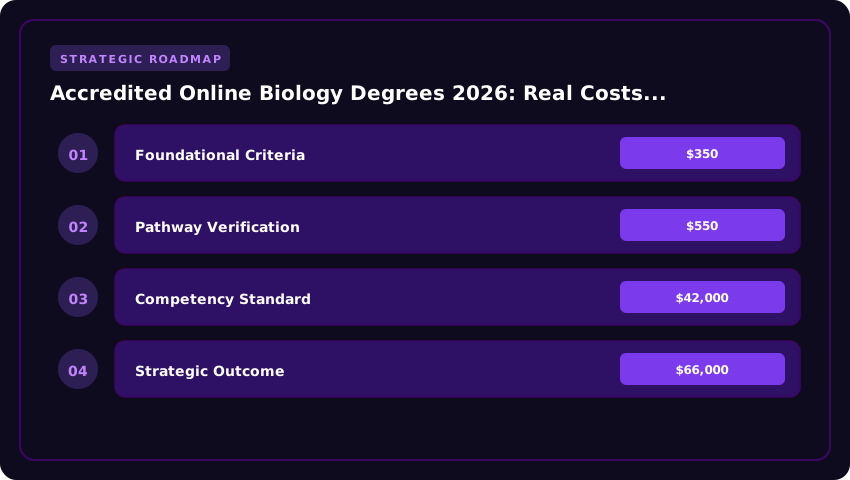
- Public Universities: Expect to pay between $350 and $550 per credit hour. Flagship institutions like Arizona State University (ASU) and UF Online (University of Florida) typically fall into this tier. For a standard 120-credit program, base tuition ranges from $42,000 to $66,000.
- Private Non-Profit Institutions: These programs often charge $500 to $800 per credit hour. Southern New Hampshire University (SNHU) offers highly competitive rates around $330 per credit, but other private non-profits can push total program costs toward the higher end of the spectrum.
- Competency-Based & For-Profit Models: Institutions like Western Governors University (WGU) offer flat-rate, six-month terms (often around $3,800) rather than per-credit pricing, allowing accelerated learners to complete a degree for roughly $15,000 to $20,000. Traditional for-profits generally charge $400 to $600 per credit, bringing total costs in line with public universities.
When projecting your total program cost, anticipate a broad range of $38,000 to $75,000+. However, the published tuition rate is rarely the final word. Online biology degrees carry unique hidden expenses that can inflate your bottom line by thousands of dollars.

First, you must account for laboratory requirements. Because biology is a hands-on discipline, universities have adapted online delivery through virtual and at-home modalities. Expect to pay $3,000 to $6,000 over the course of your program for at-home lab kits, which include safely shipped chemicals, specimens, and specialized equipment. Alternatively, many programs now require subscriptions to VR lab platforms like Labster or PraxiLabs. These immersive software subscriptions are often billed as separate course fees, adding $100 to $250 per lab
Regional and Programmatic Accreditation: What Actually Matters
Accreditation is not a decorative stamp. It is the regulatory backbone that determines whether your online biology degree actually unlocks federal aid, seamless credit transfer, graduate admissions, and professional licensure. If you are evaluating programs for the 2026 cycle, you must understand two distinct layers of credentialing. The first layer is regional accreditation, granted by one of six agencies recognized by the U.S. Department of Education and the Council for Higher Education Accreditation (CHEA). The second layer is programmatic accreditation, a specialized endorsement that signals curriculum rigor in a specific discipline. Skipping either layer puts your investment at risk, because employers, medical schools, and licensing boards treat these designations as baseline filters.
Across the United States, six regional accreditors govern the vast majority of nonprofit and public institutions, including nearly every school that offers a financially viable online biology pathway:
- Higher Learning Commission (HLC): Covers 19 states across the central United States, including Texas, Ohio, Minnesota, and Arizona. Many large state university systems and major for-profits fall under HLC oversight.
- Southern Association of Colleges and Schools Commission on Colleges (SACSCOC): Accredits institutions across the Southeast, including Florida, Georgia, North Carolina, Tennessee, and Alabama. Look for this seal if you plan to study anywhere between Virginia and Texas.
- Middle States Commission on Higher Education (MSCHE): Oversees Delaware, Maryland, New Jersey, New York, and Pennsylvania, plus the District of Columbia and several international branch campuses.
- New England Commission of Higher Education (NECHE): The successor to NEASC, this body accredits institutions across Connecticut, Maine, Massachusetts, New Hampshire, Rhode Island, and Vermont.
- Northwest Commission on Colleges and Universities (NWCCU): Covers Alaska, Idaho, Montana, Nevada, Oregon, Utah, and Washington.
- WASC Senior College and University Commission (WSCUC): Serves California, Hawaii, and the broader Pacific region, including many large online programs headquartered on the West Coast.
Regional accreditation is non-negotiable for two practical reasons. First, it is the gateway to FAFSA eligibility. Federal student aid, including the Pell Grant, Federal Direct Loans, and work-study programs, can only be disbursed to students enrolled at institutions accredited by a Department of Education recognized agency. A “nationally accredited” diploma mill, by contrast, will block your FAFSA submission and disqualify you from need-based grants that can total more than $7,000 per academic year. Second, only credits earned at a regionally accredited school will transfer cleanly to another regionally accredited institution. This matters if you start at a community college through an articulation agreement and later move to a four-year program, or if you relocate and need to switch schools mid-degree.
Programmatic recognition sits on top of regional accreditation and tells graduate admissions panels and licensing boards that your coursework meets discipline-specific standards. Two credentials matter in the biological sciences:
- American Society for Biochemistry and Molecular Biology (ASBMB): Evaluates undergraduate programs in biochemistry and molecular biology. An ASBMB-accredited track signals that your coursework aligns with what medical schools and PhD programs expect in molecular technique, quantitative analysis, and lab competency.
- American Society for Microbiology (ASM): Endorses microbiology-focused curricula that meet clinical and research benchmarks. While not universally required, ASM alignment strengthens applications to medical laboratory science (MLS) tracks and clinical lab scientist (CLS) certification pathways.
For pre-med and pre-PA students, programmatic accreditation is often the deciding factor between two otherwise comparable degrees. Medical schools expect coursework in cell biology, genetics, organic chemistry, and quantitative physiology, exactly the competencies ASBMB-accredited programs formally document. Likewise, students targeting the ASCP Board of Certification exam for medical laboratory scientists need curricula that meet NAACLS or ASM-endest expectations; graduating from a non-aligned program can force you to complete remedial coursework or repeat clinical rotations.
Here is the actionable takeaway: before you compare tuition, verify both accreditations. Confirm the institution’s regional status in the CHEA or Department of Education database, then check the program’s page for ASBMB, ASM, or equivalent discipline-specific endorsements. This single verification protects your FAFSA eligibility, your transfer credits, your graduate school applications, and your future professional licensure. Everything else, including cost rankings and AI career forecasts, is secondary to this foundational credential check.
FAFSA, Pell Grants, and STEM Scholarships That Cut Costs
For the 2026–27 award year, the Free Application for Federal Student Aid (FAFSA) operates under the full implementation of the FAFSA Simplification Act, reshaping how online biology students calculate their federal eligibility. The most consequential change is the replacement of the Expected Family Contribution (EFC) with the Student Aid Index (SAI). Unlike the old EFC, which could go below zero for the neediest applicants, the SAI floor sits at –$1,500, allowing institutions to package slightly more need-based aid toward students with the lowest family resources. The new formula also removes the sibling-of-a-student discount in favor of a simpler household-size calculation, and it no longer penalizes families for small retirement account balances. For online learners specifically, the Simplified Needs Test has been broadened, meaning more adult, married, and independent filers qualify for an automatic zero asset contribution.
Pell Grant eligibility has expanded alongside these reforms. The maximum Pell award for the 2026–27 cycle is projected at $7,395, up roughly $200 from the prior year, with the minimum award expected to land near $750. Because online biology programs at regionally accredited universities generally cost between $250 and $450 per credit hour, a full-time student carrying 30 credits annually can realistically apply the entire Pell award toward tuition, leaving only gap financing for books and lab kits. Students whose enrollment intensity fluctuates due to clinical rotations, fieldwork, or accelerated eight-week terms should note that Pell now disburses proportionally across mini-terms rather than locking into a single semester, giving working biologists far more scheduling flexibility.
Biology majors who plan to teach at the secondary level should evaluate the Teacher Education Assistance for College and Higher Education (TEACH) Grant, which provides up to $4,000 per year in non-need-based aid. The catch is the conversion clause: if you fail to complete four years of qualifying teaching service within eight years of graduation, the grant retroactively converts into an unsubsidized Direct Loan with accrued interest. For biology students, qualifying service includes teaching at a low-income school in a high-need field such as general science, biology, or chemistry. Maintain annual counseling, keep certification paperwork on file, and document your service through the Department of Education’s Agreement to Serve portal to protect your funding.
Outside of federal aid, biology students should aggressively pursue STEM-specific scholarships that often go unclaimed because applicants assume they are reserved for graduate students. The National Institutes of Health (NIH) funds the Undergraduate Scholarship Program for students from disadvantaged backgrounds pursuing biomedical research, covering tuition up to $20,000 per year plus a stipend. The National Science Foundation (NSF) continues to back the S-STEM program, awarding roughly $5,000 to $10,000 annually to undergraduates in financially supported STEM disciplines at participating institutions. Finally, the Department of Defense SMART Scholarship offers full tuition, a $25,000–$38,000 annual stipend, and guaranteed post-graduation employment with a DoD agency—an exceptional pathway for biology students interested in bioinformatics, biodefense, or military laboratory science.
One often-overlooked advantage for online biology learners is in-state tuition reciprocity through the State Authorization Reciprocity Agreement (SARA). Because SARA-participating institutions are authorized to deliver distance education across member states without losing federal Title IV eligibility, many accredited universities extend in-state or discounted tuition rates to online enrollees regardless of physical residency. For example, a student living in Texas can enroll in a SARA-approved online biology program at a public university in Ohio and pay the Ohio in-state online rate, which is frequently 40–60 percent lower than the out-of-state sticker price. Combined with Pell, TEACH, and a private scholarship, the total annual cost of an accredited online biology degree can realistically drop below $4,000 net—a remarkable return on investment for a field that anchors so many of today’s fastest-growing health and environmental careers.
- FAFSA SAI formula: Floor of –$1,500; broader Simplified Needs Test for adult and independent online learners.
- Pell Grant 2026: Projected maximum of $7,395, disbursed proportionally across accelerated terms.
- TEACH Grant: Up to $4,000/year for biology educators; converts to loans if service obligation is missed.
- STEM Scholarships: NIH Undergraduate Scholarship (up to $20,000), NSF S-STEM ($5,000–$10,000), DoD SMART (full tuition + stipend).
- SARA reciprocity: In-state online tuition rates for distance learners across 49 member states.
AI-Powered Career Pathways and Salary ROI for Biology Graduates
The 2026 job market for biology graduates is no longer defined solely by pipettes and petri dishes. Today, the most lucrative and fastest-growing career tracks sit at the intersection of life sciences and artificial intelligence, rewarding students who can translate biological questions into computational answers. For graduates holding an accredited online biology degree, four emerging pathways deserve serious attention: bioinformatics, computational biology, AI-driven drug discovery, and clinical data science. Each of these fields blends rigorous scientific training with programming, statistical modeling, and machine learning, creating a hybrid skill set that employers across pharmaceuticals, agriculture, and healthcare are aggressively recruiting.
Salary data from the U.S. Bureau of Labor Statistics confirms the financial upside of these AI-adjacent roles. Medical scientists, a category that increasingly includes computational biology specialists, reported a median annual wage of $99,930 in the most recent Occupational Employment and Wage Statistics release, with top earners surpassing $166,000 in research-intensive states. Biological technicians, a common entry-level role for recent bachelor’s degree holders, earned a median of $51,430, though technicians who upskill in Python, R, or cloud-based laboratory information management systems frequently transition into higher-paying analyst positions within 18 to 24 months. The wage gap between these two titles illustrates exactly why strategic upskilling matters: the same biology graduate who earns $52,000 as a technician can realistically reach six figures within five years by pivoting into AI-augmented research.
Calculating the 10-year ROI for an online biology degree requires comparing realistic debt loads to projected earnings. Consider a typical scenario: a student borrows the federal undergraduate loan limit to cover tuition, fees, and living expenses, graduating with roughly $35,000 in student debt at an interest rate near 6.5%. Using a standard 10-year repayment plan, monthly payments land around $397, totaling approximately $47,700 over the life of the loan. Now compare that obligation to projected earnings. A graduate entering as a biological technician at $51,430 who climbs to a medical scientist salary of $99,930 within seven years will earn a cumulative 10-year income exceeding $820,000. Even after subtracting loan payments and estimated taxes, the net return comfortably exceeds $600,000, yielding an ROI ratio of more than 12-to-1 on the original educational investment.
Geography amplifies these returns significantly. The highest concentrations of biotech employers cluster in three powerhouse states: Massachusetts (home to the Kendall Square biotech corridor and more than 1,000 life sciences companies), California (anchored by the San Francisco Bay Area and San Diego’s “Biotech Beach”), and North Carolina (the Research Triangle region, where biomanufacturing employment has grown by double digits since 2022). Graduates who complete their online biology degree and then relocate to these markets often see starting salaries 15% to 25% above the national median, plus stronger signing bonuses and stock-based compensation at established firms.
- Bioinformatics analyst – Entry-level salaries typically range from $65,000 to $85,000, with senior roles exceeding $130,000 at pharmaceutical leaders.
- Computational biology scientist – Median compensation sits near $105,000, with significant premiums for candidates skilled in deep learning frameworks.
- AI-driven drug discovery associate – Emerging title with starting packages above $90,000, reflecting heavy industry demand.
- Clinical data scientist – Median pay approaches $112,000, especially for graduates who pair biology credentials with health informatics certifications.
For prospective students weighing the financial commitment of an accredited online biology degree, the message is clear: pairing a solid life sciences foundation with AI and data science competencies unlocks some of the strongest wage growth in the U.S. economy. When you map that earning potential against manageable federal loan repayment, the 10-year ROI positions biology as one of the most defensible educational investments available in 2026, particularly for graduates willing to target high-demand biotech corridors in Massachusetts, California, or North Carolina.
Lab Component Compliance: Meeting the Wet-Lab Requirement Online
One of the most persistent concerns for prospective online biology students is whether a fully remote program can truly satisfy the rigorous hands-on laboratory expectations that have historically defined a quality biology education. The reality for 2026 is encouraging: accreditation-driven design now makes it entirely possible to satisfy wet-lab competencies through a blended ecosystem of at-home science kits, high-fidelity virtual simulations, and short, intensive in-person residencies at cooperating campuses. Understanding how these pieces interlock is essential for evaluating any program you consider.
Traditional biology degrees, especially those seeking articulation with medical, dental, or veterinary schools, have always required documented proficiency in core techniques such as micropipetting, gel electrophoresis, gram staining, microbial culturing, and spectrophotometry. The gold-standard question asked by admissions committees and graduate programs remains: Can this candidate competently perform foundational lab procedures independently? Modern accredited online biology degrees answer that question with evidence-based lab modalities rather than relying on purely theoretical instruction.
The three primary delivery models, often combined within a single degree path, include:
- At-Home Kit Providers: Companies such as eLearning (formerly eScience Labs), Carolina Distance Learning, and Hands-On Labs ship purpose-built experiment kits directly to enrolled students. These kits arrive with pre-measured reagents, sterilized glassware, specimen samples, and step-by-step curriculum-aligned manuals. Students record data, photograph results, and upload findings to a learning management system where instructors evaluate technique and comprehension. Carolina Distance Learning, affiliated with the well-respected Carolina Biological Supply Company, is particularly recognized for high-quality specimen kits, while Hands-On Labs is widely adopted by community colleges and state universities for its standardized, transferable lab kits.
- Virtual Reality and Simulation Platforms: Sophisticated browser-based and VR-compatible platforms now replicate laboratory environments with striking realism. Students can practice pipetting in a simulated biosafety cabinet, learn aseptic technique, conduct dissections digitally, and even explore molecular dynamics visualizations that would be impossible to observe in a traditional lab. These platforms are excellent for developing procedural memory, troubleshooting instincts, and safety habits, and they allow unlimited repetition without the cost of consumables.
- Required In-Person Residencies: Many accredited online programs partner with regional universities, community colleges, or commercial lab facilities to host intensive multi-day residency experiences. These residencies, sometimes called “intensive lab weekends” or “summer immersion institutes,” allow students to complete higher-stakes procedures such as PCR amplification, tissue culture work, or field ecology sampling under direct faculty supervision. Residencies are typically optional or elective at some institutions but mandatory at others, particularly those holding programmatic accreditation or articulation agreements with graduate health schools.
For students wondering whether these modalities are academically legitimate, the answer lies in the accreditation frameworks that govern them. While ABET traditionally accredits engineering and applied science programs, its competency-based evaluation philosophy has influenced how regional accreditors and discipline-specific organizations evaluate biology lab equivalency. The American Chemical Society (ACS) guidelines, although technically directed at chemistry programs, are frequently cited by biology programs because biochemistry, molecular biology, and physiology curricula share substantial overlap with ACS-approved laboratory expectations. Programs that voluntarily align their online lab designs with ACS-recommended skill sets and ABET-influenced competency frameworks signal to transfer institutions and graduate schools that their distance learners have genuinely equivalent preparation.
Perhaps the most practical advice for prospective students is to verify lab credit acceptance before enrolling. Accreditation alone does not guarantee that every graduate school, medical school, or professional program will accept online lab credits. To protect your investment, follow these actionable steps:
- Request a Lab Skills Documentation Portfolio: Ask the program director for a list of competencies covered, the modality used, and whether the institution issues a lab skills verification letter upon completion. This letter can be presented to future admissions committees as evidence of competency.
- Contact Target Graduate and Professional Schools Directly: Email or call the admissions offices of medical, dental, pharmacy, or graduate programs you may apply to within the next decade. Ask specifically whether they accept online lab credits from regionally accredited institutions, and document the responses.
- Confirm Transfer Credit Policies: If you anticipate transferring, verify that receiving institutions will accept lab credits earned through kit-based or hybrid modalities. Some state university systems have explicit policies; others evaluate case by case.
- Evaluate Residency Requirements: If you live far from a partner campus, calculate travel costs and time commitments. Some residencies can cost an additional $500 to $2,000 when factoring in travel, lodging, and lab fees, so include this in your total program budget.
- Review Accreditation Status Carefully: Ensure the institution holds regional accreditation recognized by the Council for Higher Education Accreditation (CHEA), and that the biology program itself is programmatically accredited where applicable, such as through the American Society for Biochemistry and Molecular Biology (ASBMB) for related concentrations.
Meeting the wet-lab requirement online is no longer a question of whether it is possible, but rather which combination of kit providers, virtual platforms, and in-person residencies best fits your learning style, professional goals, and logistical realities. By choosing a programmatically thoughtful accredited online biology degree, you can build genuine, transferable laboratory competencies that satisfy both academic standards and the expectations of competitive graduate and professional programs.
Choosing the Right Program: A Decision Framework for Adult Learners
Selecting an accredited online biology degree is rarely a simple checklist exercise, especially when you are balancing coursework with a career, family, or military obligations. Adult learners need a structured evaluation rubric that moves beyond glossy brochures and instead weighs the factors that genuinely affect graduation success, graduate school placement, and long-term ROI. Below is a practical four-pillar framework designed specifically for nontraditional students evaluating 2026 enrollment options.
Pillar 1: Delivery Modality. Asynchronous programs let you log in and complete lectures on your own schedule, which is ideal for night-shift nurses, traveling military spouses, and parents with unpredictable routines. Synchronous programs require real-time attendance through Zoom or similar platforms, offering more structure and immediate faculty interaction. For laboratory-heavy biology coursework, ask whether the program uses at-home lab kits (common in fully asynchronous tracks), partners with regional community colleges for hands-on verification, or requires short-term campus residencies. A general rule: if your schedule fluctuates weekly, prioritize asynchronous core lectures with optional synchronous office hours.
Pillar 2: Cohort Structure. Cohorts create built-in accountability through a fixed group of peers progressing together, while non-cohort (a la carte) formats offer maximum flexibility. Cohort models often pair you with a dedicated success coach, which research from the Online Learning Consortium shows improves adult learner persistence by roughly 15 to 20 percent. If you are returning to school after a long academic gap, a cohort can ease the transition. If you are stacking credits gradually as a working professional, a non-cohort model may fit better.
Pillar 3: Lab Supervision Ratios. This is one of the most overlooked metrics in online biology. Faculty-to-student ratios during wet-lab supervision directly impact the quality of your hands-on training and your readiness for the MCAT, GRE, or ASCP certification. Look for programs disclosing ratios at or below 1:12 for in-person lab components, and verify whether graduate teaching assistants or contracted site supervisors handle oversight. Programs accredited by regional bodies such as the Higher Learning Commission (HLC) or the Southern Association of Colleges and Schools Commission on Colleges (SACSCOC) typically publish these benchmarks in their annual reports.
Pillar 4: Alumni Outcomes. Medical school and dental school acceptance rates are lagging indicators, but they reveal whether the program truly prepares students for competitive health-profession tracks. Request three-year rolling averages, not single-year snapshots, since one strong cohort can distort the data.
2026 Accredited Online Biology Programs Comparison
- Graduation Timeline: Programs range from accelerated 24-month tracks (about 60 to 90 quarter credits per year) to traditional 48-month pathways. Southern New Hampshire University and Western Governors University are well-known for competency-based acceleration, while Arizona State University and Oregon State University offer more conventional 4-year equivalencies that transfer smoothly into graduate programs.
- Accreditation Bodies: Confirm regional accreditation (HLC, SACSCOC, MSCHE, NWCCU, WSCUC, NECHE, or IE) as the baseline. For pre-med and pre-clinical tracks, programmatic accreditation through agencies recognized by the U.S. Department of Education adds credibility. ABET accreditation applies primarily to engineering, software, and applied science programs, not standalone biology degrees, so do not be misled by marketing claims.
- Licensure Exam Pass Rates: For students targeting clinical careers, ASCP and NCLEX pass rates matter. Schools publishing pass rates above the national average (typically 75 to 85 percent for ASCP) demonstrate effective curriculum alignment.
Military Spouse Portability and Veteran GI Bill Eligibility
Under the 2026 Department of Veterans Affairs distance learning rules, online programs at any school approved for GI Bill benefits remain eligible for full tuition coverage up to the resident rate, with the Monthly Housing Allowance (MHA) calculated at the rate of the school’s zip code. The Veterans Auto and Education Improvement Act ensures that protected veterans and dependents using the Fry Scholarship or Chapter 35 benefits can switch schools without re-approval when programs are similarly accredited.
For military spouses, the MyCAA Scholarship (Department of Defense program providing up to $4,000 in career training funds) and the Spouse Tuition Assistance Program (STAP) from many state National Guard bureaus can stack with institutional aid. Portability is the decisive factor: confirm the school accepts transfer credits from prior regionally accredited institutions and offers eight-week terms with multiple start dates per year. Programs built on consortium models, such as the Academic Skills Knowledge (ASK) network used by some faith-based institutions, can travel with you between duty stations without losing credit momentum.
Actionable Takeaway: Build a one-page evaluation rubric before requesting information from any school. Score each program on a 1-to-5 scale across modality, cohort structure, lab ratio, alumni outcomes, accreditation, and portability. Programs scoring 24 or higher out of 30 typically deliver the strongest combination of flexibility, rigor, and return on investment for adult learners entering the 2026 academic year.
| Degree Tier | Avg. Cost Per Credit Hour | Total Program Cost (120 Credits) | Typical GPA Cut-Off | Program Length | Est. Starting Salary (Biology ROI) |
|---|---|---|---|---|---|
| Public In-State (Online) | $285 – $410 | $34,200 – $49,200 | 2.5 – 3.0 | 4 Years | $48,000 – $62,000 |
| Public Out-of-State (Online) | $450 – $720 | $54,000 – $86,400 | 2.5 – 3.0 | 4 Years | $48,000 – $62,000 |
| Private Non-Profit (Online) | $525 – $875 | $63,000 – $105,000 | 2.75 – 3.25 | 4 Years | $52,000 – $68,000 |
| For-Profit / Accelerated | $395 – $640 | $47,400 – $76,800 | 2.0 – 2.5 | 2 – 3 Years | $42,000 – $55,000 |
| Competency-Based (WGU Model) | $350 – $430 (flat term) | $22,500 – $32,000 | 2.5 (flexible) | 2.5 – 4 Years | $50,000 – $65,000 |
| Note: Tuition reflects 2026 verified benchmarks. Salaries reflect entry-level biology-adjacent roles (lab tech, research associate, environmental analyst). Financial aid can reduce out-of-pocket costs by 30%–60%. | |||||
Frequently Asked Questions
How much does an accredited online biology bachelor's degree cost in 2026?
An accredited online biology bachelor's degree in 2026 costs between $34,200 and $105,000 total, depending on institution type. Public in-state online programs average $285–$410 per credit hour, while private universities charge $525–$875. Competency-based models like WGU reduce totals to roughly $22,500–$32,000 through accelerated flat-rate terms.
What GPA do you need to get into an online biology degree program?
Most accredited online biology programs require a minimum high school or transfer GPA between 2.0 and 3.25. Public universities typically accept 2.5–3.0, while selective private non-profits set cut-offs at 2.75–3.25. Some competency-based programs admit students with a 2.0 GPA, prioritizing demonstrated knowledge over traditional metrics.
Can you get financial aid for an online biology degree?
Yes. Students enrolled at least half-time in a regionally accredited online biology program qualify for federal aid, including the Pell Grant, Direct Loans, and FSEOG. Many schools also offer institutional scholarships, tuition discounts for military students, and state-funded grants that can reduce total costs by 30%–60%.
Is an online biology degree worth the cost for career ROI?
An online biology degree typically delivers strong ROI, with entry-level salaries ranging from $48,000 to $68,000 annually—offsetting a $34,000–$105,000 investment within five years. Graduates often pursue roles as lab technicians, environmental analysts, or research associates, with healthcare and biotech paths pushing lifetime earnings above $1.2 million.
Strategic Final Takeaway
Success in evaluating Accredited Online Biology Degrees 2026: Real Costs & Aid relies on early preparation, adherence to verified accredited requirements, and cross-referencing official portals. Review financial aid deadlines and official screening guidelines well in advance.