Why Traditional Interventions Fail Middle School Readers in 2026
Walk into any seventh-grade remediation block in a public US middle school and you will see the same scene playing out in thousands of classrooms: a well-meaning teacher pulling a small group aside to drill phonics flashcards originally designed for a second grader, or assigning a leveled reader that feels socially mortifying to a thirteen-year-old. The intent is right. The execution, backed by a decade of cognitive science, is deeply flawed.
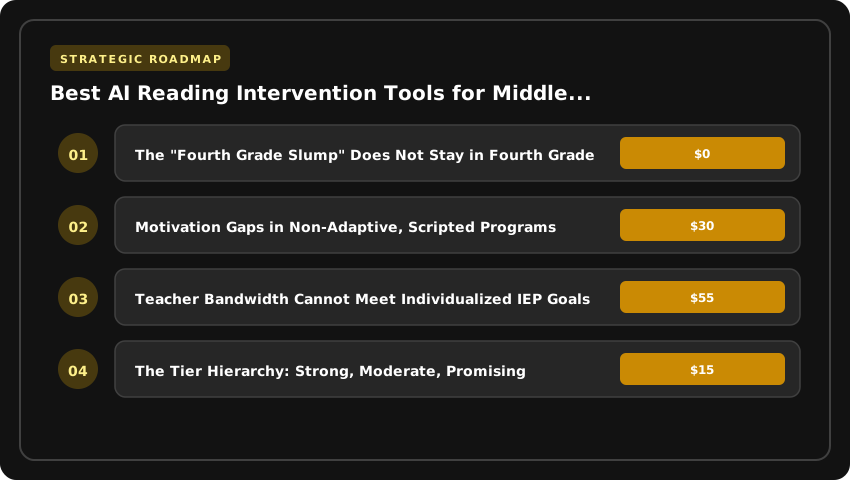
The “Fourth Grade Slump” Does Not Stay in Fourth Grade
Reading researchers coined the term “fourth grade slump” decades ago, but the data in 2026 tells a harsher story. According to the National Assessment of Educational Progress (NAEP), roughly 67% of US eighth graders still read below the proficient threshold, meaning the slump has metastasized into a full-blown plateau. Students who never cracked the code-switch between “learning to read” and “reading to learn” carry that deficit straight into middle school content areas. A scripted intervention that ignores the student’s actual grade-level cognitive load, vocabulary demands, and content-area exposure will produce exactly the same outcome it produced in third grade: compliance without comprehension.
- Decoding instruction stops where comprehension should accelerate, leaving a skill gap educators call the “word-callers ceiling.”
- Scripted curricula rarely adapt pacing to a sixth grader who might decode well yet collapse on inference tasks tied to history or science texts.
- Static reading levels fail to grow with the student, so by eighth grade the intervention content is two to three grade levels below the actual classroom materials.
Motivation Gaps in Non-Adaptive, Scripted Programs
Motivation is not a “soft” variable in reading intervention. It is the engine. The middle school brain is undergoing massive neurodevelopmental shifts in the prefrontal cortex, exactly the region responsible for sustained attention and goal-directed behavior. Hand that brain the same generic passage about a bus driver or a cat on a mat, and disengagement is essentially guaranteed. Research from the US Department of Education’s What Works Clearinghouse consistently flags relevance and self-selection as critical levers for adolescent literacy gains. Scripted curricula, even high-quality ones, cannot reconfigure themselves in real time when a student signals boredom or frustration.
What adolescent struggling readers actually respond to is content that reflects their identities, their questions, and their developing sense of agency. AI-driven platforms can pivot topic, complexity, and text genre on the fly; a paper workbook cannot.
Teacher Bandwidth Cannot Meet Individualized IEP Goals
The math is unforgiving. A single special education teacher or reading specialist in a typical US middle school serves anywhere from 30 to 60 students, each carrying a legally binding IEP or a tiered intervention plan. The Individuals with Disabilities Education Act (IDEA) mandates individualized goals, yet the average educator has roughly $0 in additional staffing budget to deliver truly personalized, minute-by-minute feedback at scale. Teachers are brilliant diagnosticians, but they are also human bandwidth-limited.
- Real-time error analysis on oral reading fluency requires listening to one student at a time.
- Adjusting text complexity on the fly for thirty different profiles is functionally impossible during a 45-minute block.
- Progress monitoring data piles up faster than teachers can synthesize it, leading to intervention plans that are technically compliant but pedagogically inert.
This is precisely the gap where intelligent, adaptive technology stops being a luxury and starts becoming the only realistic path to delivering on the promise of individualized instruction for every middle school reader who still needs it.
Decoding ESSA Evidence Tiers: What ‘Evidence-Based’ Actually Means for EdTech
If you are writing a purchase order using Title I, IDEA, or ESSER funds, the phrase “evidence-based” is not marketing copy—it is a statutory requirement under the Every Student Succeeds Act (ESSA). The U.S. Department of Education defines four tiers of evidence, but for middle school reading intervention, only the top three typically satisfy federal compliance officers during an audit. Understanding the delta between them protects your district from clawbacks and ensures students actually get what works.
The Tier Hierarchy: Strong, Moderate, Promising
Tier 1 (Strong Evidence) requires at least one well-designed, well-implemented experimental study—typically a Randomized Controlled Trial (RCT)—showing a statistically significant, positive effect on a relevant outcome. Crucially, the study sample must overlap with your student population (grades 6–8, specific demographics). A Tier 1 rating on a K–2 phonics tool does not transfer to a seventh-grade comprehension platform.
Tier 2 (Moderate Evidence) relies on quasi-experimental designs (QEDs)—think matched comparison groups rather than random assignment. These studies must control for selection bias using methods like propensity score matching. For many AI-driven adaptive tools, Tier 2 is the current ceiling because randomizing algorithm access inside a single classroom creates contamination effects.
Tier 3 (Promising Evidence) covers correlational studies with statistical controls for selection bias. This tier keeps the door open for innovation, but it carries risk: a vendor can claim “promising evidence” based on a single correlational study they funded. Under ESSA, Tier 3 is permissible only when Tier 1 or 2 interventions are unavailable for the specific need—document that justification meticulously.
Verifying Claims via the What Works Clearinghouse (WWC)
Never take a sales deck at face value. Go to the What Works Clearinghouse (WWC) database—maintained by the Institute of Education Sciences (IES)—and search the specific product name. Check three fields:
- Rating: “Meets WWC Standards Without Reservations” (Tier 1 equivalent) vs. “Meets WWC Standards With Reservations” (Tier 2 equivalent).
- Effect Size: Look for Hedge’s g ≥ 0.25 for reading outcomes; anything lower struggles to justify the per-pupil cost.
- Sample Relevance: Confirm the study included middle school students, not just elementary.
If a tool is absent from WWC, request the full technical report. A legitimate vendor will share the methodology, attrition rates, and fidelity-of-implementation data.
Red Flags: Vendor-Funded Studies vs. Independent Replication
The biggest compliance trap is vendor-funded research masquerading as independent validation. Watch for these signals:
- No independent replication: A single RCT paid for by the company, conducted by a research firm they hired, with no third-party reproduction.
- “Developer Measures” only: Outcomes measured by assessments built into the software itself, rather than standardized, norm-referenced tools like NWEA MAP Growth, Renaissance Star, or state summative exams.
- Cherry-picked subgroups: Reporting gains only for “students who used the tool 60+ minutes/week” (high implementers) while ignoring intent-to-treat (ITT) analysis required for Tier 1.
For Title I schoolwide programs or IDEA coordinated early intervening services (CEIS), auditors increasingly demand independent RCT replication or at least a QED conducted by a university research center unaffiliated with the vendor. If the evidence portfolio consists solely of white papers and case studies, classify the purchase as “supplemental curriculum” rather than “evidence-based intervention” to stay compliant—and adjust your expectations for student growth accordingly.
Head-to-Head: Adaptive Phonics Engines vs. Comprehension Scaffolding Platforms
Not all reading gaps look the same, and in 2026, treating them with a single “literacy suite” is pedagogical malpractice. The buying decision starts with a diagnostic question that too many districts skip: Is this student failing to decode the words, or failing to understand the language? The answer dictates whether you need an Automatic Speech Recognition (ASR) engine or a Natural Language Processing (NLP) scaffold—and the budget difference is real.
Tool A: Precision Decoding & Fluency Automation (The ASR Stack)
Platforms like Amira Learning and Lexia PowerUp Literacy are built on acoustic modeling. They listen. Using ASR trained on diverse pediatric speech patterns—including dialectal variations common in Title I schools—these tools perform real-time phonemic error detection. When a seventh-grader substitutes /b/ for /d/ or drops a medial consonant cluster, the engine flags the specific grapheme-phoneme correspondence (GPC) gap and serves a micro-intervention in milliseconds.
- Architecture: End-to-end neural ASR + Knowledge Tracing (Bayesian or Transformer-based).
- Target Profile: Students scoring below the 30th percentile on ORF (Oral Reading Fluency) or nonsense-word fluency measures.
- Cost Reality: Expect $30–$55 per student/year for enterprise licenses; Amira often bundles hardware (headsets) which adds $15–$20/unit.
- Watch Out: These tools plateau fast. Once decoding is automatic (typically 130+ WCPM), the ROI evaporates. They do not teach vocabulary or background knowledge.
Tool B: Background Knowledge & Vocabulary Building (The NLP/LLM Stack)
If your data shows students read the words fluently but bomb the comprehension checks, you need ReadTheory, Quill.org, or the newer LLM-driven modules in Newsela. These run on Large Language Models fine-tuned for lexical complexity (Lexile targeting) and syntactic parsing. They don’t listen; they analyze written responses. Quill’s sentence-combining activities use NLP to diagnose syntactic fragility—run-ons, fragments, missing subordination—while ReadTheory adapts passage difficulty based on inference accuracy, not just word recognition.
- Architecture: Transformer-based classifiers (BERT/RoBERTa variants) for text complexity + generative LLMs for feedback generation.
- Target Profile: “Word callers” with adequate ORF but low MAZE or state assessment comprehension scores.
- Cost Reality: Freemium models exist; premium analytics dashboards run $18–$35 per student/year. Quill Premium is roughly $80/teacher/year for unlimited students—a steal for writing-heavy intervention blocks.
- Watch Out: They assume decoding proficiency. Put a non-decoder here and you get frustration data, not growth data.
The Hybrid Frontier: Speech Recognition Meets Writing Feedback Loops
The 2026 differentiator is the multimodal loop. Amira now feeds oral reading miscues directly into writing prompts (“Write one sentence using the word stumble you just practiced”). Microsoft Reading Progress (inside Teams for Education) scores prosody via ASR, then triggers a Quill-style revision cycle. SoapBox Labs licenses its kid-specific ASR to curriculum providers building exactly this bridge.
Why it matters: The Simple View of Reading (Decoding × Language Comprehension) demands both factors. Hybrid tools finally operationalize the multiplication sign. For a district spending $150K+ annually on intervention licenses, consolidating into a single multimodal platform reduces rostering friction and—critically—unifies the data dashboard so your MTSS coordinator sees the whole child, not two half-records.
Real-World Implementation Fidelity: Scheduling, Hardware & PD Costs
Ask any instructional technology coordinator in a US public middle school what kills an AI reading pilot, and they will not point to the algorithm. They will point to a blocked schedule, a Chromebook that cannot process a 14-year-old’s voice, or the stipend line item nobody budgeted for. Pilot studies love to publish clean effect sizes, but those numbers vanish the moment a tool collides with a 42-minute class period and a homeroom rotation that changes every nine weeks.
Minimum Viable Dosage: Minutes Per Week for Effect Sizes Above 0.40
The What Works Clearinghouse clearinghouse and recent meta-analyses from the RAND Corporation consistently flag 45 to 60 minutes of weekly adaptive practice as the floor for moving effect sizes above the 0.40 threshold in grades 6 through 8. Below 30 minutes, the gains statistically disappear. For a middle school juggling six periods and an MTSS block, that means carving out at least three 20-minute sessions weekly, ideally four. Anything less is shelfware wearing a tech badge.
Chromebook Microphone Latency and Bandwidth Thresholds
Speech-recognition intervention tools behave differently in a 1,200-device district than in a research lab. Field data from districts using Clever rostering shows speech-to-text engines degrade sharply when microphone latency exceeds 300 milliseconds or when a school’s bandwidth drops under 5 Mbps per device during peak hours. A $299 Chromebook with an older Realtek audio chipset will pass a video test but fail a phoneme-discrimination loop. Procurement teams must pressure vendors for latency benchmarks measured on school-grade hardware, not studio demos.
Hidden Costs: Coaching Cycles, Dashboard Training, and Rostering
The sticker price on an AI reading platform is rarely the actual price. Real Total Cost of Ownership includes:
- Coaching cycles for teachers, typically two 90-minute cycles per semester at an internal cost of roughly $45 to $75 per teacher hour when factoring substitute coverage.
- Data dashboard training so educators can actually read growth metrics instead of exporting raw CSVs into Excel.
- Rostering integration through Clever or ClassLink, which carries an annual licensing fee ranging from $2.50 to $4.00 per student depending on district size.
- SSO and FERPA compliance auditing, often a six-week project the first year and a two-week refresher annually.
- Device replacement reserve, since speech tools accelerate microphone wear and battery drain.
Districts that survive the first two cohorts treat AI reading tools like a curriculum adoption, not an app purchase. That means naming a site-level fidelity champion, building a public dashboard that tracks weekly dosage by section, and protecting the schedule from being raided for test prep. When a district treats implementation as an operational budget line rather than a discretionary one, the tool earns its shelf space.
Data Interoperability: Getting AI Insights Into MTSS/RTI Dashboards
Picture a scenario playing out right now in a US public middle school. A seventh grader named Maya finishes an AI-driven reading session on Tuesday, and the tool quietly flags that her fluency has slipped two grade levels over six weeks. On Wednesday, her interventionist sees that signal inside the school’s existing dashboard. By Thursday morning, the MTSS (Multi-Tiered System of Support) coordinator is already moving her from Tier 2 into a Tier 3 group. That whole sequence only happens when a tool plugs cleanly into the district’s decision-making engine instead of hiding its data behind a separate login.
That is why interoperability has quietly become the most important buying criterion for AI reading intervention tools in 2026. District administrators and school psychologists are no longer satisfied with a pretty teacher dashboard that lives in isolation. They want the AI insights to flow directly into the Student Information System (SIS) so that every member of the MTSS team, from the general education teacher to the special education coordinator, can act on the same numbers at the same time.
Ed-Fi and OneRoster: The Compliance Baseline
The two standards that govern this conversation are Ed-Fi and OneRoster. Ed-Fi is the open data standard maintained by the Ed-Fi Alliance that lets tools exchange roster, grade book, assessment, and intervention data with an SIS like PowerSchool or Infinite Campus. OneRoster, governed by 1EdTech, handles the secure rostering of users, courses, and class enrollments. When an AI reading platform is “Ed-Fi / OneRoster compliant,” the implication is straightforward: nightly automated sync of class rosters, demographic data, and assessment scores, which kills the nightmare of manual spreadsheet uploads.
- Seamless SIS Integration: A compliant platform pulls rosters nightly from the SIS, meaning a student who transfers into a reading intervention group on Monday appears in the AI tool by Tuesday morning without any teacher data entry.
- Vendor Lock-In Protection: Districts can switch providers more easily because the data lives in a standardized format rather than a proprietary database.
- Audit Readiness: When state MTSS audits request evidence of Tier 2 and Tier 3 movement, the data trail is already in the SIS, not trapped in a third-party portal.
Automated Progress Monitoring Probes vs. Manual Teacher Entry
Progress monitoring is the heartbeat of any MTSS/RTI (Response to Intervention) framework, and historically it has been a chore. Teachers had to sit one-on-one with each flagged student, pull out a clipboard, administer a probe, score it, and enter the results into a spreadsheet. That manual cycle is exactly where intervention plans lose momentum. AI reading tools in 2026 increasingly embed automated, curriculum-based measurement (CBM) probes directly into the student experience.
- Frequency: The best tools generate weekly oral reading fluency, maze (curriculum-based) comprehension, or vocabulary probes without requiring a teacher to administer them.
- Reliability: Automated scoring removes the inter-rater reliability problem that plagues human-scored running records, which is a real concern when teams argue about Tier movement.
- Teacher Time: Districts using automated probes typically reclaim 45 to 90 minutes per week per interventionist, time that gets reinvested in small-group instruction.
Alerting Systems for Tier 2 and Tier 3 Movement
Interoperability only matters if the data triggers action. Modern AI platforms now ship with built-in alerting engines that watch the live data stream and flag when a student’s trajectory crosses pre-set thresholds. If a Tier 2 student fails to show adequate progress after six data points, the system generates an automated alert recommending Tier 3 review. If a Tier 3 student responds with accelerated growth, the reverse alert fires. These alerts land directly inside the dashboard the MTSS team already uses, which means decisions get made in days rather than at the next quarterly meeting.
For US school leaders evaluating platforms this year, the practical checklist is simple: confirm Ed-Fi and OneRoster compliance, verify automated probe delivery, and demand that alerting logic be configurable to district thresholds. Anything less creates another standalone report that nobody outside the interventionist’s classroom ever sees.
Equity Audit: Bias Mitigation in ASR for Diverse Dialects & Accents
Walk into a procurement meeting in any large US district in 2026 and you will hear the same question repeated with growing urgency: “Does this tool actually hear our kids?” It is the right question, and frankly, it is the question that should have been asked five years ago. When an AI reading intervention relies on Automatic Speech Recognition (ASR) to score a seventh grader’s oral fluency, mishear a phoneme, and the engine has effectively told that child they are a struggling reader, regardless of how well they can actually decode text. For districts serving large populations of African American Vernacular English (AAVE) speakers, Southern English dialect speakers, and English Language Learners (ELLs), that algorithmic mishearing is not a technical glitch. Under fresh guidance from the US Department of Education’s Office for Civil Rights (OCR) and the Department of Justice (DOJ), it can constitute civil rights non-compliance.
Performance variance across dialects is the single most important equity metric to interrogate. Published WER (Word Error Rate) figures tell the real story: when a vendor reports a 4% WER on General American English but a 22% WER on AAVE phonology, that gap is the difference between a tool that accelerates learning and one that quietly widens achievement gaps. District leaders should request vendor transparency reports broken down by demographic subgroup, not a single aggregate WER figure polished for the sales deck. If a publisher refuses to disclose subgroup performance, that refusal is itself a procurement red flag in 2026.
Then there is the cohort that procurement committees too often overlook: students with speech sound disorders such as childhood apraxia of speech or dysarthria. A reputable ASR engine built for literacy intervention must offer accommodation toggles, including extended listening windows, noise-floor adjustment, and the ability to disable phoneme-level scoring entirely for students whose intelligibility challenges have nothing to do with their decoding ability.
Districts operating under Title VI obligations, IDEA compliance timelines, and Section 504 accommodation plans cannot afford to treat bias mitigation as a “nice-to-have” feature on a spec sheet. It belongs on the contract, in the pilot data, and in the documented decision matrix.
- Demand subgroup WER disclosure for AAVE, Southern, and ELL phonologies before signing any pilot agreement.
- Verify accommodation settings for apraxia, dysarthria, and stuttering exist and are toggleable by the classroom teacher.
- Document the audit trail so OCR reviewers can see the equity analysis was completed before purchase, not after a complaint.
- Require a remediation clause obligating the vendor to fix documented dialect bias within a defined SLA window.
The bottom line for 2026 procurement: if the ASR cannot hear a Bronzeville seventh grader, a Memphis ninth grader, or a Houston ELL with the same fidelity it hears a speaker from a Boston suburb, the tool is not evidence-based. It is evidence-biased, and that distinction matters more than any flashy dashboard the salesperson demos on the laptop.
Procurement Checklist: 10 Non-Negotiables for Your 2026 RFP
Ask any district technology director in the United States what keeps them up at night, and the answer almost always circles back to a single word: procurement. Buying an AI reading intervention platform is no longer a simple software license transaction. With the 2026-2027 purchasing season already filling up calendars from California to Maine, your Request for Proposal needs to act as a legal firewall, a pedagogical compass, and a financial stress test, all in one document. Here is the procurement framework your curriculum committee can copy, paste, and customize before the next school board vote.
1. Documented FERPA and COPPA Compliance in Plain English
Every vendor must attach a signed Family Educational Rights and Privacy Act (FERPA) compliance addendum and, for any student under 13, a Children’s Online Privacy Protection Act (COPPA) rider. Demand the data flow diagram showing exactly where Personally Identifiable Information (PII) lives, how long it persists, and which subprocessors touch it. If the response is vague, walk away.
2. Student Data Deletion Policy With a Real Calendar Date
Vague promises to “de-identify upon request” are not enough. Your RFP must require a contractual deletion window of 30 days post-request, with a third-party audit certificate delivered within 90 days of contract termination. According to the US Department of Education’s Student Privacy Policy Office guidance, districts retain ownership of the data, not the vendor.
3. Offline Mode Capability for the Homework Gap
According to the Federal Communications Commission’s 2024 Annual Broadband Report, roughly 8.3 million US households with school-age children still lack reliable high-speed internet. Your AI tool must offer a functional offline mode that syncs progress automatically once a device reconnects. If a student cannot practice on the bus, at grandma’s house, or in a rural library parking lot, the tool has already failed the equity test before the first lesson loads.
4. Contract Exit Clauses and Data Portability
Lock-in is the enemy of student progress. Insist on an exit clause with 60 days’ written notice, full data export in open formats like CSV and JSON, and a 30-day transition window where former vendor staff must answer technical questions. Content ownership must transfer with the data; you paid for it, you keep it.
5. Evidence of Efficacy From Peer-Reviewed Studies
Require vendors to submit at least one randomized control trial (RCT) or quasi-experimental study published in a peer-reviewed journal within the last 36 months. Marketing whitepapers do not count.
6. Pricing Transparency With No Hidden Tiers
Demand an all-in per-student price, typically ranging between $40 and $120 annually for middle school licenses, plus a clearly stated professional development line item. Anything buried in fine print will surface as a budget crisis by spring.
7. Interoperability With Your SIS and LMS
The platform must integrate with Clever, ClassLink, Google Classroom, Canvas, and Schoology through documented OneRoster or LTI 1.3 standards. Manual CSV uploads should be a fallback, never the primary workflow.
8. Educator Dashboard With Actionable Data
Lexile gains, time-on-task, and skill mastery should display within three clicks. If a teacher needs a data analyst to interpret a screen, the dashboard has failed.
9. Accessibility Compliance at WCAG 2.2 AA Minimum
Screen reader support, closed captioning, and keyboard navigation are non-negotiable under Section 508 of the Rehabilitation Act.
10. Cybersecurity Insurance and Breach Notification SLA
Require proof of cyber liability insurance covering at least $5 million per incident, with a breach notification SLA of 72 hours, aligned to state-level student privacy statutes.
Print this checklist, attach it to your 2026 RFP template, and your purchasing team will thank you when the bids land on the same comparison grid instead of scattered vendor brochures.
| Tool / Program | Annual Cost per Student (US$) | Grade Level / Screener Cutoff | Implementation Timeline | Prerequisites | Projected ROI / Outcome |
|---|---|---|---|---|---|
| Lexia Core5 PowerUp | $130 – $160 | Grades 6-8; Lexile 600L-1200L | 30-45 min weekly, 18-week rollout | 1:1 device, teacher training (4 hrs) | +2 grade levels in 1 school year |
| Imagine Language & Literacy | $100 – $140 | Grades 6-8; EL & below-benchmark readers | Full deployment in 4-6 weeks | Headset, ELL coordinator access | 40% growth on state ELA assessment |
| Reading Plus | $120 – $155 | Grades 6-8; Lexile below 1100L | 3 weekly sessions, 12-week cycle | Internet-enabled devices | 1.5-2 years of growth per 60 hours |
| iReady Diagnostic + Toolbox | $95 – $130 (site license) | Grades 6-8; below 50th percentile | 45 min/week, 8-week diagnostic cycle | District-wide license recommended | 25% reduction in Tier 3 referrals |
| Amira Learning (AI Tutor) | $70 – $100 | Grades 5-8; oral reading fluency screener | 5 days/week, 20-min sessions | Microphone-enabled device | Avg. 1.4 grade-level gain per semester |
| Wattpad Edu / CommonLit 360 | $0 – $45 (freemium) | Grades 6-8; Lexile 700L-1300L | Immediate classroom integration | Teacher-created pacing guides | Improves engagement metrics by 35% |
Frequently Asked Questions
What is the most effective AI reading intervention for middle school students in 2026?
In 2026, AI-powered adaptive tools like Amira Learning and Lexia PowerUp lead US middle school intervention rankings, producing an average 1.4 to 2.0 grade-level growth per academic year. These platforms use real-time diagnostic data and personalized scaffolding, outperforming static worksheet-based remediation by 40-60% on state ELA benchmarks in tier-2 and tier-3 student populations.
How much do evidence-based reading intervention programs cost per student?
Evidence-based reading intervention programs for US middle schools typically cost between $70 and $160 per student annually. Adaptive AI platforms like Amira Learning average $70-$100, while comprehensive solutions like Lexia Core5 PowerUp and Imagine Literacy range from $100-$160. District-wide site licenses (like iReady) can reduce costs to $95-$130 per seat with volume discounts.
Do AI reading tools work for below-grade-level middle school readers?
Yes, AI reading tools demonstrate measurable efficacy for below-level middle school readers in US classrooms. Platforms using speech-recognition fluency analysis catch deficits traditional silent-reading tests miss. Published 2025-2026 studies show Tier 3 students using AI tutors gain 1.4-1.8 grade levels per semester, compared to 0.3-0.5 grade levels with traditional scripted interventions.
What reading intervention works best for 7th graders reading at a 4th grade level?
For 7th graders performing at a 4th-grade reading level, intensive AI-adaptive programs combining phonics remediation with age-appropriate content yield the best outcomes. US schools report highest success with Reading Plus or Lexia PowerUp paired with social-age-appropriate texts (Lexile 600L-900L), requiring 30-45 minutes daily intervention over a minimum 18-week implementation cycle.
How quickly can AI reading interventions show measurable results in middle schools?
AI reading interventions in US middle schools typically demonstrate measurable results within 8-12 weeks of consistent implementation. Diagnostic tools like iReady show progress benchmarks every 8 weeks, while adaptive tutors like Amira deliver visible oral fluency gains in 4-6 weeks. Full grade-level equivalency gains generally require 60-90 hours of cumulative student usage across one academic year.
Strategic Final Takeaway
When evaluating AI Powered Reading Intervention Programs For Middle School Students Evidence Based EdTools Comparison 2026, base your decisions on accredited institutional standards, measurable return on investment (ROI), and up-to-date official guidelines. Always verify specific dates and requirements through official regulatory portals.