Why a Community College Degree Is the Fastest Track Into Early Childhood Education
If you have ever stood in a preschool classroom and thought, “I could do this, and I would love it,” the biggest barrier standing between you and a paycheck is almost always time, not talent. Across the United States, community colleges have quietly built the most efficient on-ramp into the early childhood workforce, compressing what used to be a four-year commitment into a credential you can earn while still working your current job.
Accelerated Associate Degree Timelines vs. the Four-Year Route
Most AAS and Associate of Arts (AA) programs in Early Childhood Education (ECE) are designed to be finished in four full-time semesters, and many schools now offer 18-month fast-track cohorts, evening hybrid formats, and even 7-week accelerated terms. Compare that to a Bachelor of Science in Education, which typically requires 120 credit hours and a full student-teaching semester. According to the US Department of Education’s National Center for Education Statistics, the average bachelor’s degree seeker takes closer to five years to finish. For aspiring preschool teachers, those extra semesters mean two more years of tuition, two more years of lost wages, and a two-year delay on the salary compounding effect that defines a career.
Lower Tuition Burden Compared to Public and Private Universities
Tuition data from College Board shows the average in-district community college costs about $3,990 per year, while in-state public four-year universities average $11,260, and private nonprofit institutions run $41,540 annually. For a degree that qualifies you for the same Child Development Associate (CDA) and state lead-teacher credentials in many states, the ROI math is undeniable. Many community colleges also participate in the Workforce Innovation and Opportunity Act (WIOA), the TEACH Grant program, and state-funded Promise Scholarships that can drop your out-of-pocket cost to zero.
Stackable Credentials That Allow Stop-Out and Re-Entry
Unlike a rigid bachelor’s pathway, the community college model is built around stackable micro-credentials. You can earn a Child Development Associate (CDA) certificate in 9 to 12 months, start working in a Head Start or state-funded preschool, stop out to raise a family, and return later to add credits toward your associate degree. Each credential increases your hourly pay and your eligibility for higher role levels without rendering prior coursework obsolete.
Regional Articulation Agreements With State Universities
One of the most underused advantages is the statewide articulation agreement. In Texas, Florida, California, and most other states, an ECE associate degree transfers as a junior-year block to partnering public universities, letting you finish a bachelor’s in just two additional semesters while keeping your job. This means the “two-year track” is not a career ceiling; it is a launchpad.
For working adults evaluating their next move, the community college ECE pathway is not the cheaper version of a university degree. It is a strategically faster, lower-risk route into a stable, growing profession, and the 2026 salary data shows exactly how that early start compounds over a full career.
Inside the Associate Degree Program: Coursework, Practicums, and State Credentials
When you enroll in an Associate of Applied Science (AAS) in Early Childhood Education, you are not just signing up for a series of introductory seminars. These programs are meticulously designed to get you classroom-ready with a potent blend of developmental theory and hands-on application. Let’s break down what you will actually study, the hours you will spend in the field, and the exact credentials you need to legally teach in the United States.
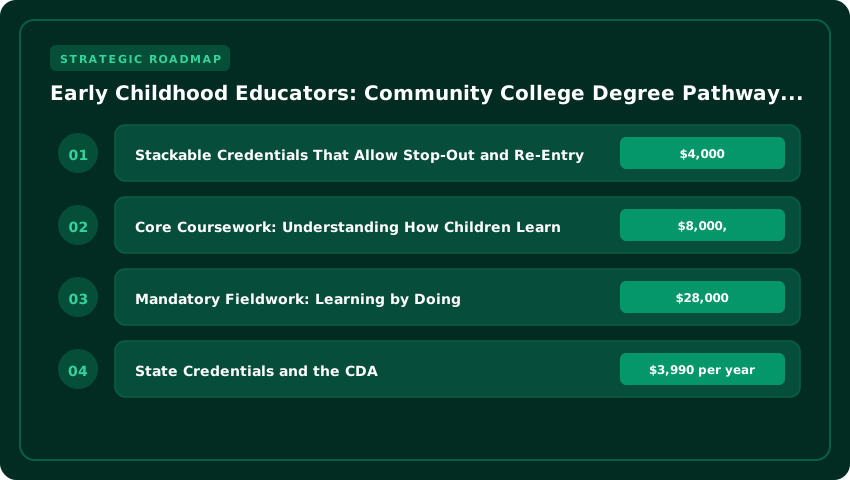
Core Coursework: Understanding How Children Learn
The academic core of a high-quality associate degree program covers the full spectrum of early childhood development. You can expect to take foundational classes in child psychology, early literacy, and curriculum design. Coursework typically zeroes in on specific developmental stages, from infant and toddler care to preschool and early primary education. You will analyze how children acquire language, develop motor skills, and form social-emotional attachments. Classes also cover critical administrative topics, such as working with diverse families and identifying developmental delays, ensuring you are fully prepared for the realities of modern American classrooms.
Mandatory Fieldwork: Learning by Doing
Textbook knowledge only goes so far. To graduate, you must complete mandatory fieldwork hours in a licensed preschool, daycare center, or Head Start setting. Most community colleges require between 100 and 300 hours of practicum experience. During these practicums, you will transition from observer to active lead teacher under the guidance of a veteran mentor. You will write lesson plans, manage classroom behavior, and assess student progress. This hands-on training is invaluable, giving you the practical confidence that employers desperately seek and a competitive edge in the job market.
State Credentials and the CDA
Earning your degree is just one piece of the puzzle. To work legally, you must also secure state-specific credentials. Many programs align their coursework to prepare you for the Child Development Associate (CDA) credential, a nationally recognized standard administered by the Council for Professional Recognition. Additionally, many states require specific teacher permits or certificates—such as California’s Child Development Permit—to work in publicly funded programs. Your community college advisor will help you navigate your state’s Department of Education requirements to ensure your credits count toward immediate employment.
The NAEYC Accreditation Benchmark
Before you enroll, verify that your community college holds accreditation from the National Association for the Education of Young Children (NAEYC). NAEYC accreditation is the gold standard for early childhood programs, ensuring that the curriculum, faculty, and clinical practices meet rigorous national benchmarks. Attending an NAEYC-accredited program guarantees that your degree will be respected by employers and easily transferable should you decide to pursue a bachelor’s degree later. It is your best insurance policy for long-term licensure mobility and career growth.
2026 Salary Projections for Community College-Trained Early Childhood Educators
Earning an Associate of Applied Science in Early Childhood Education positions you squarely inside one of the fastest-growing corners of the US labor market. According to the US Bureau of Labor Statistics (BLS), preschool teachers earned a median annual wage of $37,120 in 2024, while childcare workers brought home a median of $32,050. The wage bands are wider than most career-changers expect: the lowest 10% of preschool teachers earn around $25,000 a year, while the top 10% clear $60,000+, particularly in high-cost metros and licensed private centers.
State-by-State Salary Hotspots Worth Targeting
Geography matters enormously in this field. BLS Occupational Employment and Wage Statistics show clear leader states where an AAS degree pays off faster:
- California: Mean preschool teacher wage of $47,200, with the San Jose, San Francisco, and Oakland metros pushing experienced educators past $58,000.
- New York: Statewide mean of $46,100, and NYC-area Head Start and Universal Pre-K programs frequently list starting salaries near $48,000.
- Washington: A mean of $45,800, driven by Seattle’s high-cost labor market and aggressive state-funded pre-K expansion.
- Massachusetts and Connecticut: Both post preschool teacher means above $44,000, boosted by strong union representation in public pre-K classrooms.
The Associate vs. Bachelor’s Pay Differential
Community college graduates enter the workforce faster, but the long-term earnings gap between credential levels is real. BLS data indicates bachelor’s-prepared early childhood educators earn roughly 15% to 22% more than their associate-degree peers in comparable roles, often pulling $52,000 to $58,000 mid-career in public school settings. The strategic move many career-changers make is starting with an AAS, working under a state-approved alternative-route pathway, then completing a bachelor’s at a discounted tuition rate through articulation agreements at schools like the University of Cincinnati Online or Eastern Connecticut State.
Annual Growth Rate and Job Outlook Through 2032
The BLS projects ~187,600 total job openings annually for preschool teachers and childcare workers through 2032, driven by a 3% to 8% occupation growth rate depending on the specific role. Public pre-K expansion under state-level universal programs (notably in California, New York, and Washington) is creating sustained demand for credentialed educators who can staff newly funded classrooms. For working professionals pivoting into education, the combination of low entry cost, fast credentialing, and steady wage growth makes this one of the most predictable return-on-investment career moves available through US community colleges today.
Transfer Pathways From Associate to Bachelor’s at Public Four-Year Institutions
While an Associate of Applied Science gets you into the classroom quickly, maximizing your lifetime earnings potential often requires crossing the finish line at a four-year university. Fortunately, public higher education systems across the United States have streamlined the transition from a two-year to a four-year degree, making upward mobility highly accessible for early childhood educators.
Navigating Articulation Agreements and Credit Portability
The biggest hurdle for transferring students has historically been the loss of hard-earned credits. However, robust articulation agreements between community colleges and state university systems have largely mitigated this issue. Systems like the State University of New York (SUNY) and the California State University (CSU) network offer guaranteed transfer pathways for students who complete specific associate degree requirements. By adhering to these state-mandated articulation tracks, you can transfer up to 60 credits seamlessly, ensuring you enter the four-year institution as a junior. Straying from these mapped pathways, however, can result in losing up to 20 percent of your credits, forcing you to pay twice for equivalent coursework and delaying your graduation.
Hybrid and Online Completion Programs for Working Teachers
Balancing lesson plans, parent communications, and your own coursework is no small feat. Recognizing this, public universities have heavily invested in hybrid and online bachelor’s completion programs specifically designed for working teachers. These flexible pathways allow you to earn your Bachelor of Science in Early Childhood Education without stepping away from your current salary. Many of these programs offer asynchronous coursework and competency-based education models, letting you accelerate through material you already master on the job. Tuition for these in-state online completion programs typically ranges from $350 to $500 per credit hour, meaning you can finish your remaining 60 credits for roughly $21,000 to $30,000—a manageable investment, especially when utilizing FAFSA federal student aid and employer tuition reimbursement programs.
Salary Step-Ups and Lead Teacher Qualifications
The financial return on a bachelor’s completion is substantial. According to the US Bureau of Labor Statistics (BLS), the median annual wage for preschool teachers holding an associate degree hovers around $36,460. However, completing a bachelor’s degree unlocks higher pay scales and specialized administrative roles. BLS data indicates that preschool and childcare center directors, a position generally requiring a bachelor’s degree, earn a median salary of $54,290. Furthermore, holding a bachelor’s degree is often the baseline requirement for achieving lead teacher status in state-funded pre-kindergarten programs and meeting stringent regulatory frameworks like California’s Title 22. Ultimately, transferring to a public four-year institution isn’t just about adding letters to your resume; it is the most reliable route to a $15,000 to $20,000 annual salary step-up and long-term career stability.
Federal Financial Aid and State Scholarships Targeting Early Childhood Educators
Financing an early childhood education (ECE) credential does not have to drain your savings. Between federal Title IV aid, specialized grant programs, and state-backed scholarship pipelines, most community college students graduating with an Associate of Applied Science in Early Childhood Education can realistically cut their out-of-pocket costs to under $2,000. The trick is understanding which programs apply to you, what service commitments are attached, and how to stack the benefits legally.
FAFSA and the Federal Pell Grant Pipeline
The Free Application for Federal Student Aid (FAFSA), administered by the US Department of Education, is the gateway to nearly every major funding source below. For the 2025 to 2026 award year, the maximum Pell Grant sits at $7,395 for qualifying students, and recent expansions mean more working parents now cross the income threshold than ever before. Even if you earn a modest salary, completing the FAFSA unlocks work-study eligibility, subsidized federal loans, and most state-level scholarships. Community college financial aid offices can typically process your file within two to three weeks, and many will retroactively certify aid if you apply mid-semester.
TEACH Grant: Up to $4,000 Annually for Future Teachers
The Teacher Education Assistance for College and Higher Education (TEACH) Grant converts up to $4,000 per year into free money for students preparing to teach in low-income public schools or Title I districts. To qualify, you must maintain a 3.25 GPA, complete required coursework in teaching methodologies, and sign an agreement to serve in a qualifying school for at least four academic years within eight years of graduation. Early childhood educators who fulfill this commitment often work in public pre-K classrooms, Head Start programs, or district-administered kindergarten settings. If you fail to meet the service obligation, the grant converts to an Unsubsidized Direct Loan, so treat the contract seriously.
State Scholarship Pipelines: T.E.A.C.H. and Beyond
The T.E.A.C.H. Early Childhood scholarship remains one of the most powerful tools in the ECE field, operating in more than 20 states including Texas, North Carolina, Florida, and Colorado. The model is straightforward: the scholarship covers tuition and books, the recipient’s sponsoring employer (typically a licensed child care center) pays a small matching contribution, and the student commits to staying at that employer for a defined period, usually one to two years per funded year. Comparable state programs include the Child Care WAGE$ stipend initiative and the Growing the Workforce scholarships in Minnesota, all designed to remove cost barriers for working educators pursuing credentials.
Loan Forgiveness for Working Teachers
For graduates who take on federal student loans, two forgiveness programs offer meaningful relief. The Teacher Loan Forgiveness (TLF) program cancels up to $17,500 in Direct Subsidized or Unsubsidized Loans for highly qualified teachers serving five consecutive years at a low-income school. The Public Service Loan Forgiveness (PSLF) program, managed through MOHELA and other federal servicers, forgives remaining balances after 120 qualifying monthly payments while working full-time for a government or nonprofit employer. Many ECE professionals in Head Start, public pre-K, and nonprofit child care centers qualify for PSLF because their employers are typically 501(c)(3) organizations. Carefully track your employment certifications through the Federal Student Aid portal to avoid costly counting errors.
- File FAFSA first: Most federal and state aid requires an active FAFSA on file, so submit yours by your state’s priority deadline.
- Stack T.E.A.C.H. with Pell: Combining the T.E.A.C.H. scholarship with the federal Pell Grant frequently covers full tuition.
- Document service hours: Keep annual records of employment at qualifying schools to protect your TEACH Grant and PSLF status.
Career Advancement Beyond the Classroom: Director, Curriculum Specialist, and Family Liaison Roles
Many aspiring educators mistakenly view an early childhood credential as a terminal stop rather than a launchpad. In reality, the community college pathway offers a remarkably versatile foundation, opening doors to roles that pay significantly more than standard teaching positions. By 2026, the U.S. Bureau of Labor Statistics projects above-average growth across several specialized early childhood occupations, making now an ideal time to map out your vertical and lateral advancement strategies.
Preschool Program Director: Credentialing and Compensation
Moving from lead teacher to preschool program director is the most direct vertical leap. Most states require directors to hold a bachelor’s degree, though some allow an associate degree paired with substantial experience (often 4+ years) and an administrative credential. The Child Development Associate (CDA) credential remains a respected industry benchmark, while organizations like the National Association for the Education of Young Children (NAEYC) offer director-level credentials that can fast-track your eligibility.
Salary expectations for this role are compelling. According to BLS data, preschool and childcare center directors earn a median annual wage of $56,310, with top earners pulling in $89,170 or more. In high-cost metro areas, particularly along the West Coast and in the Northeast, six-figure director packages are increasingly common. This represents a 60% to 80% wage premium over typical lead teacher positions.
Curriculum Coordinators and Instructional Coaches
Curriculum specialists and instructional coaches represent a lateral move that many early childhood educators find deeply rewarding. These roles typically require a bachelor’s degree, though many community college graduates enter the field as coordinators and pursue their four-year degree concurrently through tuition reimbursement programs. Median pay for instructional coordinators stands at $66,490 annually, with the top 10% earning over $104,000.
- Curriculum Coordinator: $55,000–$75,000 entry-level, scaling to $90,000+ in large urban districts
- Instructional Coach: $58,000–$80,000, with corporate chains often paying 15% above public-sector rates
- Family Liaison Specialist: $45,000–$65,000, plus benefits packages that frequently include tuition assistance
Union Membership and Collective Bargaining Advantages
Public preschool programs, particularly those embedded in school districts, increasingly offer union membership through affiliates of the National Education Association (NEA) and the American Federation of Teachers (AFT). Unionized positions typically provide structured pay scales, predictable step increases, and robust continuing education benefits. For career changers prioritizing job security, collective bargaining agreements often guarantee annual raises of 2% to 4%, along with clearly defined pathways from provisional to permanent status.
Corporate Childcare Chains: A Growing Demand Signal
The corporate childcare sector is experiencing unprecedented expansion. Industry leaders like KinderCare Learning Companies and Bright Horizons Family Solutions operate thousands of locations nationwide and are actively recruiting candidates with associate degrees for management-track positions. These employers frequently offer signing bonuses, relocation packages, and accelerated promotion timelines. Bright Horizons, for instance, has publicly committed to expanding its network by hundreds of new centers through 2026, creating substantial demand for qualified directors and curriculum specialists willing to relocate.
For professionals willing to invest in continuous upskilling, the financial mathematics are clear. A two-year, $6,000 community college investment can realistically yield a career trajectory starting at $32,000 and culminating in $75,000 to $90,000 within seven to ten years, a return that few other two-year credentials can match.
Choosing the Right Community College: Accreditation, Outcomes, and Graduate Earnings
Selecting the right community college for an Early Childhood Education (ECE) credential is less about glossy brochures and more about measurable outcomes. Before signing an enrollment agreement, prospective students should evaluate four verifiable data points: programmatic accreditation, IPEDS-reported graduation rates, alumni earnings, and the school’s ability to place graduates in real classrooms. This framework turns a marketing-heavy decision into a straightforward comparison exercise rooted in federal data.
Verify Accreditation and State Approval First
Accreditation is the non-negotiable foundation. Programs should hold regional accreditation recognized by the U.S. Department of Education, such as the Higher Learning Commission or the Southern Association of Colleges and Schools, which ensures credits transfer and financial aid disburses cleanly. Beyond institutional accreditation, look for the National Association for the Education of Young Children (NAEYC) early childhood associate degree accreditation, the field’s gold standard. Without these, your credits may not articulate into a bachelor’s program at a four-year institution, and certain state teaching permits could be delayed.
Read the IPEDS and College Scorecard Data
The National Center for Education Statistics publishes the Integrated Postsecondary Education Data System (IPEDS) outcomes that every community college must report. For ECE programs, pay attention to the 150% graduation rate, which captures students who finish within three years of starting a two-year degree. Strong programs post graduation rates between 25% and 40%, which is typical for part-time-heavy enrollees. Equally important, the U.S. Department of Education College Scorecard publishes median debt and median earnings one year after graduation. Expect median debt in the $6,000 to $12,000 range for an associate degree, with median annual earnings around $28,000 to $34,000 roughly a year after completion, a launchpad wage that typically climbs into the $38,000 to $48,000 band within five years as educators earn state credentialing.
Ask for Placement Evidence, Not Promises
A program’s job placement rate matters more than its brochure list. Ask admissions advisors for documented placement into local school districts, Head Start grantees, and licensed childcare centers. Top-tier programs often report placement rates of 75% to 90% within six months of graduation. If the school cannot provide a verifiable list of employer partners, treat that as a red flag. Strong programs also maintain articulation agreements with nearby four-year universities, allowing seamless credit transfer toward a bachelor’s in child development or elementary education.
Confirm Hybrid and Evening Flexibility
For working adults, schedule alignment is essential. Many leading community colleges now offer:
- Evening and weekend cohorts designed for full-time childcare workers and paraprofessionals
- Hybrid ECE pathways blending two on-campus evenings with asynchronous online coursework
- Practicum scheduling at partner sites near students’ homes, including Head Start centers and public preschool classrooms
- Prior Learning Assessment (PLA) credits for current Child Development Associate (CDA) holders, shaving semesters off the degree
Calculate the True ROI
Run the final math before committing. A quality ECE associate program costs roughly $4,000 to $8,000 in total tuition, compared with $28,000+ annually at many four-year universities. Layer in median graduate earnings of approximately $30,000 within the first year, per College Scorecard data, and the return on investment becomes clear. Add state ECE credential pay differentials, often $2,000 to $5,000 annually, and a bachelor’s transfer pathway becomes financially inevitable within five years of hire.
| Decision Criterion | Community College AAS Pathway | Four-Year University B.Ed Pathway |
|---|---|---|
| Total Tuition Cost | $4,000 – $8,000 (in-district) | $28,000+ per year (avg. $112,000 total) |
| Time to Credential | 18 – 24 months | 48 months (4 years) |
| Prerequisites | High school diploma/GED; basic placement tests | SAT/ACT scores; competitive GPA; essays |
| Median 2026 Salary Outlook | $33,000 – $38,000 (entry-level preschool) | $47,000 – $54,000 (K-3 public school teacher) |
| 5-Year ROI (Net) | ~$130,000 – $150,000 | ~$85,000 – $110,000 (higher debt load) |
| Class Schedule Flexibility | Evening, weekend, and online hybrid options | Predominantly daytime, in-person |
| State Certification Eligibility | Yes (Child Development Associate & state permits) | Yes (full state teaching licensure) |
Frequently Asked Questions
How much does an Associate degree in Early Childhood Education cost at a US community college?
An Associate of Applied Science (AAS) in Early Childhood Education at a US community college typically costs between $4,000 and $8,000 total for in-district students. This represents roughly 70% savings compared to four-year universities, where annual tuition frequently exceeds $28,000 for out-of-state residents.
What is the 2026 salary outlook for early childhood educators with a community college degree?
The 2026 median salary for early childhood educators holding an AAS ranges from $33,000 to $38,000 annually for entry-level preschool teachers. Those working in Head Start programs or licensed daycare centers often receive higher wages, with projected 8% job growth through 2026 according to Bureau of Labor Statistics forecasts.
How long does it take to get an Early Childhood Education degree from a community college?
An Associate of Applied Science in Early Childhood Education typically requires 18 to 24 months of full-time study. Many community colleges also offer accelerated 12-month certificate programs for career changers, plus evening and weekend courses designed for working parents balancing employment with academic coursework.
Can you become a licensed teacher with an Associate degree from a community college?
Yes, graduates can earn the Child Development Associate (CDA) credential and state-specific early childhood permits through an AAS program. However, public K-3 teaching positions in most US states still require a Bachelor's degree and full state licensure, which typically requires transferring credits to a four-year university.
What are the admission requirements for an Early Childhood Education program at community colleges?
Most US community college Early Childhood Education AAS programs require only a high school diploma or GED, plus basic English and math placement tests. Unlike four-year universities, there are typically no SAT/ACT score requirements, no competitive GPA cutoff, and no application essays, making admission highly accessible nationwide.
Strategic Final Takeaway
When evaluating Early Childhood Educators Community College Degree Pathway Salary Outlook 2026, base your decisions on accredited institutional standards, measurable return on investment (ROI), and up-to-date official guidelines. Always verify specific dates and requirements through official regulatory portals.