
Community colleges are quietly rewriting the rules for becoming a licensed early childhood educator in America.

How Community Colleges Are Reshaping the Early Childhood Education Bachelor’s Pathway
For decades, community colleges lived under the label of “stepping stone” schools, a place to knock out general education credits before “transferring up” to a four-year university. That narrative is being aggressively retired in the early childhood education (ECE) space. Two-year institutions are now striking formal articulation agreements with state universities and private four-year partners to deliver the entire bachelor’s degree, from foundational child development coursework to senior-year practicum and licensure prep, on campuses that cost a fraction of a traditional university.
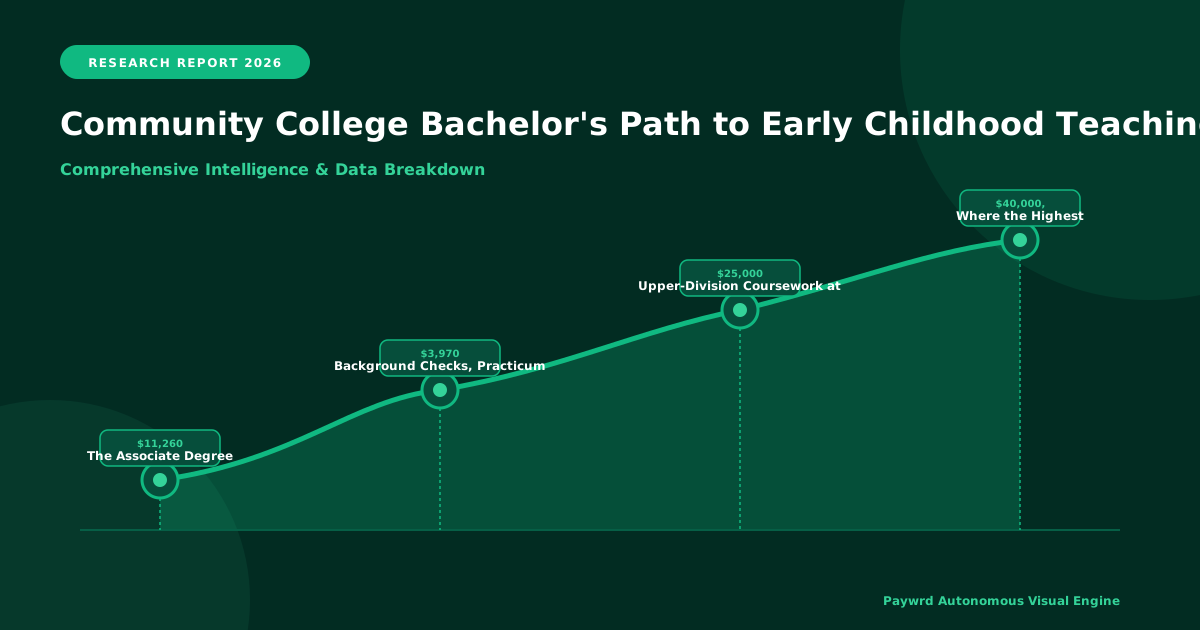
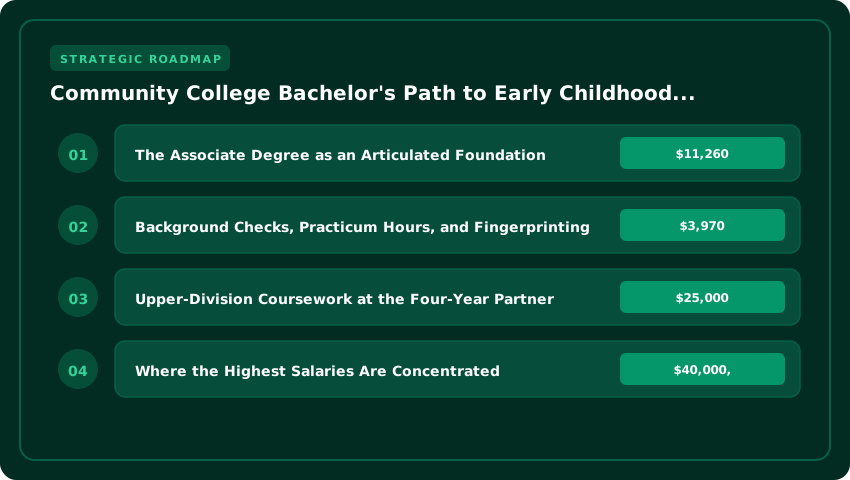
The economic math is impossible to ignore. According to College Board, the average in-state tuition and fees at a public four-year university ran about $11,260 for the 2024–25 academic year, while community college tuition averaged roughly $3,970. Even when you add upper-division coursework delivered through a university partner, the total pathway typically lands between $25,000 and $40,000, compared with $40,000 to $90,000+ for a traditional on-campus ECE bachelor’s. For career-changers and working paraprofessionals paying out of pocket, that delta can be the difference between upgrading credentials and staying stuck in an assistant role.

Why Two-Year Schools Are Becoming Strategic Partners, Not Just Feeders
The shift is being driven by three converging forces:
- Workforce demand: The U.S. Bureau of Labor Statistics projects about 135,700 openings for preschool and childcare center directors each year through 2033, and roughly 129,500 annual openings for kindergarten and elementary teachers. States cannot fill those pipelines fast enough through traditional four-year routes alone.
- Employer expectations: Head Start programs and state-funded pre-K classrooms increasingly require a bachelor’s degree with state teaching certification, often tied to pay scales and lead-teacher eligibility.
- Applied learning DNA: Community colleges already operate on-site lab schools, child development centers, and practicum partnerships with local districts. Embedding the upper-division ECE curriculum into that ecosystem produces graduates who have logged hundreds of supervised classroom hours before their first interview.
The Associate Degree as an Articulated Foundation
The linchpin of every successful community college ECE pathway is a tightly designed transfer articulation agreement. These are not casual handshake deals; they are state-approved contracts, often registered with the U.S. Department of Education’s Title IV financial aid framework so students can keep accessing FAFSA Pell Grants and federal loans seamlessly across institutions.
Here’s how the structure typically works for an early childhood education major:
- Years 1–2 (Associate of Arts in Early Childhood Education or Associate of Science in Teaching): General education core plus ECE fundamentals, child growth and development, curriculum planning, observation practicums, and often a Child Development Associate (CDA) credential stackable into the degree.
- Years 3–4 (Bachelor’s Completion): Delivered either on the community college campus by partner university faculty, online, or in a hybrid weekend/evening format. Coursework covers assessment, special education inclusion, literacy and numeracy methods, and a full student-teaching residency required for state licensure.
- Cap: Graduates walk away with a BA or BS in Early Childhood Education plus eligibility for an initial state teaching license, typically Birth–Grade 2 or Birth–Grade 3, depending on the state’s Department of Education certification office.
What makes this model especially attractive for professional and corporate upskilling audiences is its stackability. A current teaching assistant, after-school program coordinator, or daycare lead can start the associate portion tomorrow, earn a CDA-credentialed promotion within 18 months, and keep climbing without ever stepping away from a paycheck. For employers sponsoring tuition reimbursement, the ROI is measurable: promoted staff fill lead roles faster, and classrooms staffed by bachelor’s-credentialed teachers consistently score higher on early literacy and social-emotional readiness benchmarks tracked by state agencies.
Community colleges are no longer the lobby of the university. In early childhood education, they are increasingly the front door, the engine, and, for many working adults, the smartest financial path to a credential that pays.
Decoding State-by-State Licensure Requirements for Early Childhood Educators
If you have ever stared at a map of the United States wondering why moving one state over can completely rewrite your teaching career, you are not alone. Early childhood education (ECE) licensure is regulated at the state level, meaning the certificate that lets you lead a Pre-K classroom in Houston will not automatically transfer to a kindergarten room in Albany. Understanding these nuances is essential before you commit to a community college bachelor’s pathway, because every credit hour, practicum, and exam should align with the license you actually plan to hold.
Pre-K, Kindergarten, and Elementary Bands Across California, Texas, Florida, and New York
Most states slice early childhood credentials into three loose bands: Pre-K (often birth through age 4 or 5), Kindergarten (typically age 5), and Elementary (grades 1 through 3 or 1 through 6). California issues a Multiple Subject Teaching Credential with an Early Childhood Education specialist instruction authorization, while Texas funnels candidates into either an EC-3 or EC-6 Core Subjects with Science of Teaching Reading certification through the Texas Education Agency. Florida offers a Prekindergarten/Primary Education track (age 3 through grade 3) issued by the Florida Department of Education, and New York splits the world into Birth-Grade 2 and Grades 1-6 certificates, each with its own Educating All Students (EAS) and Content Specialty Tests. Picking the right band early prevents you from repeating student teaching twice.
Mandatory Praxis Core, Praxis II, and State-Specific Benchmarks
Nearly every state requires a basic skills and a subject-specific exam before issuing an initial certificate. If your target state accepts the Praxis Core Academic Skills for Educators, you will need to clear reading (156), writing (162), and math (150) in most reporting clusters. The Praxis II Early Childhood Education (5025) cut score varies by jurisdiction, but 145 is a common floor. California skips Praxis entirely and instead mandates three subtests of the California Basic Educational Skills Test (CBEST) and the California Subject Examinations for Teachers (CSET). Texas requires TExES Core Subjects EC-6 (391) plus the standalone Science of Teaching Reading (293) exam. Florida candidates must pass the FTCE Professional Education Test and an Early Childhood subject area exam, while New York leans on its own New York State Teacher Certification Examinations (NYSTCE) framework.
Background Checks, Practicum Hours, and Fingerprinting
No paycheck lands in a public school classroom until you clear the safety net. All 50 states require a criminal background check, and the vast majority mandate FBI fingerprinting through approved vendor networks such as Identogo or state-run systems like New York’s TEACH portal. Florida and Texas also require a background screening that flags any disqualifying offenses listed under Chapter 435 of the Florida Statutes or the Texas Education Code. Practicum hours are equally specific: California mandates 600 hours of supervised field experience for the PK-3 Early Completion Option, while New York requires 100 clock hours of fieldwork plus a full semester of student teaching aligned to Birth-Grade 2 standards. Florida’s Professional Certificate pathway demands an internship of at least one full semester in a prekindergarten or primary setting.
- Verify your state band first: Pre-K, Kindergarten, and Elementary certificates are not interchangeable across state lines.
- Plan your exams early: Register for Praxis Core, Praxis II, or your state’s alternative before your final practicum semester.
- Schedule fingerprinting in advance: Vendor appointments can run three to six weeks out, especially during back-to-school surges.
- Track practicum hours meticulously: Universities must sign off on every clock hour for your state’s Department of Education to approve your application.
The Step-by-Step Transfer and Articulation Map for an ECE Bachelor’s Degree
Moving from an associate degree to a bachelor’s in Early Childhood Education (ECE) without losing hard-earned credits is less about luck and more about mapping the pipeline with surgical precision. The transfer and articulation process is a formal agreement between your two-year institution and a four-year partner school, dictating exactly which courses count, which ones replace major requirements, and where you will land on the university roster. When followed correctly, it is the closest thing American higher education offers to a guaranteed shortcut, and it can save a working adult between $20,000 and $40,000 in tuition compared to starting over at a state university.
Locating a Guaranteed Admission Transfer (GAT) or TAG Program
Every state handles transfer guarantees a little differently, but the concept is universal: meet the GPA threshold (usually 2.5 to 3.0), finish the required general education core, and you are contractually admitted to a partner university. In California, the system is called a Transfer Admission Guarantee (TAG) and is administered through UC and CSU pathways. Texas uses the Guided Pathways transfer framework, while Florida leans on its statewide articulation agreements. The U.S. Department of Education’s College Navigator database lets you filter by “Articulation Agreement,” but your fastest route is the advising office at your community college. Ask specifically whether they have a signed ECE-to-BA pipeline with a nearby four-year school, then request the term-by-term course match sheet. If your college lacks a formal agreement, you can still transfer under the umbrella of the FAFSA-recognized state common course numbering system.
Core Lower-Division Coursework: Where Credits Transfer Cleanly
The lower-division leg of the journey covers the foundations every early childhood educator must master, and these courses are almost always designed to transfer.
- Child Development (typically CD 105 or ECE 101): Covers prenatal through middle childhood theory, and it is a required lower-division major at virtually every four-year ECE program. Three credits in, three credits out.
- Literacy Foundations and Language Acquisition: Courses in emergent literacy, phonemic awareness, and children’s literature usually articulate as junior-level reading methods credits.
- Observation and Practicum: Field-based courses where you log 45 to 90 hours in a licensed preschool or Pre-K classroom translate into the field-experience blocks required before student teaching. Keep every timesheet and reflection journal; universities will audit these during the transition.
- General Education Core: English composition, college math, U.S. history, and a natural science with lab are part of the College Board-aligned transfer curriculum and almost never lose credit.
Upper-Division Coursework at the Four-Year Partner
Once admitted, you will spend roughly 60 credit hours completing the upper-division major at the university. These classes are where the degree shifts from theory to professional practice. Expect three heavy lifts:
- Assessment and Evaluation: You will learn to administer developmental screenings, interpret data, and write individualized learning plans, a skill set the Bureau of Labor Statistics reports is increasingly tied to a median annual wage of $61,930 for kindergarten and elementary teachers.
- Curriculum Design for Ages Birth through Grade 3: Coursework in curriculum design focuses on developmentally appropriate practice, anti-bias frameworks, and STEM integration for young learners.
- Student Teaching Residency: The capstone is a 12- to 16-week, full-time student teaching placement in a partner school, supervised by both a cooperating teacher and a university coach.
Ask your university advisor to run an official “Transfer Credit Evaluation” before registering for your first upper-division class. That single document is your defense against credit loss, ensuring the thousands of dollars and hundreds of hours you invested at the community college travel with you straight to commencement.
Comparing Tuition, Financial Aid, and FAFSA Strategies for the ECE Pathway
The financial math behind an early childhood education (ECE) degree is often the deciding factor for adults juggling jobs, families, and tuition bills. When you stack a community college bachelor’s pathway against a traditional public four-year university, the savings show up quickly. According to the College Board, the average in-district community college tuition runs about $3,800 per year, while out-of-state community rates hover near $8,000. A public four-year in-state university averages closer to $11,260 annually, with private nonprofit universities crossing $41,000 per year. Multiplied across a four-year applied bachelor’s program, a community college learner can graduate having spent roughly $15,200 in tuition, compared to $45,000+ at a state university. That gap often exceeds $30,000, even before room, board, and textbook costs enter the calculation.
Federal student aid stays fully available to community college bachelor’s students who file the Free Application for Federal Student Aid (FAFSA) through the U.S. Department of Education. The Pell Grant remains the single most powerful lever, sending up to $7,395 per year (2024-25 award year) to qualifying undergraduates earning under roughly $60,000 in adjusted family income. Layered on top, many states operate need-based grants that mirror the Pell formula, such as California’s Cal Grant B, New York’s TAP, or Florida’s FSA. For aspiring early childhood teachers specifically, the TEACH Grant offers up to $4,000 annually to candidates who pledge to teach in a high-need field like ECE for at least four years at a low-income school. Failing to complete that service obligation converts the grant into an unsubsidized federal loan, so the commitment deserves careful planning.
For working teaching assistants already inside a classroom, the financial picture improves further through employer tuition reimbursement and Head Start scholarship pathways. Many school districts, childcare chains, and Head Start grantees under the U.S. Department of Health and Human Services offer tuition reimbursement of $1,000 to $5,250 per year, matching the federal lifetime cap. Head Start’s National Center on Early Childhood Health and Wellness also connects employees with T.E.A.C.H. Early Childhood scholarships, which routinely cover tuition, books, and release time while learners stay on payroll. Combined strategies let a working assistant attend a community college bachelor’s program with Pell, a state grant, TEACH funds, and employer reimbursement all stacked together.
- Pell Grant: Up to $7,395/year for low-income undergraduates; no repayment required.
- TEACH Grant: Up to $4,000/year for future early childhood teachers in high-need schools.
- State Grants: Vary by state, often $1,000-$4,000 annually for eligible residents.
- Employer Tuition Reimbursement: Typically $1,000-$5,250/year, tax-free under Section 127.
- Head Start / T.E.A.C.H. Scholarships: Cover tuition, textbooks, and release time for practicing assistants.
Stacking these sources strategically is where real savings emerge. A community college ECE student could realistically offset $10,000 to $15,000 of annual costs through combined federal, state, and employer aid, finishing a bachelor’s degree with minimal debt compared to peers paying full freight at a four-year campus. Future early childhood teachers should run the numbers through the Federal Student Aid Estimator before each enrollment cycle and meet annually with the financial aid office to renew scholarships, recalculate TEACH service obligations, and verify employer reimbursement timelines.
Salary Expectations and Job Outlook for Licensed Early Childhood Teachers in the U.S.
Let’s talk numbers, because a career decision this significant deserves a clear financial forecast. According to the U.S. Bureau of Labor Statistics (BLS), preschool teachers earned a median annual wage of approximately $37,120 in 2024, while kindergarten and elementary special education teachers averaged closer to $63,670. The gap looks dramatic, but it reflects a real split in the profession: licensed teachers in public K-3 classrooms typically access step-and-lane salary scales, robust benefits, and pension plans, whereas private-center and Head Start educators often negotiate hourly pay without the same structural support. For community college graduates holding a bachelor’s degree and state licensure, the public-school track generally opens the higher earning lane, especially when paired with an early childhood endorsement.
Where the Highest Salaries Are Concentrated
Geography matters enormously. BLS Occupational Employment and Wage Statistics show the top-paying metropolitan areas for preschool and kindergarten teachers include coastal hubs like San Francisco-Oakland-Hayward, Boston-Cambridge-Newton, and the Washington, D.C. metro, where mean annual wages can exceed $75,000. Yet these headline numbers require context: a $70,000 salary in San Francisco carries roughly the same purchasing power as $42,000 in Dallas or Atlanta, once rent, childcare, and state income tax are factored in. Mid-sized metros such as Denver, Seattle, and Raleigh-Durham often deliver a more balanced ratio of wage to cost of living, which is worth modeling carefully when projecting a five-year earnings trajectory.
Job Growth and Where the Demand Lives
The employment outlook is genuinely encouraging. BLS projects roughly 130,500 combined annual openings for preschool and kindergarten teachers through 2034, driven by enrollment growth in early grades and rising public investment in pre-kindergarten access. Universal Pre-K expansion is a major accelerant. States like California, New York, Colorado, and Florida have all committed multi-year funding streams to widen access, which directly translates into new licensed teaching positions. The U.S. Department of Education has also funneled supplemental grants through programs like Title II to support early educator preparation, particularly in high-need districts.
Modeling a Realistic Five-Year Earnings Trajectory
Here is a practical scenario for an Early Childhood Education (ECE) bachelor’s graduate entering a public-school system. Year 1 starting salary might land in the $48,000–$54,000 range, depending on the state salary schedule. By Year 3, with completion of a residency year and an additional credential, that figure often climbs to $56,000–$62,000. Year 5, with a master’s lane or a lead teacher designation, $64,000–$72,000 becomes realistic in many districts. Add the possibility of moving into a coaching or curriculum specialist role, and the ceiling rises further. Compared to peers who enter the workforce with only an associate degree, the licensed bachelor’s pathway typically yields $15,000–$25,000 in additional annual earnings by Year 5, a meaningful return on an investment already priced significantly below a four-year university degree.
Accreditation and Program Quality Markers That Matter to Hiring Districts
Before you commit two to four years and roughly $18,000 to $40,000 in tuition to a community college bachelor’s pathway, you need to know how hiring districts in your state will actually judge your transcript. The truth is, a degree alone rarely clears an HR screening filter. What unlocks interviews, licensure reciprocity, and competitive salary steps is a specific stack of credentials that align with how the U.S. Department of Education and state teacher-licensing offices classify programs. Miss any one of them, and you may end up re-paying for coursework you thought you had finished.
Why CAEP, NAEYC, and Regional Accreditation Status Directly Affect Licensure Portability
Regional accreditation is the non-negotiable foundation. Look for institutions accredited by one of the seven regional bodies recognized by the Council for Higher Education Accreditation (CHEA), such as the Higher Learning Commission (HLC) or the Southern Association of Colleges and Schools (SACSCOC). Without this layer, your credits likely will not transfer and your degree may not satisfy state teaching license requirements, even if the campus feels legitimate.
On top of regional accreditation, look for program-specific recognition. The Council for the Accreditation of Educator Preparation (CAEP) is the national gold standard that most state departments of education reference when approving licensure pathways. Pair this with the National Association for the Education of Young Children (NAEYC) professional preparation standards, and your degree signals competency from preschool through grade 3, exactly the grade band most early childhood hires cover.
- Regional accreditation ensures your credits transfer and your degree is recognized by state licensing boards.
- CAEP accreditation aligns your preparation with national educator quality benchmarks, a key HR filter.
- NAEYC-aligned coursework signals age-appropriate expertise that district curriculum coordinators actively seek.
Field Placement Quality: How District Partnerships Influence Clinical Experience Evaluation
Even a perfectly accredited program can fall short if the clinical experience is weak. Strong community college bachelor’s pathways maintain formal memoranda of understanding with local school districts, Head Start agencies, and licensed childcare centers. Ask admissions advisors directly: “Which districts host your student teachers, and how many hours of supervised practicum are embedded?” Competitive programs typically require 12 to 16 weeks of full-time student teaching with a cooperating teacher who holds a master’s degree and has been trained as a clinical supervisor.
Districts evaluating your resume will often call your student-teaching site to confirm performance, so a placement in a well-regarded local school carries real weight. Programs that rely on “in-house lab schools” or online-only practicum substitutes can raise red flags during HR vetting.
Red Flags in Non-Accredited “Bachelor’s Completion” Programs Marketed to Working Teachers
Be cautious of programs advertised heavily on social media to already-employed paraprofessionals. Common warning signs include: a lack of CAEP or regional accreditation, vague language about “experiential credit” for life or work experience that bypasses required practica, no published state licensure exam pass rates, and tuition structures that balloon past $55,000 without transparent FAFSA cost-of-attendance breakdowns. The U.S. Department of Education’s FSA portal lets you confirm every school’s accreditation status in seconds, use it before you sign an enrollment agreement.
Action Checklist: Launching Your Community College ECE Bachelor’s Pathway in 2025
You have done the research, weighed the tuition math, and visualized yourself guiding a classroom of curious kindergartners. Now the question shifts from inspiration to execution: what do you actually do in the next ninety days to lock in your seat for the Fall 2025 cohort? Treat this section as your operational playbook, a semester-by-semester roadmap designed to keep you ahead of admission bottlenecks and missing-document headaches that derail far too many would-be educators every January and August.
90-Day Execution Timeline for Fall 2025 Enrollment
- Days 1 to 14 — Declare Your Intent and Pick Your Home Campus: Visit your target community college’s ECE department page, confirm the bachelor’s program is accepting new cohorts for Fall 2025, and submit your initial interest form. Most institutions use the rolling admission model, so applying between February and April gives you a meaningful edge over the late-summer scramble.
- Days 15 to 45 — Pin Down Transfer Partnerships: If your pathway involves a 2+2 articulation agreement, schedule a joint advising session with both the community college transfer office and the four-year partner university. Bring a draft of your intended associate degree course sequence so advisors can flag any prerequisite mismatches before you burn tuition dollars on the wrong elective.
- Days 46 to 75 — File the FAFSA and Surface Scholarship Money: The Free Application for Federal Student Aid (FAFSA) opens December 1, but priority deadlines at most community colleges fall on March 1. Submit early, even if your income picture is uncertain, then layer in ECE-specific scholarships through the Phi Theta Kappa honor society, the National Association for the Education of Young Children (NAEYC), and state-level TEACH Grant programs worth up to $4,000 per year for future teachers committing to high-need classrooms.
- Days 76 to 90 — Lock the Fall Schedule and Confirm Field Placement Logistics: Register for your first-semester courses (typically Child Development, Introduction to Education, and Composition I), confirm immunization compliance for school-site observations, and email the field placement coordinator to clarify which districts partner with your campus for the required 100+ observation hours.
Documentation You Must Gather Before Orientation
Every state Department of Education (DOE) licensure portal requires specific paperwork before you can step into a PreK-3 classroom, and most program directors will not finalize your acceptance until these items are verified. Pull sealed transcripts from every high school and prior college you attended, even if you only completed a single dual-enrollment course. Order official immunization records covering MMR, Tdap, and the COVID-19 series, since partner school districts often reject placement candidates whose records are more than twelve months old. Finally, begin a digital observation hour log now, using a simple spreadsheet that tracks date, site, mentor teacher signature, and reflection notes. Future you, sitting in a licensure interview defending those hours to a state reviewer, will thank present you for the meticulous record-keeping.
Your Next-Step Call to Action This Week
- Book a 30-minute transfer advising appointment through your community college’s student success portal before the end of the month.
- Bookmark your state’s DOE licensure portal (for example, the Texas Education Agency, the Florida Department of Education, or the California Commission on Teacher Credentialing) and screenshot the ECE grade-band requirements for your target age range.
- Create a one-page pathway tracker listing every required course, transfer milestone, and certification exam so you can measure progress every semester.
The community college bachelor’s route rewards planners. Treat this checklist as a living document, revisit it each term, and you will graduate with both the degree and the state teaching license that hiring principals are actively searching for in every U.S. region.
| Decision Criteria | Community College Bachelor’s Pathway | Traditional University Pathway |
|---|---|---|
| Total Tuition Cost (In-State, 4 Years) | $12,000–$22,000 | $40,000–$65,000+ |
| Admission GPA Cutoff | 2.0–2.5 (often open access for lower division) | 2.75–3.0+ (competitive Teacher Ed admission) |
| Time to Licensure | 4 Years (Seamless 2+2 or CC Baccalaureate) | 4–5 Years (incl. transfer credit loss risk) |
| Clinical Field Hours Required | 600–800 hrs (Embedded in local centers) | 600–800 hrs (Often campus-lab school based) |
| Median Starting Salary (Public Pre-K/K) | $38,000–$48,000 | $38,000–$48,000 |
| Student Teaching Placement Flexibility | High (Workplace-based apprenticeships common) | Moderate (Assigned by university coordinator) |
| ROI (5-Year Net Earnings vs Debt) | Positive ($15k–$25k net advantage) | Neutral/Negative (High debt service burden) |
| Prerequisites for Upper Division | Associate Degree (ECE preferred) + Praxis Core | 60 Credits + Praxis Core + Portfolio/Interview |
Frequently Asked Questions
Can you get a teaching license with a community college bachelor's degree?
Yes. Over 20 states now authorize community colleges to confer Bachelor of Applied Science (BAS) or Bachelor of Science in Education degrees leading directly to state Pre-K–3 licensure. Graduates meet identical CAEP/state accreditation standards as university peers and sit for the same Praxis II/edTPA exams.
How much does a community college bachelor's in early childhood education cost?
Total tuition typically ranges from $12,000 to $22,000 for the full four-year degree at in-state rates. This represents roughly 40–50% of the cost at public four-year universities, where total tuition often exceeds $40,000 before fees and housing.
What are the admission requirements for a community college teaching bachelor's program?
Applicants generally need an Associate degree (A.A. or A.A.S. in ECE preferred) with a 2.0–2.5 GPA, passing Praxis Core scores (or state equivalent), a clear background check, and documented field experience hours. Many programs waive SAT/ACT requirements entirely.
Do school districts hire teachers with community college bachelor's degrees?
Yes. Public school districts hire graduates holding state-issued licenses regardless of the degree-granting institution’s classification. Because CC pathways emphasize extensive workplace-based student teaching, graduates often enter the workforce with stronger local district connections and applied classroom management skills.
What is the salary difference between CC and university early childhood grads?
There is no salary difference. Public school salary schedules are based strictly on degree level (Bachelor’s), license type, and years of experience—not the institution attended. Both pathways start at the same BA step on the district pay scale, typically $38,000–$48,000 nationally.
Strategic Final Takeaway
When evaluating Community College Bachelors Degree Early Childhood Education Certification State Licensure Pathway, base your decisions on accredited institutional standards, measurable return on investment (ROI), and up-to-date official guidelines. Always verify specific dates and requirements through official regulatory portals.

