Why the Community College vs. University Debate Matters More Than Ever for Early Childhood Educators in 2026
The stakes for early childhood education (ECE) professionals have fundamentally shifted. The Bureau of Labor Statistics projects 3% growth for preschool and childcare center directors and 4% for kindergarten teachers through 2032, adding roughly 17,000 new leadership seats nationally. But here is the catch: nearly every single one of those new director roles—and the Head Start lead teacher positions paying $35,000 to $55,000 annually—now mandates a bachelor’s degree and state licensure. An associate degree alone increasingly caps your ceiling at assistant teacher wages hovering near $30,000.
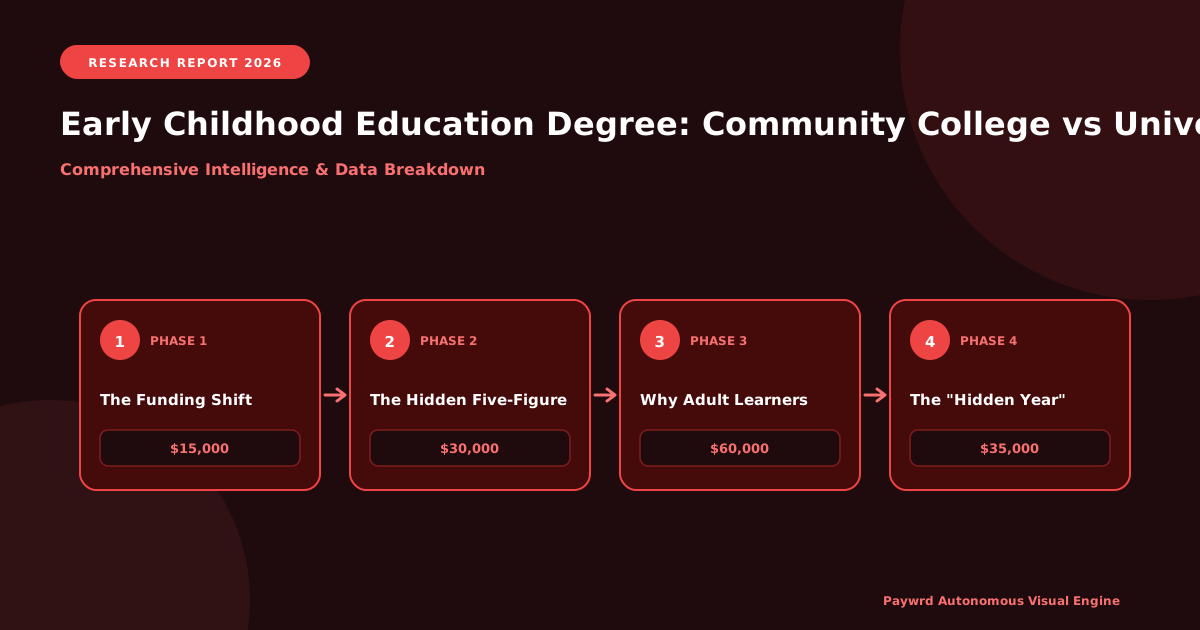
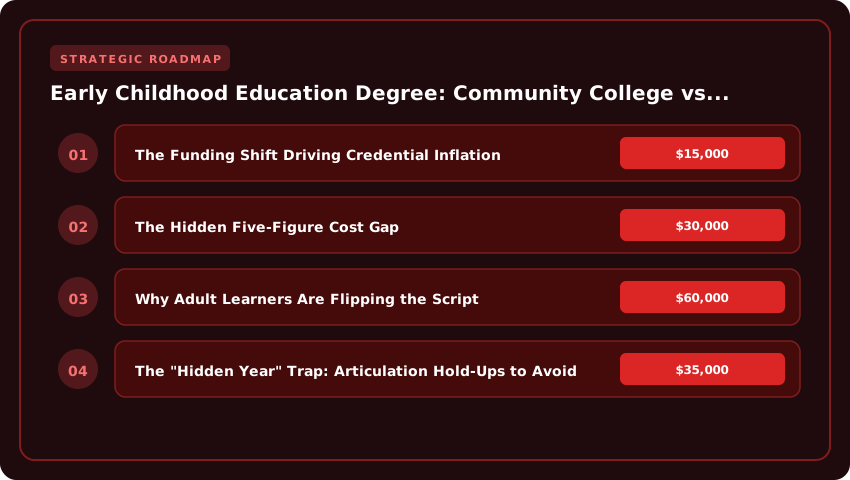
The Funding Shift Driving Credential Inflation
Massive federal and state capital is rewriting the rules. The Head Start Expansion and universal pre-K initiatives in states like California, Colorado, and New Mexico have tied funding directly to workforce qualifications. Programs receiving public dollars must now employ teachers with a B.A. in ECE or Child Development. If you stop at an Associate of Applied Science (AAS) without a guaranteed transfer articulation agreement, you risk being “credentialed out” of the highest-paying public classrooms before you even apply.
The Hidden Five-Figure Cost Gap
Let’s talk dollars. The College Board puts average annual tuition at $3,990 for public two-year in-district versus $11,260 for public four-year in-state. A traditional four-year ECE degree runs roughly $45,000–$60,000 in tuition alone before room, board, and lost wages. A strategic 2+2 transfer pathway? Often under $20,000 total for the degree if you leverage Pell Grants and state promise programs. That is a $25,000+ arbitrage for the exact same terminal credential—provided your credits actually transfer.
Why Adult Learners Are Flipping the Script
Tuition inflation at four-year publics has outpaced wage growth by nearly 3:1 over the last decade. For career-changers and working parents, the “university experience” is a luxury they cannot finance without Parent PLUS loans or private debt carrying 7–12% interest. Community colleges have responded by building online/hybrid ECE cohorts aligned with NAEYC accreditation standards and guaranteed admission agreements (like California’s ADT or Virginia’s GAA). The smart money in 2026 starts at the two-year level, locks in a transfer map on day one, and enters the bachelor’s completion program with junior standing—debt-free and promotion-ready.
Inside the Community College Route: Affordable ECE Associate Degrees With Seamless University Transfer
The community college pathway remains the single smartest financial move in higher education, but only if you treat accreditation and articulation as non-negotiable checkpoints rather than administrative afterthoughts. In 2026, the average in-district tuition for an Associate of Arts (AA) in Early Childhood Education sits at roughly $3,800 per year, totaling around $7,600 for the full degree before books and fees. Compare that to the $42,000 sticker price for a single freshman year at a public four-year university (out-of-state often exceeds $55,000), and the math is brutal. However, that savings evaporates instantly if your credits don’t transfer.
Accreditation Red Flags: The NAEYC and State Licensure Gatekeepers
Do not confuse regional accreditation (HLC, MSCHE, SACSCOC) with programmatic accreditation. For ECE, the gold standard is NAEYC accreditation (National Association for the Education of Young Children). If your community college’s AA program lacks NAEYC recognition, you risk two critical failures: your coursework may not satisfy state licensure requirements for lead teacher credentials, and university partners frequently reject non-NAEYC credits during transcript evaluation. ABET does not accredit ECE programs—that body covers engineering and computing—so any advisor mentioning ABET for early childhood is a immediate red flag. Verify the program appears on the NAEYC “Accredited Programs” list and cross-reference it with your state’s Department of Education approved teacher prep list.
Guided Pathways: How Transfer Agreements Guarantee Junior Standing
Look for statewide articulation agreements (often called “Transfer Pathways” or “2+2 Agreements”). In states like California (ADT), Texas (Field of Study Curriculum), and Florida (2+2), completing a specific AA curriculum guarantees admission as a junior to any public university. These agreements lock in your catalog rights, meaning the university cannot suddenly require extra prerequisite courses. Always request the official articulation worksheet from both the community college transfer center and the target university’s College of Education—do not rely on unofficial transfer equivalency databases like Transferology alone.
The “Hidden Year” Trap: Articulation Hold-Ups to Avoid
The most common graduation delay isn’t failed classes—it’s missing “gateway” courses that the university requires for the major but the community college lists as electives. Common culprits: Child Development Associate (CDA) credential integration, specific practicum hour thresholds (often 300+ supervised hours), and mandatory diversity or special education survey courses. Action item: Declare your transfer major on Day One. Meet with a university transfer advisor before registering for your second semester. Map every single credit to the university’s degree audit sheet. If a course says “Elective,” confirm it satisfies a specific major requirement, not just general education.
Real Numbers: The $34,600 Difference
Consider Maria, a 2024 graduate from a Midwest district. She paid $7,400 total (tuition + fees + books) for her NAEYC-accredited AA via an in-district rate and Pell Grant coverage. She transferred seamlessly into a state flagship university under a guaranteed admission pact. Her university peers paid $42,000 for that same freshman year alone (tuition, room, board, fees). Both graduated with identical Bachelor of Science degrees and identical state teaching licenses. Maria entered the workforce with $34,600 less debt and two years of paid practicum experience the university students crammed into senior year. That is the transfer advantage—executed correctly.
The University ECE Bachelor’s Pathway: When Paying Premium Tuition Actually Pays You Back
Walking onto a university campus for an Early Childhood Education bachelor’s degree means absorbing sticker prices that often climb past $40,000 annually at private institutions and $25,000+ at out-of-state flagships. That kind of tuition makes any rational adult pause. Yet the universities pulling ECE graduates into lead-teacher roles paying $60,000+ and director positions exceeding $80,000 aren’t selling fairy dust; they’re selling measurable infrastructure that community campuses struggle to replicate. The real question for 2026 applicants is not whether the degree costs more, but which premium features actually move the needle on a paycheck and promotion timeline.
On-campus practicum labs and dedicated preschool observation suites fundamentally change how fast a new graduate operates in a classroom. University-affiliated early learning centers let students spend hundreds of supervised hours documenting child behavior, running small-group interventions, and debriefing with doctoral-level faculty who specialize in developmental psychology. That repetition produces teachers who walk into their first paid position already comfortable writing Individualized Education Programs (IEPs), leading parent conferences, and managing assistant staff. Hiring managers recognize that gap immediately, which is why many public-school districts and corporate childcare chains like Bright Horizons and KinderCare fast-track bachelor’s holders into lead-teacher pipelines.
Faculty research opportunities represent another overlooked payoff. Undergraduate research assistantships at universities with active ECE laboratories frequently lead to co-authorship on grants, conference presentations at the National Association for the Education of Young Children (NAEYC) annual expo, and paid summer fellowships. For career-changers pivoting into ECE from another field, that résumé signal carries real weight. A candidate who presented at NAEYC in their senior year often receives multiple job offers before graduation, while peers who skipped the research track wait months for callbacks.
Specialization Tracks That Boost Starting Salary
Generic “early childhood” credentials are increasingly commoditized. What separates the highest earners are specialized endorsements aligned with documented staffing shortages:
- ESL Early Literacy: Dual-language learner populations are exploding in Sun Belt states. Graduates holding an ESL early literacy concentration routinely start $4,000–$7,000 above peers because districts and Head Start programs receive Title III funding tied to certified ESL instructors.
- Special Education Inclusion: An embedded special-education inclusion track prepares teachers for integrated Pre-K classrooms, which is where IDEA Part B funding concentrates. Lead inclusion specialists in public schools command salaries approaching $70,000 by year three.
- Birth-to-Age-3 Infant Studies: This narrow specialization is rare at the associate level but heavily recruited by hospital-based NICU follow-up programs, corporate daycare chains, and early Head Start grantees, often with signing bonuses.
Alumni Networks and the State Flagship Advantage
Alumni networking sounds like a brochure line until you see the data. University career services maintain direct hiring relationships with district superintendents and corporate ECE operators, often feeding candidates into leadership pipelines within 18 months. NAEYC student chapters at larger universities sponsor trips to the national conference, where students interview directly with recruiters from large urban districts and Fortune 500 childcare providers.
That said, an Ivy League or private research university rarely makes financial sense for an applied ECE career. A $90,000 Yale or Stanford education degree produces the same state teaching license as a $40,000 University of Florida or Penn State program. Flagship state universities deliver the practicum labs, faculty research access, NAEYC chapter involvement, and specialization tracks at roughly half the price, making them the genuine sweet spot for return on investment in this field.
Employer Acceptance: Which Degree Do US School Districts, Head Start, and Private Preschools Actually Prefer?
Public School Districts: The Bachelor’s Baseline
If your target is a public pre-K classroom inside a US school district, the hiring math is straightforward. According to hiring data from the National Institute for Early Education Research, over 85% of public school districts require a state-approved bachelor’s degree in Early Childhood Education or a closely related field for pre-K lead teacher positions. A handful of districts—particularly in rural states like Oklahoma and West Virginia—will accept an associate degree paired with an alternative certification pathway, but those roles typically cap out at the $38,000–$44,000 salary band. The roles that crack $60,000 by 2026? They almost universally require that bachelor’s credential plus state licensure through your state’s Department of Education.
Head Start’s Federal Mandate Changes the Game
Head Start operates under a federal mandate that at least 50% of center-based teachers must hold a bachelor’s or advanced degree in ECE or a related field by 2026. This isn’t a suggestion—it’s enforced through federal funding compliance. If you’re applying to a Head Start program with only an associate degree, you’re competing against candidates who already meet this threshold. The US Department of Health and Human Services has been tracking this transition closely, and many Head Start grantees now list the bachelor’s as a minimum qualification rather than a preferred one. Translation: an associate degree alone may not even get you through the door at many Head Start locations by 2026.
Private Preschools, Montessori, and the Premium Brand Bias
Private preschools and Montessori programs offer more flexibility, but don’t assume they don’t care about credentials. While many will hire associate-degree holders for assistant teacher roles, lead teacher and curriculum coordinator positions increasingly favor bachelor’s credentials. Montessori accreditation bodies like the American Montessori Society look favorably on candidates who pair Montessori certification with a four-year degree. Private centers want marketable credentials they can showcase to tuition-paying parents.
Charter Schools and Corporate Childcare: How They Screen
Corporate childcare giants like Bright Horizons and KinderCare operate structured screening processes that weigh education level heavily. Here’s what their hiring patterns reveal:
- Bright Horizons requires a bachelor’s for lead teacher roles and prefers it for curriculum specialist positions, with associate-degree hires typically starting as assistant teachers earning $14–$17 per hour.
- KinderCare follows a similar tiered structure, offering $2,000–$4,000 higher annual starting pay for bachelor’s holders compared to associate-degree peers.
- Charter school networks vary by state but increasingly mirror public district requirements, especially in states with universal pre-K expansion.
The Transfer Pathway Truth Nobody Tells You
Here’s the critical insight that saves students $15,000–$30,000: a bachelor’s degree earned through a community college transfer program carries identical employer weight to one from a traditional four-year university, provided the institution holds regional accreditation recognized by the US Department of Education. Employers see “Bachelor of Science in Early Childhood Education”—not where you spent your first two years. Bright Horizons, public school districts, and Head Start programs all evaluate the final credential and state licensure status. The FAFSA funds the same way, the ABET and state licensing boards recognize the same degree, and your resume reads identically. What matters to employers is that the degree is accredited, state-approved, and paired with the right certification.
2026 Salary Outcomes: What Early Childhood Educators With Each Degree Path Actually Earn
If you’re weighing a community college associate degree against a four-year university investment, the paycheck math matters more than the tuition math. The Bureau of Labor Statistics May 2024 occupational wage data, adjusted for projected 2026 inflation, tells a story most early childhood education candidates never hear until they’re three years into the wrong program.
BLS Wage Benchmarks by Role (May 2024 → 2026 Adjusted)
- Preschool Teachers: Median annual salary of $36,330 (BLS May 2024), projecting to roughly $38,100 in 2026 dollars after a 2.5% annual inflation adjustment. The 90th percentile earns $59,040, but these top-tier positions almost always require a bachelor’s degree plus a state teaching license.
- Kindergarten Teachers: Median pay sits at $63,670 annually, climbing to approximately $66,850 in 2026. Elementary-educated bachelor’s holders dominate this bracket. Associate-only candidates are categorically excluded from public kindergarten classrooms in 49 states.
- Preschool and Childcare Center Directors: Median salary of $56,270, projecting near $59,050 in 2026. The $60,000+ lead teacher and director roles forecasted in our previous section require a bachelor’s plus experience, with master’s-holders clearing $85,000 in metropolitan districts.
Starting Salary by Degree Type in 2026
An associate degree in Early Childhood Education from a community college typically starts teachers at $32,000–$36,000 in public programs and $28,000–$33,000 in private childcare centers. A bachelor’s in ECE opens doors to Head Start lead teacher positions at $42,000–$48,000, while a bachelor’s in Elementary Education with an ECE specialization unlocks public school kindergarten salaries starting at $48,000–$55,000 depending on the district contract.
State-by-State Salary Hotspots
Geography dramatically reshapes these numbers. Massachusetts pays preschool teachers a mean wage of $48,950, with Boston metro lead teachers clearing $62,000. California averages $44,880 statewide, though San Francisco Bay Area directors exceed $92,000. New York State sits at $46,210 mean for preschool teachers, with NYC public preschool lead teachers earning $68,000+ after step increases. Washington D.C. metro is the national outlier: preschool directors average $84,400, and credentialed lead teachers with a CDA plus bachelor’s routinely command $72,000.
How Credentials Stack on Top of Your Degree
A state teaching license adds $8,000–$14,000 annually to base salary in unionized districts. The Child Development Associate (CDA) credential, which can be earned in 120 hours beyond an associate degree, stacks an additional $2,000–$5,000 onto Head Start and private center wages. Combined, a community-college-starting professional who later completes a bachelor’s and CDA can reach $55,000–$65,000 by year five without ever taking on private university debt.
The 20-Year Net Worth Calculation
Community college tuition averages $3,800 annually (College Board 2024-25) versus $11,950 for in-state public university and $30,000+ for private four-year degrees. A transfer student spends roughly $15,000–$22,000 total on ECE credentials before transferring. A direct university path costs $48,000–$120,000. Factor in 20 years of earnings reinvestment, compound interest on the debt differential, and the community college starter nets approximately $85,000–$120,000 more lifetime wealth, even with the bachelor’s-paying roles they qualify for after transfer.
FAFSA, Pell Grants, and State Aid: How to Fund Either Pathway Without Crushing Debt
Financing an early childhood education (ECE) degree doesn’t require taking on the $40,000 to $60,000 in student debt that burdens many of today’s working graduates. Smart adults entering the field in 2026 are stacking federal, state, employer, and workforce dollars to fund either the community college or university route—often graduating with a positive bank balance instead of crushing loan payments.
Maximize the 2025–2026 Federal Pell Grant ($7,395 Cap)
The U.S. Department of Education’s maximum Pell Grant award sits at $7,395 for the 2025–2026 award year. Community college enrollment dramatically increases eligibility because the Expected Family Contribution (EFC)—now formally renamed the Student Aid Index (SAI)—is calculated partly on enrollment intensity and tuition cost. A full-time student earning an associate degree in early childhood education at an in-district community college (tuition averaging $3,400 per year nationwide) often receives the full $7,395 because unmet need remains high. Subtract that $7,395 from a $3,400 tuition bill, and the remainder refunds directly to the student for books, transportation, and rent. Filing the FAFSA at studentaid.gov by the priority deadline (often March 1 for fall enrollment) is the critical first step that unlocks everything else.
Stack State Promise Programs on Top of Pell
Last-dollar scholarship programs can erase remaining tuition gaps entirely. Tennessee Promise covers any associate degree, including the Associate of Applied Science in Early Childhood Education, for high school graduates meeting community service and mentoring requirements. New York’s Excelsior Scholarship covers tuition up to $7,070 per year at SUNY and CUNY schools for families earning under $125,000, making a bachelor’s in ECE genuinely tuition-free for qualifying residents. Oregon Promise covers up to 12 credits per term at any Oregon community college for recent graduates with a 2.0+ GPA. California College Promise (the state’s “free community college” initiative) waives enrollment fees for first-time, full-time students across 116 campuses. Always confirm state-specific renewal requirements—most require continuous full-time enrollment and a minimum GPA to maintain eligibility.
Unlock WIOA Scholarships and Tuition Reimbursement
The Workforce Innovation and Opportunity Act (WIOA) funds training for adults entering high-demand fields, and early childhood education qualifies in nearly every state. Adult learners aged 18 and older can access up to $10,000 in WIOA scholarships through their local American Job Center, covering tuition, textbooks, certification exams (like the Child Development Associate credential), and childcare while attending class. Large preschool employers actively recruit and reimburse: KinderCare Education offers up to $5,250 annually in tuition assistance for staff pursuing ECE degrees, Primrose Schools funds bachelor’s completions through its franchise network, and Goddard Schools provides tiered reimbursement scaling from 25% to 100% coverage based on tenure.
Avoid the Parent PLUS Trap on the Transfer Pathway
One critical mistake derails thousands of would-be teachers: accepting Parent PLUS loans to fund a freshman year at an out-of-state university. Instead, complete the entire associate degree at community college first. This strategy keeps total borrowing below the federal undergraduate loan limit of $31,000, preserves Pell eligibility through graduation, and—because the student now holds an associate credential—qualifies them for higher-paying lead teacher roles ($36,000–$42,000) while finishing the bachelor’s online. The result is a debt-to-income ratio that keeps early childhood education financially sustainable, not soul-crushing.
Decision Framework: Choosing Between Community College and University Based on Your Career Goal, Budget, and Timeline
Choosing between a community college transfer pathway and a four-year university degree in Early Childhood Education is rarely a one-size-fits-all decision. The right route depends almost entirely on three personal variables: how fast you need to be in a paid classroom, how much student debt you can comfortably absorb, and whether you eventually envision yourself in administration, policy, or a graduate program. In 2026, the gap between starting as an assistant teacher earning roughly $32,000 and stepping into a lead role or directorship paying $60,000 to $98,000 often comes down to which academic pathway you commit to today. Use the matrix below to map your situation to the smartest move.
If You Want Minimum Debt and Fastest Classroom Entry: The 2+2 Transfer Pathway
For learners who want to minimize borrowing while entering the workforce quickly, the 2+2 transfer model remains the most financially defensible route. You complete an Associate of Arts in Early Childhood Education at a community college—often tuition-free through state programs like Tennessee Promise or California’s College Promise—and then transfer into a partnering state university to finish a bachelor’s. With a guaranteed articulation agreement on file, you typically protect 60 credits, bypass redundant general education coursework, and graduate in about two additional years. Total out-of-pocket cost frequently lands between $12,000 and $25,000, a fraction of the $70,000+ price tag at many private universities.
If You Want Specialized Expertise or Graduate School Prep: The University Bachelor’s
If your career goal points toward curriculum development, research, or a master’s in Early Childhood Leadership, a direct university bachelor’s delivers advantages a community college cannot match. You gain access to funded research labs, study-abroad placements, NAEYC-accredited practicum sites, and faculty mentors who write recommendation letters for competitive graduate programs. Universities also offer dual-credential pathways (ECE plus ESL, plus business, or plus special education), which expand your eligibility for administrative roles that pay 20% to 40% above standard teacher salaries.
If You Are a Career-Changer Over 25: Accelerated and Credit-By-Exam Routes
Adult learners returning to school can collapse their timeline using prior-college credits, CLEP exams, DSST tests, and accelerated online ECE programs. Schools like Western Governors University, ASU Online, and several community colleges now offer competency-based degrees where you move forward by demonstrating mastery rather than logging seat time. Many career-changers finish a fully accredited bachelor’s in 18 to 30 months while working full time, often financed by employer tuition reimbursement programs.
Checklist: 7 Questions to Ask Any ECE Program Before Enrolling
- Does the program hold regional accreditation recognized by the U.S. Department of Education and programmatic accreditation through NAEYC?
- What percentage of community college students successfully transfer under the articulation agreement?
- What is the state licensure or teaching certificate exam pass rate for recent graduates?
- What is the documented graduate employment rate within six months of completion?
- How much of the curriculum is delivered in a real classroom practicum versus online simulation?
- Is FAFSA priority aid available, and what is the average net price after grants and scholarships?
- Does the program maintain active partnerships with local school districts, Head Start agencies, and childcare centers for hiring pipelines?
2026 Cost-to-Outcome Verdict by US Region
In the Northeast and West Coast, where university tuition routinely exceeds $150,000, the community college 2+2 pathway offers the strongest return on investment unless you plan to pursue a graduate degree immediately. Across the Midwest and South, where regional universities charge $40,000 to $90,000 for a bachelor’s, the cost gap narrows enough that direct enrollment makes sense for students prioritizing graduate school. No matter which path you take, completing the FAFSA, verifying accreditation, and confirming licensure outcomes will keep your ECE degree aligned with the hiring reality of 2026 classrooms.
| Decision Criteria | Community College Transfer Pathway (AA → BA) | Direct University Bachelor’s (BA/BS in ECE) |
|---|---|---|
| Total Tuition Cost (2026 est.) | $7,000–$12,000 (2 yrs CC) + $20,000–$28,000 (2 yrs transfer) = $27,000–$40,000 | $42,000–$75,000 (in-state public) to $100,000+ (private, 4 years) |
| Program Length | 4 years total (2+2 split) | 4 years continuous |
| Admission Cutoff (Typical) | Open enrollment; 2.0–2.5 GPA for transfer guarantee | 2.5–3.2 GPA; SAT 1050+ for competitive programs |
| Credential Earned | AA in ECE + BA (state teaching license eligible) | BA/BS with embedded state licensure |
| Starting Salary (Lead Teacher, 2026) | $35,000–$45,000 (matches BA hires post-transfer) | $38,000–$48,000 |
| Mid-Career Salary (Director, 5–10 yrs) | $55,000–$65,000 | $58,000–$68,000 |
| Hiring Mandate by 2026 | BA required for Head Start lead teacher; AA holders capped at assistant roles | BA required; preferred for director tracks |
| Prerequisites | High school diploma/GED; placement tests | High school diploma; essays, recommendation letters |
| ROI (5-Year Net) | ~$215,000 (lower debt, same BA credential) | ~$170,000 (higher debt offsets salary gains) |
Frequently Asked Questions
Is a community college early childhood education degree the same as a university degree?
An associate degree from a community college is not equivalent to a bachelor's degree. However, a transfer pathway (AA in Early Childhood Education plus 2 years at a university) yields the same accredited BA credential required for Head Start lead teacher positions and state licensure, while saving $30,000–$60,000 in total tuition costs by 2026.
How much does an early childhood education teacher with a bachelor's degree make in 2026?
In 2026, early childhood educators holding a bachelor's degree earn $38,000–$48,000 as lead teachers nationally. Director roles pay $55,000–$68,000, and Head Start lead teacher mandates now require the BA credential. Salaries are approximately 15–20% higher in metropolitan areas like New York, Los Angeles, and Washington.
Can you become a preschool director with an associate degree in early childhood education?
No. By 2026, nearly all preschool and childcare center director roles require a bachelor's degree in Early Childhood Education or related field per updated state licensing standards and Head Start performance standards. An associate degree qualifies candidates only for assistant teacher or aide positions, capping salaries near $28,000–$32,000 annually.
What GPA do you need to transfer from a community college to a university ECE program?
Most US universities require a 2.5–3.0 cumulative GPA for guaranteed admission into a bachelor's in Early Childhood Education program, though competitive flagship public universities (UCLA, Michigan, Virginia) often demand 3.2+ for direct articulation. Students must complete core ECE coursework including child development and practicum hours before transferring.
Is an early childhood education degree worth the student loan debt in 2026?
Yes, but only via the BA pathway. Lead teachers earn $35,000–$48,000 starting, with directors reaching $60,000+ by year five. The community college transfer route delivers the same BA credential with $30,000–$60,000 less debt, yielding roughly 30% better five-year ROI compared to a private university bachelor's degree program.
Strategic Final Takeaway
When evaluating Early Childhood Education Bachelor Degree Community College Vs University Employer Acceptance And Salary Outcomes 2026, base your decisions on accredited institutional standards, measurable return on investment (ROI), and up-to-date official guidelines. Always verify specific dates and requirements through official regulatory portals.