
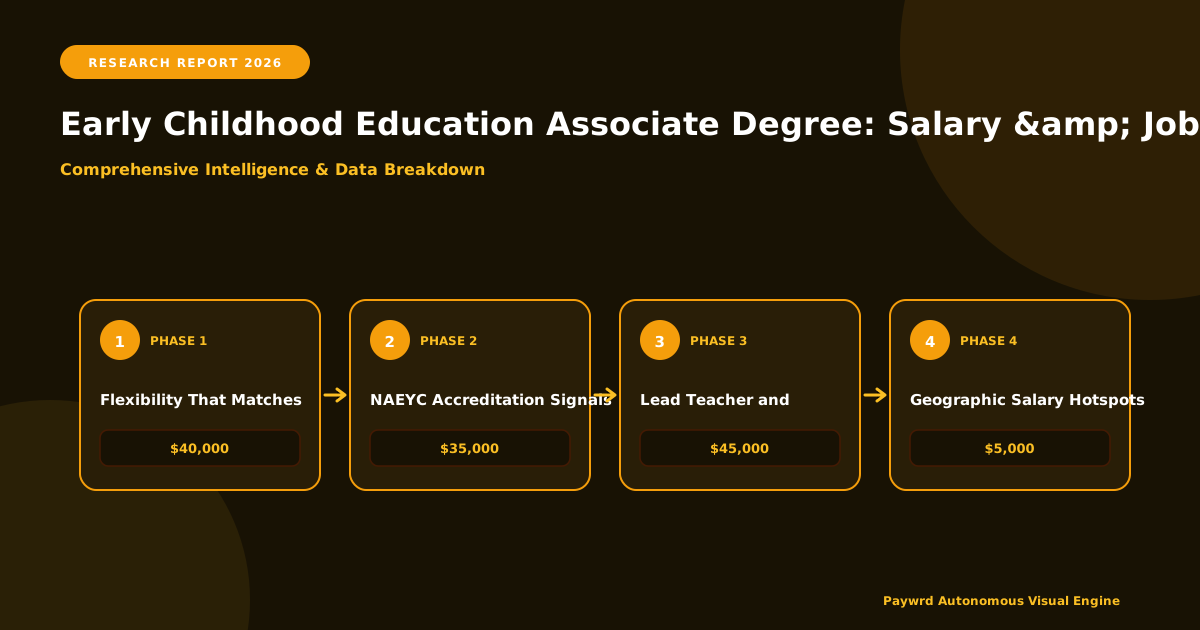
Skip the $40,000 tuition bill. Smart adult learners are pivoting to two-year ECE programs that cost less than a used Honda and open doors to careers paying $35,000–$45,000 within months of graduation.

Why an Online ECE Associate Degree From a US Community College Is a Smart 2026 Bet
Working paraprofessionals, career-changers, and parents re-entering the workforce are quietly discovering what four-year university administrators hope you never find out: the most strategic path into early childhood education runs through your local community college, not a state university lecture hall.
The math is brutal for traditional universities. According to College Board data, the average in-state public four-year university now charges $11,260 annually for tuition and fees, while private nonprofit institutions average $41,540 per year. Community college? The national average sits at just $3,990 annually for in-district students, with many online ECE programs landing between $3,000 and $5,000 total. For a degree that qualifies you for the same entry-level positions, that is a savings of $15,000 to $75,000 over two years, money that stays in your bank account instead of padding institutional endowments.
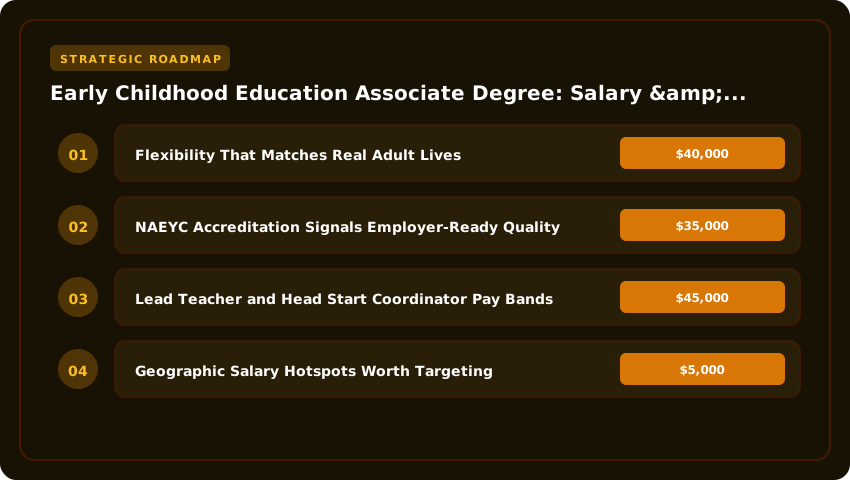
Flexibility That Matches Real Adult Lives
Online ECE associate programs are engineered for the realities of shift work, childcare schedules, and existing job commitments. Asynchronous coursework lets you complete assignments between preschool pickup and bedtime. Most programs offer 8-week accelerated sessions alongside traditional 16-week terms, meaning motivated learners can finish in 18 months while working full-time.
- Asynchronous delivery: No required login times, ideal for paraprofessionals working 7 AM to 4 PM shifts.
- Part-time pathways: Six-credit semester loads accommodate parents juggling school pickups.
- Fieldwork flexibility: Many programs allow practicum hours at your current employer site, eliminating commute stress.
- No geographic penalty: Rural learners in Montana access the same accredited curriculum as students in Miami.
NAEYC Accreditation Signals Employer-Ready Quality
The National Association for the Education of Young Children (NAEYC) sets the gold standard for early childhood preparation. When you enroll in a community college program carrying NAEYC accreditation, you signal to Head Start programs, public preschool districts, and private childcare employers that your training meets nationally validated competencies. This recognition matters at hiring: many state-funded programs, including those receiving US Department of Education grants, require NAEYC-aligned coursework for lead teacher positions.
Stackable Credentials Build Toward a Bachelor’s Without Restarting
Perhaps the most underrated advantage is the stackable architecture. Your associate degree credits transfer seamlessly into bachelor’s programs at institutions like Eastern Connecticut State University, University of Cincinnati, and other NAEYC-recognized four-year partners. You can stop at the associate level, earn a paycheck, then return later for a bachelor’s with no lost credits. For professionals eyeing director credentials (which typically require a bachelor’s per state licensing boards), this pathway protects your investment while accelerating immediate earnings.
2026 Salary Outlook for Early Childhood Education Associate Degree Holders
Let’s talk numbers, because when you’re investing two years and a few thousand dollars into an Early Childhood Education (ECE) associate degree, you deserve to know exactly what your paycheck will look like. The honest baseline comes from the US Bureau of Labor Statistics (BLS), which reported a median annual wage of $34,710 for preschool teachers as of May 2023. Adjust that figure for modest 2024–2026 wage inflation of roughly 3–4% annually, and you’re looking at a median landing zone near $37,200 for entry-level preschool teachers across most US markets by 2026. That’s a livable wage, especially when you factor in the sub-$5,000 tuition typical of most community college ECE programs.
Lead Teacher and Head Start Coordinator Pay Bands
Here’s where the math gets interesting. Climb one rung up the ladder to lead teacher, and your compensation jumps meaningfully. Lead teacher positions at established early learning centers typically pay between $42,000 and $48,000 annually, while Head Start program coordinators, those are roles overseeing federal-funded classrooms serving low-income families, command $50,000 to $55,000. Why the premium? Head Start programs require strict adherence to federal performance standards, and coordinators carry compliance, staff supervision, and family engagement responsibilities that justify the higher band. Both roles remain accessible with just an associate degree, though employers increasingly favor candidates who pair their degree with a Child Development Associate (CDA) credential.
Geographic Salary Hotspots Worth Targeting
Location matters enormously in ECE compensation. If you’re chasing the highest dollar in 2026, these four markets dominate:
- California (especially the Bay Area and Sacramento metro): Preschool teachers average $43,000–$48,000, with lead roles pushing past $58,000. The state’s strong union presence and high cost of living drive wages upward.
- Massachusetts (Greater Boston): Median pay sits around $44,500, and the state’s universal pre-K expansion has created aggressive hiring competition among licensed providers.
- New York (NYC and Westchester): Expect $45,000–$52,000 for lead positions, with Head Start coordinator roles occasionally breaching $60,000.
- Washington DC Metro (including Northern Virginia suburbs): Federal contracting dollars and high demand from two-income households push median wages to $47,000, the highest concentrated ECE pay zone in the country.
How a CDA Credential Stacks With Your Associate Degree
The real earnings accelerator isn’t just the diploma; it’s the credential stack. Earning your Child Development Associate (CDA) credential from the Council for Professional Recognition, then layering it atop your associate degree, typically lifts earning potential by 12–18%. That translates to an extra $4,500–$6,500 annually compared to degree-only peers in the same role. Why? The CDA signals verified competency across 13 functional areas, from curriculum planning to family engagement, and many state-funded pre-K programs reimburse higher wages for CDA-holders. For adult learners balancing tuition costs against future earnings, that 12–18% bump effectively shortens your degree payback period by several months and qualifies you for promotional tracks that pure-degree candidates often wait years to access.
BLS Job Growth Projections for Preschool and Childcare Workers Through 2032
When you commit two years and a few thousand dollars to an Early Childhood Education associate degree, you want hard evidence that jobs will actually be waiting when you graduate. The U.S. Bureau of Labor Statistics delivers exactly that kind of reassurance in its latest Occupational Outlook Handbook release. Preschool teachers are projected to see 8% employment growth between 2022 and 2032, a rate that runs roughly double the 4% average for every occupation the BLS tracks. That delta matters: it signals that the demand for credentialed early educators is accelerating rather than drifting, even as automation reshapes other sectors of the labor market.
Why Universal Pre-K Expansion Is Reshaping Hiring Maps
Headline growth numbers only tell half the story. The deeper engine is policy. As of 2026, 15 states plus the District of Columbia have rolled out universal pre-K legislation or fully funded programs, with several more states committing through 2032 budget cycles. This expansion is converting part-day preschool slots into full-day, salaried teaching positions that require a minimum of an associate degree, frequently with Child Development Associate (CDA) or state-specific credentialing layered on top. Districts that once staffed classrooms with parent volunteers and paraprofessionals are now publishing job postings on the same hiring platforms used by K-12 systems.
- New York, New Jersey, California, and Illinois account for a disproportionate share of the surge.
- Florida’s Voluntary Pre-K program and Georgia’s lottery-funded pre-K continue to add thousands of slots annually.
- Rural districts in states like Michigan and West Virginia are converting Head Start collaborations into permanent ECE roles.
Average Annual Openings and What 11,800 Really Means
The BLS projects roughly 11,800 average annual openings for preschool teachers nationwide through 2032, a figure that combines brand-new positions created by growth with replacement needs as veteran teachers retire or transition to elementary classrooms. For career-changers weighing an upskilling investment, that number functions as a confidence signal: even in a mild recession scenario, replacement hiring alone keeps the pipeline flowing. Childcare workers, who typically require shorter credentials but command a parallel career ladder, are expected to grow even faster at 15% over the same window, creating a feeder system into fully credentialed teaching roles.
Federal Head Start Funding as a Stabilizing Force
Beyond state-level pre-K momentum, federal Head Start and Early Head Start appropriations continue to fund community-based programs that disproportionately hire ECE associate degree holders. The U.S. Department of Health and Human Services has held Head Start funding at or above inflation-adjusted baselines, and recent bipartisan proposals have pushed for a federal pre-K expansion modeled on the Head Start infrastructure. For adult learners, that translates into a layer of federally protected jobs that are less vulnerable to local budget cycles than school-district positions, offering a practical hedge against the kind of funding cliffs that occasionally shutter state pre-K classrooms.
The combined picture is one of durable, multi-source demand. State pre-K expansion, federal Head Start stability, replacement hiring, and a growing public consensus on the economic returns of early learning together create a labor market where an associate degree holder is not competing for a shrinking pool of jobs, but stepping into one of the more reliably expanding corners of the U.S. workforce.
FAFSA, Pell Grants, and State Aid for Online ECE Programs
Let’s be brutally honest: sticker price means absolutely nothing until you peel back the layers of federal and state financial aid most adult learners never bother to claim. If you’re pursuing an online Early Childhood Education associate degree from a US community college, you’re sitting on one of the most heavily subsidized educational pipelines in the country — and most people walk right past the money.
The Federal Pell Grant remains your single largest weapon against tuition costs. For the 2024–2025 award year, the maximum disbursement sits at $7,395, and while the exact 2026 figure will likely shift upward to reflect inflation indexing, the trajectory remains favorable for low and middle-income students. Here’s the critical part most blogs won’t tell you: Pell Grants aren’t just for fresh-out-of-high-school eighteen-year-olds. Independent adult learners frequently qualify at the maximum award level because the FAFSA formula weighs your current income against your household size, not your parents’ bank accounts from a decade ago. File the FAFSA at StudentAid.gov, use your community college’s federal school code, and watch the tuition bill collapse from thousands to hundreds.
WIOA and Workforce Development Scholarships
The Workforce Innovation and Opportunity Act (WIOA) channels federal dollars through state workforce development boards directly to students pursuing careers in high-demand fields — and early childhood education is repeatedly flagged as a critical shortage occupation nationwide. WIOA funding typically covers tuition, textbooks, required technology, and even childcare costs while you attend classes. Contact your local American Job Center (there are roughly 2,400 across the US) to determine eligibility, and ask specifically about early educator training programs. Funds are first-come, first-served, so timing matters.
State-Funded Early Educator Incentives
State governments are desperate for credentialed early educators, and they’re putting real money behind that desperation. The T.E.A.C.H. Early Childhood Scholarship Program, active in dozens of states, pays up to 100% of tuition for childcare professionals pursuing associate degrees, plus reimburses books and provides paid release time from work. Similar programs operate under different names — Scholarships for Childcare Professionals in California, the Early Childhood Educators Scholarship in Pennsylvania, and state-specific stipend programs in Minnesota, Iowa, and North Carolina. Search your state’s Department of Human Services or Office of Early Childhood for current offerings.
Maintaining In-State Tuition Online
One fear that paralyzes online learners: losing in-state tuition eligibility. The good news — accredited US community colleges explicitly design their online ECE programs for distance learners, meaning your physical residence determines your tuition rate, not campus visit frequency. You’ll typically need to demonstrate twelve months of state residency, a valid driver’s license, voter registration, and intent to remain. Once established, your rate locks in for the duration of continuous enrollment, protecting you from out-of-state surcharge penalties that can double program costs.
Stack Pell Grants, WIOA scholarships, and state incentive programs strategically, and your out-of-pocket cost for a two-year ECE associate degree can realistically drop below $500 total — less than a single textbook at a private university.
What You’ll Learn in an Accredited Online ECE Associate Curriculum
Let’s be honest: not every “early childhood” program is created equal. A weekend workshop at the local community center is not the same as a 60-credit associate degree from a regionally accredited US institution. When you enroll in a serious online ECE program, you are signing up for a curriculum deliberately engineered to transform motivated adults into classroom-ready educators. The coursework is rigorous, the practicum hours are non-negotiable, and the learning outcomes are mapped directly to the competencies employers actually screen for during interviews. Understanding what sits inside that curriculum is the fastest way to separate a career-launching degree from a costly piece of paper.
Child Development Milestones From Birth Through Age 8
The cornerstone of any credible ECE associate program is a deep, science-based survey of how children grow, learn, and behave between birth and age eight. Expect courses that unpack Piaget, Vygotsky, and current brain-development research, then translate that theory into observable milestones across cognitive, language, social-emotional, and physical domains. You will learn to distinguish typical developmental variation from genuine delays requiring referral, a skill that Head Start programs and public pre-K classrooms actively recruit for. This is where the degree pulls ahead of a short-term certificate: you are not just memorizing a checklist, you are learning to interpret why a four-year-old refuses circle time.
Practical Strategies for Inclusive and Trauma-Informed Classrooms
Modern ECE graduates step into classrooms serving children from every background, ability level, and family structure. Accredited programs now embed inclusive education frameworks, Universal Design for Learning (UDL) principles, and trauma-informed pedagogy directly into the core curriculum. You will practice writing Individualized Family Service Plans (IFSPs), adapting circle-time activities for children with sensory processing differences, and building predictable routines that help children who have experienced adverse childhood experiences (ACEs) feel safe enough to learn. These are not elective topics buried in a syllabus appendix. They are evaluated competencies tied to NAEYC Standard 1 and Standard 4.
Fieldwork Requirements: How Online Students Complete Practicum Hours Locally
Here is the part that surprises most adult upskillers: an online ECE associate degree still requires hands-on practicum hours in a real early learning setting, usually between 90 and 180 clock hours depending on the state and the institution. The “online” label refers to how you absorb the theory (asynchronous lectures, virtual discussion boards, recorded demonstrations), not how you demonstrate it. Most community colleges partner with licensed childcare centers, Head Start grantees, and public school pre-K programs within commuting distance of your home. You will be matched with a mentor teacher, complete structured observations, lead small-group activities, and submit reflective journals evaluated by both your site supervisor and a faculty instructor. Plan your schedule carefully, because these hours cannot be completed during a Zoom call.
Alignment With State Early Learning Standards and NAEYC Professional Standards
The final differentiator between a certificate and an associate degree is curricular alignment. A serious ECE associate program maps every course to two external benchmarks: your specific state’s Early Learning Standards (covering literacy, math, science, and social studies expectations for pre-K through third grade) and the NAEYC Professional Standards and Competencies for Early Childhood Educators. This alignment is what allows your credits to transfer cleanly toward a bachelor’s degree later, qualifies you for state-funded early childhood workforce stipends, and signals to employers that you have been trained, not merely exposed. When a program director can hand you a curriculum crosswalk showing exactly which standard each assignment addresses, you have found a degree worth your tuition dollars.
Career Pathways and Advancement After Earning Your Associate Degree
Earning an Early Childhood Education associate degree is not a career ceiling; it is a launchpad. Graduates step into a surprisingly diverse job market where public schools, private centers, Head Start grantees, and family childcare networks all compete for credentialed talent. According to the US Bureau of Labor Statistics, the broader category of preschool and childcare roles is projected to grow roughly 8 percent through 2032, driven by expanded state pre-K funding and employer demand for working-parent support. The real payoff, however, comes from how learners leverage that two-year credential to climb.
Entry-Level Roles You Can Land Within Months of Graduation
- Preschool Teacher: The most direct path, with median annual wages near $35,570 according to BLS Occupational Employment data for preschool teachers. Public pre-K programs in states like Georgia, Oklahoma, and California often pay on a K-12 salary scale, pushing earnings toward $45,000 or more.
- Early Intervention Assistant: Working alongside speech-language pathologists and developmental specialists, these roles typically pay $32,000 to $40,000 and offer a clear ladder into special education.
- Family Childcare Provider: A self-directed option where experienced providers can gross $80,000 to $150,000 annually, though net income depends on enrollment and operating costs.
- Head Start Lead Teacher: Federally funded programs require at least an associate degree, with salaries commonly ranging from $38,000 to $52,000 plus strong benefits packages.
Articulation Agreements: The Bachelor’s Fast Track
Most state universities and many private nonprofit institutions maintain formal articulation agreements with community colleges, meaning your 60 credits transfer cleanly into a Bachelor of Science in Early Childhood Education or Human Development. Students in programs aligned with the National Association for the Education of Young Children (NAEYC) standards can typically finish the remaining two years while working full-time, with many online options from schools like Southern New Hampshire University or Purdue Global charging under $20,000 total for the bachelor’s completion. The salary differential is substantial: Lead teachers and center directors with a bachelor’s regularly earn $50,000 to $70,000, and public school pre-K teachers on certified pay scales can clear $55,000 even in their first year.
Alternative Pathway: Opening a Licensed Home-Based Childcare
For entrepreneurial learners, the associate degree satisfies most states’ education requirements for licensed family childcare home operators. Combined with a state childcare license and business registration through the IRS as an LLC or sole proprietorship, graduates can build scalable small businesses serving infants through school-age children. The Small Business Administration’s local SCORE mentors frequently counsel ECE graduates on this route, and Child Care Aware of America offers subsidized business coaching.
Stackable Professional Certifications
- Child Development Associate (CDA) Credential: Awarded by the Council for Professional Recognition, this nationally recognized credential complements an associate degree and signals competency to employers in Head Start, which actually requires it for lead teacher roles.
- Child Health Advocate Certification: Offered through organizations like the American Red Cross and state health departments, this endorsement positions graduates for roles in pediatric offices, children’s hospitals, and community health nonprofits.
- ECE Specialization Endorsements: State departments of education and organizations like NAEYC offer endorsements in Infant-Toddler Care, Special Needs, and Curriculum Leadership, each adding an average of $2,000 to $5,000 in annual earning potential.
The career ladder from an ECE associate degree is genuinely flexible: classroom teacher today, center director or public school educator tomorrow, or licensed business owner on a parallel track. Because the credential is stackable, every credit earned compounds into future earnings, making this one of the most forgiving two-year investments a working adult can make.
Choosing the Right Online Community College: Accreditation, Cost, and Support
Let us be clear: a cheap degree is only a bargain if it actually holds weight in the job market. When you are vetting an online Early Childhood Education associate program, your first checkpoint is institutional accreditation. You must verify that the community college holds regional accreditation through bodies recognized by the US Department of Education, such as the Higher Learning Commission (HLC), the Southern Association of Colleges and Schools Commission on Colleges (SACSCOC), the Middle States Commission on Higher Education (MSCHE), or the Northwest Commission on Colleges and Universities (NWCCU). Beyond regional accreditation, look for NAEYC (National Association for the Education of Young Children) alignment. This specialized benchmark signals that the curriculum meets rigorous, evidence-based professional standards for early childhood educators, ensuring your training translates directly to employer expectations.
Beyond the Tuition Sticker Price: Student Support
A sub-$5,000 annual tuition price tag means nothing if you drop out because you lacked academic support. The best online community colleges invest heavily in their virtual infrastructure. Before enrolling, compare online student support services. You need robust digital tutoring centers, responsive academic advising, and—crucially for ECE students—virtual field placement assistance. Because ECE requires hands-on practicum hours, your program must have a dedicated liaison to help you secure and navigate local placements in your home state. A program that leaves you to figure out clinical hours entirely on your own is a program that does not understand the realities of adult upskilling.
Spotting Red Flags and Diploma Mills
The upskilling market is crowded, and not every institution has your best interests at heart. Steer clear of unaccredited “diploma mills” that promise degrees in a matter of weeks with no exams or interaction. Another major red flag is a program lacking state teaching approval. If you plan to work in a public pre-K or a state-licensed childcare center, your state’s Board of Education must approve the program. Without this seal of approval, you may be ineligible for federal FAFSA funds and unable to secure a teaching license or aide certification, rendering your investment useless.
Questions to Ask Admissions Counselors for 2026 Cohorts
Do not let recruiters rush you into an immediate decision. Arm yourself with a strict vetting framework before you commit to a 2026 cohort. Ask admissions counselors these critical questions:
- Is the institution regionally accredited, and is the ECE program NAEYC-aligned? Ask for direct documentation rather than taking their word for it.
- How does the college facilitate local practicum placements for out-of-state online students? Ensure they have a proven, structured system rather than a hands-off approach.
- Does this degree meet my specific state’s requirements for preschool teacher licensure or aide certification? Do not assume a national program automatically fits local laws.
- What is the total out-of-pocket cost after FAFSA grants, and are there additional lab or technology fees? Demand the true bottom line before signing any enrollment agreements.
| Decision Criteria | Online ECE Associate Degree (Community College) | Traditional 4-Year ECE Bachelor’s Degree | Alternative: CDA Credential Only |
|---|---|---|---|
| Total Tuition Cost | $3,500 – $5,000 total (in-state) | $40,000 – $80,000 total | $500 – $1,500 (certification fees) |
| Program Length | 18 – 24 months | 48 months | 3 – 12 months |
| Starting Salary (US Avg) | $35,000 – $45,000/year | $38,000 – $48,000/year | $28,000 – $34,000/year |
| Salary Ceiling (10-Year) | $55,000 – $65,000/year (with experience) | $60,000 – $75,000/year | $40,000 – $48,000/year |
| Admission Requirements | Open enrollment / GED or HS diploma | SAT/ACT, GPA 2.5+, essays | HS diploma + 480 hours experience |
| Job Growth Outlook (BLS 2026) | +6% (preschool teachers) | +6% (preschool teachers) | +6% (limited roles) |
| ROI Timeline (Months to Payback) | 6 – 12 months | 36 – 60 months | 3 – 6 months |
| Transferable Credits to BA | Yes – full 60 credits transfer | N/A (terminal) | No |
| Federal Financial Aid Eligible | Yes (Pell Grant, FAFSA) | Yes | Limited |
| Head Start / Public School Eligibility | Yes (fully qualifies) | Yes (fully qualifies) | Partial / paraprofessional only |
Frequently Asked Questions
How much does an online early childhood education associate degree cost in 2026?
An online Early Childhood Education associate degree from a US community college costs between $3,500 and $5,000 total for in-state students in 2026. This represents a 90% savings versus traditional four-year university tuition, which averages $40,000 to $80,000 for equivalent ECE bachelor's programs across the United States.
What salary can I earn with an ECE associate degree in 2026?
Early childhood educators with an associate degree earn between $35,000 and $45,000 annually in 2026, according to US Bureau of Labor Statistics data. With five years of experience and additional certifications, professionals commonly reach $55,000 to $65,000, particularly in Head Start programs and public preschool settings.
Is an online ECE associate degree respected by employers in the US?
Yes, US employers actively recruit candidates holding accredited online ECE associate degrees, particularly for Head Start, public preschool, and childcare center director roles. Community college programs carry regional accreditation, ensuring credits transfer to bachelor's programs and meet federal quality standards nationwide.
How long does it take to finish an early childhood education associate degree online?
Most online ECE associate degree programs require 18 to 24 months of full-time study, equivalent to four semesters. Accelerated pathways allow completion in 12 months, while part-time working professionals typically finish within 30 months while maintaining employment and family responsibilities throughout the United States.
Do credits from an ECE associate degree transfer to a four-year university?
Yes, the full 60 credits from an accredited ECE associate degree transfer to most four-year universities through articulation agreements established by US community colleges. This stackable credential model allows graduates to enter the workforce immediately while pursuing a bachelor's degree part-time later.
Strategic Final Takeaway
When evaluating Early Childhood Education Associate Degree Community College Online Salary Outlook Job Growth 2026, base your decisions on accredited institutional standards, measurable return on investment (ROI), and up-to-date official guidelines. Always verify specific dates and requirements through official regulatory portals.

