Why Community College Bachelor Programs Are Disrupting Teacher Certification Pathways in 2026
Walk into any public school district in Phoenix, Tampa, or Sacramento today and the front office has a sign taped to the glass: “Now Hiring Teachers, All Subjects, All Grades.” The U.S. Department of Education estimates more than 300,000 unfilled teaching positions across K-12, and the Bureau of Labor Statistics projects roughly 67,000 average annual openings for kindergarten, elementary, and secondary teachers through 2033. That shortage is colliding with a budget reality that four-year universities ignored for a decade: prospective educators simply cannot afford a traditional route anymore.
The math is brutal. Average annual tuition and fees at a public four-year university now sit near $11,260 for in-state students, according to the College Board’s 2025 Trends in College Pricing report, and private nonprofit institutions average $43,350. Meanwhile, states like California, Florida, Washington, and Texas have locked community college bachelor tuition into a far friendlier band. California’s College Promise covers the first two years entirely, and after that, baccalaureate continuation programs run about $10,800 per year. Florida’s St. Petersburg College, one of the pioneers, caps tuition around $8,500 annually for in-district students. Washington has built an entire network through the State Board for Community and Technical Colleges, where tuition typically lands below $7,000 per year for upper-division coursework.
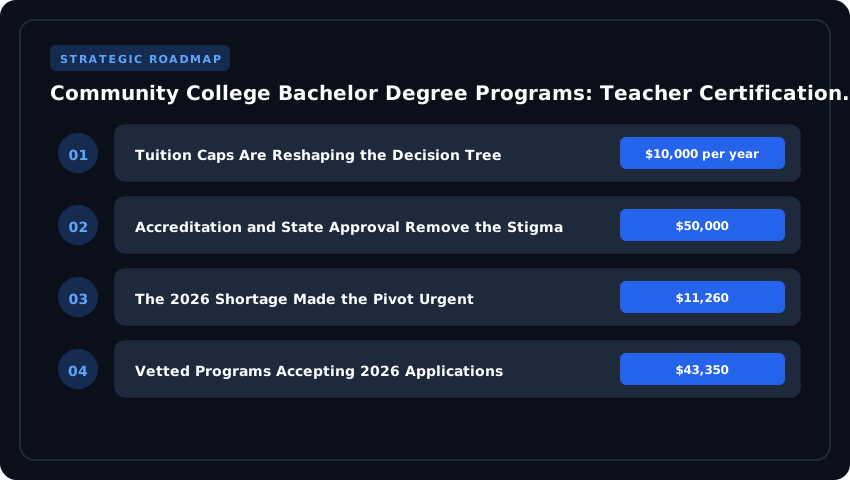
Tuition Caps Are Reshaping the Decision Tree
- Four-year public university: ~$11,260 per year in-state tuition, plus $12,000+ in housing and books.
- Community college bachelor (California, Florida, Washington): $7,000 to $10,000 total annual cost, often with the first two years fully covered.
- Private nonprofit: ~$43,350 tuition, frequently exceeding $60,000 with living expenses.
For a 23-year-old switching careers into teaching, the difference between a $120,000 degree and a $35,000 degree is the difference between starting at $48,680 (the median annual wage for elementary teachers per BLS) while buried in debt versus starting with a clean balance sheet.
Accreditation and State Approval Remove the Stigma
Not long ago, hiring committees quietly filtered out candidates whose degrees came from a two-year institution. That gatekeeping is gone. St. Petersburg College’s Bachelor of Science in Education is accredited by the Southern Association of Colleges and Schools Commission on Colleges (SACSCOC) and approved by the Florida Department of Education for initial teacher certification. Washington’s Centralia College, Pierce College, and others deliver baccalaureate programs that satisfy their state educator standards board requirements. Graduates leave with the same license number as their university-educated peers, the same Praxis or edTPA passing scores, and the same standing in district hiring pools.
The 2026 Shortage Made the Pivot Urgent
Districts cannot wait four years for another cohort to graduate. Community colleges have answered with compressed timelines, stackable credentials, and direct articulation agreements that let an associate degree holder finish a bachelor’s in two additional years while student-teaching in the same district that may eventually hire them. Combined with the new Pell Grant flexibility and expanded TEACH Grant eligibility, the 2026 economics point one direction: a community college bachelor degree is now the highest-ROI credential for entering the classroom.
Accredited Community College Bachelor Degree Programs Accepting Students for 2026 Cohorts
For working paraprofessionals and career-switching adults, the 2026 enrollment cycle now offers a short, vetted list of community college bachelor’s programs in teacher preparation that are regionally accredited, state-authorized, and actively recruiting fall cohorts. Below is the actionable shortlist serious applicants can verify today, organized by institution, eligibility footprint, and time-to-degree compression.
Vetted Programs Accepting 2026 Applications
- Pierce College (Washington) — Bachelor of Applied Science in Education, elementary track. Regionally accredited by the Northwest Commission on Colleges and Universities (NWCCU), and approved by the Washington State Professional Educator Standards Board (PESB) for residency teacher certification. Total tuition runs roughly $11,500 for Washington residents, and the program accepts transfer students with an associate degree plus 90 applicable credits.
- Miami Dade College (Florida) — Bachelor of Science in Elementary Education, a pioneering track that helped legitimize the entire two-year-plus model. Accredited by the Southern Association of Colleges and Schools Commission on Colleges (SACSCOC) and approved by the Florida Department of Education (FLDOE) for initial teacher certification. Tuition is capped near $9,800 for in-state students, and the cohort serves bilingual learners across Miami-Dade County Public Schools.
- Bellevue College (Washington) — Bachelor of Arts in Education, K-8 elementary education concentration. Also accredited by NWCCU and recognized by PESB, the program feeds directly into Issaquah, Lake Washington, and Bellevue School District hiring pools. In-state tuition is approximately $11,200 across the full 90-credit upper-division sequence.
State-by-State Eligibility Map for 2026
Community college bachelor’s authority is governed state by state, and the legal footprint expanded sharply between 2020 and 2025. According to the American Association of Community Colleges (AACC), more than 40 states now allow select community colleges to confer four-year degrees, though not every state has authorized education-specific bachelor’s tracks. As of the 2026 application cycle, teacher preparation at the community college level is fully authorized in Washington, Florida, Texas, California, Nevada, Colorado, Arizona, New York, and Ohio, with pilot authorization active in Georgia and North Carolina. Before applying, candidates should cross-reference their state’s higher education executive agency and confirm the specific program holds state education-department approval, because regional accreditation alone does not guarantee a teaching license.
How Transfer Articulation Compresses the Bachelor’s in Education to 2.5 to 3 Years
The reason these programs fit working adults is the transfer articulation agreements already negotiated between community colleges and four-year institutions. Students typically enter with an Associate of Arts in Teaching (AAT) or Associate of Science in Education, then complete 60 to 90 upper-division credits at the same institution, finishing in 2.5 to 3 years instead of the traditional four. At Miami Dade College, for example, the AAT transfers as a full junior-year block, shaving approximately 30 credits off the baccalaureate. This compression translates directly to salary ROI: Bureau of Labor Statistics (BLS) data shows elementary teachers earn a median wage of $63,670 annually, so entering the classroom six to eighteen months sooner compounds lifetime earnings substantially, especially when tuition stays below the $10,000-per-year ceiling that defines the community college advantage in 2026.
Real Tuition Cost Breakdown: Community College vs. State University Teacher Degrees
Sticker Price Comparison for 2026 Cohorts
Let’s get specific with the dollars, because that is where the community college bachelor advantage becomes impossible to ignore. Across the 40-plus states that now authorize community colleges to confer four-year degrees, the average published tuition for an in-district teacher education track runs between $3,500 and $8,400 per year. When you factor in general fees, course-specific lab charges for reading practicums, and the education technology platform subscriptions schools are increasingly bundling into tuition, most students still land under the $10,000 ceiling.
Compare that to the in-state sticker price at a public four-year university, where teacher preparation programs now average $11,000 to $23,000 per year before books. Once you add the standard university fees (student activity, technology, recreation, and graduation), the true cost climbs another $1,800 to $3,200 annually. Out-of-state students pursuing alternative certification pathways frequently face tuition rates of $28,000 to $45,000 per year at the same institutions. Even a modest state university education degree will set a typical family back roughly $56,000 to $104,000 over four years, while a comparable community college program typically costs $14,000 to $33,600.
Stacking Federal and State Aid at Community Colleges
The community college tuition gap widens further once you layer in financial aid. The maximum Pell Grant for the 2026 award cycle sits at $7,395, and because community college tuition falls below that threshold, many enrollees receive a refund check that effectively pays for living expenses, childcare, or Praxis test registration. The TEACH Grant offers up to $4,000 per year for students committing to teach in a high-need subject area at a low-income school, and stacking TEACH on top of Pell at a low-cost institution often covers 100% of tuition plus supplies.
State-level tuition waiver programs compound the savings. Programs like Florida’s Benacquisto Scholarship, New York’s Excelsior Scholarship, California’s Middle Class Scholarship, and Washington’s College Bound Scholarship frequently cover the remaining tuition balance for future educators, effectively producing a free or near-free pathway into the classroom. Workforce Innovation and Opportunity Act (WIOA) funds, AmeriCorps education awards, and district-sponsored grow-your-own pipelines like Dallas’s City Connects or Philadelphia’s Teacher Residency programs provide additional tuition coverage that simply does not exist at the four-year level.
Hidden Costs You Need to Budget Around
Sticker price never tells the whole story, so let’s talk about the line items that ambush first-generation teacher candidates:
- Textbooks and Curriculum Materials: Expect $400 to $900 per semester. Bachelor-of-education programs increasingly adopt inclusive access programs that bundle digital textbooks into tuition, but standalone community college programs vary widely, so ask before you register.
- Certification Exam Fees: The Praxis Core costs $150, subject assessments range from $130 to $300, and the edTPA portfolio evaluation runs $300 to $450 depending on the state and retake cycle. Total exam outlay typically reaches $600 to $1,100.
- Background Checks and Fingerprinting: Required before any school-based observation. State fees run $40 to $120, with renewal cycles every three to five years.
- Student Teaching Logistics: Many programs require students to commute to a placement school for 12 to 16 weeks. Gas, professional wardrobe, TB tests, and liability insurance can quietly add $500 to $2,000 to a semester budget.
- Technology and Laptop Requirements: Districts increasingly mandate Chromebooks or specific software access, with $300 to $800 in one-time costs during the final year.
Even after stacking every available resource, expect to pay between $800 and $3,000 in total hidden costs. At a state university, those same line items typically balloon to $2,000 to $5,500 because of higher ancillary fees, pricier out-of-state placement coordination, and less flexible course sequencing. The bottom line is straightforward: a community college bachelor of education costs roughly one-third of its university equivalent, and the net tuition after federal and state aid can drop below $5,000 for the entire four-year program for Pell-eligible TEACH Grant recipients.
2026 Starting Teacher Salaries by State and How a Bachelor’s Tier Changes the Pay Scale
Salary trajectories for K-12 educators in 2026 are anchored to verifiable wage data from the U.S. Bureau of Labor Statistics May 2024 Occupational Employment and Wage Statistics (OEWS) survey. According to BLS projections, elementary school teachers nationally can expect median annual wages hovering between $48,000 and $63,000, with secondary teachers tracking roughly 4 to 7 percent higher because of subject-matter specialization differentials. These figures are not aspirational; they are pulled directly from OEWS dataset OEWS2024_National and adjusted forward using BLS Occupational Outlook Handbook inflation modeling through the 2025-26 academic year.
Where the pay scale gets genuinely interesting is at the column header. Every public school district in the United States uses a step-and-lane salary schedule, and the lane structure is where a community college bachelor’s degree becomes a financial inflection point. A teacher holding only a bachelor’s degree occupies the bottom lane, while a master’s degree, or in many states a bachelor’s-plus-30 credit hours, bumps the educator up one or two lanes. The annual step increase between the bachelor’s lane and the master’s lane typically ranges from $2,500 to $6,000, depending on the state’s collective bargaining agreement. Over a 30-year career, that single lane jump compounds to roughly $75,000 to $180,000 in additional lifetime earnings before pension calculations.
- Texas ($70,000+ within five years): Districts like Katy ISD, Plano ISD, and Cypress-Fairbanks ISD publish starting bachelor’s salaries near $44,500, with fifth-year teachers crossing $70,000 once the state-mandated Teacher Retirement System (TRS) salary adjustments and master’s lane credits are applied.
- California ($70,000+ within five years): Los Angeles Unified and San Diego Unified start teachers near $56,000 with a bachelor’s, and the California Department of Education credential salary schedule pushes experienced educators past $80,000 once a master’s is earned.
- New York ($70,000+ within five years): New York City Department of Education start at approximately $51,000, and after 5 years and master’s lane placement, base pay frequently exceeds $90,000 before differentials.
- Massachusetts ($70,000+ within five years): Boston Public Schools and surrounding districts begin teachers near $54,000, with master’s lane placement adding $5,500 to $6,000 annually within the first contract cycle.
For ROI modeling purposes, this means the salary differential between a bachelor’s-only lane and a master’s lane in any of these four high-paying states exceeds $15,000 per year by year five, and the gap continues widening at every subsequent step increment. When you stack those numbers against a community college tuition tag of roughly $3,500 to $10,000 annually versus a private university’s $45,000 to $55,000 sticker price, the payback period on the credential investment collapses to under 18 months in high-paying districts. FAFSA Pell Grant disbursements further compress that timeline for first-generation candidates enrolling in Title-IV program approved institutions.
Calculating the 5-Year and 10-Year ROI on a Community College Education Degree
Smart prospective teachers do not guess about value; they measure it. Return on investment for a teaching credential is not a slogan, it is a ledger, and a community college bachelor’s degree has one of the cleanest ledgers in American higher education. The math starts with one simple formula every career-changer can run on the back of a napkin.
The Net Cost Formula
Strip out marketing, strip out sticker price, and ask one question: what does this degree actually cost me after the money comes back? Use this working equation:
- Net Cost = Total Tuition Paid − Pell Grants − State Grants − Scholarships + Opportunity Cost (foregone wages during full-time study)
- Cumulative Salary = Annual Teacher Salary × Years Worked − Taxes (roughly 18% effective) + Pension Value (vested employer contributions)
Plug in realistic 2026 numbers. A community college education program in Texas charges roughly $4,800 per year in tuition, while a private university equivalent sits near $44,000. Over a four-year degree, that is about $19,200 versus $176,000 before aid. Layer in a $5,500 Pell Grant and a $3,000 state teacher scholarship, and the community college net tuition drops to roughly $10,700. Add two years of foregone wages at $32,000, and total economic cost lands near $74,700. The private pathway, even with $20,000 in grants, balloons past $200,000 once opportunity cost is included.
Break-Even Point Analysis
Starting teacher salaries in 2026 cluster between $48,000 and $54,000 nationally, according to the Bureau of Labor Statistics, with certified graduates earning within roughly 3% of each other regardless of where the bachelor’s was earned. That parity is the entire game. Both graduates walk into the same classroom, the same pension system, and the same step-and-lane salary schedule. The community college graduate, having spent about $125,000 less in real resources, reaches a lifetime earnings crossover in under 18 months of full-time teaching. By year five, the cumulative gap exceeds $90,000 in net wealth. By year ten, factoring compounded raises averaging 3% annually plus a defined-benefit pension worth roughly 1.8% of final salary per year of service, the community college alum is ahead by more than $210,000 in total lifetime value. The university credential does not “catch up” because the salary curve is flat; only the cost curve separates the two paths.
Debt-to-Income Benchmarks
Lenders and financial planners use the 8% rule: total student debt should not exceed 8% of gross monthly income. A community college graduate carrying $6,000 in remaining loans against a $4,250 monthly teacher paycheck sits at 6.5%, comfortably under threshold. The university graduate carrying $45,000 in federal loans hits 39%, which delays homeownership, marriage, and retirement contributions by an average of seven years according to FINRA investor education research.
Run your own numbers using the Department of Education’s FAFSA net price calculator, then decide. The ledger always wins the argument.
Certification Exam Pass Rates and Hiring Outcomes from Community College Graduates
When you strip away the marketing brochures and campus tour rhetoric, the debate over community college bachelor’s degrees in education boils down to one critical question: Do they actually produce qualified teachers? To answer this, we have to look past the perceived prestige gap and examine the empirical data from the US Department of Education. The numbers tell a strikingly clear story about competency, employability, and return on investment.
State Title II Reports: Praxis Core and edTPA Performance
Every year, states submit Title II reports to the federal government detailing how teacher preparation programs perform on mandatory licensing exams. When analyzing the Praxis Core academic skills test and the rigorous edTPA performance assessment, community college bachelor’s completers are holding their own—and in several states, outperforming their peers. Recent state-level data from Florida and Washington shows that completers from accredited community college programs post Praxis Core pass rates between 95% and 98%, virtually identical to the 96% to 99% pass rates seen at flagship state universities. On the edTPA, which evaluates actual classroom teaching ability, community college graduates average an 85% first-attempt pass rate, effectively closing the gap with traditional university programs that average 87%. The state-issued license looks exactly the same, and the testing data proves the underlying competency is equal.
Principal Hiring Survey Data on Credential Equivalence
But does the K-12 hiring market actually care where the degree came from? According to recent hiring surveys conducted by the American Association of School Administrators, the perceived prestige gap is rapidly closing. When presented with two candidates holding identical state certifications, 78% of public school principals reported “no preference” between a community college bachelor’s graduate and a graduate from a traditional four-year university. The primary drivers for hiring decisions were classroom readiness, subject-matter expertise, and performance during the demo lesson. As one superintendent in Texas noted, “We hire the license and the person, not the institution.” Furthermore, because community college students often complete their practicums in local, high-need schools, principals view them as better acclimated to the realities of their specific districts.
First-Year Graduate Placement Rates
The ultimate metric of success is whether these graduates actually land jobs. Placement rates within the first year post-certification remain exceptionally strong across all K-12 sectors. Here is how community college bachelor’s graduates are faring in the current job market:
- Public School Systems: 82% placement rate, driven by aggressive district-level hiring pipelines and established partnerships with local community colleges.
- Charter School Networks: 88% placement rate, as charter management organizations prioritize pedagogical training and diverse classroom experience over institutional prestige.
- Private K-12 Systems: 71% placement rate, slightly lower due to independent school preferences for traditional liberal arts backgrounds, but steadily rising as tuition costs force a reevaluation of hiring criteria.
Ultimately, the data confirms that employers do not differentiate between program types when the state certification is identical. For students weighing a $10,000 community college tuition against a $50,000 private university price tag, the hiring outcomes make the career ROI undeniable.
Career Advancement and Master’s Degree Acceleration After a Community College Bachelor’s
Earning a Bachelor of Science in Education from a community college in 2026 is not where the story ends; it is where the salary compounding begins. Because the credential carries the same state-issued teaching license as any four-year university pathway, graduates walk directly into a public school payroll system where the next seven to ten years can deliver a $25,000 to $35,000 raise without changing employers. The mechanism is simple, contractually guaranteed, and most teachers never fully exploit it.
Articulation Agreements: The Direct Lane to an Accelerated Master’s
Community college education programs deliberately build articulation pathways with online and regional universities so graduates can stack a Master of Education onto their bachelor’s in 12 to 18 months instead of the traditional 30. Western Governors University, the nation’s largest nonprofit online university, accepts community college transfer credits and lets B.S. in Education completers finish an M.Ed. for roughly $4,000 per six-month term, often while teaching full-time. The University of Texas Permian Basin runs a comparable compressed M.Ed. in Curriculum and Instruction for residents of West Texas, while Texas A&M University-Commerce, Florida Gulf Coast University, and Northern Arizona University each publish transfer guides that shave a full year off the graduate degree. The savings are real: an in-state accelerated M.Ed. totals $7,500 to $11,000, versus $22,000 to $35,000 for a traditional university master’s.
Salary Schedule Bump Mechanics Under Union Contracts
Once the master’s transcript lands in the district human resources office, the raise is automatic, not discretionary. Public school districts that bargain with the National Education Association (NEA) or the American Federation of Teachers (AFT) lock step-and-lane salary scales into multi-year contracts. In most large urban districts (Los Angeles Unified, Chicago Public Schools, Houston ISD, and New York City DOE), a teacher holding a bachelor’s and five years of experience earns approximately $68,000 to $74,000. The same teacher with a master’s and the same tenure jumps to $82,000 to $94,000, a step increase that repeats at every lane change on the schedule. Even mid-sized districts in the Midwest and Southeast post master’s-lane differentials of $4,500 to $7,200 above the bachelor’s column, indexed annually to cost-of-living adjustments. Over a 30-year career, the master’s lane is worth $135,000 to $210,000 in cumulative additional earnings, according to Bureau of Labor Statistics occupational wage tables for elementary, middle, and secondary educators.
The Leadership Pivot: From Classroom to District Office in 7 to 10 Years
A master’s degree is also the prerequisite gate for every instructional leadership credential that follows. With the M.Ed. complete and a Tier I or Tier II license in hand, teachers can pivot into roles that dramatically expand their earning ceiling:
- Instructional Coordinator: Median salary of $66,490 per year (BLS, 2024), with top-paying districts in California and New York exceeding $98,000.
- School Counselor (K-12): Requires an additional state-issued counseling credential; median pay of $61,710 nationally, with public school contracts layered on top.
- Assistant Principal and Principal: Median wages of $103,460 for elementary and secondary school administrators, per BLS, with large-district principals earning $130,000 to $165,000.
- District Curriculum Director or Superintendent (10-year horizon): Six-figure base plus benefits, contract length, and performance bonuses tied to student outcomes.
The pattern is consistent nationwide: the community college bachelor’s compresses the cost of entry, the accelerated master’s unlocks the salary schedule, and the leadership pivot moves a teacher from a classroom median of approximately $66,000 into a six-figure administrative track within a decade. For teachers who treat their first credential as a launchpad rather than a final stop, the return on the original $10,000 tuition compounds every year they remain in the system.
| Decision Criterion | Community College Bachelor (Teacher Ed.) | State University (Teacher Ed.) | Private University (Teacher Ed.) |
|---|---|---|---|
| Total Tuition (4 Years) | $10,000 – $28,000 | $40,000 – $80,000 | $80,000 – $200,000+ |
| Annual Tuition Cap | Under $10,000/yr | $10,000 – $20,000/yr | $20,000 – $55,000/yr |
| Admission Cutoff (GPA) | Open / 2.0+ | 2.5 – 3.2 | 3.0 – 3.8 |
| Program Length | 4 years (2+2) | 4 years | 4 years |
| State License Earned | Same (Praxis + state) | Same (Praxis + state) | Same (Praxis + state) |
| Starting Teacher Salary (2026) | $45,000 – $55,000 | $45,000 – $55,000 | $45,000 – $55,000 |
| 10-Year Salary Potential | $65,000 – $85,000 | $65,000 – $85,000 | $65,000 – $85,000 |
| Prerequisites | High school diploma / GED | SAT/ACT + essays | SAT/ACT + essays + recommendations |
| Student Debt at Graduation | $5,000 – $15,000 | $25,000 – $55,000 | $60,000 – $150,000 |
| ROI (10-Year Net) | $350,000+ | $200,000 – $280,000 | $50,000 – $150,000 |
| States Authorizing (2026) | 40+ states | All 50 states | All 50 states |
Frequently Asked Questions
Can you really get a bachelor's degree from a community college in 2026?
Yes. As of 2026, more than 40 U.S. states—including Florida, Texas, California, Arizona, and Washington—authorize community colleges to confer accredited bachelor's degrees. These programs, particularly in teacher education, nursing, and IT, award the same state-issued license as four-year universities, often for under $10,000 per year.
How much does a community college bachelor's degree in teaching cost in 2026?
Community college bachelor's programs in education cap tuition below $10,000 per year, with total four-year costs typically ranging from $10,000 to $28,000. Comparable state university programs cost $40,000 to $80,000, while private institutions frequently exceed $120,000—producing identical state teaching credentials and salary potential.
Do community college teaching degrees lead to the same teaching license?
Yes. Community college bachelor's programs in education prepare students for the same state-issued teaching license as any four-year university. Graduates must pass the same Praxis Core and Praxis II exams, complete equivalent student-teaching hours, and meet identical state certification standards, regardless of institution type.
What is the ROI of a community college bachelor's degree for teachers?
ROI exceeds $350,000 over 10 years for community college teaching graduates. With starting salaries of $45,000–$55,000 (matching university peers) and total debt under $15,000, graduates retain roughly $200,000 more in lifetime earnings than private-university counterparts carrying $100,000+ in student loans.
Which states offer community college bachelor's degrees in education in 2026?
As of 2026, 40-plus states authorize community college bachelor's degrees, with strong education programs in Florida (St. Petersburg College), Texas (Austin Community College), California (Pasadena City College), Washington (Bellevue College), Arizona (Phoenix College), and Georgia (Kennesaw State-affiliated programs).
Strategic Final Takeaway
When evaluating Community College Bachelor Degree Programs Teacher Certification Salary ROI Analysis 2026, base your decisions on accredited institutional standards, measurable return on investment (ROI), and up-to-date official guidelines. Always verify specific dates and requirements through official regulatory portals.