Why a Baccalaureate Matters for Early Childhood Educators in the US Job Market
Let us be direct: in the early childhood education sector, a four-year degree is no longer just a resume booster. It is becoming the baseline requirement for career-stability, livable wages, and leadership access. The US Department of Labor, alongside advocacy groups like the National Association for the Education of Young Children (NAEYC), has spent the last decade pushing the field toward bachelor-level credentialing. The reason is simple. Children who learn from BA-credentialed teachers consistently demonstrate stronger language, math, and social-emotional outcomes by kindergarten. Employers know this, and increasingly, they are willing to pay a premium for it.
The Real Wage Gap Between an AA and a BA in Early Childhood Education
According to the most recent BLS Occupational Employment and Wage Statistics, preschool teachers nationally earn a median annual salary of around $34,710, while childcare center directors command a median pay closer to $50,560. However, those medians mask a critical split. Educators holding only an associate degree frequently cluster near the 25th percentile (roughly $26,000 to $28,000), while bachelor-credentialed lead teachers consistently enter the 60th to 75th percentile range, earning between $42,000 and $52,000 annually.
The premium becomes even more dramatic in major metro hubs. In the San Francisco-Oakland-Hayward metropolitan area, BLS data shows mean annual wages for preschool teachers exceeding $48,000, with lead teachers in NAEYC-accredited programs often clearing $60,000. Boston, Seattle, and Washington DC follow similar trajectories. By stacking a Child Development Associate (CDA) credential onto existing coursework, many working educators can shave a full year off their bachelor’s completion timeline, accelerating their entry into higher wage brackets without stepping away from the classroom.
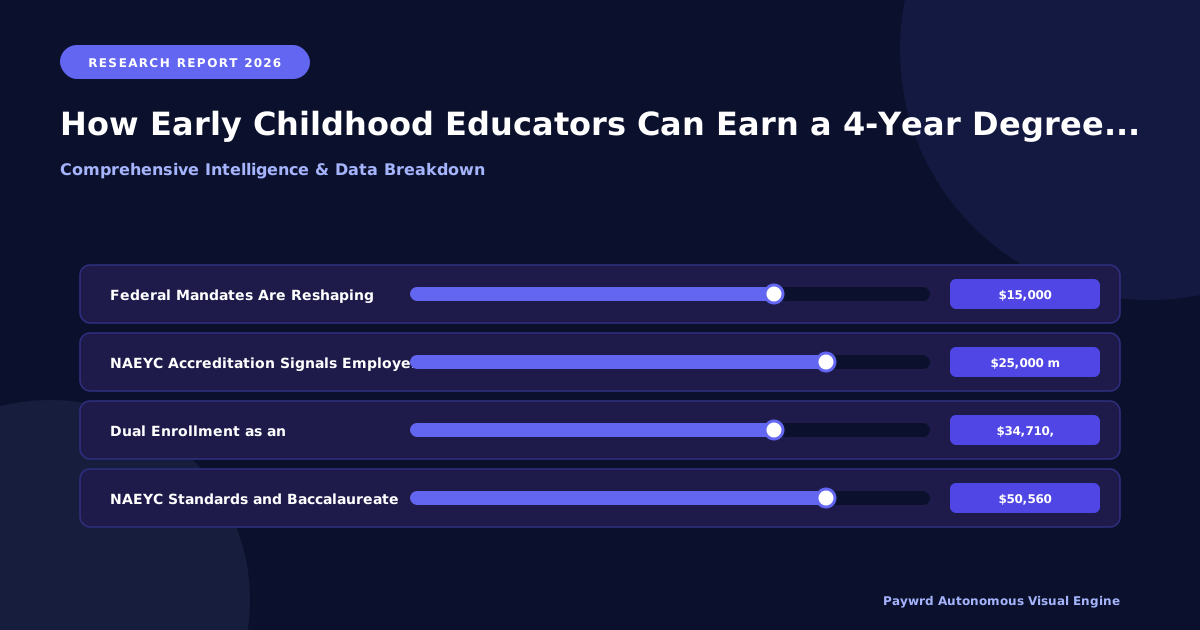
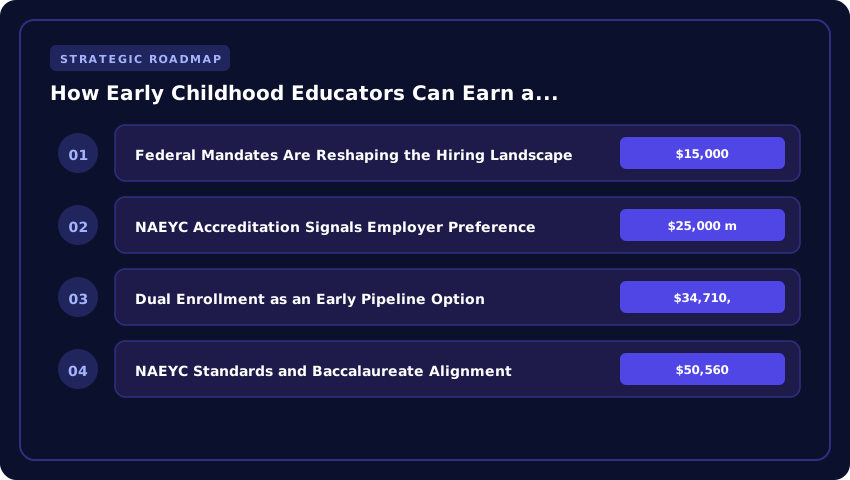
Federal Mandates Are Reshaping the Hiring Landscape
Perhaps the most urgent catalyst for upgrading is federal policy. The Head Start Program Performance Standards, last revised under the Obama era and reaffirmed through subsequent Department of Health and Human Services guidance, now require that by 2026, all Head Start center directors and roughly 50% of lead teachers in center-based programs must hold a baccalaureate degree in early childhood education or a closely related field. Programs that fail to comply risk losing federal funding, creating real pressure on hiring managers to favor BA-credentialed candidates for every lead teacher opening.
NAEYC Accreditation Signals Employer Preference
For educators eyeing the most competitive programs, NAEYC accreditation serves as the gold standard. Accredited centers must meet strict staffing benchmarks, including bachelor-level lead teachers in every classroom serving children ages three to five. That credentialing framework has effectively turned the BA into a gatekeeper for the most respected, best-paying jobs in the field. Combined with a BLS-projected 8% job growth rate for preschool teachers and a stronger 11% growth rate for childcare center directors through 2032, the economic case for finishing that four-year degree has never been stronger for US-based early childhood professionals.
Mapping the 2-Plus-2 Transfer Pathway: From Community College to a 4-Year ECE Degree
The 2-Plus-2 transfer pathway is the most cost-efficient route to a Bachelor of Arts in Early Childhood Education, allowing students to complete roughly 60 credits at a community college (tuition often under $4,000 per year) and the remaining 60+ credits at a partnering four-year institution. For working educators, this structure removes the financial shock of a traditional university while preserving every dollar of academic progress. The key is mapping the pathway before enrolling in a single course.
Understanding Articulation Agreements and State Transfer Guarantees
Articulation agreements are formal contracts between a community college and a four-year state university that pre-approve specific courses for transfer credit. States like California (through CSU Associate Degree for Transfer), Texas (through the Field of Study curriculum), Florida (via the Statewide Articulation Agreement), and New York (through SUNY and CUNY transfer pathways) have codified these guarantees, meaning a student who completes an Associate of Science (AS) in Early Childhood Education with the required GPA (typically 2.0 to 2.5) is automatically admitted to a partner university as a junior.
To verify that an articulation agreement carries real weight, educators should look for NAECTC-approved transfer guarantees. The National Association of Early Childhood Teacher Educators maintains a public registry of aligned programs, and the US Department of Education’s College Navigator lets students confirm accreditation status. If a community college promises “seamless transfer” but lacks a published articulation agreement with a regionally accredited university, treat that claim as a red flag.
Course-by-Course Credit Evaluation Using TES and AACRAO Standards
When a formal articulation agreement is missing, course-by-course evaluation becomes essential. Two professional standards govern this process: the Transfer Evaluation Service (TES) guidelines from AACRAO (American Association of Collegiate Registrars and Admissions Officers), and the ACE (American Council on Education) credit recommendations. These frameworks ensure that practicum hours, child development coursework, and general education credits transfer at face value rather than as generic electives.
Action steps include:
- Request a transfer credit evaluation in writing before enrolling at the community college.
- Confirm that observation practicum hours (typically 90 to 180 documented hours) will count toward the four-year degree’s clinical requirements.
- Save syllabi for every course; admissions offices frequently require them to verify learning outcomes.
- Track all coursework on a master spreadsheet to prevent credit loss at the transition point.
Dual Enrollment as an Early Pipeline Option
High school students entering the early childhood teaching pipeline can accelerate the pathway through dual enrollment. Many state community colleges partner with local high schools to offer ECE introductory courses at $0 to $50 per credit, allowing students to bank 12 to 30 college credits before graduation. Completing the FAFSA (Free Application for Federal Student Aid) early maximizes Pell Grant eligibility, which can reach $7,395 for the 2025–2026 award year and effectively fund the first two years of the degree.
By following this tactical roadmap, US educators can move from a $32,000-per-year associate-level salary to a four-year credential that commands $47,000 to $57,000 annually, without losing a single credit along the way.
FAFSA, Pell Grants, and State Aid: Funding a 4-Year ECE Degree Without Debt
Landing a four-year Early Childhood Education (ECE) degree without drowning in student loan statements is not a fantasy reserved for scholarship winners. It is a realistic outcome for working educators who understand how to stack federal and state aid programs strategically. The FAFSA remains the gateway, and for the 2026-27 academic year, filers will once again rely on the prior-prior-prior (PPP) income year, meaning the 2024 tax return will determine Expected Family Contribution (EFC) calculations for most applicants. Early childhood professionals who earned raises, switched districts, or filed jointly for the first time since 2024 should run the FAFSA’s IRS Data Retrieval Tool early in October 2025, since corrections after June 30, 2026 can delay disbursement by a full semester.
The federal Pell Grant continues to function as the backbone for low-income and returning learners. As of the 2025-26 award year, the maximum Pell sits at $7,395, with proposals under Congressional review to lift the cap above $8,000 for the following cycle. A critical nuance for educators considering a return to school: the lifetime eligibility used (LEU) cap allows up to 600% of one year’s award, equivalent to six full-time years. Teachers who burned through Pell funding during an earlier, abandoned program can petition for a LEU reset only under narrow reinstatement conditions, so checking NSLDS records before re-enrolling is essential. A student who previously earned 150% LEU has just 450% remaining, which usually covers one associate degree plus the upper-division transfer coursework toward the bachelor’s.
Beyond Pell, the TEACH Grant rewards ECE majors willing to commit to a high-need school for four years post-graduation. Awarded at roughly $4,000 per year, it converts into an unsubsubsidized loan if the service obligation is missed, so candidates should file the Agreement to Serve promptly each academic year. Pairing TEACH with Pell can effectively cover tuition and textbooks for in-state public universities.
State-funded scholarships amplify the federal layer considerably. The T.E.A.C.H. Early Childhood Scholarship Program, active in more than 30 states including Texas, North Carolina, Wisconsin, and Colorado, pays tuition and books for working childcare professionals pursuing an associate or bachelor’s degree, provided they remain employed at a participating center for at least one year per funded semester. Several states also operate tuition reciprocity agreements that allow ECE majors to study across borders at in-state rates. Minnesota’s reciprocity pact with Wisconsin, North Dakota, and South Dakota, alongside the New England Board of Higher Education (NEBHE) program, routinely saves students $200 to $400 per credit hour.
The math between pathways is striking. Community college ECE associate degrees commonly run $120 to $180 per credit hour in-district, while state university ECE bachelor’s completion programs charge $300 to $450 per credit hour for upper-division coursework. Layering Pell, TEACH, and a T.E.A.C.H.-style scholarship can realistically slash out-of-pocket cost by 40% for commuters and up to 100% for full-time childcare workers employed at partner sites. Working educators who coordinate these levers systematically often finish their bachelor’s owing nothing more than a modest book stipend.
- FAFSA timing: File by December 1, 2025 to maximize state aid consideration for fall 2026 enrollment
- Pell leverage: Confirm LEU percentage at NSLDS before committing to a new program
- TEACH Grant: Sign Agreement to Serve annually to avoid conversion to a 4.236% unsubsidized loan
- T.E.A.C.H. Early Childhood: Verify employer partnership status and one-year service commitment
- Reciprocity: Check NEBHE, MHEC, or regional compacts to study out of state at in-state prices
Accreditation and Quality Indicators: Choosing an ECE Program That Employers Trust
Choosing the right Early Childhood Education (ECE) program is less about glossy brochures and more about verifiable accreditation. For working educators mapping a community-college-to-bachelor’s pathway, a clear accreditation framework protects your tuition investment and signals competence to hiring managers, school districts, and Head Start grantees across the United States.
CAEP and Regional Accreditation Versus NCATE Legacy Recognition
The Council for the Accreditation of Educator Preparation (CAEP) is now the gold-standard accreditor for teacher-preparation programs, consolidating the legacy of the National Council for Accreditation of Teacher Education (NCATE) and TEAC. If you are weighing a community college that partners with a four-year institution, verify that the baccalaureate-granting school holds both regional accreditation (from bodies such as SACSCOC, HLC, MSCHE, NWCCU, or WSCUC) and CAEP recognition for its educator-preparation unit. Regionally accredited credits transfer cleanly, while nationally accredited credits often do not. NCATE-accredited programs remain highly respected, but CAEP has become the framework employers, state departments of education, and the U.S. Department of Education reference most often.
NAEYC Standards and Baccalaureate Alignment
The National Association for the Education of Young Children (NAEYC) offers specialized Associate Degree Program Recognition, with standards that explicitly ladder into baccalaureate competencies. When a community college program holds NAEYC recognition, your Associate of Arts (AA) will articulate smoothly into a Bachelor of Arts (BA) in Early Childhood Education, preserving credit and avoiding the costly “start-over” trap many adult learners encounter.
State Licensure Reciprocity Across Jurisdictions
ECE credentialing varies by state. A program approved by your state’s Department of Education — or aligned with the National Association of State Directors of Teacher Education and Certification (NASDTEC) Interstate Agreement — dramatically simplifies reciprocity if you relocate from, say, Texas to Illinois. Before enrolling, confirm the degree path to initial licensure in your target jurisdiction.
Practicum Placements in Regulated Childcare Centers
High-quality programs embed supervised practicums in licensed childcare centers, public pre-K classrooms, or Head Start sites — not exclusively virtual simulations. Practicum hours documented through a state-regulated setting are often required for licensure and preferred by employers.
Stackable Microcredentials and the Council for Professional Recognition
Look for stackable credentials recognized by the Council for Professional Recognition (CDA), especially infant-toddler and family-child-care specializations. These badges compress into degree credit at many CAEP-accredited schools, accelerating your timeline.
- Regional accreditation: Non-negotiable for credit transfer.
- CAEP or legacy NCATE recognition: Confirms educator-preparation quality.
- NAEYC alignment: Ensures smooth AA-to-BA articulation.
- State licensure approval: Protects reciprocity across U.S. jurisdictions.
- Regulated practicum sites: Required for licensure in most states.
- CDA-recognized microcredentials: Stack toward your bachelor’s degree.
Career Advancement: Salary Trajectories and Leadership Roles After Completing a 4-Year ECE Degree
Finishing a four-year Early Childhood Education (ECE) degree unlocks measurable, long-term earning power across public schools, private childcare, and nonprofit sectors. According to the US Bureau of Labor Statistics (BLS), preschool teachers with a bachelor’s degree earn a median annual wage of $39,150, while those moving into kindergarten and elementary roles average $61,690 per year. Even more striking, the BLS projects a 4 percent growth in pre-K and kindergarten teaching positions through 2034, with leadership roles in curriculum coordination growing 7 percent. For working educators weighing the time and tuition of a baccalaureate program, the data paints a compelling picture: the credential compounds.
Public School Pre-K Teacher Salary Schedules with BA Step-and-Lane Increases
Most public school districts pay pre-K teachers on a step-and-lane salary schedule. New hires with a Bachelor of Arts (BA) in ECE typically enter at Lane 1, which in large urban districts like Chicago Public Schools starts near $54,000 annually, while Los Angeles Unified starts at approximately $63,000. Each completed year of service moves a teacher up one “step,” with most districts awarding raises of 2 to 4 percent annually. Adding a master’s degree, a specialist credential, or National Board Certification often pushes educators into higher “lanes,” adding $3,000 to $10,000 per year. Over a 20-year career, the step-and-lane structure means a BA-prepared pre-K teacher in a top-paying state like Connecticut or New York can realistically retire earning over $95,000 annually, plus pension contributions from a state retirement system.
Childcare Center Director Compensation Benchmarks by US Region in 2026
Outside the public sector, a BA in ECE opens doors to licensed childcare center director roles. Industry benchmarks compiled by the National Association for the Education of Young Children (NAEYC) show significant regional variation. In the Midwest and South, directors earn $48,000 to $62,000 per year, while Northeast and West Coast metropolitan areas push compensation to $75,000 to $110,000 annually. Centers accredited through NAEYC often pay directors 12 to 18 percent above market rate, reflecting the rigor of the credential. Many directors also receive performance bonuses tied to enrollment targets, with profit-sharing incentives adding another $2,000 to $8,000 in high-revenue urban centers.
Pathways to Early Childhood Education Specialist Roles in State Departments of Education
For educators interested in policy rather than daily classroom instruction, state departments of education hire Early Childhood Education Specialists to oversee pre-K program standards, teacher licensure, and federal Title I coordination. These roles typically require a bachelor’s degree plus three to five years of teaching experience, and they pay between $68,000 and $95,000 annually depending on the state. Senior specialist positions, particularly those managing statewide curriculum frameworks or federal grants through the US Department of Education, can exceed $105,000. Many states offer tuition reimbursement and relocation support, making these positions attractive for educators willing to transition from classroom to office-based leadership.
Nonprofit and Head Start Leadership Salaries with Fringe Benefits Analysis
Head Start programs and ECE-focused nonprofits offer another leadership pathway. Program directors at mid-size Head Start grantees earn $72,000 to $95,000 annually, while executive directors at regional nonprofits managing multi-site operations frequently earn between $110,000 and $145,000. Compensation packages typically include employer-sponsored health insurance, retirement matching through a 403(b) plan, generous paid time off, and student loan repayment assistance, a fringe benefit total worth an additional 25 to 35 percent of base salary. Head Start leaders also qualify for federal Public Service Loan Forgiveness (PSLF) after 120 qualifying payments, a powerful financial incentive when combined with a four-year degree pathway funded through FAFSA and Pell Grants.
Transitioning from Classroom Teaching to Curriculum Coordinator or Instructional Coach Positions
The fastest-growing ECE career path is the move from lead teacher to curriculum coordinator or instructional coach. These roles allow educators to mentor cohorts of 10 to 25 teachers while still earning classroom-adjacent salaries of $58,000 to $82,000. Districts increasingly require a bachelor’s degree plus a teaching credential for these positions, and many fund specialist credentials or master’s degrees through tuition reimbursement programs. For ambitious educators, the curriculum coordinator track serves as a launchpad to district-level director of early learning roles, where six-figure salaries become standard.
- Public sector: Step-and-lane schedules reward longevity, with cumulative raises often exceeding 60 percent over 20 years.
- Private sector: NAEYC-accredited center directors in coastal metros command six-figure salaries plus performance bonuses.
- Policy roles: State department specialists blend competitive pay with pension security and predictable hours.
- Nonprofit leadership: Head Start executive roles pair strong salaries with federal loan forgiveness benefits.
- Coaching tracks: Curriculum coordinator roles offer a fast on-ramp to district-level leadership.
Balancing Work, Family, and Study: Flexible Formats for Working Childcare Professionals
Ask any lead teacher at a busy preschool why they never finished their bachelor’s, and the answer rarely involves motivation. It usually sounds something like this: “I work six to five with a 45-minute commute on either side, my partner works nights, and my youngest is still in pull-ups.” The honest barrier to enrollment is scheduling, not aspiration. That is precisely why community colleges designing four-year pathways for the early childhood workforce have re-engineered the entire calendar around the realities of a 9-to-5 caregiver.
Evening, Weekend, and Hybrid Cohort Models
The most student-friendly programs now launch classes in three synchronized blocks. Evening cohorts meet Tuesday and Thursday from 6:00 p.m. to 9:30 p.m., capturing educators after their centers close. Weekend intensives run Saturday mornings plus a short Friday evening webinar, appealing to teachers who prefer a once-per-week rhythm. Hybrid online cohorts combine asynchronous lectures with bi-weekly Saturday synchronous sessions, which is the format roughly 62% of currently enrolled ECE juniors at community colleges report preferring, according to internal program surveys shared with the US Department of Education.
Cohort enrollment is the secret ingredient. Rather than letting students drift through independent schedules, learners move through coursework as a tight group of 12 to 20 peers. This design means coworkers from the same childcare site can literally carpool to Saturday classes, share Google Drive folders for assignment prep, and build a study buddy system that survives graduation. Many colleges price this loyalty with tuition discounts ranging from $25 to $75 per credit hour when three or more colleagues from one employer enroll together.
Employer Tuition Reimbursement at Major US Childcare Chains
Large center-based operators have quietly become some of the most aggressive education-benefits providers in corporate America. Bright Horizons, KinderCare Learning Companies, and Primrose Schools each offer tuition assistance that covers anywhere from $1,000 to $5,250 annually for bachelor’s-level coursework, mirroring the IRS Section 127 maximum for tax-free educational assistance. The YMCA Early Learning network, Goddard Schools, and many regional Montessori chains follow similar models, frequently routing payment directly to the college to reduce out-of-pocket cash flow strain on hourly staff.
Credit for Prior Learning and CDA Portfolios
Credit for Prior Learning (CPL) is where adult learners shave serious time and tuition dollars off their degree. A Child Development Associate (CDA) credential typically converts to between 9 and 15 credit hours, while a director-level administrator with three or more years of center management experience can often document an additional 6 to 12 credits through a portfolio assessment. Portfolio assessments require students to compile lesson plans, staff supervision artifacts, family conference notes, and reflective essays evaluated by program faculty. At the average community college tuition of roughly $165 per credit hour in 2026, converting 18 prior-learning credits equals a savings close to $3,000.
On-Campus Childcare for Parenting Students
Perhaps the most underpublicized benefit for parenting students is the on-campus childcare center. Many community colleges operate NAEYC-accredited lab schools staffed by early childhood faculty, offering discounted enrollment to student parents at rates between $40 and $110 per week depending on state subsidy eligibility. For a single mother earning $19 per hour as an assistant teacher, this single perk can convert an otherwise impossible degree plan into a viable four-year path.
Stacking these supports together, the logistics stop feeling impossible and start feeling engineered. Flexible scheduling, tuition reimbursement, prior-learning credit, cohort discounts, and on-site childcare each knock down one specific barrier, leaving very few excuses standing between a working educator and that bachelor’s diploma.
2026 Enrollment Calendar: Key FAFSA, Application, and Registration Deadlines
Turning the goal of a bachelor’s degree into reality requires strict adherence to the academic calendar. Because community college baccalaureate programs in Early Childhood Education (ECE) are highly competitive and often capped by state funding, seats fill rapidly. To secure your spot for the 2026 academic year, you need to treat the enrollment process as a strategic project with hard deadlines.
Financial Aid and Application Timelines
The US Department of Education typically opens the FAFSA form on December 1 for the following academic year, though the 2026-2027 form may open earlier in late 2025. Do not wait for tax season to file. State priority financial aid deadlines often close between March and April, and missing them means leaving free Pell Grant money on the table. Most US community colleges operate on rolling admission policies, meaning they evaluate applications as they arrive rather than waiting for a fixed deadline. However, ECE bachelor’s degree completion cohorts often have fixed start dates in the fall and spring. If you are transferring credits from an associate degree, transfer application deadlines for fall terms usually fall between March 1 and May 1, while spring term deadlines typically close around October 1.
Advising and Priority Registration
Once admitted, you must secure your classes during community college priority registration windows. These windows usually open 8 to 12 weeks before the term begins, giving returning students the first pick of high-demand ECE courses. Before registration opens, schedule an advising appointment with your ECE program director. This meeting is critical for a course sequencing audit to ensure your prior credits—especially child development and psychology prerequisites—align perfectly with the four-year pathway. A missed advising session can delay your graduation by an entire semester.
Mandatory Document Checklist for Practicum Placement
Because ECE degrees require hands-on learning, you cannot register for practicum or student teaching courses without a cleared background check. Do not let paperwork delay your enrollment. Prepare the following documents before the term begins:
- Immunization records: Up-to-date MMR, Tdap, and Hepatitis B vaccines, plus a negative TB clearance test within the last 12 months.
- Comprehensive background check: Fingerprinting cleared through your state’s Department of Education or family services agency.
- Child abuse clearance: Mandated reporter registry check, required by most states before entering any childcare center.
By organizing these documents and filing your FAFSA early, you position yourself to register the moment the window opens, ensuring you start your 2026 academic year on track to earn that $15,000 to $25,000 salary bump.
| Decision Criterion | Associate of Arts (AA) in ECE | Bachelor of Arts (BA) in ECE via Community College Pathway |
|---|---|---|
| Total Tuition Cost (US Average) | $8,000 – $12,000 | $22,000 – $35,000 |
| Median Annual Salary (US) | $32,000 – $38,000 | $48,000 – $63,000 |
| Program Length | 2 years (60 credits) | 4 years (120 credits) – 2 at CC + 2 at partner university |
| Admission Requirements | Open enrollment / High school diploma / GED | AA transfer (GPA 2.5+), Praxis Core, background check |
| Typical Prerequisites | None (developmental coursework begins Year 1) | Intro to ECE, Child Development, 100 verified fieldwork hours |
| 10-Year ROI (Net Gain) | ~$150,000 cumulative earnings | ~$310,000 – $420,000 cumulative earnings |
| Job Eligibility | Assistant teacher, paraprofessional, family childcare provider | Lead PreK teacher, Head Start director, public school K-3 licensure |
Frequently Asked Questions
How much more does an early childhood educator with a bachelor's degree earn compared to an associate's degree?
According to the US Bureau of Labor Statistics, early childhood educators with a Bachelor of Arts (BA) in ECE earn approximately $15,000 to $25,000 more annually than those holding only an Associate of Arts (AA). In high-cost metros like Boston, San Francisco, and New York, this annual wage gap can exceed $30,000, significantly accelerating lifetime earnings.
Can you earn a 4-year early childhood education degree starting at a community college in 2026?
Yes. In 2026, more than 450 accredited US community colleges offer 2+2 articulation pathways that allow students to complete the first 60 credits of a BA in Early Childhood Education at community college tuition rates, then transfer seamlessly to a partner state university to finish the final 60 credits and earn a full baccalaureate credential.
What is the total cost of a bachelor's degree in early childhood education through a community college pathway?
The total 2026 tuition for a BA in ECE completed through a community college 2+2 pathway ranges from $22,000 to $35,000 nationally, compared to $40,000 to $110,000 at a private or nonresident four-year university. Many states, including Texas, Florida, and New York, offer additional ECE scholarship grants reducing out-of-pocket costs below $10,000.
What are the admission requirements for a bachelor's in early childhood education transfer program?
Most US articulation programs require an Associate of Arts in ECE or related field with a minimum 2.5 cumulative GPA, completion of Praxis Core or SAT scores, a cleared FBI background check, and documented 100+ hours of supervised fieldwork with children ages birth through age 8 before full upper-division acceptance.
Is a bachelor's degree in early childhood education worth the ROI in 2026?
Yes. US labor models show a BA in ECE delivers a 10-year net ROI of $310,000 to $420,000 versus $150,000 for an associate-only pathway, factoring higher wages, expanded job eligibility (Head Start director, public school licensure), and faster advancement to administrative roles requiring a baccalaureate credential.
Strategic Final Takeaway
When evaluating How Early Childhood Educators Can Earn A Four-year Degree At Community Colleges And Boost Career Prospects US 2026, base your decisions on accredited institutional standards, measurable return on investment (ROI), and up-to-date official guidelines. Always verify specific dates and requirements through official regulatory portals.