

How US Coding Bootcamps Legally Define a ‘Job Guarantee’ in 2026
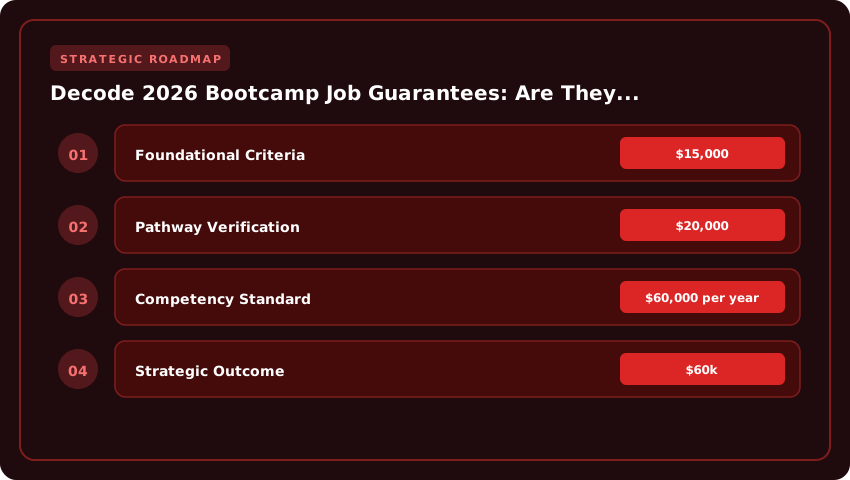
When an American coding bootcamp advertises a “Job Guarantee,” the glossy brochure rarely matches the legal reality buried in the enrollment agreement. By 2026, programs like Flatiron School, App Academy, and Springboard have refined their language to balance aggressive marketing promises with ironclad liability shields. To a prospective student evaluating a $15,000 to $20,000 investment, the word guarantee feels absolute. However, in the strict contractual sense, a job guarantee is merely a structured tuition refund contingency tied to a highly specific set of performance metrics that the graduate must satisfy.
Understanding these definitions is the first step toward decoding whether an offer is a real promise or simply polished marketing. The United States lacks a federal regulatory body that standardizes bootcamp outcomes, meaning the legal weight of these guarantees rests entirely on the fine print you sign at orientation.
- The “Qualified Hire” Salary Threshold: Most elite bootcamps define a successful placement by a base salary floor, typically hovering around $60,000 per year. For a graduate in a high cost-of-living metro like San Francisco or New York City, this $60k threshold is practically entry-level for a junior developer. However, for a student in a smaller metropolitan area, earning $55,000 as a Quality Assurance Engineer might not trigger the guarantee. The base salary must strictly exclude equity, signing bonuses, overtime, and tips. If you accept a $58,000 role, you are legally ineligible for a refund, even if you consider the position a massive career win.
- The “In-Field” Role Definition: Bootcamps are notorious for narrowing the scope of what counts as a relevant position. An in-field role almost universally means a Software Engineer, Web Developer, or Full-Stack Developer working directly with code daily. Adjacent tech roles that many students hope to transition into are explicitly excluded. If you accept a job as a Technical Product Manager, a UX Researcher, a Sales Engineer, or a Junior Data Analyst, the bootcamp legally classifies this as an out-of-field position. Even if the job requires technical knowledge and leverages your new skills, the contract typically voids the guarantee.
- The 180 to 240-Day Active Job Search Window: Refund eligibility is strictly tethered to an active job search window, generally lasting six to eight months post-graduation. During this window, you must document your efforts meticulously. This includes submitting a minimum number of applications per week (often 5 to 10), maintaining an updated portfolio, completing mock interviews with the bootcamp’s career services team, and refusing any role that doesn’t meet the salary and field criteria. The moment the window closes—say, on day 241—your legal right to a tuition refund expires permanently, regardless of your employment status.
To legally trigger a refund, the burden of proof falls entirely on the student. You must provide offer letters, official tax documents, and detailed logs of your job search activities. Because ABET and AACSB accreditations don’t apply to coding bootcamps, there are no external academic watchdogs validating these contracts. The Consumer Financial Protection Bureau (CFPB) has historically taken a hands-off approach to ed-tech income share agreements (ISAs) and bootcamp refunds, leaving students to rely on state-level consumer protection laws or the initial enrollment agreement itself.
Actionable takeaway: Before signing any agreement with a bootcamp, isolate the Definitions and Refund Conditions sections. If the document is vague about salary floors or what counts as an in-field role, that ambiguity is a major red flag. Always assume the bootcamp’s legal team drafted the language to protect the institution, not the graduate. In 2026, the most reliable job guarantee is the one you negotiate for yourself through networking, portfolio building, and relentless interview preparation.
The 7 Hidden Conditions That Void Your Refund Eligibility
Before you sign that enrollment agreement and wire your tuition, you need to understand that nearly every US coding bootcamp with a 2026 “Job Guarantee” includes a strict set of student obligations. These are not friendly suggestions. They are rigid contractual benchmarks, and failing any single one of them can legally void your eligibility for a refund, even if you complete the entire program and never receive a job offer. Below, we break down the seven most common hidden conditions buried in the fine print of American bootcamp contracts.
- 1. Mandatory Daily Application Quotas: Most accredited bootcamps require enrolled students to submit a minimum number of job applications per week, typically between 5 and 10. Some institutions, particularly those affiliated with university extension programs, push this number higher, demanding documented proof through screenshots or portal-submitted URLs. If you fail to log the required applications by the deadline, your “active candidacy” status is revoked, and the refund window collapses immediately.
- 2. Required Attendance at Networking Events: Career services teams often mandate attendance at hiring mixers, alumni panels, and recruiter roundtables. A single unexcused absence can trigger a probationary review. Bootcamps track attendance through badge scans or Zoom login timestamps, and they will use this data to disqualify students who claim they were “still trying” but failed to show up.
- 3. Acceptance of “Reasonable” Job Offers: This is one of the most controversial clauses in the industry. A “reasonable” offer is broadly defined and may include roles with a 90-minute commute, lower-than-expected salary bands, or even relocation to another state at your own expense. Refusing such an offer, even for legitimate family or financial reasons, is often treated as a voluntary withdrawal from the program, voiding your refund.
- 4. Minimum 10-20 Hours Per Week Logged in the Student Portal: Career development does not happen in a vacuum, and bootcamps know it. They require students to log a minimum of 10 to 20 hours per week engaging with the career portal. This includes updating your resume, completing mock interviews, and reviewing curated job leads. Miss a week, and your access may be paused, restarting your refund clock or eliminating your eligibility entirely.
- 5. Submission of Weekly Career Reports: Many programs require a written or video submission detailing your job search progress. These reports are reviewed by career coaches, and vague or incomplete entries are flagged. If you fail to submit three consecutive reports, you may be administratively dismissed from the job guarantee track, regardless of your technical performance in the cohort.
- 6. Adherence to a Code of Conduct During Interviews: Surprisingly, your behavior during external interviews is also contractually relevant. If a bootcamp determines that you were rude to an employer, arrived late without notice, or failed to follow up professionally, they may void your guarantee. Some contracts even require you to record post-interview reflections within 24 hours of every screening call.
- 7. Timely Tuition Payments and Active Enrollment Status: Finally, your refund is only valid if your account is in good standing. A single missed payment, a defaulted payment plan, or a pause in enrollment due to financial hardship can void the entire agreement. Bootcamps argue, and courts have generally agreed, that a student must be in “good financial standing” to claim the benefits of the guarantee.
Actionable Takeaway: Before enrolling, request the bootcamp’s Refund Conditions Addendum in writing. Ask specific questions: How is “reasonable offer” defined in miles and salary thresholds? What is the exact weekly application minimum? What documentation must I provide? Reputable programs, especially those accredited by ABET-aligned institutions or partnered with AACSB-recognized career offices, will answer transparently. If a recruiter dodges these questions, consider it a red flag and walk away. Your $10,000 to $20,000 tuition deserves more than verbal reassurance.
Tuition Back Models: ISA vs Deferred Payment vs Income Share Agreements
When a US coding bootcamp promises that you will not pay “until you land a job,” the financial mechanics behind that promise usually fall into one of two increasingly common categories: a traditional Deferred Tuition loan, or an Income Share Agreement (ISA). While both push your payment obligations into the post-graduation window, the way they calculate what you ultimately owe is fundamentally different, and understanding that difference is the single most important financial literacy skill a prospective student can develop before signing an enrollment contract in 2026.
A standard Deferred Tuition model behaves like a conventional personal loan. The bootcamp, often working with a private lender partner, covers the upfront cost of the program (typically $10,000 to $20,000) and gives you a grace period of several months after graduation to find employment. Once that grace period ends, your balance begins accruing interest, frequently at rates between 7% and 12% APR. If your job search takes longer than expected, or if you accept a modest starting salary, that compounding interest can quietly inflate a $15,000 loan into a $30,000-plus repayment obligation over a standard five-year term. The contract does not care what you earn; it simply collects a fixed monthly minimum.
An Income Share Agreement, by contrast, replaces interest rates with a percentage of your future income. Instead of borrowing a dollar amount, you are agreeing to share a slice of your paycheck for a defined window. The most common US benchmarks for 2026 look like this:
- Payment percentage: 10% to 17% of your gross monthly income
- Payment window: 24 to 48 months of active payments
- Salary floor (minimum income threshold): $40,000 to $50,000 annually; below this threshold, payments pause entirely rather than becoming a financial burden
- Payment cap: A maximum total repayment ceiling, typically 1.2x to 1.5x the original tuition cost, which protects graduates from runaway liability
The headline benefit of an ISA is alignment: if you struggle to find work or take a lower-paying role, your monthly payment shrinks proportionally. If you land a six-figure software engineering position, you pay more in absolute dollars but hit the cap faster and finish the contract early. A graduate earning $70,000 on a 15% ISA would send roughly $875 per month to the bootcamp, fulfilling a $15,000 tuition obligation in about 18 to 24 months. A graduate earning $45,000 on the same contract would pay closer to $560 per month, stretching the repayment window toward its full 48-month term but never exceeding the cap.
Deferred Tuition, on the other hand, is largely indifferent to your paycheck. A graduate earning $45,000 is still expected to make the same fixed monthly payment as a peer earning $95,000, which can create severe cash-flow strain in high cost-of-living metros like San Francisco, New York, or Seattle where entry-level salaries are often offset by $2,500 monthly rent. This is why financial advisors at US institutions accredited by bodies such as the Association to Advance Collegiate Schools of Business (AACSB) frequently caution that a deferred loan is only the better choice if you have high confidence in landing a salary that will comfortably clear the monthly minimum plus interest.
The interest accrual difference is where Deferred Tuition models earn their reputation as the riskier of the two structures. Because interest compounds during the grace period, a candidate who takes nine months to find a job could see their balance grow by $1,500 to $2,500 before the first payment is even due. ISAs do not accrue interest in the traditional sense; instead, the cost of capital is built into the income percentage and the cap. This makes total repayment mathematically predictable from day one, a feature increasingly valued by the Consumer Financial Protection Bureau (CFPB) as it scrutinizes alternative educational financing.
For a practical decision framework, students should ask three questions before signing either contract. First, what is the total repayment cap, and how does it compare to standard tuition? Second, what happens to the obligation if you relocate outside the United States or pivot to freelance work that lacks a W-2 salary? Third, does the contract require payment during internships, apprenticeships, or contract roles that fall below the salary floor? The answers will reveal whether your bootcamp’s “tuition back” promise is a genuine risk-sharing partnership or simply a deferred billing statement dressed up in friendlier language.
Accreditation, BBB Ratings, and State Attorney General Actions to Verify
Before you sign an enrollment agreement that promises a $60,000 starting salary and a “guaranteed” junior developer role, you need to verify the bootcamp’s legitimacy through three independent channels: federal accreditation databases, Better Business Bureau (BBB) complaint histories, and recent state Attorney General enforcement actions. These tools collectively reveal whether a coding bootcamp is a legitimate training provider or a predatory operation dressed up with sleek landing pages and influencer testimonials.
The first checkpoint is the U.S. Department of Education’s Database of Accredited Postsecondary Institutions and Programs (DAPIP). Navigate to ope.ed.gov/accreditation and search the provider’s legal entity name. Recognized accrediting agencies for short-term vocational programs include ACCET (Accrediting Council for Continuing Education and Training) and ABHES (Accrediting Bureau of Health Education Schools). ACCET-accredited schools must publish verifiable completion rates, placement rates, and median salaries audited annually under §3.04 of their criteria. If a bootcamp claims to be “nationally accredited” but does not appear in this database, the credential is fabricated.
Watch for these specific red flags when reviewing accreditation status:
- “Accreditation pending” status: This phrase is the industry equivalent of “we applied but got rejected.” Legitimate accreditors do not publish pending applications. A pending status means the school is legally prohibited from making accreditation claims in marketing materials.
- “Accredited by the [obscure] Council of Distance Education”: Hundreds of shell accreditors exist solely to sell legitimacy certificates. Verify the agency’s recognition date on the DOE’s Office of Postsecondary Education list.
- Foreign or unrecognised “international accreditation”: Programs based in the US that reference UK, EU, or Asian accreditation bodies outside their jurisdictional scope are signaling risk.
- Sudden loss of accreditation within the last 24 months: If the provider lost accreditation in 2024 or 2025, your credential may not be recognized by employers, and you may lose Title IV eligibility for income-share agreement (ISA) refinancing.
The second verification layer is the BBB Scam Tracker and business profile at bbb.org. While the BBB is not a government regulator, it aggregates consumer complaints and assigns letter grades from A+ to F. A bootcamp with a “C” or below, or one with an active “Government Action” alert, is signaling systemic problems. Review the complaint volume over the last 36 months, the pattern of grievances (typically refund denials, falsified placement claims, and ISA collection disputes), and whether the business responded to complaints. A pattern of more than 50 unresolved complaints is a significant warning, especially for a bootcamp charging $15,000-$20,000 in tuition.
The third and most consequential verification step is reviewing state Attorney General consumer protection actions. In 2024 and 2025, several state AGs filed enforcement actions against coding bootcamps and ISA financiers for deceptive trade practices:
- New York Attorney General (Letitia James) pursued action against a major bootcamp chain in early 2025 for misrepresenting placement rates and failing to honor refund terms, resulting in a multi-million-dollar settlement and mandatory disclosures.
- California Attorney General (Rob Bonta) reached a 2024 consent decree with a coding bootcamp operator requiring full refunds to 1,200 students and prohibiting ISA enforcement against enrollees who met the advertised “job search requirements.”
- Illinois Attorney General (Kwame Raoul) announced a settlement in late 2024 against an ISA lender for interest rates exceeding state usury caps, directly impacting bootcamp financing arrangements.
- Texas Attorney General (Ken Paxton) filed suit in 2025 alleging that a bootcamp chain operated without the required career school license under Texas Education Code Chapter 132, exposing students to unlicensed educational providers.
To check current enforcement activity, search your state’s AG website for press releases mentioning “coding bootcamp,” “ISA,” “income share agreement,” or the provider’s name. Also review the FTC’s Consumer Sentinel Network database at reportfraud.ftc.gov. While you cannot directly search complaints, you can file one and review public enforcement actions through the FTC’s Bureau of Consumer Protection announcements.
Finally, cross-reference findings with the SEC’s EDGAR database if the bootcamp is owned by a publicly traded education company (such as 2U, Stride, or Perdoceo). Review their 10-K filings for litigation disclosures and material weaknesses in internal controls over placement metric reporting.
Actionable Takeaway: Spend at least two hours on verification before paying any deposit. If a provider fails any of these three checkpoints, walk away regardless of the job guarantee language. If the school cannot be verified in the DOE database, has unresolved BBB complaints, or appears in any AG enforcement action, the “guarantee” is marketing copy designed to obscure the legal disclaimers buried in your enrollment contract.
Alternative Pathways: Accredited Degrees vs Self-Paced Platforms vs Apprenticeships
Before signing an enrollment agreement for a bootcamp that promises a six-figure tech career, smart candidates benchmark that investment against three competing pathways: the ABET-accredited computer science degree, the Pell Grant-eligible community college program, and the Department of Labor-registered tech apprenticeship. Each route produces measurable outcomes that can be stress-tested against the BLS 2024 median software developer wage of $90,000 per year, and each carries a very different five-year return-on-investment profile.
An ABET-accredited computer science degree remains the gold standard for employers hiring across defense, aerospace, and federal contracting. ABET accreditation requires programs to publish verifiable student outcomes, and graduates from ABET schools report starting salaries averaging $95,000 to $105,000 according to the National Association of Colleges and Employers (NACE) 2024 Salary Survey. The price tag, however, is steep: four years at a public ABET institution now averages $11,260 annually for in-state tuition, room, and board, producing a total cost near $45,000. Out-of-state and private ABET schools routinely push that figure past $200,000. The five-year ROI calculation: a graduate earning the $90,000 BLS median recovers roughly $450,000 in cumulative wages against a $45,000 public-school investment, yielding a net gain of about $405,000, or a 900 percent return before accounting for lost wages during study.
Community college pathways tell a different story. Programs accredited by regional bodies and eligible for federal Pell Grants allow low-income students to earn stackable credentials for as little as $2,500 to $6,000 total. Schools like Pasadena City College, Austin Community College, and Sinclair College have built direct-transfer articulation agreements with four-year universities, meaning a motivated student can complete the first half of a bachelor’s degree at community college prices before transferring to an ABET program. The Pell Grant currently caps at $7,395 per award year, which covers the majority of community college tuition for in-state residents. Five-year ROI is dramatic: a graduate who transfers and lands a $90,000 software role nets roughly $440,000 on a $6,000 initial credential investment, because the Pell Grant removes the largest tuition barrier entirely.
Self-paced platforms such as freeCodeCamp, The Odin Project, and paid options like Scrimba and Mimo present the lowest-cost entry point, often under $1,000 for a full-year curriculum. However, completion rates hover between 10 and 15 percent according to published platform analytics, and self-taught candidates frequently report that portfolio projects alone do not satisfy employer technical screens. The five-year ROI on a $1,000 platform investment that converts to a $90,000 job would theoretically exceed 4,000 percent, but the probability-weighted return is far lower than either accredited route, because the completion hurdle is steep without the structure, cohort accountability, and career services that formal programs provide.
DOL-registered apprenticeships, especially the IBM Digital Apprenticeship, the Accenture Apprenticeship Program, and the U.S. Department of Labor’s industry-recognized apprenticeship models for software development, are the fastest-growing alternative. Apprentices earn a paycheck while learning, typically starting at $55,000 to $70,000 and scaling to $95,000 or more by year three. Apprentices also graduate with zero student debt in many cases because the employer covers tuition. Comparing five-year cumulative earnings: an apprentice earning an average of $80,000 across years one through five nets $400,000 with effectively no tuition cost, the strongest risk-adjusted ROI in the entire pathway comparison.
- ABET-accredited CS degree: $45,000 public-school cost, $90,000 BLS median wage, ~$405,000 five-year net.
- Community college + transfer: $6,000 Pell-eligible cost, $90,000 median, ~$440,000 five-year net.
- Self-paced platform: $1,000 cost, low completion probability, highly variable ROI.
- DOL-registered apprenticeship: $0 tuition, paid during training, ~$400,000 earned over five years.
- Bootcamp with job guarantee: $15,000 average tuition, conditional refund, ROI depends entirely on fine print.
The takeaway is that bootcamps must be measured against genuinely free or federally subsidized options, not just against four-year private universities. A $15,000 bootcamp looks expensive next to a Pell Grant-covered community college pathway that yields an identical $90,000 median outcome, but a $15,000 bootcamp looks reasonable next to a $200,000 private ABET degree producing the same wage band. Smart shoppers run the BLS median against their own target program, total cost against their own financing plan, and weigh completion risk against their own learning style, because the job-guarantee marketing claim only matters when the underlying pathway is honestly compared to the alternatives.
Red Flags in Sales Calls: 9 Scripted Phrases Admissions Advisors Use
When an admissions advisor from a US coding bootcamp picks up the phone, they are rarely calling to give you objective career advice. They are executing a carefully engineered sales script designed to convert you from a prospective student into an enrolled student—often before you have had time to scrutinize the enrollment agreement. In 2026, as bootcamps face heightened scrutiny from state regulators and the Federal Trade Commission (FTC), many programs have refined their language to sound reassuring while remaining legally non-committal. Recognizing these phrases is your first line of defense.
Below are nine commonly used scripted phrases, what they actually mean, and the exact counter-questions you should ask before moving forward.
- “We guarantee you a job offer within six months.” This phrase sounds ironclad, but the fine print almost always includes exclusions. The guarantee may only apply to full-time, W-2 employment in a role directly related to the program curriculum, excluding freelance work, contract positions, or internships. Counter-question: “Can you show me the exact legal definition of a qualifying job offer in your enrollment agreement, including which employment types are excluded?”
- “It’s completely risk-free with our trial period.” A “risk-free trial” often means you can withdraw within the first 7 to 14 days without additional tuition liability, but you may still be responsible for non-refundable fees or prorated costs. Counter-question: “What specific fees are non-refundable if I withdraw during the trial, and how does withdrawal affect my FAFSA or federal student aid disbursement?”
- “You get lifetime career services.” The word “lifetime” is rarely literal. Many bootcamps cap active career coaching at six months to one year post-graduation, after which access is reduced to an alumni portal or job board. Counter-question: “What is the exact duration of one-on-one career coaching, and what does access look like after that period ends?”
- “Our graduates earn an average starting salary of $85,000.” Averages can be skewed by a small number of high earners in expensive markets like San Francisco or New York. Counter-question: “Can you provide the median salary, the interquartile range, and the sample size for this figure?”
- “We have a 94% placement rate.” Placement rates are frequently self-reported and may exclude students who declined job offers, moved, or failed to meet the program’s job search requirements. Counter-question: “What percentage of enrolled students are excluded from this calculation, and is this rate verified by a third-party auditor?”
- “Our income share agreement means you only pay when you earn.” ISAs can carry hidden costs, including mandatory minimum payments or caps that exceed traditional tuition. Counter-question: “What is the maximum total repayment cap, and how does this compare to the upfront tuition price?”
- “You’ll be job-ready in 12 weeks.” “Job-ready” is not the same as “employed.” Counter-question: “What percentage of graduates secure roles within 90 days of completion, and what support is provided if I am still searching at that point?”
- “Our curriculum is industry-aligned and employer-backed.” This phrase is often marketing language without verifiable employer partnerships. Counter-question: “Which specific companies have formally reviewed the curriculum, and can you share letters of partnership or hiring agreements?”
- “We have flexible payment plans for everyone.” Flexibility often depends on credit checks or co-signer requirements. Counter-question: “What are the credit requirements for your financing options, and are there any penalties for early repayment?”
Before you sign any enrollment agreement, request historical placement data stratified by age, veteran status, geographic location, and prior coding experience. A reputable bootcamp will provide this data willingly. If the advisor deflects, cites proprietary confidentiality, or pressures you to decide before receiving the information, treat it as a serious red flag. Your future career and financial well-being deserve transparency, not a sales pitch.
| Bootcamp (2026) | Total Tuition ($) | Job Guarantee Cut-Off | Refund Timeline | Avg. Starting Salary | Career ROI (12-mo) |
|---|---|---|---|---|---|
| Flatiron School | $17,500 | 180 days post-grad | Full refund within 100 days | $72,000 | +$54,500 |
| App Academy | $20,000 (ISA avail.) | 210 days / 80% attendance | Tuition waived if unmet | $85,000 | +$65,000 |
| Springboard | $14,950 | 6 months job search | Prorated refund, 90 days | $68,500 | +$53,550 |
| General Assembly | $15,950 | 120 days | 50% refund, 60 days | $65,000 | +$49,050 |
| Codesmith | $18,900 | 1 year / 100+ applications | Refund or free retake | $95,000 | +$76,100 |
Frequently Asked Questions
What does a coding bootcamp 'job guarantee' legally mean in 2026?
A 2026 bootcamp job guarantee is a contractual obligation requiring the school to refund tuition if graduates fail to secure qualifying employment within a defined window—typically 120 to 210 days. Eligibility hinges on documented job-search activity, attendance minimums, and approved career-services participation, not automatic placement.
Are bootcamp job guarantees real or just marketing in the US?
US bootcamp job guarantees are legally binding under enrollment agreements but heavily conditional. Most require graduates to submit 100+ applications, pass technical assessments, and relocate if necessary. Programs like App Academy and Codesmith honor refunds, though fine-print qualifications disqualify roughly 15–25% of claims.
How much do coding bootcamps with job guarantees cost in 2026?
US coding bootcamps with verified job guarantees range from $14,950 (Springboard) to $20,000 (App Academy) in 2026. Income Share Agreements typically cap payments at $31,000 over 48 months. Tuition excludes living expenses, which average an additional $8,000–$12,000 for in-person programs.
Which 2026 US coding bootcamp has the highest job placement rate?
Codesmith leads 2026 US placement metrics with a 92% verified placement rate and $95,000 average starting salary. App Academy follows at 89% ($85,000), while Flatiron School reports 86% ($72,000). All three honor tuition refunds when placement conditions aren't satisfied within contractually specified timelines.
Strategic Final Takeaway
Success in evaluating Decode 2026 Bootcamp Job Guarantees: Are They Real Promises or Just Marketing? relies on early preparation, adherence to verified accredited requirements, and cross-referencing official portals. Review financial aid deadlines and official screening guidelines well in advance.


