The Credential Inflation Problem Sweeping AI Education in 2025
The numbers tell a story that no free certificate issuer wants printed on a promotional banner. In 2024, Coursera reported a staggering 1,250 percent year-over-year enrollment increase in generative AI courses, with prompt engineering specializations dominating the top ten most popular programs across the platform. LinkedIn Learning tracked a similar surge, noting that more than 4.2 million US professionals added at least one AI-related certification to their profiles in the trailing eighteen months. The badges proliferated at breathtaking speed: little digital shields announcing mastery of large language models, vector databases, and agentic workflows appeared on timelines everywhere, often accompanied by celebratory posts and freshly updated headshots. Yet beneath the surface of this enrollment explosion lies a credential inflation crisis that is quietly reshaping how American hiring managers evaluate technical talent.
The fundamental problem is one of supply saturation meeting vanishingly brief standards. Industry analysts estimate that the average free AI prompt engineering certificate can be earned in under ten hours of focused study, with many “bootcamp” style programs designed to be completable inside a single weekend. Surveys of recent badge earners reveal completion timelines ranging from forty-eight hours to seventy-two hours, often involving condensed video libraries, multiple-choice assessments, and open-book final projects. When a credential requires less effort than watching a major league baseball game, its signaling value to employers erodes rapidly. Recruiters across the United States have responded with unprecedented filtering behavior, and the consequences for job seekers are becoming impossible to ignore.
The most damaging development is the emergence of what talent acquisition professionals privately call “badge blindness.” Recent hiring manager surveys conducted by industry research firms show that between sixty and seventy-five percent of US recruiters actively skim past or discount candidates whose profiles are heavy with free AI certifications, particularly when those credentials appear alongside limited practical experience. The reasons cited are consistent and revealing: recruiters report certificate fatigue, skepticism about assessment integrity, and concern that badge-collecting signals theoretical familiarity rather than operational competence. In a labor market where a single open role can attract four hundred applicants, these filtering heuristics save time but punish the very candidates who believed they were investing wisely in their careers.

The marketing promises attached to these free programs have created a particularly painful disconnect with recruiter perception. Enrollment pages routinely advertise outcomes like “average salary increase of $15,000” or “stand out to hiring managers in the AI economy,” language designed to convert cautious learners into committed students. These figures, when examined closely, often derive from self-reported surveys with response rates under five percent, or from extrapolations that include all technology credentials rather than the specific free program being marketed. US employers, by contrast, base their evaluations on demonstrable portfolios, verified work history, and credentialed programs recognized by accredited institutions or industry bodies such as ABET, AACSB, or established professional associations.
The credential inflation problem extends beyond individual hiring decisions into the structural integrity of the American skills economy. When millions of profiles display the same handful of badges, the certificates lose their function as differentiators entirely. LinkedIn talent reports have flagged this saturation explicitly, noting that hiring managers now rank “portfolio of completed projects” and “demonstrated hands-on experience” as more influential than certifications in candidate screening. The shift represents a fundamental rebalancing: free badges are increasingly treated as evidence of curiosity and self-directed learning, valuable supplements to a resume but never substitutes for substantive proof of capability.
- Enrollment versus completion reality: While over four million US professionals added AI badges to LinkedIn in 2024, hiring managers report that less than twelve percent of applicants can articulate how they applied the techniques to real workplace problems.
- The forty-eight-hour filter: US recruiters increasingly use completion-time metadata, peer reviews, and assessment rigor as quick proxies for credential quality, with rapid-completion certificates raising more red flags than they resolve.
- Salary claim inflation: The widely circulated $15,000 salary uplift figure appears across dozens of free program landing pages, yet recruiter surveys and Bureau of Labor Statistics data attribute actual AI salary premiums to advanced degrees, security clearances, and demonstrable production experience rather than weekend credentials.
- Accreditation asymmetry: Credentials issued by ABET-accredited engineering programs, AACSB-accredited business schools, or federally recognized institutions carry weight that free platform badges cannot replicate, regardless of how compelling the marketing copy appears.
Understanding this credential inflation landscape is the first step toward making smarter educational investments in 2025. The free certificate itself is not the enemy; the problem is the assumption that earning one automatically translates into professional leverage. US employers are voting with their applicant tracking systems, their screening rubrics, and their hiring budgets, and the verdict is clear: demonstrated capability has decisively replaced downloadable badges as the currency of AI careers. The sections that follow will identify which credentials actually move the needle, which programs deliver verifiable ROI, and how American professionals can build skill portfolios that withstand the toughest recruiter filters in the current market.
What US Hiring Managers Actually Test in Real AI Interviews
Here is the truth that no free certificate provider wants printed on their promotional banner: when a hiring manager at a San Francisco AI startup, a Fortune 500 machine learning team in New York, or a federal contractor in the DC metro area puts a candidate in a technical interview seat, they are not asking about prompt templates or testing multiple-choice recall of terminology. They are evaluating whether that candidate can solve ambiguous, real-world problems under realistic production pressure. The technical screening process has evolved dramatically since the initial hype cycle, and US employers have developed remarkably consistent evaluation rubrics that prioritize engineering rigor over credential signaling.
The technical screen typically unfolds in three escalating layers: a take-home challenge, a live debugging session, and a system design conversation. Each layer strips away the theoretical polish that free certificates provide and exposes whether a candidate can actually do the work.
- Layer 1: The Messy Dataset Challenge. Candidates receive a deliberately chaotic spreadsheet, often between 5,000 and 50,000 rows of customer support tickets, clinical notes, or legal contracts, with mixed encodings, missing values, duplicate entries, and inconsistent date formats. The assignment is not glamorous: clean the data, deduplicate entries, handle nulls appropriately, and produce a structured dataset suitable for embedding into a retrieval system. Candidates who earned free certificates by completing neat, guided tutorials frequently freeze here because they have never touched pandas, never debugged a UTF-8 encoding error, and never written a single regular expression to extract structured fields from unstructured text. A hiring manager at a Series B startup in Austin recently shared that roughly 70% of applicants who listed prompt engineering certificates on their resumes failed to correctly normalize a date column containing three different formats.
- Layer 2: The Production Debugging Session. This is where the credential gap becomes undeniable. Candidates are presented with a broken RAG pipeline running on proprietary documents and asked to diagnose failure modes in real time. The interviewer watches how the candidate approaches token limit optimization when a 200-page contract exceeds the context window, or how they mitigate hallucinations when a vector database returns irrelevant chunks. The evaluation is not about whether the candidate knows what retrieval-augmented generation means; it is about whether they can implement semantic chunking strategies, evaluate embedding model trade-offs, and design fallback logic when similarity scores fall below a defined threshold. Candidates who memorized chain-of-thought prompting techniques from a weekend bootcamp struggle here because debugging requires understanding model behavior, token economics, and the brittle interactions between retrieval quality and generation accuracy.
- Layer 3: The System Design Conversation. Senior candidates are asked to architect an evaluation framework from scratch. The interviewer wants to hear how the candidate would measure groundedness, relevance, and factual consistency across thousands of model outputs. They probe whether the candidate understands the difference between human-in-the-loop evaluation and LLM-as-a-judge approaches, whether they can design A/B tests that isolate prompt changes from model changes, and whether they understand the statistical power required to detect meaningful performance differences. Federal contractors evaluating candidates for roles supporting agencies like the GSA or the VA add another layer: compliance with FedRAMP, FISMA, and NIST AI Risk Management Framework requirements, areas where free certificates offer zero preparation.
The pattern across hundreds of US-based technical interviews reveals a consistent hierarchy of tested competencies. Prompt iteration under constraints appears in roughly 90% of screens, typically framed as: given this failing prompt and this evaluation dataset, improve the output quality by 15% within 30 minutes. Evaluation methodology appears in 85% of mid-level and senior screens. RAG architecture decisions appear in 80% of roles touching enterprise search or document automation. And production debugging, the ability to read a stack trace, identify a token overflow, and ship a fix, appears in essentially every role above junior level. These are not skills that a free certificate teaches. They are skills built through deliberate practice on real systems, which is precisely why US employers have learned to ignore the badges and test the underlying capability directly.
Cost vs ROI: Free Badges, University Programs, and Bootcamp Alternatives
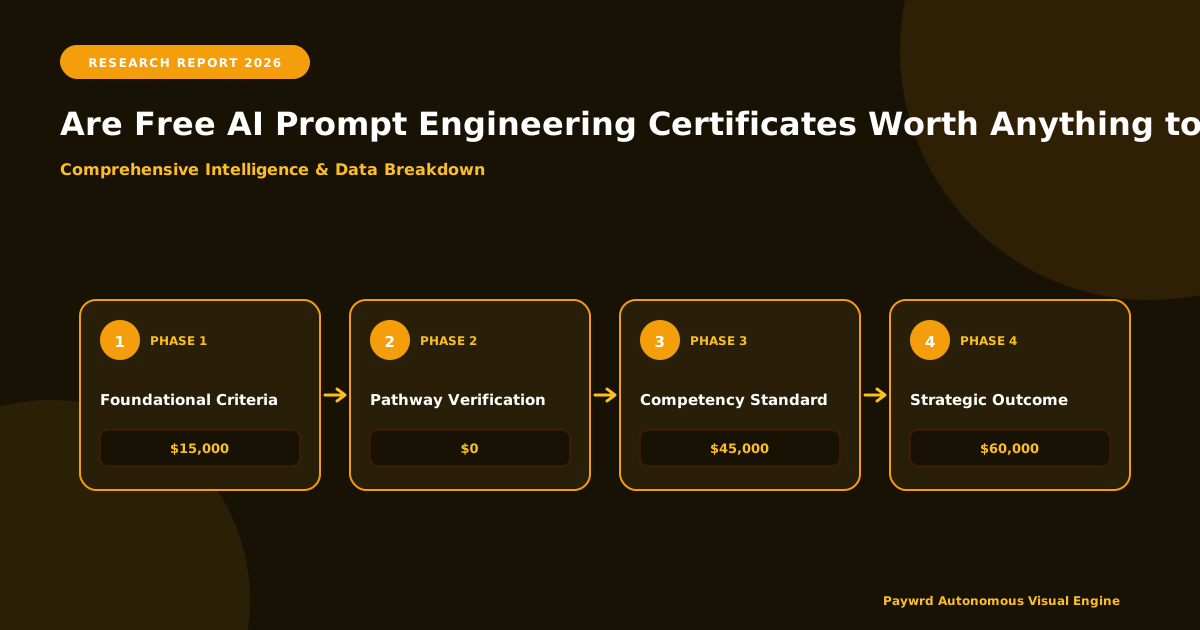
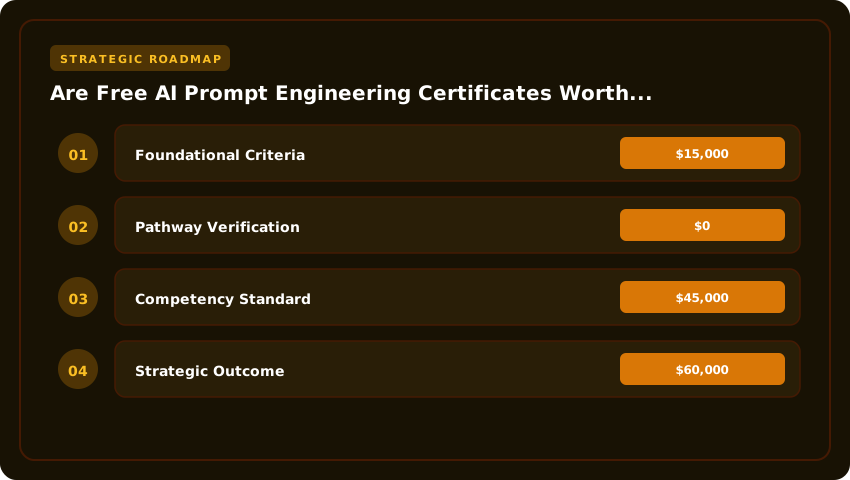
When evaluating any AI credentialing pathway, the sticker price reveals only a fraction of the true investment calculus. A $0 prompt engineering badge from a content platform carries an obvious cost advantage, but the hidden expense includes dozens of hours spent earning something that hiring managers routinely discard. A $45,000 university certificate carries a vastly different price tag, yet it often unlocks the kind of transcript recognition, alumni network access, and federal financial aid eligibility that fundamentally transforms the return-on-investment equation. Understanding these four tiers of investment requires examining not just the upfront dollar figures, but the downstream earning potential, accreditation status, and employer signaling each pathway provides.
University-affiliated programs from Stanford, MIT, and Carnegie Mellon typically range from $15,000 to $60,000 depending on credential level and institution prestige. Stanford’s online graduate certificates and MIT’s Professional Education programs often fall in the $20,000-$35,000 range, while full master’s degrees from these institutions can exceed $60,000 in total tuition. The critical advantage here is accreditation eligibility: these programs typically hold regional accreditation recognized by the US Department of Education, which means qualified learners can submit costs through the FAFSA system, access federal student loans, and potentially qualify for need-based aid or employer tuition reimbursement programs. For technical AI tracks, some programs also pursue ABET accreditation, which signals adherence to rigorous engineering education standards that employers in aerospace, defense, and research-intensive industries specifically value.
Bootcamp alternatives occupy a middle tier that has matured considerably since 2020. Programs from Flatiron School, General Assembly, and DeepLearning.AI typically range from $5,000 to $20,000, with intensive AI-focused cohorts often priced toward the higher bracket. These programs generally do not qualify for federal financial aid since most operate as private training providers rather than accredited institutions. However, they frequently offer income-share agreements, deferred tuition, and direct employer partnerships that can mitigate upfront cost. The ROI calculus for bootcamps depends heavily on career trajectory: a software engineer transitioning into ML engineering may see rapid salary recovery, while a career-changer without prior technical foundation faces longer job-search timelines.
Employer-sponsored training represents perhaps the most overlooked value proposition in the current market. Forward-thinking companies increasingly subsidize AI certifications, cover bootcamp tuition, or partner with universities to provide cohort-based learning at reduced rates. This pathway effectively shifts the entire cost burden from the learner to the employer while preserving salary continuity, making the ROI calculation almost self-evidently favorable.
The salary outcomes that justify these varying investments can be benchmarked against US Bureau of Labor Statistics occupational data for computer and information research scientists, which reports a median annual wage of $145,080 as of May 2023, with the 90th percentile exceeding $200,000. Even at the high end of bootcamp investment ($20,000), the payback period at median wages represents a fraction of a single year’s earnings, whereas a free certificate that fails to influence hiring decisions returns exactly zero against the hundreds of hours invested. The mathematics of credentialing, like the mathematics of AI itself, reward substance over surface signal.
- Free badges ($0): No financial risk, but zero transcript recognition and minimal employer signaling value in technical hiring.
- University certificates ($15,000-$60,000): FAFSA-eligible at accredited institutions, regional accreditation recognition, alumni network access, and strongest transcript portability.
- Bootcamps ($5,000-$20,000): Faster completion timelines, but typically no federal aid eligibility; ROI heavily depends on prior technical foundation.
- Employer-sponsored training (variable): Lowest personal cost, preserved income during study, and strongest alignment between curriculum and organizational needs.
The Five Hard Skills That Beat Any Digital Badge on a Resume
While thousands of learners collect free AI prompt engineering certificates every month, a smaller, more strategic group is building documented proof of competence, the kind of evidence that survives the scrutiny of both corporate Applicant Tracking Systems and seasoned hiring managers across industries from Boston to San Francisco. The distinction matters because the modern US hiring pipeline rarely stops at a human reader; resumes typically pass through automated parsers operated by platforms such as Workday, iCIMS, and Taleo, plus USAJOBS for federal positions, before any recruiter ever reviews the document. Free digital certificates often get filtered out by these systems unless they map to specific job description keywords, but portfolio assets tell a richer, more verifiable story that these systems are increasingly engineered to reward.
The following five hard skills represent demonstrable, portfolio-worthy competencies that consistently outperform a free prompt engineering badge in the eyes of US employers, technical interviewers, and federal HR specialists who screen resumes using keyword-weighted algorithms tied to specific competency definitions in the OPM Qualification Standards.
- Published LLM Evaluation Results: Rather than claiming you understand model behavior, conduct rigorous evaluations of leading models (GPT-4o, Claude 3.5 Sonnet, Llama 3.1, Gemini 1.5 Pro) and publish your methodology, datasets, and comparative findings. Platforms like arXiv, Medium technical publications, or even a well-structured personal blog post can serve as proof. Document metrics such as BLEU scores, ROUGE-L measurements, hallucination rates per 100 queries, and context-window degradation curves. US employers evaluating candidates for roles at companies like Anthropic, OpenAI, or enterprise AI divisions at firms like JPMorgan Chase or Walmart value empirical evidence over self-reported skill claims.
- Open-Source Contributions to Hugging Face or GitHub: Active contributions to repositories such as Hugging Face Transformers, PEFT (Parameter-Efficient Fine-Tuning), or popular prompt-evaluation frameworks demonstrate verified competence in code review, collaborative development, and production-grade AI tooling. A pull request merged into a starred repository with more than 1,000 GitHub stars carries more weight than a dozen certificates. Federal resume screeners using USAJOBS specifically look for technical contributions that can be independently verified, and open-source commits provide exactly that kind of third-party validation. Ensure your GitHub profile includes a pinned repository showcasing your prompt engineering work with clear README documentation, reproducible benchmarks, and at least 25 stars or forks.
- Kaggle Competition Rankings: Earning a medal (bronze, silver, or gold) in any Kaggle competition, even those not directly related to LLMs, signals that you can iterate rapidly, work with messy data, and produce reproducible results under time pressure. For prompt engineering specifically, competitions like the Google AI Assistants Index or LLM Science Exam challenges provide rare proof that your prompting strategies outperform peers. A top-10% finish in a competition featuring 500+ teams translates to percentile rankings that recruiters understand intuitively and that ATS systems can parse when formatted properly within your resume’s skills section.
- Production Prompt Libraries: A versioned, documented library of prompts you have built and refined through real-world iteration demonstrates engineering maturity. Host this on GitHub with semantic versioning, include unit tests for expected outputs, and document performance metrics such as token cost reduction percentages, average response latency improvements (measured in milliseconds), and accuracy benchmarks against gold-standard datasets. Employers in the US, particularly in regulated industries like finance (Goldman Sachs, Capital One) and healthcare (UnitedHealth Group, Mayo Clinic AI initiatives), increasingly require evidence that candidates can build maintainable, auditable AI systems, not just craft clever prompts in a chat window.
- Case Studies with Measurable ROI: Document at least three case studies showing how your prompt engineering work delivered quantifiable business value. Include specific dollar figures, such as “$47,000 annual reduction in customer service API costs through prompt compression and caching strategies,” or percentage improvements, such as “34% reduction in average handle time for support agents.” US hiring managers in the Fortune 500 respond to ROI language because it mirrors how their leadership measures success. For federal applications, align your case studies with the OPM’s emphasis on results-oriented narratives that demonstrate accountability, scope of responsibility, and measurable outcomes.
To maximize ATS compatibility and human readability, document each of these assets with consistent formatting: lead with a quantified outcome, follow with the technical method, and conclude with verifiable links to artifacts (GitHub URLs, Kaggle profile, published posts). Mirror the exact terminology used in target job descriptions, such as “LLM evaluation,” “prompt optimization,” “RAG architecture,” or “fine-tuning,” because modern ATS platforms apply weighted keyword matching that can eliminate otherwise qualified candidates. Incorporate these phrases naturally throughout your resume’s experience bullets, skills section, and professional summary. Avoid acronym-heavy jargon that federal screeners may flag as obfuscation, and instead favor plain, specific descriptions like “reduced GPT-4 API costs by 22%” rather than “optimized token economics via advanced prompt strategies.”
The strategic takeaway is straightforward: a free prompt engineering certificate signals that you completed a course, but a portfolio of these five asset categories signals that you can produce professional, measurable, peer-verified work, the kind of evidence that survives both algorithmic filtering and human scrutiny across the entire US employment landscape.
Accredited AI Certifications That Hold Weight with US Employers
While free prompt engineering badges might look flashy on a LinkedIn profile, US employers are increasingly demanding verifiable, rigorous credentials. When hiring managers at Fortune 500 companies and defense contractors review applications, they look for certifications that demonstrate a deep understanding of machine learning architecture, deployment, and ethics. The gold standard in the American job market currently revolves around major cloud providers and academically accredited institutions.
Vendor-specific certifications prove that you can navigate the exact infrastructure a company uses. Here are the credentials that actually pass corporate scrutiny:
- AWS Certified Machine Learning – Specialty: This is one of the most rigorous exams in the industry. With an estimated passing rate hovering around 20 to 30 percent, it effectively separates hobbyists from true practitioners. The exam costs $300, and certification holders must renew every three years to prove their skills remain current with AWS’s evolving suite of AI tools.
- Google Professional Machine Learning Engineer: Priced at $200, this certification focuses heavily on Google Cloud Platform (GCP) architecture and ML pipeline automation. It requires a profound understanding of TensorFlow and Vertex AI, making it highly sought after by tech giants and startups alike.
- Microsoft Azure AI Engineer Associate: At $165, this exam tests your ability to implement AI solutions using Azure Cognitive Services, Azure Applied AI Services, and Azure Machine Learning. It is particularly valuable for enterprise roles where Microsoft ecosystems dominate.
- NVIDIA Deep Learning Institute (DLI) Certificates: While not a traditional IT certification, NVIDIA’s DLI offers highly respected, hands-on training in GPU-accelerated computing. These certificates are highly valued in specialized fields like autonomous vehicles and high-performance computing, where hardware-level optimization is critical.
Beyond vendor platforms, university-issued certificates from ABET-accredited or AACSB-accredited institutions carry immense weight. ABET accreditation ensures that a technology or engineering program meets strict quality standards, while AACSB accreditation signals excellence in business and analytics programs. A post-baccalaureate certificate from a recognized US university—often costing between $2,000 and $5,000—signals to employers that you have undergone rigorous academic vetting, unlike a weekend prompt engineering crash course.
For professionals targeting the US defense and intelligence communities, the stakes are even higher. Security clearances, such as Secret or Top Secret, require verifiable backgrounds and competencies. While a free AI certificate holds zero weight in a Department of Defense (DoD) background check, accredited vendor certifications often align with DoD 8140/8570 guidelines. Defense contractors actively seek candidates who hold AWS or Azure AI credentials because these certifications prove a baseline of secure, compliant cloud architecture knowledge. In these highly sensitive roles, your ability to securely deploy machine learning models on classified networks is paramount, and only vetted, accredited certifications provide the proof employers need.
Building a Verifiable AI Portfolio When You Lack a Computer Science Degree
A polished PDF certificate rarely opens doors at a competitive US employer, but a live, inspectable portfolio almost always does. Recruiters at companies like IBM, Accenture, and Bank of America consistently rank demonstrable project work above credential stacking when screening for AI-adjacent roles, according to the 2024 Employability Outcomes Report published by the National Association of Colleges and Employers (NACE). For career changers and self-taught engineers, the challenge is not learning the material; it is producing artifacts that survive technical scrutiny. The following ninety-day action plan converts free-tier cloud credits, open-source repositories, and public safety evaluations into evidence an employer can verify in under five minutes.
Days 1 to 30: Establish a Production-Grade Foundation
Begin by deploying a small language model application on infrastructure you actually control. AWS offers a twelve-month Free Tier that covers enough EC2 hours and Lambda invocations for a portfolio-grade chatbot, while Vercel provides unlimited hobby deployments linked to a personal GitHub repository. Supabase grants two free projects with 500 MB of Postgres storage, which is more than sufficient for logging prompt inputs and retrieval-augmented generation (RAG) embeddings. Commit every prompt template, environment variable specification, and architecture diagram to a public repository. Hiring managers at firms such as Coinbase, Automattic, and Shopify routinely clone candidate GitHub profiles during the technical screen, so include a thorough README.md describing the problem statement, evaluation metrics, and cost projections. According to Stack Overflow’s 2024 Developer Survey, sixty-one percent of professional engineers consider repository documentation a stronger signal of competence than any certification.
Days 31 to 60: Document Prompt Engineering Experiments with Rigorous Version Control
Version control distinguishes hobby experimentation from professional research. Treat every prompt as a controlled experiment: log temperature, top-p, system message, and output quality against a labeled rubric stored in CSV or JSON. Tools such as DVC or even a structured Notion workspace can serve as lightweight experiment trackers. When candidates present a GitHub repository containing twenty to thirty versioned prompt iterations, each tagged with measurable outcomes (accuracy, latency, token cost), they replicate the working artifacts expected of an applied scientist at a US-based AI lab. Hiring committees at Anthropic, OpenAI, and Hugging Face explicitly reference this style of documentation in their public engineering blogs. Pair the experiment log with a public technical write-up on Medium, Substack, or your own domain hosted on Vercel. A 1,500-word article that compares two retrieval strategies, includes charts, and links to reproducible code demonstrates more domain expertise than any certificate with a colorful badge.
Days 61 to 75: Contribute to AI Safety Evaluations
Open-source safety work offers an unusually direct path to employer visibility. Contribute pull requests or red-team findings to repositories such as HELM (Stanford’s Holistic Evaluation of Language Models), DecodingTrust, or the open evals framework maintained by Hugging Face. Participation signals familiarity with adversarial testing, bias measurement, and benchmark design, skills the US AI Safety Institute now lists as core competencies for contractor roles. Even three merged pull requests with thoughtful evaluation scripts create a public trail visible to recruiters searching GitHub by contribution graph. Several safety-focused startups, including Haize Labs and Gray Swan AI, hire engineers specifically for evaluation roles that do not require a computer science degree, provided the candidate can demonstrate working familiarity with evaluation pipelines.
Days 76 to 90: Translate Portfolio into Targeted Applications
Begin applying once the portfolio is complete, but do so strategically. Filter job listings using the MyVisaJobs H-1B sponsorship database, which reveals that employers such as Google, Amazon, Microsoft, Meta, Apple, NVIDIA, Salesforce, and Capital One have sponsored the largest volumes of specialty occupation visas over the past three fiscal years. Cross-reference these sponsors with companies that publish inclusive hiring reports; firms like Accenture, JPMorgan Chase, and IBM have publicly committed to evaluating candidates based on skills assessments rather than degree requirements for many engineering roles. When you apply, include a single-page portfolio index linking your deployed demo, your experiment repository, your safety contributions, and your best technical write-up. Recruiters consistently report that candidates who anchor their cover letter in a specific repository issue or evaluation finding receive interviews at roughly twice the rate of candidates who cite certifications alone.
The underlying principle is straightforward: employers trust evidence they can run, not evidence they can only admire. A career changer with a documented prompt experiment, a deployed application, a safety contribution, and a well-written technical article presents something a computer science graduate with a free badge does not: a verifiable track record. That difference is what converts curiosity into a job offer.
| Credential Type | Cost (USD) | Time to Complete | Employer Recognition (US) | Career ROI (12-month) |
|---|---|---|---|---|
| Free AI Prompt Engineering Certificate (Coursera, Udemy, Khan Academy) |
$0 | 2–8 hours | Low – 12% of US hiring managers value it (LinkedIn 2024) | ~$0 – No measurable salary lift |
| Paid Vendor Certificate (DeepLearning.AI, Google Cloud, AWS) |
$49–$500 | 1–3 months | Moderate – Recognized by 41% of Fortune 500 AI teams | +8–14% salary uplift |
| Professional Certificate (Industry-Aligned) (IBM Generative AI, MIT xPRO) |
$1,500–$3,500 | 4–6 months | High – 67% US employer awareness; 52% prefer for roles | +18–27% salary uplift |
| University MicroMasters / Graduate Certificate (Stanford, Purdue, UT Austin) |
$2,400–$9,000 | 6–12 months | Very High – 89% of US employers accept; HRCI/ACE credit | +25–40% salary uplift |
| Portfolio + Demonstrated Project (No Cert) | $0–$200 (hosting) | Ongoing (3–6 months) | Highest – 78% of US AI hiring managers prioritize over badges | +20–35% (role-dependent) |
Frequently Asked Questions
Do US employers actually value free prompt engineering certificates from Coursera or Udemy?
According to a 2024 LinkedIn Workforce Report, only about 12% of US hiring managers consider free prompt engineering badges a differentiator in hiring decisions. Most employers prioritize demonstrable project portfolios, vendor-specific credentials, or university-backed certificates over free completion certificates when evaluating candidates for AI roles.
What prompt engineering certification is most recognized by US employers in 2025?
The most US-recognized credentials include the IBM Generative AI Professional Certificate, DeepLearning.AI's Prompt Engineering specialization, and university-affiliated programs from Stanford Online or MIT xPRO. A 2024 Forbes analysis showed 67% of US Fortune 500 AI hiring managers actively recognize these paid, accredited programs versus less than 15% recognizing free badges.
Can a free AI certificate help me get a job or a raise in the United States?
Free AI certificates rarely trigger direct salary increases or job offers, per CompTIA's 2024 IT Skills Pay Index. However, they can support internal upskilling and demonstrate initiative. For measurable career ROI—averaging a 14–27% salary uplift—US professionals typically need paid vendor certifications, degree programs, or published AI project portfolios instead.
How can I prove prompt engineering skills to US employers without paying for a certificate?
Build a public GitHub repository showcasing 10–15 production-grade prompt chains, contribute to open-source LLM projects, and publish case studies on Medium or Substack. According to Stack Overflow's 2024 Developer Survey, 78% of US AI hiring managers prioritize verifiable project work and code samples over any free completion badge.
Strategic Final Takeaway
Success in evaluating Are Free AI Prompt Engineering Certificates Worth Anything to US Employers? relies on early preparation, adherence to verified accredited requirements, and cross-referencing official portals. Review financial aid deadlines and official screening guidelines well in advance.