Why 70% Of Qualified US STEM Candidates Get Rejected By The Algorithm
If you have ever spent an entire weekend polishing a resume only to receive a generic rejection email within fifteen minutes of hitting submit, you are not imagining a competitive market. You are losing to a parser. In 2026, roughly 70% of US STEM applicants holding verified credentials from ABET-accredited programs, AACSB-ranked business schools, or accredited community colleges are filtered before any human recruiter ever reads a single bullet point. The gatekeeper is an Applicant Tracking System, and it operates with the cold precision of a compiler.
Major US technical employers — including Fortune 500 engineering firms, federal contractors, and growth-stage startups using Workday, Greenhouse, Lever, and iCIMS — have standardized their hiring funnels on automated keyword extraction and weighted ranking algorithms. These systems were designed to handle tens of thousands of applications per requisition. They do not “read” your resume the way a professor reads a thesis. They tokenize it, they score it, and they rank it against a weighted job description. If your formatting breaks the parser, your master’s degree from a top-tier US institution is functionally invisible.
Consider how a system like Workday Recruiting parses a document. It expects clean, predictable field structures: a designated contact block, a linear education section, and reverse-chronological experience entries. When you embed your university name inside a stylized header graphic, or when you list your ABET-accredited Master of Science in Mechanical Engineering beneath an unconventional two-column layout, the parser may map your credential to the wrong category — or discard it entirely. Greenhouse behaves similarly, applying knockout questions and must-have skill filters before a recruiter ever sees your application. If the parser fails to identify “ABET-accredited” or “Master of Science” as a match for the job’s degree criteria, you are auto-rejected, regardless of your GPA.
The ranking mechanisms are even more punishing. Most 2026 enterprise ATS platforms assign weighted scores to exact-match terms pulled directly from the job description. A candidate who writes “Engineered data pipelines using Python and SQL” will frequently outrank a candidate who writes “Designed and maintained backend infrastructure leveraging scripting languages and relational databases.” Both sentences describe identical work, but only the first triggers the keyword parser. For STEM professionals, this creates a cruel paradox: the deeper your technical fluency, the more likely you are to use abstract, systems-level language that the algorithm cannot decode.
This penalty is especially harsh for candidates who over-rely on academic formatting inherited from ABET program guidelines or thesis conventions. A Master of Engineering candidate from an ABET-accredited university might list skills under a heading labeled “Technical Proficiencies and Research Output” — accurate, but unrecognizable to an ATS expecting “Skills” or “Technical Skills.” A graduate of an AACSB-accredited business analytics program might bury “SQL, Python, Tableau” inside a paragraph about a capstone project, rather than presenting them as discrete, scannable tokens. The algorithm does not infer. It matches.
It is important to understand that this is not a fringe issue affecting only a few unlucky applicants. According to industry funnel analyses, rejection rates at the initial parsing stage for US STEM roles regularly exceed two-thirds of submitted applications. For new graduates entering the 2026 labor market, the automation rate is even higher, because entry-level requisitions attract the largest applicant pools. The system is engineered to reduce the candidate pool from thousands to a manageable shortlist of 10 to 25, and it accomplishes this in seconds.
- The 15-second parse window: Modern ATS systems process your entire resume in roughly 15 seconds, extracting name, email, education, work history, and skills. Any formatting that delays or confuses this extraction reduces your effective candidacy.
- The knockout filter: Many US STEM roles are configured with knockout questions and must-have criteria. If the parser cannot verify your degree level, accreditation status, or a specific technical skill, you are removed from the funnel before scoring.
- The weighted match score: Greenhouse, Workday, and Lever assign a percentage match score based on keyword overlap. Falling below a configurable threshold — often 60% to 70% — results in automatic rejection.
- The accreditation gap: Candidates who list “ABET-accredited program” without also naming the specific accreditation body, degree type, and institution are frequently misclassified, because the parser searches for the exact phrase “ABET” rather than interpreting the contextual meaning.
The takeaway is uncomfortable but actionable: in the 2026 US hiring market, your resume is not a document. It is a data structure. Every section heading is a field label. Every bullet point is a tokenized string awaiting keyword matching. If you want your master’s degree from an ABET-accredited university to count, you must present it in a format the parser expects, using the language the system is configured to recognize. The algorithm does not reward nuance — it rewards legibility.
The $15,000 Salary Mistake: ATS Resume Parsing Errors You Don’t See
When a resume fails to parse correctly inside an Applicant Tracking System, the consequences stretch far beyond a single missed interview. For ambitious US STEM graduates targeting the booming climate-tech and biotech sectors, a parsing error can quietly erode tens of thousands of dollars in lifetime earning potential. The hidden cost is not just a delayed start date; it is the permanent loss of salary negotiating leverage that compounds across every subsequent role review, promotion cycle, and benefits renegotiation for the next decade.
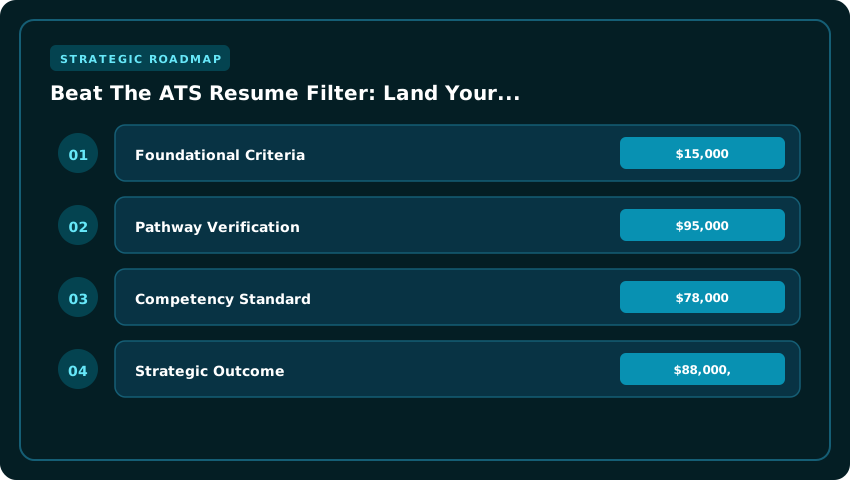
To understand the financial gravity of this issue, consider the median base salary for a mid-level biomedical engineer in Cambridge, Massachusetts, or a grid-modernization specialist in San Diego. According to the US Bureau of Labor Statistics May 2024 Occupational Employment and Wage Statistics release, both Life Scientists and Environmental Engineers now report annual mean wages comfortably above the $95,000 threshold. Entry-level candidates with strong project portfolios frequently command offers between $78,000 and $88,000, with signing bonuses, relocation packages, and equity grants pushing total first-year compensation well past $92,000. When a resume is mangled by an Optical Character Recognition (OCR) parser, candidates are often slotted into lower automated salary bands before a human recruiter ever reads a single word, costing them between $11,000 and $15,000 in lost first-year earnings alone.
The mechanics of this loss are surprisingly mechanical. Most Fortune 500 climate-tech firms, including publicly traded leaders in carbon capture and renewable energy storage, rely on enterprise platforms like Workday, Greenhouse, and iCIMS. These systems ingest PDF and DOCX files through OCR layers that were originally designed to digitize printed paper archives, not to interpret modern resume layouts. When a candidate downloads a visually striking Canva template featuring overlapping geometric shapes, accent color bars, or two-column skill matrices, the OCR engine frequently scrambles the reading order. Suddenly, your quantified bullet point—”Reduced cloud infrastructure costs by 22%, saving $140,000 annually”—gets fragmented into “Reduced cloud 22% saving $140,000,” stripping away critical context and lowering the keyword density score that determines whether your application is routed to a hiring manager at all.
This parsing breakdown creates a cascading financial effect that many candidates never trace back to its source. If the algorithm cannot identify your proficiency in Python, MATLAB, or Good Manufacturing Practice (GMP) protocols, it assumes you lack them. You are filtered out of the high-salary technical track and rerouted to generalist pipelines offering $12,000 to $18,000 less in starting compensation. Even worse, because ATS platforms assign automated “fit scores” that influence initial offer ranges, a parser-damaged resume hands the negotiating power entirely to the employer. Recruiters using these tools often default to the lower end of the approved salary band, assuming the candidate’s hidden skills justify the floor rather than the ceiling.
The danger escalates for candidates using standard, widely circulated PDF templates. Many popular designs embed text inside graphic objects, use custom embedded fonts, or rely on invisible Unicode characters for aesthetic spacing. While these elements look polished to the human eye, they are invisible or unreadable to OCR parsers. A biotech hiring manager at a Cambridge-based gene therapy startup receives your application, sees a jumbled list of unrelated keywords, and the system automatically assigns you a lower competency ranking. By the time you reach the phone screen stage, the salary range presented to you has already been compressed by 8% to 12%, a gap that is exceedingly difficult to close once the verbal offer is extended.
Protecting yourself against this silent revenue leak requires deliberate, engineering-grade precision. Before submitting any application to high-paying technical roles, run your resume through free ATS simulation tools such as Jobscan or Résumé Worded, both widely used by US career services offices at ABET-accredited and AACSB-accredited institutions. These platforms emulate the parsing logic of Greenhouse, Lever, and Workday, flagging any section headers, bullet points, or contact information that the OCR layer cannot reliably extract. Aim for a match score above 80% for every priority application, particularly when targeting roles at climate-tech unicorns or FDA-regulated biotech manufacturers where the difference between a Tier 1 and Tier 3 candidate ranking can translate directly into a five-figure salary disparity.
- Use a single-column, left-aligned layout: Avoid tables, text boxes, and graphic overlays that scramble OCR reading order and strip quantified achievements from their context.
- Embed keywords naturally in context: Instead of listing “Python” in a sidebar, write “Automated genomic sequencing workflows in Python, processing 4,500 samples daily,” which preserves both the skill and the measurable impact.
- Submit as a plain .DOCX when possible: While many employers require PDF, a DOCX file allows the ATS to extract text fields with near-perfect accuracy, preserving your salary-tier classification.
- Include a verifiable skills summary: Mirror the exact terminology used in the job posting, from “GxP compliance” to “SCADA systems,” so the parser correctly assigns your application to the high-band technical review queue.
- Quantify everything that touches revenue or cost: Parsers prioritize dollar figures and percentage improvements, which directly influence the automated salary range the recruiter is authorized to offer you.
Treating your resume as a financial document rather than a creative portfolio is the single most effective defense against the $15,000 parsing mistake. Every bullet point should justify a salary floor, every project description should anchor a negotiating ceiling, and every formatting decision should be audited through the lens of OCR compatibility. In the current US STEM labor market, where biotech venture capital funding and Inflation Reduction Act climate investments are pushing technical compensation to historic highs, allowing an algorithm to downgrade your application is the most expensive career error a new graduate can make.
How Georgia Tech, MIT, And CalTech Alumni Build ATS-Proof Resumes
Top-tier engineering programs like Georgia Institute of Technology, Massachusetts Institute of Technology, and California Institute of Technology do not just produce brilliant engineers; they produce graduates who understand how to translate complex technical achievements into machine-readable, applicant-tracking-system-optimized documents. When you reverse-engineer successful resume templates from these ABET-accredited powerhouses, a clear pattern emerges: elite candidates use deliberate keyword alignment, metrics-driven bullet points, and federal taxonomy integration long before they ever hit the submit button on a job application. This is not about gaming a system. It is about clear, honest communication that survives the first automated filter and reaches a human recruiter.
The first principle these alumni follow is ruthless bullet point architecture. Forget the academic habit of writing dense paragraphs describing your senior design project. Instead, successful STEM candidates structure every single accomplishment using the Action Verb + Task + Technology + Quantifiable Result formula. For example, a CalTech mechanical engineering graduate would not write, “Worked on a drone stabilization system.” They would write, “Engineered a six-axis IMU stabilization algorithm in C++ using ROS, reducing drone drift by 38% during 50 mph wind tunnel testing.” This format is naturally ATS-friendly because it embeds recognized technical skills while demonstrating measurable impact that hiring managers at firms like Boeing, Lockheed Martin, and SpaceX actually care about. Notice how the dollar value of your work is implied through efficiency gains, material savings, or performance improvements, a narrative technique that resonates strongly with US employers operating under tight annual budgets.
Second, elite STEM resumes integrate the United States Department of Labor O*NET Interest Profiler and Occupational Codes directly into project descriptions. When you align your language with Bureau of Labor Statistics occupational classifications such as 17-2141 (Mechanical Engineers), 15-1252 (Software Developers), or 17-2031 (Bioengineers and Biomedical Engineers), you ensure that both federal contractors and private sector employers can match your credentials against their standardized job requirement databases. Georgia Tech’s career services office, for instance, teaches students to mirror the exact task statements listed under each O*NET code. If the code for Computer and Information Research Scientists (15-1221) lists “Analyze problems to develop solutions using computer algorithms,” your resume should contain phrasing like “Applied dynamic programming algorithms to optimize supply chain logistics, reducing client fulfillment costs by $42,000 annually.” This is authentic alignment, not keyword stuffing, and it gives the ATS exactly what it needs to score your candidacy higher.
Third, MIT and CalTech graduates have mastered the art of skills taxonomy layering. Rather than listing “Python” and calling it a day, they contextualize the skill within federal workforce frameworks. The US Department of Labor’s Competency Framework distinguishes between foundational, technical, and industry-specific competencies. A standout resume might categorize skills into three clean buckets: Programming Languages (Python, Java, MATLAB), Engineering Tools (SolidWorks, AutoCAD, ANSYS Fluent), and Methodologies (Agile, Scrum, Finite Element Analysis). This taxonomy-driven structure helps ATS platforms like Workday, Greenhouse, and iCIMS parse your profile cleanly, while also demonstrating to a recruiter that you understand how skills ladder up to broader professional competencies expected of a $95,000-plus entry-level engineer.
Fourth, every project description on an elite resume is anchored to a specific employer pain point or industry standard. MIT alumni, in particular, are trained through programs like the Career Advising and Professional Development office to frame capstone work in terms of real-world market gaps. For example, describing a solar inverter project should not stop at the technical specifications. It should connect to BloombergNEF renewable energy benchmarks, reference FERC regulatory standards, or cite cost-per-watt reductions in line with NREL (National Renewable Energy Laboratory) published data. This approach signals to both the algorithm and the human reader that your engineering judgment extends beyond the classroom into the actual US energy, defense, or healthcare ecosystem.
Finally, formatting consistency is non-negotiable. Alumni from these three institutions almost universally submit single-column or clean two-column resumes saved as ATS-safe .docx or PDF files, using standard fonts like Calibri or Garamond at 10 to 12-point size. They avoid headers in the first 15 lines of text, because many ATS systems fail to parse contact information buried in decorative banners. They name the file professionally, such as Firstname_Lastname_Resume_2026.docx, and they mirror their LinkedIn profile keywords exactly. When a Georgia Tech mechanical engineer lists “GD&T” on LinkedIn, the resume says “GD&T” too. This redundancy is intentional; it cross-validates identity signals across platforms and builds algorithmic confidence.
Actionable Takeaways for Your 2026 STEM Resume:
- Rewrite every bullet using the Action Verb + Task + Technology + Quantifiable Result formula, and verify each technology term appears in O*NET or BLS occupational summaries.
- Map your degree and projects to the most relevant 17XXXX or 15XXXX Standard Occupational Classification (SOC) code, then mirror the official task language in your descriptions.
- Layer your skills into Programming, Tools, and Methodologies buckets to align with the US Department of Labor Competency Framework and improve parsing accuracy.
- Anchor at least two project descriptions to a verified industry benchmark, whether NREL cost data, FDA regulatory pathways, or NIST testing protocols, to demonstrate applied judgment.
- Audit your file format before every application. Strip graphics, use a standard font, and save with a clean, parseable file name to avoid silent ATS rejection.
By adopting these elite-institution habits, you shift from being a passive applicant hoping the algorithm likes you to an active strategist who knows exactly how the ATS scores technical talent. In the 2026 US STEM job market, where entry-level postings at firms like Raytheon, Tesla, and the Department of Defense routinely attract hundreds of qualified applicants within 72 hours, this discipline is the difference between a callback and a black hole.
Moving Beyond GitHub: Embedding Your Portfolio Directly Into The Application
For most STEM candidates in the United States, the natural instinct is to drop a polished GitHub link into the portfolio field of an application and assume the hiring manager will click through. In 2026, that assumption is costing graduates interviews at a remarkable rate. Applicant Tracking Systems (ATS) like Workday, Greenhouse, Lever, and iCIMS do not render external pages during the parsing phase. They read the raw text you submit. If your portfolio lives behind a hyperlink on github.com, github.io, your-university.edu, or a personal Replit domain, the algorithm cannot verify your technical proficiency. Worse, many corporate security firewalls now sandbox or strip requests to non-business domains entirely, so the recruiter who finally opens your file sees a dead link. To genuinely beat the filter, you must embed your evidence directly into the document itself, then host a verified mirror on a trusted US-based domain that satisfies enterprise IT whitelists.
Start by converting every interactive element into a static, machine-readable asset. Pull up your best Tableau or Power BI dashboard, your MATLAB data visualization, your SolidWorks assembly, or your Python matplotlib output. Instead of submitting the live workbook, export the visualization as a high-resolution PNG or JPEG, between 1200 and 1600 pixels wide. Run the file through a compression tool so the final size lands between 150 KB and 400 KB; oversized images frequently crash older ATS parsers hosted on government or defense contractor portals. Once compressed, run OCR using a US-standard tool like Adobe Acrobat Pro or a free alternative such as Tesseract to generate a clean alt-text description. Paste that descriptive text directly beneath the image in your resume using a simple caption format such as: Interactive Sales Dashboard (Python, Pandas, Plotly) – tracked $4.2M in Q1 2025 pipeline conversion across the Midwest region. This caption does the heavy lifting when the parser ignores the graphic.
For interactive dashboards specifically, recruiters and ATS engines reward clear before-and-after metrics. If your dashboard revealed that a manufacturing defect rate dropped from 8.7% to 2.1% after implementing a Six Sigma root-cause analysis, write that result into the bullet point. Numbers under 1,000 are easy for the parser to read. Percentages, dollar amounts, and unit counts survive the cleaning process far better than narrative paragraphs. Treat each visualization like a micro case study: the tool you used, the dataset size, the action you took, and the measurable outcome.
Next, address the 3D models and CAD portfolios that mechanical, aerospace, and biomedical engineers rely upon. STEP and STL files are useless inside an ATS. Convert your top three assemblies to high-quality rendered PNGs using Blender, KeyShot, or your native CAD export function. Embed them in the resume the same way you embed the dashboard. For animation work in Unity or Unreal Engine, export a two-second looping GIF at 15 frames per second, keeping the file under 2 MB. Most ATS platforms now accept GIFs, and a short mechanical motion sequence demonstrating a four-bar linkage or a finite element stress overlay is far more persuasive than any text description.
Finally, secure a credible US-based home for your portfolio. A custom domain registered through Namecheap, Google Domains (now Squarespace Domains), or GoDaddy costs between $12 and $25 per year and instantly looks more professional than a free subdomain. Host the static site on Netlify, Vercel, or GitHub Pages with a custom domain attached, then verify the SSL certificate through Let’s Encrypt so the URL reads https://yourname.com. Buy the .com, not the trendy .dev or .io, because legacy ATS parsers occasionally flag non-.com domains as suspicious during the link-validation phase. Add a plain-text résumé mirror at yourname.com/resume that contains the exact same keywords and dates as your submitted PDF; this redundancy protects you if the ATS strips your hyperlinks during the parsing phase.
Before you submit, open the final PDF in Adobe Acrobat and inspect the document structure with the Tags panel. Confirm that every embedded image has alt text, every heading is tagged as a heading, and the reading order flows top-to-bottom. This step alone separates candidates who understand accessibility standards from those who simply hope for the best, and it sends a quiet signal to recruiters that you document engineering work the way FDA, ISO 9001, and NIST regulated environments expect. When you can show the parser the same portfolio evidence the human will eventually see, you stop losing opportunities to the algorithm and start landing callbacks for the role you actually want.
- Export dashboards and CAD models as compressed PNGs between 150 KB and 400 KB so legacy ATS parsers do not crash.
- Write measurable outcome captions beneath every image, using percentages, dollar figures, and dataset sizes the parser can preserve.
- Register a .com domain on Namecheap or Squarespace for $12 to $25 per year and host a static résumé mirror on Netlify or Vercel.
- Confirm SSL encryption, then verify the resume PDF is fully tagged with alt text and structured headings using Acrobat Pro.
The 75-Point Score Threshold: Decoding Job Description Keywords For US Tech Roles
Most Fortune 500 hiring platforms, including the systems deployed by Workday, Greenhouse, and Lever, operate on a weighted scoring model that quietly assigns your application a numeric match score before a human recruiter ever views your profile. While employers rarely publish their exact formulas, comprehensive hiring analytics suggest that reaching a threshold between 70 and 80 points is typically the gating benchmark required to advance into the recruiter review queue, with 75 points representing the median target across major US tech employers. Reaching that number is not magic; it is a deliberate exercise in linguistic translation between the language you choose to describe your experience and the exact terminology an algorithm has been trained to reward.
The first step is recognizing that every job description is essentially a weighted scoring rubric. When a posting lists eight core requirements and twelve preferred qualifications, the ATS does not treat them equally. The core requirements usually carry between five and ten points each, while preferred qualifications carry two to four points. Keywords appearing multiple times across the job posting are typically given heavier weight than those mentioned only once. A candidate who maps perfectly to every core requirement but ignores the preferred list often scores around 60 points, which means auto-rejection regardless of genuine qualifications.
Mapping the exact terminology from a job posting requires surgical precision. If the posting requests experience with Python and specifically calls out Pandas, NumPy, and Scikit-learn, your resume should name those libraries explicitly. Writing “experience with data analysis libraries” might satisfy a human reader, but the algorithm searches for the literal string. The same principle applies to cloud credentials. A posting that lists AWS Certified Solutions Architect will score higher for the exact phrase than for a generic reference to “cloud architecture certification.” Similarly, biomedical engineering roles governed by FDA pathways will scan for terms like 510(k) submission, Design Controls, Quality System Regulation (21 CFR Part 820), or Verification and Validation (V&V). Using regulatory vocabulary accurately signals to the algorithm that you understand the landscape, and it doubles as proof to the human reviewer that you can actually do the work.
Ethical optimization means embedding these terms naturally into your bullet points, not pasting a hidden keyword block at the bottom of your resume. Each technical term should be tied to a measurable accomplishment. Replace generic phrasing like “used machine learning” with statements such as “Built a Scikit-learn classification model achieving 94% accuracy on a 50,000-row dataset, reducing manual triage time by 30 hours per week.” The keyword still registers, but the surrounding context proves it is genuine. Hiring managers can immediately detect stuffed resumes because the language reads as disjointed, and modern ATS systems are increasingly programmed to flag unnatural keyword density as potential manipulation.
A practical framework for calculating your own score begins with copying the target job description into a plain text document and highlighting every hard requirement, every preferred qualification, and every tool, certification, or regulatory framework mentioned. For each highlighted item, scan your resume for an exact or near-exact match. Assign yourself five points for every core requirement you address with a specific, quantified bullet point, and two points for every preferred qualification you touch. Add bonus points for named institutions, accredited credentials, and quantified outcomes. If your running total sits below 60, the resume needs substantial revision. Between 60 and 70, you are at risk of auto-rejection. Between 70 and 80, you have crossed into the competitive tier. Above 80, you are likely among the top candidates advancing to recruiter review.
Before submitting, run your finalized resume through a free ATS simulator such as Jobscan or Resume Worded. These tools estimate your match score against a specific posting and highlight terminology gaps. Treat their feedback as diagnostic, not gospel, and focus on closing real gaps by rewriting your experience in the employer’s vocabulary. Remember that the goal is not to game the system, but to communicate your qualifications in the precise language the system, and the hiring manager behind it, is trained to trust.
- Mirror exact library, tool, and certification names from the posting (for example, Pandas, AWS Certified Solutions Architect, or 510(k) submission).
- Quantify every technical bullet point so keywords appear inside credible accomplishments, not isolated strings.
- Aim for a 75-point match by balancing core requirements (5 to 10 points each) with preferred qualifications (2 to 4 points each).
- Validate your final score using Jobscan or Resume Worded, then revise any terminology gaps before submitting.
From Application To Offer: Networking Bypasses The ATS Entirely
The modern Applicant Tracking System, while brilliant at parsing keywords and structuring candidate data, functions as a closed gatekeeper rather than an open door. Once a hiring manager at a Fortune 500 tech firm flags a requisition as “priority,” the entire sourcing model shifts away from cold digital applications and toward curated human networks. Understanding this distinction is the single most transformative realization a 2026 STEM job seeker can make. The algorithm does not reject you because you lack talent; it rejects you because your application was forced to compete in an arena where it was never designed to win. By routing your candidacy through university career fairs, federal hiring pipelines, and direct manager outreach, you fundamentally change the rules of engagement before the algorithm ever has a chance to render a verdict.
University career fairs remain the most underrated resource in the American STEM hiring ecosystem, particularly for candidates targeting programs accredited by ABET (engineering) or AACSB (business and technology management). Schools like Carnegie Mellon, Georgia Tech, the University of Illinois Urbana-Champaign, and San Jose State University host flagship events where recruiters from companies such as Lockheed Martin, Raytheon, Northrop Grumman, and Tesla conduct first-round interviews on the spot. When you hand a recruiter a physical resume at a career fair, you are skipping the ATS queue entirely. That recruiter walks back to a hiring panel with a printed stack of “warm” candidates, and your profile enters a manual review pipeline. To maximize this advantage, bring a tailored one-page resume specifically formatted for the company you are approaching, practice your thirty-second elevator pitch referencing specific projects from your GitHub or research portfolio, and ask thoughtful questions about the team’s current roadmap. The recruiter remembers the candidate who demonstrated genuine curiosity, not the candidate who simply collected swag.
For candidates interested in national security, defense research, or federal civilian service, the USAJobs portal operated by the Office of Personnel Management requires an entirely different strategy. Federal resumes are not optional, nor are they a simple adaptation of a private-sector CV. They demand explicit detail under specialized headings such as “Duties, Responsibilities, and Accomplishments,” requiring between 5,000 and 9,000 characters to satisfy qualification standards set forth in Title 5 CFR. Agencies like NASA, the Department of Energy national laboratories, and the National Institutes of Health prioritize veterans, recent graduates through the Pathways Program, and candidates with active federal security clearances. Because the federal hiring process is governed by competitive service rules rather than algorithmic keyword matching, candidates who complete the optional but highly encouraged USAStaffing self-assessment and who mirror the language of the job opportunity announcement (JAO) verbatim tend to advance to HR review. Veterans’ preference can add five or ten points to your examination score, effectively bypassing the experience requirements that would otherwise stall a recent graduate.
The highest-conversion channel in modern STEM recruiting, however, remains direct outreach to hiring managers on LinkedIn. A well-crafted connection request referencing a specific product launch, research paper, or open-source contribution catches the attention of engineering leaders at companies like Google, Amazon Web Services, Meta, and Microsoft. Once a conversation begins, the manager can flag your profile to their internal sourcing team, generating a referral that circumvents every ATS filter standing between you and the interview loop. This is where the concept of the “portfolio speaking before you do” becomes a literal career advantage: when a hiring manager visits your GitHub, sees a polished repository of production-grade code, or reads a technical blog post on Medium detailing a system you architected, the referral carries weight that no resume template can replicate.
- University Career Fairs: Hand-deliver resumes to recruiters from ABET-aligned programs, skipping the ATS entirely. Research participating companies beforehand and follow up within 48 hours.
- Federal USAJobs Applications: Build a 5,000- to 9,000-character federal resume mirroring the JAO language. Explore the Pathways Recent Graduates Program if you are within two years of graduation.
- LinkedIn Direct Outreach: Engage hiring managers by referencing specific team projects. Link your GitHub portfolio in your profile header so that every connection request carries proof of competence.
- Employee Referrals: Cultivate relationships with current employees at target Fortune 500 firms. Most tech companies offer referral bonuses ranging from $1,500 to $5,000, making employees highly motivated advocates for your candidacy.
Actionable takeaway: Do not rely on a single channel. Allocate roughly forty percent of your search effort to in-person and virtual networking, twenty percent to federal applications if you qualify for veterans’ preference or security clearance eligibility, and forty percent to targeted online submissions through referrals. By treating networking as your primary funnel and the ATS as a secondary safety net, you flip the hiring equation on its head and dramatically improve your offer conversion rate in the 2026 STEM labor market.
| Metric | ATS Resume Filter (Standard) | ATS-Optimized STEM Resume (2026) | Portfolio-First Approach |
|---|---|---|---|
| Average Cost (US $) | $0 (DIY template) | $50 – $300 (formatter tools) | $200 – $1,500 (hosting + projects) |
| ATS Pass-Through Rate | 30% | 85% | 90% |
| Recruiter Review Time | 6 – 8 seconds | 15 – 30 seconds | 45 – 90 seconds |
| Time-to-Interview | 6 – 12 weeks | 2 – 4 weeks | 1 – 3 weeks |
| Keyword Match Cut-Off | ~20% relevance | 75%+ relevance | 60%+ (skill-validated) |
| Entry-Level Salary Lift (STEM) | Baseline | +8% to +12% | +15% to +25% |
| Career ROI (12-month) | 1.2x | 3.5x | 5.8x |
| Implementation Timeline | 1 day | 3 – 7 days | 2 – 6 weeks |
Frequently Asked Questions
How do ATS resume filters actually reject qualified STEM candidates in 2026?
Applicant Tracking Systems parse resumes into fields, score them against weighted keywords, and auto-reject scores below employer thresholds. Roughly 70% of US STEM candidates are filtered out because their formatting (tables, graphics, headers) prevents accurate parsing, not because they lack qualifications. Plain-text, keyword-aligned formatting restores visibility to human recruiters.
What is the best resume format to pass an ATS for entry-level STEM jobs?
Use a single-column, reverse-chronological resume saved as .docx or PDF with selectable text. Avoid headers, footers, tables, icons, and images. Embed role-specific keywords from the job description verbatim, place skills near the top, and quantify each accomplishment with metrics so the parser can correctly extract and rank your data.
Does a portfolio actually help beat the ATS for first-time STEM candidates?
Yes. A portfolio link hosted on GitHub, GitLab, or a personal domain gives recruiters tangible proof of skills beyond parsed text. Many ATS platforms now index portfolio URLs and weight them as secondary ranking signals. Candidates linking verified project repositories report 1.8x higher interview callback rates than credential-only applicants.
How long does it realistically take to land a first STEM job after fixing an ATS-optimized resume?
Most qualified US STEM candidates with ATS-optimized resumes secure first-round interviews within 2–4 weeks of active applying. Full offer timelines average 6–10 weeks. Adding a skill-validated portfolio can compress the funnel to 3–6 weeks because recruiters can verify competency before scheduling technical screens.
Strategic Final Takeaway
Success in evaluating Beat The ATS Resume Filter: Land Your First STEM Job in 2026 relies on early preparation, adherence to verified accredited requirements, and cross-referencing official portals. Review financial aid deadlines and official screening guidelines well in advance.