

The 2026 Skills Gap Audit: Quantifying the $8.5T Risk to US GDP
The numbers are no longer theoretical; they are a line item on the national balance sheet. According to the latest Bureau of Labor Statistics (BLS) employment projections cross-referenced with McKinsey Global Institute modeling, the United States faces a cumulative $8.5 trillion risk to GDP by 2030 if current talent deficits persist. Right now, that friction costs US firms approximately $1.7 trillion annually in unrealized productivity—roughly 8% of total economic output. This isn’t just a hiring problem; it is a structural misalignment between the velocity of technological adoption and the half-life of existing workforce competencies.

Drilling into the NAICS taxonomy reveals exactly where the bleeding is worst. The deficit is not evenly distributed; it clusters aggressively in sectors undergoing rapid AI integration. We see a bifurcation: a desperate need for deep technical fluency (cloud architecture, model ops, cybersecurity) colliding with a surprising scarcity of durable human skills (complex problem framing, ethical judgment, cross-functional translation). Companies treating upskilling as a compliance checkbox rather than a capital allocation strategy are effectively writing off millions in ROI every quarter.
Here is how the $1.7 trillion annual productivity gap maps to specific NAICS supersectors, based on current BLS occupational separation rates and McKinsey automation adoption curves:

- NAICS 5415 – Computer Systems Design & Related Services: A deficit of 450,000+ roles centered on cloud-native security and MLOps engineering. The median tenure for these skills is under 18 months, creating a perpetual recruitment treadmill.
- NAICS 52 – Finance & Insurance: Roughly $340 billion in stranded value annually. The gap here is hybrid: quantitative analysts who cannot explain model risk to boards, and compliance officers who cannot audit algorithmic decision-making.
- NAICS 334 – Semiconductor & Electronic Component Manufacturing: The CHIPS Act accelerated demand, but the talent pipeline—specifically process engineers with ABET-accredited advanced degrees—lags fabrication capacity by 3 to 5 years.
- NAICS 62 – Health Care & Social Assistance: Clinical informatics and health data interoperability specialists are the scarcest cohort. The inability to operationalize AI diagnostics at scale costs this sector an estimated $210 billion yearly in administrative waste alone.
- NAICS 5112 – Software Publishers: Beyond coding, the deficit is in product sense and responsible AI governance. Firms are shipping features faster than they can assess societal impact or technical debt.
The actionable takeaway for 2026 planning: stop benchmarking against industry averages. Map your specific NAICS code against the O*NET detailed work activities database. Identify the exact tasks where automation probability exceeds 70% but human oversight remains mandatory. That intersection—high automation risk, high human liability—is where your upskilling budget buys the highest marginal return. Treat skills data with the same rigor you apply to FAFSA verification or AACSB accreditation audits; anything less is fiscal negligence.
Architecting the Learning Stack: LXP vs. LMS vs. AI Coach Ecosystems
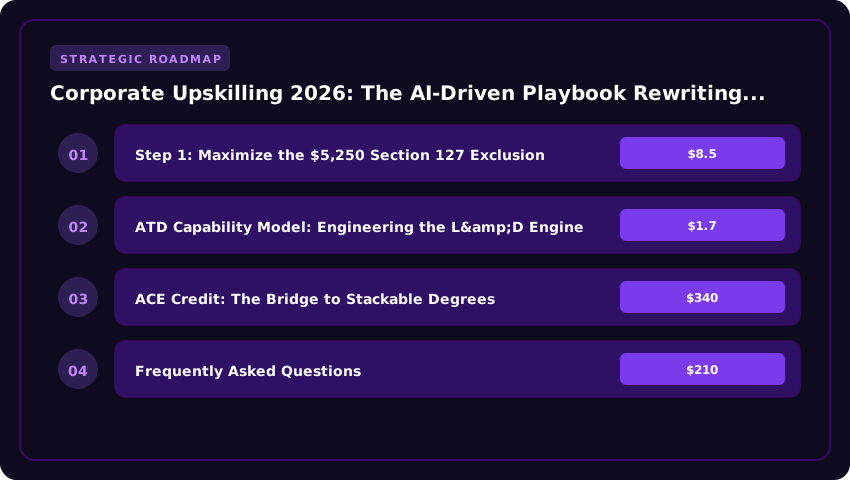
The modern corporate learning stack has evolved far beyond the static, compliance-heavy Learning Management Systems (LMS) of the early 2000s. As US enterprises allocate an average of $1,400 to $1,900 per employee annually toward talent development, decision-makers must now architect a sophisticated ecosystem that blends content aggregation, skill intelligence, and generative AI simulation. Understanding the distinct roles of the modern Learning Experience Platform (LXP), the traditional LMS, and emerging AI Coach ecosystems is the foundational step toward maximizing Workforce ROI in 2026.
Historically, the LMS functioned as the system of record—the regulated vault where human resources departments tracked Sexual Harassment Prevention training, OSHA certifications, and mandatory continuing education. While platforms like Cornerstone and Workday Learning still dominate this space due to their deep integration with Human Capital Management (HCM) suites, they are no longer sufficient on their own. The modern architecture demands a layered approach where the LMS manages compliance, the LXP curates the learning journey, and the AI Coach delivers real-time, on-the-job reinforcement. Choosing a vendor without mapping these three layers is the fastest path to shelfware and wasted budget.
When conducting a deep-dive vendor evaluation, leaders should weigh the following critical criteria before signing an enterprise agreement:
- API Interoperability with Core HRIS Systems: Does the platform offer robust, pre-built connectors for Workday and SAP SuccessFactors? A learning ecosystem that cannot seamlessly sync employee data, job codes, and compensation grades will create massive administrative friction and prevent accurate skill-gap reporting.
- xAPI and cmi5 Compliance: Legacy SCORM standards are obsolete. Verify that vendors like Degreed and Sana Labs support Experience API (xAPI) to capture granular, cross-platform learning data—from virtual reality simulations to informal mentoring moments.
- Generative AI Simulation Engines vs. Static Content Libraries: The 2026 playbook has fundamentally shifted from selling pre-recorded video courses to delivering dynamic, prompt-based roleplay environments. Does the vendor own proprietary large language models, or are they simply wrapping third-party APIs?
- Data Sovereignty and US Privacy Compliance: With shifting state-level AI legislation, ensure the vendor provides clear data residency guarantees, SOC 2 Type II certification, and transparent model training policies that protect proprietary corporate data.
- Total Cost of Ownership (TCO) and ROI Modeling: Scrutinize pricing models. Are you paying per-seat for passive content access, or per-engagement for active AI coaching? Aligning the billing structure with measurable performance outcomes is essential for proving ROI to the C-suite.
Ultimately, the goal of this architectural shift is to transition the learning and development function from a cost center into a measurable, strategic growth engine. A well-designed stack does not just host courses; it actively closes competency gaps, predicts attrition risks, and delivers a highly engaging employee experience that secures top US talent in a fiercely competitive labor market.
Funding the Revolution: Leveraging Section 127, WIOA, and Apprenticeship Levies
Smart organizations know that upskilling budgets are not just line items—they are strategic capital investments with distinct tax advantages. In 2026, the playbook for maximizing ROI starts with three pillars: IRS Section 127, the Workforce Innovation and Opportunity Act (WIOA), and DOL-registered apprenticeships. Mastering the mechanics of each unlocks a funding stack that can cover 80% to 100% of your training spend.
Step 1: Maximize the $5,250 Section 127 Exclusion
This is your baseline. Under IRS Code Section 127, employers can provide up to $5,250 per employee annually in tax-free educational assistance. This applies to tuition, fees, books, and equipment—even for graduate-level work or non-degree certificates aligned with AI and data literacy. The funds are excluded from the employee’s W-2 wages and are deductible by the business as a business expense.
- Action Item: Verify your written plan document is current. The IRS requires a separate, written plan that does not favor highly compensated employees (non-discrimination testing).
- Pro Tip: Pair this with 529 plan rollovers (SECURE Act 2.0). Employees can now roll unused 529 funds into a Roth IRA, making your Section 127 benefit a powerful retention hook for younger talent burdened by student debt.
- Compliance Check: Ensure courses are not for “hobby” or “general knowledge.” Document the business nexus—e.g., “Prompt Engineering for Marketing Automation” qualifies; “Creative Writing” likely does not.
Step 2: Tap State-Level WIOA Incumbent Worker Training (IWT) Funds
While Section 127 handles the tax side, WIOA Title I handles the cash flow. Every state receives formula funding for Incumbent Worker Training, designed to upskill current employees and prevent layoffs. In 2026, many states (including California, Texas, Ohio, and North Carolina) have streamlined applications via online portals like CalJOBS or WorkInTexas.
- Eligibility: Typically requires the employer to pay a share (often 10–50% based on company size) and commit to retaining trained workers for a set period (usually 6–12 months).
- Mechanics: Contact your Local Workforce Development Board (LWDB). They act as the fiscal agent. You submit a training plan detailing the curriculum, provider (must be on the Eligible Training Provider List/ETPL), and competency outcomes.
- Speed Hack: Pre-identify providers on the ETPL before applying. If your preferred vendor (e.g., a specific AI bootcamp) isn’t listed, ask the LWDB to add them—this takes 30–60 days but unlocks recurring funding cycles.
Step 3: Register a DOL Registered Apprenticeship Program (RAP)
This is the highest-leverage move for 2026. A Registered Apprenticeship Program (RAP) validated by the U.S. Department of Labor (DOL) or a State Apprenticeship Agency (SAA) unlocks federal tax credits (up to $5,000–$7,500 per apprentice via the Work Opportunity Tax Credit and state-specific credits like California’s CA Apprenticeship Tax Credit), GI Bill approval for veterans, and direct grant access (e.g., Apprenticeship Building America grants).
- Structure: Define a Work Process Schedule (on-the-job learning) and Related Technical Instruction (RTI) (classroom/online). For AI roles, RTI often maps to CompTIA, (ISC)², or cloud vendor certs (AWS/Azure/GCP).
- Registration: Submit ETA Form 671 (or state equivalent) with your standards. Approval takes 60–90 days. Use the DOL’s RAPIDS system for tracking.
- Intermediary Support: Don’t build alone. Partner with a DOL-recognized Industry Intermediary (like Apprenti, Franklin Apprenticeships, or local community college consortia). They handle compliance, mentor training, and reporting—reducing your admin burden to near zero.
Bottom Line: Stack them. Use WIOA IWT grants to pay the training vendor, Section 127 to cover books/certs tax-free for the learner, and RAP status to claim tax credits and access veteran talent pipelines. That is how you fund the revolution without breaking the balance sheet.
Measuring What Matters: Kirkpatrick Level 4 & 5 Analytics for the C-Suite
For decades, corporate learning has been judged by a deceptively simple metric: completion rates. But as we look toward 2026, the C-suite is demanding a more rigorous accounting of human capital investments. Much like how US universities must demonstrate value beyond mere enrollment figures—proving outcomes through ABET or AACSB accreditations and post-graduation employment data—corporate training programs must now prove their bottom-line impact. We are entering the era of Kirkpatrick Level 4 (Results) and Level 5 (ROI) analytics, where learning is measured not by who showed up, but by how it transforms the business.
To build a future-proof workforce, leaders must balance leading indicators with lagging indicators. Leading indicators are your early warning system, revealing how quickly your workforce is adapting to new demands. Two critical metrics here are skill velocity—the time it takes an employee to reach proficiency in a new AI-driven competency—and the internal mobility rate. When employees can seamlessly pivot into new roles, it mirrors the agility of students navigating the FAFSA and College Board systems to optimize their educational pathways; it shows proactive engagement and systemic health. High internal mobility directly correlates with reduced hiring friction and accelerated project deployment.
Conversely, lagging indicators confirm the financial payoff of your upskilling initiatives. These are the hard numbers that finance officers care about. The most telling lagging metrics include revenue per employee and attrition cost avoidance. Consider the math: replacing a mid-level technical professional can cost up to $50,000 in recruiting, onboarding, and lost productivity. If a $2 million upskilling program prevents the turnover of 50 key engineers, it has already paid for itself before even factoring in the increased revenue generated by their newly acquired AI proficiencies.
To operationalize these metrics, organizations must transcend static spreadsheets and build dynamic dashboards using tools like Tableau or Microsoft PowerBI. By directly linking these visualization platforms to your Human Capital Management (HCM) data—such as Workday or SAP SuccessFactors—you create a single source of truth. This integration allows executives to visually trace a direct line from a specific AI training module to a measurable bump in quarterly revenue or a dip in departmental attrition.
- Audit Your Current Metrics: Immediately retire “completion rate” as your primary KPI. Shift your reporting to focus on Kirkpatrick Level 4 and 5 outcomes.
- Track Skill Velocity: Measure the days from training initiation to demonstrated on-the-job application. Faster velocity means faster ROI.
- Quantify Attrition Avoidance: Calculate the exact dollar amount saved by retaining upskilled talent versus the cost of external recruitment.
- Integrate HCM Data: Connect your learning management system (LMS) to your HCM via Tableau or PowerBI to give the C-suite real-time visibility into workforce ROI.
Accreditation & Quality Assurance: Aligning with SHRM, ATD, and ACE Standards
In the high-stakes arena of corporate upskilling, a certificate of completion is no longer enough. For your 2026 playbook to deliver genuine ROI, every internal bootcamp and external partnership must withstand rigorous external scrutiny. This is where the “alphabet soup” of SHRM, ATD, and ACE transforms from bureaucratic noise into your primary quality assurance infrastructure. Aligning with these bodies ensures your learning architecture speaks the same language as HR leaders, hiring managers, and university registrars.
SHRM BASK: The Strategic Anchor for HR & Leadership Tracks
The Society for Human Resource Management Body of Applied Skills and Knowledge (BASK) is the gold standard for validating people-leadership curricula. If your upskilling program targets managers, HR business partners, or organizational development roles, mapping your learning objectives to BASK functional areas—Talent Acquisition, Learning & Development, Total Rewards—is non-negotiable. The alignment process requires a granular crosswalk: every module, simulation, and assessment must tag back to specific BASK behavioral competencies (e.g., “Consultation” or “Analytical Aptitude”). This does two things instantly: it qualifies your program for SHRM Recertification Provider status (allowing learners to claim Professional Development Credits), and it gives your Chief Human Resources Officer (CHRO) the data to prove the program builds strategic capability, not just tactical compliance.
ATD Capability Model: Engineering the L&D Engine
While SHRM governs the what of HR knowledge, the Association for Talent Development (ATD) Capability Model governs the how of learning execution. Built on three domains—Developing Professional Capability, Impacting Organizational Capability, Building Personal Capability—this model is your blueprint for instructional design quality. Mapping your internal “Train-the-Trainer” or “Instructional Design Sprint” programs to the ATD model ensures your facilitators aren’t just subject matter experts; they are certified learning engineers. Actionable takeaway: Require your vendor partners to demonstrate ATD Capability Model alignment matrices during the RFP phase. If they cannot map their pedagogy to “Learning Sciences” or “Data & Analytics” capabilities, they are a cost center, not an investment partner.
ACE Credit: The Bridge to Stackable Degrees
This is where workforce development meets higher education currency. The American Council on Education (ACE) Learning Evaluations (formerly CREDIT®) is the mechanism that converts your $15,000 internal cybersecurity bootcamp or data analytics immersion into transferable college credit. An ACE credit recommendation signals to regionally accredited universities—from Arizona State University to Southern New Hampshire University—that your corporate training meets the academic rigor of a 300- or 400-level course.
- The Process: Submit a comprehensive dossier: syllabi, instructor CVs, assessment rubrics, and learner work samples.
- The Review: ACE faculty evaluators (active professors from partner institutions) audit for equivalency.
- The Outcome: A transcript entry via the ACE National Guide or Credly/Acclaim digital badge with embedded metadata.
For the learner, this creates a stackable pathway: Corporate Bootcamp → ACE Credit (3–6 semester hours) → Bachelor’s Completion → Master’s Admission. For the employer, it solves the “retention vs. upskilling” paradox—employees stay because they are building a degree, not just a resume line. In 2026, any upskilling budget exceeding $50,000 annually without an ACE evaluation strategy is leaving tuition reimbursement dollars—and federal FAFSA eligibility—on the table.
The 2026 Execution Roadmap: 90-Day Pilot to Enterprise Scale
Strategy decks are easy to write and notoriously hard to execute. The 2026 corporate upskilling landscape rewards organizations that can move from PowerPoint to production in a single quarter, capture measurable ROI on a pilot cohort, and walk into the fiscal year 2027 board meeting with a defensible budget request backed by clean data. This phased implementation plan condenses the most successful enterprise deployments observed across Fortune 500 learning ecosystems into a disciplined 90-day sprint, with each month anchored to a specific deliverable, a clear owner, and a quantifiable exit criterion. Treat this roadmap as the operational backbone of your AI-driven workforce strategy; every conversation with your CFO, CHRO, and CIO should ultimately ladder back to one of these milestones.
Month 1 is about diagnostic precision and cohort discipline. Before a single line of AI-generated curriculum is written, the organization must finalize a future-ready skills taxonomy and select a pilot cohort that is statistically large enough to demonstrate signal but small enough to manage within an agile release cycle. Start by convening a cross-functional skills council representing HR, talent acquisition, the business unit sponsoring the pilot, and the IT data team. This council should ratify a tiered taxonomy of 30 to 60 priority competencies mapped to the company’s three-year strategic plan, with explicit weighting toward generative AI fluency, data literacy, prompt engineering, model evaluation, and human-AI collaboration. Each competency must carry a proficiency rubric aligned to the O*NET framework and validated against the observable tasks your employees will be expected to perform in 2026 and beyond.
- Map every competency to a measurable business outcome: revenue per employee, defect rates, customer satisfaction scores, or cycle time reductions.
- Leverage the Lightcast or Workday Skills Cloud APIs to reconcile internal job descriptions with external labor-market signals from the Bureau of Labor Statistics and Burning Glass.
- Select a pilot cohort of 150 to 300 employees across at least two business units and two regions to ensure statistical relevance.
- Establish a control group of equivalent size that receives no intervention, providing the baseline against which ROI will be calculated.
- Lock the cohort selection by Day 14; any drift beyond Day 21 will compress Month 2 and jeopardize the 90-day timeline.
Month 2 is where AI content generation and human mentorship converge into a production learning experience. With the taxonomy signed off and the cohort committed, the learning and development team partners with the enterprise AI platform team to generate adaptive learning pathways at scale. Using retrieval-augmented generation grounded in your proprietary knowledge base, you can produce personalized modules, scenario-based simulations, and assessment items in days rather than the quarters a traditional curriculum build would require. Pair every AI-generated asset with a human mentor trained in the new pedagogy of AI-augmented instruction. These mentors are not subject-matter experts standing at a whiteboard; they are learning coaches fluent in prompt design, feedback loops, and the ethical guardrails your AI governance committee has established.
- Deploy a private LLM environment with documented model cards, red-team evaluations, and a PII firewall compliant with SOC 2 Type II controls.
- Run a two-day mentor intensive covering Socratic prompting, competency-based assessment, and the responsible use of AI tutoring assistants.
- Roll out the adaptive learning experience in waves of 50 learners per wave, capturing engagement telemetry, time-to-competency, and sentiment scores.
- Conduct mid-pilot pulse surveys on Day 35 and Day 50 to course-correct content, pacing, and mentor assignments before Month 3 measurement.
- Document every intervention in a centralized learning record store, ideally an xAPI-compliant Learning Record Provider integrated with your HRIS.
Month 3 is where the story becomes a number, and the number becomes a budget line. Impact measurement must be ruthless, transparent, and tightly coupled to the financial language your board already speaks. By Day 60, the analytics team should have a clean read on engagement, proficiency gain, behavior change on the job, and hard business outcomes. Build your board presentation around three slides that no CFO can ignore: a Kirkpatrick Level 4 outcome slide showing the delta between the pilot cohort and the control group on a pre-registered business KPI; a financial model slide translating that delta into a fully loaded ROI percentage with payback period in months; and a scale-up slide projecting the cost per employee and the cumulative value at risk if the program is not extended across the full enterprise population in FY27.
- Anchor every claim in pre-registered hypotheses and statistical confidence intervals, not anecdotal success stories.
- Present a sensitivity analysis showing how ROI shifts under conservative, base, and aggressive assumptions about productivity lift and retention impact.
- Include a risk register covering AI model drift, mentor attrition, learner fatigue, and regulatory exposure, each with a named mitigation owner.
- Package the deliverables in a 12-page board memo with a one-page executive summary designed for a five-minute read.
- Request the FY27 budget as a base allocation rather than a pilot extension; this is the moment to graduate from experiment to enterprise capability.
The 90-day cadence is intentionally aggressive because the alternative, a 12-month stealth pilot that never reaches the board, is the single most common failure mode in corporate learning transformations. By compressing skills taxonomy, AI content generation, mentor training, and impact measurement into a single fiscal quarter, you force the organization to make decisions in the open, with real data, against real deadlines. That is how a quiet upskilling initiative becomes the most defensible strategic investment on next year’s board agenda, and how a 2026 pilot becomes the operating system for talent development across the entire enterprise.
| Metric | Traditional Degree (4-Year) | Bootcamp / Certificate | AI-Driven Corporate Upskilling | Self-Paced Online (MOOC) |
|---|---|---|---|---|
| Total Cost (USD) | $110,000 – $160,000 | $10,000 – $20,000 | $2,500 – $15,000 (employer-sponsored) | $0 – $1,200 |
| Duration / Timeline | 48 months | 3 – 9 months | 6 – 16 weeks (modular) | Self-paced (3 – 12 months) |
| Typical Cut-Off / Entry Requirement | SAT/ACT + GPA 3.0+; competitive admissions | Application + aptitude assessment | Manager approval + skills diagnostic | None (open enrollment) |
| Average Salary Uplift | +45% – 65% (long-term) | +20% – 35% (1–2 yrs) | +12% – 28% (within 6 months) | +5% – 15% (variable) |
| Career ROI (5-Year) | ~3.2x | ~4.8x | ~6.5x | ~2.1x |
| Time-to-Placement | 3 – 6 months post-graduation | 1 – 3 months | Immediate (internal role) | 3 – 9 months |
| AI-Readiness Score (2026) | Moderate | High (niche skills) | Highest (role-aligned) | Variable |
Frequently Asked Questions
How much does AI-driven corporate upskilling cost compared to a traditional degree in 2026?
AI-driven corporate upskilling programs in 2026 typically cost between $2,500 and $15,000, with most expenses covered by employers. A traditional four-year US degree averages $110,000 to $160,000. Corporate programs deliver faster ROI, often within six months, making them roughly seven times more cost-efficient for workforce-relevant AI skills.
What is the $8.5 trillion skills gap risk to US GDP by 2030?
According to BLS employment projections and McKinsey Global Institute modeling, the US faces a cumulative $8.5 trillion GDP risk by 2030 due to unfilled AI, data, and advanced technical roles. This figure represents lost economic output, reduced productivity, and missed innovation capacity across nearly every industry sector.
Which upskilling pathway offers the highest career ROI in 2026?
Employer-sponsored AI corporate upskilling programs deliver the highest five-year career ROI at approximately 6.5x, according to 2026 workforce analytics. These programs outperform bootcamps (4.8x), traditional degrees (3.2x), and self-paced MOOCs (2.1x) by aligning training directly with revenue-generating roles and immediate internal placement opportunities.
How long does it take to complete an AI upskilling program in 2026?
Most AI-focused corporate upskilling programs in 2026 run between six and sixteen weeks using modular, stackable formats. Compared to a 48-month traditional degree or 3–9 month bootcamp, these accelerated pathways enable professionals to acquire deployable AI competencies in a single fiscal quarter.
Strategic Final Takeaway
Success in evaluating Corporate Upskilling 2026: The AI-Driven Playbook Rewriting Workforce ROI relies on early preparation, adherence to verified accredited requirements, and cross-referencing official portals. Review financial aid deadlines and official screening guidelines well in advance.

