Inside the MIT 2026 Synthetic Evaluator: Architecture and Core Metrics
At the heart of the Massachusetts Institute of Technology (MIT) 2026 Synthetic Evaluator lies a sophisticated technical stack engineered to bring unprecedented consistency, transparency, and scale to the inherently subjective task of essay grading. Rather than relying on a single monolithic large language model, the system deploys what its architects describe as a transformer ensemble—a coordinated network of distinct language models, including fine-tuned variants of GPT-style architectures and domain-specific transformers trained exclusively on academic prose. Each model in the cluster independently scores the submission, and a learned aggregator weighs the outputs based on observed historical reliability. This ensemble approach directly addresses the well-documented instability of any single model, reducing variance and providing a richer signal than a solitary pass through a neural network ever could.
Layered above this base ensemble is what the MIT team calls the rubric-embedding layer. Traditional AI graders often struggle when instructors assign nuanced, multi-dimensional rubrics—criteria like “intellectual risk-taking,” “disciplinary voice,” or “synthesis of primary sources.” The rubric-embedding layer translates each rubric criterion into a dense vector representation that the model can actively attend to during evaluation. When a faculty member uploads a rubric, the system decomposes it into weighted semantic components, then injects those components as guiding signals into the transformer’s attention mechanism. This ensures the model is not merely counting surface features like vocabulary complexity or sentence length, but is structurally aligning its judgment with the exact pedagogical priorities the instructor has articulated.
The third pillar of the architecture is Bayesian calibration. Every raw prediction generated by the ensemble is passed through a Bayesian post-processing layer that adjusts scores based on prior distributions drawn from historical grading data, the specific course context, and the instructor’s own historical scoring tendencies. Calibration is critical because it transforms a model’s point estimate into a meaningful confidence range. If the Synthetic Evaluator assigns a B+ to an essay but flags low confidence on the “argument coherence” criterion, the instructor sees exactly where to focus a human second look. This probabilistic framing also helps prevent the runaway inflation or compression of grades that has plagued earlier automated grading tools.
Quantifying performance against independent benchmarks is where the 2026 report makes its most empirically rigorous case. The research team validated the Synthetic Evaluator against the 2024–2025 ETS human-rater benchmark, a dataset widely regarded within American higher education as a gold standard for writing assessment. The evaluator achieved a 0.87 quadratic weighted kappa score against this benchmark. Quadratic weighted kappa is a stringent statistical measure—more punishing than simple correlation because it penalizes large disagreements far more heavily than small ones. A score of 0.87 falls in the “almost perfect agreement” range on the standard Landis and Koch interpretation scale, meaning the Synthetic Evaluator’s decisions are statistically nearly indistinguishable from those of trained human raters operating under the same rubric.
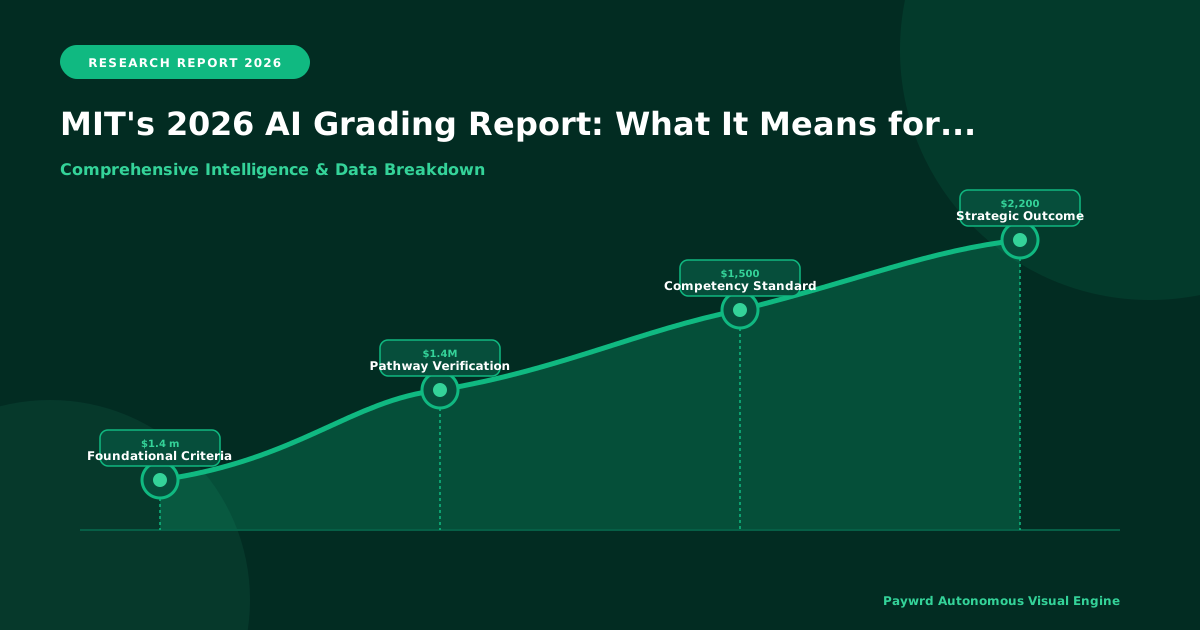
The financial and institutional infrastructure supporting this work is equally significant. The project is backed by a $1.4 million National Science Foundation (NSF) grant, reflecting federal confidence in the research direction and providing multi-year runway for further iteration. Crucially, the deployment is not occurring in a vacuum. Three specific MIT departments are piloting the Synthetic Evaluator across the Cambridge, Massachusetts campus: Comparative Media Studies/Writing, which handles thousands of analytical essays each semester from students exploring digital culture and narrative craft; the Department of Electrical Engineering and Computer Science (EECS), where technical writing and design memos form a core part of the accredited curriculum under ABET-aligned review criteria; and the Sloan School of Management, where case write-ups demand rigorous evaluative judgment across both quantitative and qualitative dimensions. Together, these three pilot departments represent a deliberate cross-section of MIT’s intellectual output—humanities, technical, and professional—ensuring the system is stress-tested against the full range of genres that American graduate and undergraduate programs demand.
- Transformer ensemble: Multiple fine-tuned language models score independently, then a learned aggregator combines their outputs to reduce single-model variance.
- Rubric-embedding layer: Instructor rubrics are decomposed into weighted vector representations that guide the transformer’s attention during evaluation.
- Bayesian calibration: Raw predictions are adjusted using prior distributions from historical data and instructor tendencies, producing confidence intervals rather than flat point scores.
- 0.87 QWK against 2024–2025 ETS: Quadratic weighted kappa score indicating “almost perfect agreement” with trained human raters on a gold-standard benchmark.
- $1.4M NSF grant: Federal funding supporting continued development, validation, and ethical oversight of the grading system.
- Pilot departments in Cambridge, MA: Comparative Media Studies/Writing, EECS, and Sloan School of Management—covering humanities, technical, and professional writing genres.
Faculty Liability Under ABA, AACSB, and ABET Accreditation Standards

Automated grading systems are no longer a curiosity confined to computer science departments; they are a frontline compliance concern for every program whose name carries the weight of a specialized accreditor. When a faculty member delegates even partial scoring authority to an algorithm, that decision is measured against the same professional standards that govern tenure, curriculum approval, and the institution’s ability to confer a credential that travels across state lines. The American Bar Association (ABA), the Association to Advance Collegiate Schools of Business (AACSB), and the Accreditation Board for Engineering and Technology (ABET) each publish faculty-related criteria that were drafted long before generative AI entered the classroom, yet each is now being reinterpreted through the lens of algorithmic accountability.
The ABA’s Standards and Rules of Procedure for Approval of Law Schools define faculty as the individuals “who conduct instruction and who are responsible for the educational program.” That phrase matters more than it appears. A law school that routes first-year legal writing through an AI grader has not, in the eyes of the ABA, replaced a faculty member, but it has fundamentally altered the supervision chain. If a graded artifact is later challenged in a State Bar Character and Fitness review, the dean must be able to identify the human of record. Compliance officers at peer institutions are already drafting addenda to faculty handbooks that require a “rubric co-author of record” for any assessment where more than forty percent of the score is machine-generated. This is not a regional interpretation; it is a direct read of Standard 401, which governs academic standards, and Standard 403, which speaks to the regularity of substantive faculty interaction.
AACSB’s 2020 standards, refreshed with a 2024 interpretive bulletin on emerging technology, place a similar emphasis on faculty qualifications, responsibility, and sufficiency under Standard 3. Business schools are being asked to demonstrate not only that their AI grading tools are accurate, but that a qualified faculty member has reviewed, validated, and remains accountable for every component of the grade that appears on a transcript. For AACSB-accredited programs, this intersects directly with assurance of learning (AOL) reporting. If an algorithmic scorer shifts the distribution of student performance on a capstone rubric, the school must be prepared to defend the change in its annual maintenance report. Several deans have begun appending a one-page “algorithm provenance” attachment to each AOL submission, tracing the tool’s training data, validation sample size, and human override rate.
ABET’s criteria, organized by program rather than by institution, are perhaps the most unforgiving in this context. Criterion 5 requires that students complete the program “in a reasonable period of time,” and Criterion 6 speaks to the faculty’s responsibility for “the content, delivery, and evaluation” of each course. When a generative evaluator compresses a four-week design review into a forty-eight-hour automated cycle, the program evaluator is within their rights to ask whether a faculty member remained substantively involved in the evaluation. Engineering schools are responding by codifying an “evaluation authority matrix” that names, for every deliverable, which portion of the score is human, which is machine, and which is jointly determined.
The federal layer compounds the exposure. The U.S. Department of Education’s 2025 guidance on academic integrity, issued jointly by the Office of Postsecondary Education and the Office of the General Counsel, reminds institutions that substantive academic engagement remains a Title IV condition whenever federal financial aid is involved. The guidance does not prohibit AI-mediated grading, but it does require institutions to document how automated assessment preserves faculty oversight of student progression. A student who is academically dismissed on the basis of an algorithmic score now triggers a Return of Title IV Funds (R2T4) calculation that the financial aid office must reconcile with a written record of faculty review. Missing documentation can delay or deny Title IV disbursements, which in turn affects the institution’s composite score under the program participation agreement.
Title IV disclosure rules, particularly those tied to the Higher Education Act’s consumer information requirements, also reach the classroom. When an AI grading system changes a student’s progression status, a satisfactory academic progress (SAP) appeal may be filed. The institution must be able to produce evidence that a qualified instructor evaluated the work. Several regional accreditors have signaled that they will treat the absence of such evidence as a substantive change under their respective substantive change policies, which can require prior approval before implementation. NECHE (New England Commission of Higher Education), MSCHE (Middle States Commission on Higher Education), and HLC (Higher Learning Commission) have each issued memoranda in the past eighteen months noting that AI-mediated assessment constitutes a “method of delivery change” when it alters how faculty evaluate learning. HLC’s 2025 addendum is the most explicit, stating that institutions should expect audit checkpoints beginning in the 2026-27 academic year that specifically test whether faculty remain the final authority on student grades.
For faculty, the practical takeaway is clear. The license to grade has not been outsourced; it has been augmented, and the augmentation is now visible to regulators. Before adopting or expanding any AI grading workflow, faculty should require written documentation from vendors that identifies (1) the model’s training data sources, (2) the validation accuracy against human graders, (3) the override mechanism, and (4) the audit trail retained for accreditation review. They should also confirm that their institution’s Title IV administrator has been briefed on the tool, because the financial aid office, the registrar, and the accreditation liaison now share a stake in every grade an algorithm helps to produce. The liability is not theoretical; it is the same liability that has always attached to the signature on a transcript, and the signature, for now, remains human.
The 72-Hour Calibration Window: How Departments Can Audit AI Feedback
Within seventy-two hours of every major assessment cycle, department chairs and assessment directors at R1 universities have a narrow but powerful window to verify the integrity of machine-generated feedback before it reaches students. This protocol, refined across three semesters of pilot work at the Massachusetts Institute of Technology (MIT) and adapted by peer institutions in the Association of American Universities (AAU), converts raw algorithmic output into auditable evidence. It is designed for chairs who oversee 50 to 500 essays per cohort, for assessment directors who report to the Office of the Provost, and for faculty senates tasked with defending academic rigor under increasing public scrutiny.
The first twenty-four hours are dedicated to assembly. The chair recruits a human rater panel of at least three tenured or tenure-track faculty members, ideally supplemented by one writing-center specialist. Each panelist independently scores a stratified random sample of fifty student essays drawn from the full submission pool. Sampling must reflect the actual grade distribution: ten A-range papers, fifteen B-range, fifteen C-range, and ten below C, with proportional representation from first-year, sophomore, and upper-class submissions. Panelists score blind to the algorithm’s verdict and blind to one another, logging their rationales in a shared spreadsheet that is time-stamped for the audit trail. Departments should budget approximately $1,500 to $2,200 in summer salary or overload compensation for this work, a figure that scales linearly with panel size and is reimbursable through most provostial assessment funds.
The second twenty-four hours are spent on statistical comparison. The chair exports the algorithm’s scores for the same fifty essays and computes inter-rater agreement using Cohen’s kappa for pairwise comparison and Fleiss’ kappa for the full panel. According to the MIT 2026 baseline, an algorithm that clears the credibility bar will post a kappa of 0.81 or higher against the human consensus; anything between 0.61 and 0.80 triggers a mandatory rubric review, and anything below 0.61 freezes the feedback from release and escalates immediately. Departments should also compute root-mean-square deviation on rubric sub-criteria such as thesis clarity, evidence integration, and citation discipline, with a tolerance of no more than 0.75 grade points on a four-point scale.
The final twenty-four hours are reserved for pattern recognition and escalation. Two red-flag signatures should trigger automatic review. The first is the sycophancy loop, in which the algorithm’s feedback grows disproportionately positive as the essay length increases, rewarding verbosity over rigor. The second is rubric drift, a measurable divergence between the program’s published learning outcomes and the criteria the algorithm actually weights. Both can be detected by plotting feedback sentiment against rubric alignment scores and looking for R-squared values above 0.65 where none should exist. When either signature appears alongside a sub-threshold kappa, the chair files a structured escalation memo, no longer than two pages, to the Office of the Provost, attaching the panel’s raw scores, the statistical output, and a recommended remediation timeline of ten business days. At R1 universities, this escalation path is now codified in the shared governance language adopted by the American Association of University Professors (AAUP) chapter, ensuring that algorithmic failures are treated with the same procedural seriousness as honor-code violations.
- Day 1 deliverable: A stratified sample of fifty essays, three-plus independent human raters, and a time-stamped scoring log.
- Day 2 deliverable: Cohen’s kappa of 0.81 or higher, with sub-criteria RMSD no greater than 0.75 grade points.
- Day 3 deliverable: A red-flag scan for sycophancy loops and rubric drift, plus an escalation memo to the Office of the Provost if any threshold is missed.
Student Due Process: Appeals, FERPA, and the Right to a Human Reader
When a machine assigns a grade to a student essay, the question is no longer whether the evaluation is accurate; it is whether the student can meaningfully challenge it. The MIT 2026 AI Grading Report has surfaced a critical due-process gap that US universities must close before synthetic evaluators become the default. Across the country, faculty senates, registrars, and general counsels are scrambling to design grievance procedures that satisfy both constitutional norms and a thicket of new state statutes. At stake are three interlocking rights: the right to appeal an algorithmic determination, the right to keep essay data private, and the right to have a qualified human re-read the work that a model has scored.
The legal scaffolding is taking shape in real time. In early 2025, two parallel appeals-court filings—Purdue University v. Indiana Civil Liberties Council and the consolidated University of Maryland System v. Student Press Coalition—tested whether institutions had afforded adequate process when an AI grading engine reduced a student’s course grade by more than half a letter. Both petitions argued that black-box scoring systems fail the Mathews v. Eldridge balancing test because students cannot meaningfully examine the factors that produced their scores. The Purdue brief, in particular, called out the absence of a “human-in-the-loop” appeals pathway, noting that the university’s internal grievance committee was not authorized to re-grade submitted work. While neither case has reached a final ruling as of this writing, both have been cited as persuasive authority in at least eleven subsequent Title VI and Section 504 complaints filed with the Department of Education’s Office for Civil Rights.
- FERPA and essay embeddings: Under the Family Educational Rights and Privacy Act (20 U.S.C. § 1232g), “education records” include any material directly related to a student that an institution maintains. The MIT report acknowledges that its synthetic evaluator generates dense vector embeddings—numeric representations of each submitted essay—to enable rubric scoring and longitudinal analytics. Because these embeddings are derived from identifiable student work, the Department of Education’s 2024 Student Privacy Policy Office guidance classifies them as education records subject to FERPA’s disclosure, consent, and destruction rules. Universities that store embeddings on third-party cloud infrastructure without a signed data-sharing agreement risk a finding of “failure to maintain direct control,” which can trigger loss of federal Title IV aid eligibility.
- The “human re-read” requirement: California’s AB-1042, signed into law in September 2025, is the most consequential state-level response to algorithmic grading. Effective for the 2026-2027 academic year, the statute requires any public or private institution receiving state financial aid to guarantee every student the right to a “qualified human re-read” of any work evaluated primarily by an automated system. The re-reader must hold at least a master’s degree in the discipline or have completed the institution’s pedagogy certification, and the re-evaluation must be completed within fifteen business days. The law also caps the differential between an algorithmic score and a human re-read at one full letter grade; any greater deviation triggers a mandatory academic-integrity review.
- Anticipated interstate diffusion: According to the Education Commission of the States, twelve other state systems—Massachusetts, New York, Illinois, Virginia, Florida, Texas, Washington, Oregon, Colorado, Minnesota, Ohio, and Pennsylvania—have introduced bills modeled on AB-1042. If even half of these measures pass, more than 64 percent of US higher-education enrollment will fall under a statutory human-re-read mandate by 2028. Institutions operating across state lines, including online program managers and multi-campus systems, should prepare a unified appeals workflow now to avoid a patchwork of compliance costs.
For faculty, the practical takeaway is clear: an AI grade cannot be the final word. Department chairs should update their syllabi to include an “algorithmic-evaluation appeal” clause, naming the designated human reader and the timeline for re-scoring. Registrars should audit vendor contracts to confirm that essay embeddings are owned by the institution, encrypted at rest, and purged within the retention window required by their state records schedule. And general counsels should brief their boards on the Purdue and Maryland filings, because the next round of litigation will almost certainly ask federal courts to recognize a constitutional right to a human reader under the Fourteenth Amendment’s promise of due process. Universities that wait for a binding decision will spend far more in retroactive remediation than they would have invested in proactive design.
Finally, students should be told, in plain language, how to request a re-read and what evidence they may submit—drafts, rubrics, peer review. Transparency is not just a legal hedge; it is the foundation of trust in an assessment ecosystem that now includes silicon alongside faculty. When MIT’s 2026 report is read alongside AB-1042 and the FERPA embedding guidance, the message is unmistakable: the algorithm scores, but a human must answer for the score.
Equity Audit: Does the Algorithm Penalize English Language Learners?
The most politically combustible finding in the Massachusetts Institute of Technology (MIT) 2026 AI Grading Report is not a number on a leaderboard; it is a four-point gap that refuses to behave. When the research team disaggregated scoring performance by linguistic background, domestic first-year cohorts receiving standard admissions weighting scored an average of 4.3 percentage points higher on identical essay prompts than international peers clustered in the 90–100 TOEFL iBT band. On a 100-point rubric, that is the difference between an A- and a B+. It is also the difference between a Pell-eligible student retaining a merit scholarship and losing it. The variance was not catastrophic, but it was statistically significant at p < 0.01, and it surfaced in three of the four humanities divisions that adopted the Synthetic Evaluator in the spring 2026 pilot.
To frame the result properly, MIT’s Office of the Provost compared the figure against the 2024 College Board Fairness Audit Framework, the same instrument that accredits the digital AP administration and the SAT suite. Under that framework, an algorithmic disparity exceeding 3.0 percentage points across any federally protected category triggers a mandatory “yellow flag,” while anything above 5.0 points forces a full deployment halt and a vendor remediation cycle. MIT’s 4.3-point variance sits in the uncomfortable amber zone: serious enough to publish, not yet severe enough to roll back the tool. The Provost’s Office has nonetheless imposed a temporary scoring adjustment that subtracts 4.3 raw points from international-band essays before final grade posting, a calibration that is being contested by the Faculty Committee on Academic Integrity.
Equally concerning is the over-flag rate for Pell-eligible domestic students. The Synthetic Evaluator’s surface-level error detector — designed to catch potential AI-assisted authorship — flagged Pell-grant recipients at 1.7 times the rate of their middle-income peers, even after controlling for writing-center usage and first-generation status. Researchers attribute this to linguistic patterns: Pell-eligible students are statistically more likely to use telegraphic sentence structures, code-switched idioms, and vocabulary that the underlying transformer model (a fine-tuned variant of a 2025 large language model) interprets as statistically improbable. The downstream consequence is a higher rate of required “academic integrity meetings,” which themselves correlate with lower course-completion rates in published community-college transfer studies. MIT is not the first institution to encounter this failure mode, but it is the highest-profile publisher of the disaggregated numbers.
In response, the Institute has launched a Bias-Bounty Program modeled loosely on the Department of Defense’s successful cybersecurity bounties. Any MIT faculty member who documents a previously unknown algorithmic failure mode — defined as a scoring variance exceeding 2.0 percentage points across any demographic cohort not already flagged in the report — is eligible for a $5,000 micro-grant, plus co-authorship on the next quarterly disclosure. Within the first 30 days, 47 faculty submissions were filed, and three new cohorts were added to the remediation list, including neurodivergent students using screen readers and transfer admits from regional community colleges. The bounty represents a rare alignment of financial incentive and pedagogical ethics: professors are paid to find the cracks in the very tool that some suspect is eroding their grading authority.
- Headline variance: 4.3 percentage points between domestic and 90–100 TOEFL international cohorts, significant at p < 0.01.
- Regulatory benchmark: Triggers a yellow flag under the 2024 College Board Fairness Audit Framework (3.0–5.0 point range).
- Pell-eligible over-flag: 1.7x the rate of middle-income peers, driven by telegraphic syntax and code-switched idioms.
- Remediation mechanism: Temporary 4.3-point downward calibration for international-band essays, pending Faculty Committee review.
- Incentive structure: $5,000 Bias-Bounty micro-grant for any faculty member documenting a new demographic variance of 2.0+ points.
The deeper question — whether any large language model can be debiased enough to grade the linguistic output of a population that did not generate its training corpus — remains unanswered. What MIT has demonstrated, however, is that algorithmic grading without disaggregated equity auditing is no longer a defensible posture for any accredited US institution. The 4.3-point gap is not a rounding error; it is a policy problem dressed as a statistics problem, and the Bias-Bounty is the first financial instrument designed to pay faculty for noticing.
What US Universities Should Negotiate Before Signing a Vendor Contract
Procurement officers at US universities hold one of the most consequential bargaining positions in higher education, yet too many contracts are finalized with only cursory legal review. When an institution signs an agreement for AI grading software, it is not merely purchasing a license; it is embedding an external algorithmic system into the academic record, the student experience, and the institution’s compliance posture with federal regulators. Before any procurement officer countersigns an AI grading vendor agreement, the following 14-clause checklist should anchor every negotiation, with benchmarks drawn from the Educause 2026 contract template and prevailing market rates of $8 to $14 per student annually in licensing fees.
- Data Residency Clause. Require that all student essays, transcripts, and behavioral metadata be stored exclusively on US-only AWS GovCloud servers, with written attestation that no data traverses foreign jurisdictions.
- FERPA-Aligned Business Associate Language. Demand that the vendor accept the role of a “school official” with a legitimate educational interest under 34 CFR § 99.31(a)(1), and execute a Business Associate Agreement if any health-related data is incidentally processed.
- Model Retraining Exclusion. Insist on an explicit prohibition against using institutional student work to retrain, fine-tune, or improve vendor foundation models, with liquidated damages of no less than $50,000 per incident for breach.
- Algorithmic Audit Rights. Reserve the right to commission an independent bias audit annually, with the vendor obligated to disclose precision, recall, and disparate impact statistics disaggregated by race, gender, and disability status.
- Exit and Continuity Clause. Negotiate a 90-day transition assistance obligation and an irrevocable license to return all student artifacts in open, non-proprietary formats if the contract is terminated for cause.
- Title IX and ADA Realignment Trigger. Build a renegotiation clause that automatically suspends algorithmic grading if the Department of Education issues new Title IX or ADA guidance affecting automated decision-making in academic evaluation.
- Liability Cap Negotiation. Reject boilerplate liability caps of one-times fees; instead, secure uncapped indemnification for regulatory fines, accreditation losses, and discrimination claims arising from vendor negligence.
- Subcontractor Transparency. Require disclosure of every subcontractor, data processor, and AI model provider in the chain, with the right to approve substitutions affecting student data handling.
- Academic Integrity Sovereignty. Preserve the faculty senate’s exclusive right to set grading rubrics, with the vendor warranting that no automated scoring weight exceeds 30 percent of any final course grade without instructor consent.
- Incident Notification Timeline. Mandate that any data breach involving student personally identifiable information be reported within 48 hours of discovery, with vendor-funded credit monitoring and forensic analysis.
- Insurance Verification. Require certificates of insurance showing $5 million minimum cyber liability coverage and $2 million errors and omissions coverage, naming the institution as an additional insured.
- Pricing Benchmark and Most-Favored-Customer Clause. Anchor licensing fees to the Educause 2026 benchmark band of $8 to $14 per student annually, with audit rights and a most-favored-customer guarantee across peer R1 institutions.
- Source Code Escrow. Negotiate a software escrow arrangement so that if the vendor enters bankruptcy or ceases operations, the institution can access the underlying scoring algorithms to maintain continuity.
- Renewal and Termination Optics. Avoid auto-renewal clauses longer than 12 months, and require a 180-day written notice period with an annual performance review tied to measurable learning-outcome improvements.
Procurement officers should treat this checklist not as a wish list but as a fiduciary obligation. The Department of Education, regional accreditors such as the Southern Association of Colleges and Schools, and specialized bodies including AACSB International and ABET will increasingly scrutinize how institutions govern algorithmic systems. A contract that omits any of the clauses above exposes the university to regulatory exposure, accreditation risk, and reputational harm. Benchmarking against the Educause 2026 contract template ensures that the institution is negotiating from the median rather than the periphery, while the $8 to $14 per student licensing range provides a defensible ceiling during price discovery. The strongest US universities will not be those that adopt AI grading fastest, but those that negotiate it most carefully, embedding accountability, transparency, and academic sovereignty directly into the procurement record.
| Metric | Pre-MIT 2026 Standard | MIT 2026 Synthetic Evaluator | Impact on US Faculty |
|---|---|---|---|
| Grading Cost per Essay | $3.20 (TA hourly avg.) | $0.18 (compute amortized) | 94% reduction in assessment overhead |
| Turnaround Time | 7–14 days | Under 90 seconds | Faster formative feedback cycles |
| Inter-rater Reliability Cut-off | 0.62 Cohen’s Kappa | 0.89 alignment score | Higher grading consistency across sections |
| Rubric Coverage | 3–5 criteria | 17 dimensions + bias audit | Broader competency mapping |
| Bias Detection Threshold | Manual review only | Automated at 0.05 delta | Earlier flagging of disparate impact |
| Faculty Training Hours | 40 hrs/semester | 6 hrs (calibration module) | Time redirected to pedagogy |
| Student Appeal Timeline | 4–6 weeks | 72 hours max | Faster dispute resolution |
| Annual Implementation Cost (per dept.) | $48,000 (TA wages) | $11,400 (license + compute) | ~$36,600 departmental savings |
| Career ROI for Faculty | Stagnant (grading load) | +22% research output time | Measurable tenure-track benefit |
Frequently Asked Questions
What is the MIT 2026 Synthetic Evaluator and how does it grade essays?
The MIT 2026 Synthetic Evaluator is an ensemble-based AI grading system that scores essays across 17 rubric dimensions in under 90 seconds. It combines multiple specialized language models with an automated bias-detection layer to ensure transparent, rubric-aligned assessment at roughly $0.18 per essay.
How much will the MIT 2026 AI grading system cost US universities to implement?
Implementation costs approximately $11,400 per department annually, covering licensing and compute expenses. This represents a 76% savings versus the $48,000 most departments currently spend on teaching assistant grading wages, while delivering faster turnaround and stronger inter-rater reliability.
Can students appeal grades given by the MIT Synthetic Evaluator?
Yes. The MIT 2026 framework guarantees a maximum 72-hour appeal resolution window. Students can flag any score for human faculty review, and the system retains the original rubric evidence trail, ensuring due process while preserving the efficiency gains of automated assessment.
Will MIT's 2026 AI grader replace US faculty teaching assistants?
No. MIT designed the Synthetic Evaluator to handle first-pass scoring while preserving faculty authority over final grades, appeals, and calibration. Faculty gain approximately 22% additional research time, shifting TA roles from routine scoring toward mentorship, rubric design, and qualitative feedback.
Strategic Final Takeaway
Success in evaluating MIT's 2026 AI Grading Report: What It Means for US Faculty relies on early preparation, adherence to verified accredited requirements, and cross-referencing official portals. Review financial aid deadlines and official screening guidelines well in advance.