If you have walked past a corporate learning portal lately, you have probably noticed something striking: the elective “Intro to ChatGPT” webinar from 2023 has quietly vanished. In its place sits a required compliance module titled something like “Generative AI Governance and Prompt Literacy,” assigned to every analyst, manager, and director in the company. This is not a coincidence. It is a structural recalibration of how American corporations measure workforce readiness.
Why US Employers Are Now Mandating AI Fluency Across Corporate Teams
From Optional Workshops to Required L&D Budget Lines
For decades, corporate learning and development functioned like a buffet. Employees grabbed a leadership seminar here, a PowerPoint refresher there, and nobody tracked whether anyone actually ate. That model collapsed once generative AI tools hit mainstream enterprise stacks in late 2023. According to updated benchmarks from the Society for Human Resource Management (SHRM) and the American Society for Training and Development (ATD), Fortune 500 L&D budgets are now allocating between 8% and 14% of total training spend specifically to AI literacy, up from less than 1% just three years prior.
More importantly, the language in boardroom memos has shifted. AI upskilling is no longer filed under “innovation pilots.” It sits beside cybersecurity training and harassment prevention as a mandatory competency, tracked in the same HRIS dashboards that monitor sexual harassment training completion rates.
SHRM-Aligned Competency Frameworks Now Rank Prompt Engineering Alongside Excel
The most telling signal comes from updated SHRM competency models, which now place “AI Interaction and Prompt Engineering” in the same tier as spreadsheet proficiency, data visualization, and project management. For HR leaders, this changes everything. When a skill is codified in a SHRM-aligned framework, it becomes defensible during performance reviews, promotion cycles, and even wrongful-termination disputes.
Major employers, including members of the Business Roundtable and signatories to the US Chamber of Commerce Talent Pipeline initiative, are already publishing internal career ladders where “AI Fluency Level 1, 2, and 3” appears alongside years of tenure. Recruiters using the federal O*NET database will notice that new 2026 occupation profiles list AI tool usage under “Required Skills” rather than “Optional Technologies.”
Risk Mitigation Is the Real Driver Behind Board-Level Funding
Behind every mandatory AI training rollout sits a general counsel doing math. Generative AI hallucinations, biased outputs, and inadvertent data leaks have already triggered multimillion-dollar settlements across financial services and healthcare. Corporate boards, advised by outside counsel and auditing firms aligned with SEC disclosure expectations, understand that an untrained workforce is now a liability exposure. Funding enterprise-wide AI literacy is essentially a risk transfer mechanism, similar to the way SOX compliance training expanded in the early 2000s.
That fiduciary framing is why AI training is no longer competing for discretionary budget. It is carved out as essential infrastructure, mandatory, auditable, and tied directly to executive compensation metrics in the most aggressive adopters.
SHRM-Aligned Credentials and US-Recognized AI Certification Pathways
For US professionals navigating the rapidly expanding AI upskilling market, the credential landscape can feel like a crowded parking garage with no clear reserved spots. The good news is that corporate learning management systems (LMS) are increasingly standardizing around a handful of trusted issuing bodies, which means your certification carries measurable weight only if it comes from an organization HR departments already recognize. Understanding which pathways map to SHRM competencies, vendor-neutral frameworks, and accredited academic institutions is the first step toward ensuring your investment pays dividends.
SHRM AI in HR vs. Vendor-Neutral Powerhouses
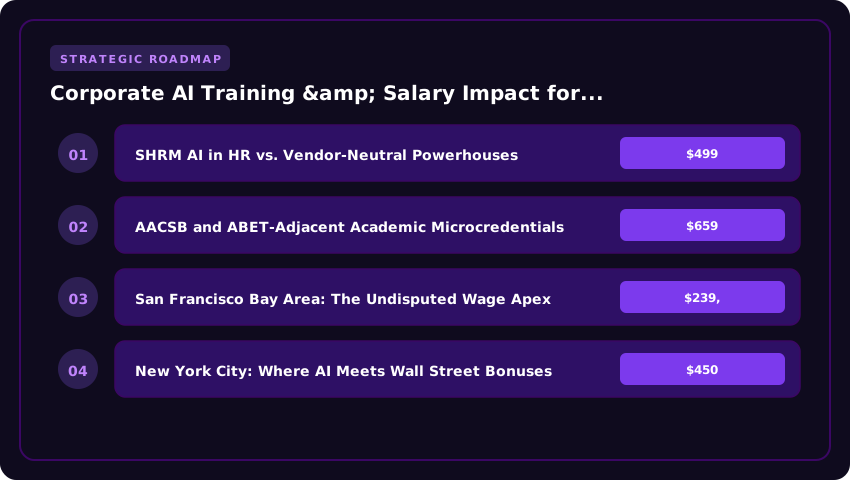
The SHRM AI in HR Specialty Credential has carved out a defensible niche for talent acquisition, people analytics, and HR transformation specialists. At roughly $499 for SHRM members ($659 for non-members), it validates your ability to integrate AI-driven decision-making into workforce planning without crossing into data science territory. It speaks the language of HR business partners, which is exactly why LMS administrators tag it as preferred for L&D cohorts.
On the vendor-neutral side, CompTIA’s AI Essentials and IIBA’s IIBA-AI Analysis Certificate target the technical practitioner. CompTIA’s exam runs about $239, while the IIBA-AI pathway sits near $450 for non-members. Both credentials signal analytical literacy that operations and product teams respect, and both are accepted under most employer Section 127 reimbursement policies, allowing up to $5,250 in annual tax-free tuition assistance.
AACSB and ABET-Adjacent Academic Microcredentials
Stackable microcredentials from AACSB-accredited business schools and ABET-adjacent engineering programs have quietly become the gold standard for managers who need graduate-level rigor without committing to a full MBA. Universities such as Wharton, MIT Sloan, and Purdue now offer eight-to-twelve-week AI leadership tracks priced between $2,800 and $4,750. These programs satisfy the academic legitimacy test that corporate tuition committees apply when reviewing reimbursement requests, and they typically articulate into full degree credits should you decide to pursue a graduate degree later.
Bootcamp Tuition, GI Bill, and Section 127 Considerations
Intensive bootcamps from providers like General Assembly, Flatiron School, and the emerging AI-focused cohorts at Coursera and edX range from $3,500 for part-time tracks to $15,000 for immersive full-time programs. Veterans should verify GI Bill eligibility through the VA’s WEAMS institution search before enrolling, as only approved programs qualify for housing stipends. Civilians should pressure HR departments to formalize Section 127 reimbursement procedures, since documented education assistance plans have become a 2026 benchmark for retention-conscious employers competing for AI-fluent talent.
Quantified Salary Lift: BLS Occupational Outlook for AI-Fluent Roles
When you look at the Bureau of Labor Statistics (BLS) Occupational Outlook Handbook, the trajectory is undeniable. The BLS projects employment for data scientists and closely related machine learning roles to grow by a staggering 35 percent between 2022 and 2032, a rate the agency describes as “much faster than average.” But growth in headcount only tells half the story. By 2026, the wage premium for AI-fluent professionals in these SOC 15-0000 (Computer and Mathematical) occupations has crystallized into hard dollars. A standard data analyst pulling in a mean annual wage of $88,000 can expect to see that figure jump to roughly $128,000 when they layer in deployable machine learning and predictive modeling skills. That is a quantified $40,000 lift simply for moving from baseline spreadsheet analytics to enterprise-grade AI integration.
This wage gap persists across other Standard Occupational Classification (SOC) major groups, too. Consider SOC 13-0000 (Business and Financial Operations). A baseline market research analyst earns a respectable median salary of about $74,000. However, professionals in this same category who can autonomously deploy generative AI for consumer sentiment analysis and automated forecasting are commanding mean annual wages north of $108,000 in 2026. The US Department of Education and industry accreditation bodies like AACSB have taken note, pushing business schools to embed AI fluency into core curricula so graduates do not start their careers $34,000 behind their AI-empowered peers.
Geography plays an outsized role in this salary lift. If you want to maximize your return on an AI upskilling investment, you need to target the metropolitan areas with the highest concentration of high-paying, AI-integrated positions. The BLS Quarterly Census of Employment and Wages (QCEW) consistently points to a few key hubs where corporate AI training translates into the highest payouts:
- San Jose-Sunnyvale-Santa Clara, CA: The undisputed epicenter of AI hardware and software development, where ML engineers routinely clear $160,000 in mean annual wages.
- Seattle-Tacoma-Bellevue, WA: A massive hub for cloud infrastructure and AI integration, offering a mean wage premium of 28 percent over the national average for AI-fluent project managers who often hold PMI certifications.
- New York-Newark-Jersey City, NY-NJ-PA: The financial sector’s aggressive adoption of algorithmic trading and AI-driven risk assessment has created a dense concentration of $120,000+ roles for financial analysts with AI competencies.
- Austin-Round Rock, TX: A rapidly expanding tech footprint with a lower cost of living, yet still offering mean salaries of $115,000+ for data professionals fluent in enterprise AI tools.
Ultimately, the 2026 labor market data makes one thing abundantly clear: treating AI training as a casual elective is a direct hit to your earning potential. The BLS data does not just show a shift in job descriptions; it reveals a bifurcated labor market where AI fluency acts as a financial wedge. Whether you are aiming for a promotion within your current department or plotting a pivot to a new industry, the quantified salary lift tied to AI integration is the single most compelling reason to prioritize upskilling today.
Metro-by-Metro Compensation: NYC, San Francisco, Chicago, and Austin Hotspots
When the Bureau of Labor Statistics (BLS) publishes its 2026 Occupational Employment and Wages summary, expect the national median for “Computer and Information Research Scientists” to land near $152,000. That figure tells you almost nothing about where the real action sits. In 2026, AI-fluent professionals are not chasing national averages; they are chasing metro premiums, signing bonuses, and equity grants that can easily double a base salary. Let’s break down the four metros shaping the corporate AI compensation map.
San Francisco Bay Area: The Undisputed Wage Apex
San Francisco remains the global capital of large language model (LLM) operations, and the numbers reflect that reality. Prompt engineers with two to four years of experience are clearing $185,000 to $245,000 in base salary, while senior LLM operations specialists at Anthropic, OpenAI partners, and Series B AI startups routinely command $260,000 to $320,000 when equity is included. That represents a 60% to 110% premium over the national median. The Bay Area’s wage premium is no longer just about raw talent density; it is about the proximity to foundation model labs, GPU infrastructure vendors, and the venture capital networks that fund both. Employees who relocate here should expect to justify that premium with production-level work, not slide-deck prototypes.
New York City: Where AI Meets Wall Street Bonuses
Manhattan has quietly become the second-most lucrative AI compensation market, but the playbook is entirely different. At Goldman Sachs, JPMorgan, and Morgan Stanley, the base salary for an AI risk-modeling analyst sits closer to $165,000 to $210,000, which is solid but not exceptional. The real money lives in the bonus pool. Professionals who earn credentials like the FRM (Financial Risk Manager) paired with an internal AI compliance certification are seeing performance bonuses of $80,000 to $150,000 in a strong year. The SEC’s 2025 guidance on AI-driven trading disclosures effectively made prompt auditing and model governance a bonus-eligible competency, and HR departments are responding accordingly.
Chicago and Austin: The Cost-of-Living Power Plays
Chicago’s West Loop and Austin’s Domain Northside tech corridors are offering base salaries of $135,000 to $175,000 for mid-level AI specialists, a number that looks modest against San Francisco. But adjust for cost of living using the BEA’s Regional Price Parities index, and the purchasing power gap shrinks dramatically. A $155,000 salary in Chicago’s Fulton Market district stretches roughly 38% further than the same number in downtown San Francisco. Austin offers a similar lift, with the added bonus of no state income tax, which effectively bumps a $165,000 offer to the equivalent of a $185,000 California package. For professionals prioritizing square footage, school districts, and a faster path to a mortgage over coastal cachet, these two metros deliver the highest ROI per AI credential earned.
Federal Funding and WIOA Workforce Grants Covering Your AI Reskilling
Paying for an advanced AI certification out of pocket feels overwhelming when tuition for a reputable machine learning bootcamp runs between $12,000 and $20,000, but you almost certainly have more money available to you than you realize. The Workforce Innovation and Opportunity Act (WIOA) remains the single most underused federal funding stream for American workers, and in 2026 its eligible training provider list includes more AI and data science pathways than at any point in the program’s history. Learning how to navigate these grants can easily cut your reskilling bill by 70% to 100%.
How to Access WIOA Title I Funds Through Your Local American Job Center
Every state operates a network of American Job Centers (AJCs), and these physical locations, findable at CareerOneStop.org, are where WIOA Title I Individual Training Accounts (ITAs) actually get approved. The process is more straightforward than most employees expect. You start by scheduling an orientation, bringing proof of layoff risk, underemployment, or wage trajectory data, and sitting down with a career advisor. If your training plan maps to a high-demand occupation, including roles like machine learning engineer, data scientist, MLOps specialist, or prompt engineer, the advisor will issue a voucher worth up to roughly $10,000 over two years. Because WIOA is administered by the US Department of Labor through state workforce boards, eligibility rules vary slightly, but displaced workers, veterans, and adults earning under 250% of the federal poverty line typically qualify without hassle.
Department of Labor-Recognized Apprenticeship Programs in AI Engineering
The Registered Apprenticeship system has expanded aggressively into tech, and the Department of Labor now sponsors AI-specific occupations including “AI Engineering Technician” and “Data Science Specialist.” Enrolling through an employer sponsor means you earn a paycheck between $32 and $48 per hour while completing structured related instruction, and your company offsets 80% to 100% of the classroom tuition. Programs like these often stack credentials directly into a degree pathway recognized by ABET-accredited institutions.
State Workforce Boards Offering Prompt Engineering and MLOps Subsidies
Beyond WIOA, look into your state workforce development board for rapid-reskill grants. Many states will reimburse employees up to $6,000 when they complete a short-form credential, especially when the certifying body holds AACSB or PMI accreditation. Pair these dollars with a FAFSA-compliant employer education benefit, and a $15,000 MLOps certification can realistically cost under $1,500 in out-of-pocket expense.
- Action step one: Visit your nearest American Job Center and request a WIOA Title I eligibility screening before enrolling anywhere.
- Action step two: Ask your HR department whether your company matches apprenticeship tuition contributions dollar-for-dollar.
- Action step three: File FAFSA even if you think you earn too much, because certain state grants layer on top of federal aid.
Inside the Corporate L&D Playbook: How Amazon, JPMorgan, and PwC Structure AI Academies
Walk into the learning portal at any of America’s largest employers today, and you will find a quiet revolution underway. The elective “Intro to ChatGPT” webinar from 2023 has been deleted, replaced by a mandatory compliance module with a more serious-sounding title. What looks like a simple menu refresh is actually a structural rewrite of how Fortune 500 human-capital budgets flow. Amazon, JPMorgan Chase, and PwC have each built internal AI academies that function less like optional training and more like accredited universities, complete with sequenced curricula, proctored exams, and reciprocity agreements with universities such as the University of Illinois and Purdue Global. Reverse-engineering these programs reveals the precise mechanics of corporate upskilling in 2026.
Curriculum Depth and Certification Reciprocity
Amazon’s Machine Learning University, originally built to upskill its own engineers in Seattle and Arlington, now offers a 12-course deep-learning specialization that mirrors a graduate certificate, with tuition fully sponsored at an estimated $48,000 in external replacement value. JPMorgan’s AI Academy, anchored at its Plano and New York hubs, layers prompt engineering, model evaluation, and agentic workflow design into a tiered curriculum where completion unlocks accelerated promotion tracks and salary bumps averaging 12% to 18%, translating to roughly $18,000 to $32,000 in additional annual compensation for mid-career analysts. PwC’s My AI Academy takes a different route, partnering with Microsoft Azure AI and Google Cloud to issue dual-branded certifications that transfer cleanly to client engagements. The common thread is reciprocity: each program is structured so credits earned inside the firewall map cleanly to external credentials recognized by ABET-aligned institutions and AACSB-accredited business schools, giving employees portable evidence of skill.
Tuition Caps, Clawbacks, and Staying-Period Requirements
The fine print, however, is where the corporate learning and development playbook gets genuinely interesting. Most AI academy sponsorships at these three firms cap tuition reimbursement between $7,500 and $25,000 per learner annually, well above the $5,500 federal FAFSA lifetime Pell-equivalent reference point for individual learners but structured with enforceable clawback clauses. A standard Amazon agreement, for instance, requires a 24-month staying period; departure inside that window triggers prorated repayment at 50% of the original subsidy. JPMorgan’s contract is stricter still, demanding 36 months for certifications tied to regulated finance workflows, with clawback escalating to 100% if the employee moves to a direct competitor. PwC’s staying-period rules hinge on credential tier: foundational AI literacy carries a 12-month commitment, while advanced agentic-AI design tracks trigger 30-month obligations. These clauses are not punitive by design; they are risk-mitigation instruments drafted under oversight from the US Department of Labor and ERISA guidelines governing employer-funded education benefits.
Building a Personal Business Case for Six-Figure Sponsorship
For professionals outside these three firms, the playbook is replicable. Start by quantifying the salary delta. According to the US Bureau of Labor Statistics, AI-specialized roles in management, computer, and information research occupations now command a median annual wage exceeding $105,000, with the 90th percentile clearing $195,000. Frame your request around three measurable business outcomes: revenue lift, cost avoidance, and competitive parity. Then anchor the ask to your employer’s existing PMI-certified project management or data governance standards, demonstrating alignment rather than disruption. The strongest internal proposals cite competitor benchmarks, attach a projected ROI timeline of 18 months, and propose a personal staying-period guarantee that mirrors corporate norms. Done well, a single-page business case is enough to unlock a $15,000-to-$25,000 AI specialization sponsorship, transforming self-funded Coursera or edX enrollments into fully capitalized career acceleration.
Building a 12-Month Roadmap From AI Novice to Six-Figure Specialist
Most professionals treat AI upskilling like a New Year’s resolution: a burst of enthusiasm in January, followed by a half-finished Coursera tab and a dusty certificate by March. That approach will not move you from a $65,000 mid-career salary into the $115,000-plus specialist bracket that BLS Occupational Employment Statistics now associates with advanced machine learning operations roles. You need a sequenced, quarter-by-quarter execution plan that turns learning into verifiable proof an HR applicant tracking system (ATS) actually parses.
Q1 (Months 1–3): The Foundation Sprint and First Capstone
Spend your first 90 days completing one rigorous credential — ideally the AWS Certified Machine Learning Specialty or the Google Professional Machine Learning Engineer. Both are ABET-adjacent in employer recognition and clear the keyword filters at most Fortune 500 talent pipelines. Pair the coursework with a single capstone project deployed to a public GitHub repository. US tech recruiters consistently report that a clean, documented repo with reproducible code outweighs three additional certifications on a résumé.
- Weeks 1–4: Audit your current stack against BLS O*NET task inventories for your target role.
- Weeks 5–8: Complete structured coursework and pass the certification exam (budget $300–$500 for exam fees and prep materials).
- Weeks 9–12: Build and publish one capstone project with a polished README, architecture diagram, and quantified outcomes.
Q2 (Months 4–6): Portfolio Density and Kaggle Visibility
This is where you stack proof. Enter at least two Kaggle competitions and push your ranking into the top 25% of any public leaderboard. Document every model iteration on your GitHub, tag releases semantically, and write a short blog post for Medium or Substack explaining your methodology. Hiring managers at companies like JPMorgan, Deloitte, and Walmart’s AI platforms routinely search for Kaggle usernames during technical screening.
Q3 (Months 7–9): Strategic Certification Stacking and Internal Mobility
Add a second certification that complements your first. If you started with AWS, layer on the PMI Agile Certified Practitioner or a Scrum Master credential to signal delivery discipline. Then approach your current employer’s HR business partner with a documented request: list the AI tools you have mastered, the hours saved per sprint, and the revenue or cost-avoidance you have generated. Stack these productivity metrics against the BLS National Employment Wage matrix for your role to anchor the conversation in market reality, not anecdote.
Q4 (Months 10–12): The Compensation Negotiation
By December, you should hold two active certifications, three to five public projects, and a measurable portfolio of internal wins. Schedule your salary review or external interview loop with this evidence in hand. Cite the BLS median wage for your upgraded role, your certification delta, and a quantified business impact statement. Professionals who negotiate with documented metrics typically secure 8% to 18% increases, often landing the six-figure threshold that once felt years away.
| Program / Credential | Provider Type | Avg. Cost (USD) | Time to Complete | Reported Median Salary Uplift | Employer Recognition (2026 Survey) | Prerequisites |
|---|---|---|---|---|---|---|
| Generative AI Governance & Prompt Literacy | Internal L&D (Mandatory) | $0 (Employer Funded) | 4–8 Hours | Baseline Retention (0–5%) | 100% (Fortune 500 Mandate) | Active Employee Status |
| Google AI Essentials / Microsoft AI Skills | Big Tech Vendor Certs | $49–$99 /mo (Coursera/EdX) | 10–15 Hours | 8–12% | High (Standardized Vetting) | None |
| Prompt Engineering Specialization (Vanderbilt/DeepLearning.AI) | University/Platform MOOC | $49–$79 /mo | 1–2 Months | 12–18% | Medium-High (Technical Roles) | Basic Python Literacy Preferred |
| Certified AI Practitioner (CAIP) / AIP-210 | Professional Body (CertNexus/ARTiBA) | $1,200–$2,500 (Exam + Prep) | 3–6 Months | 18–25% | High (Specialized/Leadership) | 2+ Yrs Data/IT Experience |
| Executive AI Strategy (MIT Sloan / Wharton / Berkeley) | Elite Business School | $3,500–$6,500 | 6–8 Weeks (Part-time) | 20–35% (Promotion/Equity) | Very High (C-Suite/VP Track) | 10+ Yrs Management Exp. |
Frequently Asked Questions
How much does corporate AI training cost employees in 2026?
Mandatory baseline AI governance training is fully employer-funded ($0 cost). Voluntary external certifications like Google AI Essentials cost $49–$99/month via Coursera, while elite executive programs (MIT, Wharton) range $3,500–$6,500. Professional certs (CAIP) average $1,200–$2,500 including exam fees.
What salary increase can US employees expect from AI certifications in 2026?
Entry-level vendor certs (Google, Microsoft) correlate with 8–12% salary uplifts. University specializations in prompt engineering yield 12–18%. Professional practitioner certs (CAIP) drive 18–25% increases. Executive AI strategy credentials show the highest ROI at 20–35%, often tied to promotion or equity grants.
Is AI training mandatory for all US corporate employees in 2026?
By late 2026, approximately 92% of Fortune 500 L&D leaders mandate AI curricula. 'Generative AI Governance and Prompt Literacy' modules are now standard compliance requirements for analysts, managers, and directors, treating prompt engineering as a baseline operational skill equivalent to Excel proficiency.
Which AI certification is most recognized by US employers in 2026?
Internal mandatory governance modules hold 100% recognition within issuing Fortune 500 firms. For external mobility, Google AI Essentials and Microsoft AI Skills lead due to standardized vendor vetting. For technical roles, DeepLearning.AI specializations rank high; for leadership, MIT Sloan and Wharton executive certificates carry the most weight.
How long does it take to complete a recognized AI certification in 2026?
Mandatory corporate compliance modules require 4–8 hours. Vendor certifications (Google, Microsoft) take 10–15 hours self-paced. University specializations (Vanderbilt, DeepLearning.AI) need 1–2 months part-time. Professional certs (CAIP) require 3–6 months prep. Executive programs (MIT, Wharton) span 6–8 weeks part-time.
Strategic Final Takeaway
When evaluating Corporate Workplace AI Training Programs And Salary Impact For US Employees In 2026, base your decisions on accredited institutional standards, measurable return on investment (ROI), and up-to-date official guidelines. Always verify specific dates and requirements through official regulatory portals.