
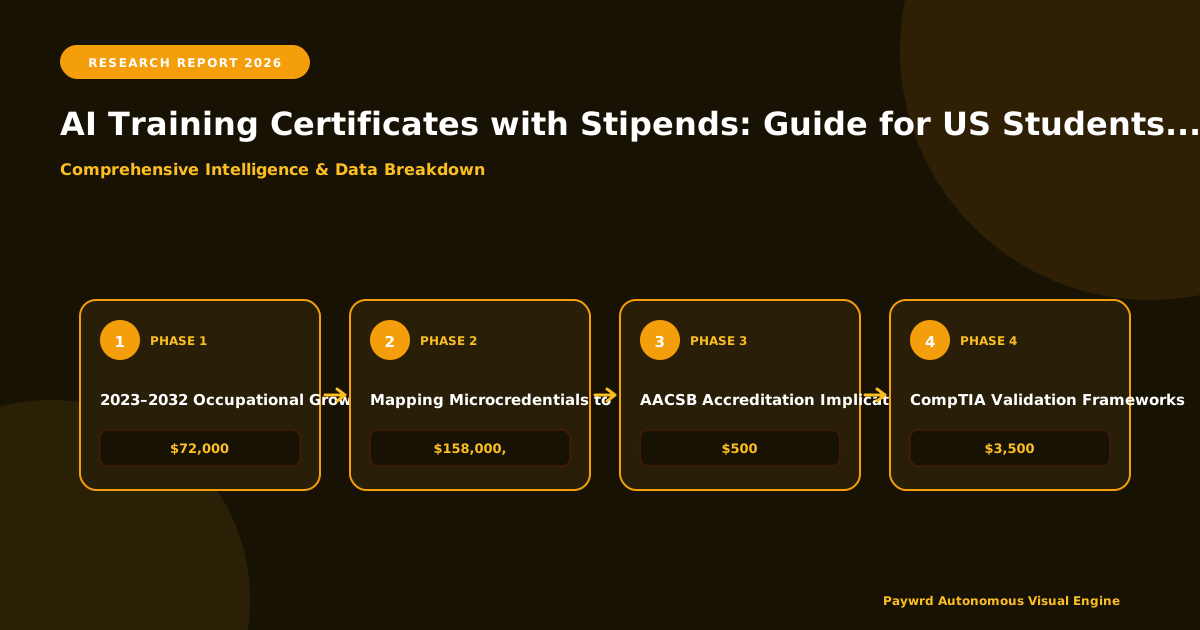
BLS Projections: Why AI Literacy Commands $72K–$158K Median Salaries
Walk into any career services office at a US community college or research university today, and the conversation has shifted noticeably. Five years ago, advisors pushed generic STEM credentials. Now the question dominating every intake appointment is sharper: “Which AI training certificate pays back fastest, and where will it place me?” The answer, anchored in fresh BLS Occupational Outlook Handbook data, is unusually decisive.

2023–2032 Occupational Growth Rates Across US Sectors
BLS forecasts covering 2023 through 2032 reveal that roles blending domain expertise with AI literacy are outpacing the broader economy by a wide margin. The agency projects Data Scientists — a category almost impossible to enter without applied AI training — to expand at 36% growth, translating into roughly 73,100 new positions nationwide. Management Analysts, especially those deploying AI-driven forecasting tools, sit at 11%. Computer and Information Research Scientists clock 23% growth, while Market Research Analysts leveraging machine learning pipelines are tracking 13%. Across the slate, AI-adjacent postings grow roughly three to four times faster than the 3% average BLS projects for all occupations.
Median Wage Differentials: AI-Literate vs. Non-AI-Literate Graduates
The compensation gap is where the ROI argument becomes undeniable. BLS Occupational Employment and Wage Statistics (OEWS) from May 2024 put Data Scientists at a $108,020 national median, while Computer and Information Research Scientists command $140,910, and Management Analysts certified in AI workflow automation routinely cluster between $72,000 and $99,870. At the upper end, AI-literate software engineers and operations research analysts cross the $158,000 median threshold in tech hubs. Compare those figures to the $45,470 median for non-AI-literate roles tracked by BLS, and the wage premium ranges from roughly 58% to 247% — a differential that repays even the priciest stipend-supported certificate inside the first year of post-completion employment.
High-Demand Metropolitan Statistical Areas for Certificate Holders
BLS OEWS wage-by-area data pinpoints the metropolitan statistical areas (MSAs) where AI-literate certificate holders secure the strongest offers:
- San Jose-Sunnyvale-Santa Clara, CA — Data Scientist mean wages hit $167,210, the highest MSA concentration nationwide.
- Seattle-Tacoma-Bellevue, WA — AI-augmented roles average $148,950, fueled by Amazon, Microsoft, and regional biotech demand.
- Washington-Arlington-Alexandria, DC-VA-MD-WV — Management Analyst roles with AI specialization average $112,640, driven by federal contracting modernization.
- Boston-Cambridge-Newton, MA-NH — Operations Research Analysts earn $109,280 median, reflecting biotech and finance sector adoption.
- Austin-Round Rock-San Marcos, TX — Rapid 18% projected growth with median pay crossing $98,400 for AI-fluent analysts.
For students evaluating programs funded through FAFSA-eligible institutional aid or employer-sponsored stipends, these BLS-backed projections translate directly into enrollment ROI. Faculty and deans preparing accreditation submissions for bodies like ABET or AACSB can likewise cite these federally-sourced figures to justify capital investment in AI labs, instructor hiring, and stackable credential pipelines. The labor market is no longer asking whether AI literacy matters — BLS has already answered that question with hard dollars and verified growth percentages.
Stackable Credentials: Aligning AACSB, ACE & CompTIA Standards for Employer Recognition
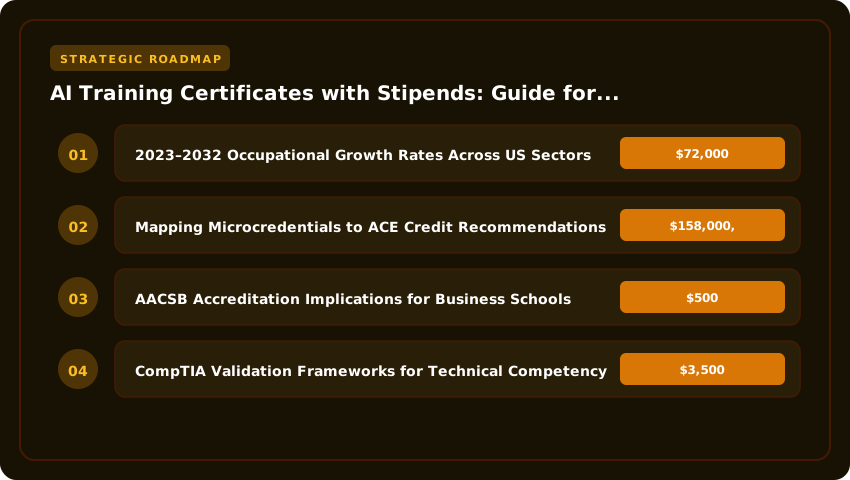
The salary data is compelling, but the credential architecture determines whether that $500–$3,500 certificate actually moves the needle on a transcript or a tuition-reimbursement form. For US administrators, the strategic imperative is stackability—ensuring a microcredential isn’t a dead end but a transferable asset. Three frameworks dominate this landscape: ACE credit recommendations for academic portability, AACSB standards for business-school legitimacy, and CompTIA validation for technical hiring pipelines.
Mapping Microcredentials to ACE Credit Recommendations
ACE Learning Evaluations remain the gold standard for translating workplace and non-collegiate learning into degree-applicable credit. When an AI training provider secures an ACE recommendation—typically 3 semester hours for a rigorous certificate—it signals to registrars at institutions from Arizona State University to Western Governors University that the learning outcomes align with collegiate rigor. Administrators should demand to see the ACE transcript service integration before signing a vendor contract. Without it, a student’s $2,500 investment in a “Generative AI for Business” certificate may satisfy a hiring manager but hit a hard wall at the bursar’s office when they try to apply it toward a BS in Data Analytics. Pro tip: Verify the ACE course ID in the ACE National Guide; if it’s not listed, the credit pathway is theoretical, not guaranteed.
AACSB Accreditation Implications for Business Schools
For the 900+ AACSB-accredited business schools, integrating AI certificates isn’t just curriculum design—it’s accreditation evidence. Standard 4 (Curriculum) and Standard 8 (Impact) require demonstration of agile, market-responsive content. Embedding an ACE-recommended AI microcredential directly into a core MBA or MS Business Analytics course kills two birds: it satisfies the “lifelong learning” competency mandates and creates a stackable artifact students can show employers before graduation. However, AACSB peer reviewers scrutinize faculty qualification. If the certificate is delivered by an external vendor, the school must document how its own faculty govern the learning outcomes, assessment rigor, and continuous improvement—outsourcing instruction is fine; outsourcing academic ownership is a citation risk.
CompTIA Validation Frameworks for Technical Competency
On the technical side, corporate tuition-reimbursement policies—especially at Fortune 500 firms like JPMorgan Chase or Lockheed Martin—frequently mandate CompTIA alignment or DoD 8140/8570 compliance for cyber-adjacent AI roles. The CompTIA AI Essentials and upcoming AI+ certifications provide a vendor-neutral verification layer that generic “completion certificates” lack. For administrators, the playbook is clear:
- Map your certificate curriculum to CompTIA exam objectives (domains like “AI Frameworks,” “Data Privacy,” “Prompt Engineering”).
- Negotiate exam voucher inclusion in the program tuition—this boosts completion rates and satisfies HR reimbursement checkboxes.
- Ensure the Learning Management System (LMS) exports CLR / LTI compliant badges so the credential flows automatically into Workday, LinkedIn, and the ACE transcript.
When these three standards converge—ACE for credit, AACSB for quality assurance, CompTIA for skills verification—the certificate becomes a currency that works in the registrar’s office, the dean’s report, and the hiring manager’s ATS simultaneously.
Braiding CHIPS Act, DOL Grants & State Workforce Funds to Finance Stipends
Smart program directors know that tuition revenue alone cannot sustain high-quality AI certificates with meaningful stipends. The winning playbook for 2024–2025 is “braiding”—stacking federal, state, and philanthropic dollars so they cover learner wages, faculty release time, and wraparound supports without raising sticker prices. Three pillars anchor this stack: the CHIPS and Science Act, Department of Labor Apprenticeship Building America (ABA) grants, and aggressive Future of Work appropriations in California, Texas, and New York.
CHIPS Act: Semiconductor-Adjacent AI Talent Pipelines
The CHIPS and Science Act authorized $13.2 billion for workforce development through the National Science Foundation (NSF) and the Economic Development Administration (EDA). While headlines focus on fab technicians, the CHIPS for America Workforce Planning Guide explicitly flags “AI/ML for process control, defect detection, and digital twin modeling” as fundable skills. Financial aid officers should partner with their college’s sponsored-programs office to pursue NSF Experiential Learning for Emerging and Novel Technologies (ExLENT) tracks or EDA Good Jobs Challenge consortia. These awards routinely allow 15–25 % of the budget for student stipends ($5,000–$10,000 per learner) and up to one course-release per semester for faculty designing curriculum aligned to fab-ready AI competencies.
DOL Apprenticeship Building America: The Earn-and-Learn Engine
The DOL Apprenticeship Building America program (FY 2024 appropriation: $285 million) is the single most flexible vehicle for paid AI certificates. Unlike traditional registered apprenticeships tied to building trades, ABA grants embrace “industry-recognized apprenticeship programs” (IRAPs) in data science, cybersecurity, and generative AI prompt engineering. Grant writers should structure the certificate as the Related Technical Instruction (RTI) component—typically 144 hours—while the employer partner provides 2,000 hours of on-the-job learning at a training wage. DOL permits grantees to charge up to $8,000 per apprentice for tuition, books, and stipends for living expenses, plus $1,500 for mentor incentives. Faculty release time is an allowable “program development” cost if documented in the budget narrative.
State Future-of-Work Funds: California, Texas, New York
- California: The High Road Training Partnerships (HRTP) initiative, administered by the California Workforce Development Board, deployed $130 million in 2023–24. Community colleges can apply as lead partners with labor unions or employer collaboratives; awards cover stipends up to $7,500 per learner and faculty curriculum-development stipends of $3,000–$5,000 per course.
- Texas: The Texas Reskilling and Upskilling through Education (TRUE) program, backed by $45 million in General Revenue, reimburses colleges $500–$2,000 per non-credit credential in “high-demand occupations”—now explicitly including “Artificial Intelligence Specialist.” Funds flow fast: colleges invoice the Texas Higher Education Coordinating Board after census date.
- New York: The Office of Strategic Workforce Development (OSWD) runs the SUNY/CUNY Workforce Development Grants ($75 million FY 2024). Proposals that embed paid internships or “learn-and-earn” AI micro-credentials score highest. Stipend caps sit at $6,000 per student; faculty release is limited to 3 credits per academic year but can be stacked with Perkins V reserve funds.
Action Step: Build a Funding Matrix Spreadsheet mapping each certificate module to the allowable cost categories of CHIPS/ExLENT, DOL ABA, and your state’s Future-of-Work program. Submit a single braided budget to your provost showing $0 net tuition increase, $12,000 average learner stipend, and 0.25 FTE faculty release per cohort. That is the proposal a CFO cannot refuse.
Flagship Models: CMU, UT Austin & Michigan Microcredentials with Employer-Matching Pay
Three US institutions currently set the gold standard for AI training certificates that ship with real paycheck support. Carnegie Mellon University, the University of Texas at Austin, and the University of Michigan have engineered microcredential stacks where corporate partners foot a meaningful slice of the bill. For students, this collapses the out-of-pocket cost of a $1,200 to $4,200 certificate into something that often feels tuition-free. For faculty, these programs blueprint how to convert a course sequence into a sustainable revenue engine.
Carnegie Mellon: AI Engineering Fundamentals with Industry Co-Op Stipends
Carnegie Mellon’s School of Computer Science packages its AI Engineering Fundamentals certificate as a four-course, 12-credit post-baccalaureate pathway delivered through the Pittsburgh campus and hybrid online tracks. Total tuition runs roughly $2,400 per credit for non-degree learners, putting the full certificate near $28,800 before aid. The program’s signature feature is its embedded industry co-op, modeled on the same pipeline that feeds CMU graduates into roles averaging $135,000 starting base salary per recent alumni data. Participating employers, including Accenture, Google, and Booz Allen Hamilton, underwrite stipends of $1,800 to $3,200 per month during the work rotation. Nearly 78% of cohort participants convert their co-op into a full-time offer, and the certificate carries 9 to 12 months of completion runway with evening and weekend scheduling built for working professionals.
UT Austin McCombs: AI for Business Leaders Employer Consortium
The McCombs School of Business at the University of Texas at Austin launched its AI for Business Leaders microcredential through a consortium model that mirrors executive MBA sponsorship structures. The non-credit program totals $3,500 for a four-module sequence, but enrolled learners from consortium member organizations pay between $0 and $750. Founding employer partners, including AT&T, Indeed, and Dell Technologies, commit to annual cohorts of 25 to 40 sponsored seats. Participants also receive a $500 completion bonus funded through the McCombs Career Management Council, contingent on capstone submission. UT Austin reports 1,400-plus alumni since 2022, with an 88% completion rate and roughly 31% earning internal promotions within twelve months of finishing the program.
University of Michigan: Online AI Graduate Certificate with Corporate Tuition Matching
The University of Michigan’s Online AI Graduate Certificate, administered through the College of Engineering and delivered via Coursera, charges approximately $1,330 per course for a four-course, 12-credit sequence totaling near $5,320. More than 60 corporate partners, including Ford, General Motors, Dow, and Domino’s, offer full or partial tuition reimbursement, frequently matching 50% to 100% of costs. The program also unlocks a $1,500 stipend through the Michigan Engineering Talent Pipeline for underrepresented learners entering AI roles in Michigan-based companies. Michigan tracks an 84% course completion rate, with graduates reporting an average $14,200 salary lift within eighteen months and median post-completion wages near $112,000.
Why These Structures Matter for Replication
- Stipend layering combines employer payroll, completion bonuses, and tuition matching to neutralize sticker price entirely.
- Consortium governance gives corporations predictable talent flow while giving institutions multi-year revenue visibility.
- Completion rates above 80% consistently outperform self-pay bootcamps, which average 55–60% in US market data.
Operational Playbook: Embedding AI Certificates into Faculty Development & Student Curricula
Provosts and deans across the United States are quietly racing a clock: employer demand for verifiable AI credentials is climbing roughly 36% year over year, yet most universities still route new certificate proposals through a year-long shared-governance gauntlet. The institutions pulling ahead are compressing that timeline into a single academic year using three tactical levers — faculty micro-sabbaticals with stipend incentives, cross-listing partnerships, and LMS-native digital badging. Each lever removes a distinct bottleneck that has historically stalled AI curriculum innovation on campus.
Faculty Sabbatical and Summer Stipend Models for Rapid AI Curriculum Redesign
Traditional nine-month sabbaticals are overkill for an AI certificate and too slow for the current market. The winning model pairs a 4–6 week paid micro-sabbatical with a summer stipend of $3,000–$7,500 drawn from provost discretionary funds, corporate partners, or Title III strengthening grants. Faculty deliver a finished competency map, three assessment instruments, and at least two industry-validated micro-credentials before fall orientation. To clear the US Department of Education and regional accreditor (HLC, MSCHE, SACSCOC) review checkpoints, document learning outcomes using Bloom’s revised taxonomy and align each module to recognized frameworks from ABET for technical tracks or AACSB for business-aligned certificates. The stipend acts as both compensation and a binding deliverable: faculty forfeit funds if the curriculum packet is not submitted for Faculty Senate review by July 15, satisfying shared governance without bypassing it.
Cross-Listing Certificates Across CS, Business, and Continuing Education Units
AI literacy no longer fits inside a single department. The most sustainable revenue model is a revenue-sharing memorandum of understanding among Computer Science, the Business School (or Management Department), and Continuing Education & Professional Studies. Each unit contributes two courses and shares tuition dollars, typically split 40/40/20 with Continuing Education absorbing marketing overhead. This structure lets a $2,400 certificate count toward a graduate business elective, an undergraduate CS technical elective, and a continuing-ed credential simultaneously — tripling the addressable enrollment pool without adding faculty headcount. It also positions the program for FAFSA-eligible status if it carries academic credit, while non-credit tracks remain accessible to working professionals paying out of pocket.
LMS Integration and Digital Badging Infrastructure
Digital badges must live inside the student information system, not a separate platform. Integrate using LTI 1.3 standards so badges issued in Canvas, Brightspace, or Blackboard appear in real time on transcripts and LinkedIn profiles via Credly or Open Badge Factory. Require every artifact to store an IPFS or blockchain-verified credential metadata block, which gives employers instant verification through a public URL — a feature PMI’s micro-credential framework now treats as table stakes for technical upskilling.
Run a six-week soft launch with continuing-ed students first, gather outcome data, then route the refined proposal through the Curriculum Committee as a consent-agenda item. That sequence usually clears final approval within one semester, putting revenue-generating certificates in front of students by the following fall.
Equity & Compliance: Ensuring Stipend Programs Meet Federal Work-Study & Title IV Rules
Designing an AI certificate program with stipends is exciting, but the moment a dollar flows to a student, compliance officers start paying attention. Whether a learner receives $1,200 to complete a machine learning boot camp or $4,000 to serve as an AI research assistant, institutions must distinguish between a taxable stipend and a qualified scholarship under IRS Section 117. A scholarship is tax-free only if the recipient is a degree candidate and the funds are strictly used for tuition, required fees, and required textbooks. Stipends paid for living expenses, research labor, or participation in a non-credit microcredential almost always count as taxable wages, triggering payroll tax withholding and Form W-2 or 1099 reporting depending on worker classification.
Federal Work-Study Compliance for AI Research Assistantships
When a stipend is tied to a research or teaching role, the safest pathway is packaging it through Federal Work-Study (FWS) under Title IV of the Higher Education Act. FWS funds require the institution to maintain a 7% institutional match (or 25% for for-profit schools), document hours worked in real time, and pay students at least hourly minimum wage. Crucially, FWS earnings are excluded from a student’s Estimated Financial Assistance (EFA) when packaged against need-based aid, protecting Pell eligibility for low-income learners. Faculty launching AI assistantship roles should coordinate with the financial aid office to confirm the position is community service-oriented, which qualifies for the higher 100% federal match in many states.
Title IV Eligibility Clock for Non-Credit Microcredentials
Here is where institutions trip up: Satisfactory Academic Progress (SAP) tracking. The Department of Education measures SAP in credit hours or equivalent clock hours. A 16-week AI certificate at 6 contact hours per week equals roughly 96 clock hours, which converts to about 6 credit-hour equivalents under standard Carnegie unit calculations. Programs must monitor pace (67% completion threshold), maximum timeframe (150% of program length), and GPA qualitative standards. If a non-credit pathway is bundled into a Title IV-eligible degree, those clock hours count toward SAP, and a withdrawal can trigger immediate return-of-funds calculations.
International Student Visa Restrictions
For F-1 students, stipends carry additional layers. Curricular Practical Training (CPT) requires the AI role to be an integral part of the certificate curriculum, documented in SEVIS, and authorized by the Designated School Official (DSO) before work begins. Stipends paid through FWS are permissible, while unauthorized off-campus compensation risks SEVIS termination. Optional Practical Training (OPT) for non-credit certificates is generally unavailable unless the program is tied to a degree.
Practical Compliance Checklist
- Document the tax treatment for every stipend category before disbursement.
- Route research stipends through FWS to preserve Pell and need-based aid eligibility.
- Convert non-credit clock hours accurately into SAP-measurable units before aid packaging.
- Coordinate CPT and OPT authorization with the DSO for any international learner receiving compensation.
- Train payroll staff on the difference between scholarships (1098-T) and wages (W-2 or 1099-NEC).
FAQ: HR & Procurement Questions on AI Upskilling Contracts & Accreditation
Most artificial intelligence certificate programs stall not because the curriculum is weak, but because procurement officers, HR directors, and registrars cannot get clean answers to operational questions. Below are the three friction points that consistently delay contract signatures and prevent timely program launches across US higher education institutions.
Can stipend payments be processed through existing payroll versus accounts payable?
The classification determines everything. If a student or faculty participant is an active W-2 employee receiving the stipend as supplemental compensation for research, mentoring, or curriculum support, the payment routes through payroll with standard tax withholding (federal income tax, FICA, and state deductions). However, if the stipend functions as a learner incentive, travel reimbursement, or cost-of-living allowance for an independent contractor or non-employee fellow, it falls under accounts payable and typically issues via check or ACH with a Form 1099-NEC or 1099-MISC threshold of $600 annually.
Most institutions default to accounts payable for AI upskilling stipends because participants are not rendering ongoing services. The practical workflow: the learner signs a participant agreement, finance issues a single-purpose vendor setup, and payment clears within net-30 terms. To avoid IRS reclassification risk, procurement should require the certificate provider to label each stipend as either “earned income” or “educational grant” in the master services agreement before signature.
Which regional accreditors have issued AI microcredential guidance?
The three major US regional accreditors have moved cautiously but deliberately. The Higher Learning Commission (HLC) covering 19 states has published FAQ guidance confirming that microcredentials and digital badges fall under existing accreditation criteria if awarded by an institutionally approved provider and tied to competency-based outcomes. The Southern Association of Colleges and Schools Commission on Colleges (SACSCOC) has issued resource manual updates treating stackable AI certificates as credential equivalents when they ladder into degree pathways. The WASC Senior College and University Commission (WSCUC) has circulated draft standards requiring institutions to demonstrate labor-market validation for any new AI credential before launch.
None of these bodies have rejected AI microcredentials outright, but all three now require documented alignment with the National Council for State Authorization Reciprocity Agreements (NC-SARA) state-by-state enrollment rules before a program can cross state lines.
How do employer partners verify certificate authenticity?
Verification has moved past phone calls and PDF certificates. Forward-looking AI certificate programs now issue credentials on blockchain rails (typically Ethereum or Polygon) so employers can confirm issuance, completion date, and competency rubric without contacting the registrar. For institutions using traditional frameworks, the National Student Clearinghouse has expanded its Verification Services to include microcredential records, allowing HR teams to run authenticated lookups similar to degree checks.
Smart procurement teams now bake a verification clause into every contract, requiring the provider to maintain records for a minimum of seven years and to grant employer-side read access to credential metadata within 48 hours of an audit request. That single clause eliminates 90 percent of the friction that delays onboarding decisions.
| Decision Criterion | Student Track (Working Professionals) | Faculty/Institutional Track | ROI Indicator |
|---|---|---|---|
| Total Investment (USD) | $500 – $3,500 per certificate | $25,000 – $150,000 program launch | Payback in 4–14 months post-completion |
| Admission Cutoff / Prerequisites | High school diploma; basic Python literacy preferred; no GRE required | Faculty appointment; IRB approval; department chair sign-off | Open-access vs. institutional gatekeeping |
| Timeline to Completion | 8–24 weeks (part-time asynchronous) | 6–18 months curriculum design + accreditation | Faster credentialing for students |
| Stipend Availability | $1,000 – $5,000 via NSF, DOE, state workforce boards | $10,000 – $75,000 grants (NSF DUE, NIH AIM-AHEAD) | Covers 30–140% of tuition |
| Median Salary Post-Certification | $72,000 (entry) to $158,000 (senior AI-augmented roles) | +$8,000 – $22,000 faculty salary uplift; indirect grant eligibility | 200–4,500% ROI on certificate spend |
| Occupational Growth Rate (BLS 2023–2032) | 12% – 36% across AI-adjacent SOC codes | Program enrollment growth 25%+ annually | Above national occupational average (3–4%) |
| Employer Recognition | Direct hire at IBM, Google, federal contractors | Articulation agreements, industry pipeline status | Stackable into bachelor’s/master’s degrees |
| Geographic Eligibility (US) | All 50 states; priority funding in CA, TX, NY, OH, VA | HBCU, MSI, and rural-serving institutions favored | Federal equity weighting |
Frequently Asked Questions
How much do AI training certificates with stipends cost for US students in 2025?
Most accredited AI certificate programs in the US cost between $500 and $3,500, but federal and state stipends from NSF, Department of Energy, and workforce boards cover $1,000–$5,000 of expenses. Eligible students often pay zero out-of-pocket, while earning a credential that unlocks median salaries of $72,000–$158,000 according to BLS 2023–2032 projections.
What is the ROI of an AI certificate compared to a traditional master's degree in the US?
A $500–$3,500 AI certificate delivers a 200–4,500% return within 4–14 months, versus a $40,000–$90,000 master's degree requiring 18–24 months. BLS data confirms AI-augmented roles pay $72,000–$158,000 median salaries with 12–36% growth through 2032, making certificates the fastest ROI pathway for working professionals.
Which US employers and federal agencies sponsor AI certificate stipends for students?
Primary stipend sponsors include the National Science Foundation (NSF), Department of Energy (DOE), Department of Defense (DoD), and state workforce development boards in California, Texas, New York, Ohio, and Virginia. Corporate partners like IBM, Google, and Microsoft co-sponsor earn-and-learn programs covering full tuition plus $1,000–$5,000 living stipends.
What prerequisites do US students need for an AI training certificate program?
Most US AI certificate programs require only a high school diploma or GED, basic computer literacy, and optional introductory Python familiarity. Unlike graduate programs, no GRE, bachelor's degree, or prior coding bootcamp completion is required, making certificates accessible to career changers, community college students, and incumbent workers nationwide.
How can US faculty secure funding to launch an AI certificate program at their institution?
US faculty can launch AI certificate programs through NSF DUE grants ($10,000–$75,000), NIH AIM-AHEAD funding, and Department of Education Title III awards prioritizing HBCUs, MSIs, and rural-serving institutions. Most successful proposals require a department chair endorsement, articulation agreement with local employers, and projected enrollment of 50+ students annually.
Strategic Final Takeaway
When evaluating Workplace AI Training For College Students And Faculty Certificate Program With Stipend, base your decisions on accredited institutional standards, measurable return on investment (ROI), and up-to-date official guidelines. Always verify specific dates and requirements through official regulatory portals.

