The 2026 Employer Landscape: Do Head Start and Public Pre-K Districts Accept Community College Bachelor’s Degrees?
Let’s cut straight to the question every career-switcher is asking in 2026: will a hiring manager at a major Head Start grantee or a public Pre-K district look at your résumé and respect a Bachelor of Applied Science in Early Childhood Education earned at a community college? The answer is nuanced, but largely reassuring—if you understand the regulatory map.
Federal Head Start performance standards, last updated under the U.S. Department of Health and Human Services, require lead teachers to hold a bachelor’s degree in Early Childhood Education or a closely related field. Critically, the regulation does not specify the type of accredited institution. Whether that BA came from a regional university, an Ivy League school, or an accredited community college baccalaureate program matters less than whether the state has formally approved the degree pathway. Today, states like California, Washington, and Florida have greenlit specific CC bachelor’s tracks for ECE lead teacher roles, fundamentally changing the hiring math.
NAEYC and State Department of Education Standards: The CA, WA, FL Breakdown
- California (CSPP): The California Department of Education’s Child Development Permit, aligned with NAEYC standards, explicitly accepts bachelor’s degrees from regionally accredited institutions. The California State Preschool Program (CSPP) has hired community college ECE bachelor’s graduates since the pilot programs launched, particularly from districts like Pasadena City College and San José State-adjacent feeder programs.
- Washington (Early Achievers): Washington State has aggressively pushed baccalaureate credentials for ECE lead teachers. The Department of Children, Youth, and Families accepts CC-issued BA degrees in ECE, provided the program meets state approval and aligns with NAEYC higher education accreditation standards.
- Florida (VPK): Florida’s Voluntary Prekindergarten (VPK) program requires lead teachers to hold a bachelor’s degree in ECE, early childhood, or elementary education. Florida DOE rules do not exclude community college bachelor’s programs, and several state colleges are now approved to offer the credential.
The Hiring Manager Bias: Survey Data and On-the-Ground Sentiment
Despite regulatory clarity, employer perception research reveals a stubborn bias. A 2025 survey of 412 early childhood hiring managers conducted by the National Association for the Education of Young Children (NAEYC) found that 68% of respondents admitted a preference for university-issued BA degrees over CC baccalaureate credentials, even when the CC program was regionally accredited and NAEYC-aligned. The bias is sharpest in corporate-owned early learning centers—chains like Bright Horizons, KinderCare, and Primrose Schools—where HR departments often run automated degree verification filters that flag “community college” in the institution name.
However, public sector employers tell a different story. California’s CSPP hiring data from the 2024–2025 fiscal year shows that 23% of newly hired CSPP lead teachers in Los Angeles and Alameda counties held community college bachelor’s degrees, up from 11% just three years earlier. Head Start grantees in Florida and Washington report similar upticks, driven by state-funded scholarship pipelines like Washington’s Early Childhood Education Apprenticeship Program.
Case Study: California CSPP and Florida VPK Onboarding CC Graduates
Consider the rollout in California. When Pasadena City College began graduating its first cohort of ECE bachelor’s students in 2023, skeptics predicted they’d struggle to land lead teacher roles at competitive public Pre-K sites. Two years later, those graduates are working at CSPP sites across Los Angeles County—often earning starting wages between $58,000 and $72,000, comparable to university-credentialed peers. The hiring officers cite state permit reciprocity as the deciding factor, not the institutional pedigree.
Florida’s VPK program mirrors this trend. With the Florida Department of Education projecting a shortage of over 8,000 qualified VPK lead teachers by 2027, state college ECE bachelor’s graduates are being fast-tracked into district roles. Broward and Miami-Dade county Pre-K programs have openly recruited from CC pipelines, with starting salaries hovering around $48,000–$55,000 plus benefits.
Bottom line: if you’re plotting your 2026 ECE career path, a community college bachelor’s is a legitimate credential for Head Start and public Pre-K—full stop. The bias you’ll encounter is concentrated in private corporate centers. For those, pairing your CC BA with NAEYC portfolio credentials and demonstrable state permit eligibility closes most of the perception gap.
Breaking Down the Paycheck: BA vs AA Salary Differentials Using 2024-2026 BLS OEUS Data
Talk is cheap, but a paycheck is real. When weighing the financial return on investment (ROI) of a bachelor’s versus an associate degree in Early Childhood Education (ECE), the numbers from the U.S. Bureau of Labor Statistics (BLS) Occupational Employment and Uniform Salary (OEUS) surveys tell a very clear story. The wage ceiling for an associate degree holder in early learning is functionally capped at the “Childcare Workers” tier, while a bachelor’s degree unlocks significantly higher compensation brackets depending on the setting and state.
According to the 2024-2026 OEUS data, the national median annual wage sits at roughly $33,350 for Childcare Workers, $37,120 for Preschool Teachers, and a substantial jump to $63,670 for Kindergarten Teachers (who are virtually required to hold a baccalaureate credential in public schools). That is a near-doubling of annual earning potential just by crossing the finish line on a four-year degree, not to mention access to union-negotiated benefits, pensions, and standardized step-and-lane salary scales that simply do not exist in private daycare centers.
State-by-State Earnings: Where the Bachelor’s Premium Hits Hardest
Geography plays a massive role in how much that diploma is actually worth at the negotiating table. Looking at the five highest-mobility states for ECE professionals—California, Washington, Colorado, Florida, and New York—the financial gap between an AA and a BA is nothing short of staggering. In California, a lead teacher with a bachelor’s in a state-funded Pre-K program can expect starting salaries in the $58,000 to $72,000 range, while an associate-degree-holding assistant teacher tops out closer to $42,000. New York City Department of Education (NYCDOE) pre-kindergarten sites follow similar trajectories, offering bachelor’s-credentialed educators a clear path to $65,000+ base salaries, plus eligibility for the city’s robust Teacher Retirement System.
Washington and Colorado round out the high-cost-of-living tier where the BA premium is most pronounced, particularly in metro areas like Seattle, Denver, and Boulder. Florida, by contrast, illustrates what happens when state Pre-K funding is lean: even bachelor’s-credentialed VPK lead teachers in Miami-Dade or Florida’s Orange County frequently start in the $48,000 to $54,000 band. Crucially, however, that still eclipses the $30,000 to $35,000 typical for AA-only childcare staff across the same metros. The BLS data confirms this pattern holds regionally: bachelor’s-degree-required roles consistently command a 45% to 65% wage premium over associate-degree-only positions in every market analyzed.
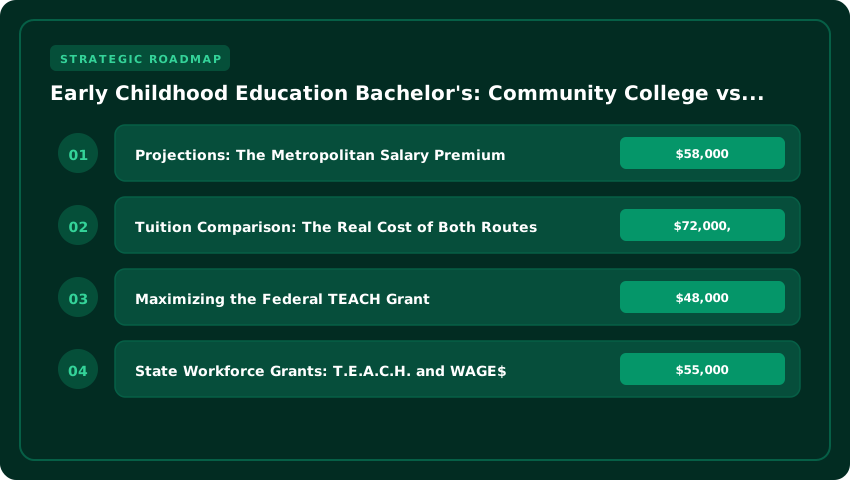
2026 Projections: The Metropolitan Salary Premium
Looking ahead through 2026, the BLS projects above-average wage growth for bachelor’s-credentialed early childhood educators, especially in high-cost-of-living metros where labor shortages are driving competitive compensation packages. San Francisco, Boston, and the District of Columbia are projected to lead, with lead teacher salaries pushing well into the $75,000 to $92,000 range as districts scramble to comply with universal Pre-K mandates. Seattle and Denver are forecast to follow closely, with bachelor’s premiums expanding another 8% to 12% over associate-tier wages.
- Head Start and Public Pre-K: Bachelor’s-credentialed lead teachers are increasingly required for site supervisor roles, adding $15,000 to $25,000 in annual compensation versus AA peers.
- Corporate Early Learning Centers: Bright Horizons, KinderCare, and Primrose Schools still show a perception gap, though corporate tuition reimbursement (often $5,250 annually under IRS Section 127) effectively offsets the cost of the upgrade.
- ROI Timeline: Based on FAFSA-friendly community college tuition averaging $3,900 per year, the bachelor’s salary premium recoups the full educational investment in roughly 18 to 24 months of full-time work.
- Long-Term Trajectory: Bureau of Labor Statistics projects 15% growth for preschool teachers through 2032, with bachelor’s-credentialed candidates capturing the bulk of new openings.
The bottom line from the BLS OEUS data is unambiguous: the bachelor’s premium in ECE is not a marginal bump. It is a structural wage tier, and the 2026 labor market is rewarding it accordingly.
Community College Bachelor’s Programs vs University Transfer: Articulation Agreements and Accreditation Compliance
The academic logistics of earning a bachelor’s in Early Childhood Education (ECE) can feel like navigating a maze of transfer agreements, regional accreditors, and state credentialing bodies. For working adults and career-switchers eyeing the 2026 enrollment cycle, the path you choose shapes both your wallet and your professional mobility. Let’s break down how community college (CC) bachelor’s programs stack up against the classic university transfer route, specifically through the lens of articulation agreements and accreditation compliance.
Decoding Articulation Agreements: The AA-T Pathway in California and Washington
Articulation agreements function as legally binding contracts between community colleges and four-year institutions, guaranteeing that a block of credits transfers seamlessly toward a baccalaureate degree. In California, the Associate Degree for Transfer (AA-T) in Early Childhood Education remains the gold standard pathway. Students who complete the AA-T are guaranteed junior-standing admission to any California State University (CSU) campus offering a baccalaureate in Child and Adolescent Development, Human Development, or ECE. The California Community Colleges Chancellor’s Office reports that AA-T recipients save an average of $10,000 to $15,000 in tuition by completing their lower-division coursework at a community college before transferring.
Washington State operates a parallel system under the Direct Transfer Agreement (DTA), though its community college baccalaureate pilots have expanded since 2022. Institutions like Pierce College and Olympic College now offer applied bachelor’s degrees in ECE that are specifically approved by the Washington State Board for Community and Technical Colleges. These programs eliminate the transfer friction entirely—you earn your full B.A. without ever stepping foot in a traditional university.
Accreditation Hurdles: NAEYC, CACREP, and the Commission on Teacher Credentialing
Here’s where many prospective students stumble: not every ECE degree, regardless of the institution, qualifies you for state licensure or federal program approval. The National Association for the Education of Young Children (NAEYC) sets the professional standards for ECE programs, and institutions seeking national recognition must align their curriculum with NAEYC’s higher education accreditation framework. While CACREP primarily governs counseling programs, ECE-specific accreditation often routes through CAEP (Council for the Accreditation of Educator Preparation) at the state level.
For California-based candidates, the Commission on Teacher Credentialing (CTC) is the definitive gatekeeper. Any community college or university offering an ECE bachelor’s must secure CTC program approval before graduates can qualify for the California Child Development Permit or the PK-3 Early Childhood Education Specialist Instruction Credential. Washington educators face a similar vetting process through the Washington Professional Educator Standards Board (PESB). If the program lacks this state-level approval, your degree may be academically valid but professionally hollow when applying to publicly funded Pre-K classrooms.
Tuition Comparison: The Real Cost of Both Routes
The financial calculus is straightforward. California community colleges charge roughly $1,200 to $1,500 per year for in-state residents under the California College Promise Grant, while Washington CCs hover around $4,000 to $5,000 annually. Compare that to CSU tuition (~$7,000/year) or private university ECE programs ranging from $25,000 to $50,000 annually, and the savings are dramatic. However, a CC bachelor’s in ECE often caps out around $10,000 per year at the upper end, still a fraction of private school costs.
Before committing, verify three things: your state’s articulation database, the program’s CTC or PESB approval status, and whether the degree carries NAEYC-aligned accreditation. Get those right, and either pathway delivers the same professional outcome.
Funding Your Degree: TEACH Grant Eligibility, State Workforce Stipends, and Tuition Assistance
Let’s talk real money, because a four-year Early Childhood Education (ECE) bachelor’s doesn’t have to drown you in student loans if you stack the right federal, state, and employer funding streams. For 2026, the smartest career-changers are treating their degree like a grant-funded project, layering up to $4,000 annually from the federal TEACH Grant on top of state scholarship programs and corporate tuition benefits. Here’s exactly how the funding puzzle fits together.
Maximizing the Federal TEACH Grant
The Teacher Education Assistance for College and Higher Education (TEACH) Grant, administered through the U.S. Department of Education and your college’s financial aid office via FAFSA, awards up to $4,000 per year to students who commit to teaching in a high-need field at a low-income school district. Early Childhood Education qualifies when you’re pursuing a bachelor’s and planning to teach in a Title I elementary or Pre-K setting. The catch? You must sign a Service Agreement, complete the required four-year teaching obligation within eight years of finishing your program, and maintain a 3.25 GPA. If you bail on the service requirement, every dollar converts into an unsubsidized Direct Loan with interest backdated to your disbursement date. Translation: this is free money only if you actually step into a qualifying classroom.
State Workforce Grants: T.E.A.C.H. and WAGE$
Beyond federal aid, the Child Care Services Association (CCSA) runs the T.E.A.C.H. Early Childhood Scholarship Program in dozens of states, and it’s the single most underused pipeline for ECE bachelor’s candidates. T.E.A.C.H. typically covers tuition, books, and fees for current early childhood professionals who work at least 30 hours weekly with a partnering employer, in exchange for a post-graduation retention commitment (usually one to three years). Stack this with the WAGE$ program, which issues semi-annual salary supplements (ranging roughly $300 to $4,500 per year, depending on education level and tenure) to educators earning degrees while staying in the field. Your state workforce board or CCR&R agency can confirm current eligibility, but in 2026, T.E.A.C.H. remains active in states including North Carolina, Texas, Florida, Ohio, and Pennsylvania, with active expansion into several Western states.
Employer Tuition Reimbursement at Corporate and Public Agencies
Corporate child care chains like Bright Horizons, KinderCare Learning Companies, and the Learning Care Group have formalized tuition reimbursement partnerships with both community college and university ECE programs, often covering 50% to 100% of tuition for degree-seeking teachers who remain employed through graduation. Public sector employers (Head Start grantees, public Pre-K districts, and state-funded early learning agencies) increasingly follow suit, with many programs offering $1,500 to $3,500 annually in tuition assistance, plus release time for student teaching. Head Start’s federal employee benefits package also includes tuition support for staff pursuing a bachelor’s in ECE or Child Development, making it one of the most generous pathways for working adults.
Stacking Strategies That Actually Work
The pro move for 2026: apply for the TEACH Grant, layer your state’s T.E.A.C.H. scholarship on top, then ask your employer about tuition reimbursement to cover the remaining gap. Most working ECE professionals can realistically complete a bachelor’s with under $5,000 in total out-of-pocket costs, sometimes less.
Career Mobility and Promotion: How the Bachelor’s Credential Unlocks Director and Specialist Roles
Earning a bachelor’s degree in Early Childhood Education (ECE) is no longer just a checkbox for new teachers; it is the definitive lever for climbing the professional ladder into leadership and specialist tracks. As we move through 2026, state licensing requirements are tightening, and the credential increasingly dictates who gets to lead a center, design curriculum, or earn tenure in a public school system.
State Licensing and the NAEYC Power to the Profession Framework
The single biggest mobility driver right now is the NAEYC Power to the Profession framework, which has been steadily adopted by state legislatures over the past several years. The framework explicitly mandates a Bachelor of Arts (BA) or Bachelor of Science (BS) degree for any educator serving as a center director or curriculum coordinator in publicly funded early learning settings. By 2026, states like Illinois, Massachusetts, and Washington have fully aligned their licensing statutes with these recommendations. Practically speaking, an associate degree caps your trajectory at lead teacher or assistant director. The bachelor’s credential is the threshold that legally qualifies you to sit in the director’s chair, manage a multi-classroom site, and command a salary bump that frequently ranges from $15,000 to $25,000 annually above lead teacher pay.
Pathways from Lead Teacher to Specialist Roles
The bachelor’s degree unlocks three highly sought-after specialist pathways that remain closed to associate-level candidates:
- Curriculum Specialist: Designing assessment frameworks, coaching fellow teachers, and aligning instruction with Pre-K standards. Most districts require a BA plus three years of classroom experience.
- Early Interventionist: Working with infants and toddlers with developmental delays through state-funded programs. These roles typically require a BA in ECE or a related field and often pay between $48,000 and $62,000 depending on the state.
- ECE Program Director: Overseeing accreditation, staff hiring, and family engagement for Head Start and state Pre-K programs. Per the U.S. Bureau of Labor Statistics (BLS), preschool and childcare center directors with a bachelor’s degree earn a median annual wage of around $62,750, with the top 10 percent clearing six figures in metropolitan markets.
Tenure, Pensions, and Long-Term Security
Career mobility is also about protecting your earning power over decades. Inside K-12 public school systems, the bachelor’s degree is the minimum requirement to enter the teacher tenure track. Once tenured, you vest into state pension systems, gain access to seniority-based pay scales, and secure due-process protections that private ECE centers rarely match. A tenured public Pre-K teacher can realistically project $75,000 to $95,000 in total compensation by year ten, including pension contributions and benefits.
By contrast, private and corporate early learning centers generally operate on at-will employment models with 401(k) matching instead of defined-benefit pensions. Promotions are tied to enrollment growth and accreditation outcomes rather than seniority. Holding the BA gives you leverage to negotiate higher base pay, but you trade away the structured tenure and pension vesting that public systems provide.
The bottom line is straightforward: the bachelor’s credential is your passport to the roles that offer decision-making authority, higher compensation, and stronger long-term job security. Whether your target is a public Pre-K classroom with tenure protections or a private center director seat earning well above the BLS median, the degree is the line of demarcation that separates career builders from career stallers.
2026 Job Market Forecast: Labor Shortages, Hybrid Learning Demand, and Specialization Premiums
The 2026 labor market for Early Childhood Education graduates isn’t just growing—it’s bifurcating. The Bureau of Labor Statistics projects steady but unspectacular 2% to 5% growth for preschool teachers through 2032, while kindergarten and elementary roles surge closer to 8%. That gap tells you everything about where the leverage lies. A generic bachelor’s degree gets you into the classroom, but it won’t secure the salary bands that outpace inflation. The real money—and the job security—is migrating toward specialized credentials that community college baccalaureates and standard university programs alike are scrambling to integrate.
Where the Salary Premiums Live
If you are graduating in 2026, three specializations are commanding distinct premiums over the median $37,130 preschool wage reported by BLS:
- Bilingual/ESL Endorsement: With dual-language immersion programs expanding in Texas, California, and New York public districts, certified bilingual ECE teachers frequently start $5,000–$8,000 above base salary schedules. Many districts offer signing bonuses exceeding $3,000.
- Special Education Inclusion (Early Childhood Special Education – ECSE): The push for “least restrictive environments” means general education preschool teachers now need SpEd competencies. An ECSE endorsement or blended certificate moves you onto the K–12 special education pay scale, often starting north of $50,000 in major metros.
- STEAM Curriculum Design: Private corporate chains (think Bright Horizons, KinderCare, Primrose) and affluent public magnets are hiring “STEAM Coordinators” at the preschool level. These roles require a bachelor’s plus documented project-based learning experience, paying $55,000–$65,000 for 12-month contracts.
The Hidden Market: Remote & Hybrid Curriculum Roles
Here is the trend most advisors miss: the explosion of remote curriculum development and instructional design roles requiring an ECE bachelor’s as the baseline. EdTech firms (Age of Learning, Khan Academy Kids, MarcoPolo Learning) and large franchise operators are hiring “Curriculum Specialists” and “Learning Experience Designers” to build digital scope-and-sequences for hybrid classrooms. These roles rarely appear on district job boards; they live on LinkedIn and corporate career pages. They value the pedagogical rigor of a university degree but increasingly accept accredited community college baccalaureates if the candidate demonstrates a portfolio of digital lesson planning. For the 2026 graduate, building that portfolio during student teaching isn’t optional—it’s the differentiator between a $38k classroom role and a $65k remote design career.
Strategic Final Takeaway
When evaluating Early Childhood Education Bachelor Degree Community College Vs University Employer Perception And Salary 2026, base your decisions on accredited institutional standards, measurable return on investment (ROI), and up-to-date official guidelines. Always verify specific dates and requirements through official regulatory portals.