Tuition Reality Check for the 2026 Early Childhood Pipeline
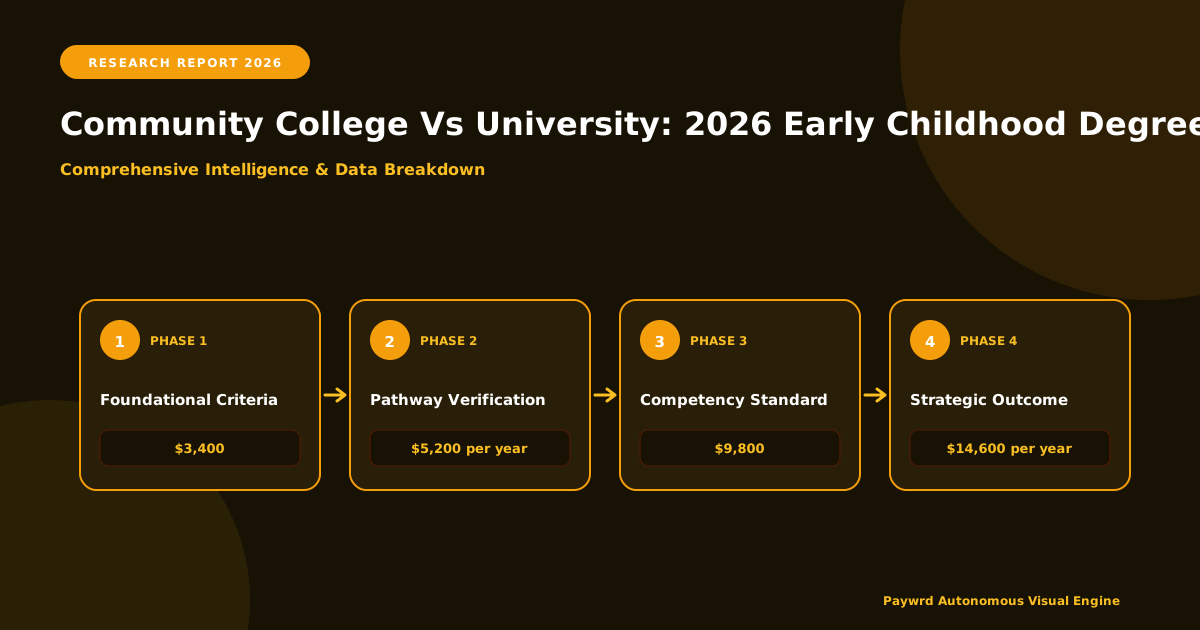
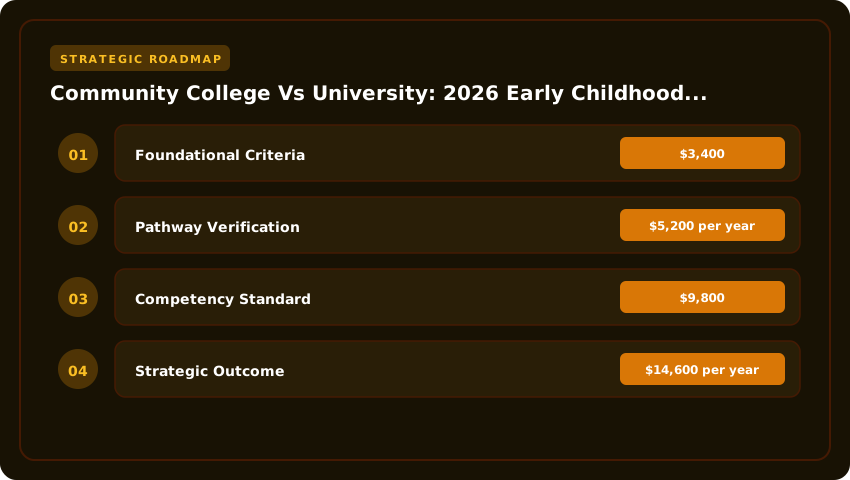
Understanding the real cost of an Early Childhood Education (ECE) degree requires looking past the advertised sticker price and digging into the line items that actually appear on a billing statement. For the 2025-2026 academic year, published tuition schedules from accredited institutions across the United States show a meaningful but narrowing gap between community college and public four-year state university pathways. An in-district community college ECE associate degree typically runs between $3,400 and $5,200 per year in published tuition, while a public four-year state university bachelor’s degree in the same field generally falls between $9,800 and $14,600 per year for in-state residents. These figures come directly from College Board’s 2025-2026 annual survey of undergraduate tuition and required fees, cross-checked with individual institutionalregistrar disclosures.
However, published tuition is only the starting point. After the FAFSA (Free Application for Federal Student Aid) is filed and a federal Pell Grant is disbursed, the average net price for a low- and middle-income ECE student shifts significantly. For the 2025-2026 award year, the maximum Federal Pell Grant is $7,395, and according to the U.S. Department of Education, roughly 58% of community college ECE students and 41% of public four-year ECE students receive a Pell-eligible award. Once that grant is applied, the average net price for a community college ECE student drops to approximately $1,100 to $2,800 per year, while the average net price at a four-year state university for a Pell-receiving ECE student averages $4,400 to $8,900 per year. For students who qualify for the full maximum Pell award plus a state-level early childhood grant, the community college pathway can effectively reduce tuition to zero at certain institutions, particularly those participating in statewide ECPipeline scholarship initiatives.
Mandatory student fees are another often-misunderstood line item. Community college ECE programs typically bundle $300 to $900 in mandatory fees per year, covering technology access, student activities, and lab use for practicum placements. Public four-year universities, by contrast, average $1,800 to $3,400 in mandatory fees, with ECE-specific lab fees for observation practicum and assessment tools sometimes billed separately. Textbook expenses remain one of the most underestimated components for any education major. According to the College Board’s 2025-2026 estimates, Early Childhood Education textbooks run between $700 and $1,100 per year, slightly higher than the all-majority average due to specialized curriculum guides, child development textbooks, and required assessment instruments. Many community colleges have responded by adopting Open Educational Resources (OER) for their ECE associate programs, which can cut textbook costs to under $150 per year, while university ECE programs are slower to adopt OER at scale.
Actionable takeaway for 2026 Early Childhood Education candidates: always run the net price calculator on every institution under consideration, factor in Pell Grant eligibility, and ask each admissions office whether their ECE program participates in statewide scholarship pipelines, because the published tuition gap between community college and university often shrinks dramatically once aid is applied.
- Community College ECE (In-District): Published tuition $3,400–$5,200; average net price after Pell $1,100–$2,800; mandatory fees $300–$900; textbooks $150–$700.
- Public 4-Year University ECE (In-State): Published tuition $9,800–$14,600; average net price after Pell $4,400–$8,900; mandatory fees $1,800–$3,400; textbooks $700–$1,100.
NAEYC Accreditation and NIT Standards: What Actually Counts
When evaluating an Early Childhood Education (ECE) degree for the 2026 academic year, the single most important quality marker is recognition by the National Association for the Education of Young Children (NAEYC). Founded in 1926 and headquartered in Washington, D.C., NAEYC sets the professional benchmark for educator preparation across the United States. However, a common misconception among community college students is that NAEYC “accredits” programs in the same way that regional bodies such as the Higher Learning Commission or the Southern Association of Colleges and Schools accredit institutions. It does not. Instead, NAEYC recognizes programs that align with its National Institute for Early Childhood Professional Development (NIT) standards, creating a two-tiered quality signal that students must learn to read.
For Associate degree pathways typically offered at community colleges, NAEYC recognition focuses on the NIT Associate Degree Standards. These standards evaluate whether a program covers the eight core knowledge areas: child development, curriculum, assessment, health and safety, family and community relationships, professionalism, program management, and field experiences. To qualify, a community college program must include a minimum of 480 clock hours of practicum with children from birth through age eight, and faculty teaching core ECE courses must hold at least a Bachelor’s degree in early childhood or a related discipline, with 50% of those faculty holding a graduate degree specifically in early childhood education. This is why students comparing a community college versus a university should verify that the Associate of Applied Science (AAS) or Associate of Arts (AA) track carries active NAEYC recognition, not merely institutional accreditation.
For Bachelor degree pathways, the NIT standards escalate significantly. A recognized Bachelor’s program must include supervised field experiences totaling at least 960 clock hours, with at least three distinct early childhood settings across the age span. Faculty teaching upper-division ECE courses must hold a terminal degree (typically a Ph.D. or Ed.D.) in early childhood education or a closely aligned discipline. Universities seeking NAEYC recognition must also demonstrate that candidates demonstrate competency in coaching, mentoring, and advocacy, which is why coursework in leadership and research methodology is non-negotiable.
The distinction between NAEYC-aligned programs and regionally accredited institutions is critical for transfer students. Regional accreditation, granted by one of the seven U.S. Department of Education-recognized regional bodies, validates the institution as a whole and ensures credit transferability and FAFSA eligibility. NAEYC recognition validates the specific quality of an early childhood curriculum. A student could attend a regionally accredited university with a perfectly valid degree that nonetheless fails to meet NAEYC standards, resulting in a credential that may not satisfy state early childhood educator requirements under the National Association of State Directors of Teacher Education and Certification (NASDTEC) framework.
Mapping these standards against the Child Development Associate (CDA) credential, administered by the Council for Professional Recognition, reveals important transfer rules. The CDA is a competency-based credential, not a degree, and it represents approximately 12 college credits in many ECE transfer articulation agreements. As of 2026, NAEYC-recognized Associate programs increasingly accept the CDA as satisfying the entry-level foundational coursework requirement, provided the candidate completed the credential through a Council-accredited training organization. However, the CDA does not waive the 480-hour practicum requirement, nor does it substitute for the required child development academic coursework at the upper-division level when transferring into a Bachelor’s program. Students holding a CDA who enter a NAEYC-recognized Bachelor’s pathway typically receive credit for 9 to 15 semester hours, depending on the state’s articulation agreement and the Council’s verification status.
Actionable takeaways for 2026 enrollment:
- Before committing to any community college ECE program, search the NAEYC program recognition database to confirm active status, and note the recognition expiration date.
- Confirm that the host institution holds regional accreditation recognized by the U.S. Department of Education to protect FAFSA eligibility and Title IV funding access.
- If you hold a CDA, request a formal transcript evaluation from the target institution’s ECE department to identify exactly which credits will transfer before you register.
- For Bachelor’s completion, prioritize programs that list NAEYC recognition explicitly, especially if you intend to pursue state teaching licensure or a Master’s degree in early childhood leadership.
Reverse Transfer and 2+2 Articulation Agreements Explained
For prospective early childhood education (ECE) students weighing a community college versus a university pathway, articulation agreements are the single most important structural advantage you have not yet been quoted a price on. A state-level articulation agreement is essentially a formal, pre-negotiated contract between two- and four-year institutions that guarantees the acceptance of coursework, credit hours, and learning outcomes from one program into another. For students pursuing an Associate of Applied Science (AAS) in Early Childhood Education at a community college and later laddering into a Bachelor of Science in Early Childhood Education at a partner state university, these contracts can save you an entire academic year of duplicated tuition and, in many states, $8,000 to $15,000 in unnecessary coursework.
Two of the most widely emulated models in the United States are Ohio’s Transfer Assurance Guides (TAG) and the Illinois Articulation Initiative (IAI). Ohio’s TAG system, governed by the Ohio Department of Higher Education, identifies universal courses in specific disciplines that are guaranteed to transfer among all Ohio public colleges and universities. For ECE students, this means a complete block of early childhood coursework, including child development, curriculum design, and observation practicum hours, will transfer seamlessly into any participating Ohio four-year institution. Illinois operates under the IAI, a similar statewide transfer compact recognized across more than 100 institutions, including the City Colleges of Chicago and public state universities like Illinois State University and Southern Illinois University Carbondale.
Beyond TAG and IAI, many states offer what is commonly called a 2+2 articulation pathway. In a 2+2 model, a student completes two years of prescribed coursework at a community college earning an AAS degree, then enters a partner university as a junior to complete two additional years and earn a bachelor’s degree. The “2+2” label is shorthand for the structural promise that every credit earned in the first half will count toward graduation in the second half. This is enormously valuable in early childhood education because the AAS curriculum already incorporates supervised field experiences in licensed child care centers, Head Start programs, and state-funded Pre-K classrooms. Rather than starting those practicum hours over at a four-year school, students arrive with hundreds of documented contact hours already on their transcript.
Reverse transfer is the complementary mechanism that makes 2+2 pathways financially and academically attractive. Reverse transfer allows a student who has transferred to a four-year university to retroactively combine university credits with previously earned community college credits to be awarded an associate degree they never formally received. For example, a student who leaves a community college after earning 45 credits toward an AAS, transfers to a state university, and completes 30 more credits, can petition to have those 30 university credits applied back toward the associate credential. The student ends up with both an AAS and a bachelor’s degree. This matters for ECE professionals because the AAS alone qualifies graduates for the Child Development Associate (CDA) credential equivalency and many state lead teacher licenses, while the bachelor’s degree unlocks program director roles and higher salary tiers under state childcare licensing scales.
To maximize the benefits of articulation agreements, students should take the following actionable steps:
- Request the official transfer pathway sheet from the community college advising office before enrolling in your first semester, and confirm the AAS courses are part of a TAG, IAI, or equivalent statewide agreement with your target university.
- Verify accreditation status by ensuring both institutions hold regional accreditation recognized by the Council for Higher Education Accreditation (CHEA), and confirm the ECE program aligns with National Association for the Education of Young Children (NAEYC) standards.
- Apply through the central application portal in your state whenever possible. In Ohio, this is the Common App or the university’s transfer-specific portal; in Illinois, the IAI-approved coursework is typically coded on transcripts automatically.
- Meet with the university transfer advisor before completing 30 community college credits, as many articulation agreements require students to follow a prescribed course sequence to preserve junior standing.
- Track practicum hours carefully, because supervised early childhood field experience is non-transferable in most states unless documented on the official AAS transcript with verification signatures from a licensed mentor teacher.
Understanding the mechanics of TAG, IAI, and 2+2 articulation turns the community college versus university decision from a financial gamble into a strategic, sequenced investment. For 2026 ECE candidates in states with robust transfer compacts, the most cost-efficient pathway typically begins at the two-year level, leverages the AAS for immediate workforce entry, and uses the articulation contract to compress the bachelor’s degree into two additional years rather than the traditional four. Always confirm the specific participating institutions, the semester in which the agreement was last updated, and whether the receiving university requires a minimum GPA for guaranteed admission, which most state universities set between 2.0 and 2.5 for transfer applicants in approved articulation programs.
Online, Hybrid, and Cohort Models for Working Adults
For working adults pursuing an Early Childhood Education (ECE) degree in 2026, the delivery format of the program frequently matters just as much as the institution that grants the credential. Most nontraditional learners balancing full-time employment, family caregiving responsibilities, and existing classroom roles cannot realistically attend a daytime, semester-long course on a physical campus. In response, both community colleges and four-year universities have built robust online infrastructures, but the structural differences between these systems can profoundly affect completion timelines, practicum logistics, and total tuition outlay. Understanding how asynchronous community college models compare with university-based Bachelor of Science (BS) completion tracks is essential for making a financially sound and academically rigorous choice.
Accredited asynchronous online programs at community colleges, such as Rio Salado College in Arizona and Sinclair College in Ohio, have become benchmarks for flexibility. Both institutions hold regional accreditation through the Higher Learning Commission (HLC), and their Associate of Applied Science (AAS) degrees in Early Childhood Education are recognized by the National Association for the Education of Young Children (NAEYC) under their associate-degree standard. Students can enroll continuously, complete coursework at any hour of the day, and progress through competencies without mandatory live sessions. Tuition is typically benchmarked at around $85 to $110 per credit hour for in-district learners, with out-of-state rates usually capped near $300 per credit hour. For working adults in metropolitan Phoenix or the Dayton region, these figures represent one of the most affordable entry points into the field.
University-based online BS completion tracks operate quite differently. Institutions such as the University of Cincinnati, Eastern New Mexico University, and the University of Wisconsin–Stout admit students who already hold an associate degree, awarding transfer credit for the entire lower-division block. Programs are commonly structured in eight-week accelerated course formats, allowing learners to complete two courses per traditional semester, effectively doubling the pace of credit accumulation. However, tuition is generally higher, frequently ranging from $330 to $490 per credit hour even before regional discounts are applied. Universities accredited under AACSB-adjacent or NCATE/CAEP-aligned standards (Council for the Accreditation of Educator Preparation) ensure the bachelor-level credential meets state lead teacher qualifications, a critical requirement for Head Start and publicly funded pre-K classrooms.
Practicum placement represents one of the most underestimated variables in this decision. Community college online programs typically arrange practicum experiences within the student’s home community, using a placement coordinator who negotiates with local childcare centers, Head Start grates, and state-funded Pre-K programs. University BS completion tracks often require a more rigorous 300 to 600 hour capstone practicum, and the university placement office generally insists on partnering with sites affiliated with the institution’s teacher preparation unit. For working paraprofessionals, this can create logistical friction if the sponsoring district or center is not on the university’s pre-approved partner list.
In-state tuition reciprocity adds yet another dimension. Students living near state borders, particularly in the Midwest and Mountain West, can frequently apply for academic exchange programs such as the Midwest Student Exchange Program (MSEP) or the Western Interstate Commission for Higher Education (WICHE) Western Academic Leadership Forum. These agreements can reduce out-of-state tuition at participating universities by $80 to $150 per credit hour, narrowing the cost gap with community college rates. For example, a Missouri resident enrolling in a Kansas or Iowa institution may pay roughly $320 per credit hour instead of the full $470 out-of-state rate.
Accelerated eight-week terms are now standard across both sectors, but the structural philosophy differs. Community college accelerated courses emphasize workforce upskilling, allowing students to layer credentials such as the Child Development Associate (CDA) and the state-level Early Childhood Credential while progressing. University accelerated terms prioritize degree completion momentum, compressing the same content into shorter bursts for learners who already have foundational knowledge. Working adults should examine whether the academic calendar allows continuous enrollment, whether courses carry the same federal financial aid eligibility under FAFSA Title IV, and whether prior learning assessment (PLA) credit can convert workplace training into college credit, potentially shaving $1,500 to $3,000 off the total degree cost.
Actionable steps for prospective students include the following:
- Verify regional accreditation status through the Council for Higher Education Accreditation (CHEA) database before enrolling.
- Confirm the program aligns with your state’s Department of Education lead teacher requirements, using the state education agency’s publicly published credentialing checklist.
- Request a detailed practicum placement policy from the institution’s education department, including whether placements can occur at your current workplace.
- Calculate the true cost difference between community college plus transfer versus a direct BS completion track, including textbooks, technology fees, and proctoring expenses that often add $400 to $700 per year.
- Ask about cohort models: some universities guarantee lockstep scheduling with the same classmates for the duration of the program, which can improve persistence rates by as much as 15 percent for adult learners.
- Submit the FAFSA early, ideally by the priority deadline, to capture Pell Grant eligibility and state-based early childhood educator scholarships that can offset tuition by $1,000 to $2,500 annually.
Lifetime ROI: Salary Outcomes, Loan Debt, and Career Mobility
When weighing a community college pathway versus a four-year university degree in Early Childhood Education, the smartest move is to model the entire financial arc, not just the first paycheck. The U.S. Bureau of Labor Statistics 2024 Occupational Employment and Wage Statistics (OEWS) survey gives us a credible snapshot of what Early Childhood educators actually earn across the country, and the spread between roles is wider than most prospective students expect.
According to OEWS, Preschool Teachers (SOC 25-2011) earn a national mean annual wage of approximately $37,120, with the 90th percentile clearing roughly $56,000 in higher-cost metros such as Boston, San Jose, and Seattle. Kindergarten and Elementary School Teachers (SOC 25-2012), who typically require a bachelor’s degree and state licensure, post a national mean closer to $63,850, with top earners reaching above $99,000 in well-funded suburban districts. Education and Childcare Administrators / Preschool and Childcare Center Directors (SOC 11-9031) average $59,290 nationally, and the upper quartile frequently surpasses $85,000 once a program earns NAEYC accreditation or operates a multi-site franchise.
- Preschool Teachers (entry-friendly via associate degree): Mean ~$37,120/yr; 25th–75th percentile band roughly $30,000–$47,000.
- Kindergarten Teachers (bachelor’s required in public K–3 settings): Mean ~$63,850/yr; strong pension and step-raise schedules in most states.
- Center Directors (often require director credentials + experience): Mean ~$59,290/yr; wide variance tied to program size and ownership.
Now stack those wages against realistic debt loads. A community college student who completes an Associate of Applied Science (AAS) in Early Childhood Education at a public two-year institution under in-district tuition will typically graduate with under $8,000 in federal loans, especially after applying the Pell Grant, the Teacher Education Assistance for College and Higher Education (TEACH) Grant, and any state-funded scholarship such as California’s Child Development Permit stipend programs. Their cumulative debt-to-income ratio in year one of full-time work as a preschool teacher lands near 0.21, meaning total loan balance represents only about one-fifth of a single year’s gross salary. With an Income-Driven Repayment (IDR) plan like SAVE, monthly payments often come in below a car loan.
The university-bound peer who completes a Bachelor of Science in Early Childhood Education at a four-year, regionally accredited institution (look for CAEP or NCATE** recognition) carries a much heavier ledger. Tuition at a public four-year averages $11,260 per year for in-state students and roughly $30,000+ at private, nonprofit universities, per College Board. After four years, even with Pell and state grants, median federal loan balances for education majors land between $25,000 and $40,000. If that graduate lands a kindergarten position at the OEWS mean, their first-year debt-to-income ratio sits at roughly 0.45, more than double the community college pathway.
But here is the career mobility nuance the spreadsheet must capture: a bachelor’s degree unlocks public-school licensure, which historically delivers stronger step-and-lane salary schedules, tenure-track protections, and defined-benefit pension access through state systems like CalSTRS or TRS-Ohio. Over a 35-year career, the cumulative earnings gap between a kindergarten teacher and a preschool teacher can exceed $1.2 million, even after subtracting a decade of additional student loan payments. Conversely, the community college graduate who climbs the center director track with a Child Development Associate (CDA) credential plus an AAS can still reach the OEWS 75th percentile for administrators within 8–12 years, and they did so without carrying a mortgage-sized loan balance.
- Community College + Workforce Entry: ~$8K debt, immediate wages, ~0.21 debt-to-income ratio; faster runway to director roles in private childcare markets.
- University + Licensure Track: $25K–$40K debt, higher entry wages, ~0.45 debt-to-income ratio; stronger pension and benefits trajectory in public K–3 systems.
- Hybrid Pathway: AAS at community college, then a 2+2 transfer articulation to a four-year CAEP-accredited program, preserves Pell eligibility and often the TEACH Grant, easing the debt load while keeping the licensure door open.
The actionable takeaway: do not chase the lowest sticker price without modeling lifetime earnings, and do not chase the bachelor’s credential without modeling your debt-to-income ratio under realistic OEWS wages. The right choice for a 2026 Early Childhood Education candidate is the one that aligns loan balance, accreditation strength, and career ambition within a single 30-year spreadsheet.
Financial Aid Traps and Stackable Credentials for Single Parents
The 2024–25 FAFSA rollout was chaotic, but the 2026–27 cycle brings structural changes that directly benefit single parents pursuing Early Childhood Education (ECE). The most critical shift is the replacement of the Expected Family Contribution (EFC) with the Student Aid Index (SAI). Unlike the EFC, the SAI can go as low as –$1,500, allowing financial aid officers to see a truer picture of need for students with zero or negative discretionary income. For a single parent heading a household of two, this negative SAI often unlocks the maximum Pell Grant ($7,395 for 2024–25, indexed for inflation in 2026) plus Supplemental Educational Opportunity Grants (SEOG) and state need-based aid without the previous “automatic zero” income ceiling confusion.
However, a major trap remains: income protection allowances for single parents are still calculated against prior-prior year taxes (2024 returns for the 2026–27 FAFSA). If you picked up overtime or a second job in 2024 to build a safety net, your SAI will inflate. The actionable fix? Use the Professional Judgment (PJ) appeal process immediately after filing. Submit a letter to your community college financial aid office documenting the loss of that income (reduced hours, job loss, or childcare-related work interruption) alongside a current budget. Colleges have broad authority to adjust the SAI downward for “special circumstances,” but you must ask—proactively.
Beyond federal aid, state-funded childcare workforce stipends are the hidden goldmine. Over 30 states now operate Early Childhood Workforce Registries tied to direct compensation supplements. In Washington State, the Early Achievers Grant covers full tuition and books for ECE certificates and associate degrees at community colleges. Colorado’s Early Childhood Teacher Credential stipend pays up to $3,000 annually for credentialed staff in licensed centers. California’s Child Development Permit Stipend Program (administered through local Resource & Referral agencies) offers tiered payments based on permit level. These funds are not loans, do not require FAFSA verification of parental income beyond residency, and stack legally on top of Pell. Check your state’s registry before enrolling; many require you to be employed in a licensed facility while studying.
The TEACH Grant offers up to $4,000 per year (aggregate $16,000 for undergrad) but carries a severe clawback clause: if you do not teach in a high-need field at a low-income school or educational service agency for four full years within eight years of graduation, the grant converts to an unsubsidized Direct Loan with interest accruing from disbursement date. For ECE majors, “high-need field” qualification is narrow—typically only special education, bilingual education, or STEM endorsements count. A general ECE associate degree alone rarely qualifies. Do not accept a TEACH Grant unless your program explicitly maps to a qualifying endorsement and you have a written plan to meet the service obligation.
The fastest ROI for single parents is the stackable credential pathway: earn your Child Development Associate (CDA) credential while completing your Associate of Applied Science (AAS) in ECE. The CDA requires 120 hours of formal education (often embedded in your first semester courses), 480 hours of professional experience (count your current job), and a portfolio. In Head Start settings, a CDA + AAS meets the lead teacher qualification under the 2016 Head Start Performance Standards (45 CFR §1302.91) immediately upon graduation. Without the CDA, an AAS graduate often starts as an assistant teacher at $14–$17/hour; with the CDA, you step into a lead role at $19–$24/hour plus benefits. Many community colleges (e.g., Ivy Tech, Dallas College, Northern Virginia Community College) now offer CDA prep as a zero-credit, tuition-free module inside the AAS pathway. Ask your advisor to map the CDA competency standards to your course syllabi in week one—do not wait until capstone.
- File FAFSA October 1, 2025 for 2026–27; use the IRS Direct Data Exchange (DDX) to avoid verification flags.
- Request a Professional Judgment review if 2024 income doesn’t reflect 2026 reality.
- Register in your state’s Workforce Registry on day one of classes to unlock stipends.
- Avoid TEACH Grant unless pursuing SpEd/Bilingual endorsement with a signed service plan.
- Embed CDA coursework into your first two semesters; verify Head Start lead-teacher eligibility with your local grantee HR office.
| Metric | Community College (A.A.S. / A.A. ECE) | Public University (B.S. / B.A. ECE + Licensure) |
|---|---|---|
| Avg. Annual Tuition & Fees (In-State, 2025-26) | $3,950 – $4,800 | $10,800 – $12,500 |
| Total Direct Cost (Degree Completion) | $8,500 – $11,000 (2 Years) | $45,000 – $55,000 (4 Years) |
| Admission Cut-Off (HS GPA / Testing) | Open Access (Diploma/GED); Placement Tests | 2.75–3.25 GPA; SAT 1000–1150 / ACT 20–23 (Test-Optional Common) |
| Time to Workforce Entry | 18–24 Months (Associate + CDA) | 48–54 Months (Bachelor’s + Student Teaching) |
| Licensure Eligibility (2026 Standards) | CDA Credential; Lead Teacher (Birth–Pre-K) in most states; Not eligible for K–3 Public License | Full State Teaching License (Birth–Grade 3 or Pre-K–Grade 3); Meets Federal Head Start Lead Teacher Mandate |
| Median Starting Salary (2026 Proj.) | $32,000 – $38,000 (Childcare / Private Pre-K) | $44,000 – $52,000 (Public School Pre-K / K–3) |
| Transfer Pathway Efficiency (AA to BA) | 60 Credits Transfer (Articulation Agreements); 2+2 Pathway Saves ~$25k | N/A (Entry Point); Accepts 60–72 Transfer Credits Max |
| Student-to-Faculty Ratio (ECE Dept.) | 16:1 – 22:1 (High Practicum Focus) | 18:1 – 25:1 (Lecture) / 12:1 (Field Placement) |
| 20-Year Net ROI (Degree Cost vs. Earnings Delta) | High Ratio (Low Cost / Moderate Earnings) | Moderate Ratio (High Cost / Higher Lifetime Earnings + Pension Eligibility) |
Frequently Asked Questions
What is the total tuition cost difference for a 2026 Early Childhood Education degree between community college and public university?
For the 2025-2026 academic year, a community college Associate degree in ECE averages $8,500–$11,000 total tuition, while a public university Bachelor's with licensure averages $45,000–$55,000. The four-year path costs roughly 4x–5x more upfront, though university graduates access public school salary schedules and pension systems unavailable to associate holders.
Can you teach public school Kindergarten with a community college Early Childhood degree in 2026?
No. A community college Associate degree (A.A.S. or A.A.) qualifies graduates for the CDA credential and lead teacher roles in private childcare or Head Start (Birth–Pre-K). It does not meet state Department of Education requirements for a K–3 or Pre-K–Grade 3 public teaching license, which mandates a regionally accredited Bachelor's degree and supervised student teaching.
How does the 2+2 transfer pathway work for Early Childhood Education majors in 2026?
The 2+2 pathway allows students to complete an Associate of Arts (A.A.) at a community college (approx. 60 credits) and transfer into a public university Bachelor's program as a junior. Strong articulation agreements guarantee 60 credits transfer, saving $25,000+ in tuition. Students must maintain a 2.5–2.75 GPA and complete specific prerequisite courses (Child Development, Intro to Education) for seamless entry.
What is the salary ROI difference between an Associate and Bachelor's in Early Childhood Education for 2026 graduates?
2026 Associate graduates enter private sector roles averaging $32,000–$38,000. Bachelor's graduates with licensure start at $44,000–$52,000 in public Pre-K/K–3 roles. Over 20 years, the Bachelor's degree yields ~$400,000+ higher cumulative earnings and pension vesting, offsetting the ~$35,000 higher degree cost within 4–5 years of public school employment.
Strategic Final Takeaway
Success in evaluating Community College Vs University: 2026 Early Childhood Degree relies on early preparation, adherence to verified accredited requirements, and cross-referencing official portals. Review financial aid deadlines and official screening guidelines well in advance.