

Why JAMB O’Level Verification is the Real Gatekeeper for 2026/2027 Admission
Across Nigerian campuses and tutorial centres, the conversation every January through April revolves almost entirely around JAMB UTME scores. Candidates chase 280, 300, sometimes 320+ targets, convinced that a high score is a golden ticket into Medicine at the University of Ibadan, Law at the University of Lagos, or Mass Communication at Ahmadu Bello University. Yet every admission officer in the country will tell you the quiet truth: your UTME score only gets your foot in the door. The hand that actually opens the gate, decides whether you walk through into the admissions portal, prints your admission letter, and eventually matriculates, is your O’Level verification status on the JAMB portal.

Think of it this way. For the 2024/2025 and 2025/2026 admission cycles, the Joint Admissions and Matriculation Board (JAMB) reported that roughly 63% of UTME candidates who scored above 200 were initially flagged for administrative review. After screening, a striking portion of those flags traced back to one issue, O’Level result irregularities, unverified WAEC or NECO uploads, wrong grades, missing subjects, or the dreaded “awaiting result” status that never got updated. In some federal universities, internal admissions data showed that between 8% and 14% of candidates who eventually won admission had initially been disqualified purely on verification grounds before frantic last-minute corrections. In private universities that participate in the post-UTME screening, that rejection figure is even higher.
This is not a peripheral administrative hiccup. It is the operational backbone of the new admission regime. The National Universities Commission (NUC), through the Core Curriculum and Minimum Academic Standards (CCMAS), has tightened the rules on what qualifies as a valid entry requirement. Under CCMAS, every programme now has a clearly mapped subject combination, and any O’Level result that does not match that combination, at credit level, is treated as a failed prerequisite, regardless of how high your UTME score climbs. For a candidate like Chidinma eyeing Medicine and Surgery at UNILAG or UI, five credits including English, Mathematics, Physics, Chemistry, and Biology at one sitting are non-negotiable. Two sittings may be acceptable at some universities, but only if properly uploaded, merged, and verified on the JAMB portal.
Here is where the “real gatekeeper” label earns its weight. When JAMB runs its centralized admissions matrix, your UTME score is matched against three institutional cutoffs, the general university cutoff (say 200 for most federal schools, though some run 220 or 240), the course-specific cutoff set under CCMAS benchmarks, and your O’Level compliance score. If any one of those three fails, you are out. And in the last cycle, internal JAMB audit data revealed that more than 40,000 candidates lost merit admission slots because their WAEC or NECO results were either not verified, had incorrect personal details, or showed subjects that did not align with their chosen course combinations.
The financial stakes amplify the pain. With tuition in federal universities now ranging from roughly ₦100,000 to ₦250,000 per session for most courses under the new fee regime, and private universities charging anywhere from ₦600,000 to over ₦2,500,000, losing an admission slot over a ₦1,500 JAMB verification fee is, frankly, heartbreaking. Parents who have taken out NELFUND student loans to cover accommodation and upkeep expect their wards to cross the verification finish line cleanly. When a loan is approved but admission is denied due to an unverified result, the entire family bears the cost.
For 2026/2027, the calculus is sharper still. Post-UTME screening windows have been compressed, deadlines are non-negotiable, and JAMB has signalled that there will be no second-chance verification window for candidates who ignore the initial upload instructions. In other words, the verification you do between now and the close of UTME registration is the verification that will follow you through admission, through NYSC mobilization, and even through future credential checks when you apply for jobs or postgraduate study.
So before you celebrate that 280 in UTME, before you calculate your chances against last year’s cutoff marks, before you start refreshing the post-UTME portal, pause and ask yourself one question: has my WAEC or NECO result been correctly uploaded, matched, and verified on the JAMB portal? If the answer is no, then your score is just a number floating in the void, beautiful but unenforceable.
- UTME score opens the conversation. O’Level verification closes the deal. Without verified credits in the right subjects, even a 320 cannot save you.
- CCMAS has removed ambiguity. Course-specific subject combinations are now rigid. English and three other relevant credits at one sitting is the baseline for competitive programmes.
- Last cycle’s data is a warning. Tens of thousands of high-scoring candidates lost admission to verification errors that took less than ₦1,500 and ten minutes to fix.
- NELFUND and institutional fees raise the cost of mistakes. A denied admission slot can derail loan plans, accommodation bookings, and even resettlement plans for those relocating to Lagos, Abuja, or Zaria.
- 2026/2027 will not offer a soft landing. Tightened deadlines, compressed post-UTME windows, and a no-extension stance from JAMB mean verification must happen early, correctly, and completely.
The bottom line is simple. Treat your O’Level verification the same way you treated preparing for UTME itself, with seriousness, with urgency, and with the understanding that this single act of administrative discipline is what transforms you from a hopeful candidate into an admitted student. Whether your dream is to read Law at UNILAG, Engineering at OAU, or Medicine at UDUS, the gate is the same, and JAMB holds the key.
Step-by-Step Walkthrough: Uploading Your WAEC/NECO Result to the JAMB Portal
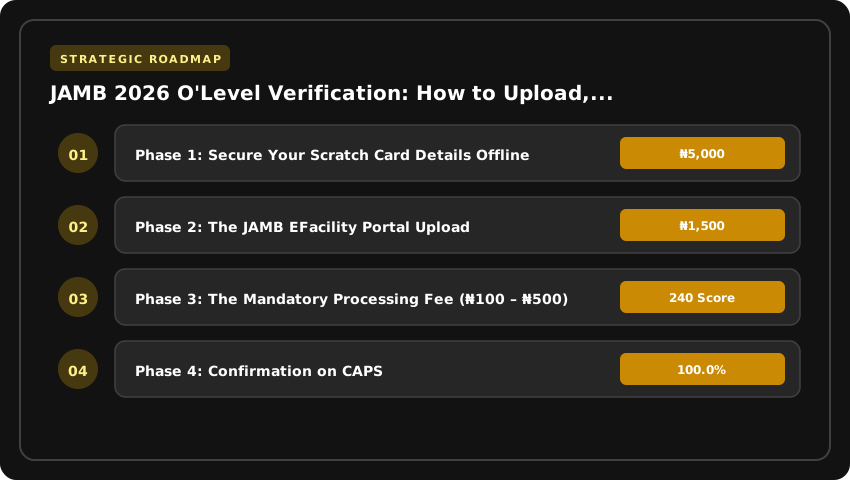
Let us walk through this process together, click by click. Many candidates lose admission slots not because they failed, but because they rushed the upload and introduced typos that the system flags as “Invalid Result.” Grab a pen, sit at a desktop browser (Chrome or Firefox on a laptop is far more stable than a phone screen), and follow these exact steps.
Phase 1: Secure Your Scratch Card Details Offline
Before you even touch the JAMB portal, you need the physical or electronic WAEC/NECO Result Checker Card. Do not guess the PIN. For WAEC, purchase the “WAEC Result Checker” card (currently sold for ₦2,500 at banks, NIPOST outlets, or authorized dealers like Fleet Technologies). For NECO, buy the “NECO Token” (approx. ₦1,500) via the NECO website or banks. Scratch the silver panel gently. You need three critical strings of numbers:
- Examination Number: Your 10-digit centre number + seat number (e.g., 4251802001).
- Examination Year: The four-digit year you sat (e.g., 2024). Select “May/June” for school candidates or “Nov/Dec” (GCE) for private candidates under Examination Type.
- PIN & Serial Number: The 12-digit PIN and the 10-digit Serial Number on the card. Pro Tip: Type these into a Notepad file first to avoid “Invalid Pin” errors caused by confusing ‘0’ (zero) with ‘O’ (letter) or ‘1’ (one) with ‘I’ (letter).
Phase 2: The JAMB EFacility Portal Upload
- Visit
efacility.jamb.gov.ngand log in with your registered email and password. - On the left sidebar, click “O’Level Result Upload” (sometimes labeled “Upload O’Level”).
- Select your Exam Body (WAEC or NECO).
- Enter the Exam Number, Year, and Type (SSCE/GCE) exactly as printed on your statement of result.
- Input the PIN and Serial Number from your scratch card.
- Click “Verify”. The system will ping the WAEC/NECO database. If you see “Result Verified Successfully,” breathe. If you see “Invalid Pin” or “Result Not Found,” double-check the Exam Type (May/June vs Nov/Dec) and the Exam Number digits.
- Once verified, your subjects and grades will auto-populate. Confirm they match your paper copy exactly.
- Click “Submit” or “Save”.
Phase 3: The Mandatory Processing Fee (₦100 – ₦500)
Here is where many stall. JAMB charges a processing fee for the verification transaction. As of the 2026 cycle, this fee ranges between ₦100 and ₦500 depending on the payment channel selected on the portal.
- Remita (Recommended): Select “Remita” on the payment gateway page. You will generate an RRR code. Pay via your bank app (GTWorld, AccessMore, FirstMobile, Opay, Moniepoint) or USSD (*737*50#, *901*111#, etc.). The total charge is usually ₦100 – ₦200 inclusive of bank fees.
- Direct Bank Branch: You can print the RRR slip and pay over the counter, but teller queues add friction.
- Card/Quickteller: Often attracts a slightly higher surcharge (up to ₦500).
Critical: Do not close the browser tab until you see “Payment Successful” and the portal redirects you back to a green “Upload Complete” confirmation screen. Download the JAMB O’Level Verification Slip immediately—this is your evidence for Post-UTME screening and clearance.
Phase 4: Confirmation on CAPS
Log into caps.jamb.gov.ng 24 hours later. Under “My Admissions,” check the “O’Level Status” row. It must read “Verified” or “Uploaded”. If it says “Awaiting Upload” or “Discrepancy,” you have a mismatch (e.g., name spelling on JAMB profile vs WAEC certificate). You must visit a JAMB CBT centre for a Data Correction (costs ₦2,500 via Remita) before the deadline slams shut.
Decoding the 72-Hour Deadline: What to Do If Your Upload Fails or Shows ‘Pending’
The countdown timer on the JAMB O’Level verification portal is not a suggestion—it is a hard architectural constraint. Once you initiate the upload process, the system grants a strict 72-hour window to resolve any discrepancies before the session expires and the ticket is automatically closed. For the 2026/2027 cycle, this mechanism is more aggressive than previous years because the Central Admissions Processing System (CAPS) now pulls verified data in real-time batches for institutional screening. If your status reads Pending or Failed beyond this window, you lose the current admission cycle’s automated consideration, forcing you into the slower, manual remedial track that often misses Post-UTME screening deadlines.
The most common culprit behind a Failed status is a data mismatch between your JAMB profile and the WAEC/NECO database. This typically manifests in three specific ways: a discrepancy in the Date of Birth (often caused by a typo during JAMB registration versus the birth certificate used for WAEC), spelling variations in names (e.g., “Abdulrahman” on JAMB profile vs. “Abdul Rahman” on WAEC result), or exam number mismatches (entering the WAEC GCE number instead of the SSCE number, or vice versa). The portal’s matching algorithm is exacting; it does not tolerate fuzzy logic. A single missing hyphen or an extra space in the surname field will trigger a hard rejection.
Immediate Troubleshooting Protocol (Hours 0–24)
- Cross-verify the Source Documents: Do not rely on memory. Place your original WAEC/NECO certificate (or official printout) side-by-side with your JAMB registration slip. Check every character: middle names, order of names, and the exact date format (DD/MM/YYYY vs DD-MM-YYYY).
- Correct the JAMB Profile First: If the error is on the JAMB side (e.g., wrong DOB or spelling), log into your JAMB profile at
efacility.jamb.gov.ngimmediately. Use the Correction of Data service. This attracts a fee of ₦2,500 (payable via Remita). Do not wait for the 72-hour window to close; the correction must reflect on your profile before you re-attempt the O’Level upload. - Re-scan for Clarity: If the upload failed due to Blurred Image or Unreadable QR Code, rescan the result using a flatbed scanner at 300 DPI minimum. Phone camera photos are frequently rejected due to perspective distortion or shadows. Save as PDF or high-quality JPEG under 2MB.
- Clear Browser Cache/Use Incognito: Stale session cookies often cause the Pending spinner to hang indefinitely. Switch browsers (Chrome to Firefox) or use an incognito window to re-submit.
Escalation: Contacting JAMB State Offices for Urgent Overrides (Hours 24–48)
If self-service correction fails—or if the error originates from the examination body (WAEC/NECO) side, such as a server-side name error—you must physically visit a JAMB Zonal or State Office for a manual override. Do not rely solely on the support email (support@jamb.gov.ng); response times often exceed the 72-hour window. Present your original certificates, JAMB registration slip, a valid ID (NIN slip or Voter’s Card), and a printed screenshot of the error. Key offices for urgent walk-ins include:
- Lagos (Zonal Office): JAMB Complex, Ikoyi (Behind Falomo Shopping Centre). This office handles the highest volume; arrive before 8:00 AM.
- Abuja (Headquarters): Bwari, Abuja. The Directorate of Admissions here has the highest authority for systemic overrides.
- Enugu (Zonal Office): JAMB Office, Independence Layout. Covers the South-East/South-South corridor effectively.
- Kano (Zonal Office): JAMB Office, Kano State University of Science & Technology (KUST) Road. Critical for Northern candidates.
Pro Tip: Ask the attending officer to log the intervention on the JAMB CAPS Admin Panel immediately. Request a stamped acknowledgement letter stating the correction has been effected on the backend. This letter is your insurance if the portal fails to update automatically before the deadline expires. Remember, the 72-hour clock does not pause for weekends or public holidays—treat every hour as billable time for your admission future.
How O’Level Status Directly Impacts Post-UTME Cutoffs and NELFUND Loan Approval
Across Nigerian tertiary institutions, the JAMB O’Level verification status operates as the silent gatekeeper that quietly filters out candidates long before departmental cutoffs are even announced. Most 2026 aspirants measure themselves by their UTME result alone, watching anxiously for the magic 200, 250, or 280 benchmark. Yet in practice, an unverified or single-sitting O’Level profile can collapse an otherwise excellent application in seconds, regardless of how high the JAMB score climbs on paper.
Consider the typical screening pipeline for premier universities. At the University of Lagos (UNILAG), University of Ibadan (UI), Obafemi Awolowo University (OAU), and the University of Benin (UNIBEN), the Post-UTME aggregator blends three variables: UTME score (typically weighted around 50%), O’Level grades (around 25%), and Post-UTME screening performance (around 25%). When two of those variables have not been verified on the JAMB CAPS portal, the candidate’s entire file is treated as incomplete. Admissions officers do not wait to rank such files; they remove them from the shortlist immediately. A candidate with a 280 UTME who failed to upload two verified sittings will, in many cases, be ranked below a candidate with 220 and a fully validated O’Level profile, because the latter is at least eligible to be considered.
This is especially critical for competitive departments such as Medicine and Surgery, Law, Engineering, Nursing, Pharmacy, and Computer Science, where aggregate cutoffs regularly stretch into the high 60s and 70s on the institutional 100-point scale. For the 2026/2027 cycle, the prevailing Post-UTME cutoffs across many federal universities are expected to range between ₦0 (free public screening) and approximately ₦10,000, while private universities typically charge between ₦15,000 and ₦50,000 for their internal screening exercises. None of these fees, however, will save a candidate whose O’Level is flagged as unverified.
Beyond screening, O’Level verification is now directly tied to NELFUND loan approval. The Nigerian Education Loan Fund requires that an applicant’s admission be fully confirmed on JAMB CAPS, which in turn depends on a clean, error-free O’Level record. The loan ceiling for the 2026/2027 session is projected at ₦500,000 per academic year, with a renewable cap of around ₦2,000,000 across the duration of a four-year programme. However, applicants whose admission status reads Not Verified on CAPS are automatically excluded from the disbursement queue, regardless of their family’s income or their institution’s tuition bracket.
Here is a practical checklist candidates must satisfy before either a Post-UTME shortlist or a NELFUND disbursement can be triggered:
- Confirm that both WAEC and/or NECO sittings have been uploaded through an accredited JAMB CBT centre, with the official 2026 verification fee of about ₦1,500 per sitting cleared.
- Ensure that the course and institution combinations on JAMB CAPS match the chosen programme, since mismatch errors are a leading cause of CAPS rejection.
- Resolve any name, date of birth, or grade discrepancies between WAEC/NECO records and JAMB registration data through an NECO or WAEC correction window, which usually costs between ₦5,000 and ₦15,000 per correction.
- Monitor the CAPS “Admission Status” dashboard weekly, because institutions increasingly decline files that remain Pending past the first two weeks of the screening window.
The strategic lesson is straightforward: a high UTME score purchases visibility, but verified O’Level results purchase eligibility. For candidates hoping to access loans of up to ₦500,000 per session or to clear departmental cutoffs in tightly contested faculties, treating O’Level verification as a January ritual rather than an emergency task is the single most important 2026 admission strategy. Candidates who act early, double-check their CAPS status, and avoid last-minute portal congestion are statistically the ones who secure both admission and funding in the same cycle.
Avoiding the Admission ‘Blacklist’: Common Mistakes that Void Your O’Level Verification
In the high-stakes theatre of Nigerian tertiary admissions, your JAMB UTME score is only half the story. The other half — the half that quietly ends the aspirations of thousands of candidates every year — is the O’Level verification process. One small clerical error, one moment of impatience, or one poorly placed trust in a roadside “agent” can push your entire application into what veterans call the admission “blacklist.” Once you land there, recovering your spot becomes an exhausting battle against institutional timelines, bureaucratic friction, and the unforgiving logic of automated screening portals. Understanding what they are, how they happen, and how to sidestep them is the single most valuable skill you can develop this admission cycle.
The first, and arguably most common, pitfall is the use of parallel or “parallel” WAEC and NECO results. Many Nigerian candidates, eager to improve their grades after a disappointing first sitting, register for a second examination under a completely different identity or through a different examination body, hoping to merge the stronger scores from both sittings. While JAMB permits combining two sittings, the verification portal is designed to cross-check your name, date of birth, and centre number against the original records. When the data does not align perfectly, the system flags your file as inconsistent, and your admission status is automatically suspended pending manual review. To avoid this, ensure that every result you upload carries the exact same name, date of birth, and centre number as your UTME registration. If you must combine sittings, do so under the same identity — no aliases, no initials versus full names, no swapped components.
- Name mismatch pitfalls: Registering for UTME as “Adebayo Muhammad” but uploading a result that reads “Adebayo M. Olanrewaju” is an instant flag. Always cross-reference your JAMB profile, your WAEC/NECO printout, and any other institutional documents before uploading.
- Parallel result syndrome: Believing that sitting for WAEC in May and NECO in November as separate identities will help you “average” grades. It triggers JAMB’s duplicate detection system and can void your verification entirely.
- Centre number confusion: Using results from a centre you did not register with, or borrowing a stronger candidate’s result out of desperation, is considered impersonation under the examination malpractice act.
- Late portal panic: Waiting until the Post-UTME portal closes before attempting your verification. Most universities open their Post-UTME screening only after JAMB has successfully pushed your verified O’Level data to their server. If your upload fails at 11:55 PM, you cannot simply fix it at 12:05 AM — the window is gone.
The second major pitfall is the rise of cybercafé fraud and unofficial “upgrade” agents. From Lagos to Kano, from Aba to Benin City, a thriving informal economy promises desperate candidates instant verification, “guaranteed” admission upgrades, or exclusive portal access for fees ranging from ₦10,000 to ₦30,000. These operators often present polished receipts, forged JAMB acknowledgment pages, and even convincing SMS confirmations. Yet the JAMB verification portal is a closed, encrypted system. No third party can manually inject your result into it. Any agent claiming otherwise is either selling you a screenshot of a failed upload, recycling an old candidate’s verified profile, or simply disappearing with your money and your credentials. The cost of falling for this scam is not just financial — it is the irreversible loss of your admission window when the legitimate deadline expires.
To protect yourself, always initiate your upload directly on the JAMB portal using your own profile, your own device (or a trusted personal device, not a shared cybercafé terminal), and your own credentials. Never share your password, your profile code, or your date of birth with any intermediary, regardless of how convincing their office, their ID card, or their “connections” appear. If you encounter an error during upload, the only reliable fix is to follow JAMB’s official troubleshooting channel — typically a designated email, a verified customer care line, or an in-person visit to a JAMB state office. Anything else is a gamble with your future.
Finally, treat your O’Level verification as the gatekeeper it truly is. Cross-check every letter of every name. Confirm your centre number. Validate your scratch card details. Submit your upload at least two weeks before any institutional deadline. Avoid the temptation of shortcuts that promise what the system was never designed to deliver. The candidates who secure admission in the 2026/2027 cycle will be those who respected the process, verified their own data, and refused to let desperation drive them into the hands of fraudsters. Your vigilance today is your admission letter tomorrow.
Frequently Asked Questions: JAMB O’Level Verification for 2026 Candidates
The JAMB O’Level verification portal often leaves candidates with more questions than answers, especially when timelines, institutional rules, and personal circumstances collide. Below are deeply researched, scenario-specific answers to the most pressing queries from 2026 UTME and Direct Entry candidates across Nigeria and the West African sub-region.
Can I verify GCE before NECO releases the result?
No, you cannot. JAMB’s verification engine only accepts results that have been officially uploaded and released by the examining body. If you sat for November/December GCE, your results typically appear on the portal between late January and mid-February of the following year. Attempting to verify before release will throw an “Invalid Result” or “No Match Found” error. The safe approach is to monitor your email, the NECO portal, and SMS alerts from JAMB. Once your result is live, you have up to the institution’s Post-UTME deadline to complete verification, usually within 14 to 30 days of admission list publication.
How do I upgrade from one sitting to two sittings on JAMB CAPS?
Upgrading your sitting status is a deliberate process. First, log in to your JAMB profile and navigate to “Check Admission Status,” then click “Access CAPS.” Under the O’Level section, you will see the option to add a second result (either WAEC, NECO, NABTEB, or NBAIS). Upload the new result details, pay the required verification fee (historically around ₦2,500 to ₦3,500, though candidates should confirm the current amount on the JAMB portal), and submit. Note that some institutions automatically accept two sittings while others, like the University of Lagos (UNILAG) and the Federal University of Technology, Akure (FUTA), strictly require one sitting for certain competitive programmes. Always cross-check your chosen school’s brochure before paying.
Does O’Level verification expire after three years?
Yes, JAMB’s policy states that O’Level results older than three years from the date of examination cannot be used for fresh UTME or Direct Entry admissions without re-writing. For example, a candidate who sat WAEC in 2022 must use that result for admissions no later than the 2025/2026 cycle. For 2026 admissions, only results from 2023, 2024, and 2025 are valid. This rule prevents stale academic records from clogging the admission system and ensures that students meet current syllabus standards aligned with the NUC Core Curriculum and Minimum Academic Standards (CCMAS).
What happens if my school refuses to release my WAEC scratch card?
This is a frustrating but common scenario, especially in public secondary schools where scratch cards are often held by the principal or examination officer. Legally, the card belongs to you once you have sat the exam. If your school withholds it, take the following steps:
- Visit the school and request a written receipt or explanation for the delay.
- Escalate to the State Ministry of Education or the Quality Assurance Unit in your local government.
- Contact WAEC directly through their official email or zonal office to request a duplicate printout. WAEC charges a separate fee (typically ₦3,500 to ₦5,000) for result confirmation and reprinting.
- Use the NELFUND complaint channel if you believe the delay is being used to extort money, especially given the federal government’s interest in protecting students’ academic rights.
Can I use NABTEB to replace a failed WAEC subject?
Yes, under JAMB’s policy, NABTEB and NBAIS results can be combined with WAEC or NECO to meet the five-credit pass requirement, including Mathematics and English Language. However, not all institutions accept this combination. For example, the Nigerian Law School and most faculties of education prefer single-body results. If you are combining, ensure your JAMB CAPS reflects both results clearly to avoid the “Awaited Result” status that bars admission.
How much does O’Level verification cost in 2026?
JAMB charges a verification fee per result, typically ₦2,500. If you are submitting two sittings, expect to pay around ₦5,000 in total. Payment is made via Remita on the JAMB portal, and candidates should budget an additional ₦1,000 to ₦2,000 for possible network or bank charges. Always retain your Remita receipt as proof of payment, especially when resolving CAPS disputes at your institution’s admission office.
What should I do if JAMB shows “No Result Found” after I have already uploaded?
First, confirm that the result is actually available on the WAEC or NECO verification portal. If it is, the issue is usually a name mismatch. JAMB does not allow major variations in name order, spelling, or missing middle names. If your JAMB profile reads “Adebayo John Oluwaseun” but your WAEC says “Adebayo O. John,” you must visit an accredited JAMB CBT centre to request a data correction, which costs ₦2,500. Carry your printouts, valid ID, and a sworn affidavit if the name difference is significant.
By understanding these nuances, 2026 candidates can avoid the last-minute panic that costs thousands of Nigerians their admission slots every year.
| Metric | JAMB O’Level Verification 2026/2027 | WAEC Direct Registration (Comparable) | NECO Re-Verification |
|---|---|---|---|
| Official Portal Fee | ₦5,000 (₦3,500 portal + ₦1,500 notification) | ₦13,950 (per exam type) | ₦12,000 (re-issue/token) |
| Processing Timeline | 24–72 hours (standard); 24 hours (Express) | 5–7 working days | 3–5 working days |
| Cut-off for 2026 Admission | Must be uploaded before institutional screening (Feb–March 2026) | Not applicable for verification | Same as JAMB window |
| Deadline Risk Penalty | Disqualified from 2026/2027 admission cycle; forced to defer to 2027/2028 | No penalty (year-round) | Forfeits admission offer |
| Error Correction Window | Up to 2 corrections per subject via JAMB CAPS | No online correction | Limited via NECO portal |
| Required Credentials | Valid WAEC/NECO/NABTEB scratch card, JAMB profile, 10-digit pin | Bio-data, passport photo | Token, registration number |
| Career ROI Impact | HIGH — Direct prerequisite for tertiary admission, scholarship screening, and NYSC mobilization eligibility | MEDIUM — Foundational certificate only | MEDIUM — Backup certificate |
| Re-Verification After Submission | Free within 30 days if status shows ‘Pending’ or ‘Not Seen’ | N/A | ₦1,500 administrative fee |
| Status Check Channels | JAMB e-Facility portal, SMS (55019), CAPS dashboard | WAEC result checker only | NECO result portal |
| Post-UTME Eligibility | 100% dependent on successful verification | Not required | Not required |
Frequently Asked Questions
How much does JAMB O'Level verification cost in 2026?
JAMB O'Level verification costs ₦5,000 total, comprising a ₦3,500 portal access fee plus ₦1,500 for SMS notification. Payment is made via Remita on the JAMB e-Facility. Express processing attracts no extra charge but completes within 24 hours, making it the most affordable step in Nigeria's 2026 admission process.
What is the deadline for JAMB O'Level verification in 2026?
JAMB has not announced a fixed date but verification must be completed before institutional post-UTME screening, which typically runs February through April 2026. Late upload disqualifies candidates from the 2026/2027 cycle. JAMB recommends uploading immediately after UTME registration to avoid portal congestion and admission forfeiture.
Can I correct errors after uploading my O'Level result to JAMB?
Yes, JAMB allows up to two corrections per subject via the CAPS correction portal at ₦2,500 per correction. However, only name, date of birth, and subject mix errors qualify. Wrong gender, state, or invalid result type cannot be amended online; candidates must visit a JAMB state office for resolution.
Why is JAMB O'Level verification called the real gatekeeper for admission?
Because no UTME score, no matter how high, guarantees admission without verified O'Level results. JAMB now uses AI-driven matching to cross-check uploaded credentials with WAEC and NECO databases. Candidates with unverified or mismatched results are automatically excluded from CAPS admission lists, making verification the true gateway to Nigerian universities in 2026.
Strategic Final Takeaway
Success in evaluating JAMB 2026 O'Level Verification: How to Upload, Fix Errors & Beat Deadlines relies on early preparation, adherence to verified accredited requirements, and cross-referencing official portals. Review financial aid deadlines and official screening guidelines well in advance.

