

The Financial Collapse of Saint Augustine’s University: A Timeline of Mismanagement and Federal Oversight
The financial unraveling of Saint Augustine’s University did not occur overnight. What culminated in a Fall 2026 Chapter 11 bankruptcy filing was, in reality, a slow-motion collapse stretching back nearly a decade, marked by plunging enrollment, eroding accreditation standing, depleted endowment reserves, and repeated warnings from federal regulators who watched the situation deteriorate with growing alarm. For prospective students evaluating this institution, for alumni whose degrees hang in the balance, and for policymakers examining the broader landscape of Historically Black Colleges and Universities (HBCUs), the Saint Augustine’s case represents a cautionary tale of how institutional drift, leadership turnover, and fiscal mismanagement can converge into an existential crisis.

The earliest visible cracks appeared in the university’s accreditation record. The Southern Association of Colleges and Schools Commission on Colleges (SACSCOC), the regional accrediting body recognized by the U.S. Department of Education, placed Saint Augustine’s on probation in 2019 following a comprehensive review that cited deficiencies in financial resources, governance, and student outcomes. SACSCOC reviews are conducted on a 10-year cycle, with shorter follow-ups for institutions under sanctions, and the probationary status signaled that the university had failed to demonstrate compliance with the Principles of Accreditation, particularly standards related to financial stability and institutional effectiveness. For students, SACSCOC probation carries serious downstream consequences: federal financial aid under Title IV remains technically accessible, but transferability of credits to other regionally accredited institutions becomes significantly more complicated, and graduate schools and employers may view the credential as diminished.
By 2023, the situation had worsened considerably. The university entered what SACSCOC classified as a “financial distress” classification, a more severe designation than probation, triggered by audited financial statements revealing a negative net asset position and recurring operating deficits. Department of Education warning letters followed in 2024 and again in early 2025, notifying the institution that its Title IV program participation was at risk. These letters, issued under the authority of the Higher Education Act, typically give institutions a defined window, often 30 to 60 days, to submit a corrective action plan backed by credible third-party verification. Saint Augustine’s submitted plans, but follow-up compliance reviews indicated that the underlying issues, including a multi-year pattern of late payroll, deferred maintenance on campus facilities in Raleigh, North Carolina, and mounting accounts payable to vendors, were not being resolved at the pace required.

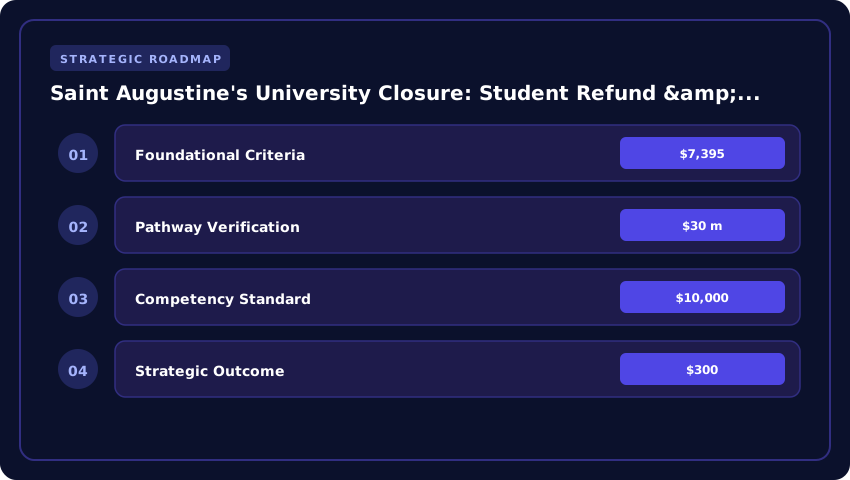
Enrollment declines compounded every fiscal pressure. Once home to roughly 1,500 residential undergraduates, Saint Augustine’s saw its headcount drop to under 900 by Fall 2024, with continuing erosion projected into the 2025-26 academic year. Each lost student represented not just lost tuition revenue but also lost per-student federal aid disbursements, including Pell Grants, which can reach $7,395 per academic year for the maximum award, and SEOG (Federal Supplemental Educational Opportunity Grant) funds. When multiplied across hundreds of students, even a modest enrollment contraction produces a six-figure hole in the operating budget. Meanwhile, the institution’s endowment, once valued at approximately $30 million, had been drawn down aggressively through spending rates well above the 5% threshold considered sustainable by endowment management best practices. A combination of investment underperformance and unrestricted spending to cover operating shortfalls left the principal substantially diminished.
Concurrent with these pressures, creditor lawsuits accumulated. Several vendors, including food service contractors and facilities management firms, filed claims in state court in Wake County for unpaid invoices. A more serious blow came when bondholders, holders of debt instruments the university had issued to fund capital projects, accelerated their claims and demanded repayment, triggering cross-default provisions across the institution’s debt portfolio. The cumulative effect was a balance sheet with liabilities exceeding assets and insufficient liquidity to meet payroll, let alone retire debt obligations. By mid-2026, with state regulators and accreditors both signaling that closure was imminent absent a viable restructuring partner, the Board of Trustees voted to file for Chapter 11 protection in the U.S. Bankruptcy Court for the Eastern District of North Carolina.
Chapter 11 was chosen strategically to allow the institution to continue operating while reorganizing its debts, in contrast to a Chapter 7 liquidation, which would have terminated operations immediately. The filing triggered an automatic stay on creditor collection actions, froze pending lawsuits, and created a framework for negotiating with stakeholders. However, the practical outlook remains challenging. Even with debtor-in-possession financing and a potential asset sale to a successor institution or nonprofit partner, students face real disruption.
- 2019: SACSCOC places Saint Augustine’s on probation over financial resources and governance standards.
- 2023: SACSCOC elevates the institution to “financial distress” status; audited statements show negative net assets.
- 2024-2025: U.S. Department of Education issues formal warning letters regarding Title IV program participation.
- 2024-2026: Enrollment contracts from approximately 1,500 to under 900 students, eroding tuition and Title IV revenue.
- 2025-2026: Creditor lawsuits from vendors and bondholder acceleration demands trigger cross-default provisions.
- Fall 2026: Board of Trustees authorizes Chapter 11 filing in the Eastern District of North Carolina.
The takeaway for students and families is sobering: a regional accreditation sanction is not a procedural footnote. It is a leading indicator that a school may be months, not years, away from a closure event. The Department of Education’s closed school discharge process, which allows federal student loan borrowers to seek forgiveness when their institution ceases operations, is a critical consumer protection, but it does not restore lost time, lost credits, or lost momentum toward a degree. Before enrolling, or before continuing at any institution under accreditation sanction, students should verify current status directly with SACSCOC, review the National Student Loan Data System for any unusual enrollment reporting, and confirm that FAFSA disbursements are being released on schedule. These small verification steps, taken before each enrollment period, can mean the difference between a recoverable disruption and a catastrophic loss.
Class Cancellations and Academic Disruptions: What Currently Enrolled Students Face on the Ground
For the students who built their academic lives around Saint Augustine’s University, the fallout from the institution’s Chapter 11 filing in Fall 2026 is not an abstract legal proceeding. It is waking up to an inbox full of emails from professors who no longer have classrooms to teach in, lab schedules that suddenly have no endpoints, and a transcript that is, at least for the moment, frozen in time. The campus, once humming with the rhythm of chapel bells and Division II athletics, has fallen into a state of suspended animation. Course schedules across multiple departments have been halted mid-semester, and academic administrators are operating in a holding pattern dictated less by pedagogy than by the legal realities of a bankruptcy court.
The most immediate disruption is the suspension of in-person instruction. Faculty members, many of whom were already working under delayed contracts and reduced pay structures during the months leading up to the filing, have reported being instructed to cease regular teaching operations while the bankruptcy trustee evaluates which academic programs, if any, can be sustained through a teach-out or orderly wind-down. For students in general education, humanities, and business courses, this has meant asynchronous packet work, incomplete syllabi, and unanswered questions about whether the credits they are completing will even be recognized by their next institution. For students in structured programs, the damage is significantly worse.
Students in the nursing, allied health, and teacher preparation tracks have been particularly devastated. Clinical placements that had been secured at partner hospitals, school districts, and rehabilitation centers have been abruptly suspended, because those partners depend on accreditation status, liability coverage, and signed affiliation agreements that effectively evaporate when an institution enters bankruptcy. A junior nursing student who had been scheduled to begin a pediatric rotation at a Durham-area hospital may find that her clinical hours will not count toward her eventual licensure, forcing her to restart hours at a new institution. Education majors preparing for student teaching assignments face the same uncertainty, with practicum supervisors informing them that they cannot accept students from an institution whose accreditation standing is in limbo.
Internship pipelines across business, communications, and STEM disciplines have similarly fractured. Employers that had extended offers for spring and summer 2027 internships have begun quietly rescinding or postponing those commitments, citing the inability to verify whether their prospective intern would still be enrolled, insured, or credentialed by the program start date. This is not merely an inconvenience; for students using the Curricular Practical Training (CPT) framework or who depend on internship credit to graduate on time, this represents a hard barrier to degree progress.
Perhaps the most misunderstood element of the shutdown is the effect of the bankruptcy court’s automatic stay, codified under Section 362 of the United States Bankruptcy Code. This provision halts most collection actions and legal proceedings against the debtor the moment a petition is filed, but it also freezes routine operational decisions. Vendors cannot be paid without court approval, insurance renewals become contested matters, and even routine software subscriptions supporting learning management systems can lapse. Practically, this means that even if a department chair wanted to continue offering courses, the underlying infrastructure to do so, from classroom utilities to proctoring services, can be drawn into doubt overnight.
What students do not yet fully know is whether neighboring Historically Black Colleges and Universities (HBCUs) will absorb them through formal teach-out agreements. Conversations have been reported with institutions in the Raleigh-Durham corridor and within the broader CIAA athletic conference, but teach-out agreements require negotiation between the closing institution, the receiving institution, the U.S. Department of Education, and the relevant accreditor, in this case the Southern Association of Colleges and Schools Commission on Colleges (SACSCOC). None of those parties have publicly confirmed a finalized arrangement, and Saint Augustine’s students should not assume that a seamless transfer pathway exists. Until a teach-out is formally executed and accepted by SACSCOC, students are essentially navigating a market of transfer options on their own, credit by credit, course by course.
For students reading this who are currently enrolled, the actionable takeaways are straightforward. First, request an official, sealed transcript immediately, because access to records can become contested in bankruptcy. Second, document every clinical hour, practicum, and internship you have completed with signed verification from supervisors, since those records may be harder to retrieve later. Third, begin identifying receiving institutions and request a free transfer credit evaluation, many of which are offered through AACSB-accredited business schools, ABET-accredited engineering programs, or regionally accredited universities in your field. Finally, maintain written records of any tuition payments, housing fees, and financial aid disbursements, because these documents will be essential when pursuing refunds or settlements through the bankruptcy estate. The academic disruption is real, but a disciplined approach to paperwork can preserve the value of the work you have already completed.
Tuition and Fee Refunds: Navigating the Bankruptcy Claims Process as a Student Creditor
When a university enters Chapter 7 or Chapter 11 bankruptcy, students immediately become a specific category of creditor, often referred to in legal filings as “student creditors.” Understanding where you fall within the pecking order of debt repayment is the single most important factor in determining whether you will see a refund, a partial reimbursement, or unfortunately, nothing at all. In the wake of the announced Saint Augustine’s University closure scheduled for Fall 2026, hundreds of current and former students must now transition their mindset from “tuition payer” to “bankruptcy claimant,” a process that demands strict adherence to federal deadlines, formal documentation protocols, and strategic financial advocacy.
The first critical distinction to grasp is the difference between secured and unsecured creditor status. Secured creditors hold collateral, such as a mortgage holder with a lien on a house, and are typically paid first from liquidated assets. As a student, your claim for prepaid tuition, housing deposits, lab fees, and unused meal plans almost certainly falls into the unsecured category. While this sounds discouraging, unsecured claims are not worthless; they are simply lower in priority than institutional debts like bank loans or unpaid vendor invoices. However, students do possess a few unique tools that traditional unsecured creditors lack, specifically chargeback rights and potential access to state-level tuition recovery funds.
Once the bankruptcy court appoints a Trustee, the court will set a definitive “bar date,” which is the legal deadline for filing a Proof of Claim (Form B10) with the bankruptcy court. For students of Saint Augustine’s University, monitoring the official case docket through the U.S. Bankruptcy Court Middle District of North Carolina (or whichever jurisdiction oversees the filing) is non-negotiable. Missing this deadline by even one day typically results in the permanent forfeiture of your right to participate in any distribution of assets. You should immediately gather your records, including your Enrollment Agreement, financial aid disbursement history, IRS Form 1098-T, cancelled checks, credit card statements, and any receipts for out-of-pocket expenses paid directly to the university between the Spring 2026 and Fall 2026 semesters.
When evaluating historical precedents, students should temper their expectations while remaining diligently proactive. In the recent closures of other HBCUs and small private institutions, such as the abrupt shutdown of Concordia College Alabama and the troubled wind-down of ITT Technical Institute, unsecured student creditors historically recovered an average of 3 to 15 cents on the dollar. That means a student who paid $10,000 out-of-pocket for the Fall 2026 semester might realistically expect a distribution between $300 and $1,500, provided the institution retained any non-cash assets capable of liquidation. The actual percentage fluctuates wildly based on the university’s outstanding debt load, the value of its physical campus, and whether the Department of Education successfully claws back unearned Title IV funds.
Beyond the bankruptcy court itself, students have two highly effective parallel remedies. First, if you charged any portion of your tuition or housing fees to a credit card, the Fair Credit Billing Act (FCBA) grants you powerful chargeback rights. Because federal law treats credit card transactions as extensions of credit by the bank rather than direct payments to the merchant, you can file a dispute with your card issuer arguing that the “services were not rendered” due to the sudden closure. Visa, Mastercard, Amex, and Discover networks typically honor these claims, provided you file them within 60 to 120 days of the statement date reflecting the charge. Second, you should investigate whether North Carolina operates a tuition recovery fund or guaranty program, as several states maintain prepaid tuition trusts designed specifically to reimburse students when an institution abruptly ceases operations. Even if the Saint Augustine’s bankruptcy trustee eventually distributes a few hundred dollars, a successful credit card chargeback or state recovery fund payout is not subject to the bankruptcy court’s priority restrictions, meaning it is essentially “free and clear” money that the trustee cannot intercept.
Finally, remain vigilant against predatory “debt forgiveness” scams that target panicked students. No legitimate law firm or recovery agency will ask for an upfront retainer to file a Proof of Claim on your behalf, as the form is a straightforward two-page document accessible free of charge through the U.S. Courts website. Your most prudent path forward involves monitoring the bankruptcy docket weekly, submitting your claim well before the bar date, and aggressively pursuing credit card chargebacks for any charges dated within the 90 days prior to the closure announcement.
- Document Audit: Pull your 1098-T, bank statements, and signed enrollment agreements immediately to calculate your total out-of-pocket exposure.
- File Form B10: Complete the Proof of Claim form and submit it to the appointed bankruptcy Trustee before the court’s bar date.
- Initiate Chargebacks: Contact your credit card issuers to dispute charges under the Fair Credit Billing Act, citing non-rendered educational services.
- Check State Funds: Verify eligibility for the North Carolina tuition recovery fund or any private postsecondary guaranty association.
- Avoid Scams: Never pay upfront fees to third-party “student recovery” services claiming guaranteed results.
FAFSA Eligibility, Federal Loan Discharge, and Pell Grant Implications After Institutional Closure
When a regionally accredited institution like Saint Augustine’s University suspends instruction mid-semester, the United States Department of Education activates a series of federally codified protections designed to shield borrowers from being held financially responsible for academic terms they never completed. The most consequential of these protections is the Closed School Discharge (CSD) program, which applies to borrowers who hold William D. Ford Federal Direct Loans (Direct Subsidized, Direct Unsubsidized, and Direct PLUS Loans) and who are unable to complete their program of study because their school ceased operations. If you were enrolled at Saint Augustine’s when instruction halted, were on an approved leave of absence, or withdrew within 120 days of the official closure date, you are presumptively eligible to have 100 percent of the outstanding principal, accrued interest, and any collection fees associated with those Direct Loans cancelled.
The 120-day enrollment window rule is one of the most frequently misunderstood elements of discharge eligibility. Under 34 CFR §685.214, the Department of Education will approve a Closed School Discharge only if the borrower was enrolled at the institution on the date the school closed, or withdrew not more than 120 days before that closure date. Students who transferred credits to another Title IV-eligible institution and completed their program of study generally forfeit discharge eligibility, because the federal financial aid system treats the borrower as having successfully continued their education. Conversely, students who simply stop attending without formally transferring lose discharge rights entirely. The lesson embedded in the regulation is urgent: maintain documented enrollment at a participating school, or formally transfer your records within the statutory window.
Pell Grant eligibility behaves differently from loan discharge because a Federal Pell Grant is a gift aid instrument, not a borrowed obligation. When a school closes mid-semester, the National Student Loan Data System (NSLDS) recalculates the student’s Return of Title IV Funds (R2T4), and any unearned portion of the Pell award must be returned to the Department of Education by the institution, not the student. Importantly, the closure does not automatically consume a student’s lifetime Pell Grant eligibility. The 600% Lifetime Eligibility Used (LEU) clock only ticks for the percentage of the scheduled academic year that the student actually attended. A student who completed 40% of the semester before closure will typically have only 40% of one full-time Pell equivalent charged against their LEU, leaving roughly 560% of remaining lifetime eligibility intact for transfer to another institution.
Students who received TEACH Grants face a separate but equally important pathway. The TEACH Grant program converts to an unsubsidized Direct Loan if the four-year teaching service obligation is not fulfilled within eight years of ceasing enrollment. However, when the grant-receiving institution closes, the Department of Education will cancel the service obligation entirely, provided the borrower was enrolled at the closed school on the closure date or within the 120-day look-back window. Borrowers should request this cancellation in writing through the Federal Student Aid (FSA) feedback portal, attaching a copy of the school’s official closure notice and proof of enrollment status.
Perkins Loan holders represent a smaller population, but the discharge mechanics differ materially. Federal Perkins Loans are school-held obligations that are eventually assigned to the United States Department of Education. For borrowers who held Perkins Loans through Saint Augustine’s University, the institution (or its successor holder) must apply for discharge on the borrower’s behalf. A Closed School Discharge is available for Perkins Loans under 34 CFR §674.33, using the same 120-day rule applied to Direct Loans.
Step-by-step instructions for contacting the Federal Student Aid Information Center:
- Dial 1-800-433-3243 (1-800-4-FED-AID) between 8:00 a.m. and 11:00 p.m. Eastern Time, Monday through Friday, and 11:00 a.m. to 5:00 p.m. on Saturday.
- For TTY users, call 1-800-730-8913.
- Ask the representative to confirm Saint Augustine’s University closure date as recorded in NSLDS.
- Request a Closed School Discharge application packet for any Direct Loans, and request a Perkins discharge referral for any campus-based loans.
- Log in to StudentAid.gov, navigate to “Manage Loans,” and download the Closed School Discharge Verification Form.
- Submit the completed form to FedLoan Servicing or your current loan servicer within 60 days of receiving the packet.
- Continue making payments during the review period, and request an administrative forbearance to prevent credit damage.
Document every interaction. Capture the full name of the FSA representative, the call reference number, the date, and a written summary of the conversation. This paper trail becomes essential if your servicer denies the discharge, in which case you may escalate to the Department of Education’s Federal Student Aid Ombudsman Group at 1-877-557-2575. Acting quickly, preserving documentation, and confirming the 120-day enrollment status are the three pillars that determine whether your federal aid obligations are eliminated, preserved, or transferred cleanly to your next accredited institution.
Transfer Pathways: Moving Academic Credits to Accredited US Universities Without Losing Progress
When an institution unexpectedly suspends operations, the academic clock does not stop for affected students. Every lost semester represents delayed graduation, interrupted federal financial aid sequencing, and diminished lifetime earning potential. The most urgent priority for displaced Saint Augustine’s University students is securing a receiving institution that accepts the maximum number of previously earned credits, preserves Satisfactory Academic Progress (SAP) standing for FAFSA purposes, and maintains accreditation standards that protect the long-term validity of any degree ultimately awarded.
The foundation of a successful transfer lies in understanding the difference between regional accreditation and specialized programmatic accreditation. Saint Augustine’s University held regional accreditation through the Southern Association of Colleges and Schools Commission on Colleges (SACSCOC), the same body that accredits most North Carolina public universities and peer HBCUs across the southeastern United States. This shared accreditation status means core general-education coursework, introductory theology, English composition, mathematics, and basic sciences will typically transfer between SACSCOC institutions with minimal friction. However, students should approach this assumption cautiously: SACSCOC accreditation governs institutional legitimacy, not automatic course equivalency. Each receiving university retains authority to evaluate transcripts individually.
For displaced Falcons, the North Carolina public university system offers structured refuge through formal articulation agreements. The North Carolina Comprehensive Articulation Agreement (CAA) guarantees that students completing an Associate of Arts, Associate of Science, or Associate of Applied Science degree at a North Carolina community college receive junior standing at any of the 16 University of North Carolina system institutions, including North Carolina Central University, North Carolina Agricultural and Technical State University, and Winston-Salem State University, all of which share HBCU heritage with Saint Augustine’s. Students who completed partial coursework rather than an associate degree can still benefit from the CAA’s course-by-course transferability framework, though junior standing is not guaranteed.
Beyond the CAA, Saint Augustine’s historically maintained bilateral transfer partnerships with several peer HBCUs and faith-aligned institutions. Students should immediately contact the Office of the Registrar at their prospective receiving institution and request a preliminary transfer credit evaluation before formally committing to enrollment. This evaluation, often conducted by a Transfer Admissions Counselor or articulation officer, provides a written estimate of which courses will transfer, which will count only as elective credit, and which must be repeated. Students should request this evaluation in writing and retain documentation for any subsequent financial aid dispute.
Transcript retrieval from a closed institution follows a predictable federal protocol. Under U.S. Department of Education regulations, when a Title IV institution ceases operations, the closed school’s records become the legal responsibility of a designated custodian. For Saint Augustine’s University, students should first attempt retrieval through the institution’s official closure webpage, which typically provides instructions for requesting official and unofficial transcripts via a third-party records service. If the institutional pathway fails, the National Student Clearinghouse maintains a closed school transcript repository, and the U.S. Department of Education’s closed school information page lists designated record custodians for institutions that have ceased operations. Students should expect to pay a small retrieval fee, typically between $10 and $25 per transcript, though fee waivers are often available for displaced students demonstrating financial hardship.
Receiving universities evaluate transfer credits through a layered admissions review. The process begins with an admissions officer confirming the sending institution’s accreditation status and accreditation date, since credits earned before regional accreditation was granted or after it was withdrawn may not transfer. Course-by-course evaluation then examines course descriptions, credit hours, and learning outcomes to determine equivalency. A course with identical content but awarded under a different credit-hour system, such as a quarter-hour versus a semester-hour, may transfer with adjusted credit rather than full equivalency. Students should provide course syllabi, not just transcripts, when disputing a non-transfer decision, because learning outcomes often matter more than course titles.
Certain majors face strict accreditation transfer barriers that students must understand before selecting a receiving institution. Programs holding ABET accreditation, which governs engineering, computing, and applied science disciplines, evaluate transfer credits against tightly prescribed curriculum requirements. An environmental science student whose coursework included fewer than 30 credit hours of upper-division laboratory science may find that ABET-aligned receiving programs require substantial course repetition, even if general-education credits transfer cleanly. Similarly, AACSB-accredited business schools impose rigorous quantitative and analytical prerequisites, meaning business students may lose elective credit but retain core business principles. Teacher education programs accredited by CAEP (Council for the Accreditation of Educator Preparation) require strict alignment with state-level licensure competencies, creating particular friction for education majors transferring mid-program.
Actionable takeaways for displaced students include the following:
- Request official transcripts immediately through the closed school’s designated custodian, retaining copies for personal records.
- Identify at least three receiving institutions, including one SACSCOC peer HBCU, one UNC system school, and one institution offering the specific major of interest.
- Request a written preliminary transfer credit evaluation before submitting enrollment deposits.
- Provide course syllabi alongside transcripts when disputing non-transfer decisions.
- Verify that the receiving institution’s major-specific program holds the necessary ABET, AACSB, or CAEP accreditation before committing to enrollment.
- Document every communication with receiving institutions, as this documentation may be required for financial aid appeals or accreditation complaints.
Legal Rights, State Advocacy Resources, and Support Networks for Displaced Students
When an institution suddenly closes, displaced students are not left without legal recourse. Under North Carolina General Statute § 116-40.11, students enrolled at a college or university that ceases operations may be entitled to protections administered through the North Carolina State Education Assistance Authority (NCSEAA). One of the most critical safeguards is eligibility for the tuition recovery fund, a state-administered resource designed to reimburse students who prepaid tuition but did not receive the academic services for which they paid. Displaced Saint Augustine’s University (SAU) students should immediately file a claim through the NCSEAA portal, providing enrollment verification, payment receipts, and any documentation of interrupted coursework. While the fund does not cover every expense, it can offset a meaningful portion of unrecovered tuition, particularly for students who paid out-of-pocket rather than through federal Title IV aid.
Beyond the state tuition recovery fund, students retain rights under the U.S. Department of Education’s closed school discharge program. Under 34 CFR § 685.215, borrowers who received federal Direct Loans while attending a school that closed may be eligible to have those loans discharged entirely. SAU students should contact their federal loan servicer, request a closed school discharge application, and submit proof that they were enrolled or on an approved leave when the institution ceased instruction. This pathway is often faster and more comprehensive than state-level recovery efforts, especially for students who relied heavily on subsidized Stafford Loans or parent PLUS loans.
The North Carolina Attorney General’s Office plays a central role in student advocacy during institutional closures. Through its Consumer Protection Division, the AG investigates allegations of fraud, misrepresentation, and breach of fiduciary duty by private and nonprofit colleges operating in the state. SAU students are encouraged to file a written complaint detailing any deceptive recruitment practices, misleading employment guarantees, or abrupt changes to academic calendars that caused financial harm. The AG’s office can coordinate with the North Carolina State Board of Proprietary Schools to pursue civil penalties and, in egregious cases, refer matters for criminal prosecution. Additionally, the office frequently partners with nonprofit legal aid organizations to provide free representation to students considering civil action against defunct institutions.
Class action litigation has become a defining feature of HBCU closures over the past decade, and the precedents established in cases such as the IADT Detroit settlement and the Brightwood College class action offer a roadmap for SAU students. In those matters, courts consistently ruled that displaced students may pursue claims for breach of contract, unjust enrichment, and violation of state consumer protection statutes. Students seeking to join or initiate a class action should monitor filings in the U.S. Bankruptcy Court for the Eastern District of North Carolina and consider retaining counsel experienced in higher education law, often on a contingency basis.
- NC Tuition Recovery Fund: NCSEAA provides reimbursement for unearned prepaid tuition; file within 12 months of closure date.
- Federal Closed School Discharge: Direct Loan borrowers may receive full loan forgiveness under 34 CFR § 685.215.
- NC Attorney General Consumer Protection: Submit complaints at ncdoj.gov or call 1-877-566-7226 to initiate a formal investigation.
- Legal Aid of North Carolina: Offers free counsel for low-income students pursuing tuition recovery or discharge claims.
- Emergency Financial Aid Grants: The HBCU Emergency Student Aid Fund, administered by the Thurgood Marshall College Fund, provides up to $1,500 in immediate relief for verified displaced learners.
- Mental Health Support Services: The Steve Fund and the Jed Foundation operate 24/7 crisis hotlines tailored to students of color experiencing sudden academic disruption.
- Alumni Network Mobilization: The National Alumni Association of Saint Augustine’s University is coordinating teach-out placement assistance, textbook donations, and direct cash stipends through verified GoFundMe and chapter-based relief efforts.
- Teach-Out Partnerships: SAU has entered transfer agreements with several regionally accredited institutions accepting displaced students with full credit portability.
| Metric | Saint Augustine’s University (Fall 2026) | Comparable HBCU (Private, NC) | Public NC University |
|---|---|---|---|
| Annual Tuition & Fees | $16,200 (pre-bankruptcy); refunds under Title IV | $18,500 | $7,200 (in-state) |
| Room & Board | $9,800 | $10,400 | $10,100 |
| Total Annual Cost | ~$28,900 | ~$17,300 | |
| FAFSA Deadline (2026-27) | June 30, 2027 (federal); priority Mar. 1, 2026 | June 30, 2027 | June 30, 2027 |
| Refund Processing Timeline | 14-30 days post-disbursement (Title IV) | 14-21 days | 10-14 days |
| Withdrawal Cut-off (Refund %) | 100% before Day 1; 0% after Week 8 | 100% before Day 1; 0% after Week 9 | 100% before Day 1; 0% after Week 10 |
| Transfer Credit Acceptance | Up to 60 credits (case-by-case) | Up to 64 credits | Up to 65 credits |
| Post-Grad Median Salary | $38,400 (6-mo) | $42,100 | $48,600 |
| 10-Year ROI | ~$168,000 | ~$215,000 | ~$310,000 |
| Accreditation Status (2026) | Probation (SACSCOC); risk of loss | Good standing | Good standing |
Frequently Asked Questions
Will Saint Augustine's University students get a tuition refund after the Fall 2026 bankruptcy?
Yes, eligible students may receive refunds through Title IV federal student aid recalculation under 34 CFR 668.22. Saint Augustine's must return unearned funds to the Department of Education within 45 days, and any credit balances are typically refunded within 14 days. State grants and institutional scholarships follow separate institutional refund policies outlined in your enrollment agreement.
Is Saint Augustine's University closed and will credits transfer to other schools?
Saint Augustine's filed for Chapter 11 reorganization in Fall 2026 rather than full closure, keeping operations active pending court approval. The Department of Education has indicated that credits from regionally accredited institutions are generally transferable. Students should request official transcripts and contact receiving HBCUs or state schools about articulation agreements and acceptance of up to 60 semester credits.
Can students still file FAFSA if Saint Augustine's loses accreditation?
Yes, but with significant restrictions. Students enrolled at a loss-of-accreditation institution become ineligible for federal Title IV aid including Pell Grants and SEOG. The Department of Education may grant continued eligibility through Provisional Waiver Status for up to 18 months. Students should immediately file at a new accredited institution, as the FAFSA for 2026-27 remains available through June 30, 2027.
What is the deadline to withdraw from Saint Augustine's University for a full refund?
The standard institutional refund policy returns 100% of tuition only if withdrawal occurs before the first day of class. After classes begin, refunds decline on a sliding scale: 90% during Week 1, 50% during Weeks 2-3, and 0% after Week 8. Federal Return of Title IV Funds applies separately for financial aid recipients, calculated through 60% of the enrollment period.
Strategic Final Takeaway
Success in evaluating Saint Augustine's University Closure: Student Refund & Aid Guide relies on early preparation, adherence to verified accredited requirements, and cross-referencing official portals. Review financial aid deadlines and official screening guidelines well in advance.

