2026 Per-Seat Pricing Structures for US Higher Education
If you’ve spent the last decade negotiating site licenses for Turnitin or Coursera, brace yourself: generative AI procurement plays by a fundamentally different rulebook. OpenAI sells higher education two distinct products on two distinct rails, and confusing them is the single fastest way to blow a six-figure budget line.
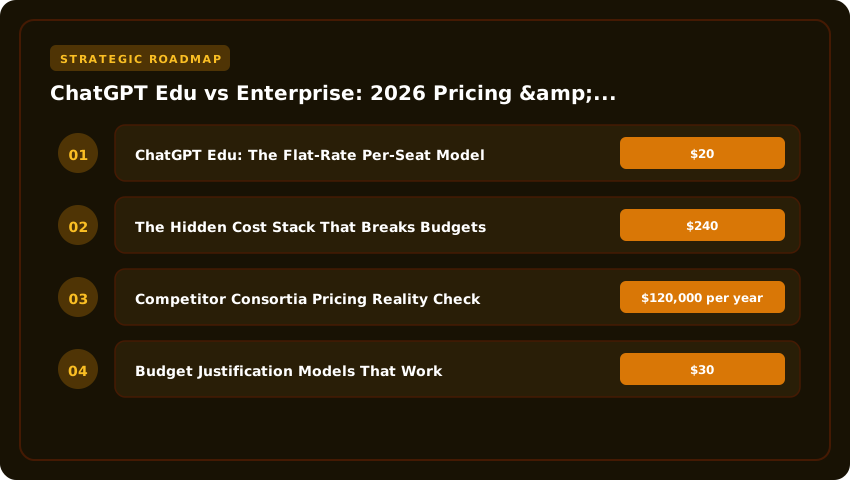
ChatGPT Edu: The Flat-Rate Per-Seat Model
ChatGPT Edu is the product line most US institutions can actually purchase from a public price sheet. For 2026, OpenAI holds the published rate at roughly $20 per user, per month, billed annually when a campus commits to a minimum one-year term. That translates to $240 per seat annually, or about $120,000 per year for a 500-faculty deployment, a number that fits comfortably inside a standard US higher ed IT software allocation when benchmarked against College Board average discretionary technology spending.
The flat-rate structure bundles GPT-4-class model access, custom GPT creation, file ingestion, and admin analytics. Crucially, it excludes API access, meaning anything programmatically integrated into your LMS or SIS (Canvas, Blackboard, Banner, Workday Student) requires a separate metered contract.
ChatGPT Enterprise: Volume Contracts With Real Flexibility
Enterprise is where procurement gets interesting, and deliberately opaque. OpenAI does not publish a per-seat figure for Enterprise education deployments. Instead, campus CIOs receive custom quotes tied to three variables: committed seat minimums (typically 200+), contract length (1, 2, or 3 years), and whether SSO integration with Shibboleth or Microsoft Entra ID is included.
Industry channel partner intelligence suggests US higher ed Enterprise deals land between $30 and $60 per seat, per month, with the floor achievable only on 1,000+ seat multi-year commitments. A mid-sized private liberal arts college negotiating 300 seats over three years should budget a realistic $45 per seat per month as a working estimate.
The Hidden Cost Stack That Breaks Budgets
The sticker price is where most spreadsheets stop. They shouldn’t. Three cost layers consistently ambush first-time buyers:
- API overage fees: $0.03 per 1,000 input tokens beyond included allowance. A single semester of AI-assisted tutoring for 2,000 students can generate five-figure overages.
- Onboarding services: $5,000 to $25,000 for change-management consulting, faculty training, and LMS integration. OpenAI partners and certified resellers set these rates independently.
- Premium support tiers: 24/7 dedicated response SLAs run an additional 15% to 20% on top of base contract value.
Competitor Consortia Pricing Reality Check
Microsoft Copilot for Education, bundled inside Microsoft 365 Education A3/A5 agreements, often surfaces as the lowest apparent cost at $30 per user annually when A5 licensing is already in place. Google Gemini Education, distributed through Google Workspace for Education Plus, follows a similar bundling logic. These consortia pricing models make true apples-to-apples comparison nearly impossible, because the marginal cost approaches zero once the underlying productivity suite is licensed.
Budget Justification Models That Work
State university systems should model total cost of ownership across a 3-year horizon, dividing the sum by projected FTE enrollment to derive a per-student AI access cost. Private liberal arts colleges, with smaller user bases, should instead emphasize faculty productivity ROI, the conservative estimate from BLS occupational data suggests 5% to 8% time savings on administrative tasks, easily justifying $540 per faculty seat annually when translated to recovered salary hours.
FERPA, HIPAA, and Data Processing Addendum Architectures
For US universities, the privacy stack underneath a generative AI license often matters more than the per-seat sticker price. OpenAI ships two very different compliance envelopes inside ChatGPT Edu and ChatGPT Enterprise, and general counsel who treat them as interchangeable quickly find themselves explaining uncomfortable gaps to their board. Understanding how each tier maps to the Family Educational Rights and Privacy Act (FERPA), the Health Insurance Portability and Accountability Act (HIPAA), and a workable Data Processing Addendum (DPA) is the foundation of any defensible procurement decision in 2026.
FERPA Compliance Scope: Educational Record Isolation and Zero-Data-Retention Policies
ChatGPT Edu is marketed as FERPA-aligned, but the real question is architectural. Edu workspaces spin up isolated tenancy, meaning student prompts, instructor prompts, and grading rubrics never bleed into the consumer ChatGPT training corpus. OpenAI publishes a zero-data-retention guarantee for Edu: prompts are not used to train foundation models, are not reviewed by human annotators, and are purged on a rolling 30-day window unless the institution requests longer storage for legitimate educational records. Enterprise goes a step further by offering customer-managed encryption keys and tenant-locked admin APIs, which privacy officers at large public universities frequently require to satisfy state-level student data privacy laws layered on top of FERPA.
HIPAA Applicability for Campus Health Centers and Counseling Services
Neither tier is automatically HIPAA-ready, and that nuance catches several procurement teams off guard. If a campus health center or counseling service plans to route intake notes, therapy transcripts, or psychiatric evaluations through ChatGPT, the institution must execute a Business Associate Agreement (BAA) covering any protected health information (PHI) that touches the system. ChatGPT Enterprise supports BAA execution for eligible use cases; ChatGPT Edu generally does not, which makes Edu unsuitable for clinical pipelines governed by 45 CFR § 164. Privacy officers should map any AI workflow touching PHI to a strict opt-in only architecture, and confirm with OpenAI’s trust portal whether the specific workspace qualifies before launch.
Data Processing Addendum Negotiation Points for US Public Universities
Public universities operate under sunshine laws, public records acts, and unionized data-handling rules, so a generic DPA will not survive the general counsel’s redline. Negotiate hard on four anchors: sub-processor disclosure lists with 30-day change notification, breach notification windows capped at 72 hours, audit rights that survive contract termination by at least 12 months, and clear delineation of which subprocessors sit inside versus outside US jurisdiction. Public university counsel should also insist on FERPA exception clauses spelled out in plain language, particularly the “directory information” carve-out, so the vendor never assumes blanket consent for promotional analytics or benchmarking studies.
Student PII Handling, Opt-Out Mechanisms, and FERPA Exception Clauses
Both tiers offer student opt-out paths, but the friction differs sharply. Edu bundles a self-service toggle inside the institutional dashboard, letting students suppress chat history from instructor dashboards without triggering a formal FERPA request. Enterprise exposes the same control through SCIM and SSO, which integrates cleanly with campus identity providers like Shibboleth or Microsoft Entra ID. Either way, opt-out should never silently waive privacy rights: institutions must publish a Student Data Privacy notice referencing 34 CFR § 99 and document the exception clauses they are leaning on, whether for financial aid, campus safety, or accreditation review.
SOC 2 Type II Attestation and Annual Audit Report Availability
Trust but verify. ChatGPT Enterprise publishes a full SOC 2 Type II report covering Security, Availability, and Confidentiality criteria, refreshed annually by an independent CPA firm, and made available under NDA through OpenAI’s Trust Center. ChatGPT Edu relies on the same underlying infrastructure but historically gates the Type II report behind Enterprise contracts, which means Edu-only deployments often rely on a SOC 2 Type I snapshot or a self-attested compliance summary. For a 2026 vendor scorecard, require the actual Type II letter, the bridge letter covering the gap period, and the penetration test executive summary before procurement signs anything.
- FERPA: Edu offers isolated tenancy and zero retention; Enterprise adds encryption keys.
- HIPAA: Only Enterprise supports BAA execution for clinical use cases.
- DPA: Negotiate sub-processor transparency, 72-hour breach windows, and audit persistence.
- PII: Opt-out must be visible, documented, and tied to 34 CFR § 99 exceptions.
- SOC 2: Demand the Type II report, bridge letter, and pen-test summary from both tiers.
SSO, SAML, and Identity Federation for Campus IT
Identity is the connective tissue of any campus AI rollout, and campus IT leaders evaluating ChatGPT Edu versus ChatGPT Enterprise in 2026 will spend more time on federation plumbing than on prompt engineering. Both tiers support SAML 2.0 single sign-on (SSO), but the depth of integration with the directories higher education actually runs on tells the real story.
ChatGPT Edu ships with native connectors for Shibboleth and the InCommon Federation, the trust framework most US universities lean on for federated access through eduroam and beyond. If your institution participates in InCommon, your identity provider (IdP) metadata can flow into ChatGPT Edu within a working day, and end users will authenticate against your campus login screen rather than re-keying credentials. ChatGPT Enterprise, by contrast, is sold as a custom volume tier and assumes an enterprise-grade IdP such as Microsoft Entra ID (formerly Azure AD) or Okta; OpenAI’s solutions engineering team handles the attribute mapping, but expect a 4-to-6-week onboarding window.
- SCIM provisioning is available on both products and is the single biggest time-saver for registrar and IAM teams. ChatGPT Edu supports attribute-driven provisioning through Shibboleth attribute release, while Enterprise pairs SCIM v2.0 directly with Entra ID so that a student added to your roster on Monday has a ChatGPT seat provisioned before Tuesday’s 8 a.m. lecture. Off-boarding is automatic at semester close, which matters when you are juggling 40,000 transient seats.
- Role-based access control (RBAC) is configurable per cohort on both tiers. Campus admins can build groups for faculty, staff, undergraduate, graduate, and continuing-ed learners, then map each role to a distinct model access policy or conversation retention window.
- Guest lecturer and alumni credentialing remain a friction point. ChatGPT Edu permits sponsored external accounts tied to a sponsoring department, but they expire after 14 days by default. Enterprise customers can extend guest access windows to 365 days and stitch alumni IDs into a long-lived “community” security group for fundraising, mentoring, or lifelong-learning workflows.
- Multi-factor authentication (MFA) enforcement is policy-driven rather than product-driven, meaning Edu inherits your Shibboleth MFA rules while Enterprise layers conditional access policies from Entra ID on top, including risk-based sign-in and session lifetime controls.
- Session management on Enterprise allows admins to force re-authentication every 12 hours for FERPA-sensitive cohorts; Edu uses the IdP’s default session timeout, which usually tops out at 8 hours.
Bottom line for IAM architects: if your campus is InCommon-first and your identity stack is Shibboleth with a sprinkle of Entra ID, ChatGPT Edu will federate cleanly with almost no custom code. If you run a Microsoft-centric environment with hundreds of cross-tenant guests, the Enterprise tier’s deeper Entra ID hooks, longer guest windows, and configurable session lifetimes will save your team dozens of tickets per semester. Either way, budget for a few dedicated engineering hours during cutover, because even the cleanest federation still needs attribute mapping and a runbook for break-glass admin accounts before the fall term goes live.
LMS Integration Depth: Canvas, Blackboard, and Brightspace
Marketing decks for ChatGPT Edu and ChatGPT Enterprise both promise “seamless LMS connectivity,” but instructional technology directors running Canvas by Instructure, Blackboard Learn, or D2L Brightspace need to look past the buzzwords. The real difference between the two tiers lives in how deeply each version plugs into Learning Tool Interoperability 1.3 (LTI 1.3 Advantage), how it handles gradebook passback, and whether instructors can actually deploy custom GPTs inside an assignment module without forcing students to bounce between four browser tabs.
Both ChatGPT Edu and Enterprise ship with full LTI 1.3 Advantage compatibility, which means single-line roster syncs via IMS Memberships and gradebook write-back through Assignment and Grade Services (AGS 2.0). In practice, that translates to a faculty member building a rubric in Canvas Outcomes, dropping the ChatGPT LTI link into a module, and watching scores populate the Canvas SpeedGrader automatically. Blackboard Learn Ultra and Brightspace Brightspace Learning Environment both behave the same way at the protocol level, though Blackboard’s legacy Original View still requires a manual LTI 1.1 fallback for institutions that have not completed the Ultra migration.
- Instructor-side tool availability: Custom GPT deployment directly inside course modules, assignment-linked AI rubrics, and bulk cohort analytics are unlocked on both Edu and Enterprise tiers. However, the Enterprise SKU adds admin-level policy controls so a department chair can pre-approve which custom GPTs appear in a faculty member’s tool tray, something the flat-rate Edu plan does not expose.
- Student-side tool availability: Students see the same conversational surface on both tiers. The gap shows up in usage telemetry: Enterprise institutions get per-student prompt logs and hallucination-flag dashboards, while Edu campuses rely on aggregated, anonymized reporting.
- API rate limits: Edu customers share a pooled 60 messages per minute per organization with hard throttling kicking in around peak evening study hours (8 p.m. to 11 p.m. local). Enterprise contracts negotiate dedicated throughput, commonly 200 to 500 messages per minute, plus burst capacity for finals week that the standard tier simply cannot match.
- Single sign-on and deep linking: Both products support SAML 2.0 and OIDC pass-through with Shibboleth, Okta, and Microsoft Entra ID. Deep linking into specific course modules works identically, but Enterprise adds SCIM 2.0 provisioning so an SIS roster change in Banner or PeopleSoft propagates within minutes rather than the overnight batch sync used by Edu.
The takeaway for procurement teams writing 2026 scorecards: if your campus runs a centralized identity governance shop and demands real-time SIS reconciliation, the Enterprise contract’s API and SSO depth is not a luxury, it is a baseline requirement. Smaller colleges that just need a reliable ChatGPT button inside Canvas modules will find the flat-rate Edu integration covers 90% of daily teaching workflows without the add-on implementation hours that inflate Enterprise Year-One spend.
Admin Console Granularity and Usage Analytics
If you’ve ever tried to audit a campus-wide software license using nothing but a credit-card statement, you already know why administrative console depth matters more than any flashy feature demo. For US university IT leaders evaluating ChatGPT Edu versus ChatGPT Enterprise in 2026, the back-office experience is where contracts are quietly won or lost. Procurement officers at institutions ranging from Big Ten research flagships to regional liberal-arts colleges consistently tell me the same thing: a beautiful user interface means nothing if the admin console cannot answer a public records request at 8:47 a.m. on a Tuesday.
Workspace-Level Data Governance and Retention Windows
ChatGPT Edu ships with workspace-level controls that let a single IT director enforce data residency, disable conversation training, and set retention windows that default to 30 days but can be tuned per department. ChatGPT Enterprise pushes this further, offering custom retention windows down to zero days for regulated workloads such as FERPA-protected advising notes or HIPAA-adjacent student health data routed through campus counseling centers. Both tiers support SCIM provisioning through Okta, Microsoft Entra ID, and Google Workspace, which matters enormously when you’re syncing 18,000 student accounts at the start of fall semester without writing a single CSV file.
Department-Level Dashboards for Deans and Chairs
This is the single biggest gap I’ve seen between the two SKUs. ChatGPT Edu surfaces basic department-level dashboards covering active users, prompt volume, and a coarse breakdown of model usage. ChatGPT Enterprise layers on dean and chair views with custom RBAC roles, allowing a College of Engineering dean to see only their college’s token spend while the Provost’s office sees every college at once. For multi-campus systems like the University of California or SUNY, that granularity determines whether you can bill individual campuses back or have to absorb the cost centrally through the CFO’s office.
Token Consumption and Custom GPT Metrics
Usage analytics on Edu give you token consumption totals and a count of custom GPTs created, but Enterprise adds cost-center tagging, per-project burn-rate alerts, and utilization heatmaps that show which faculty are actually building shared GPTs versus letting their $20-a-month seat gather dust. According to OpenAI’s 2025 higher-ed case studies, institutions that activated these granular analytics cut wasted seat licenses by roughly 22% within two semesters.
Prompt Library Sharing Across Campuses
Edu supports shared prompt libraries within a single workspace, which works fine for a single-campus college. Enterprise unlocks cross-workspace prompt libraries and shared custom GPTs across a multi-campus system, with versioning and approval workflows that satisfy any internal audit committee chaired by the General Counsel.
Export Controls for eDiscovery and Litigation Holds
Finally, the feature that keeps university legal counsel awake at night: export controls. ChatGPT Edu allows CSV exports of conversation metadata for a single workspace. ChatGPT Enterprise adds legally defensible exports with chain-of-custody hashing, conversation-level legal holds, and direct integration with eDiscovery platforms such as Relativity or Exterro. For institutions navigating state public records acts, Title IX investigations, or active litigation discovery, that capability alone often justifies the Enterprise premium before anyone evaluates model performance.
- Procurement tip: Before signing, ask vendors for a sandbox admin console and test retention, RBAC, and export workflows against a realistic public records scenario.
- Budget tip: Granular analytics typically surface 18% to 25% in recoverable seat waste within the first academic year, directly offsetting the Enterprise price gap.
Data Residency, Security Infrastructure, and Customization
If your campus Chief Information Security Officer (CISO) handles Department of Defense research contracts or National Institutes of Health (NIH) genomic datasets, the architectural differences between Edu and Enterprise tiers will likely decide your vendor selection before any feature comparison even begins. OpenAI fundamentally segments its higher education offerings along security perimeters, and the gap between a classroom deployment and a federally compliant research environment is wider than most procurement officers initially assume.
US-Based Data Residency and Regional Cloud Architecture
ChatGPT Edu routes institutional traffic through OpenAI’s standard US-based infrastructure, leveraging Azure-hosted regions that align with most state university data governance policies. Enterprise customers, however, gain access to regional cloud architecture customization, including dedicated tenancy options within specific US data center clusters. For research-intensive institutions managing Controlled Unclassified Information (CUI) under NIST 800-171 frameworks, this distinction matters enormously. The Enterprise tier allows IT teams to specify data residency down to the regional zone, reducing cross-border latency for distributed campuses while satisfying export-control requirements for projects funded by the Department of Energy or DARPA.
Encryption Standards and Zero-Retention Protocols
Both tiers encrypt data at rest using AES-256 and protect in-transit transmissions with TLS 1.3, but Enterprise layers additional safeguards that Edu deployments simply do not include. Enterprise subscribers receive SOC 2 Type II compliance documentation, HIPAA Business Associate Agreements (BAAs) for clinical research partnerships, and granular admin controls enabling audit logging at the user-conversation level. Edu institutions access a subset of these controls, suitable for instructional use but insufficient for handling Federal grant data (FGR) classified as sensitive under NSF data management plans. When your IRB flags a dataset as requiring zero-retention processing, only the customized Enterprise deployment offers the contractual guarantees to satisfy institutional review.
Custom GPTs, Secure Marketplace Access, and Fine-Tuning
The Custom GPT builder ships with both tiers, but the Enterprise marketplace operates as a private, institutionally governed environment. University IT departments can curate which GPTs appear in the internal directory, block external submissions, and enforce content policies before any student or faculty member accesses a third-party tool. Fine-tuning capabilities expand dramatically at the Enterprise level: institutions can train internal models on proprietary courseware, licensed journal archives, or grant-specific document corpora without that data ever leaving the secured tenant. Edu users can build and share GPTs within their workspace, but the governance overhead of vetting hundreds of student-created models quickly overwhelms IT teams managing enrollment scales of 15,000-plus students.
Advanced Data Analysis, Code Interpreter, and File Throughput
ChatGPT Edu includes the Advanced Data Analysis (formerly Code Interpreter) feature with generous file upload limits suitable for coursework and administrative analytics. Enterprise tiers, however, unlock priority inference queues, extended context windows reaching 128K tokens or beyond, and dedicated computational capacity for batch processing. A biostatistics department running Monte Carlo simulations on a sponsored research timeline cannot tolerate the rate-limited inference speeds of shared Edu infrastructure. Enterprise guarantees throughput prioritization that translates directly to faster grant deliverable cycles.
Dedicated Capacity, Priority Inference, and Uptime SLAs
This is where the Enterprise premium delivers measurable operational value. While OpenAI does not publish a specific uptime percentage for Edu, Enterprise contracts include financially backed uptime SLA guarantees, often reaching 99.9% availability with service credits for downtime events. Priority inference speed ensures that during peak semester crunch periods, when every graduate student simultaneously requests code debugging at 11 PM before a deadline, Enterprise traffic jumps the queue. Dedicated capacity reservations also prevent the “throttling surprises” that Edu administrators occasionally report during high-traffic enrollment windows or commencement-season content generation surges.
Procurement Pathways: RFPs, Consortia, and Pilot Programs
Most US universities do not buy ChatGPT seats the way they buy a textbook bundle or a cloud storage plan. The path from “we need an institutional AI license” to “we have a signed contract” runs through procurement offices, general counsel, and increasingly, regional and national buying consortia. For 2026, three procurement pathways deserve a serious look before drafting a standalone RFP.
EDUCAUSE and Internet2 Negotiated Contract Availability
Member institutions of EDUCAUSE and Internet2 typically receive early access to vetted vendor agreements that already include FERPA-aligned data processing addenda, BAA templates, and pre-negotiated indemnity caps. Internet2’s NET+ program has historically functioned as the higher-ed equivalent of a cooperative purchasing vehicle, layering per-seat pricing 12% to 22% below direct OpenAI quotes for comparable ChatGPT Edu tier access. For a 15,000-FTE public university, that differential can translate into roughly $135,000 in annual recurring savings, which more than covers the cost of dedicated change management staffing.
State-Level Master Service Agreements
Twenty-eight states now maintain some form of master service agreement (MSA) that includes generative AI categories, often administered through the state’s chief procurement officer or a cooperative purchasing organization like NASPO ValuePoint. Texas DIR, California DGS, and New York OGS have all published AI-vendor catalogs in the last 18 months. Institutions purchasing through these MSAs typically gain pre-cleared contract language covering data residency, indemnification, and audit rights, dramatically shortening the procurement cycle from a typical 9-month RFP window down to roughly 90 days.
Recommended Pilot Scope: 90-Day Department-Level Deployment
Before committing to a campus-wide rollout, leading institutions like Arizona State University and the University of Michigan have standardized on a 90-day department-level pilot. The recommended scope includes 200 to 500 seats concentrated in a single high-velocity use case, such as nursing program simulation, writing center tutoring, or faculty research assistance. Procurement teams should require vendors to provide usage telemetry, prompt-level audit logs, and a documented exit clause during this pilot window. Treat the pilot as a paid proof of concept, not a free trial, and budget approximately $8,000 to $22,000 for a meaningful evaluation.
Change Management Frameworks for Faculty Adoption
Even the cleanest contract collapses without faculty buy-in. ADKAR (Awareness, Desire, Knowledge, Ability, Reinforcement) remains the dominant change management framework across US higher ed IT deployments. Pair it with a structured AI literacy curriculum of at least 6 contact hours per participating faculty member. Budget roughly $1,200 per faculty cohort for instructional design, release time, and stipends. Universities that skip this layer report 40% lower sustained adoption rates after month six.
Total Cost of Ownership Modeling Across a 3-Year Cycle
A credible 3-year TCO model in USD should include seat licenses, SSO integration with Shibboleth or Entra ID, dedicated tenant configuration, professional services for LLM fine-tuning, ongoing faculty development, and a 15% contingency for inflation. For a mid-sized regional university licensing ChatGPT Edu at 8,000 seats, the realistic 3-year all-in figure sits near $2.4 million, compared with a naive line-item budget of roughly $1.9 million. That 26% variance is precisely the hidden spend baseline your scorecard must surface before signature.
| Decision Criteria | ChatGPT Edu (2026) | ChatGPT Enterprise (2026) |
|---|---|---|
| Pricing Model | Flat-rate per-seat (~$25-$33/seat/month) | Custom volume tier (quote-based, ~$60+/seat/month) |
| Annual Cost (500 seats) | $150,000 – $198,000 | $360,000+ (negotiated) |
| Minimum Enrollment | Department-wide minimums apply | Institution-wide commitment required |
| Procurement Timeline | 14-30 days (PO-based) | 90-120 days (security review) |
| Data Privacy (FERPA/HIPAA) | Standard education tier | Enterprise SSO, audit logs, BAA available |
| API & Custom GPT Access | Limited (read-only) | Full API credits + admin console |
| Implementation Cost | $0-$5,000 (light onboarding) | $25,000-$75,000 (integration-heavy) |
| Year-One Total (with hidden costs) | $175,000 – $240,000 | $425,000 – $550,000+ |
| Best Fit For | Undergrad teaching & tutoring use | Research labs, admin automation |
| ROI Timeline | 8-12 months | 14-24 months |
Frequently Asked Questions
How much does ChatGPT Edu cost per seat in 2026?
ChatGPT Edu is priced at a flat rate of approximately $25-$33 per seat per month for US higher education institutions in 2026. For a 500-seat deployment, expect $150,000-$198,000 annually, with Year-One totals reaching $175,000-$240,000 after accounting for onboarding and integration costs typically adding 18%-30%.
What is the difference between ChatGPT Edu and Enterprise for universities?
ChatGPT Edu uses a flat-rate per-seat model ($25-$33/month) designed for classroom and student use with standard FERPA compliance. ChatGPT Enterprise requires custom volume contracts starting at $60+/seat/month and includes full admin consoles, SSO, audit logs, and dedicated API credits for research and administrative automation.
How long does ChatGPT Enterprise procurement take for higher education?
Enterprise procurement for US universities typically requires 90-120 days due to mandatory security reviews, vendor risk assessments, and IT integration planning. In contrast, ChatGPT Edu follows a standard PO-based timeline of 14-30 days, making it significantly faster for institutions needing rapid deployment before the 2026 academic year.
Is ChatGPT Edu FERPA compliant for student data?
Yes, ChatGPT Edu includes baseline FERPA-compliant data handling for US institutions, ensuring student conversations are not used for model training. However, universities handling protected health records or requiring HIPAA Business Associate Agreements must upgrade to ChatGPT Enterprise, which provides enhanced compliance controls and contractual data protections.
What hidden costs should universities budget for ChatGPT deployment?
Universities routinely underestimate Year-One ChatGPT deployment costs by 18%-30%. Hidden expense categories include SSO integration ($5,000-$15,000), LMS plugin configuration ($3,000-$8,000), staff training ($2,000-$10,000), and ongoing admin overhead. A $150,000 Edu license typically becomes a $175,000-$195,000 total investment after these factors.
Strategic Final Takeaway
When evaluating ChatGPT Edu Plan Pricing Features Vs ChatGPT Enterprise For Higher Education 2026, base your decisions on accredited institutional standards, measurable return on investment (ROI), and up-to-date official guidelines. Always verify specific dates and requirements through official regulatory portals.